
Life, 1899-07-06 · page 8 of 20
Life — July 6, 1899 — page 8: what you’re looking at
What you’re looking at
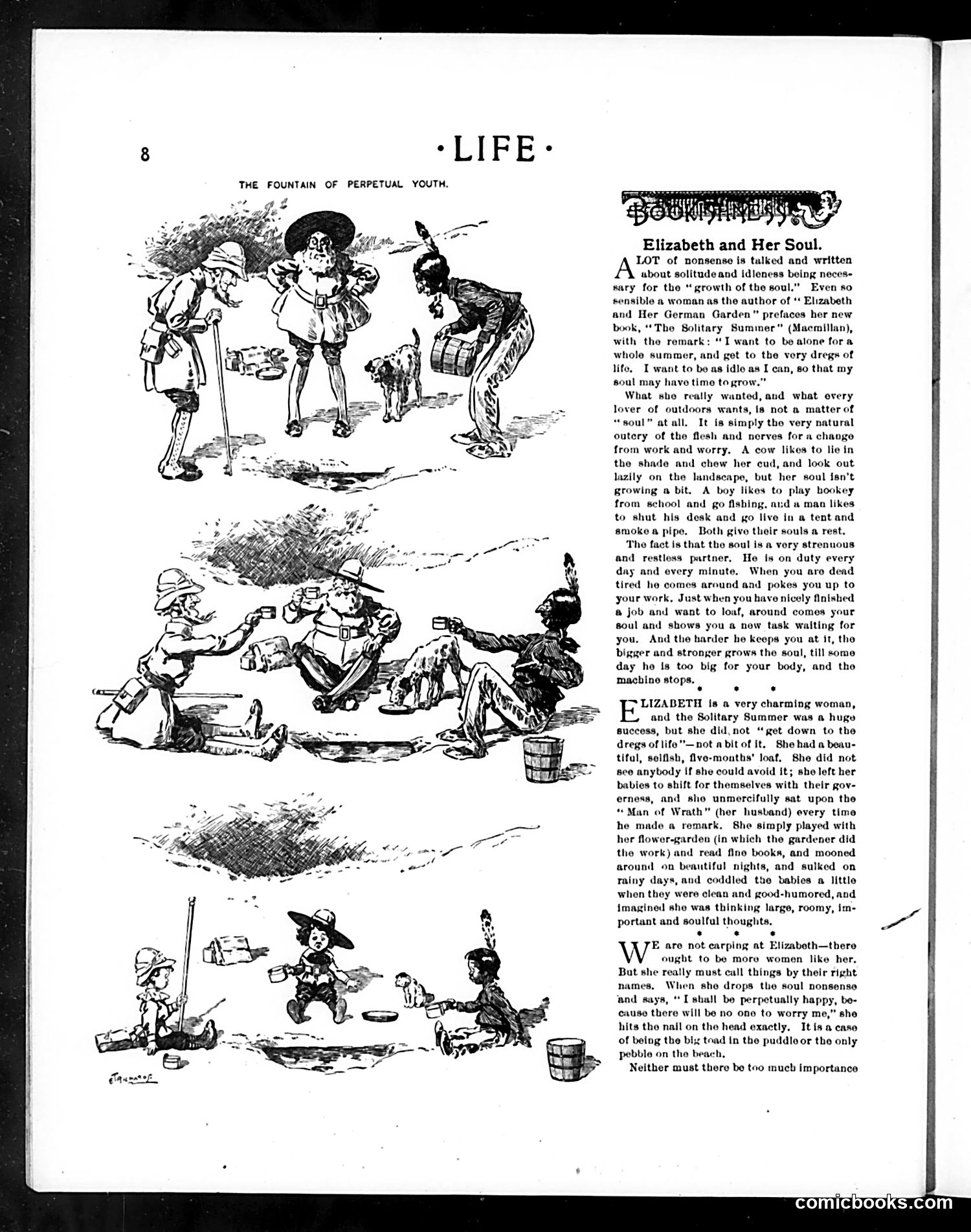
This page satirizes contemporary ideas about the "growth of the soul" through leisure and idleness. The illustrated vignettes show people—a woman named Elizabeth and her acquaintances—lounging, picnicking, and avoiding work under the guise of spiritual development. The satire targets the notion that rest and nature-contemplation constitute genuine personal growth. The text mocks this pretension: Elizabeth avoids housework, ignores social responsibilities, and spends time reading and daydreaming while claiming spiritual enrichment. The cartoon's point appears to be social criticism of wealthy or privileged individuals who romanticize idleness as "soulful" living, while dismissing practical obligations. The exaggerated depictions of lounging figures suggest the author finds this philosophy absurd and self-indulgent rather than genuinely noble or transformative.
📄 Transcribed text from this page (OCR, searchable)
Machine-transcribed from the original scan — historical spelling and the odd misread are preserved.
*LIFE- THE FOUNTAIN OF PERPETUAL YOUTH. Elizabeth and Her Soul. LOT of nonsense is talked and written ubout solitude and idleness being neces- sary for the “growth of the soul.” Even 80 sensible a woman as the author of * Elizabeth and Her German Garden” prefaces her new book, “Tho Solitary Summer” (Macmillan), with the remark: “I want to be alone fora whole summer, and get to the very dregs of life, I want to be as idle as I can, so that my soul may havo timo to grow.” What sbe really wanted, aud what overy lover of outdoors wants, is not a matter of “soul” at all, It is simply tho very natural outery of the flesh and nerves for a change from work and worry. A cow likes to lie in the shade and chew her cud, and look out lazily on the landscape, but her soul isn’t growing a bit, A boy likes to play bookey from school and go fishing, aud a man likes to shut his desk and go live in a tent and smoke a pipe. Both give their souls a rest. ‘The fact is that tho soul is a vory strenuous and restless partner, Ho is on duty every day and every minute. When you are dead tired he comes around and pokes you up to your work, Just when you have nicely finished @ job and want to loaf, around comes your soul and shows you a new task waiting for you, And the harder he keeps you at it, tho Digger and stronger grows the soul, till some day ho Is too big for your body, and tho machine stops. . 8 > LIZABETH is a vory charming woman, and the Solitary Summer was a huge success, but she did, not “get down to the dregs of life"—not abitof it. She had a beau- tifal, selfish, flve-months' loaf, She did not see anybody If she could avoid it; she left her babies to shift for themselves with their gov- erness, and sho unmercifully sat upon the “Man of Wrath” (her husband) every time he made a remark. She simply played with hor flower-garden (in which tho gardener did the work) and read flno books, and mooned around on beautiful nights, and sulked on rainy days, and coddled the babies a little whon they were clean and good-humored, and imagined she was thinking large, roomy, im- portant and soulful thoughts, oe E are not carping at Elizabeth—thero V ought to be more women like her. But she really must call things by their right names, When she drops the soul nonsense ‘and says, “ I sball be perpetually happy, be- cause there will be no one to worry me,” she hits the nail on the head exactly, It is a caso of being the bix toad in the puddlo or tho only, pebble on the beach, Neither must thero be too much importance