
A complete issue · 20 pages · 1899
Life — May 25, 1899
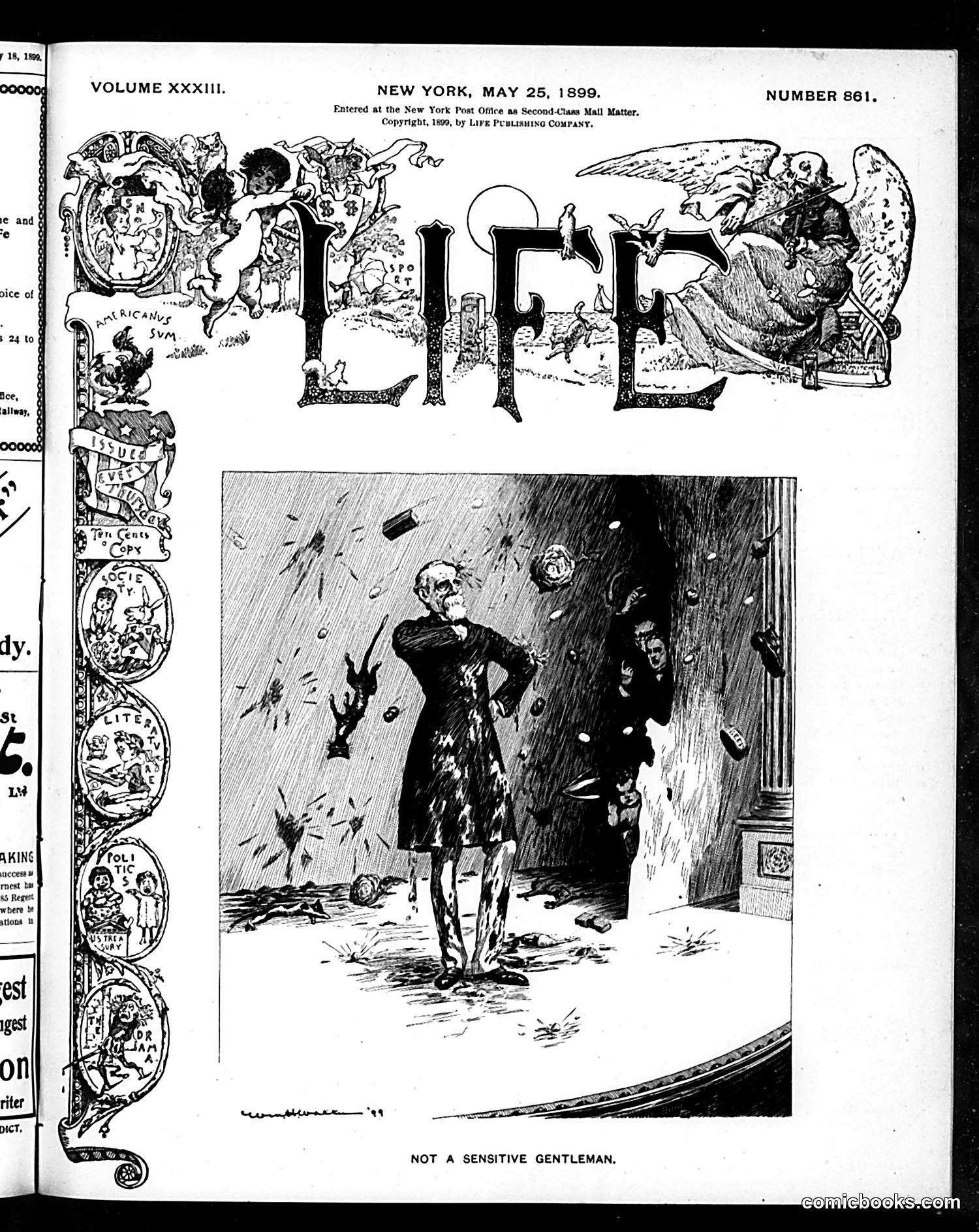
This cartoon depicts a scene of domestic chaos where a man stands in the center of a room while objects—hats, shoes, and other household items—rain down around him. A woman gestures dramatically from the left, and another figure observes from a doorway on the right. The title "Not a Sensitive Gentleman" suggests satirical commentary on male insensitivity, likely within a domestic or romantic context. The flying objects imply the woman's angry response to the man's behavior or words. This reflects late-Victorian-era social commentary about gender relations and masculine behavior, mocking men who lack consideration for women's feelings. The ornate decorative borders and fantastical header artwork are typical of Life's satirical presentation style from this period.
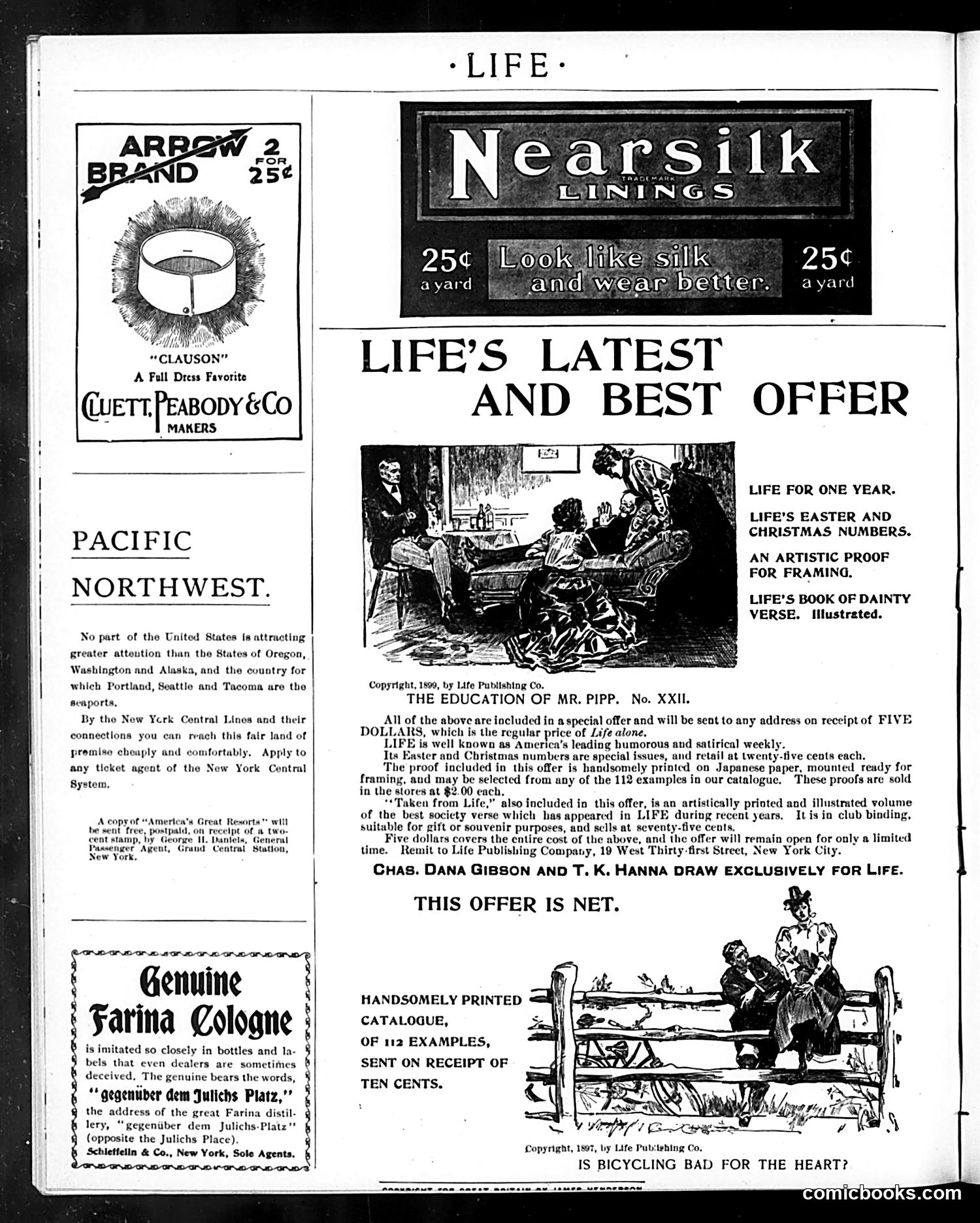
This page is primarily **advertising**, not political satire. The main content promotes Life magazine subscriptions and various products: - **Arrow Brand Collars** (top left): a fashion ad for detachable collars - **Nearsilk Linings** (top right): fabric for garments - **Life Magazine's subscription offer** (center): emphasizes special Easter and Christmas issues, plus a book of satirical verse illustrated by Dana Gibson and T.K. Hanna - **Farina Cologne** (bottom left): imported German fragrance - **Catalogue advertisement** (bottom right): promoting Life's printing services The central illustration appears to be a drawing showing people indoors, likely meant to appeal to Life's audience. The text emphasizes exclusivity and artistic quality. This is a typical turn-of-the-century magazine page mixing editorial promotion with product advertisements.
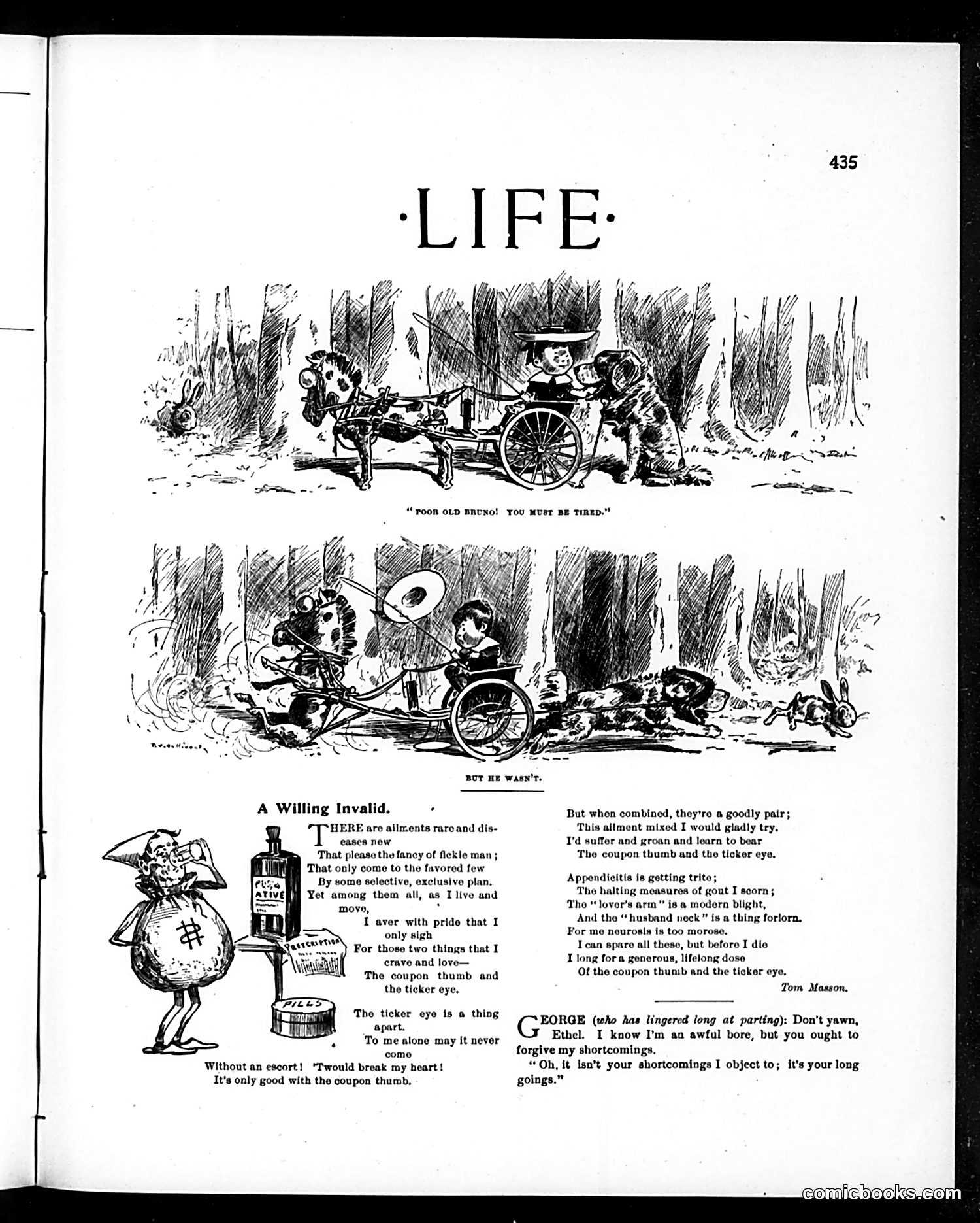
This page satirizes marital discord, specifically the "tired husband" trope common in early 20th-century humor. The top two cartoons show a man being pulled in a cart by a donkey labeled "BRENO," with captions "Poor old Breno! You must be tired" and "But he wasn't." The joke: the husband is exhausted by his wife's complaints and demands, yet the beast of burden survives—implying the wife wears him out worse than any animal. The poem "A Willing Invalid" by Tom Mawson extends this theme, depicting marriage as a burden where the speaker "longs for a generous, lifelong dose / Of the coupon thumb and the ticker eye"—suggesting he'd prefer unconsciousness to enduring his wife's nagging. The dialogue snippet shows George dismissing his wife Ethel's complaints about his "shortcomings," deflecting to her "long goings"—a pun on her constant nagging. The satire targets wives as exhausting nags.
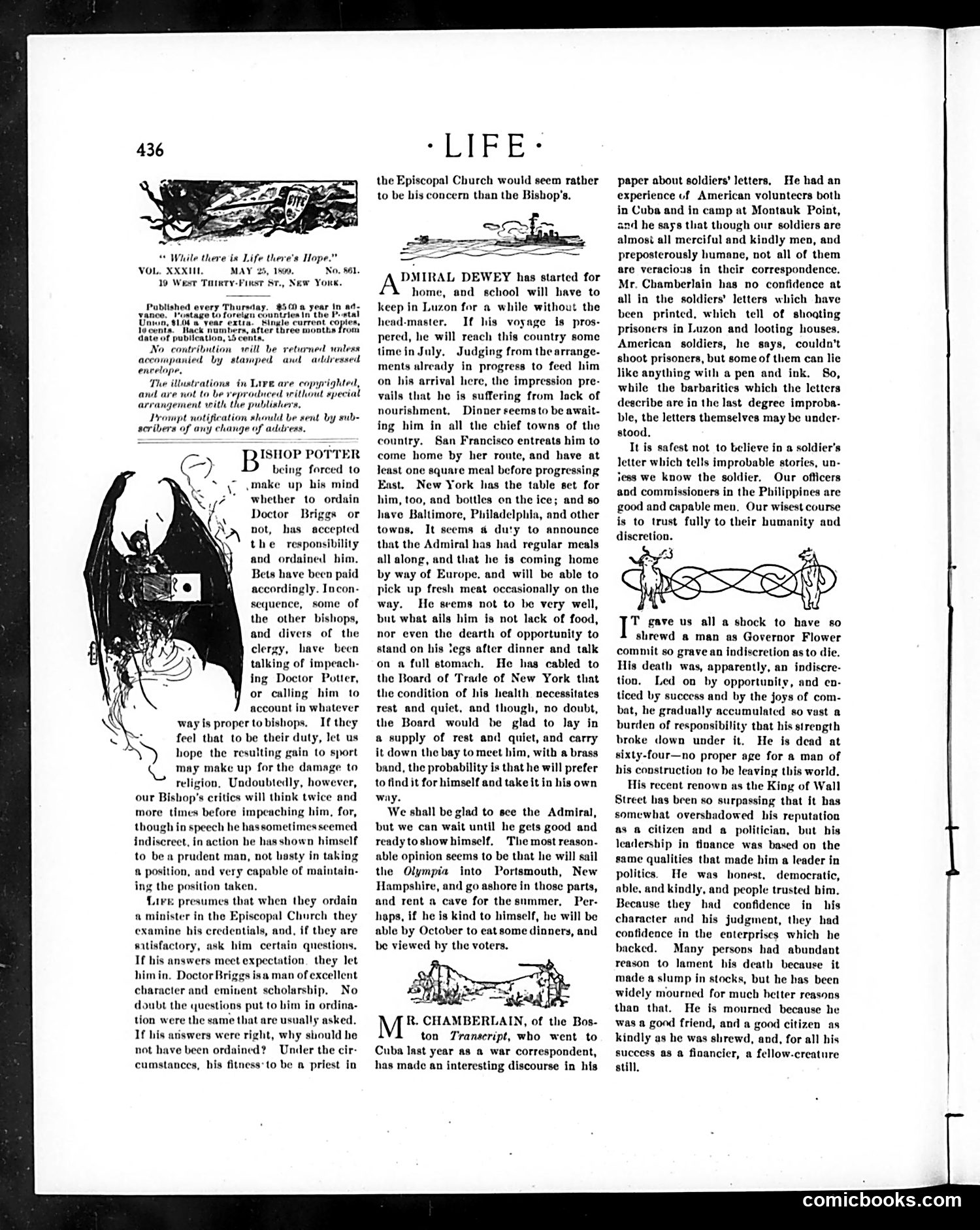
This page contains two distinct pieces of commentary on early 20th-century American institutional leadership. **Bishop Potter Cartoon**: The illustrated section critiques Bishop Potter's handling of ecclesiastical responsibility. The text suggests Potter deflected blame for church problems onto others rather than accepting accountability for his position's demands. The satire implies he lacked the character and scholarship expected of his office. **Admiral Dewey Section**: The text discusses Admiral George Dewey's homecoming and health concerns during a voyage. It addresses soldiers' letters praising American soldiers' humanity, while noting some letters from soldiers criticizing their treatment. The commentary defends military officers as "good and capable men" while cautioning against believing unverified soldier complaints without knowing the full context. Both sections reflect debates about institutional integrity and leadership credibility.
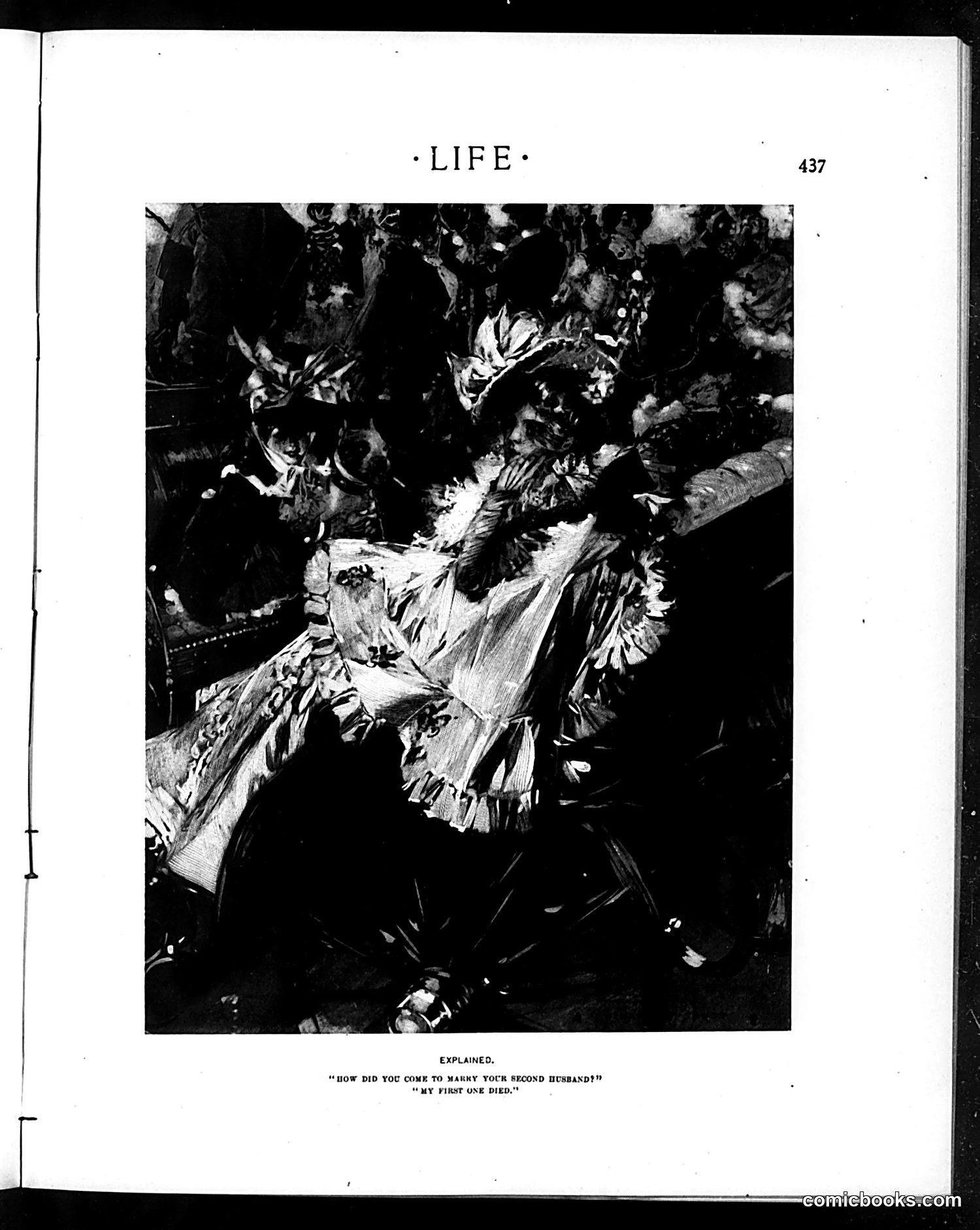
This page presents a satirical illustration titled "EXPLAINED" with the caption: "HOW DID YOU COME TO MARRY YOUR SECOND HUSBAND?" "MY FIRST ONE DIED." The cartoon depicts an elaborate Victorian-era social scene with multiple figures in period dress surrounding a reclining woman. The satire appears to target attitudes toward remarriage and widowhood in high society. The humor likely plays on the uncomfortable or scandalous nature of discussing a spouse's death as justification for remarriage—suggesting the questioner's implication that the woman's motivations were questionable or opportunistic, while her matter-of-fact response undercuts such suspicions with obvious logic. The ornate styling and formal dress indicate this mocks upper-class social conventions and gossipy attitudes toward women's marital situations.
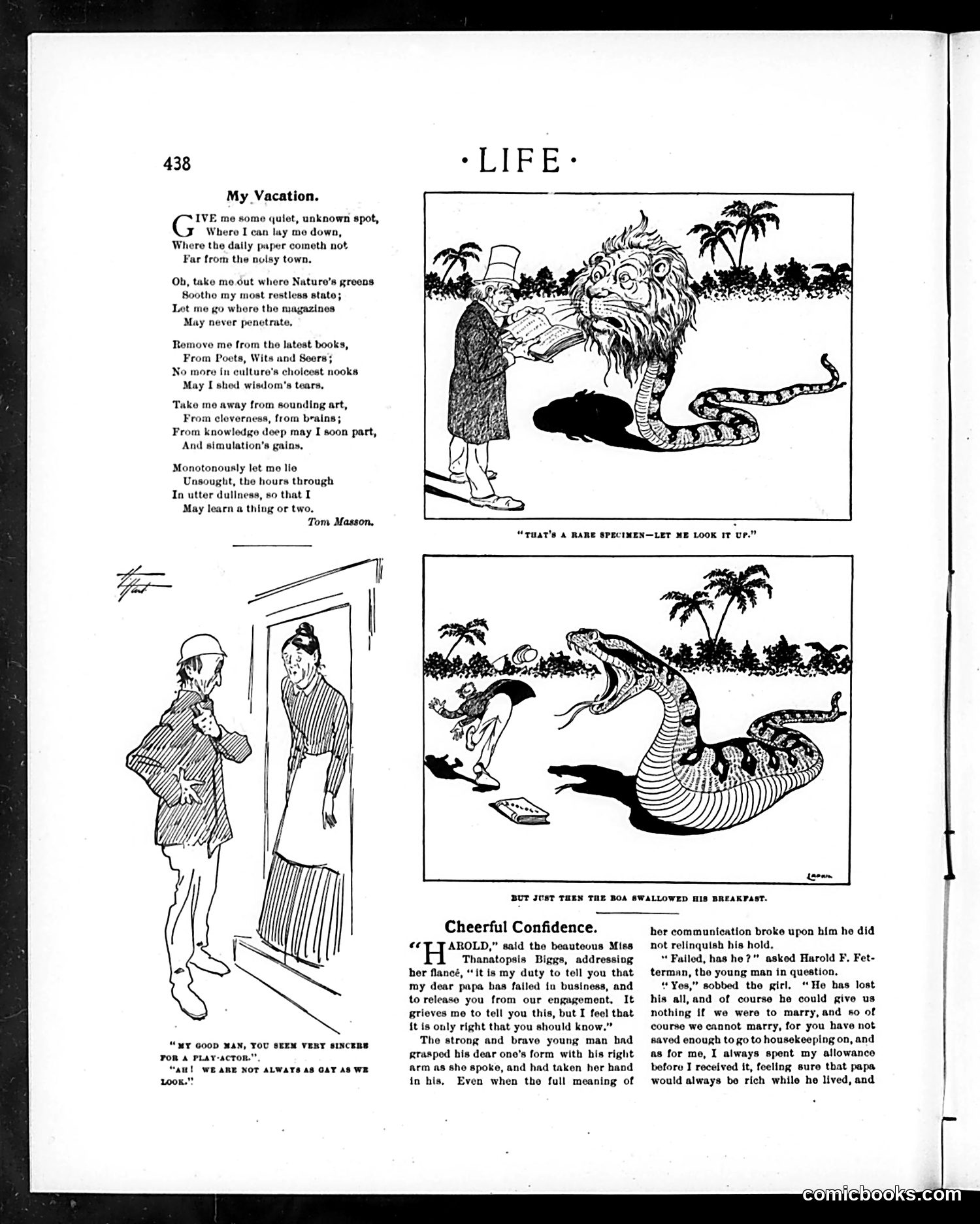
This page contains three distinct pieces: **"My Vacation" poem** by Tom Mason expresses desire to escape urban life and intellectual pursuits for peaceful rest in nature. **Top cartoon**: A man shows a woman an exotic snake specimen, captioned "That's a rare specimen—let me look it up." The humor derives from the man's distraction by the snake rather than attending to the woman. **Bottom cartoon**: Depicts a woman reassuring her fiancé about his business failure, emphasizing her confidence in marrying him despite financial ruin. The caption "But just then the boa swallowed his breakfast" suggests ironic disruption. **"Cheerful Confidence" story**: Describes a woman named Miss Thanatopsis Biggs informing her fiancé Harold F. Fetterman that she'll marry him despite his business failure, confident in his character rather than wealth. The page combines romantic comedy with class commentary typical of early 20th-century Life magazine satire.
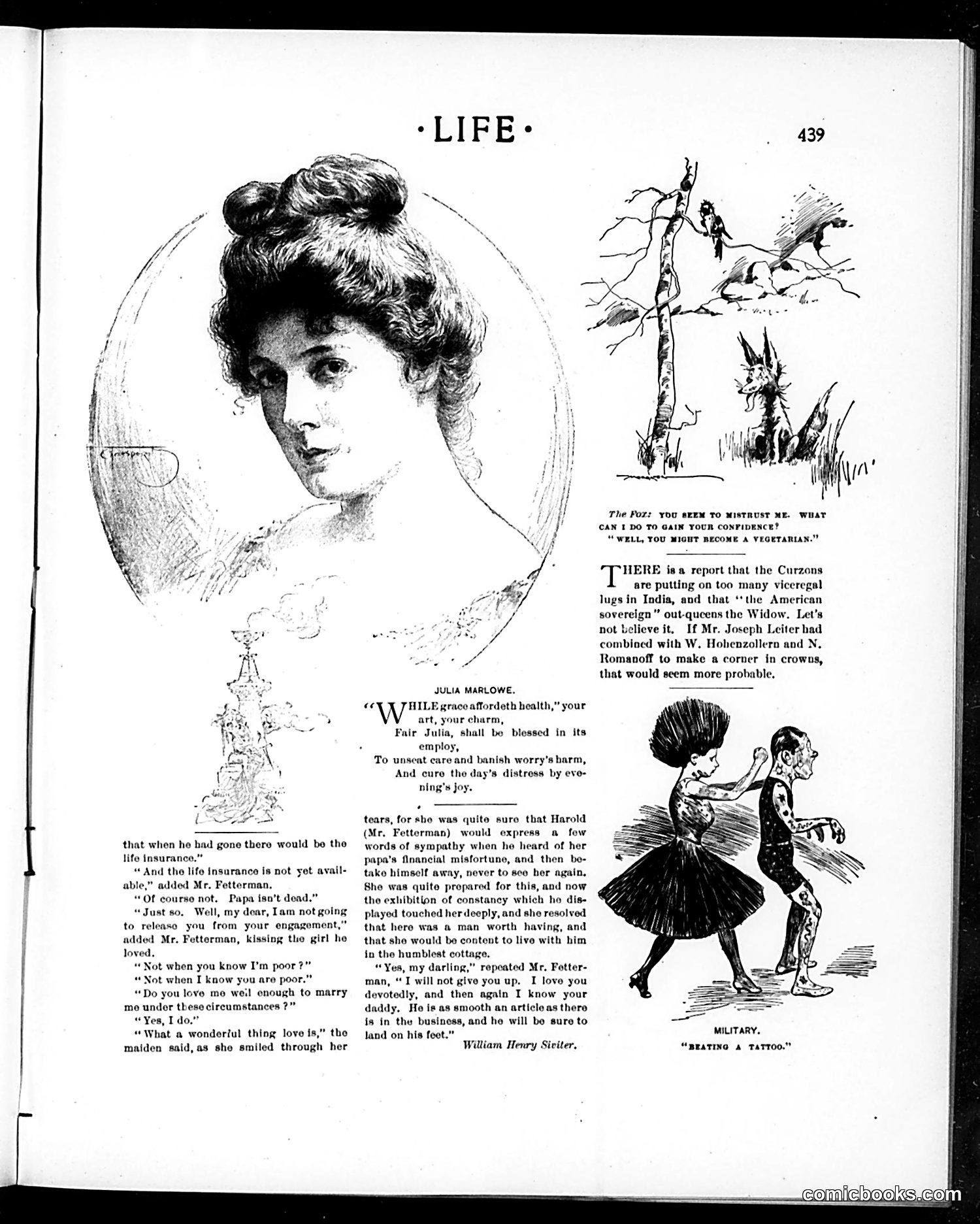
This page features a portrait of **Julia Marlowe**, a prominent stage actress of the era, accompanied by romantic poetry praising her grace and charm. The accompanying text discusses a report about the **Curzons** (likely the British diplomat George Curzon and his wife) allegedly putting on "top-drawer" airs in India, with a satirical suggestion that "the American sovereign" (likely referring to a wealthy American woman) "outqueens the Widow" (possibly Queen Victoria or another titled woman). The humor critiques social pretension and the jockeying for status among the wealthy and titled classes. The right panel, captioned **"BEATING A TATTOO,"** shows a military figure with a dancing woman—a comedic illustration unrelated to the main text.
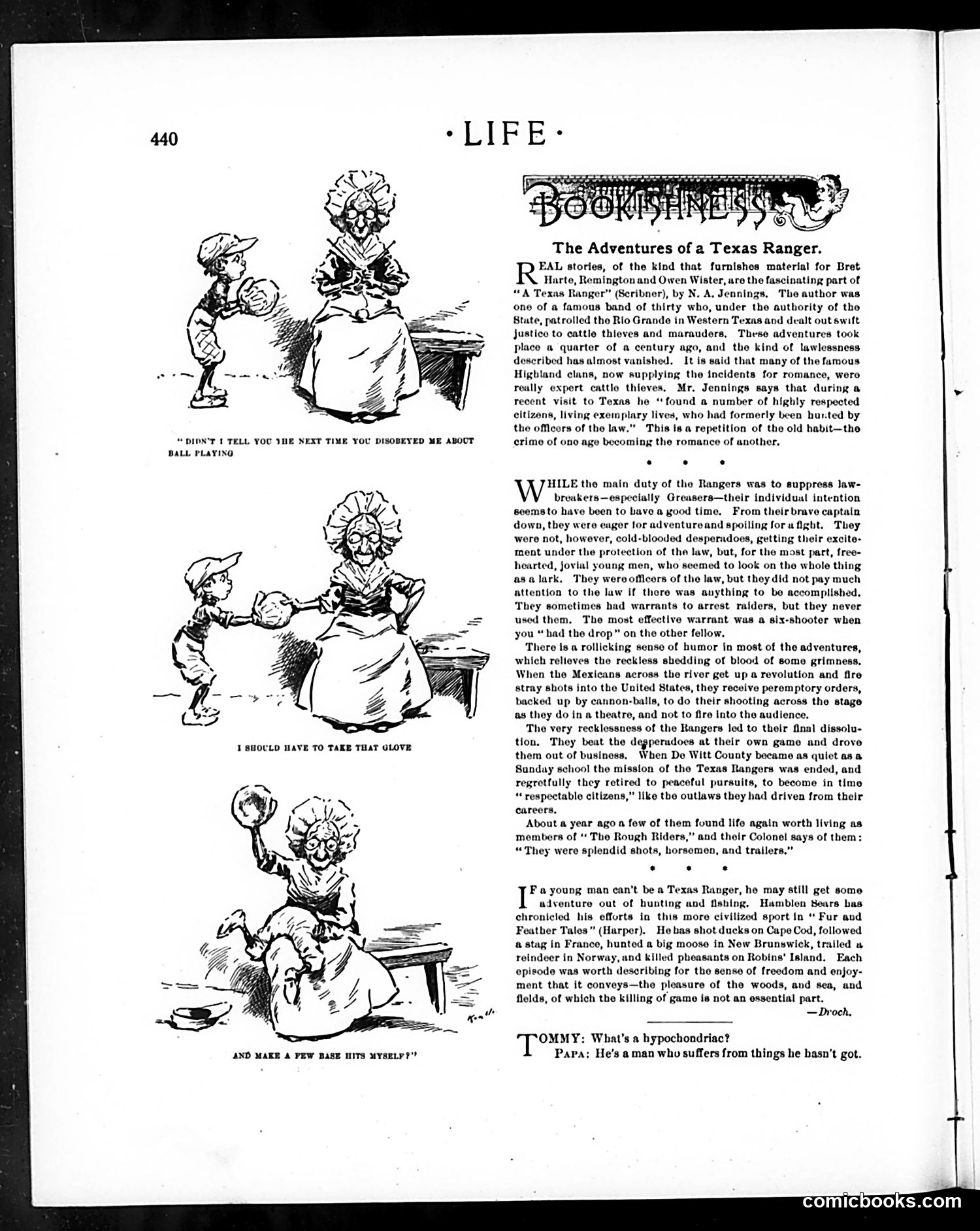
This page features three cartoon panels (left) and an article (right) about Texas Rangers—historical lawmen who patrolled the Rio Grande frontier. The sketches show a child character interacting with an adult woman, depicting humorous domestic situations with captions like "Didn't I tell you the next time you disobeyed me about ball playing" and "I should have to take that quote." The accompanying article describes Rangers as adventurous but ultimately lawless enforcers who suppressed outlaws and cattle rustlers. It humorously notes that when De Witt County became peaceful, Rangers "regretfully retired to peaceful pursuits, to become in time 'respectable citizens.'" The piece celebrates their colorful exploits while gently satirizing their transition to civilian life.
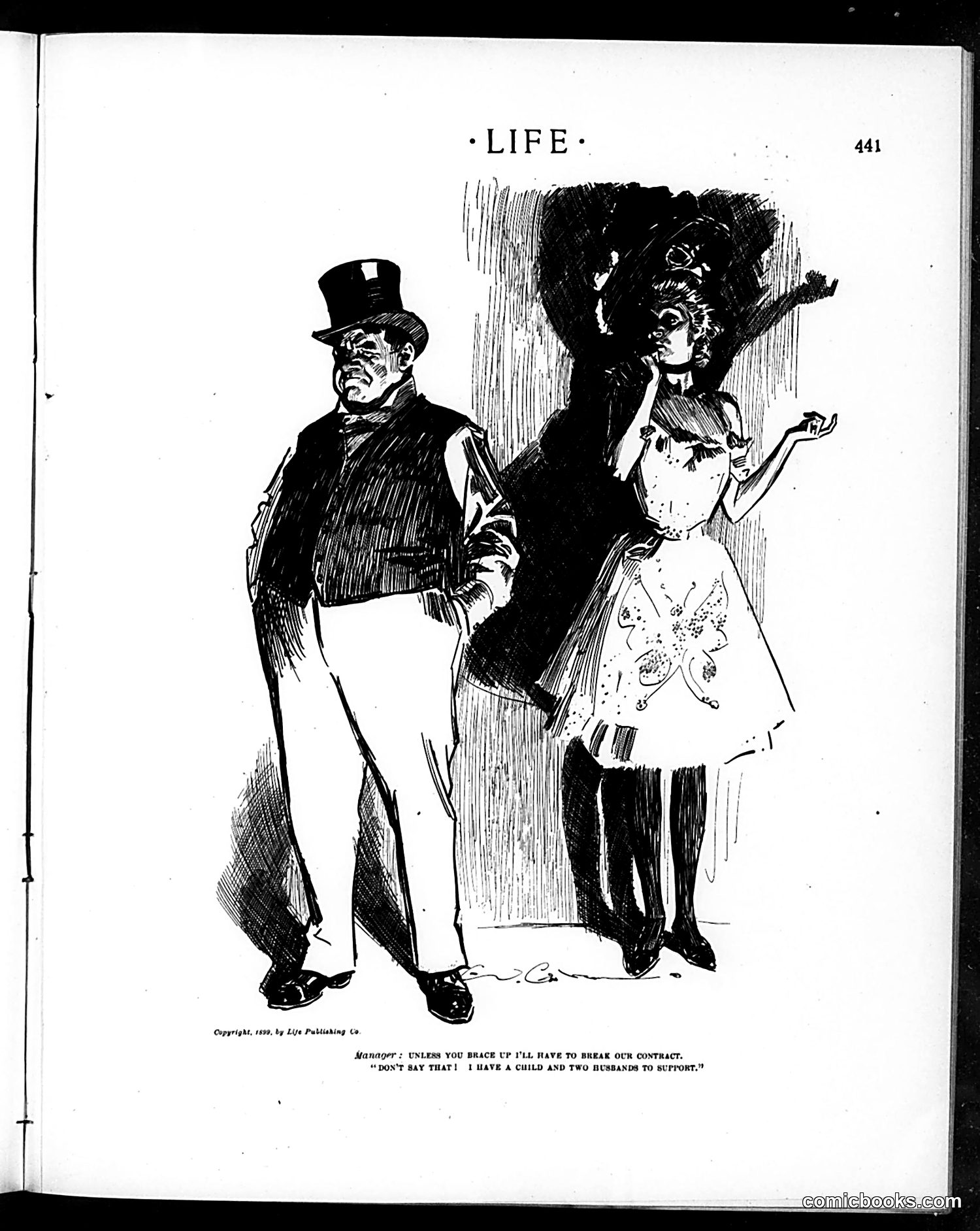
This is a satirical cartoon about labor negotiations or contract disputes. The image shows three figures: a stern man in a top hat and formal dress (likely representing a manager or employer), and two other figures—apparently a woman and child—positioned behind him. The caption reads: "Manager: Unless you brace up I'll have to break our contract. 'Don't say that! I have a child and two husbands to support.'" The satire mocks both management's harsh negotiating tactics and, more pointedly, the woman's claim of supporting multiple dependents—suggesting moral impropriety or exploitation of sympathy. The cartoon criticizes how workers (particularly women) were vulnerable to employer pressure and how they might resort to dubious claims to maintain employment during economically precarious times.
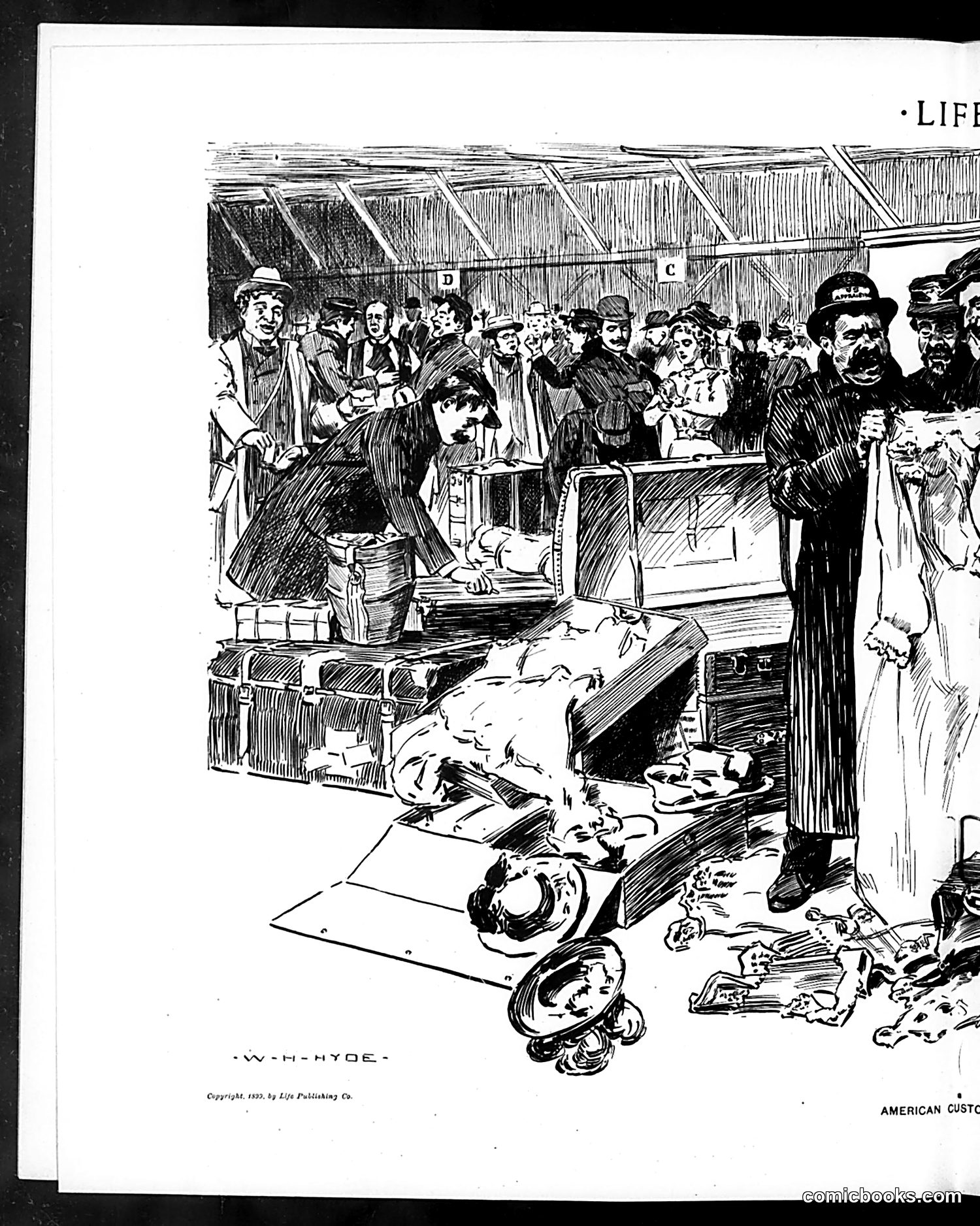
This Life magazine cartoon depicts a customs inspection scene, likely satirizing American border enforcement practices. The title "W.H. Hyde" suggests a play on "Jekyll and Hyde"—implying dual personalities or contradictory behavior. The crowded scene shows officials examining luggage and contraband while well-dressed passengers observe. Various items are scattered on the floor, suggesting confiscated goods. The cartoon likely critiques either: 1. Inconsistent or selective customs enforcement 2. Corruption among officials 3. The gap between official policy and actual practice The "Hyde" reference suggests the cartoon mocks how customs agents behave one way publicly but another way privately—a commentary on hypocrisy in government administration during the early 20th century.
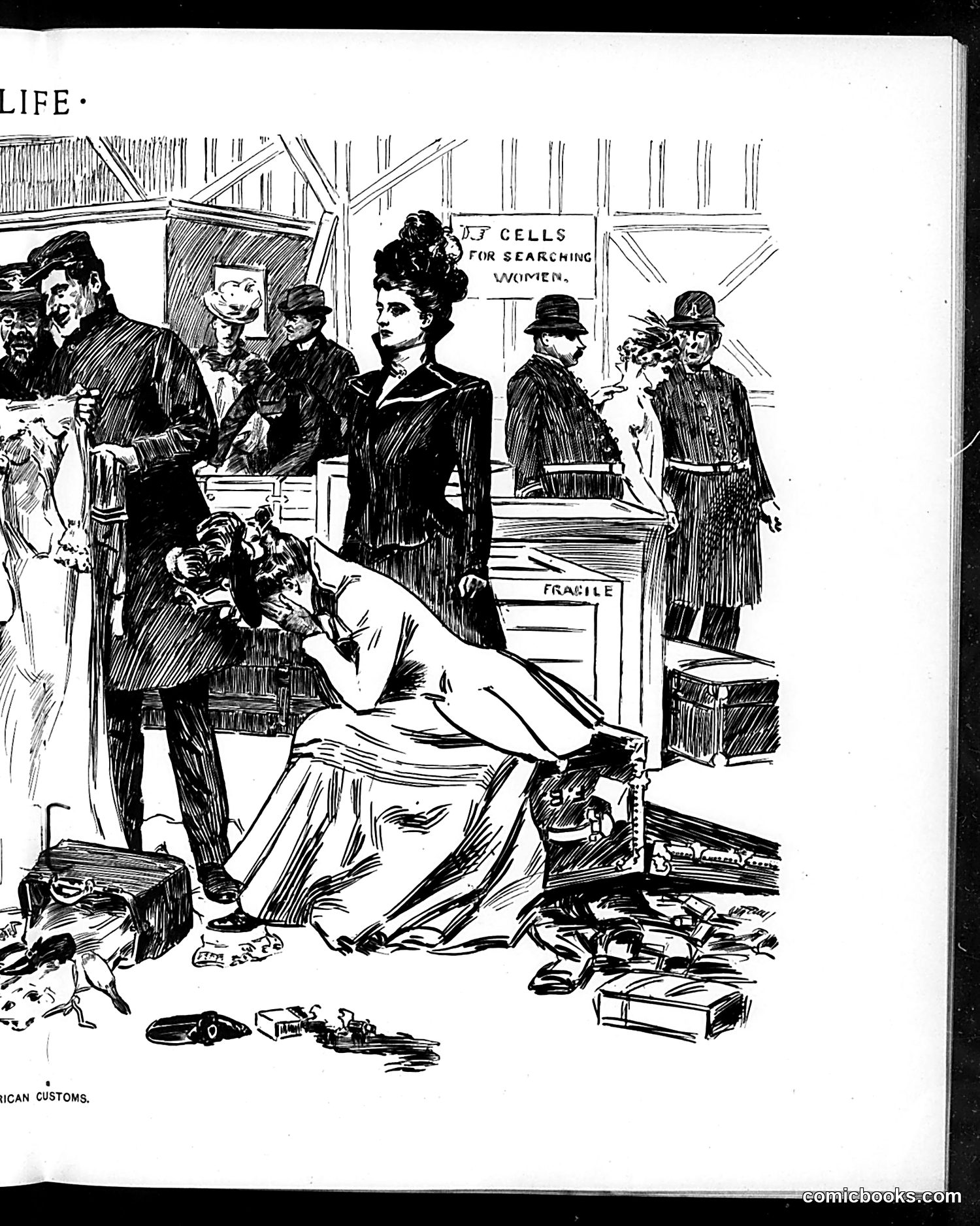
This satirical cartoon depicts a scene at what appears to be a customs inspection ("CELLS FOR SEARCHING WOMEN" visible on the sign). A woman in a long dress is being searched by female customs officials while male officials and other passengers observe. Items scattered on the ground suggest contraband being confiscated. The satire likely targets the invasive nature of customs searches, particularly the indignity imposed on women travelers. The title "LIFE" and the phrase "AMERICAN CUSTOMS" (partially visible) suggest this critiques U.S. border procedures as overly aggressive or embarrassing. The exaggerated expressions and theatrical positioning emphasize the humiliation aspect. The cartoon appears to mock both the excessive zeal of customs enforcement and the uncomfortable position it places female travelers in—a commentary on privacy invasion justified by security protocols.
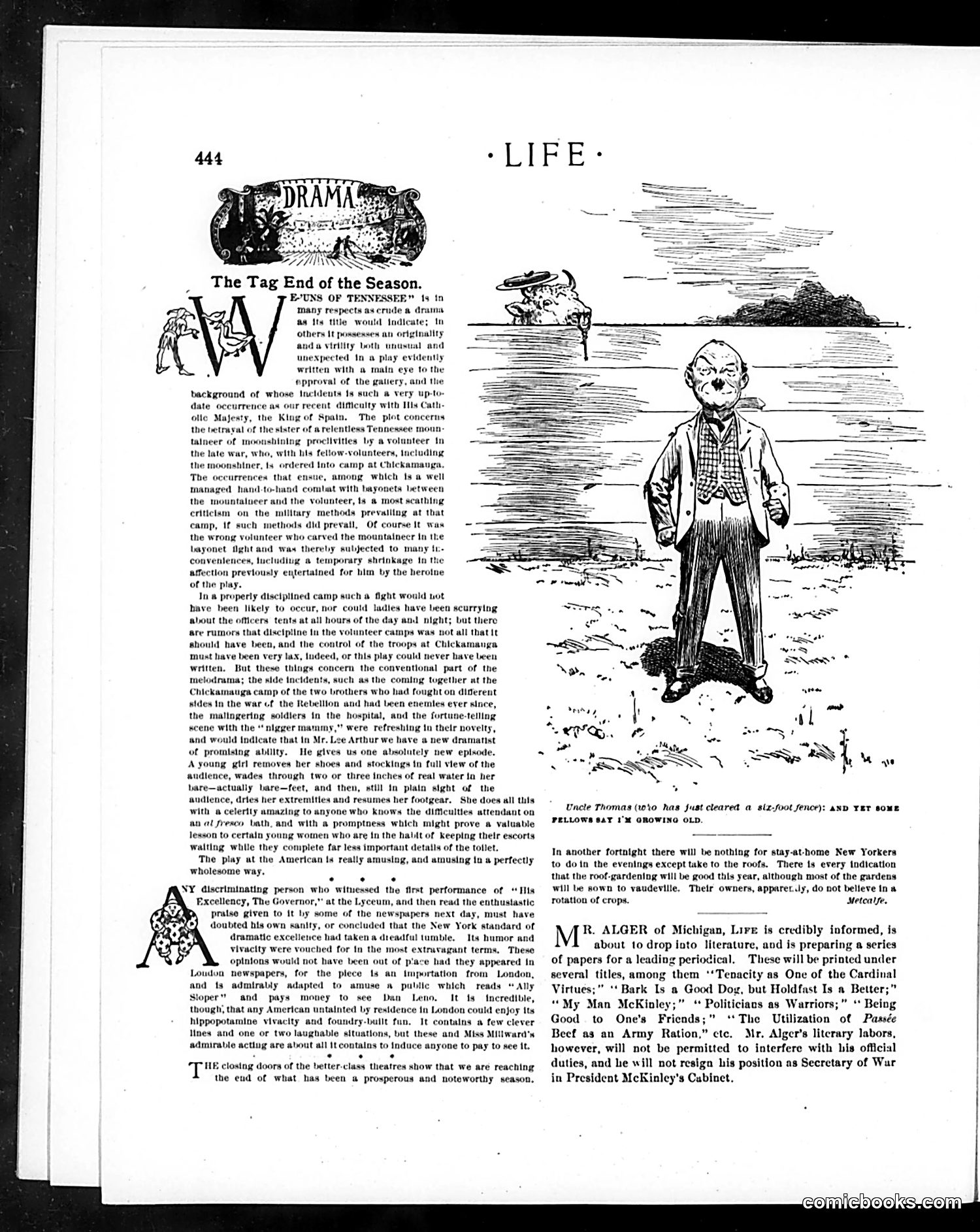
This theater review discusses a Tennessee drama presented at the Lyceum theater. The main illustration depicts an elderly man in worn clothing standing in a barren landscape—likely representing a character from the play, possibly a Civil War veteran based on the text's reference to "Chickamauga" and wartime conflict. The review criticizes the play's theatrical discipline and realism, noting concerns about military accuracy and melodramatic elements. It mentions the play includes "side incidents" like a young girl removing her shoes on stage for authenticity. The article reflects late-19th-century dramatic criticism standards, evaluating whether the production achieved proper artistic merit versus sensationalism in depicting post-war American life.
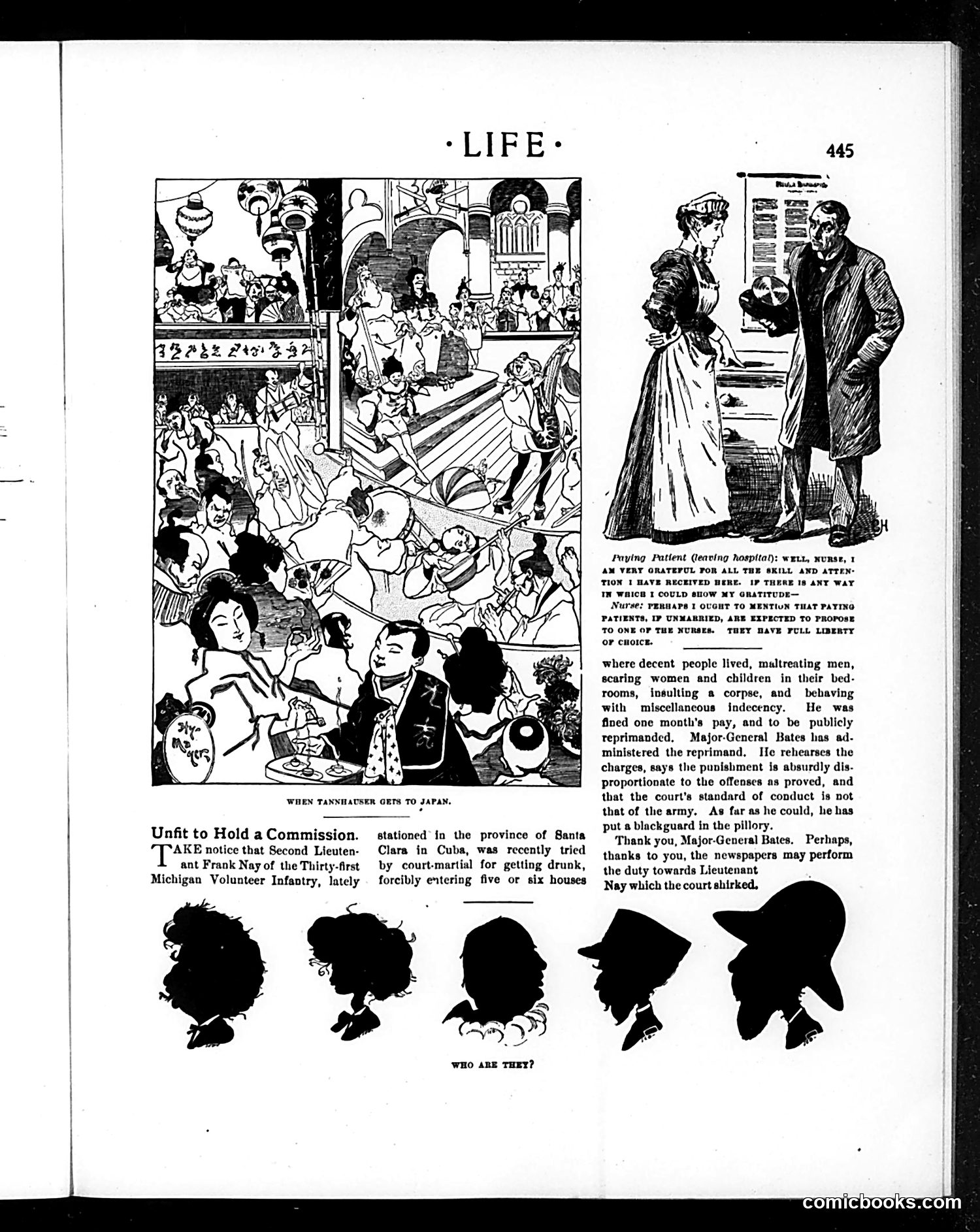
This page contains three distinct satirical pieces: **Top cartoon** ("When Tannhauser Gets to Japan"): A joke about opera—Wagner's "Tannhäuser" depicts excess and debauchery. The visual gag suggests what would happen if such opera plots were transplanted to Japan, playing on early 1900s fascination with Japanese culture and the contrast between Western excess and perceived Japanese restraint. **Middle article** ("Unfit to Hold a Commission"): Criticizes Second Lieutenant Frank Nay of the 31st Michigan Infantry, court-martialed for drunkenness and breaking into five or six houses in Cuba. The piece mocks Major-General Bates' lenient punishment (one month's pay and public reprimand) as absurdly light for serious misconduct, arguing newspapers should pressure the court to impose harsher discipline. **Bottom cartoon** ("Who Are They?"): Five silhouettes with the caption "WHO ARE THEY?"—likely a guessing game for readers, possibly identifying contemporary political or social figures, though their identities aren't specified on this page.
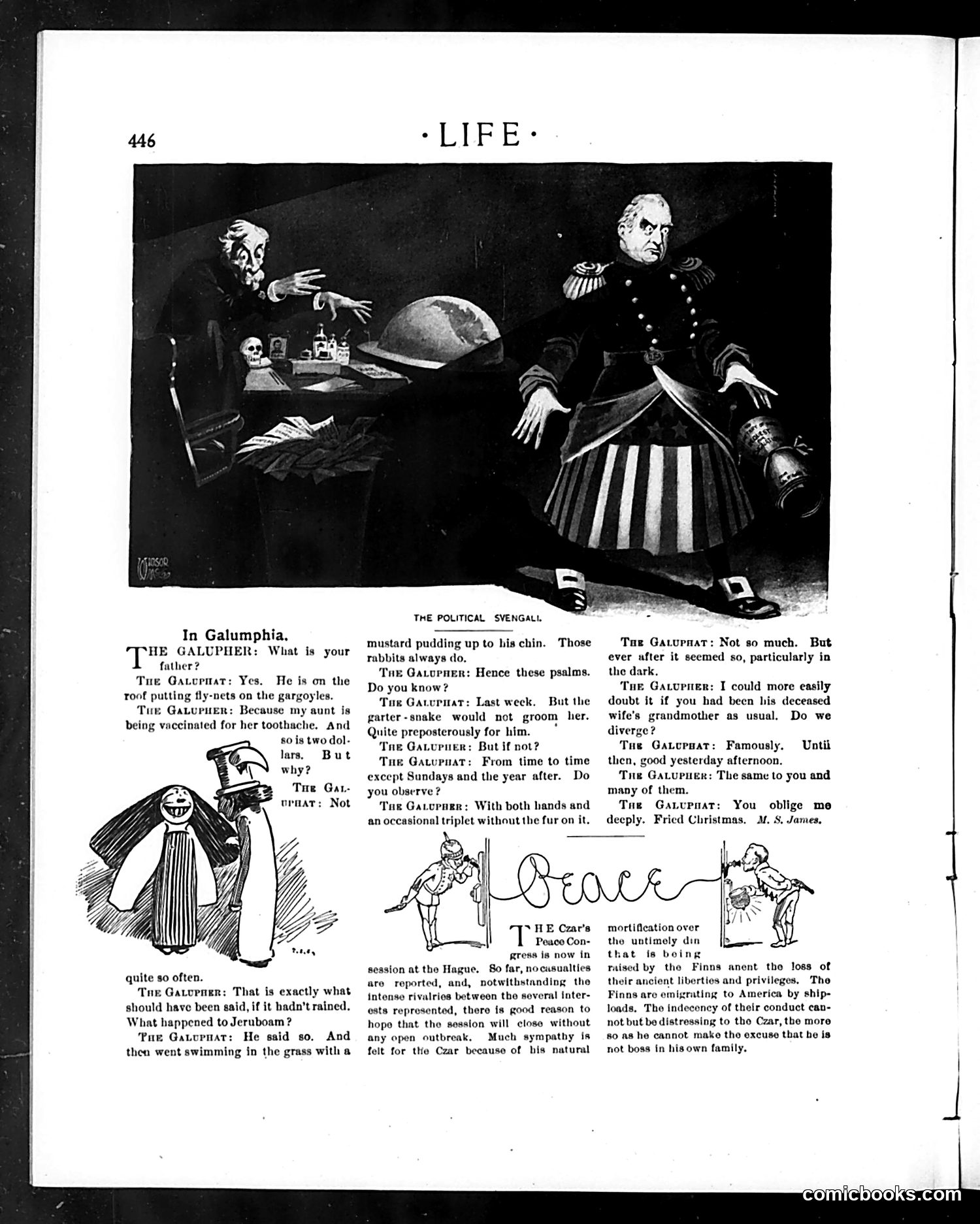
This page contains two distinct pieces. The top cartoon depicts a military figure (likely representing the Czar or Russian autocracy) confronted by an older civilian—possibly a political advisor or manipulator (the "Svengali" of the title). The dramatic chiaroscuro lighting emphasizes tension. The accompanying text satirizes the Czar's position at the Hague Peace Conference, where he faces embarrassment over Finnish resistance to Russian rule. The Finns are emigrating en masse to America in protest of losing their "ancient liberties and privileges." The satire's point: the Czar claims absolute authority yet cannot control his own territories—he cannot "be boss in his own family." This undermines his legitimacy and exposes the contradiction between autocratic pretense and actual powerlessness. The nonsensical "Galumphia" dialogue above appears to be absurdist filler, typical of *Life* magazine's humor style.
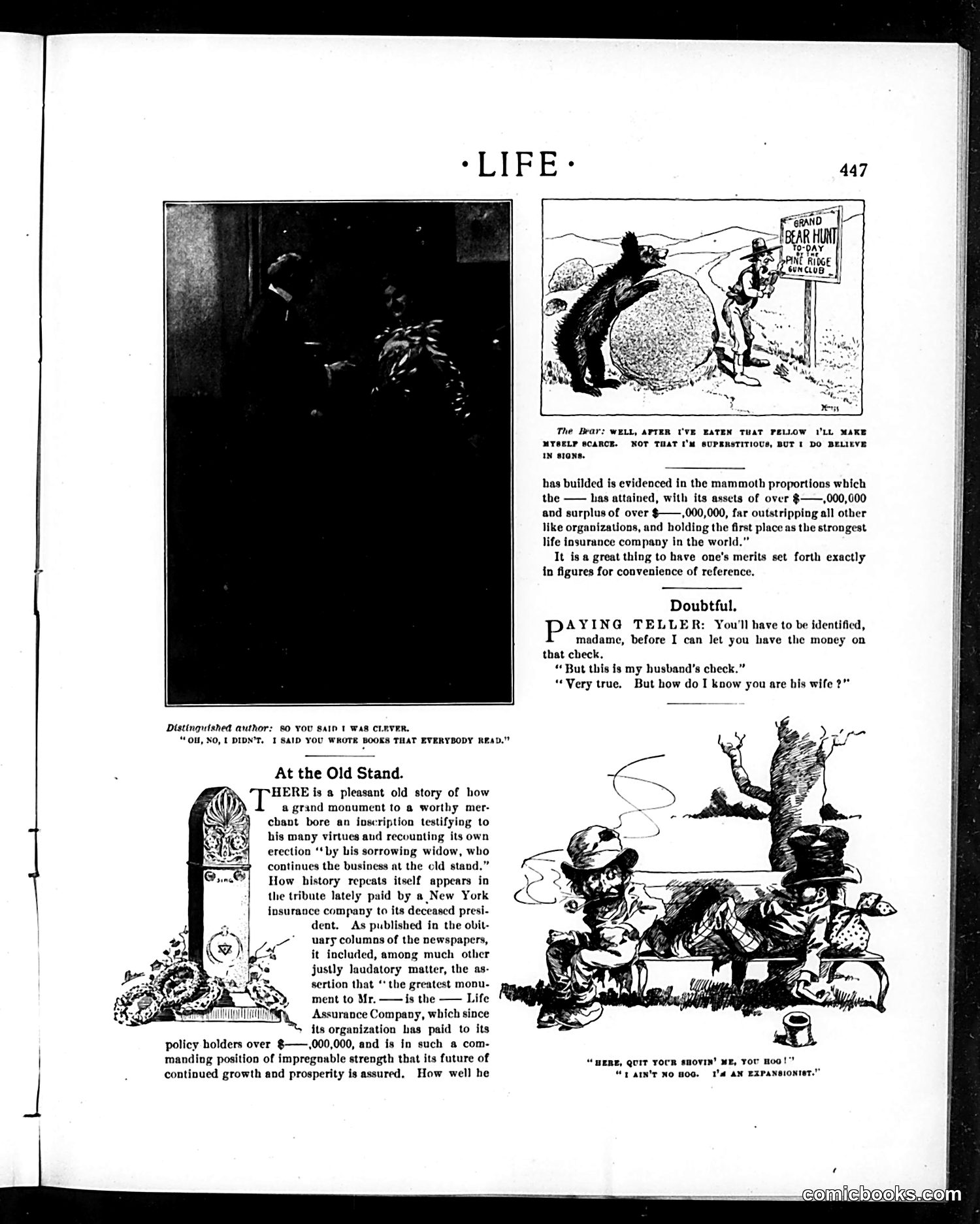
This page contains three separate satirical pieces: **Top cartoon**: A bear who has eaten someone says he'll "make myself scarce"—a dark joke about superstition and consequences. **"Doubtful"**: A bank teller refuses to cash a check from a woman, even though she claims it's her husband's check. The teller demands proof she's actually married to him. This satirizes the legal and practical barriers women faced accessing their own family's finances—they often couldn't access bank accounts independently. **"At the Old Stand"**: The main piece mocks an insurance company's obituary for its deceased president. The company boasts it's "the greatest monument to Mr. ——," citing massive assets and payouts. The satire suggests the company is essentially advertising itself through the death tribute—using the widow's continuation of the business (like the historical anecdote referenced) primarily as a vehicle for self-promotion rather than genuine memorial.
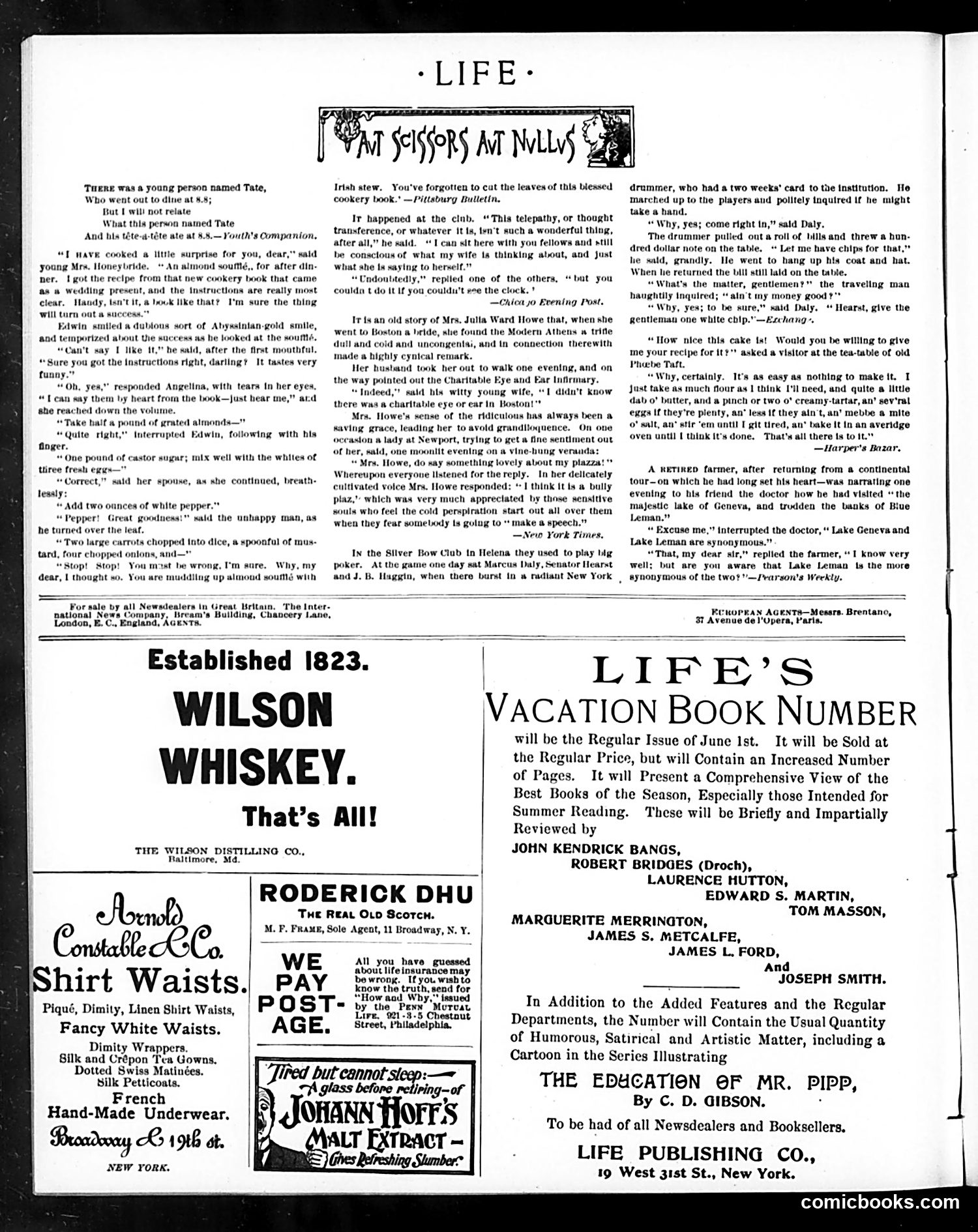
This page is primarily **advertising and announcements** rather than political satire. The main content consists of several humorous anecdotes about domestic life and social situations: 1. **"Young Person Named Tate"** — A risqué limerick about a dinner date, typical of Life's mild humor. 2. **The Almond Soufflé Story** — A newlywed's cookbook mishap where she confuses recipes, mixing almond soufflé ingredients with Irish stew instructions. The joke satirizes both poorly-printed cookbooks and wives' domestic incompetence—period stereotypes. 3. **The Telepathy Joke** — A husband claims to read his wife's thoughts from afar; the punchline reveals he's just reading the clock—mocking pseudoscientific claims. 4. **Julia Ward Howe Anecdotes** — Stories about the famous writer's wit, presented as examples of clever society banter. 5. **The Poker Game** — A traveling salesman's money is refused by wealthy poker players (Daly, Hearst, Haggin), questioning whether his cash is legitimate. The **advertisements** (Wilson Whiskey, shirt waists, malt extract) occupy significant space, typical of Life's era.
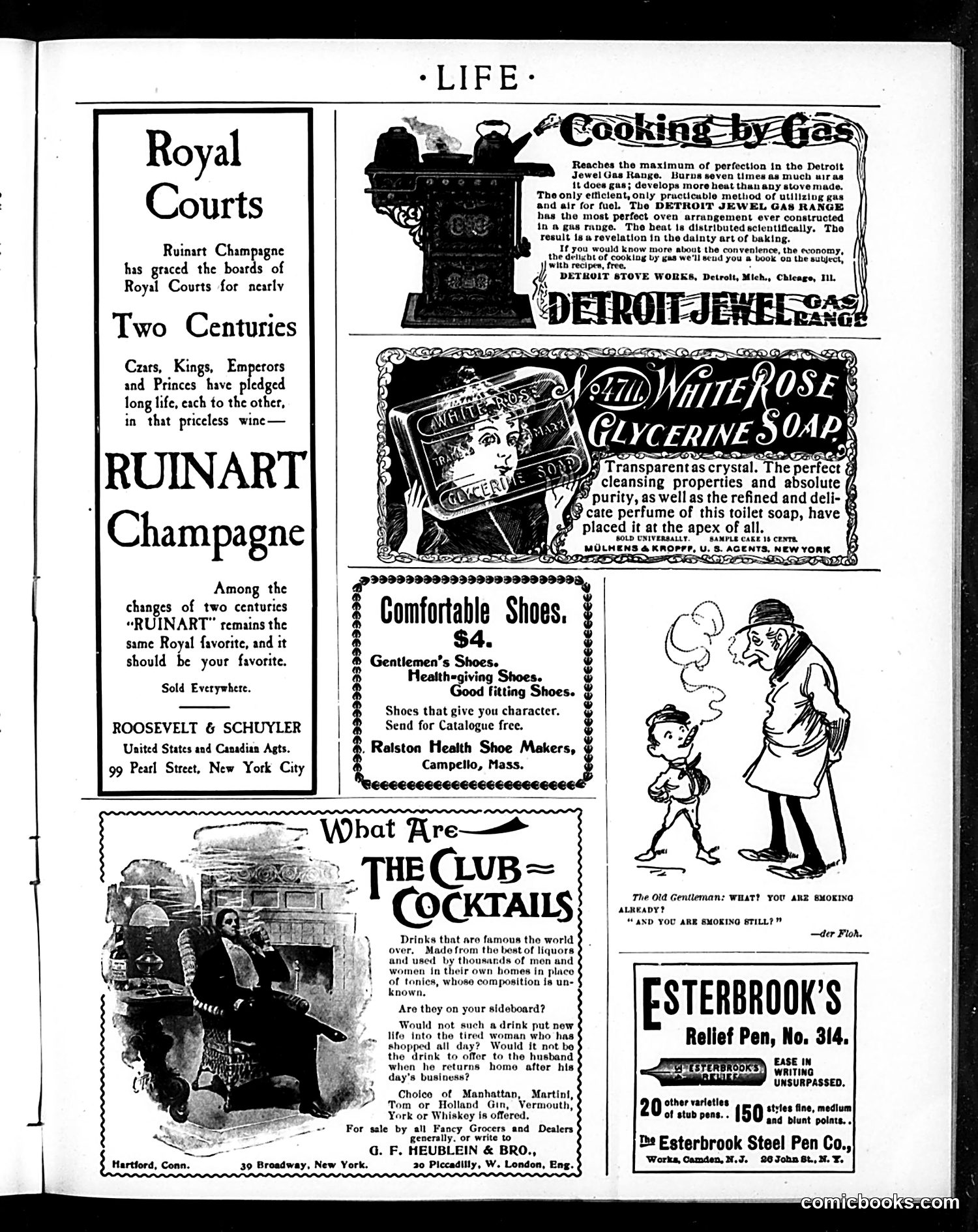
This page is primarily **advertising** with one small cartoon. The advertisements promote luxury goods to affluent readers: Ruinart Champagne (historically favored by European royalty), a Detroit Jewel Gas Range, White Rose Glycerine Soap, comfortable shoes, and Club Cocktails. These ads reflect early 20th-century consumer culture targeting the wealthy. The only cartoon appears at bottom right, captioned "The Old Gentleman: WHAT? YOU ARE SMOKING ALREADY? AND YOU ARE SMOKING STILL?" — attributed to "der Floh" (The Flea, a German publication). It depicts a small boy smoking a cigarette while an elderly gentleman expresses shock. The joke satirizes child labor and/or children's access to cigarettes, which were not yet heavily regulated. The humor relies on the audience's recognition that this is scandalous behavior, likely critiquing loose social standards or parental negligence of the era.
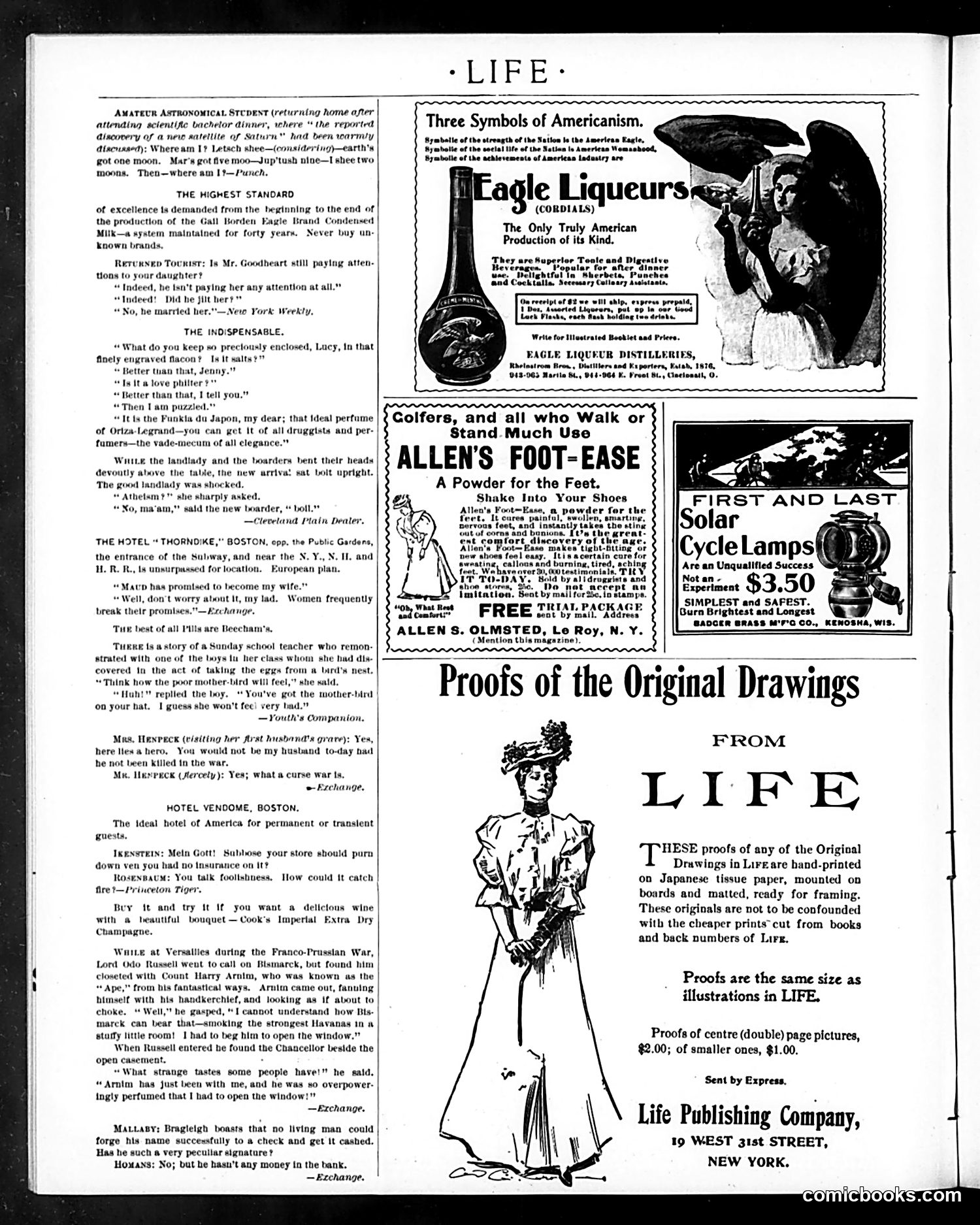
This page contains period advertisements and satirical content from *Life* magazine. The prominent "Three Symbols of Americanism" advertisement features **Eagle Liqueurs**, with an illustration of an eagle. The ad claims these cordials represent "the social life of the Nation" and "achievements of American industry"—a humorous exaggeration typical of Gilded Age advertising that wrapped commercial products in patriotic rhetoric. Accompanying ads for Allen's Foot-Ease powder and Solar Cycle Lamps use similar hyperbolic claims ("Unqualified Success"). The page also includes various brief anecdotes and jokes about hotels, romance, and social situations—standard *Life* magazine content satirizing contemporary manners and pretension. The overall satire is gentle: mocking how American businesses marketed ordinary products using inflated nationalist and aspirational language to appeal to consumers' vanity.
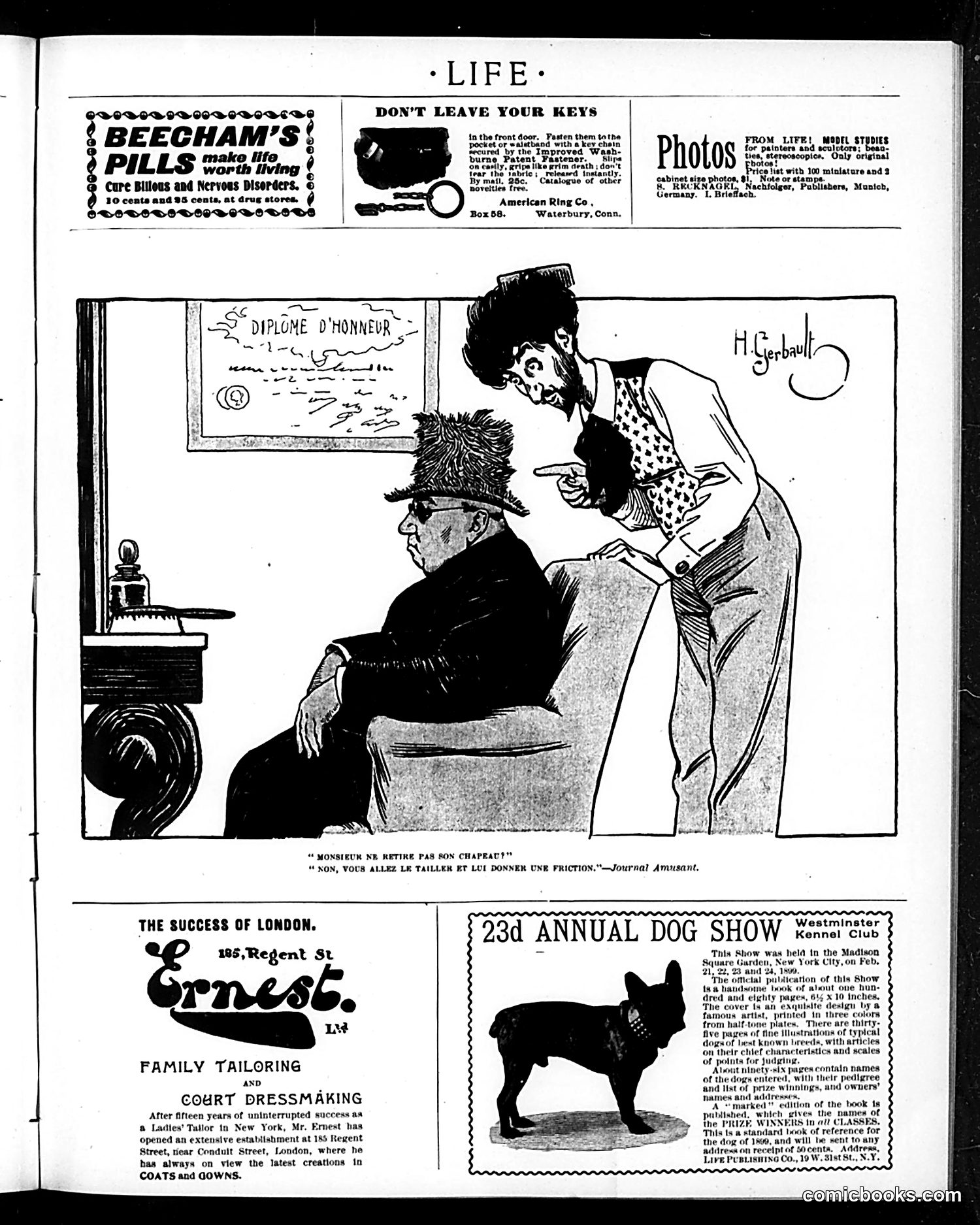
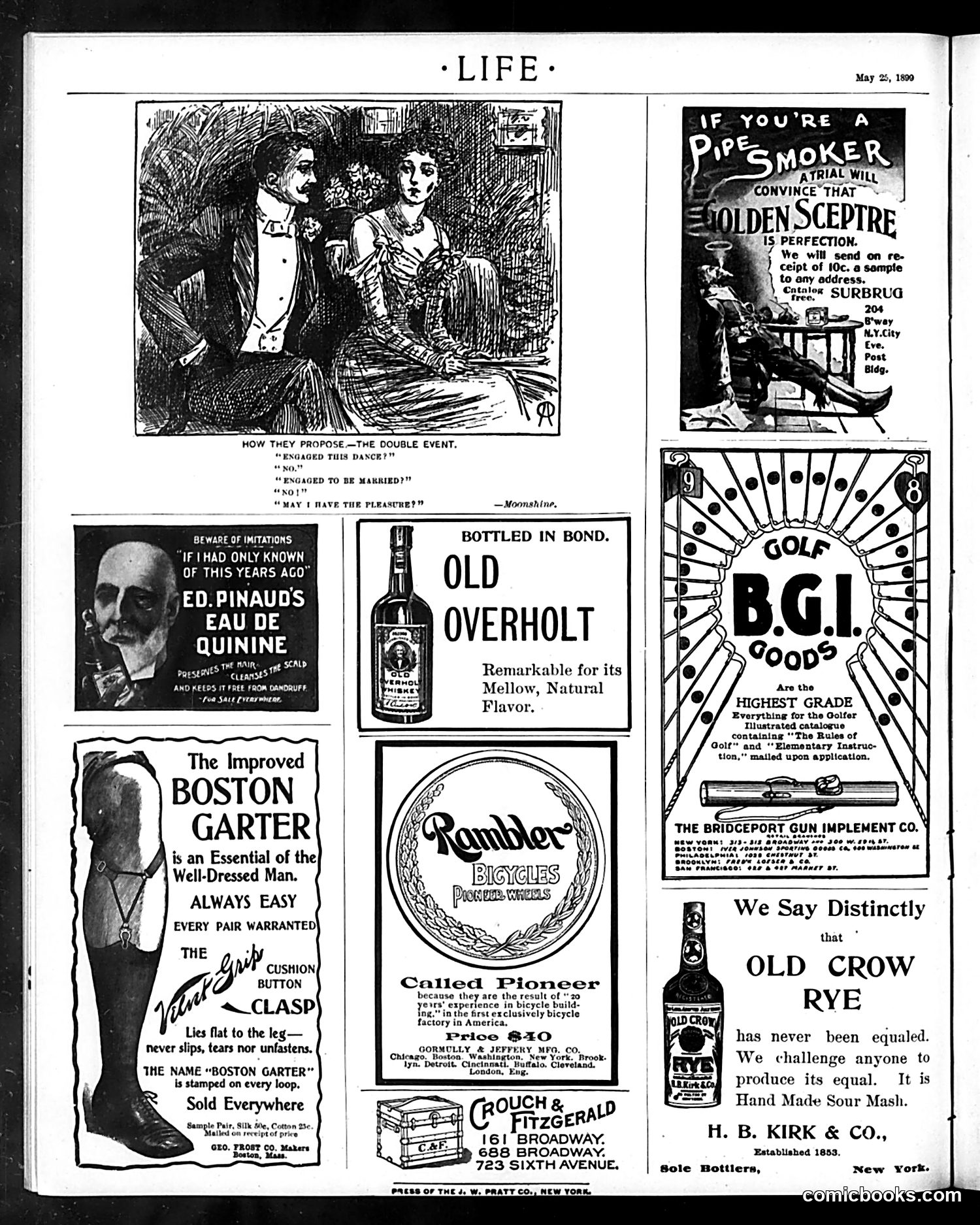
This page is primarily **advertisements** with one small cartoon at the top. The cartoon, titled "How They Propose—The Double Event," depicts a man proposing to a woman. The humor hinges on a misunderstanding: when he asks "Engaged this dancer?" and she responds "No," he then asks "Engaged to be married?" She again says "No," leading him to hopefully ask "May I have the pleasure?"—implying he's about to propose. The joke satirizes the ambiguity of "engagement" in courtship: it could mean either dancing partnership or marriage proposal, creating comic confusion. The rest of the page consists entirely of period advertisements for products like garters, liquor (Old Overholt whiskey, Old Crow rye), bicycles (Rambler), hair tonic (Ed. Pinaud's Eau de Quinine), golf equipment, and other goods. These reflect 1890s consumer culture and have no satirical content.