
Life, 1899-05-25 · page 12 of 20
Life — May 25, 1899 — page 12: what you’re looking at
What you’re looking at
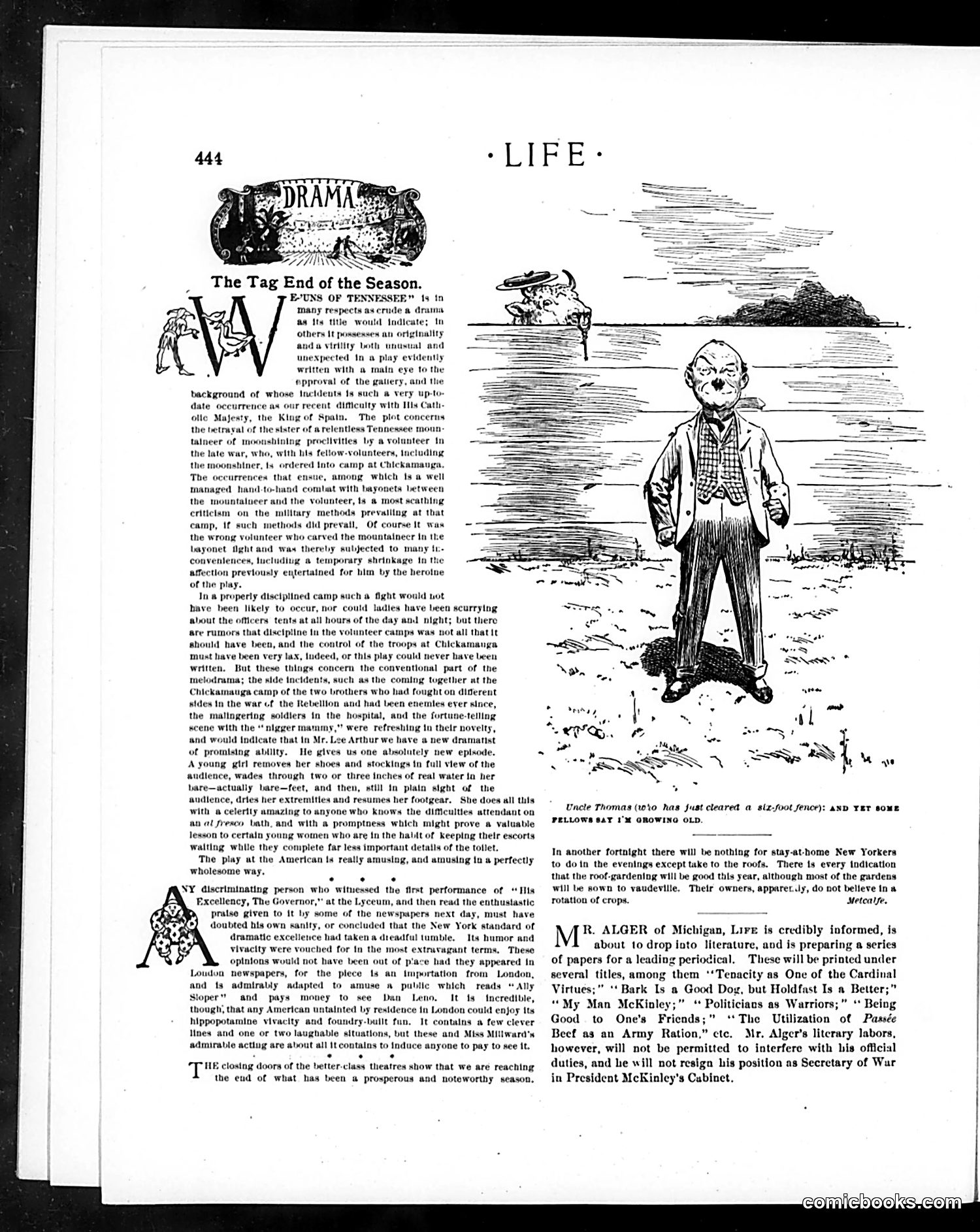
This theater review discusses a Tennessee drama presented at the Lyceum theater. The main illustration depicts an elderly man in worn clothing standing in a barren landscape—likely representing a character from the play, possibly a Civil War veteran based on the text's reference to "Chickamauga" and wartime conflict. The review criticizes the play's theatrical discipline and realism, noting concerns about military accuracy and melodramatic elements. It mentions the play includes "side incidents" like a young girl removing her shoes on stage for authenticity. The article reflects late-19th-century dramatic criticism standards, evaluating whether the production achieved proper artistic merit versus sensationalism in depicting post-war American life.
📄 Transcribed text from this page (OCR, searchable)
Machine-transcribed from the original scan — historical spelling and the odd misread are preserved.
The Tag End of the Season. E’UNS OF TENNESSEE” 14 in many respects ax crude a drama a4 Its title would Indicate; tn others It possexses an originallty anda virility both unusual and xpected In a play evidently written with a main eye to the epproval of the gatiery, and the background of whose Incidents 14 such @ very up-to- date occurrence dimeulty with Hix Cath. olle Majesty, the King of Spain, The plot concerts the hetragal of the stster of a relentless Tennessee moun: tulneer of mooushining prociivitles by a volunteer tn the late war, who, with his feltow-volunteers, Including the moonshitner, 1s ordered Into camp at Chickamauga, The occurrences that ensue, among which ts a well managed hand-to-hand combat with bayonets between the mountalucer and the volunteer, 18 @ most scathing eriticlam on the military methods prevalling at that camp, If such imethods did pre Of course It wax the wrong volunteer who carved the mountaineer tn the Layonet ight and was thereby subjected to many tr conventences, fucludiug @ temporary shrinkage In the affection previously entertained for him by the herotue of the play. In a properly disciplined camp such a fight would not have been likely to occur, nor could ladies have been scurrying about the officers tents at all hours of the day and night; but there Are rumors that discipiine tu the volunteer camps was not all that It should have been, and the control of the troops at Chickamanga must have been very lax, Iudeed, or this play could never have Leen written, But these things concern the conventional part of the clodrama; the side incidents, such asthe coming together at the Chickamauga camp of the two brothers who had fought on diserent sides In the war cf the Rebellion und had been enemies eer since, the malingering soldiers in the hospital, and the fortune-telling scene with the “nigger mammy," were refreshing tn thelr novelty, and would Indicate that In Mr. Lee Arthur we have a new dramatist of promising ablilty. He gives us one absolutely new eplsode. A young girl removes her shoes and stockings tn full view of the audience, wades through two or three inches of real water to her bare—actually bare—feet, and then, still in plain sight of the audience, dries her extremities and resumes her footgear. She does all this with a celerlly amazing to anyone who knows the difficulties attendant on an at fresco bath, and with a promptness which might prove a valuable lesson to certain young women who are in the halit of keeping thelr escorts walting while they complete far less important details of the tollet, ‘The play at the American t4 really amusing, and amusing lu a perfectly wholesome way, oe NY discriminating person who wituessed the first performance of “Its Excellency, The Governor,” at the Lyceum, and then read the enthustastie pratse given to it hy some of the newspapers next day, must have doubted his own sanity, or concluded that the New York standard o dramatic excellence had taken a dreadful tumble, Its humor and vivactty were vouched for In the most extravagunt terms, These opinions would not have been out of place had they appeared in Loudoa newspapers, for the plece 1s an importation from London, and 1s admirably adapted to amuse a public which reads “Ally Sloper” and pays money to see Dan Leno. It ts incredible, though; that any American untainted by residence in London could enjoy tts Nippopotamine vivactty and foundry-bullt fun, It contains a few clever lines and one or two laughable situations, but these and Miss Millward's admirable acting are atiout all It contains to Induce anyone to pay to sce tt. HE closing doors of the better-class theatres show that we are reaching the eud of what has been a prosperous and noteworthy season, Uncle Thomas (wio has fust cleared a siz-foot fence): AND YET some PELLOWS SAT I'M GROWING OLD. In another fortnight there will be nothing for stay-at-home New Yorkera to doin the evenings except take to the roofs. There 1s every indication that the roof-gardening will be good this year, although most of the gardens will Le own to vaudeville, Thetr owners, apparetly, do not belleve in a rotation of crops, Metcalfe, M R. ALGER of Michigan, Lire is credibly informed, is about to drop into literature, and is preparing a series ‘These will be printed under of papers for a leading periodical. several titles, among them ‘‘Tenacity as One of the Cardinal Virtues; ‘* Bark Is a Good Dog, but Holdfast Is a Better;” “My Man McKinley;” “ Politicians as Warriors;” “ Being Good to One's Fricnds;" ‘*The Utilization of Passée Beef as an Army Ration,” ete. Mr. Alger’s literary labors, however, will not be permitted to interfere with his official duties, and he will not resign his position as Secretary of Wur in President McKinley's Cabinet.