
Life, 1899-05-25 · page 4 of 20
Life — May 25, 1899 — page 4: what you’re looking at
What you’re looking at
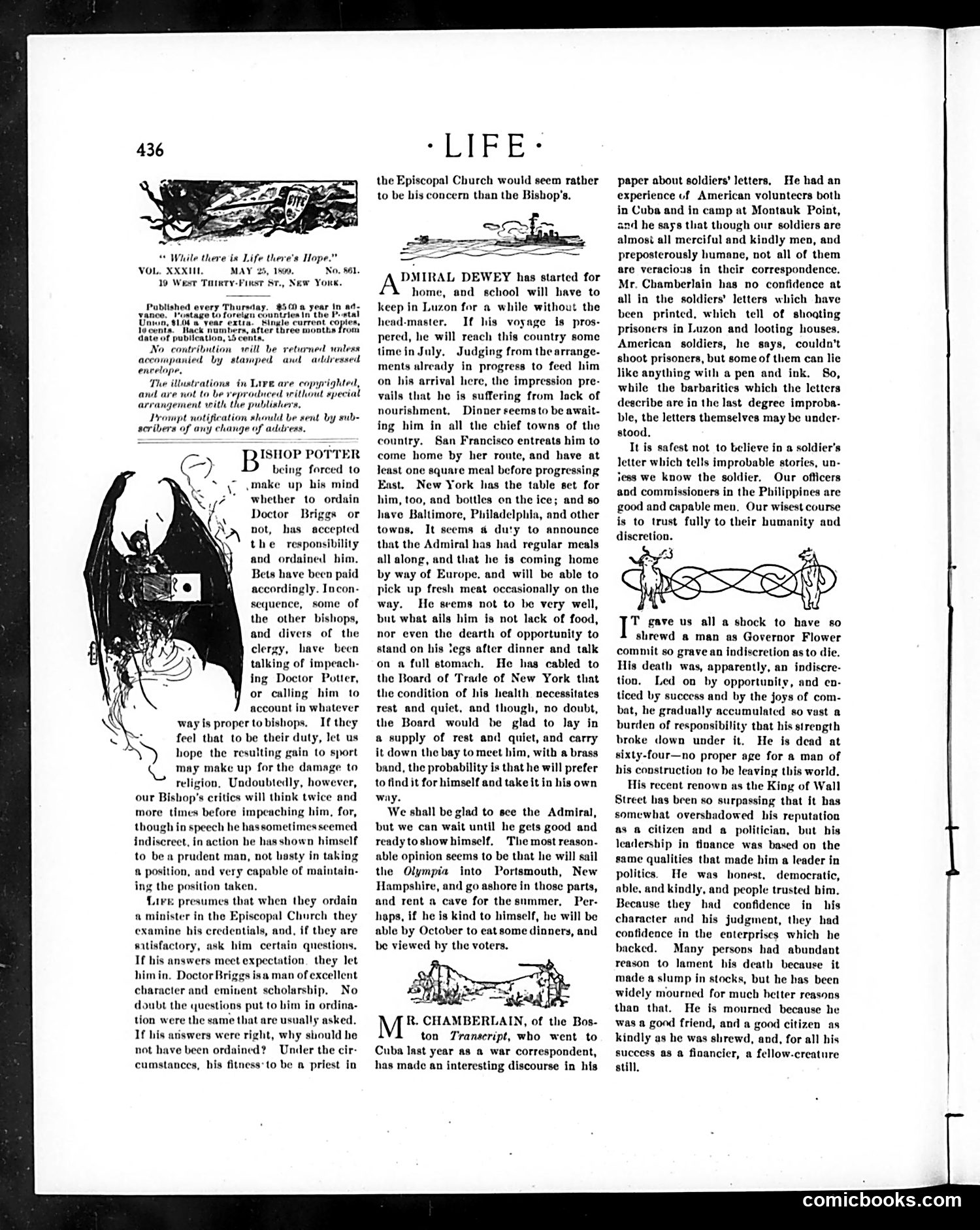
This page contains two distinct pieces of commentary on early 20th-century American institutional leadership. **Bishop Potter Cartoon**: The illustrated section critiques Bishop Potter's handling of ecclesiastical responsibility. The text suggests Potter deflected blame for church problems onto others rather than accepting accountability for his position's demands. The satire implies he lacked the character and scholarship expected of his office. **Admiral Dewey Section**: The text discusses Admiral George Dewey's homecoming and health concerns during a voyage. It addresses soldiers' letters praising American soldiers' humanity, while noting some letters from soldiers criticizing their treatment. The commentary defends military officers as "good and capable men" while cautioning against believing unverified soldier complaints without knowing the full context. Both sections reflect debates about institutional integrity and leadership credibility.
📄 Transcribed text from this page (OCR, searchable)
Machine-transcribed from the original scan — historical spelling and the odd misread are preserved.
“While there ix XML. 19 West Taiury-Finst St., New You. Published every Thursday. $50) a year In ad tage to foreign countries tt the Pestal Single current cops bers, after three months from Scents. No contribution will be returned wiles accompanied by stamped aut addressed envelope. The illustrations in Live are copyrighted, and are not to be reproduced without special arrangement with the publishers, Prompt notification should be sent by sub- scribers of any change of address. ISHOP POTTER - being forced to \°* \° \make up his mind © whether to ordain Doctor Briggs or not, the responsibility and ordained him, Bets have been paid accordingly. Incon- sequence, some of the other bishops, and divers of the clergy, have been talking of impeach- ing Doctor Potter, or calling him to account in whatever way Is proper to bishops. If they feel that to be their duty, let us hope the resulting gain to sport may make up for the damage to religion, Undoubtedly, however, our Bishop's critics will think twice and more times before impeaching him, for, though in speech he hassometimes seemed indiscreet, in action he has shown himsclf to bea prudent man, not basty in taking a position, and very capable of maintain- ing the position taken, Lire presumes that when they ordain a minister in the Episcopal Church they examine his credentials, and, if they are satisfactory, ask him certain questions, If his answers mect expectation. they let himin. Doctor Briggs isa man of excellent character and eminent scholarship. No doubt the questions put to him in ordina- tion were the same that are usually asked. If his atiswers were right, why should he not have been ordained? Under the cir- cumstances, his fitness:to be a priest in LIPE the Episcopal Church would seem rather to be his concern than the Bishop's. DMIRAL DEWEY has started for home, and school will have to keep in Luzon for a while without the head-master. If his voyage is pros- pered, he will reach this country some time in July, Judging from the arrange- ments already in progress to feed him on his arrival here, the impression pre- vails that he is suffering from lack of nourishment, Dinner seems to be await- ing him in all the chief towns of the country, San Francisco entreats him to come home by her route, and have at least one square meal before progressing East. New York has the table set for him, too, and bottles on the ice; and so have Baltimore, Philadelphia, and other towns, It seems 4 duty to announce that the Admiral has had regular meals all along, and that he is coming home by way of Europe. and will be able to pick up fresh meat occasionally on the way. He seems not to be very well, but what ails him is not lack of food, nor even the dearth of opportunity to stand on his iegs after dinner and talk on a full stomach. He has cabled to the Board of Trade of New York that the condition of his health necessitates rest and quiet, and though, no doubt, the Board would be glad to Jay in a supply of rest and quiet, and carry it down the bay to meet him, with a brass band, the probability is that he will prefer to find it for himself and take it in his own way. We shall be glad to sce the Admiral, but we can wait until he gets good and ready to show himself, The most reason. able opinion seems to be that he will sail the Olympia into Portsmouth, New Hampshire, and go ashore in those parts, and rent a cave for the snmmer, Per- haps, if he is kind to himself, he will be able by October to eat some dinners, and be viewed by the voters. R. CHAMBERLAIN, of the Bos- ton Transcript, who went to Cuba last year as a war correspondent, has made an interesting discourse in his paper about soldiers’ letters, He had an experience of American voluntecrs both in Cuba and in camp at Montauk Point, and he says that though our soldiers are almosi all merciful and kindly men, and preposterously humane, not all of them are veracious in thcir correspondence. Mr, Chamberlain has no confidence at all in the soldiers’ letters which have been printed, which tell of shogting prisoners in Luzon and looting houses. American soldiers, he says, couldn't shoot prisoners, but some of them can lie like anything with a pen and ink. 80, while the barbaritics which the letters describe are in the last degree improba- ble, the letters themselves may be under- stood. It is safest not to believe in a soldier's letter which tells improbable stories, un- jess we know the soldier. Our officers aod commissioners in the Philippines are good and capable men, Our wisest course is to trust fully to their humanity and discretion. T gave us all a shock to have so shrewd a man as Governor Flower commit so grave an indiscretion as to die. His death was, apparently, an indiscre- tion. Led on by opportunity, and en- ticed by success and by the joys of com- bat, he gradually accumulated so vast a burden of responsibility that his strength broke down under it, He is dead at sixty-four—no proper age for a man of his construction to be leaving this world. His recent renown as the King of Wall Street has been so surpassing that it bas somewhat overshadowed bis reputation as a citizen and a politician, but his leadership in tioance was based on the same qualities that made him a leader in politics. He was honest, democratic, able, and kindly, and people trusted bim. Because they had confidence in his character and his judgment, they had confidence in the enterprises which he backed. Many persons had abundant reason to lament his death because it made a slump in stocks, but he has been widely mourned for much better reasons than that. He is mourned because he was a good friend, and a good citizen as kindly as he was shrewd, and, for all his success as a financier, a fellow-creature still. comicbooks.com