
A complete issue · 20 pages · 1899
Life — April 27, 1899
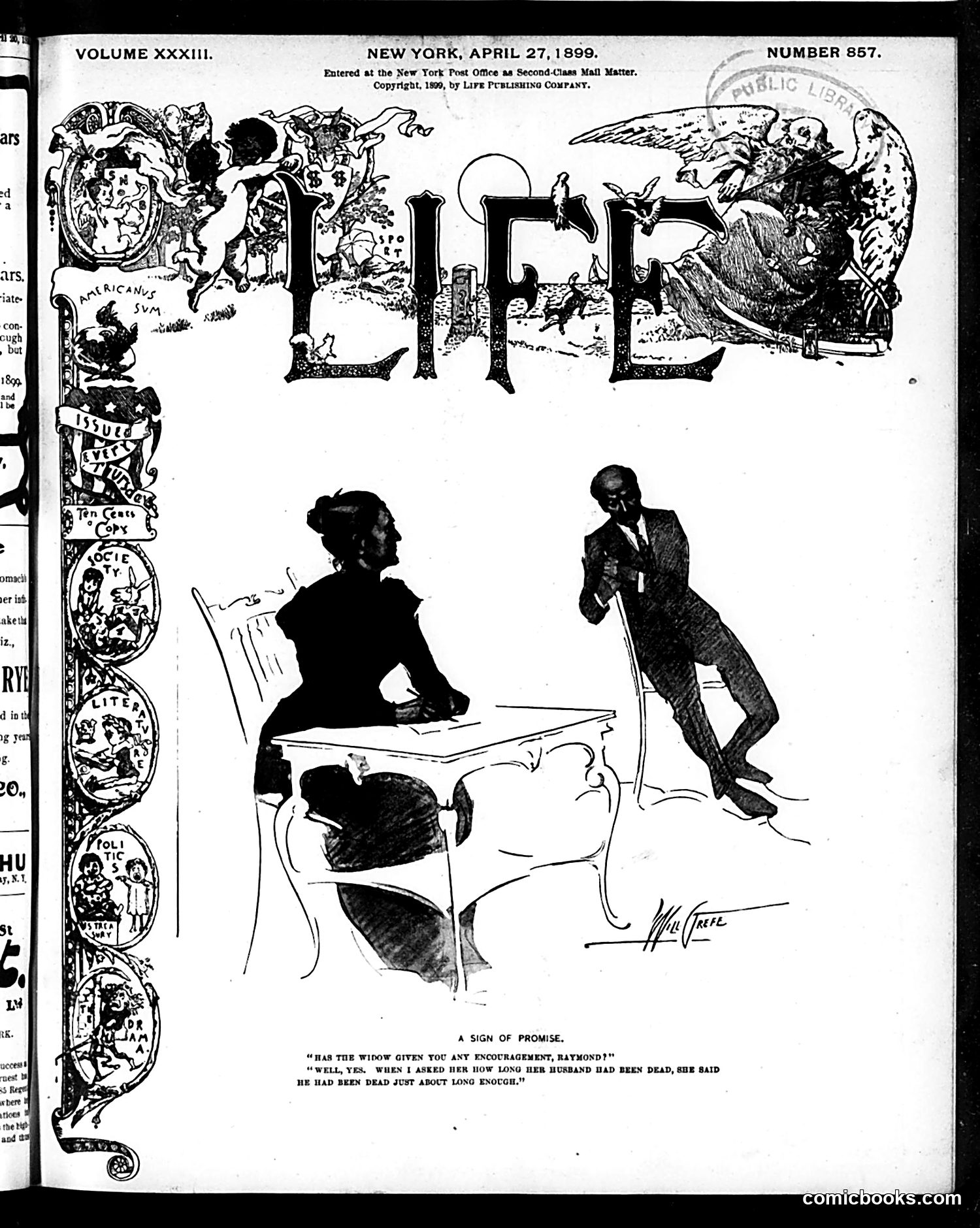
The main cartoon, titled "A Sign of Promise," depicts a domestic scene with two figures in conversation. The caption indicates a widow discussing her late husband's death with someone named Raymond. The dialogue—"Has the widow given you any encouragement, Raymond?" followed by "Well, yes. When I asked her how long her husband had been dead, she said he had been dead just about long enough"—is a joke about courtship timing. The humor derives from the widow's oblique acceptance of Raymond's romantic interest, suggesting the husband's death was sufficiently distant to make new romance socially acceptable. This reflects 1890s social conventions regarding widow remarriage and acceptable mourning periods. The cartoon satirizes both courtship customs and the practical calculations involved in matrimonial prospects.
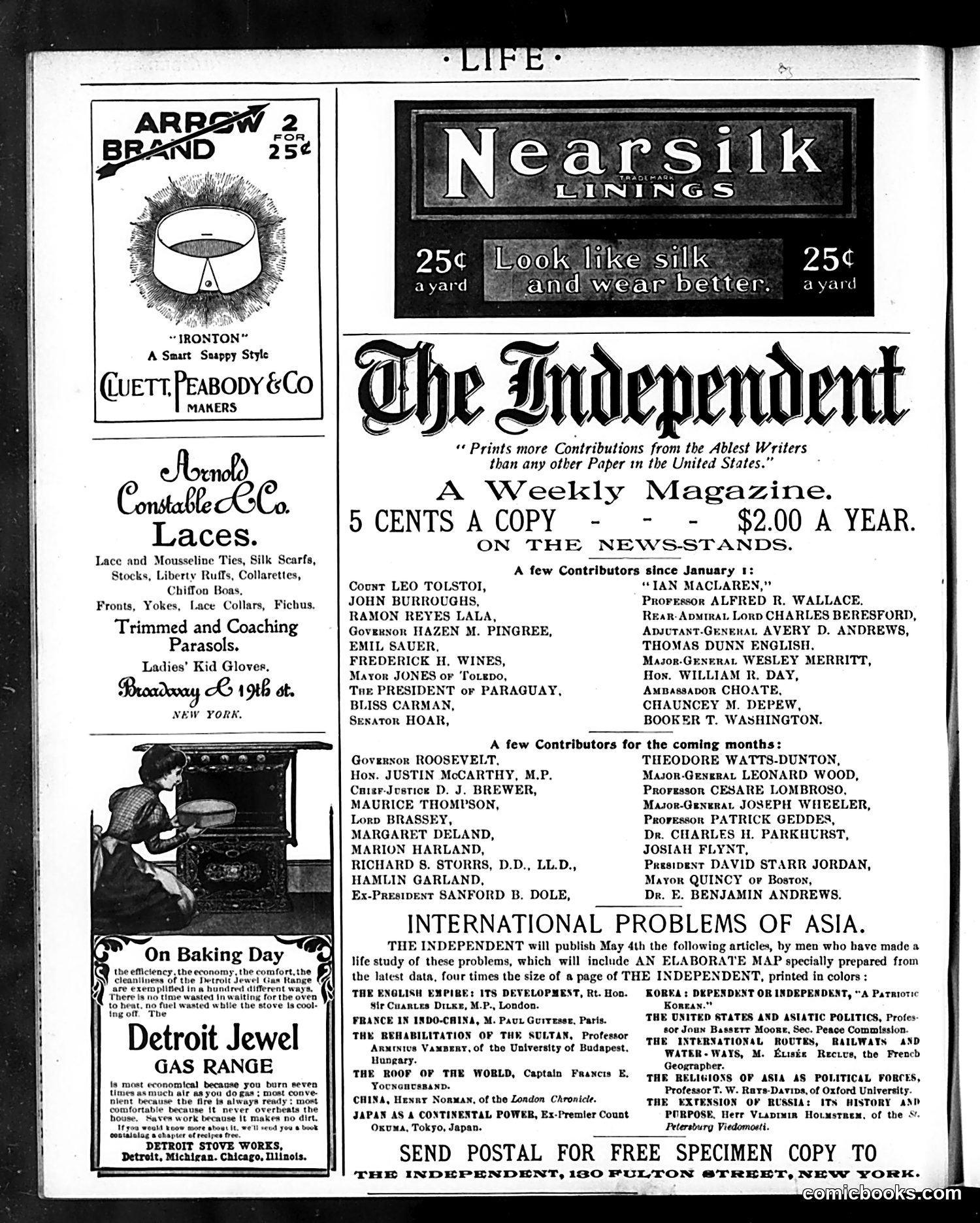
This page is primarily **advertising and magazine promotion**, not political satire. The dominant content includes: - **Product ads**: Arrow collars, Nearsilk fabric linings, Arnold Constable laces, and a Detroit Jewel gas range - **Magazine promotion**: *The Independent* weekly magazine advertises itself and lists notable contributors (Theodore Roosevelt, various generals and politicians) - **Feature announcement**: A planned series on "International Problems of Asia" by various experts The only illustration with potential satirical content is the small "On Baking Day" cartoon showing a woman with a gas range, but it appears to be straightforward domestic advertising rather than social commentary. The page reflects early 20th-century magazine economics: editorial content shares space with paid advertisements and self-promotion.
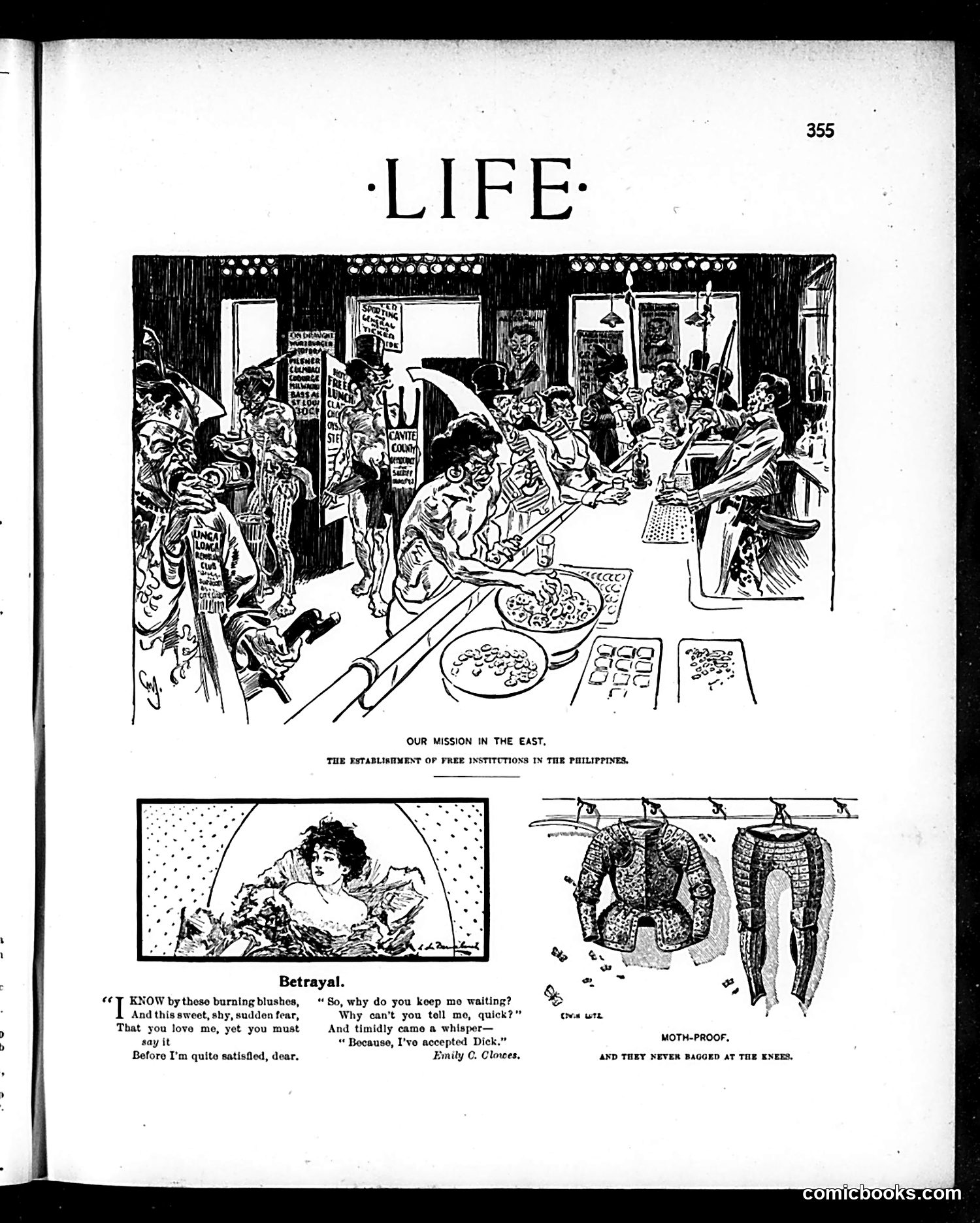
**Top Cartoon**: Satirizes American missionary and educational efforts in the Philippines. The chaotic scene depicts what appears to be a dining or social establishment with numerous figures in various states of dress and behavior. The caption "OUR MISSION IN THE EAST: THE ESTABLISHMENT OF FREE INSTITUTIONS IN THE PHILIPPINES" suggests ironic commentary—the disorder shown contradicts the stated civilizing mission. This likely critiques American colonial activities in the Philippines following the 1898 Spanish-American War. **Bottom Section**: "Betrayal" features a domestic scene with quoted dialogue about broken promises in love, attributed to "Emily C. Chivers." The accompanying fashion illustration labeled "MOTH-PROOF" and "AND THEY NEVER BAGGED AT THE KNEES" appears unrelated, mixing literary romance with practical clothing humor—typical of Life's miscellaneous satirical content.
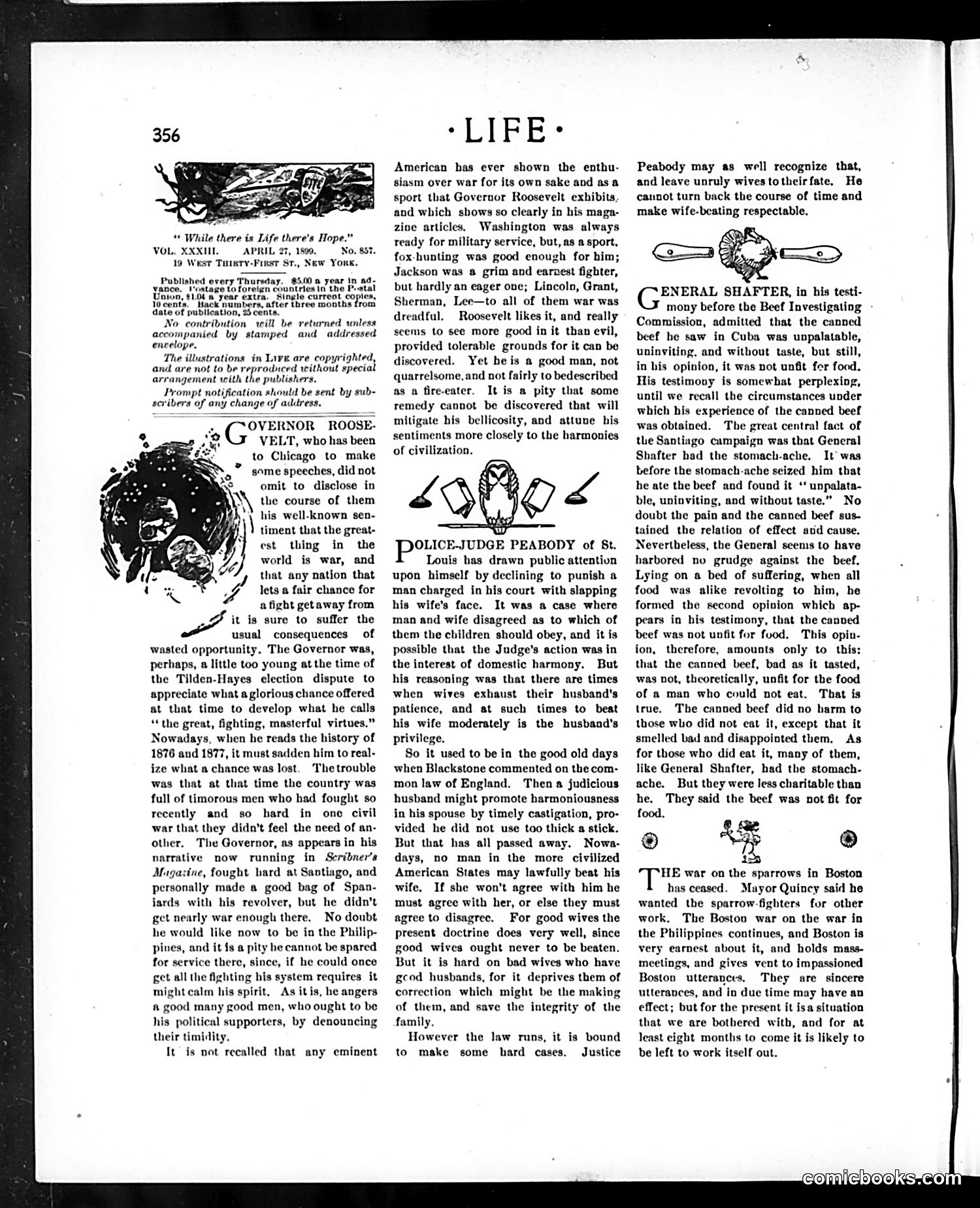
The page features commentary on Governor Roosevelt's enthusiasm for war and hunting. The left illustration depicts Roosevelt as a robust, vigorous figure—celebrating his well-known passion for combat sports and field pursuits. The text critiques Roosevelt's bellicosity, suggesting his love of war reflects poor judgment. It contrasts his martial enthusiasm with civilized restraint, implying that promoting warfare as virtuous is dangerous. The right section discusses Police-Judge Peabody of St. Louis declining to punish spousal violence, and includes commentary on sparrow-fighting in Boston. These items illustrate broader social issues: domestic violence and animal cruelty that satirize contemporary moral standards. The overall theme critiques Roosevelt's aggressive worldview while examining American civilization's inconsistencies.
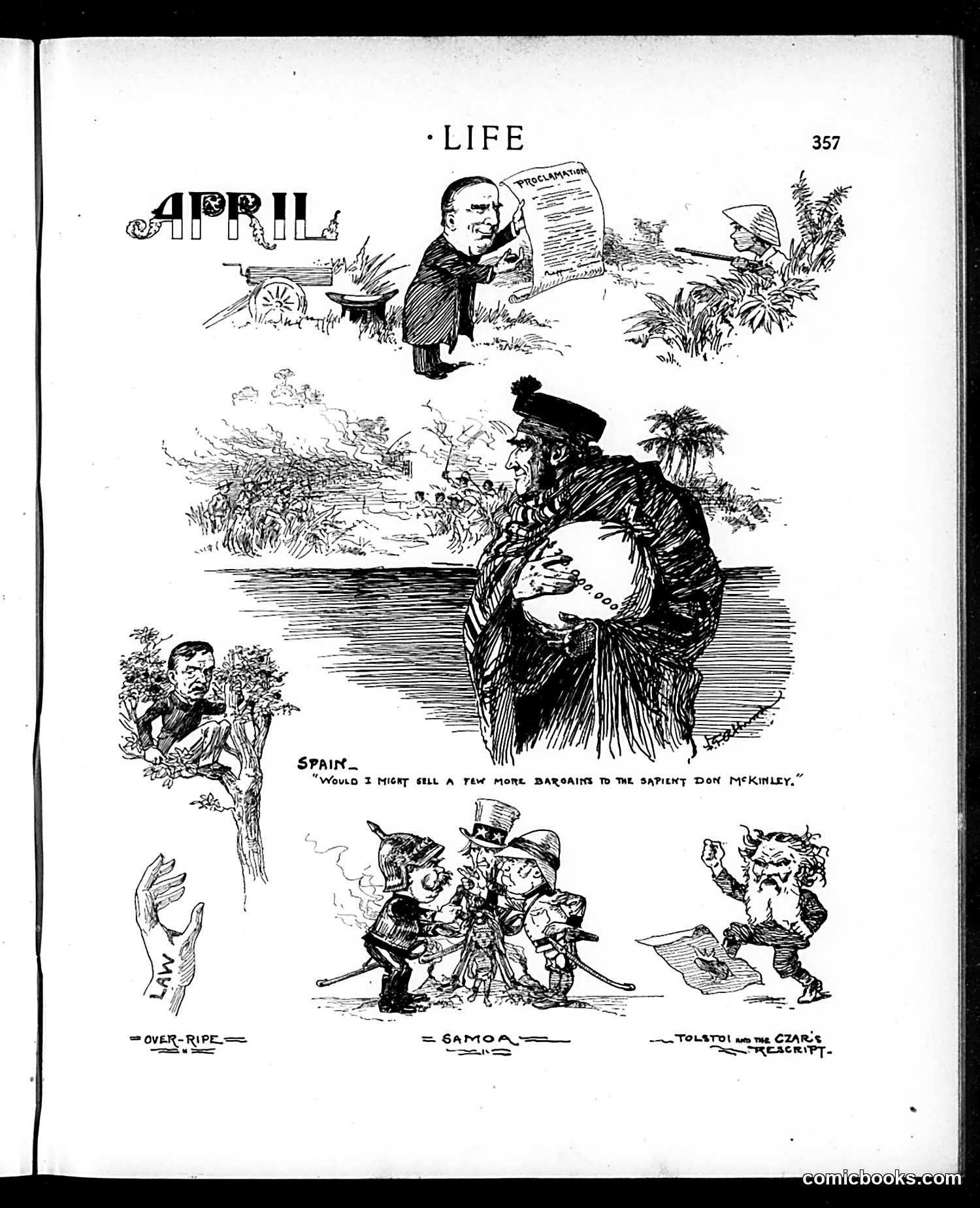
This page contains four political cartoons from an early 20th-century Life magazine: **Top cartoon**: A figure holds a "Proclamation," likely referencing presidential authority or policy announcement. **Spain cartoon**: References Spain negotiating with "the Patient Don McKinley" (President William McKinley), suggesting diplomatic bargaining, possibly regarding Spanish colonial territories or the aftermath of the Spanish-American War. **Lower cartoons**: "Over-Ripe," "Samoa," and "Tolstoi and the Czar's Edict" appear to comment on international politics—colonial disputes, Russian governance, and potentially conflicts in Samoa and imperial Russia. The satirical tone suggests criticism of American expansionism and international power dynamics of the McKinley era. Without clearer dates or labels, precise historical events remain uncertain, though the references suggest circa 1898-1901.
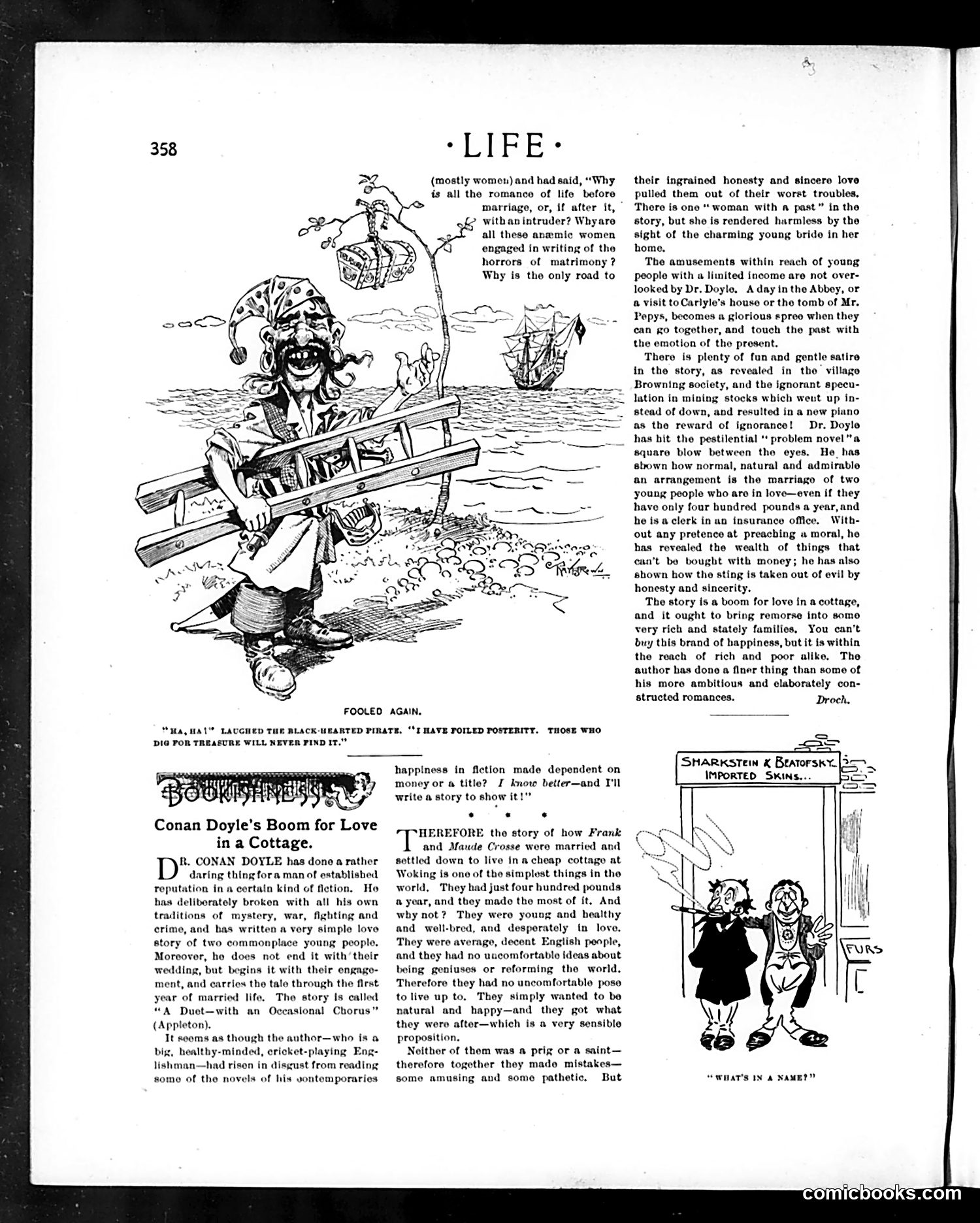
The main illustration titled "Fooled Again" depicts a grotesque pirate figure emerging from water, with the caption: "Ha, ha!" laughed the black-hearted pirate. "I have foiled posterity. Those who dig up treasure will never find it!" This appears to be satirizing marital unhappiness and financial deception. The accompanying article by Conan Doyle discusses a couple, Frank and Maude Crosse, who married on a modest budget but made mistakes despite their genuine love. The pirate imagery suggests husbands or wealth-holders who hide assets or deceive their spouses about finances. A smaller cartoon shows a woman asking "What's in a name?" — likely satirizing superficiality in relationships or society's focus on titles and appearances over substance. The satire targets both marital discord and financial dishonesty in domestic life.
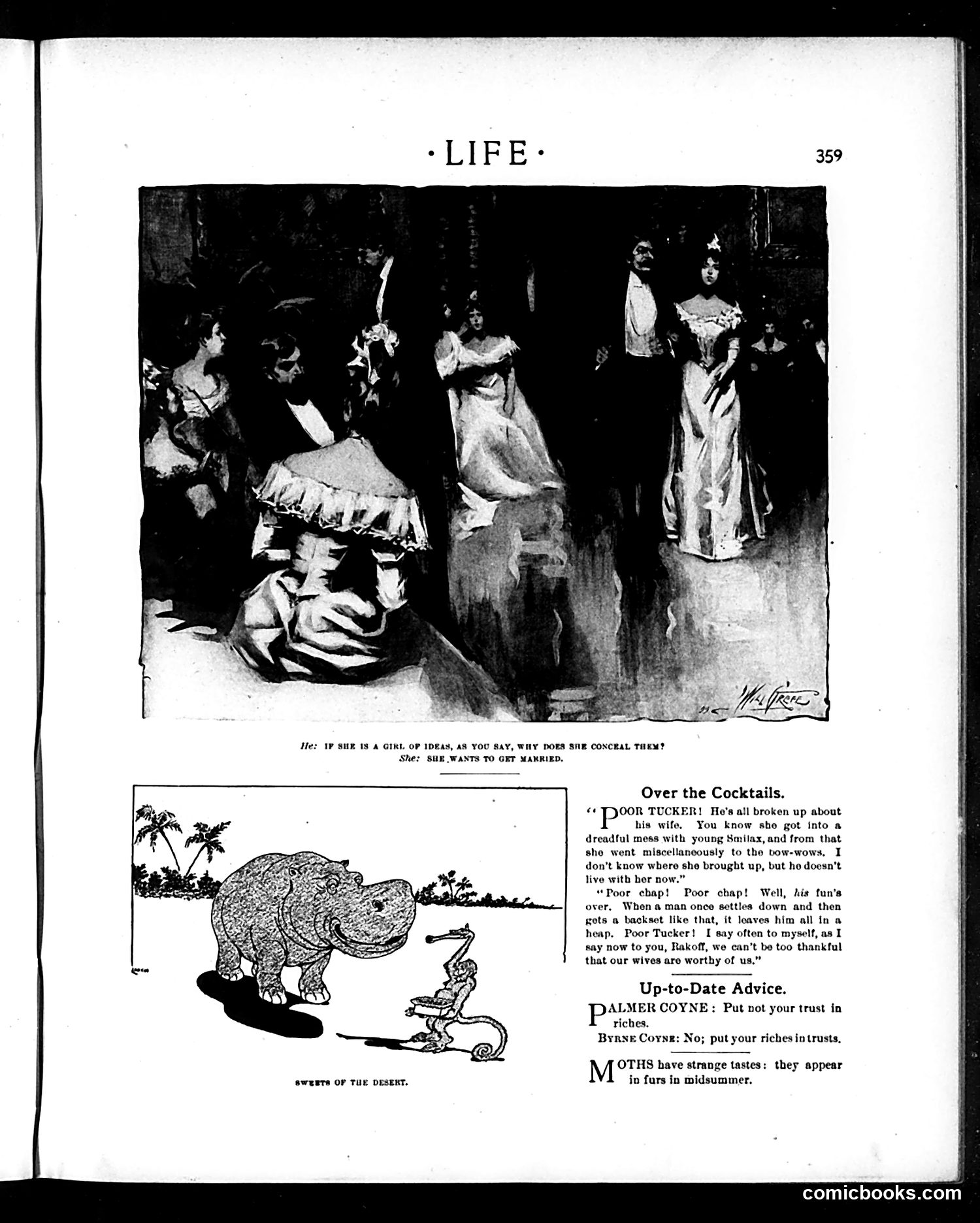
**Top Illustration:** A social scene depicting a woman concealing something (suggested by the caption "If she is a girl of ideas, as you say, why does she conceal them? She wants to get married"). This satirizes the social expectation that intelligent women must hide their intellect to secure marriage—a critique of early 20th-century gender dynamics. **"Sweets of the Desert" Cartoon:** A hippopotamus and crocodile appear to reference colonial or "exotic" imagery, likely satirizing romanticized or stereotypical portrayals of African wildlife and distant lands. **"Over the Cocktails" and "Up-to-Date Advice" Sections:** These contain brief satirical exchanges about social behavior, marriage, and wealth—typical of Life magazine's conversational humor format mocking contemporary upper-class attitudes and contradictions.
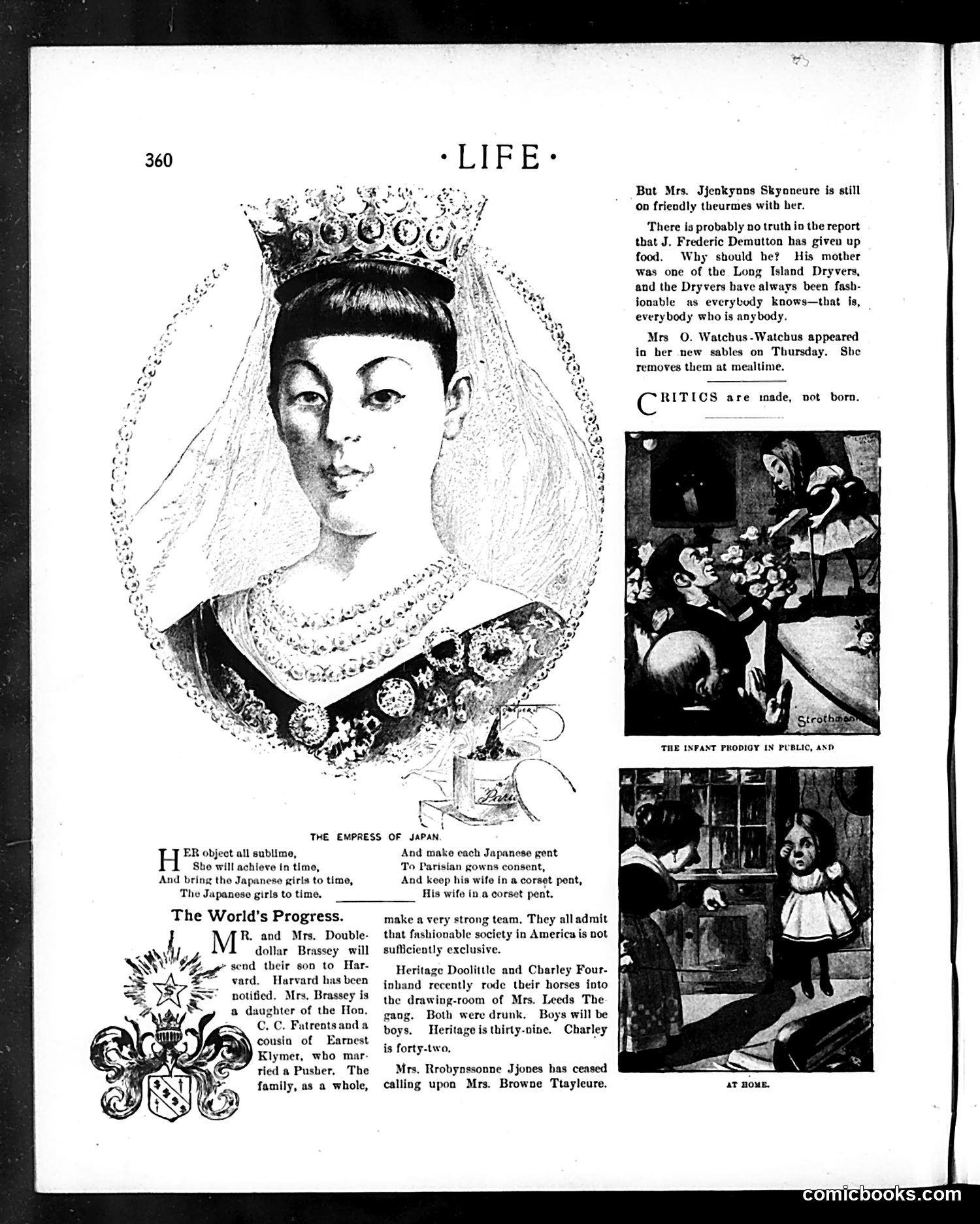
This page features a formal portrait of **the Empress of Japan** wearing an ornate crown, veil, and decorated robe—presenting her as refined and culturally elevated. The accompanying verse romanticizes Japanese women as aesthetically superior, suggesting they will "achieve in time" and "bring the Japanese girls to lime" (likely "limelight"). **"The World's Progress"** section contains gossipy social commentary about American high society—mentions of the Brassey family, Harvard connections, and scandalous behavior (drunk riding into drawing rooms, infidelity). The satire contrasts idealized Japanese femininity and imperial dignity against the crude, dissolute behavior of American aristocrats, mocking American society's pretensions to superiority while simultaneously exoticizing Japan.
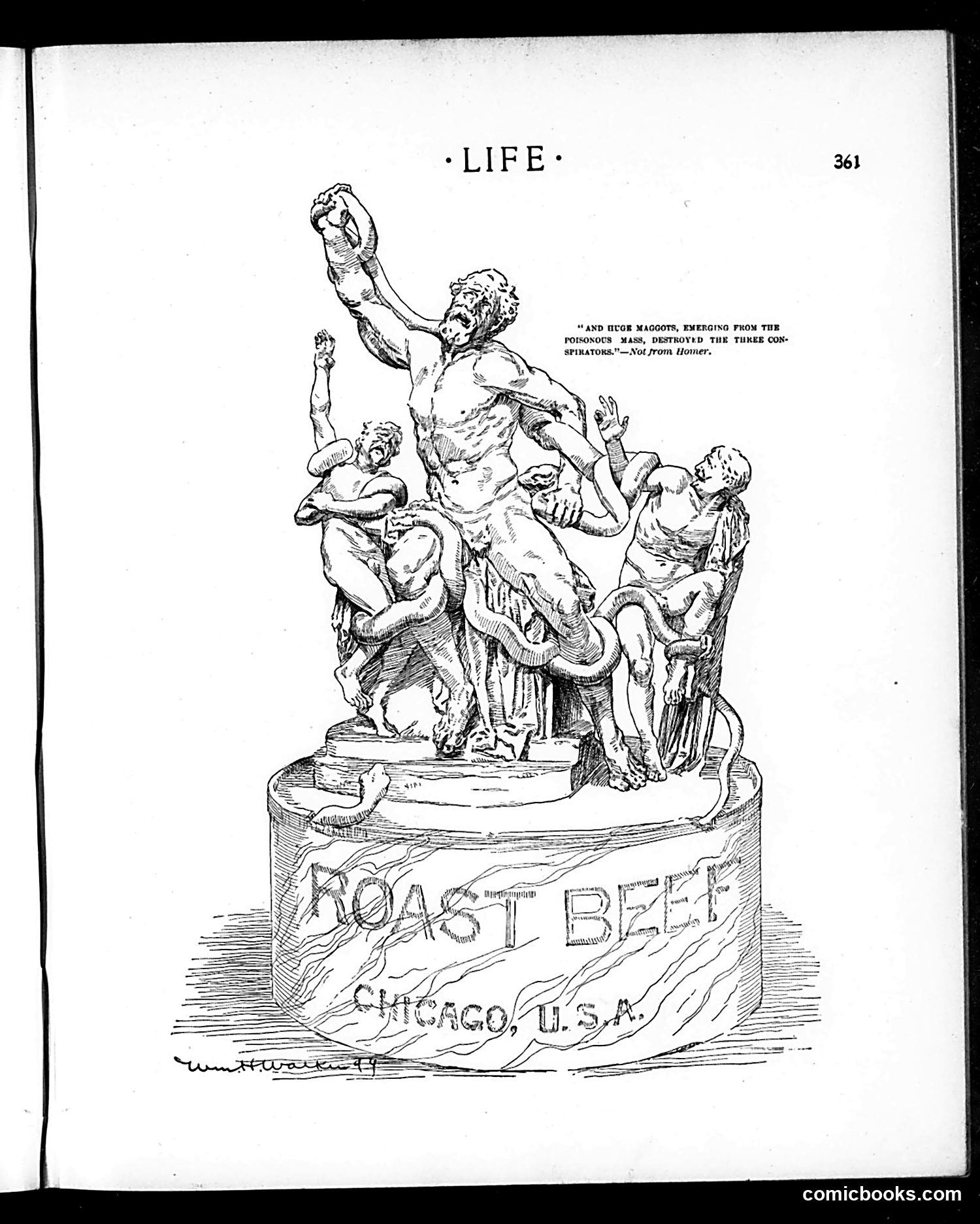
This page features a classical allegorical sculpture showing a robed female figure (likely representing Justice or Civilization) holding up a serpent or snake, surrounded by cherubs. The sculpture sits atop a pedestal inscribed "ROAST BEEF" and "CHICAGO, U.S.A." The accompanying quotation references Homer: "And Hugo Maggot, emerging from the poisonous mass, destroyed the three conspirators." The satire appears to mock Chicago's meat-packing industry—specifically its food safety scandals—by juxtaposing high classical ideals with the gritty reality of industrial meat production. The "roast beef" base and reference to maggots suggest corruption or contamination in Chicago's famous meat trade, likely alluding to Upton Sinclair's 1906 exposé *The Jungle* or related food safety controversies.
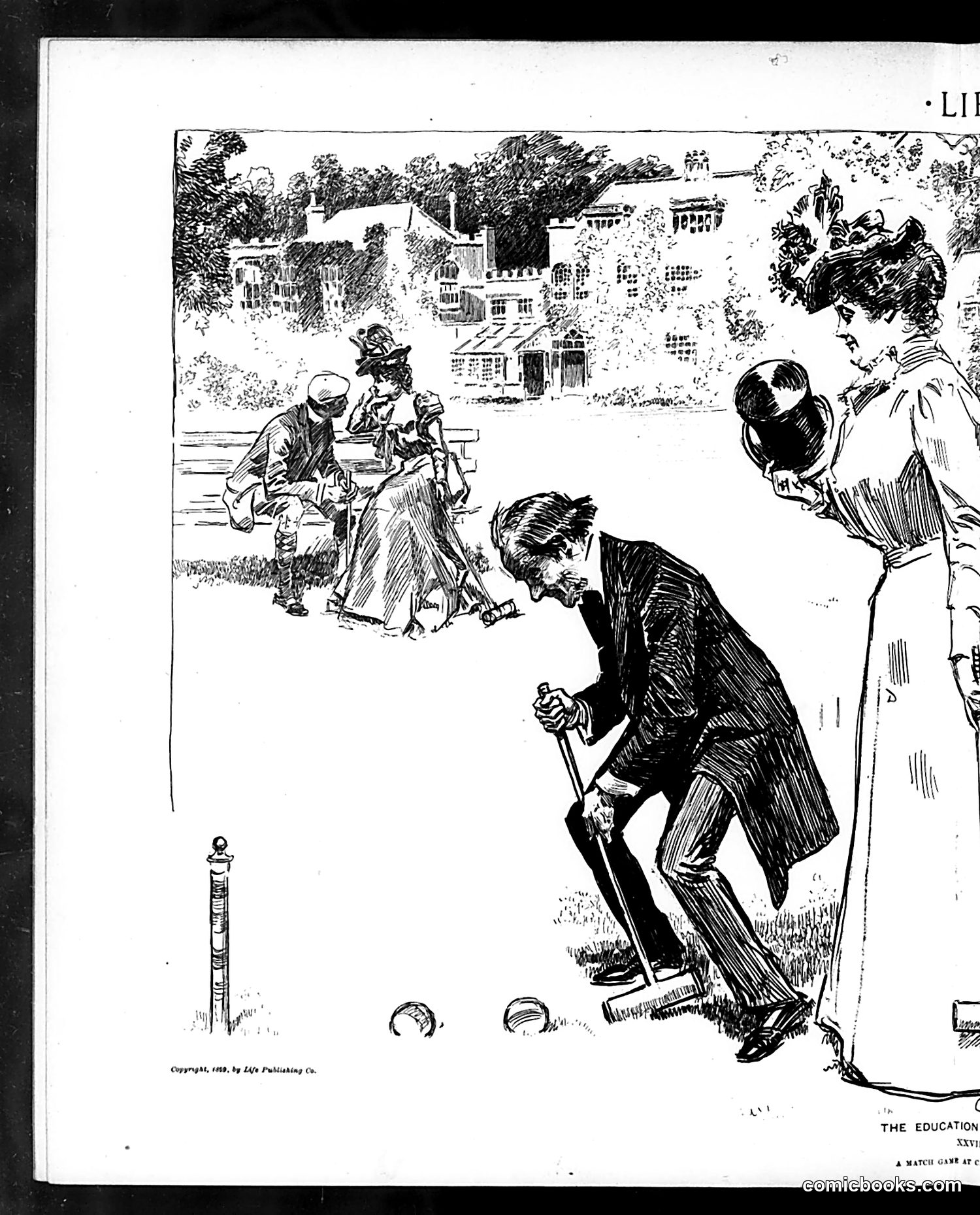
This is a satirical illustration about class and education. The central figure is a well-dressed gentleman in a dark suit, bent over with a shovel, digging or laboring. Two well-dressed women observe him from the right, one holding what appears to be a ball or sphere. In the background, other figures in casual dress interact near an estate or mansion. The satire appears to mock the idea of manual labor as "education" or character-building for the wealthy. The gentleman's formal attire contrasted with his menial work suggests irony about the notion that wealthy individuals should engage in physical labor for self-improvement or moral instruction—a common progressive-era educational philosophy. The observing women's detached stance emphasizes the performative or artificial nature of this "education." The copyright date indicates this is from Life magazine's satirical tradition.
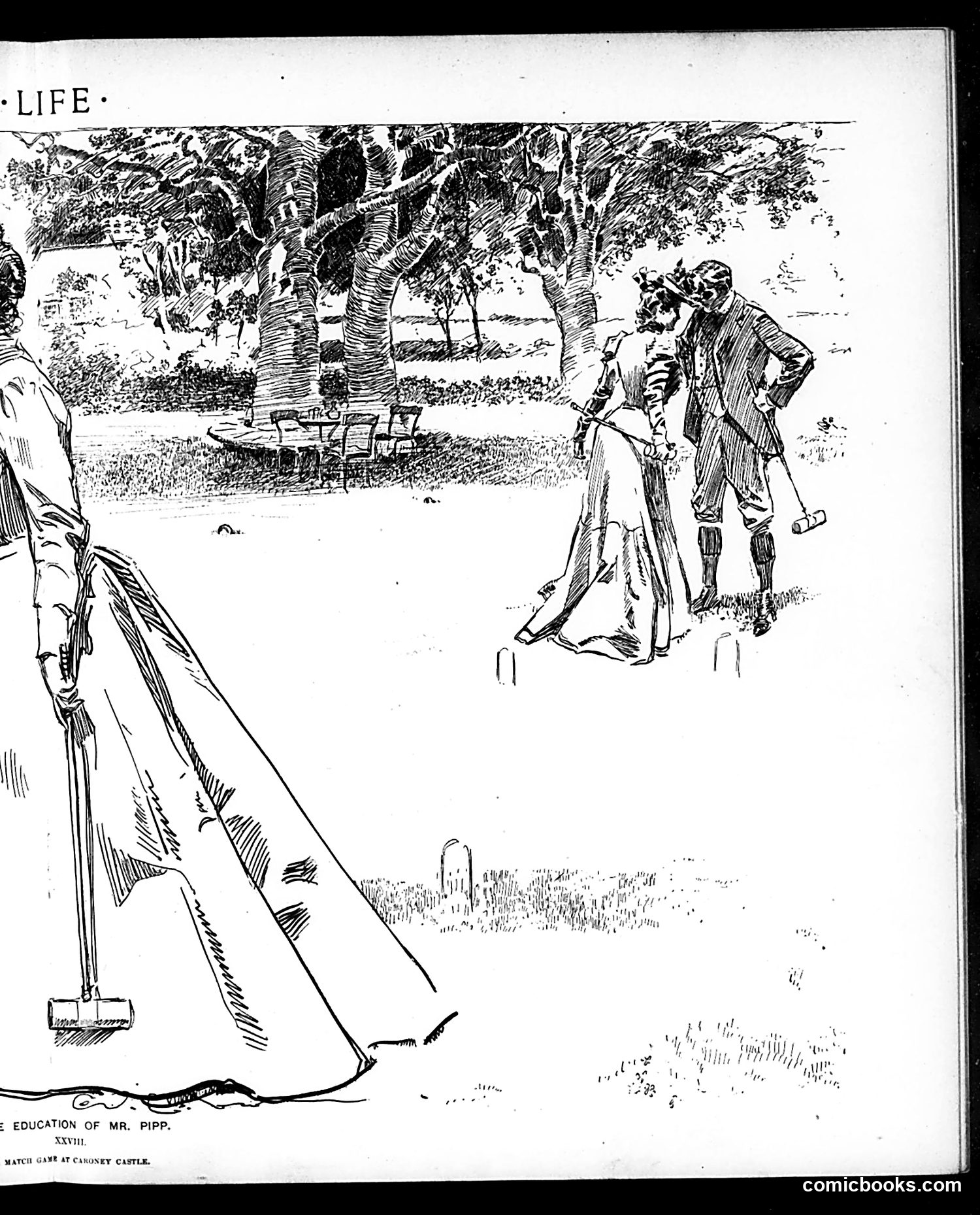
This satirical cartoon depicts a croquet game at Cassiquet Castle. The sketch shows a well-dressed man in formal attire being instructed or corrected by a woman in a long dress during play. The title "The Education of Mr. Pipp" suggests the humor concerns a man learning proper behavior—likely etiquette or social decorum—from a woman, perhaps his wife or a society figure. The croquet setting is significant: in Victorian/Edwardian-era satire, croquet was a fashionable pastime associated with upper-class social rituals. The joke appears to mock either Pipp's ignorance of proper conduct or the notion of a woman "educating" or dominating a man in social situations—commentary on gender roles and class pretension of the period.
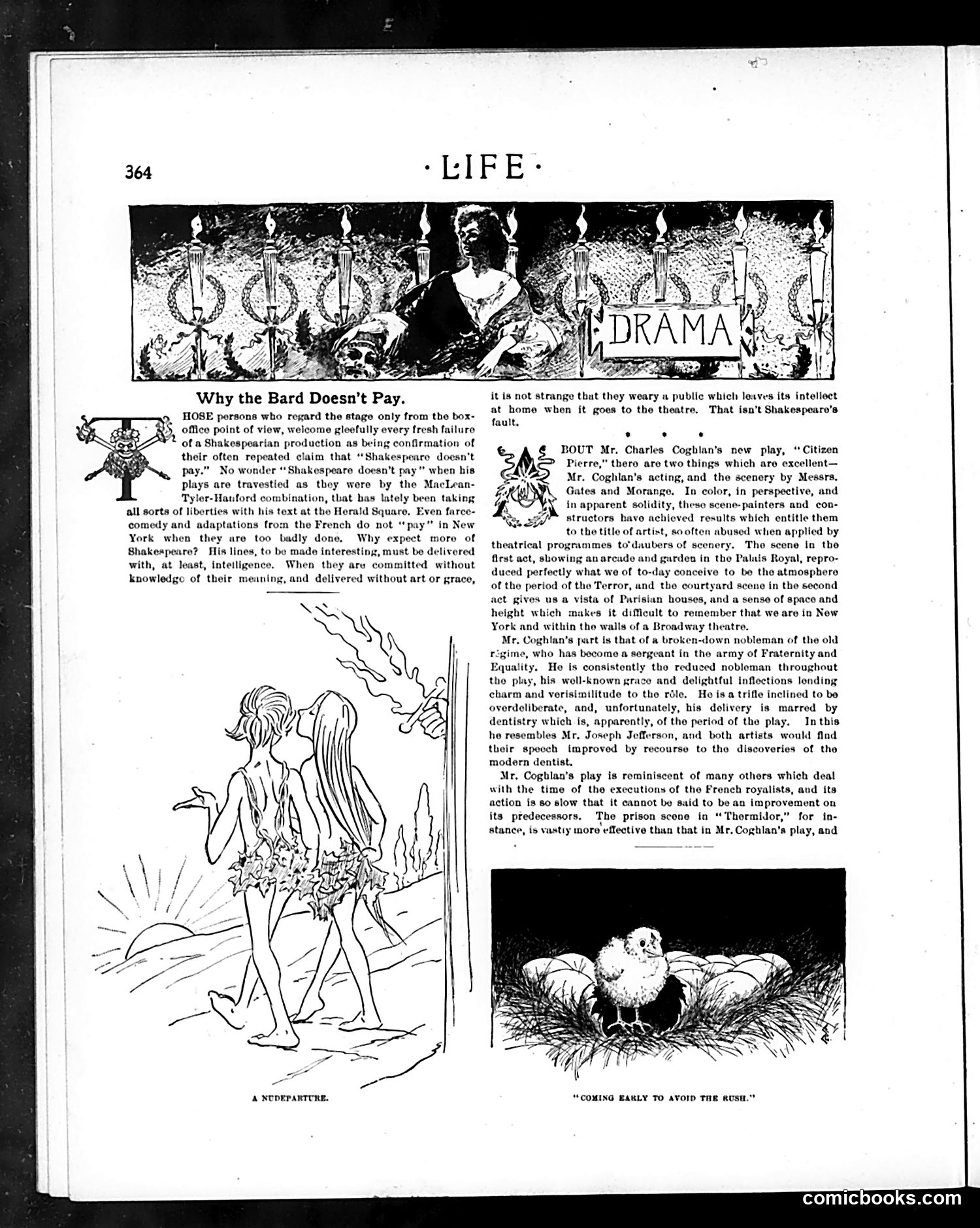
**"Why the Bard Doesn't Pay"** critiques the Herald Square Theatre's repeated claim that Shakespeare productions don't generate profit. The article sardonically suggests theaters blame Shakespeare's plays themselves rather than poor management, arguing that when intelligently performed with proper artistry, Shakespeare should succeed commercially in New York. **The Drama section** reviews Charles Coghlan's new play "Citizen Pierre," praising the acting and scenery by Gates and Moreunge. The critic notes the production effectively recreates Parisian atmosphere and period detail, though Coghlan's delivery is hindered by dentistry work resembling actor Joseph Jefferson's impediment. **Two illustrations** accompany the text: "A Nudepart" (classical mythological scene) and "Coming Early to Avoid the Rush" (a chicken in a nest).
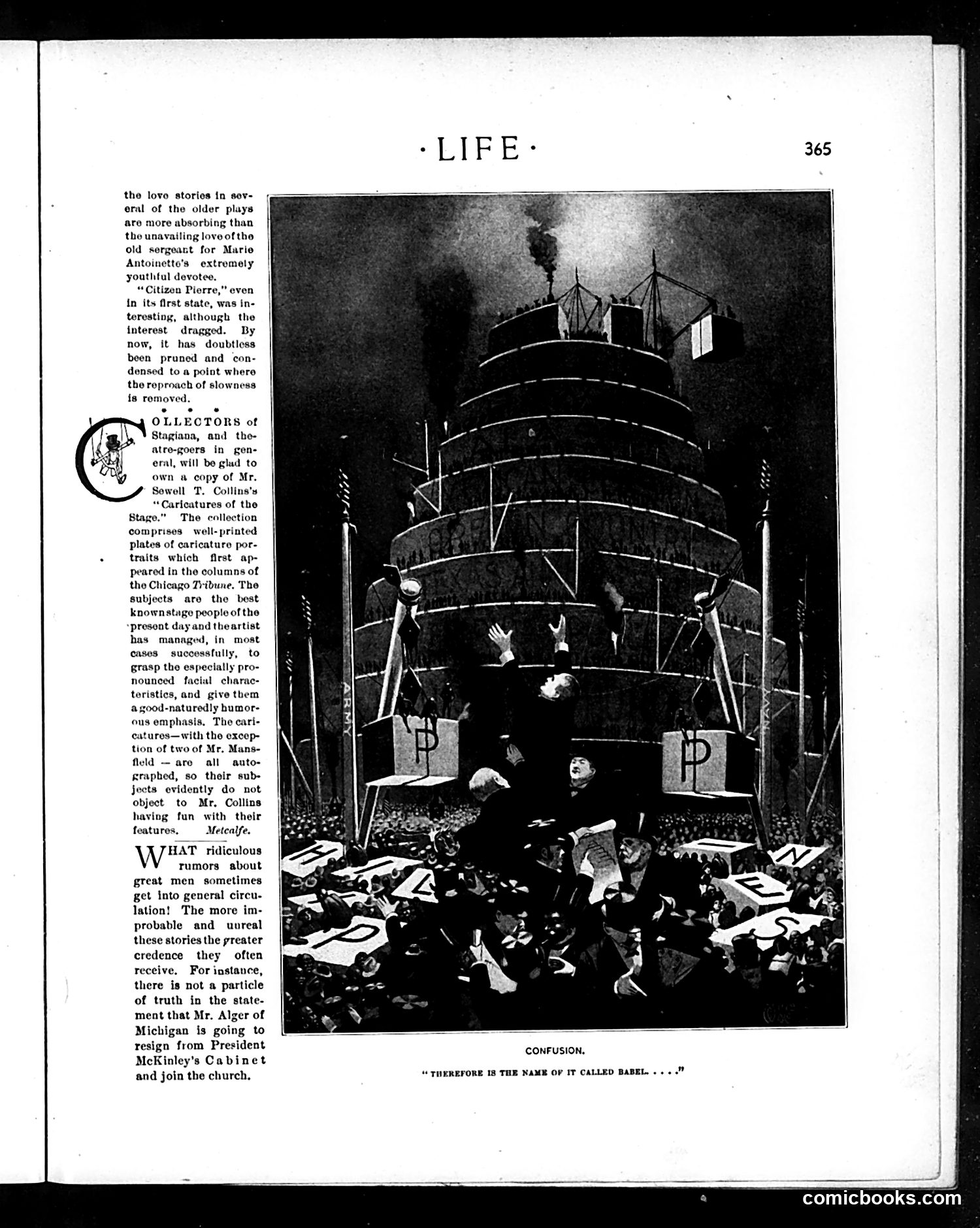
The main illustration, titled "Confusion," depicts the Biblical Tower of Babel—a chaotic scene of people in disarray within a massive, spiraling tower structure. The caption quotes Genesis: "Therefore is the name of it called Babel," referencing the Biblical story where God confused human languages, causing communication breakdown. The satirical intent appears to be commentary on contemporary confusion or chaos, though without a date visible, the specific political target is unclear. It could reference government disorder, social upheaval, or general organizational confusion of the period. The text column discusses theater and stage caricatures, plus dismisses rumors about politician Alger of Michigan supposedly resigning from President McKinley's Cabinet to join the church—framed as an absurd rumor with "not a particle of truth." The Babel image likely serves as visual metaphor for the "confusion" of misinformation and unclear communication that creates such false rumors.
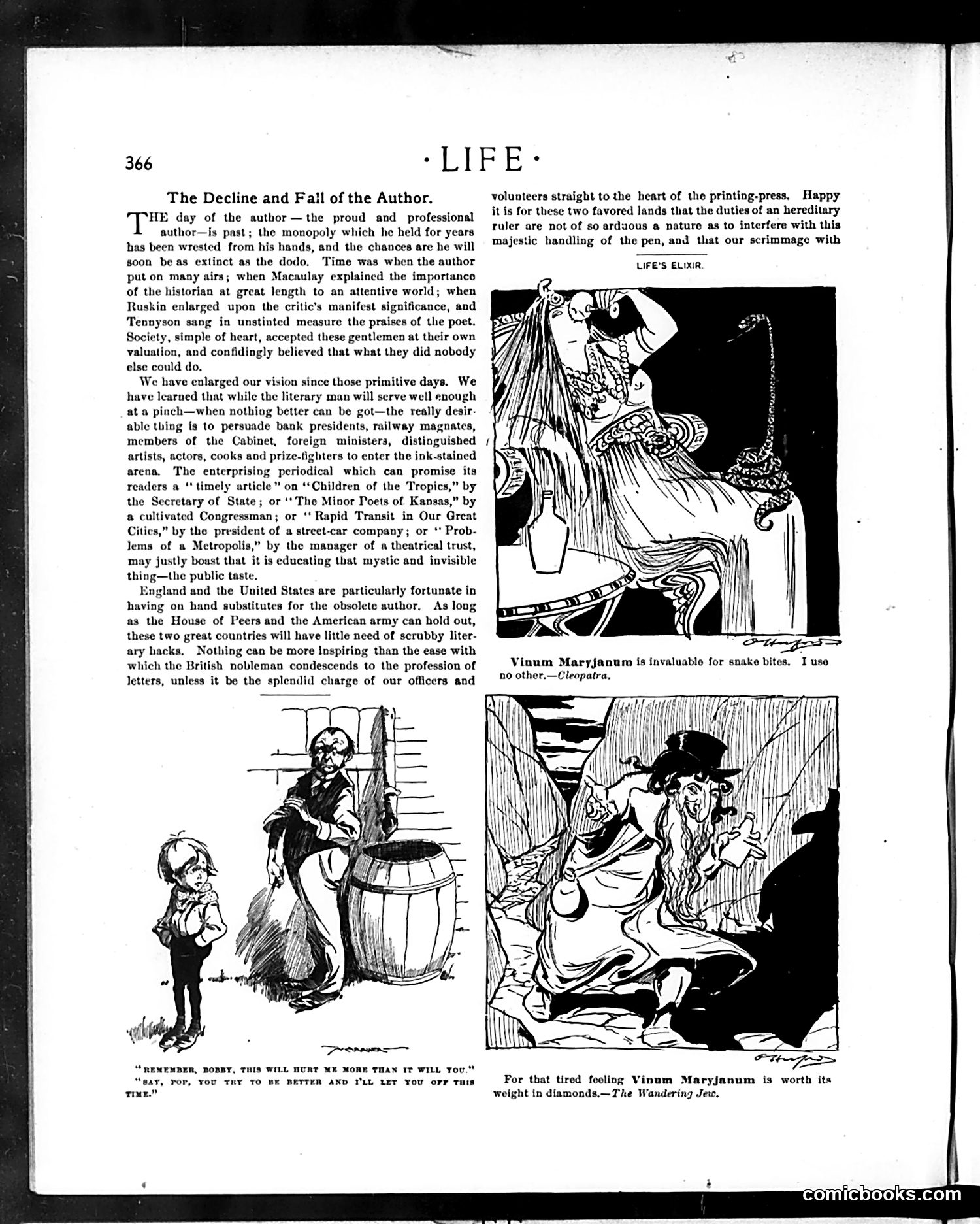
This satirical article mocks the declining prestige of professional writers. Life argues that authors—once considered authorities commanding social respect (citing figures like Macaulay, Ruskin, and Tennyson)—have been displaced by celebrities from other fields. The piece ridicules magazines that now feature articles by politicians, businessmen, actors, and military officers instead of career writers. It sarcastically praises this trend as "educating" public taste, suggesting these prominent figures' amateur writing is somehow superior to professional authorship. The final barb targets British aristocrats and American military officers who casually enter publishing despite their primary duties, implying their social standing grants them unearned credibility as writers. The cartoons illustrate this theme through humorous scenes, while the advertisements for "Vinum MaryJanum" (a patent medicine) parody the magazine's own descent into dubious promotional content—reinforcing the satire about declining standards.
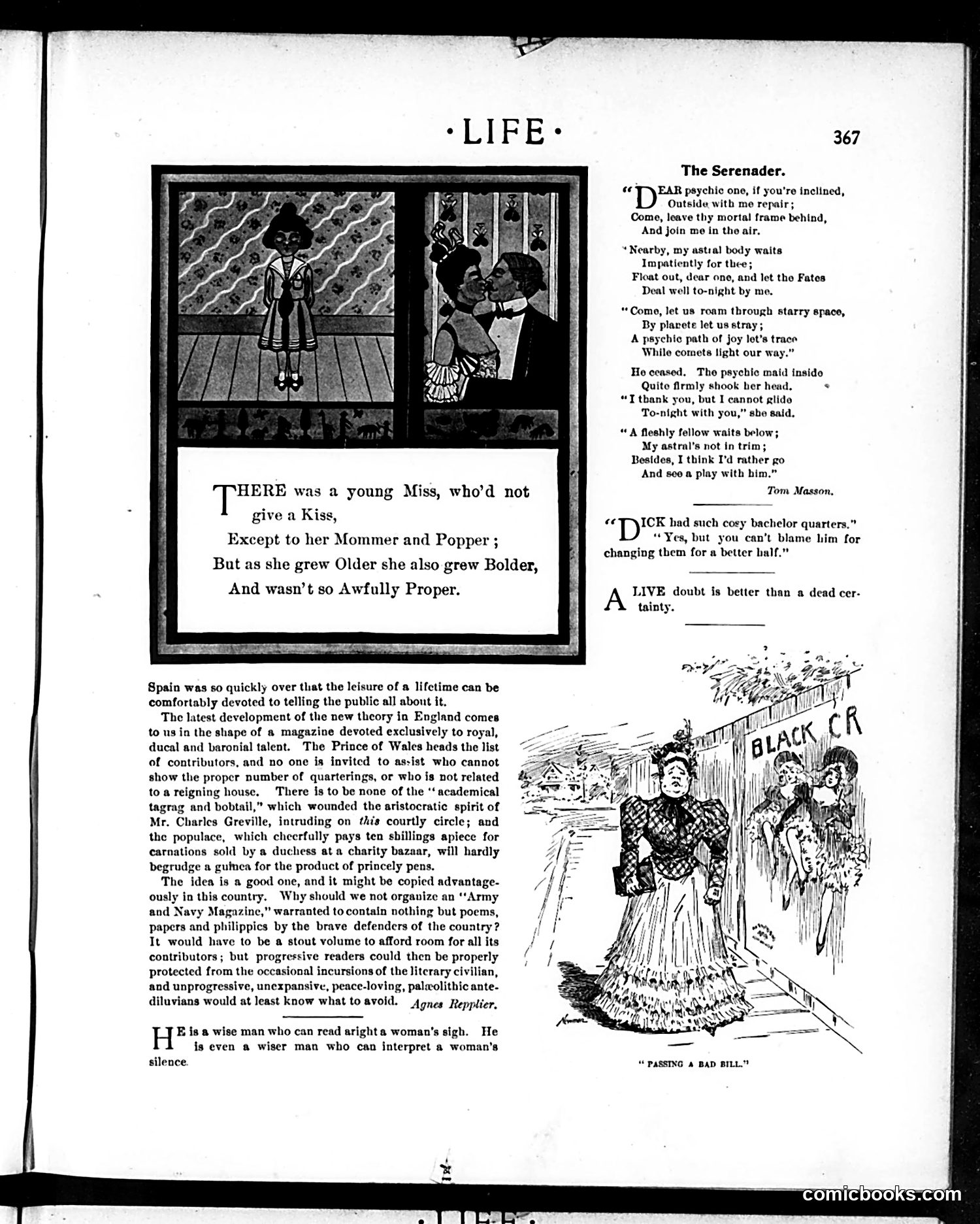
This page contains three satirical pieces typical of early Life magazine's humor: **"The Serenader"** (poem with illustration): Mocks the Spiritualist/Theosophist craze popular in late 19th-century America. A man invites a woman to join him in astral projection and psychic travel through space. She refuses, preferring to stay in her physical body for a date with "a fleshly fellow"—a practical rejection of mystical pretension. The joke: romantic spiritualism loses to ordinary earthly romance. **"There was a young Miss"** (verse): A cheeky limerick about a girl who becomes progressively bolder and less proper as she ages—mild social commentary on female propriety. **"Passing a Bad Bill"** (illustration): Shows a woman at what appears to be a legislative building, likely satirizing women's suffrage debates or female political involvement—a contentious contemporary issue. The page also includes editorial commentary on Spain (post-Spanish-American War) and a British magazine devoted exclusively to royal/aristocratic contributors, both contemporary references.
This page is primarily **advertisements and humorous anecdotal pieces**, not political cartoons. The main text features **Mr. Dooley**, a fictional Irish-American character created by satirist Finley Peter Dunne, commenting on wealthy industrialists. Dooley sarcastically describes "Shekel Island" (a biblical reference to money) where millionaires like Mark Hanna and President McKenzie ("Mack") relax while extracting wealth from the country. The satire targets **turn-of-the-century robber barons and their relationship to political power**—suggesting the wealthy essentially buy influence and retirement from public responsibility. The page also contains three humorous anecdotes: one about an heiress's embarrassing signed check, another about Red Cross pajamas, and one about a confused military captain. These mock social pretensions and miscommunication among the wealthy and military classes. The heavy advertising (whiskey, pens, soap) suggests this is a general-interest satirical magazine aimed at middle-class readers amused by mockery of both the wealthy elite and sentimental domesticity.
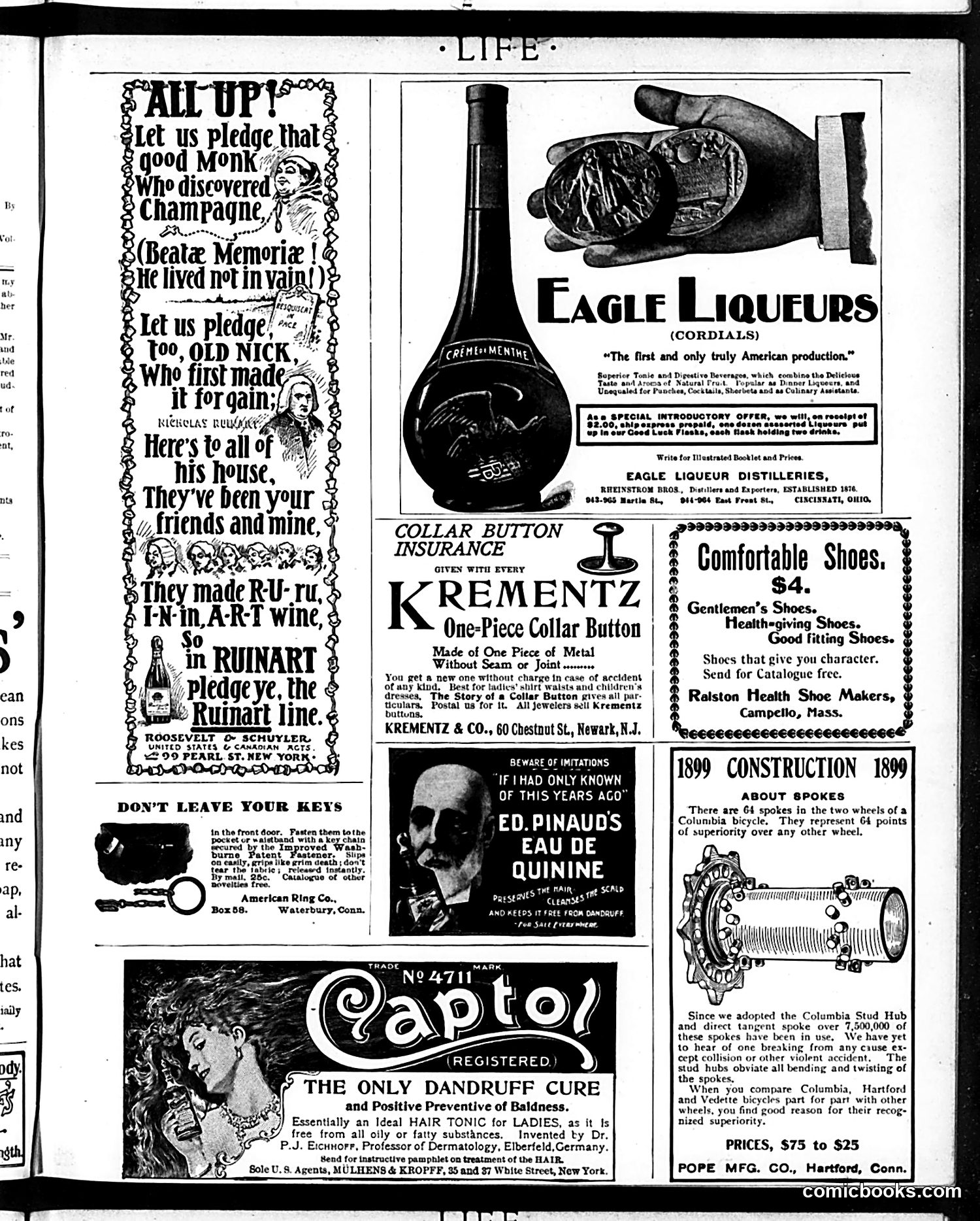
This page is primarily **advertisements** from an early Life magazine, not political cartoons. The content reflects turn-of-the-century consumer goods and services: Notable ads include: 1. **Eagle Liqueurs** — marketed as "the first and only truly American production" of cordials 2. **Krementz Collar Buttons** — one-piece metal collar buttons with insurance against loss/damage 3. **Comfortable Shoes ($4)** by Ralston Health Shoe Makers 4. **Capitol Dandruff Cure** — a hair tonic claiming to prevent baldness 5. **Ed. Pinaud's Eau de Quinine** — a grooming product 6. **Pope Manufacturing Bicycles** — emphasizing superior spoke construction (64 spokes) The left side contains a **Ruinart wine advertisement** styled as a poem pledging allegiance to the champagne, apparently mocking temperance sentiments of the era. This reflects **Gilded Age consumer culture** — products marketed with pseudoscientific claims and nationalist pride in American manufacturing.
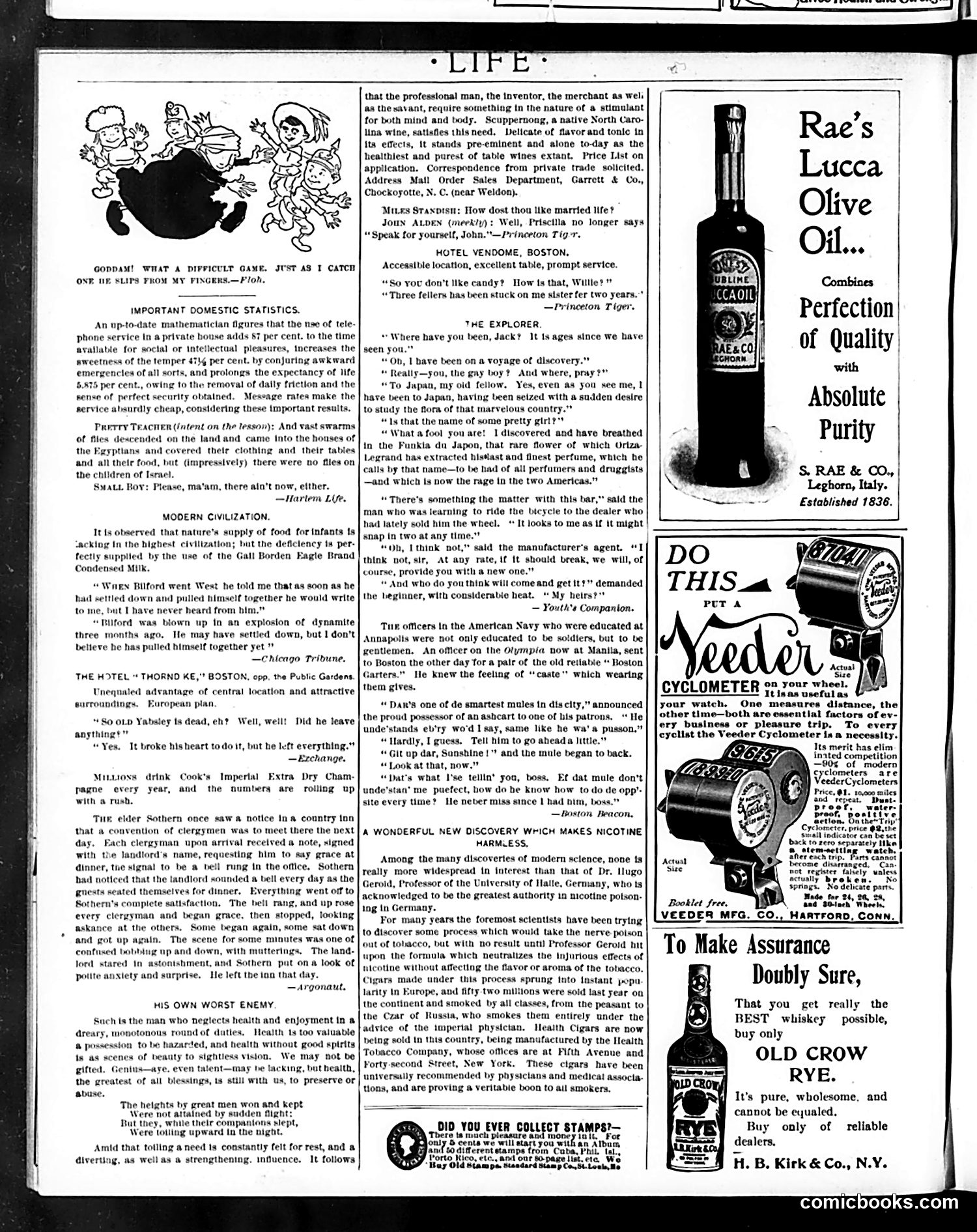
## The Main Cartoon The top cartoon shows a figure juggling items that keep slipping away, captioned "GODDAM! WHAT A DIFFICULT GAME. JUST AS I CATCH ONE, IT SLIPS FROM MY FINGERS." This appears to satirize the difficulty of managing modern life's competing demands—a common theme in early 20th-century commentary on urban, civilized society. ## The Content The page mixes humorous anecdotes with social commentary. Notable pieces include: - **"Important Domestic Statistics"**: A joke about how telephones supposedly add 87% to leisure time while reducing friction by removing "daily friction"—satirizing the exaggerated claims made about new technology's benefits. - **"Modern Civilization"**: A dark joke about how infant formula substitutes for nature, ending with a pun about a man "pulled himself together" after a dynamite explosion. The page also contains advertisements for olive oil, whiskey, and a cyclometer—typical of Life's format blending editorial humor with commercial content.
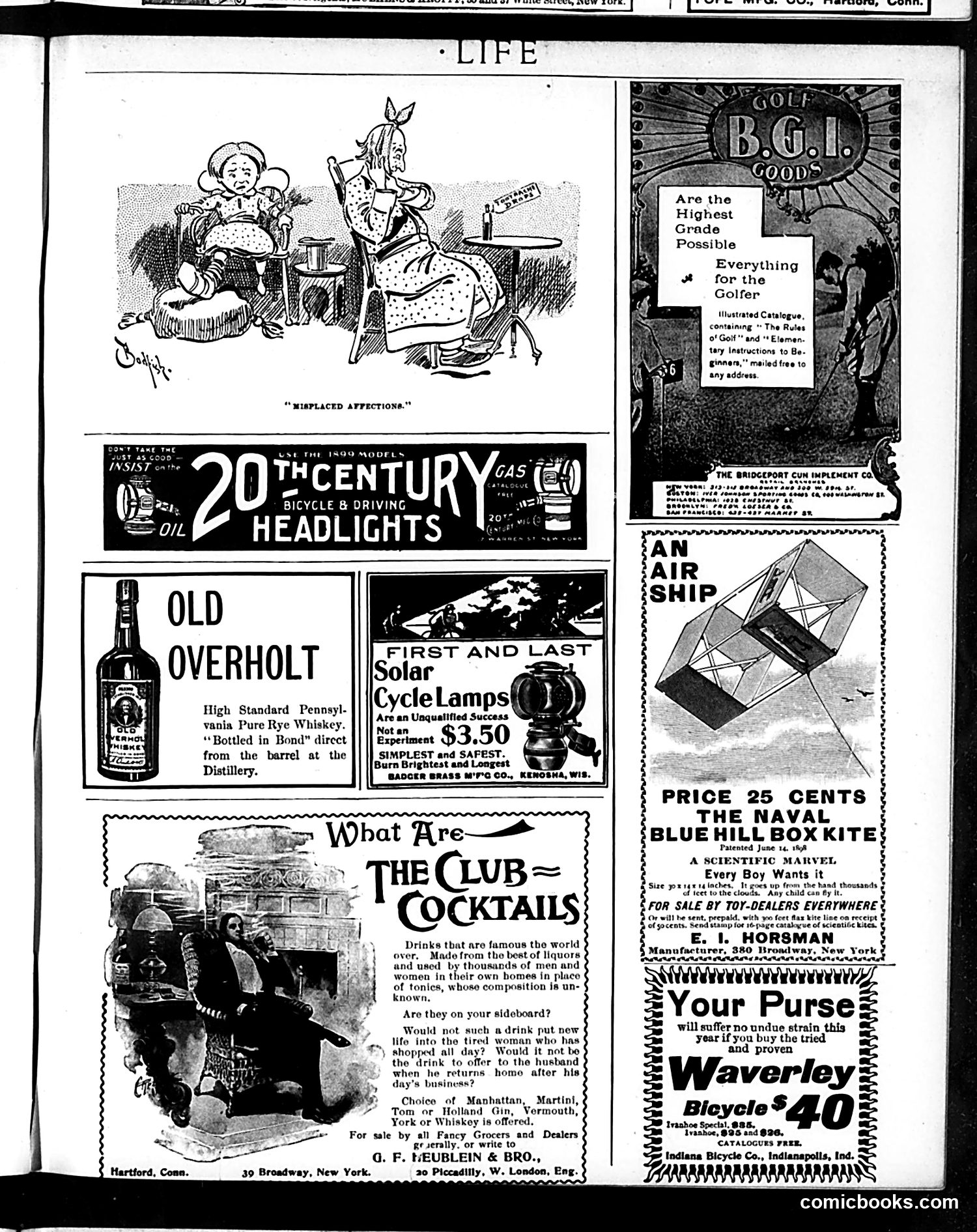
The cartoon titled "Misplaced Affections" depicts two women in Victorian dress sitting together. One appears portly and maternal; the other is thin and fashionably dressed. The joke likely satirizes misguided romantic or social priorities—the "misplaced affection" suggested by the title implies one woman is directing her attention or affection inappropriately, though the specific target remains unclear from the image alone. The page itself is primarily **advertising content** rather than editorial satire, featuring period products: whiskey, bicycle headlights, golf equipment, cocktails, kites, and bicycles. The cartoon serves as a brief humorous interlude among commercial notices—typical of *Life* magazine's format as a satirical weekly that mixed cartoons with advertising revenue.
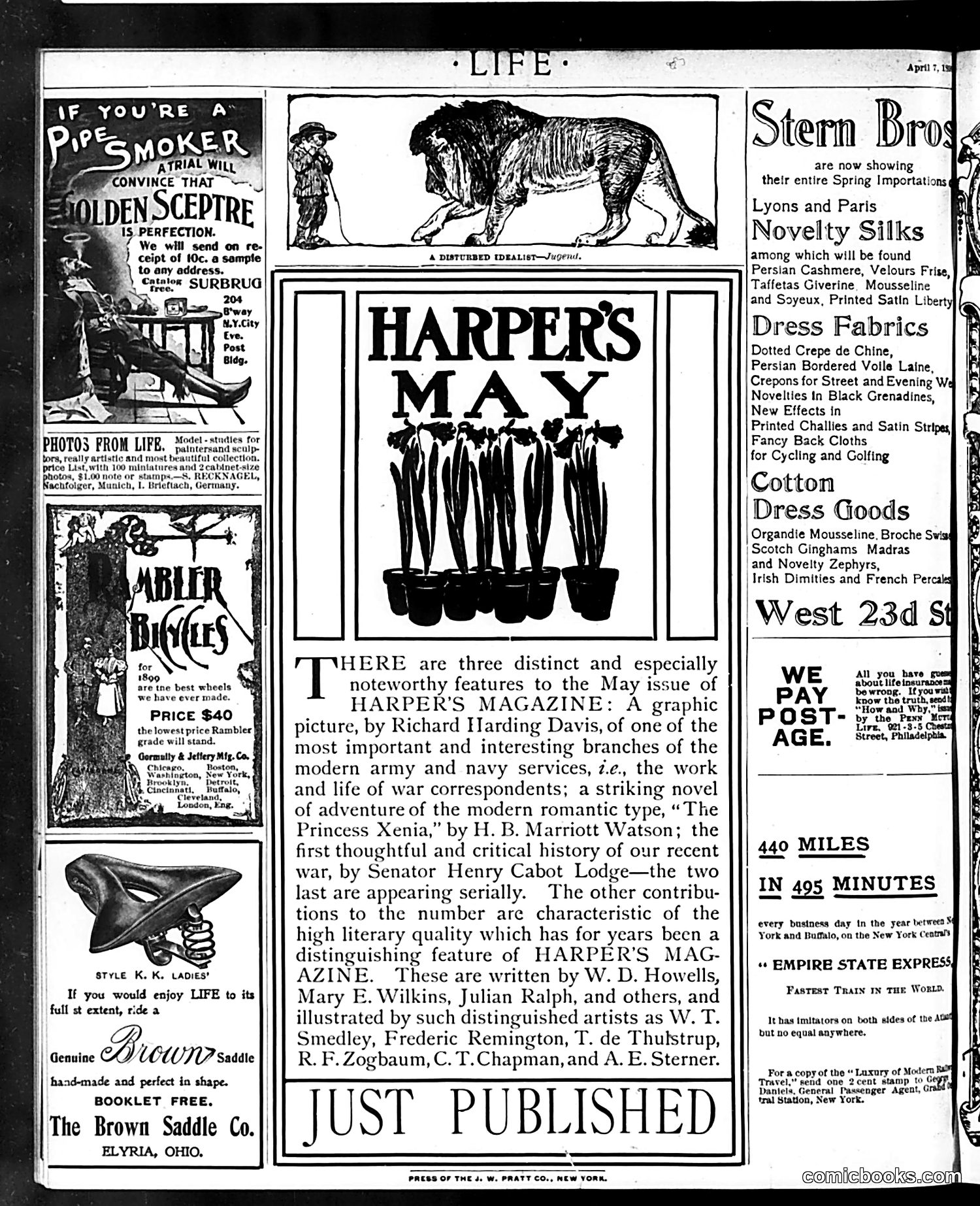
This is primarily an **advertising and promotional page**, not a political cartoon. The central content advertises Harper's May magazine issue, highlighting three major features: Richard Harding Davis's graphic picture of war correspondents (likely referencing the recent Spanish-American War of 1898); a serialized novel; and Senator Henry Cabot Lodge's "first thoughtful and critical history of our recent war." The cartoon at top shows a **"disturbed idealist"** observing a large animal—likely satirizing contemporary responses to American imperialism following the 1898 war. The page is otherwise dominated by commercial ads for bicycles (Rambler at $40, Brown Saddle Co.), pipe tobacco, dress fabrics from Stern Bros., and the Empire State Express train service. **Context for modern readers**: This reflects 1899 America's fascination with the recent war and its literary/journalistic documentation.