
Life, 1899-04-27 · page 14 of 20
Life — April 27, 1899 — page 14: what you’re looking at
What you’re looking at
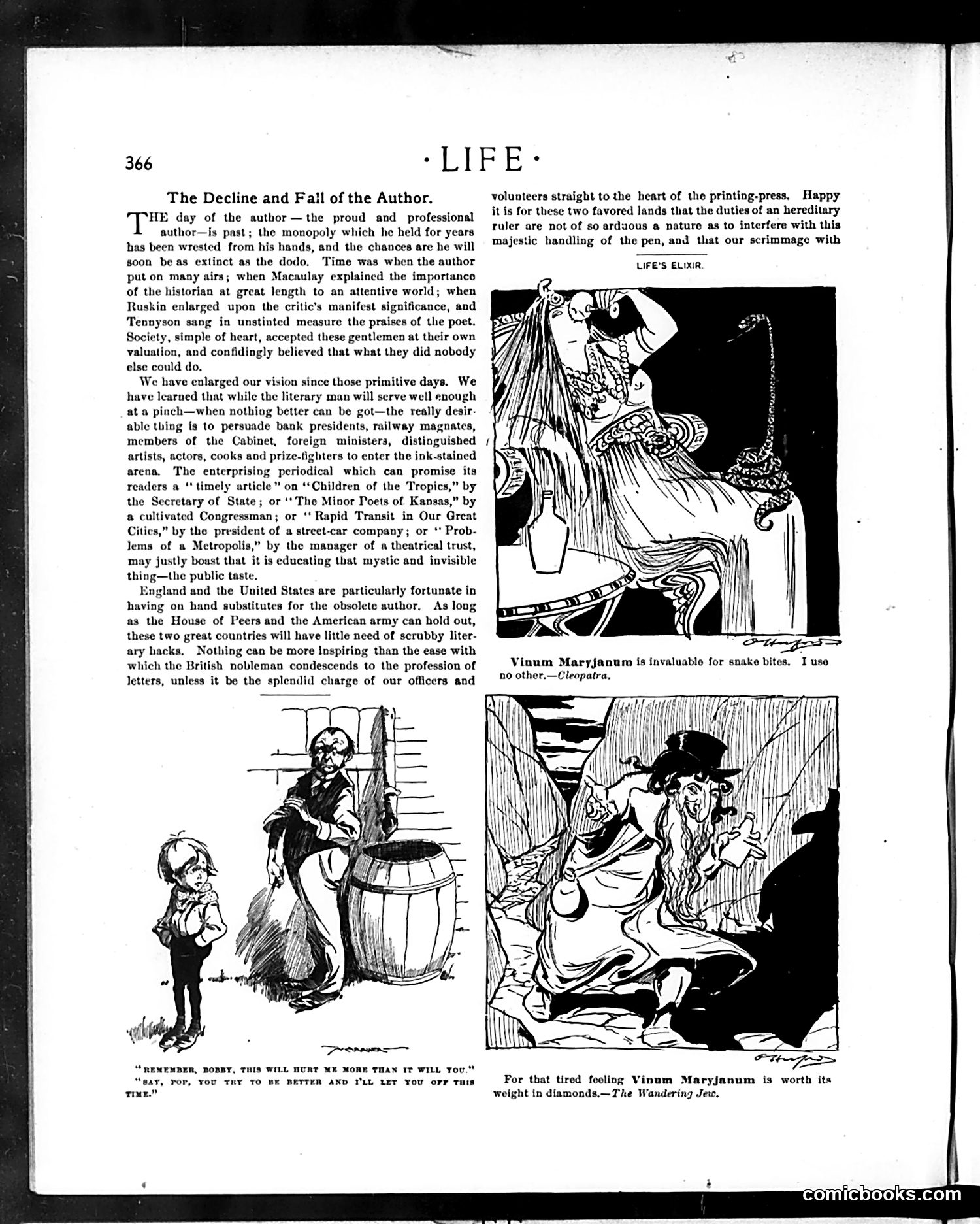
This satirical article mocks the declining prestige of professional writers. Life argues that authors—once considered authorities commanding social respect (citing figures like Macaulay, Ruskin, and Tennyson)—have been displaced by celebrities from other fields. The piece ridicules magazines that now feature articles by politicians, businessmen, actors, and military officers instead of career writers. It sarcastically praises this trend as "educating" public taste, suggesting these prominent figures' amateur writing is somehow superior to professional authorship. The final barb targets British aristocrats and American military officers who casually enter publishing despite their primary duties, implying their social standing grants them unearned credibility as writers. The cartoons illustrate this theme through humorous scenes, while the advertisements for "Vinum MaryJanum" (a patent medicine) parody the magazine's own descent into dubious promotional content—reinforcing the satire about declining standards.
📄 Transcribed text from this page (OCR, searchable)
Machine-transcribed from the original scan — historical spelling and the odd misread are preserved.
366 The Decline and Fall of the Author. HE day of the author —the proud and professional author—is past; the monopoly which he held for years has been wrested from his hands, and the chances are he will soon be as extinct as the dodo. Time was when the author put on many airs; when Macaulay explained the importance of the historian at great length to an attentive world; when Ruskin enlarged upon the critic's manifest significance, and Tennyson sang in unstinted measure the praises of the poet. Society, simple of heart, accepted these gentlemen at their own valuation, and confidingly believed that what they did nobody else could do. We have enlarged our vision since those primitive days. We have learned that while the literary man will serve well enough at a pinch—when nothing better can be got—the really desir- able thing is to persuade bank presidents, railway magnates, members of the Cabinet, foreign ministers, distinguished artists, actors, cooks and prize-fighters to enter the ink-stained arena. The enterprising periodical which can promise its readers a ‘timely article” on ‘‘Children of the Tropics,” by the Secretary of State; or ‘* The Minor Poets of Kansas,” by a cultivated Congressman; or ‘‘ Rapid Transit in Our Great Cities,” by the president of a street-car company; or ‘ Prob- lems of a Metropolis,” by the manager of a theatrical trust, may justly boast that it is educating that mystic and invisible thing—the public taste. England and the United States are particularly fortunate in having on hand substitutes for the obsolete author, As long as the House of Peers and the American army can hold out, these two great countries will have little need of scrubby liter- ary hacks, Nothing can be more inspiring than the ease with which the British nobleman condescends to the profession of letters, unless it be the splendid charge of our officcrs and «LIFE volunteers straight to the heart of the printing-press, Happy it is for these two favored lands that the duties of an hereditary ruler are not of so arduous a nature as to interfere with this majestic handling of the pen, and that our scrimmage with LIFE'S ELUUR. Vinum MaryJjanum is invaluable for snake bites. no other.—Cleopatra, Iuse For that tired fecling Vinum Maryjanum is worth its weight in diamonds.—The Wandering Jew.