
Life, 1899-04-27 · page 12 of 20
Life — April 27, 1899 — page 12: what you’re looking at
What you’re looking at
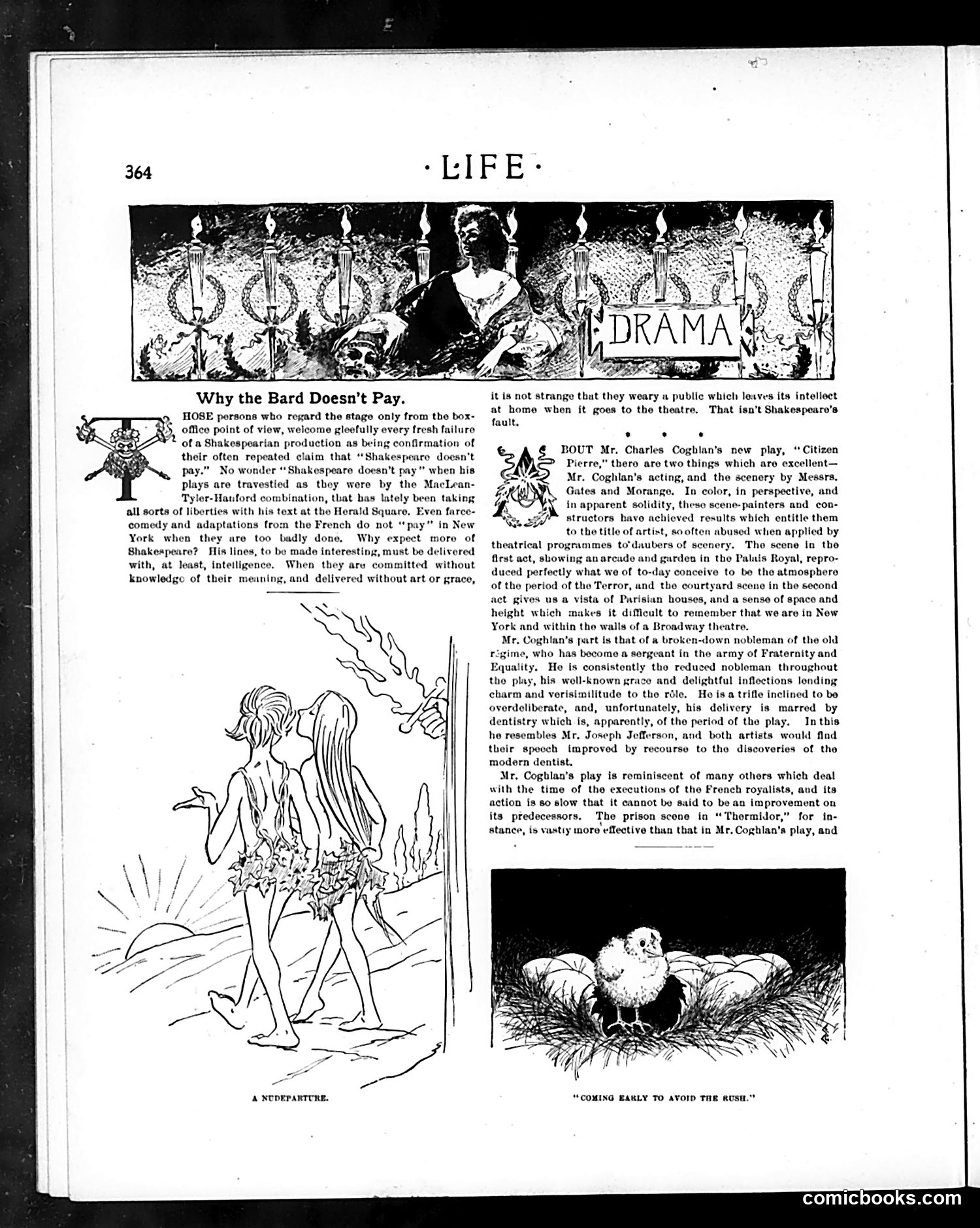
**"Why the Bard Doesn't Pay"** critiques the Herald Square Theatre's repeated claim that Shakespeare productions don't generate profit. The article sardonically suggests theaters blame Shakespeare's plays themselves rather than poor management, arguing that when intelligently performed with proper artistry, Shakespeare should succeed commercially in New York. **The Drama section** reviews Charles Coghlan's new play "Citizen Pierre," praising the acting and scenery by Gates and Moreunge. The critic notes the production effectively recreates Parisian atmosphere and period detail, though Coghlan's delivery is hindered by dentistry work resembling actor Joseph Jefferson's impediment. **Two illustrations** accompany the text: "A Nudepart" (classical mythological scene) and "Coming Early to Avoid the Rush" (a chicken in a nest).
📄 Transcribed text from this page (OCR, searchable)
Machine-transcribed from the original scan — historical spelling and the odd misread are preserved.
[i teeta So — 5 Why the Bard Doesn’t Pay. >, HOSE persons who regard the stage only from the box- pS office point of view, welcome gleefully every fresh failure of a Shakespearian production as being confirmation of their often repeated claim that “Shakespeare doesn’t pay.” No wonder “Shakespearo doesn’t pay" when his plays are travestied as they wore by the MacLean- Tyler-Hanford combination, that has lately been taking all sorts of liberties with his text at the Herald Square, Even farce- comedy and adaptations fro: the French do not “pay” in New York when they ure too badly done, Why expect moro of Shakespearo? His lines, to be made interesting, must be delivered with, at least, intelligence. When they ary committed without knowledge of their meaning, and delivered without art or grace, A NUDEPARTURE. it is not strange that they weary a public which leaves its intellect at home when it goes to the theatre. That isn’t Shakespeare's fault. * . . BOUT Mr. Charles Cogblan’s new play, “ Citizen she Pierre,” thero are two things which aro excellent— Mr. Coghlan’s acting, and the scenery by Messrs. Gates and Morange. In color, in perspective, and in apparent solidity, these scene-painters and con- structors havo achieved results which entitle them to tho title of artist, so often abused when applied by theatrical programmes to'daubers of scener; The scene in the first act, showing an arcade and garden in tho Palais Royal, repro- duced perfectly what wo of to-day conceive to be the atmosphere of tho period of the Terror, and the courtyard scene in the second act gives usa vista of Parisian houses, and a senso of spaco and height which makes {t diflcult to remember that we are in Now York and within tho walls of a Broadway theatre. Mr. Coghlan’s part is that of a broken-down nobleman of the old me, who has become a sergeant in the army of Fraternity and Equality. He is consistently tho reduced nobleman throughout tho play, his well-known grace and delightful inflections lending charm and verisimilitude to tho réle, Ho is a trifle inclined to bo overdeliberate, and, unfortunately, his dolivery is marred by dentistry which is, apparently, of the period of the play. In this he resembles Mr. Joseph Jefferson, and both artists would flad their specch improved by recourse to tho discoveries of tho modern dentist, Mr. Coghlan's play is rominiscent of many othors which deal with the time of the executions of the French royalists, aud its action {s so slow that it cannot be said to be an improvement on its predecessors, Tho prison scone in “Thormidor,” for in- stance, is vustiy more effective than that in Mr, Coghlan’s play, and Ne “COMING EARLY TO AVOID THE RUSH.” comicbooks.com