
Life, 1899-04-27 · page 6 of 20
Life — April 27, 1899 — page 6: what you’re looking at
What you’re looking at
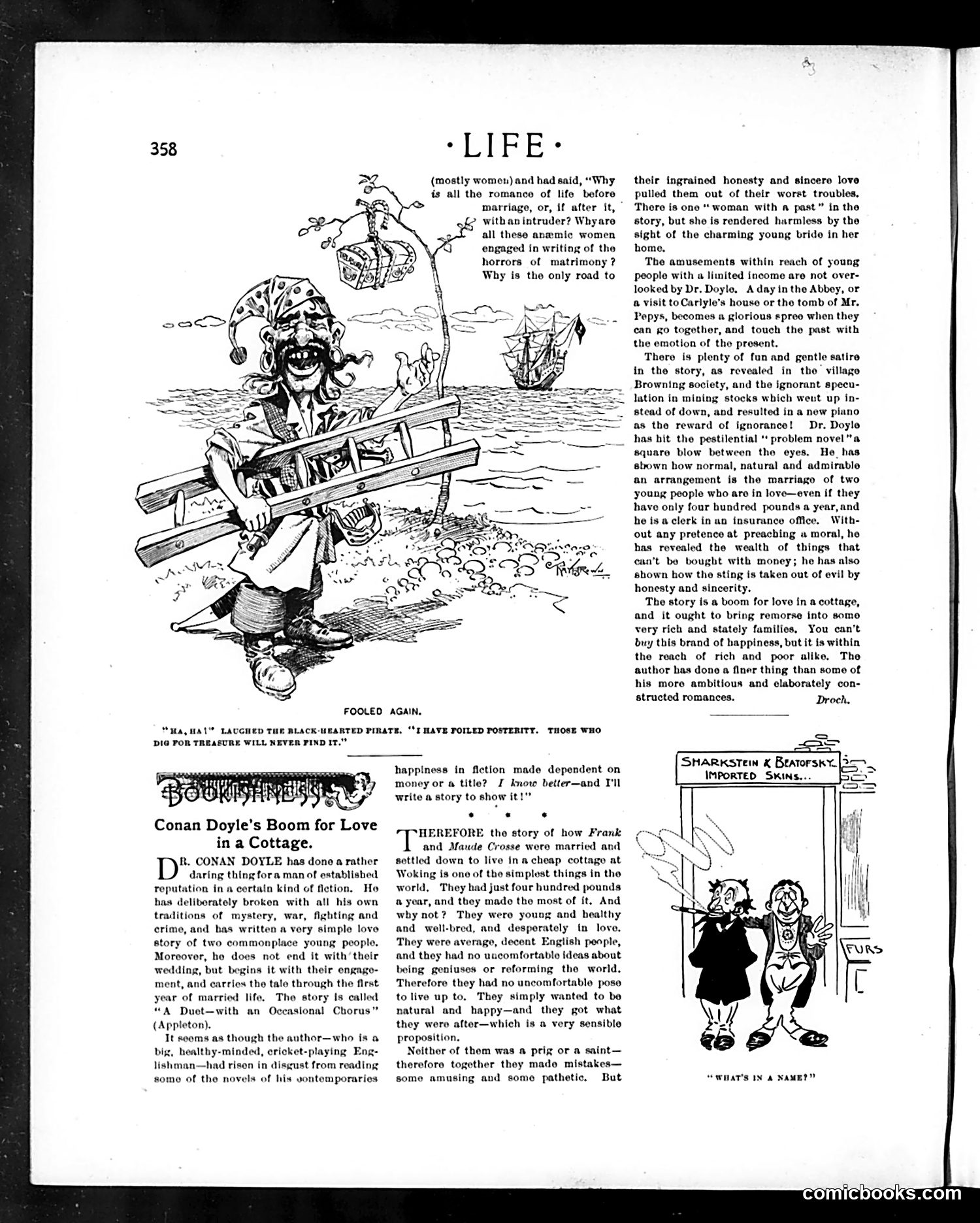
The main illustration titled "Fooled Again" depicts a grotesque pirate figure emerging from water, with the caption: "Ha, ha!" laughed the black-hearted pirate. "I have foiled posterity. Those who dig up treasure will never find it!" This appears to be satirizing marital unhappiness and financial deception. The accompanying article by Conan Doyle discusses a couple, Frank and Maude Crosse, who married on a modest budget but made mistakes despite their genuine love. The pirate imagery suggests husbands or wealth-holders who hide assets or deceive their spouses about finances. A smaller cartoon shows a woman asking "What's in a name?" — likely satirizing superficiality in relationships or society's focus on titles and appearances over substance. The satire targets both marital discord and financial dishonesty in domestic life.
📄 Transcribed text from this page (OCR, searchable)
Machine-transcribed from the original scan — historical spelling and the odd misread are preserved.
“LURE « (mostly women) and had said, “Why is all the romance of lifo before marriage, or, if after it, withan intruder? Why aro all these anwmic women engaged in writing of the horrors of matrimony ? Why is tho only road to FOOLED AGAIN. “Ma, WAL LAUGHED THE BLACK-UEARTED PIRATE, ‘I HAVE POILED POSTERITY. THOSE WHO DIG POR TREASURE WILL NEVER FIND IT.” Conan Doyle’s Boom for Love in a Cottage. R. CONAN DOYLE has dono a rather daring thing fora man of established reputation ina certain kind of fiction. Ho has deliberately broken with all his own traditions of mystery, war, fighting and crime, and has written a very simple love story of two commonplace young people. Moreover, he does not end it with ‘their wedding, but begins it with their engage- ment, and carries the tale through the first: year of married life, Tho story Is called “A Duet—with an Occasional Chorus” (Appleton). It seoms as though the author—who is a big, healthy-minded, cricket-playing Eng- lishman—had rison in disgust from reading some of tho novels of his vontemporaries happiness in fiction made dependent on money or a title? I know better—and I'll write a story to show it!” * . . HEREFORE the story of how Frank and Maude Crosse were married and settled down to live ina cheap cottago at Woking is ono of the simplest things in the world, They bad just four hundred pounds a year, and they mado tho most of it, And why not? They wero young and healthy and well-bred, and desperately in love. They were average, decent English people, and they had no uucomfortable ideas about being geniuses or reforming the world, Therefore they had no uncomfortable pose to live up to. They simply wanted to be natural and happy—and they got what they were after—which is a very sensible proposition, Neither of them was a prig or a saint— therefore together they mado mistakes— some amusing and some pathetic, But their ingrained honesty and sincere love pulled them out of thelr worst troubles, There is ono “ woman with a past” in the story, but sho is rendered harmless by the sight of the charming young brido in her home. The amusements within reach of young people with a liinited income aro not over- looked by Dr. Doyle, A day inthe Abboy, oF a visit toCarlyle’s house or tho tomb of Mr. Pepys, becomes a glorious spree when they can go together, and touch the past with the emotion of tho present. There is plenty of fun and gentle satiro in the story, as revealed in tho’ villago Browning society, and the ignorant specu- lation in mining stocks which weut up in- stead of down, and resulted in a new piano as tho reward of ignorance! Dr. Doylo has hit the pestilential “ problem novela square blow between tho eyes. He has sbown how normal, natural and admirablo an arrangement is the marriago of two young people who aro in love—even if they have only four hundred pounds a year, and he is aclork in an insurance oflce. With- out any pretence at preaching « moral, ho has revealed the wealth of things that can’t bo bought with money; he has also shown how tho sting is taken out of evil by honesty and sincerity. The story is a boom for love in a cottage, and it ought to bring remorse into somo very rich and stately families, You can’t buy this brand of happiness, but it is within the reach of rich and poor alike. Tho author has dono a finer thing than some of his moro ambitious and claborately con- structed romances. WHAT'S IN A NAMED”