
A complete issue · 20 pages · 1899
Life — March 16, 1899
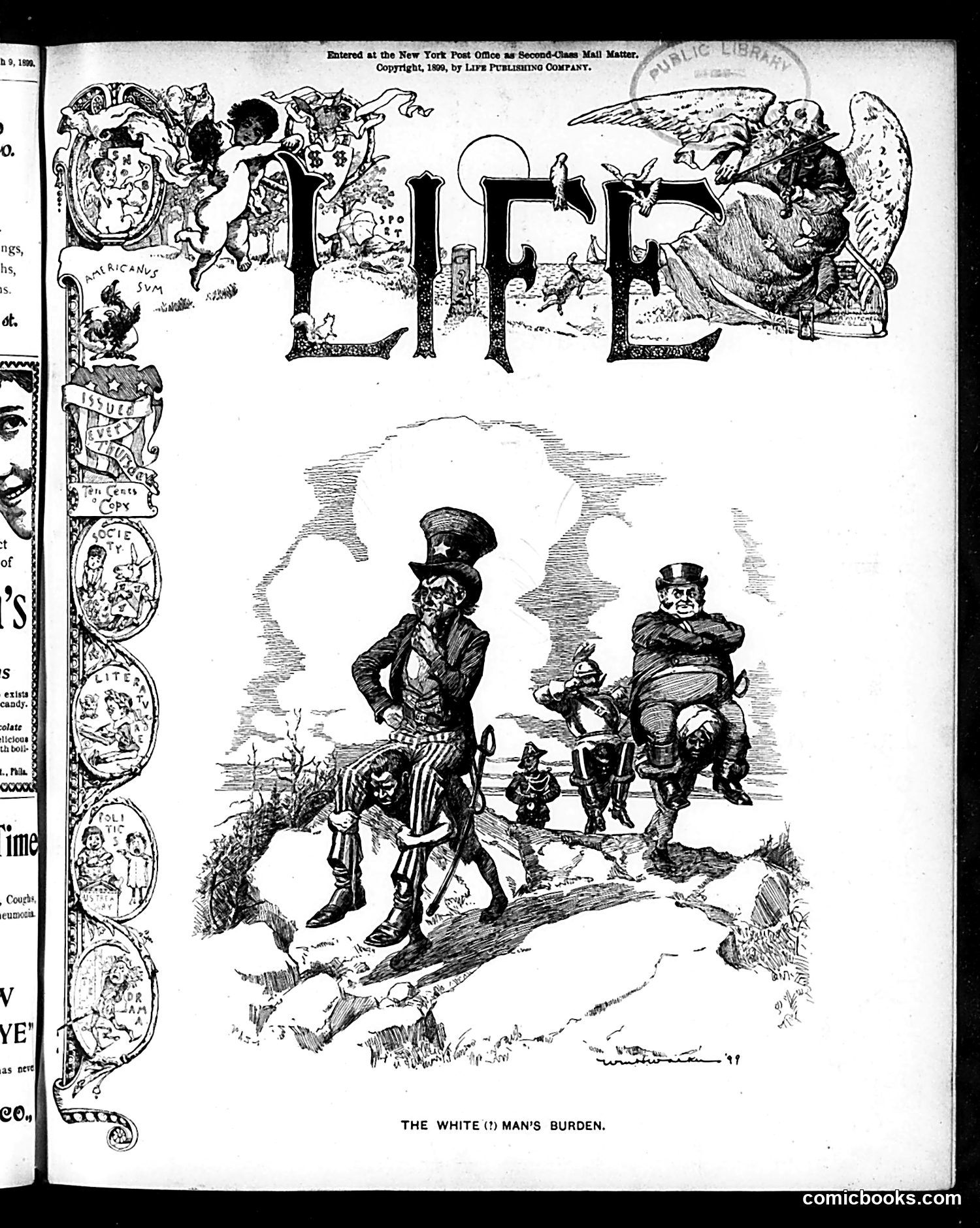
This cartoon satirizes Rudyard Kipling's 1899 poem "The White Man's Burden," which justified European imperial expansion as a civilizing mission. The image shows two well-dressed figures (appearing to represent Western colonial powers) directing smaller figures—likely caricatures of colonized peoples—to do labor. The exclamation point in the title signals ironic criticism: the cartoon mocks the notion that colonialism constitutes a "burden" for Western powers, when in fact colonized peoples bear the actual hardship and exploitation. The smaller figures carry goods or perform work while the larger figures command them, visualizing the power dynamics hidden beneath imperial ideology. This represents an anti-imperialist critique, questioning the moral justifications for colonialism that were prevalent in American and British discourse around 1900.
This page contains **advertising content for The Cosmopolitan magazine**, not political satire. The top section compares American football to the Spanish **Pelota** (a violent ball game played in Madrid), describing pelota's brutal nature with dramatic language about "casualties" exceeding football's injuries. This serves as promotional copy—using sensationalism to interest readers in Poultney Bigelow's article about the sport. The larger advertisement promotes "The Building of Mohammed's Empire," a historical serial by John Brisben Walker with illustrations by Boston artist Eric Pape. It emphasizes The Cosmopolitan's claim to reach "the largest clientele of intelligent, thoughtful readers" of any periodical worldwide. Both sections are designed to attract readers by highlighting exotic, dramatic content and the magazine's intellectual prestige.
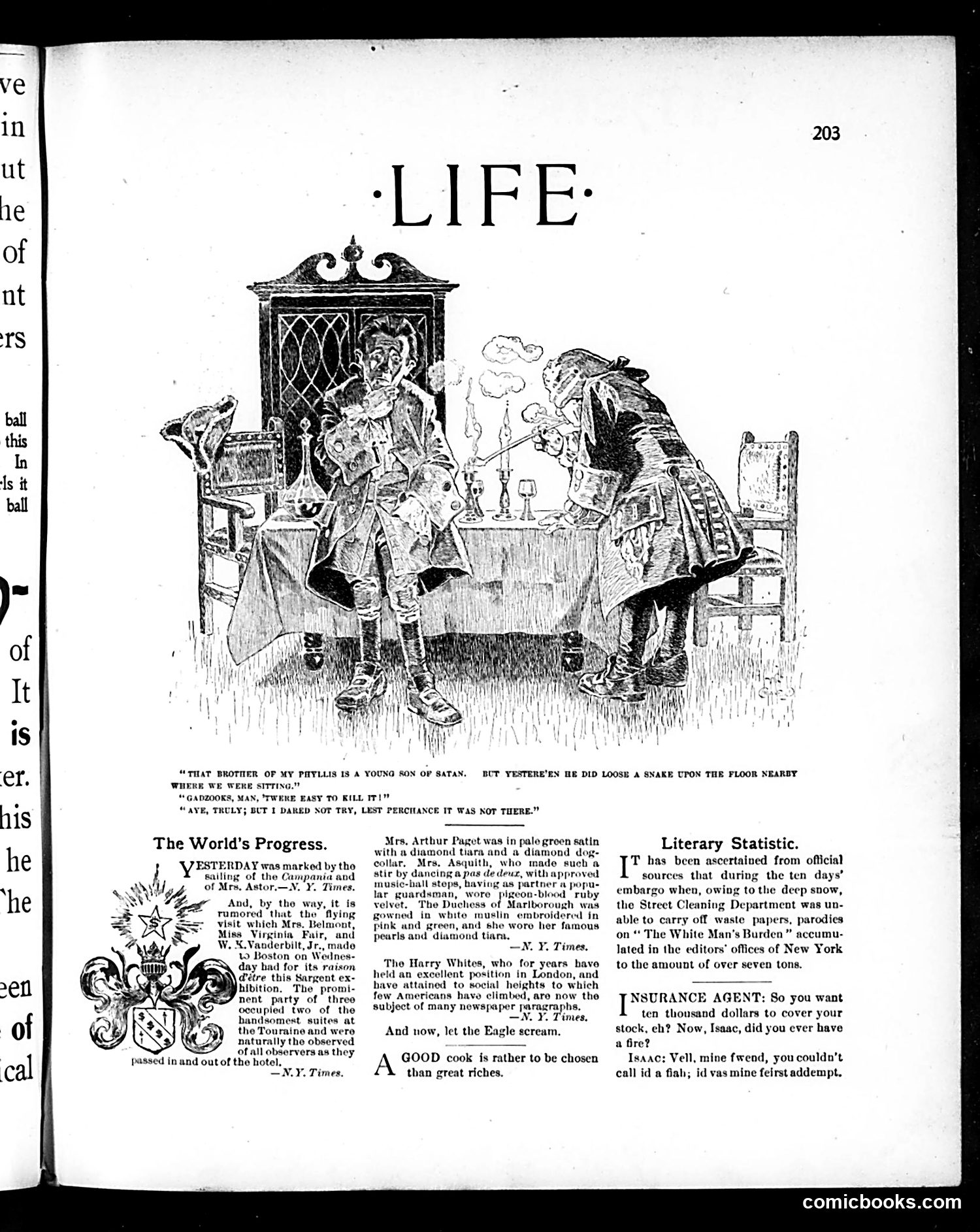
The main cartoon depicts two figures at a dinner table with the caption discussing a "brother of my Phyllis" being "a young son of Satan" who loosened a snake during their meal. This appears to be a domestic humor piece about an unwelcome guest or family member causing chaos at dinner—a common satirical theme of the era mocking social awkwardness and impropriety. Below are three separate brief items: "The World's Progress" references the *Cumania* ship and Mrs. Arthur Paget in society circles; "Literary Statistic" discusses a newspaper campaign about "The White Man's Burden"; and a humorous insurance/cooking exchange. These are typical miscellaneous satirical snippets characteristic of *Life* magazine's format, mixing social commentary with light domestic humor.
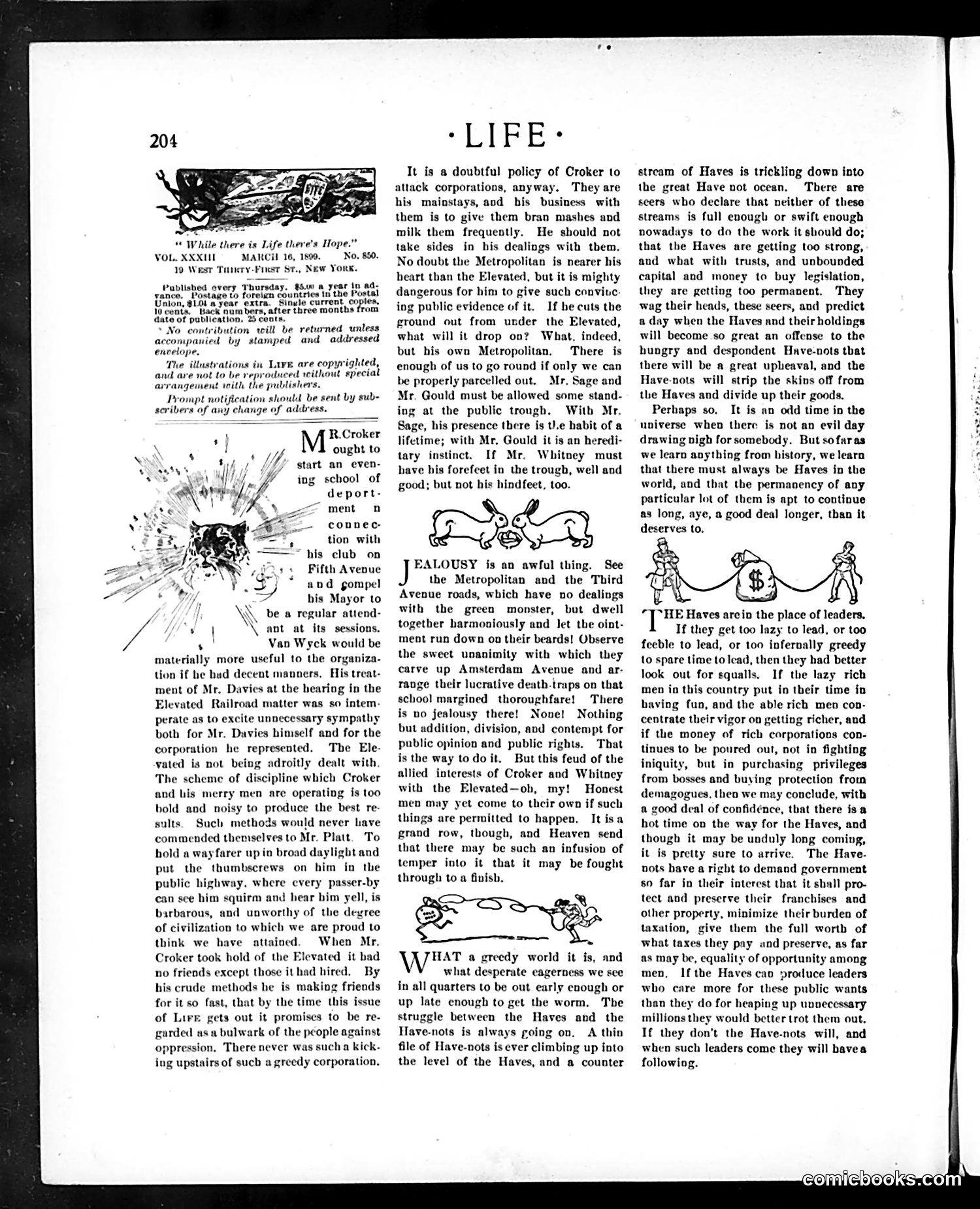
This editorial page critiques New York City's elevated railroad (the "Elevated") and its operators, particularly targeting **Mr. Croker** (likely Richard Croker, Tammany Hall boss) and associates like **Mr. Gould** and **Mr. Whitney**—wealthy industrialists controlling the transit system. The main cartoon shows a figure being thrown or ejected forcefully, illustrating the article's complaint that the Elevated's operators exploit the public through monopolistic practices while ignoring safety and service concerns. The text condemns: - Croker's corporate dealings with rival interests - Privileged treatment of wealthy operators over public welfare - The system's inherent corruption and greed The satirical thrust: wealthy monopolists operating essential public infrastructure prioritize personal profit over civic responsibility, leaving ordinary citizens victimized by their callous business methods.
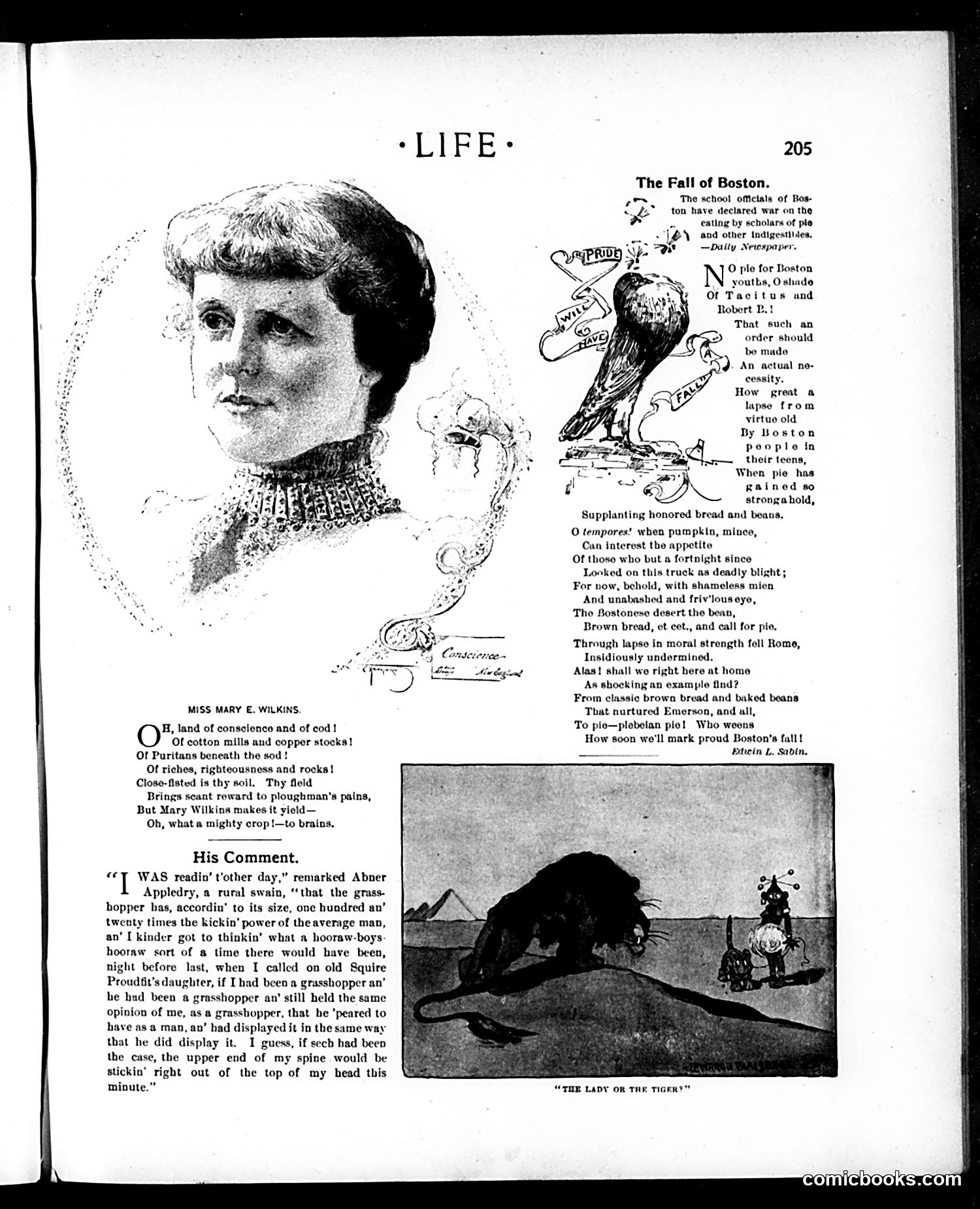
**Portrait Section:** Miss Mary E. Wilkins (a portrait with accompanying verse) celebrates her as representing New England virtue—"land of conscience and of cod" with references to Puritan heritage and cotton mills. **"The Fall of Boston" Cartoon:** A satirical poem mocking Boston's moral decline, featuring an eagle (symbol of American virtue) that appears weakened or corrupted. The text criticizes Boston's abandonment of its historical values, referencing "Tacitus and Robert E." and lamenting how "pumpkin, mince" pies and other commonplace items now define the city instead of its former intellectual and moral standards. **"His Comment":** A humorous anecdote about a grasshopper's physical strength compared to human capability—used as social commentary on masculine prowess and pride. **Bottom Image:** "The Lady of the Tiger"—likely illustrating the famous ambiguous short story by Frank Stockton about choice and consequence.
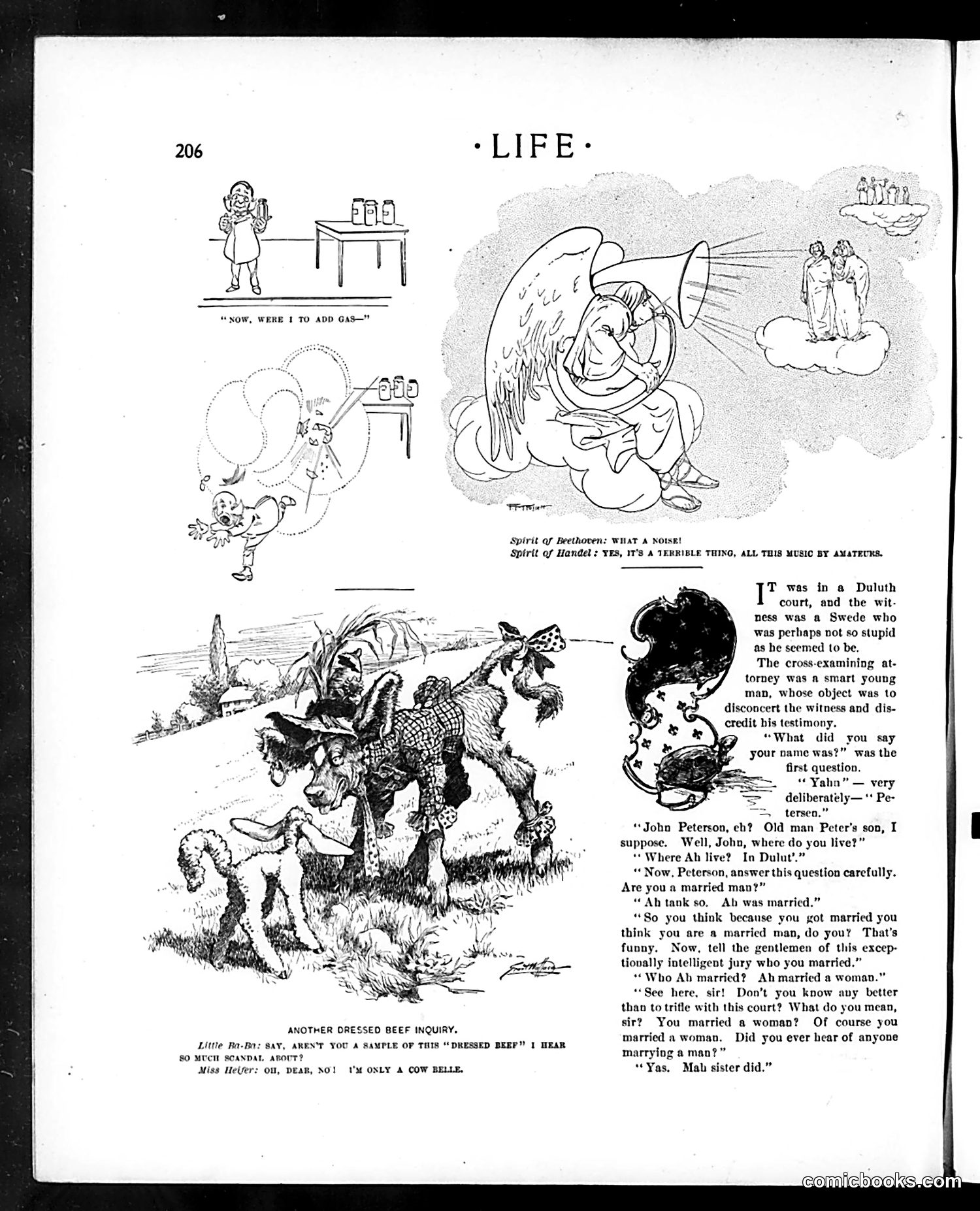
This page contains three separate humorous sketches typical of early 20th-century satirical comedy: 1. **"Now, Were I to Add Gas"**: A child watches her mother add gas to what appears to be a cooking apparatus, with exaggerated results showing the mother blown backward—satirizing the novelty and dangers of early gas cooking technology. 2. **"Another Dressed Beef Inquiry"**: A butcher defends "dressed beef" to a customer, but reveals she's "only a cow belle"—a pun playing on "cow bell" versus "cow belle," mocking customers' confusion about processed meat origins. 3. **The main text section** contains a courtroom anecdote about a Duluth witness named John Peterson, humorously exploring confusion over marital status through rapid-fire questioning—standard period humor about working-class misunderstandings of legal proceedings. The overall tone reflects contemporary attitudes toward technology, food, and class.
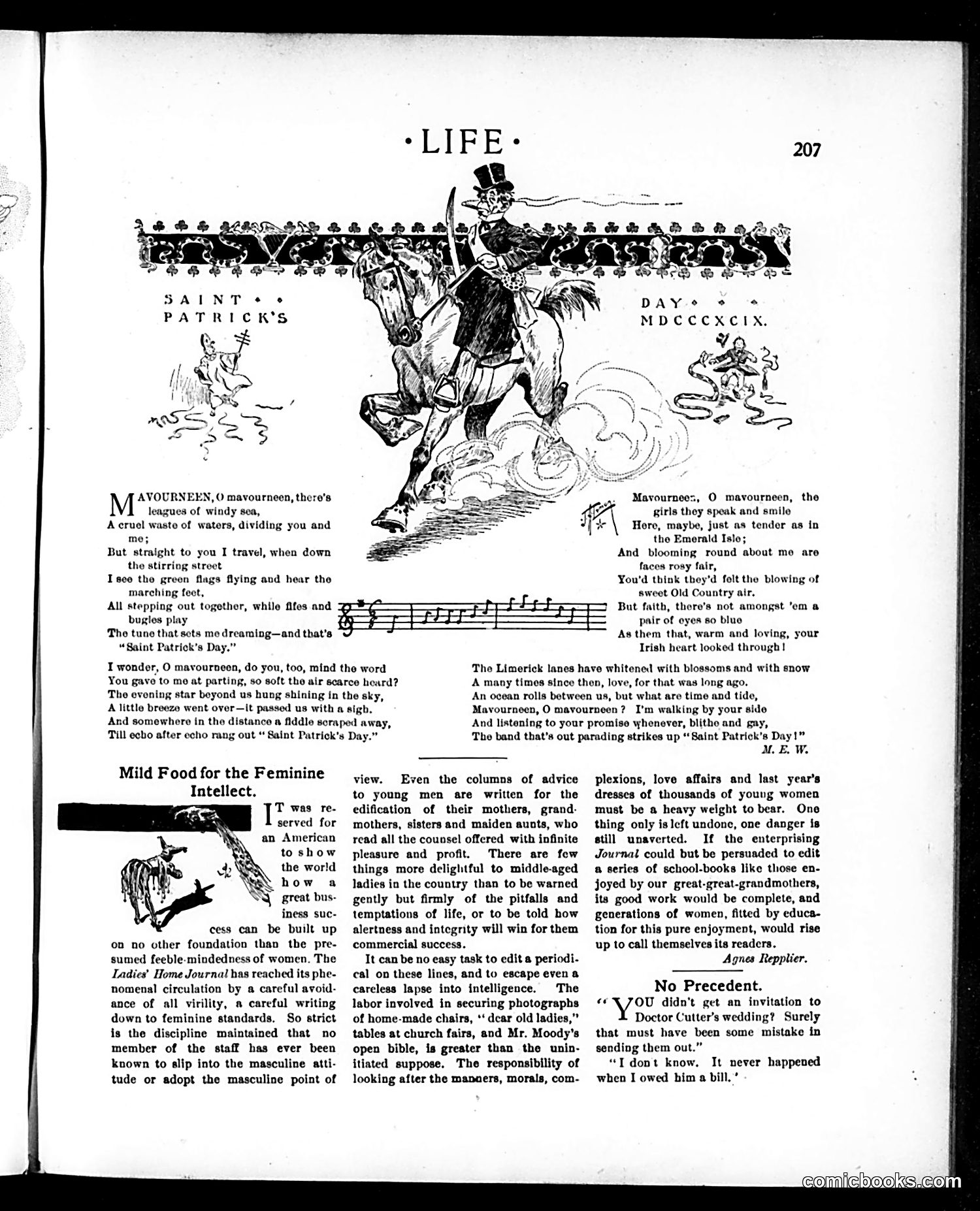
The main illustration depicts a caricatured Irish figure on horseback, wearing a top hat and riding enthusiastically across the page. He's labeled "Saint Patrick's Day" and appears to be leading a celebratory parade, with marching figures visible in the background. The accompanying poem celebrates Irish-American identity and nostalgia for Ireland—referencing "the Emerald Isle," "sweet Old Country air," and "the Lipstick lanes" (likely Dublin streets). The text emphasizes romantic attachment to Ireland while acknowledging the speaker's present American life. The satire appears gentle rather than harsh, celebrating Irish-American culture during the St. Patrick's Day holiday rather than mocking it. The exaggerated, jolly character embodies stereotypical Irish-American enthusiasm and patriotic sentiment.
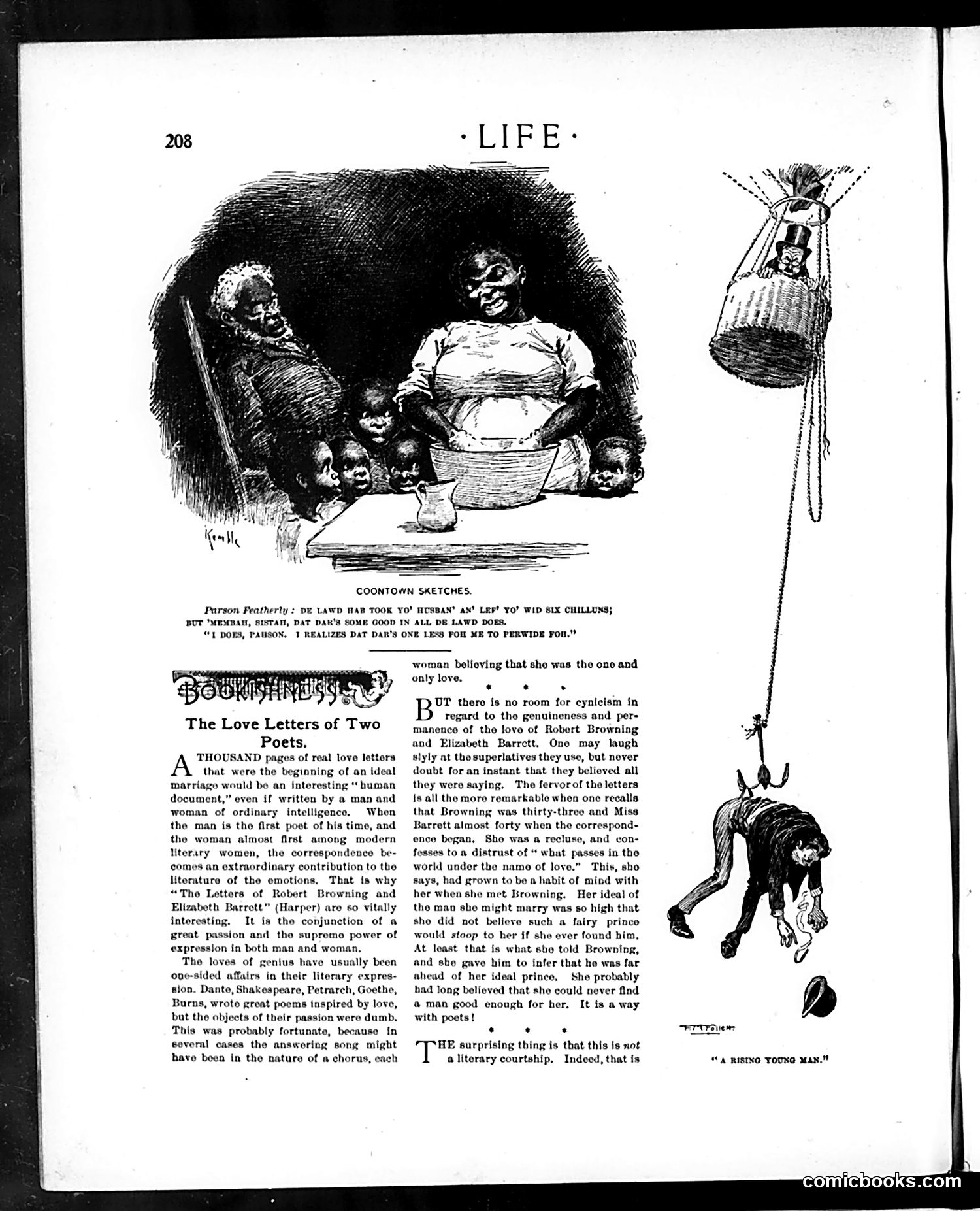
This page from *Life* magazine discusses "The Love Letters of Two Poets," comparing the romantic correspondence of Robert Browning and Elizabeth Barrett. The text argues that while their love letters display genuine passion, they lack literary merit compared to great poetry inspired by love throughout history. The "Coontown Sketches" cartoon at top depicts racial stereotypes common to the era's popular entertainment—showing Black figures in a domestic scene with dialect speech. This reflects *Life*'s occasional use of such stereotypical humor, typical of late 19th/early 20th-century American publications. The right illustration, "A Rising Young Man," shows a figure suspended by rope, likely satirizing social climbing or precarious social advancement.
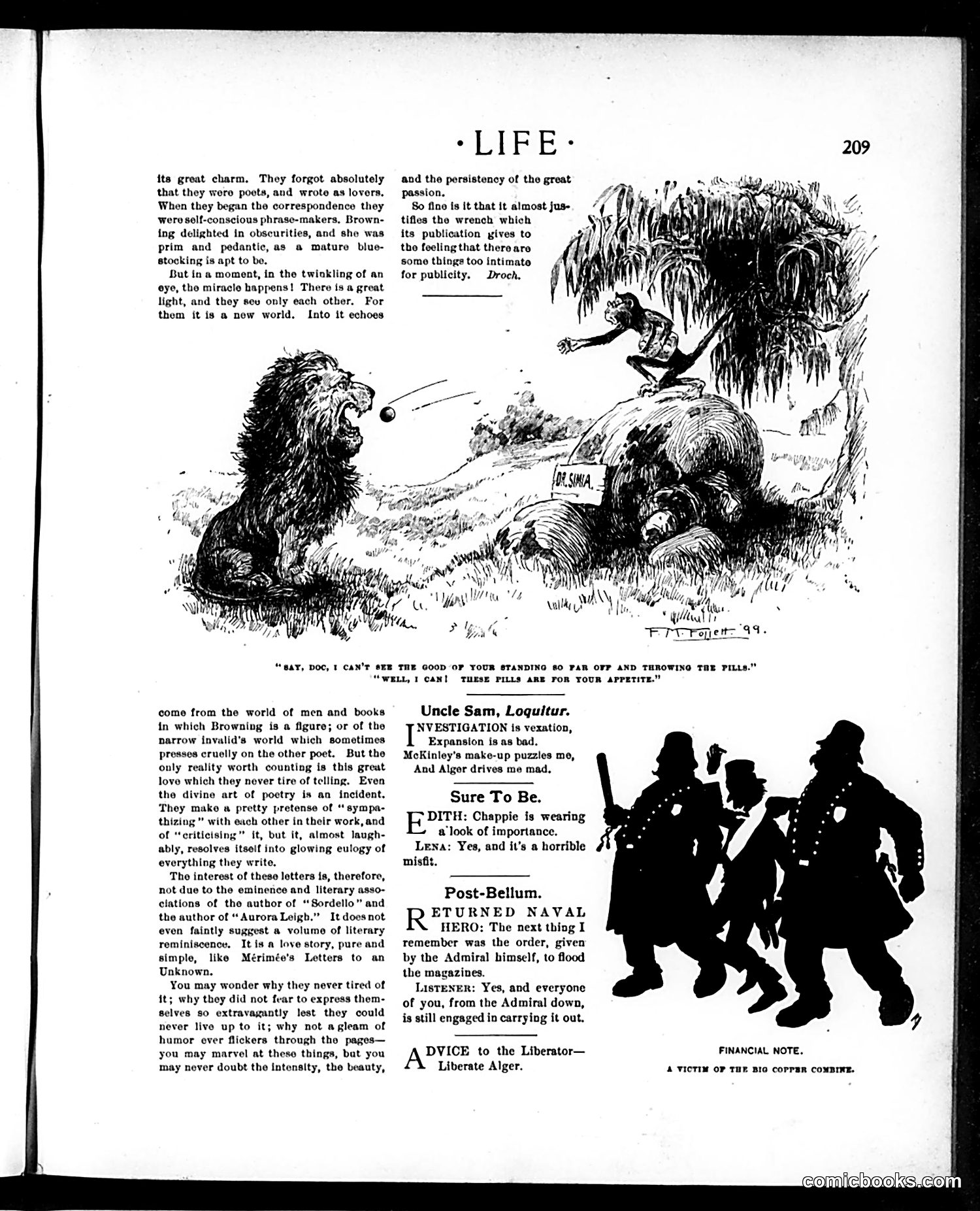
The main cartoon depicts a lion and what appears to be a hippo or similar animal, with a small figure leaping between them. The caption reads: "Say, dog, I can't see the good of your standing so far off and throwing the pills. Well, I can! These pills are for your appetite." This appears to be satirizing medical treatment or advice-giving at a distance—possibly commenting on ineffective remedies or reluctance to engage directly with a problem. The "pills for your appetite" suggests ironic commentary on treating symptoms rather than root causes. The surrounding text references literary correspondence and Uncle Sam, but the specific political context remains unclear without additional historical dating or byline information visible on this page.
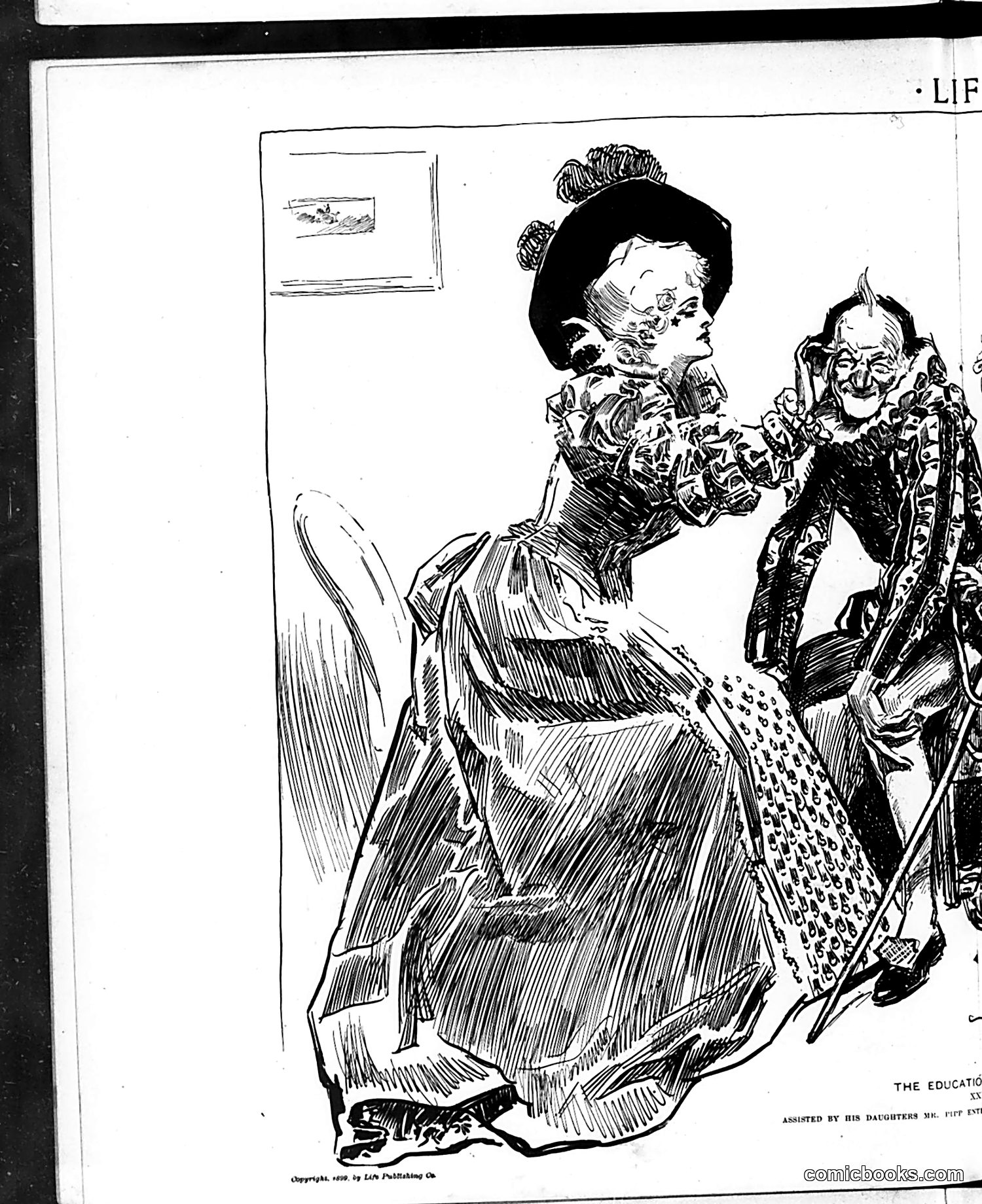
This Life magazine cartoon satirizes the education of wealthy daughters in the Gilded Age. The caption references "THE EDUCATIO[N]" and mentions daughters being "ASSISTED BY HIS DAUGHTERS MR. FIFI E[...]" The image shows an elaborately dressed woman in an ornate gown with a large hat, seated with an exaggerated posture. A caricatured male figure (appearing sharp-featured and somewhat demonic) stands beside her. The satire likely mocks the pretentious education and social refinement of wealthy young women, suggesting their "education" consisted mainly of acquiring fashionable appearance and aristocratic mannerisms rather than substantive learning. The grotesque male figure may represent a dubious or fraudulent "educator" profiting from this shallow training.
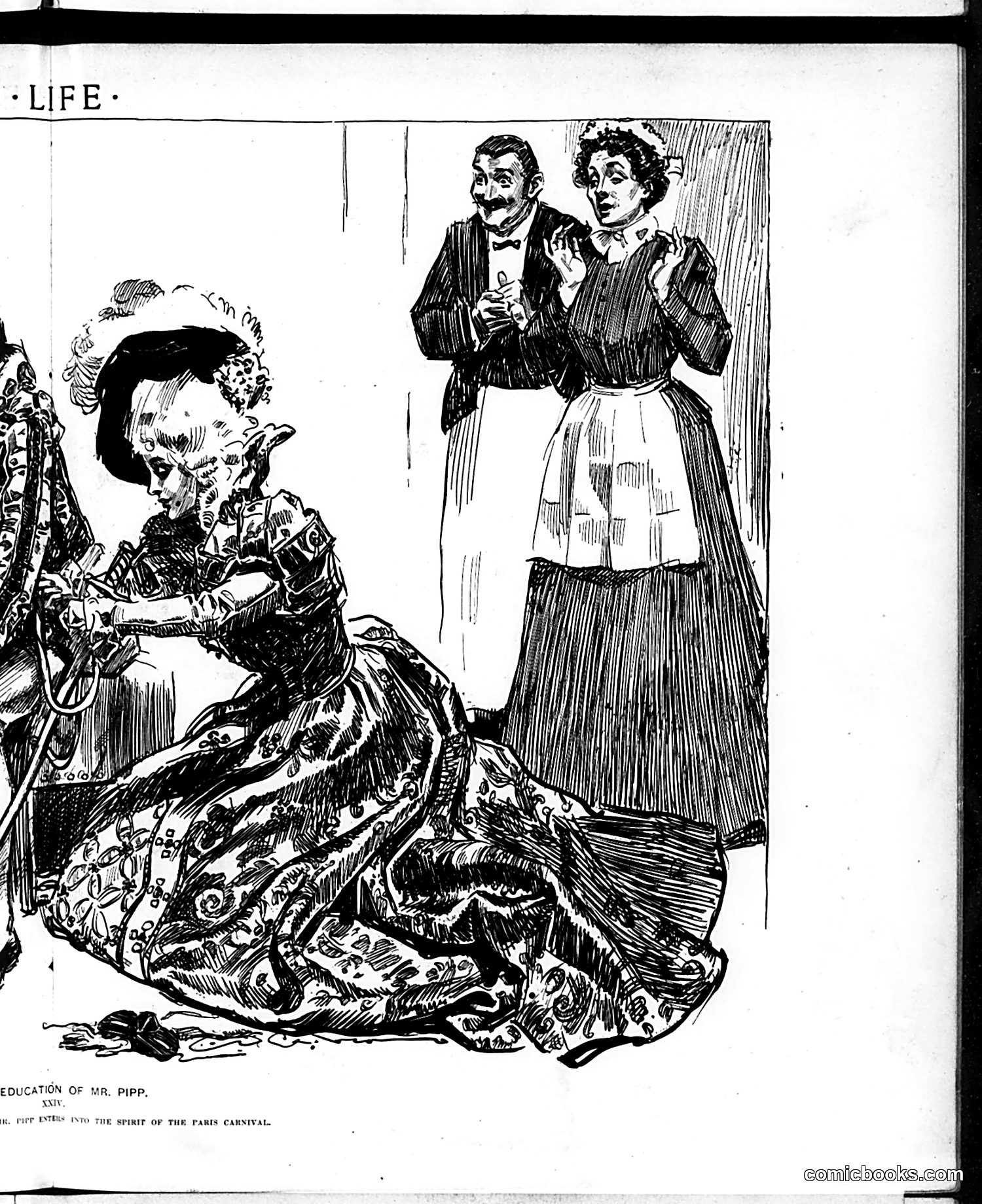
This satirical illustration from *Life* magazine depicts "The Education of Mr. Pipp" and references "Mr. Pipp Enters into the Spirit of the Paris Carnival." The cartoon shows a wealthy, elaborately dressed woman (likely representing high society or aristocracy) seated prominently in an ornate gown. Two figures in the background—a man in formal dress and a woman in simpler attire—appear to be observing or commenting on the scene. The satire likely mocks either social pretension, the excesses of the wealthy during carnival festivities, or perhaps a specific public figure's attempt to embrace bohemian or carnival culture while remaining fundamentally unchanged. The contrast between the woman's elaborate costume and the observers' reactions suggests commentary on artificial sophistication or misguided attempts at cultural participation.
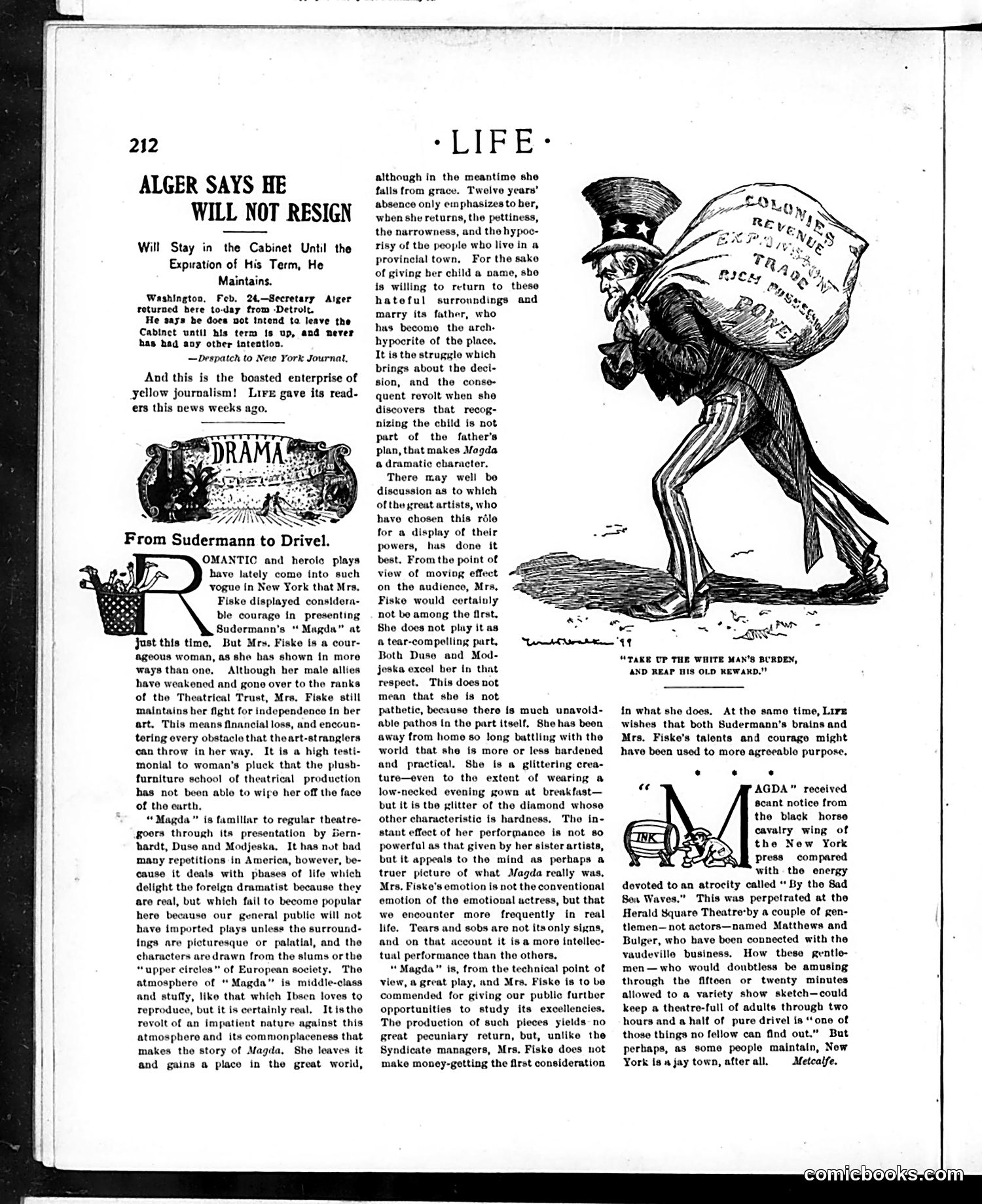
The prominent cartoon depicts **Uncle Sam** carrying a large bundle labeled "Colonies Revenues" and "Trade," illustrating **American imperialism** and colonial exploitation. The caption reads "Let Up the White Man's Burden, and Reap His Old Reward," sarcastically referencing Rudyard Kipling's famous poem "The White Man's Burden," which justified colonial expansion as a civilizing mission. This image critiques American acquisition of overseas territories (likely referring to colonies gained after the Spanish-American War). The cartoon suggests that rather than noble uplift, colonialism was fundamentally about extracting wealth and resources for American benefit. The page also contains theater reviews criticizing the play "Magda," praising actress Mrs. Fiske's performance while debating the play's artistic merit.
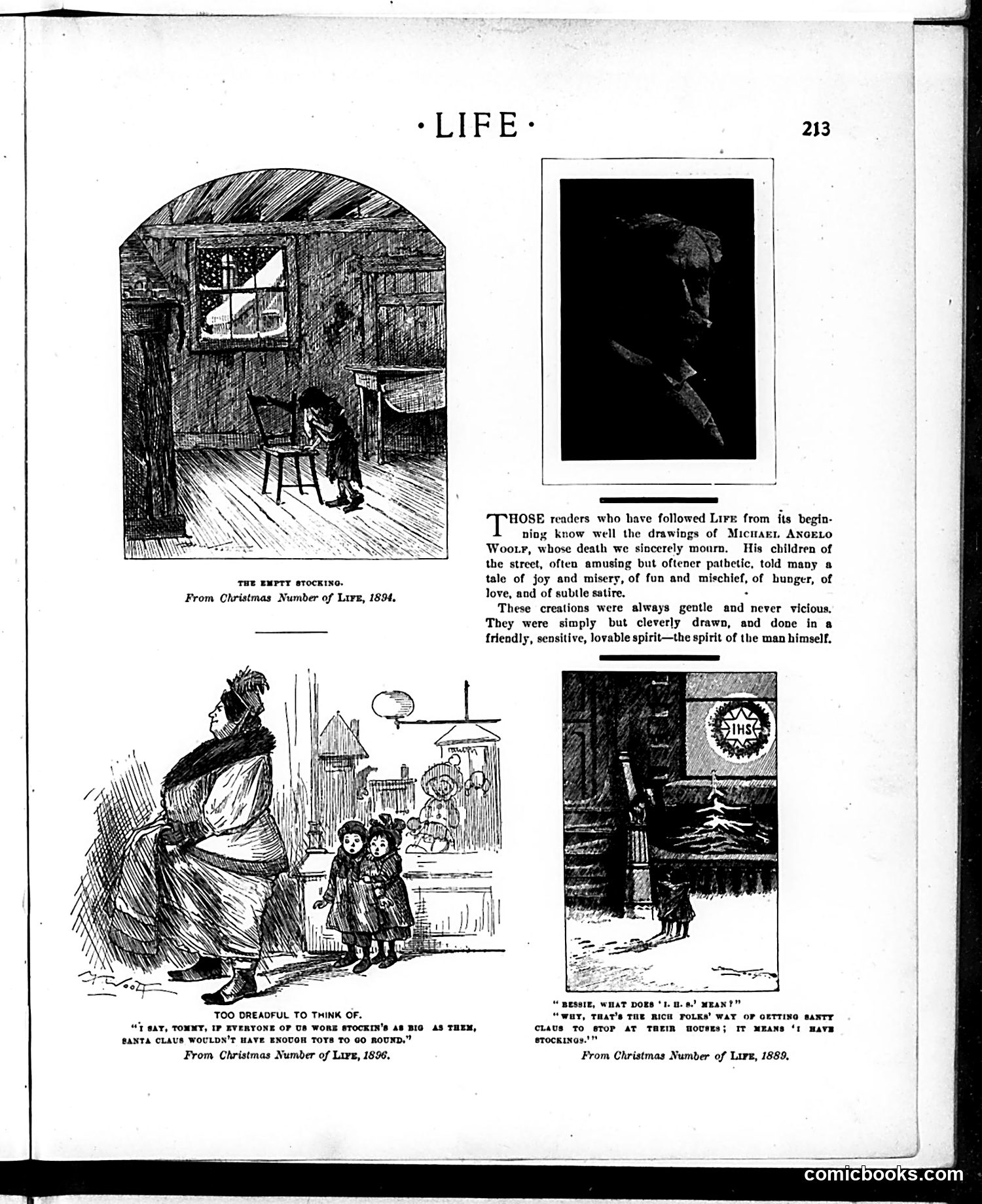
This page is a memorial to **Michael Angelo Woolf**, a cartoonist whose death the magazine mourns. The text praises his drawings of street children—poor urban kids depicted with humor and pathos. The cartoons shown are examples of Woolf's work from various Christmas issues (1894, 1896, 1889). They satirize poverty and class inequality through children's perspectives: - **"The Empty Stocking"** depicts a bare interior, suggesting a poor household at Christmas. - **"Too Dreadful to Think Of"** shows a child worried that Santa can't afford toys if everyone has large stockings to fill—dark humor about scarcity and want. - **The final cartoon** contrasts wealthy and poor families' Christmas practices, with children noting that rich people use stockings as a signal for Santa to visit their homes—implying the poor lack such advantages. Woolf's specialty was social commentary through children's innocent observations about inequality, done in a "friendly, sensitive, lovable spirit" rather than heavy-handed preaching.
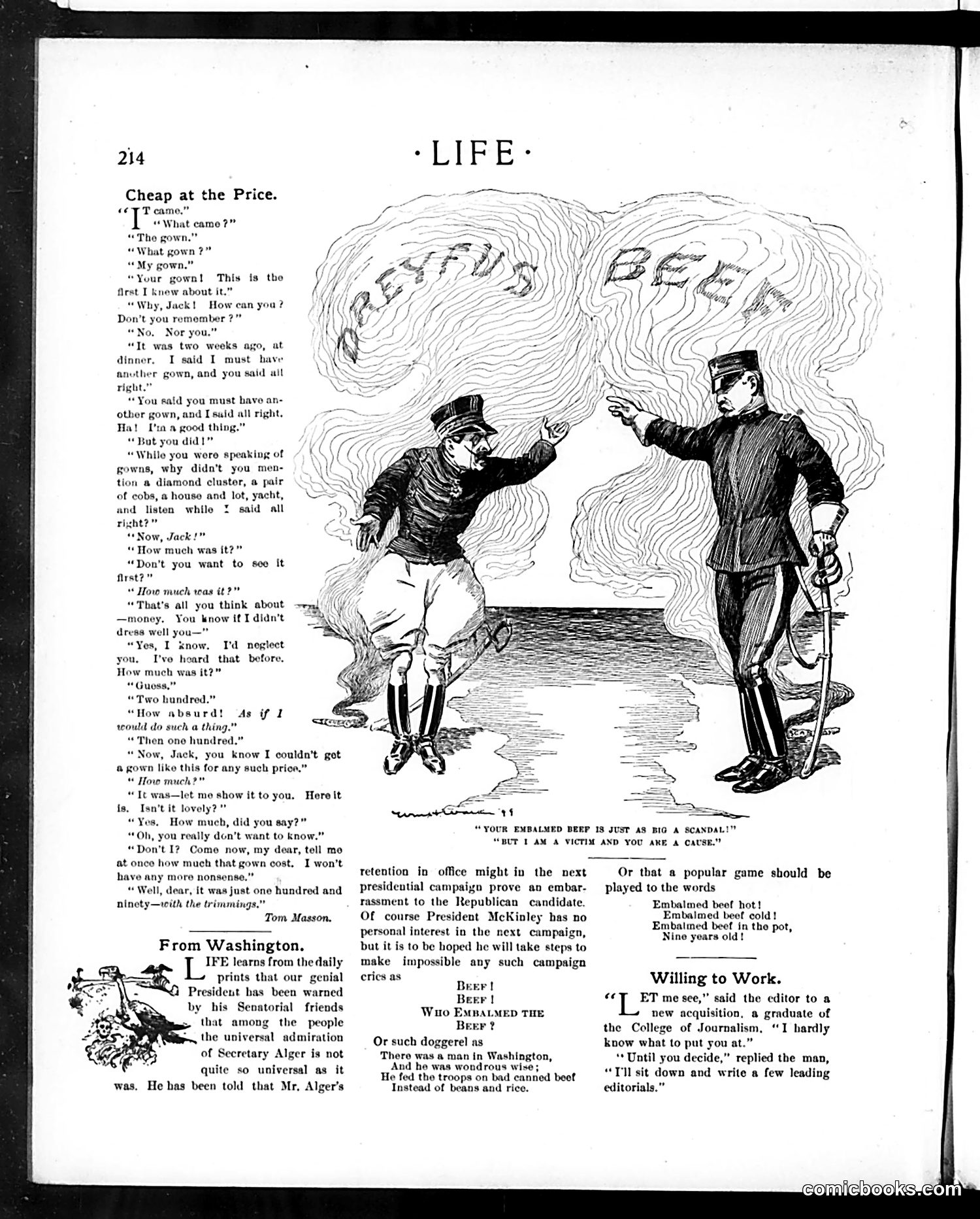
This page contains two distinct pieces of period satire: **"Cheap at the Price"** (top): A domestic comedy sketch mocking marital arguments over women's spending. A husband confronts his wife about an expensive gown, discovering it costs $190 with trimmings—far more than he expected. The satire targets both spouses: the wife's evasiveness and shopping excess, and the husband's obsession with cost. **"From Washington"** (bottom): Political criticism of Secretary of War Russell Alger during the Spanish-American War. The text references the "embalmed beef" scandal—soldiers were allegedly fed spoiled canned beef, causing illness and death. The cartoon mocks Republican political handlers warning President McKinley that Alger's continued presence endangers their party's electoral prospects. The doggerel verses ridicule both the scandal and its potential as campaign ammunition against Republicans. Both pieces use humor to critique upper-class excess and government incompetence.
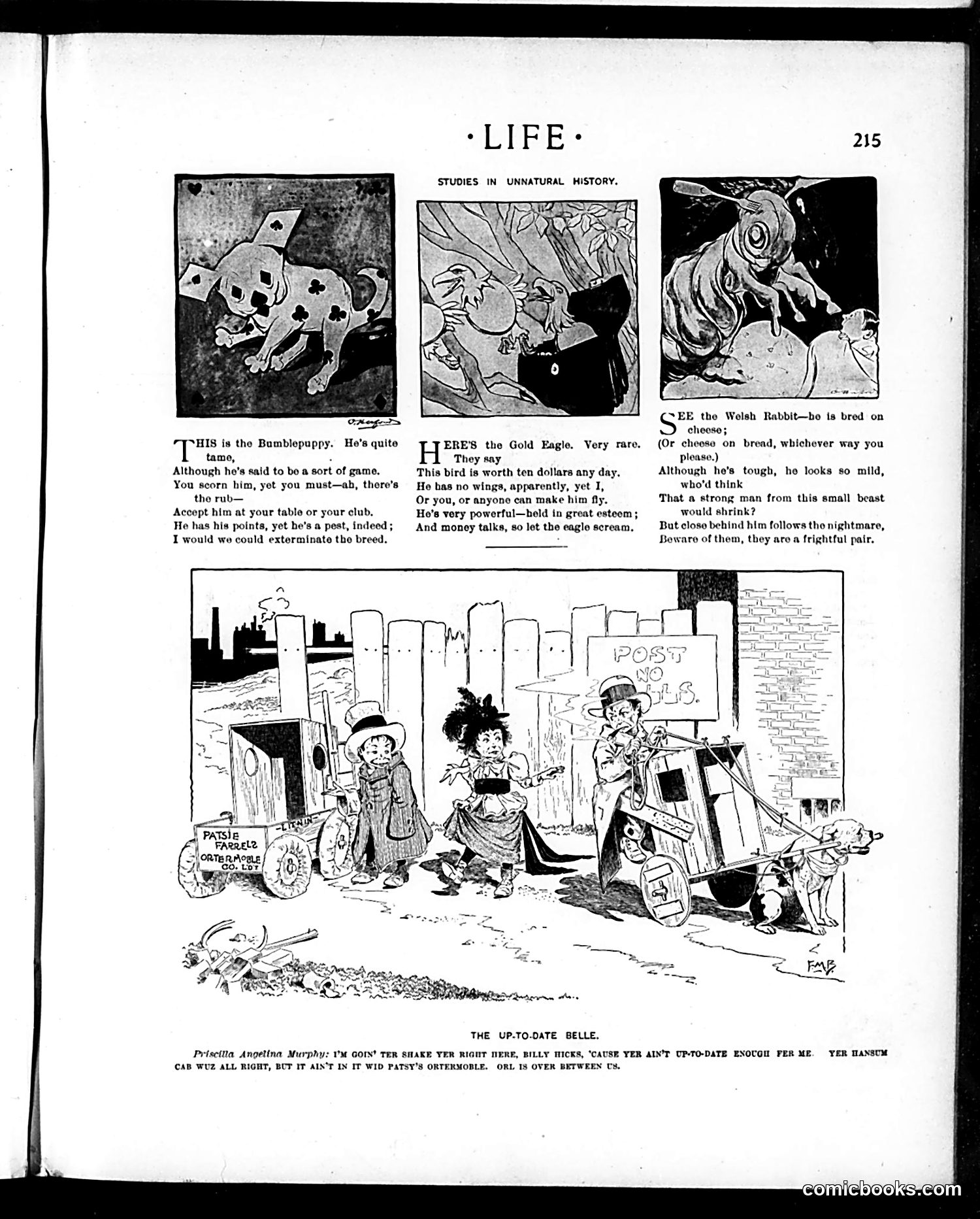
This page satirizes contemporary social absurdities through mock-naturalist "studies." **Top section:** Three illustrated "specimens" mock modern follies: - The **Bumblepuppy** — a fashionable but pointless society pet people tolerate despite disdaining it, representing social pretense - The **Gold Eagle** — money/financial speculation, depicted as wingless yet able to "fly," criticizing how wealth operates without substance - The **Welsh Rabbit** — a dish (cheese on bread) presented as deceptively mild but creating nightmarish consequences, likely referencing indigestion or poor food quality **Bottom cartoon:** "The Up-to-Date Belle" shows a modern woman boasting of her automobile ("Patsy's ortermoble") while dismissing an older cab—mocking the newly wealthy flaunting consumer goods and abandoning tradition for fashionable modernity. The densely crowded street scene emphasizes how automobiles are becoming status symbols in American cities. Overall, the page ridicules 1910s American society's obsession with conspicuous consumption, financial speculation, and abandoning established values for trendy novelties.
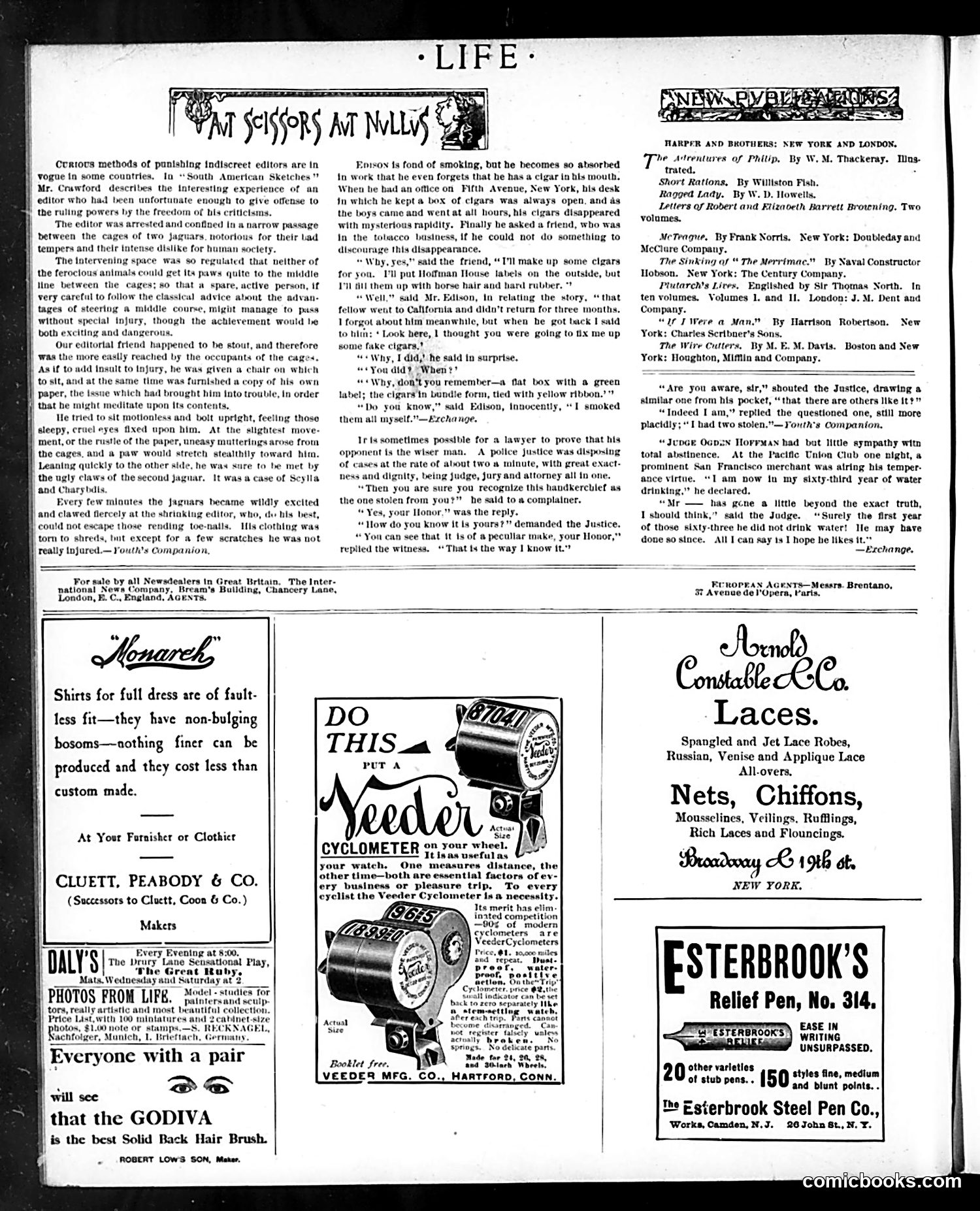
This page from the satirical magazine *Life* contains three humorous anecdotes rather than political cartoons: 1. **"At Scissors at Nulls"** (title): A story about an indiscreet editor in South America punished by being placed between two caged jaguars—a darkly comic tale illustrating authoritarian censorship methods. 2. **Edison's Fake Cigars**: An anecdote about inventor Thomas Edison, known for his absent-mindedness while working. A friend supposedly created convincing fake cigars filled with horsehair and rubber to stop office visitors from stealing Edison's cigars, but Edison smoked them all himself without noticing—a joke on both Edison's distraction and the friend's failed prank. 3. **The Lawyer and Judge**: A brief joke about a police judge disposing cases so rapidly he serves as judge, jury, and attorney simultaneously. A witness claims to recognize a stolen handkerchief by its "peculiar make," but cannot explain what makes it peculiar—satirizing legal incompetence. The page is primarily **advertisements** for period products (Monarch shirts, Veeder cyclometer, Easterbrook pens).
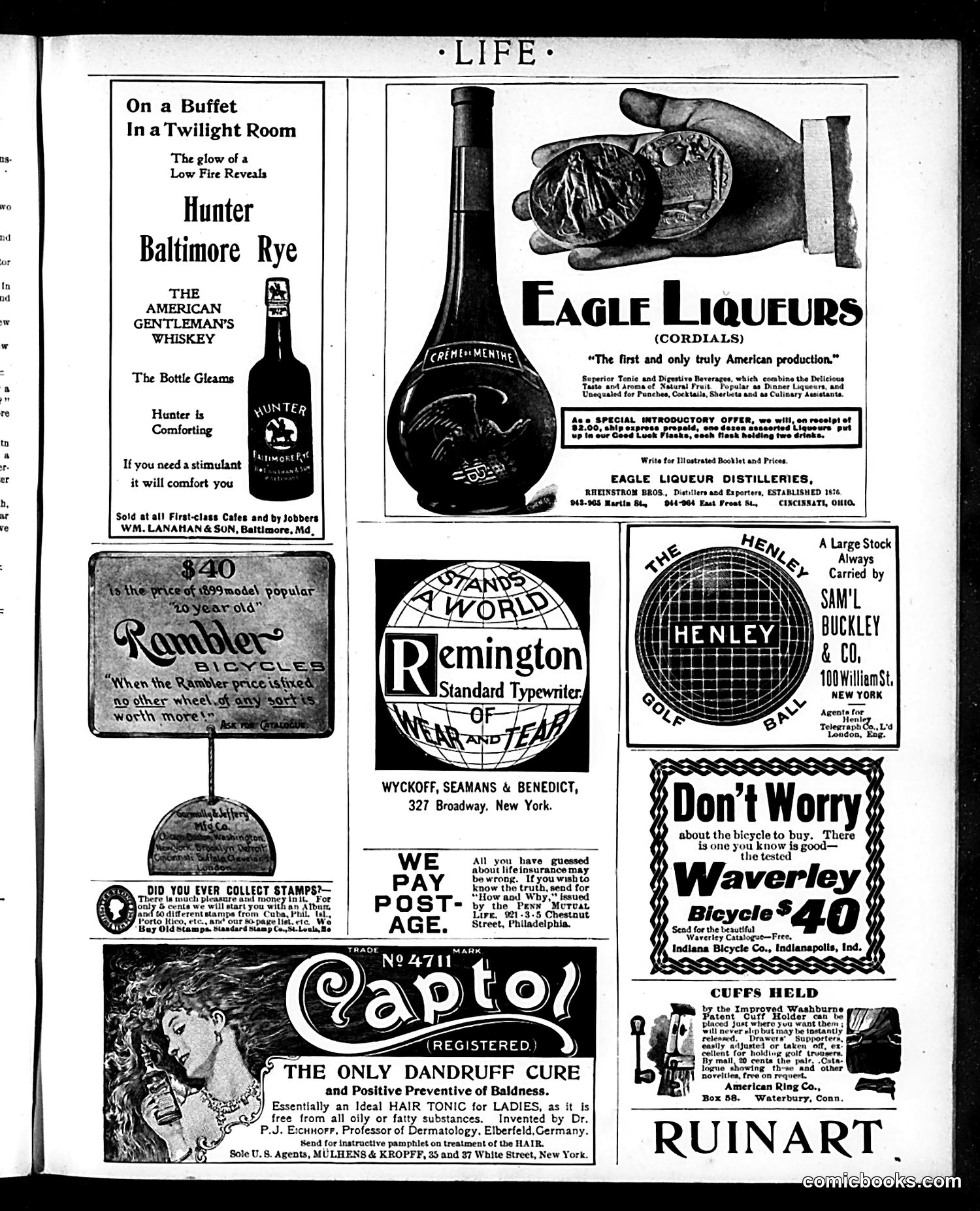
This page is **primarily advertisements** rather than editorial content or satire. It features early 20th-century product marketing for whiskey, liqueurs, typewriters, bicycles, golf balls, and patent medicines. Notable items include: **Hunter Baltimore Rye** whiskey advertisement emphasizing comfort and stimulation—language typical of era advertisements before modern regulations on health claims. **Caprol** hair tonic marketed as "the only dandruff cure and positive preventive of baldness," credited to a German dermatology professor. This exemplifies the patent medicine era when unregulated products made extraordinary claims. **Remington Standard Typewriter** and **Waverley Bicycle** ads represent consumer goods marketed to the middle class. The page reflects pre-WWI American consumer culture and advertising practices, before FDA regulations restricted medical claims and before modern advertising standards. There is no discernible political cartoon or satire present—it is a commercial advertising page.
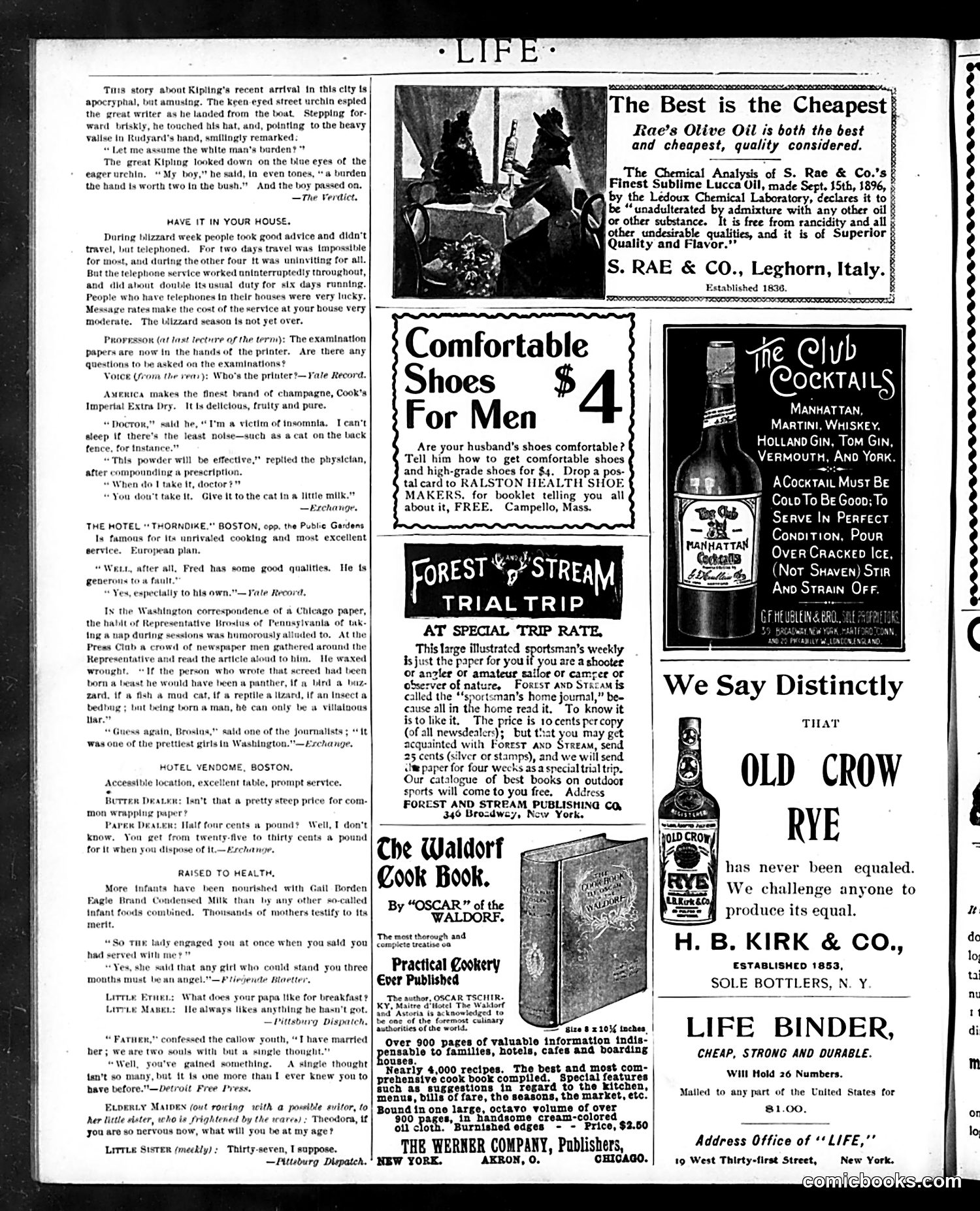
This page is primarily **advertisements and brief humorous anecdotes**, not political cartoons. The main featured story concerns **Rudyard Kipling's recent arrival in the city**. A street urchin recognizes the famous writer and cheekily references Kipling's famous poem "The White Man's Burden"—asking if he can "assume the white man's burden" while pointing to the bag Kipling carries. Kipling responds with wit, turning the boy's request into a folk saying about value ("a bird in hand is worth two in the bush"). The satire gently mocks both Kipling's well-known imperialist rhetoric and the street urchin's opportunistic cleverness. The joke relies on readers' familiarity with Kipling's poem and his celebrity status following his recent arrival. The remainder consists of period advertisements (olive oil, shoes, alcohol, cookbooks) and minor gossip items about hotels and newspaper life—typical Life magazine filler content.
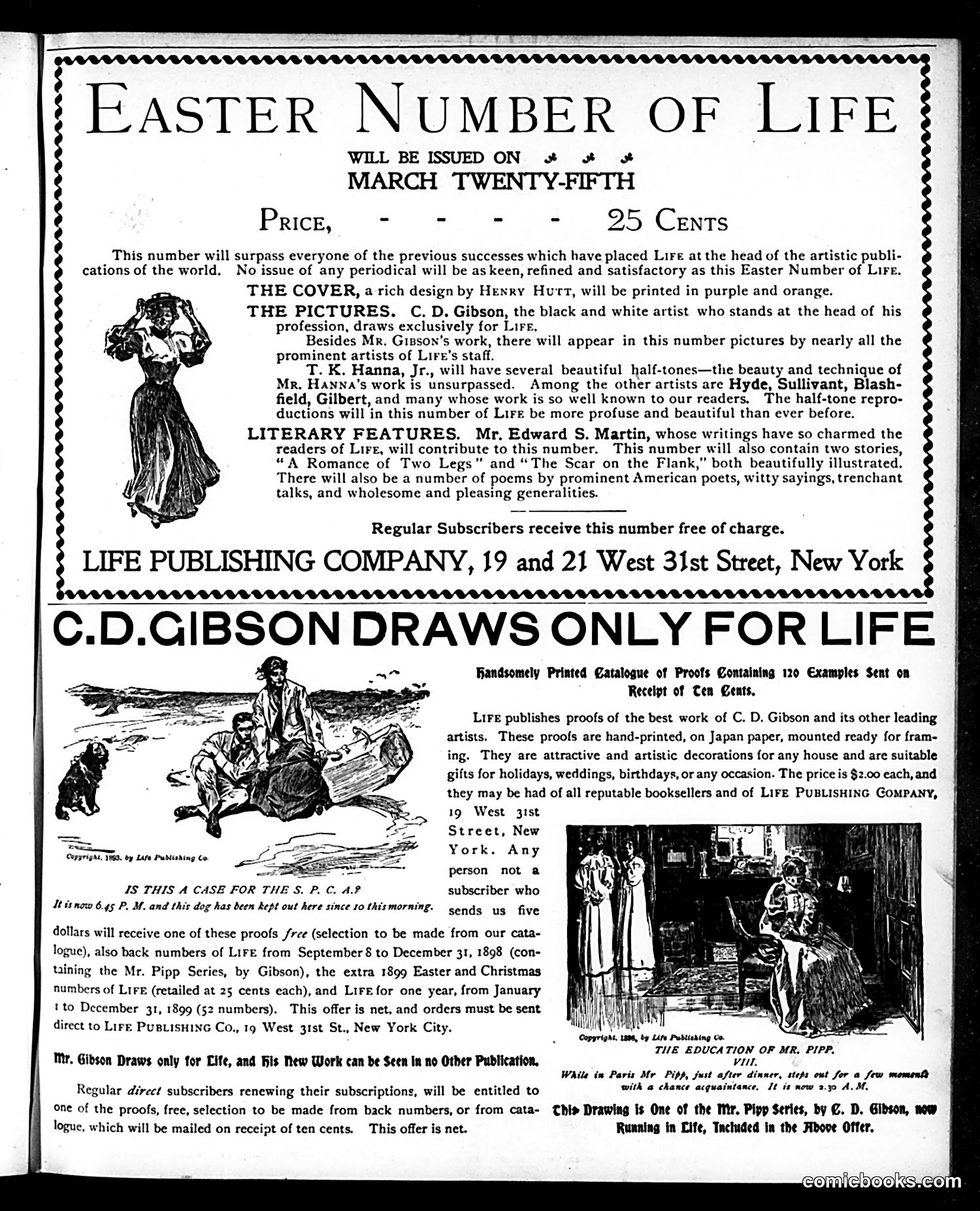
This is primarily a **title/advertising page** for Life's Easter issue (March 25, circa 1898-1899), showcasing the magazine's artistic contributors. The two cartoon vignettes illustrate Life's content: 1. **"Is This a Case for the S.P.C.A?"** — A satirical caption referencing the Society for the Prevention of Cruelty to Animals. The image shows a dog left outside from morning (10 AM) until evening (6:45 PM), satirizing the organization's mission through obvious animal neglect. 2. **"The Education of Mr. Pipp"** — Part of a Gibson series, depicts a gentleman in Paris who steps out briefly after dinner and doesn't return until 2:30 AM, humorously suggesting he's been "educated" by Parisian nightlife/temptation. Both cartoons exemplify Life's satirical humor style. The page heavily promotes C.D. Gibson, the magazine's star artist, and announces special subscription offers including back issues and art proofs. This represents Life as a leading illustrated satirical publication of the 1890s.
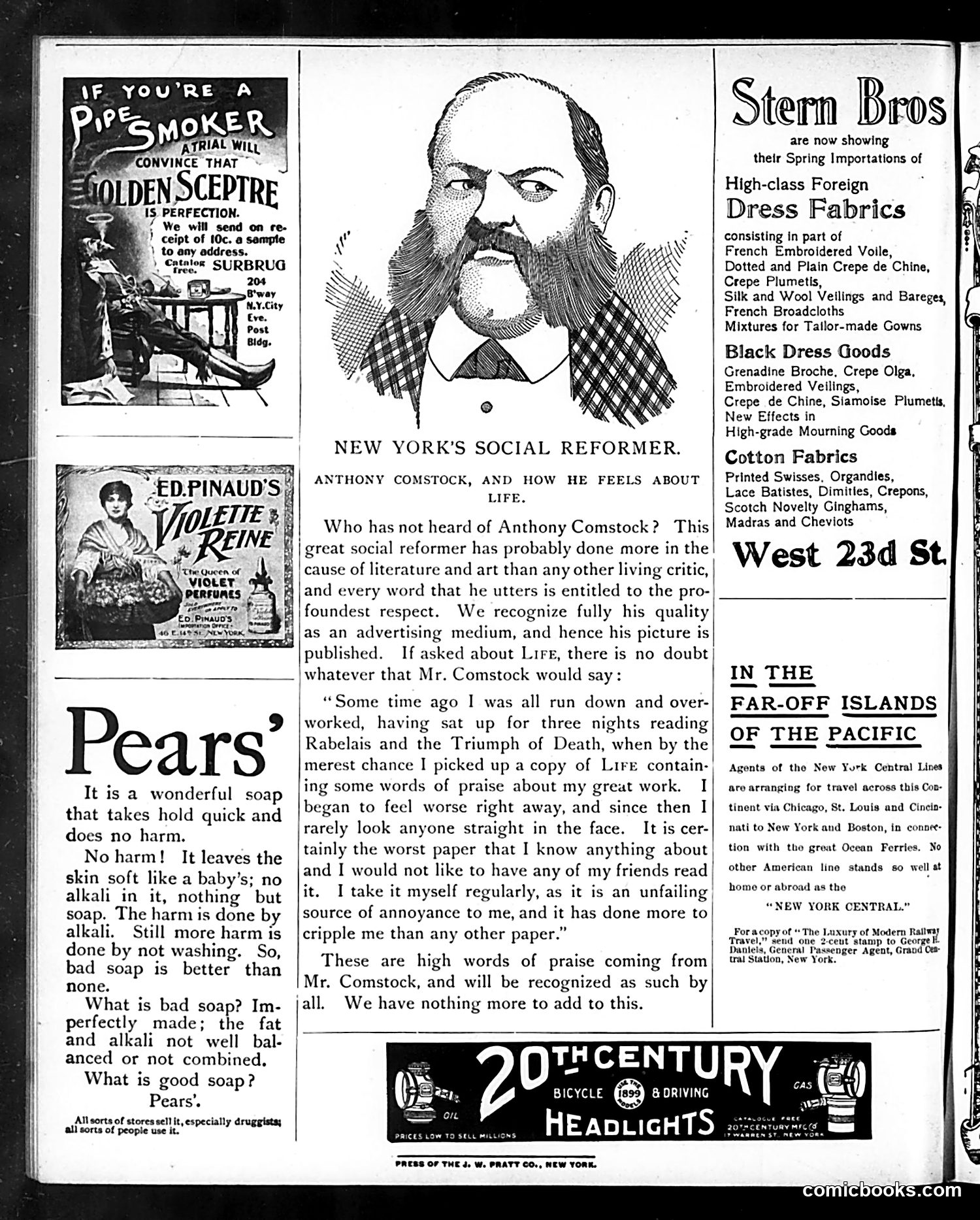
This page satirizes **Anthony Comstock**, a real historical figure and notorious American anti-vice crusader. The central article mocks him through fake praise: Life claims Comstock has done more to suppress literature and art than any living critic. The satire presents a fabricated quote where Comstock admits that reading *Life* magazine—the very publication running the article—causes him distress and "cripples" him more than any other paper. This is ironic backhanded compliment: by insulting *Life*, he's actually endorsing it as so effective at annoying moralists that it must be doing something right. The joke targets Comstock's censorious campaigns against books (mentioning Rabelais, a writer he would have opposed) and his broader moral crusades. Life's editors are essentially trolling their enemy by praising him while getting him to inadvertently recommend their magazine as dangerously anti-establishment. The surrounding ads are standard period commerce, unrelated to the satire.