
Life, 1899-03-16 · page 7 of 20
Life — March 16, 1899 — page 7: what you’re looking at
What you’re looking at
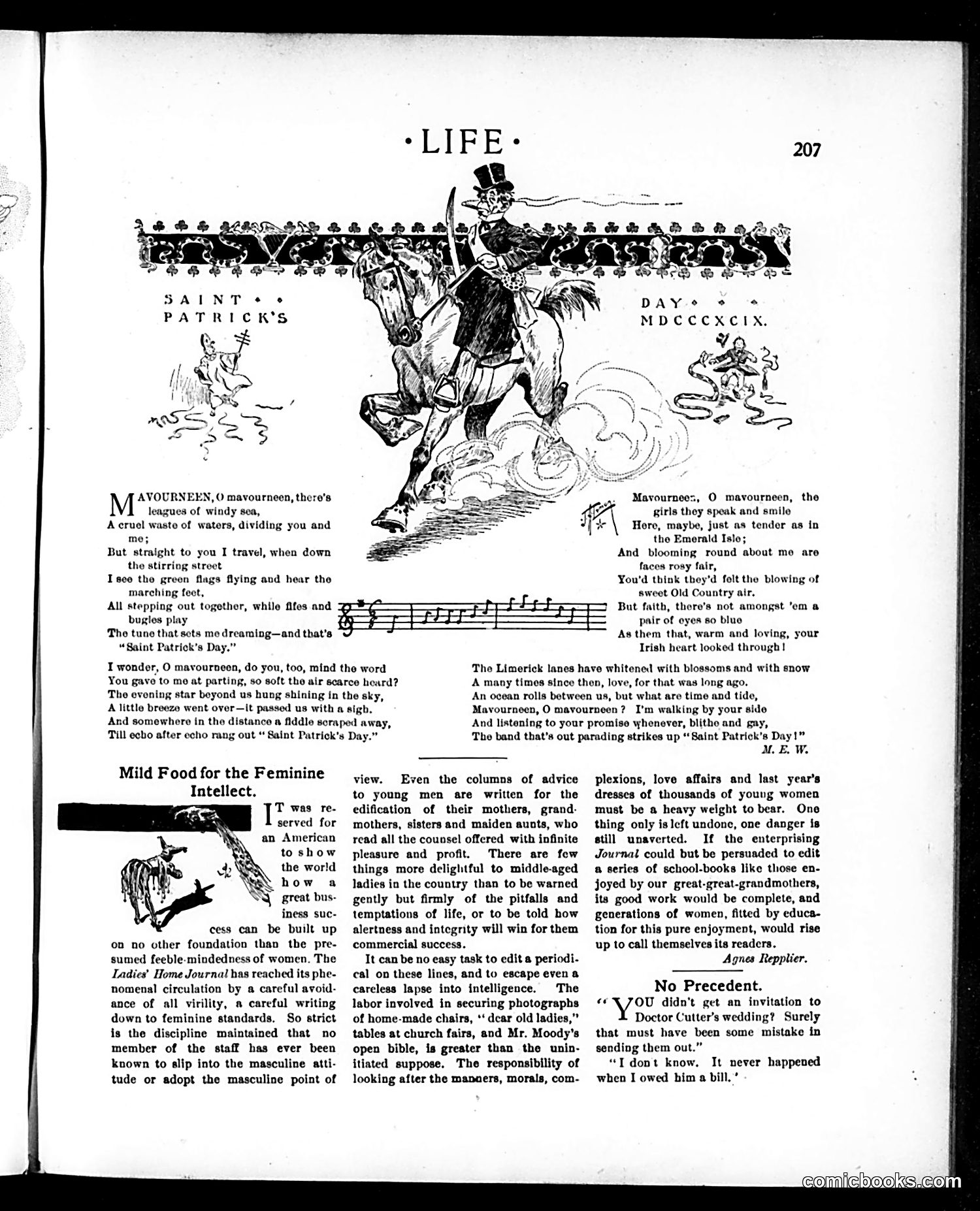
The main illustration depicts a caricatured Irish figure on horseback, wearing a top hat and riding enthusiastically across the page. He's labeled "Saint Patrick's Day" and appears to be leading a celebratory parade, with marching figures visible in the background. The accompanying poem celebrates Irish-American identity and nostalgia for Ireland—referencing "the Emerald Isle," "sweet Old Country air," and "the Lipstick lanes" (likely Dublin streets). The text emphasizes romantic attachment to Ireland while acknowledging the speaker's present American life. The satire appears gentle rather than harsh, celebrating Irish-American culture during the St. Patrick's Day holiday rather than mocking it. The exaggerated, jolly character embodies stereotypical Irish-American enthusiasm and patriotic sentiment.
📄 Transcribed text from this page (OCR, searchable)
Machine-transcribed from the original scan — historical spelling and the odd misread are preserved.
SAINT «¢ © PATRICK*S AVOURNEEN, 0 mavourneen, there's leagues of windy sea, A cruel wasto of wators, dividing you and mo; But straight to you I travel, when down the stirring street Iseo the green flags flying and hear tho marching fect, All stepping out together, while fifes and bugles play Tho tune that sets mo dreaming—and that’s “Saint Patrick's Day.” aoe Se Mavournee:, O mavourneen, the girls they speak and smile Horo, maybe, just as tender as in the Emerald Islo; And blooming round about mo aro faces rosy fair, You'd think tboy’d folt the blowing of sweet Old Country air. But faith, thoro’s not amongst ’em a pair of oyes so blue As them that, warm and loving, your Irish heart looked through! I wonder, O mavourneen, do you, too, mind the word You gavo to mo at parting, so soft tho air scarce heard? Tho ovening star boyond us bung shining in the sky, A little breeze wont over—it passed us with a sigh. And somewhere in the distanco a fiddle scraped away, Till echo after echo rang out “ Saint Patrick's Day.” Tho Limerick lanes have whitened with blossoms and with snow ‘A many timos since then, love, for that was long ago. An ocean rolls between us, but what are time and tide, Mavourneen, O mavourneen ? I'm walking by your side And listening to your promise whenever, blitho and gay, Tho band that’s out parading strikes up “Saint Patrick’s Day!” Mild Food for the Feminine Intellect. T was re- served for an American to show the world how a iness suc- cess can be built up on no other foundation than the pre- sumed feeble-mindedness of women. The Ladies’ Home Journal has reached its phe- nomenal circulation by a careful avoid- ance of all virility, a careful writing down to feminine standards. So strict is the discipline maintained that no member of the staff has ever been known to slip into the masculine atti- tude or adopt the masculine point of view. Even the columns of advice to young men are written for the edification of their mothers, grand- mothers, sisters and maiden aunts, who read all the counsel offered with infinite pleasure and profit. There are fow things more delightful to middle-aged ladies in the country than to be warned gently but firmly of the pitfalls and temptations of life, or to be told how alertness and integrity will win for them commercial success. It can be no easy task to edit a periodi- cal on these lines, and to escape even a careless lapse into intelligence. The labor involved in securing photographs of home-made chairs, *‘ dcar old ladies,” tables at church fairs, and Mr. Moody's open bible, is greater than the unin- itiated suppose. The responsibility of looking after the manoers, morals, com- MEW. plexions, love affairs and last year's dresses of thousands of young women must be a heavy weight to bear. One thing only is lcft undone, one danger is still unaverted. If the enterprising Journal could but be persuaded to edit a series of school-books like those en- joyed by our great-great-grandmothers, its good work would be complete, and generations of women, fitted by educa- tion for this pure enjoyment, would rise up to call themselves its readers. Agnes Repplier. No Precedent. & ‘OU didn't get an invitation to Doctor Cutter’s wedding? Surely that must have been some mistake in sending them out.” “T dont know, when I owed him a bill.’ It never happened