
Life, 1899-03-16 · page 5 of 20
Life — March 16, 1899 — page 5: what you’re looking at
What you’re looking at
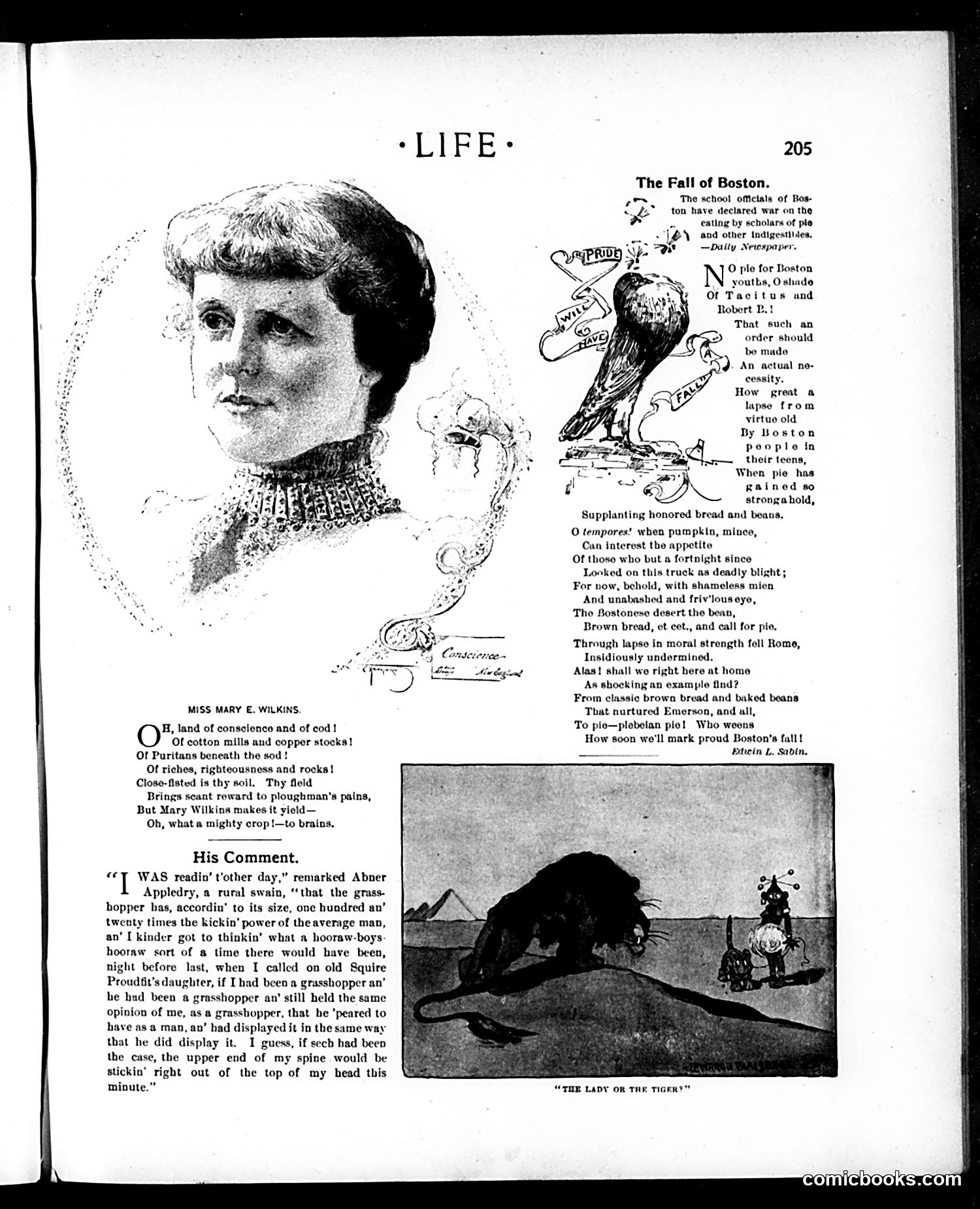
**Portrait Section:** Miss Mary E. Wilkins (a portrait with accompanying verse) celebrates her as representing New England virtue—"land of conscience and of cod" with references to Puritan heritage and cotton mills. **"The Fall of Boston" Cartoon:** A satirical poem mocking Boston's moral decline, featuring an eagle (symbol of American virtue) that appears weakened or corrupted. The text criticizes Boston's abandonment of its historical values, referencing "Tacitus and Robert E." and lamenting how "pumpkin, mince" pies and other commonplace items now define the city instead of its former intellectual and moral standards. **"His Comment":** A humorous anecdote about a grasshopper's physical strength compared to human capability—used as social commentary on masculine prowess and pride. **Bottom Image:** "The Lady of the Tiger"—likely illustrating the famous ambiguous short story by Frank Stockton about choice and consequence.
📄 Transcribed text from this page (OCR, searchable)
Machine-transcribed from the original scan — historical spelling and the odd misread are preserved.
MISS MARY E. WILKINS. H, land of conscience and of cod! Of cotton mills and copper stocks! Of Puritans beneath tho sod! Of riches, righteousness and rocks! Closo-fisted is thy soil, Thy fleld Brings scant reward to ploughman's pains, But Mary Wilkins makes it yield— Oh, what a mighty crop!—to brains. His Comment. «€T WAS readin’ t’other day,” remarked Abner Appledry, a rural swain, “that the grass- hopper has, accordin’ to its size, one hundred an’ twenty times the kickin’ power of the average man, an’ [ kinder got to thinkin’ what a hooraw-boys- hooraw sort of a time there would have been, night before last, when I called on old Squire Proudfit’s daughter, if Thad been a grasshopper an’ he hud been a grasshopper an’ still held the same opinion of me, as a grasshopper, that he ‘peared to have as a man, an’ had displayed it in the same way that he did display it. I guess, if sech had been the case, the upper end of my spine would be stickin’ right out of the top of my bead this minute.” 205 The Fall of Boston. ros ‘Tho school officials of Bos- <4" ton have declared war on the ~ eating by scholars of ple ~ [BY and other indigestities, er —Daity Newspaper. O pie for Boston youths, O shade Of Tacitus and Robert P.! That such an order should be made An actual ne- cessity. How great a lapse from virtue old By Boston poople in their teens, When pie has Rained 80 strongahold, Supplanting honored bread and beans, O tempores! when pumpkin, minco, Can interest the appetite Of thoso who but a fortnight since Looked on this truck as deadly blight; For now, behold, with shameless mien And unabashed and friv'lous eye, Tho Bostonese desert the bean, Brown bread, et cet., and call for pio. Through lapso in moral strength fell Romo, Insidiously undermined. Alas! shall wo right bere at homo As shocking an example find? From classic brown bread and baked beans That nurtured Emerson, and all, To pio—plebelan pio! Who weens How soon we'll mark proud Boston’s fall! Edwin L, Sabin, “TOE LADY OR THE TIGER?”