
Life, 1899-03-16 · page 12 of 20
Life — March 16, 1899 — page 12: what you’re looking at
What you’re looking at
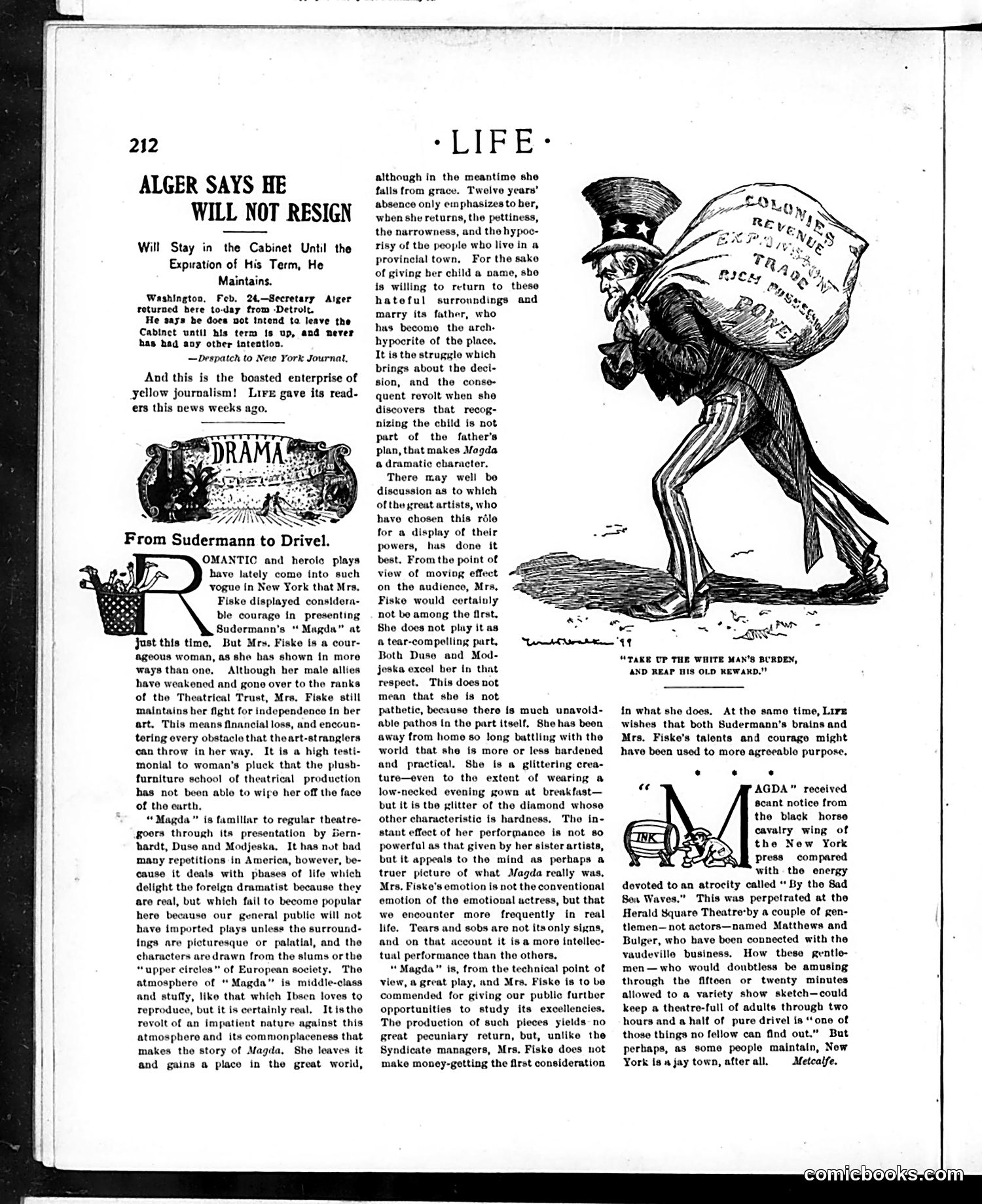
The prominent cartoon depicts **Uncle Sam** carrying a large bundle labeled "Colonies Revenues" and "Trade," illustrating **American imperialism** and colonial exploitation. The caption reads "Let Up the White Man's Burden, and Reap His Old Reward," sarcastically referencing Rudyard Kipling's famous poem "The White Man's Burden," which justified colonial expansion as a civilizing mission. This image critiques American acquisition of overseas territories (likely referring to colonies gained after the Spanish-American War). The cartoon suggests that rather than noble uplift, colonialism was fundamentally about extracting wealth and resources for American benefit. The page also contains theater reviews criticizing the play "Magda," praising actress Mrs. Fiske's performance while debating the play's artistic merit.
📄 Transcribed text from this page (OCR, searchable)
Machine-transcribed from the original scan — historical spelling and the odd misread are preserved.
212 ALGER SAYS HE WILL NOT RESIGN Will Stay in the Cabinet Until the Expiration of His Term, He Maintains. Washingtoo, Feb. 24,—Secretary Alger roturned here to-day from -Detrolt. He says be does not Intend to leave the Cabinet until his term {s up, and never has had any other intentlon. —Despatch to New York Journat, And this is the boasted enterprise of yellow journalism! Lire gave its read- ers this news weeks ago. OMANTIC and herofe plays have lately come into such vogue in New York that Mrs, Fiske displayed considera- ble courage in presenting Sudermann’s “ Magda” at just this time, But Mrs. Fiske ts a cour- ageous woman, as she has shown in more ways than one, Although her male allies. have weakened and gone over to the ranks of the Theatrical Trust, Mrs, Fiske still maintains her fight for independence in ber art, This means financial loss, and encoun- tering every obstacle that theart-stranglers can throw inher way. It is a high testi- monial to woman's pluck that the plusb- furniture school of theatrical production has not been able to wire her off the face of the earth, “Magda” is famillar to regular theatre- goors through its presentation by Bern- hardt, Duse and Modjeska, It has not bad many repetitions in America, however, be- cause it deals with pbases of life which delight the foreign dramatist because they are real, but which fail to become popular here because our general public will not have imported plays unless the surround- ings are picturesque or palatial, and tho characters aredrawn from the slums orthe “upper circles" of European society, Tho atmosphero of “Magda” is middle-class and stuffy, like that which Ibsen loves to reproduce, but it is certainly real. Itistho revolt of an impatient nature against this atmosphere and its commonplaceness that makes the story of Magda, She leaves it and gains a place in the great world, ‘LIFE: although in the meantimo she falls from grace, Twelve years’ absence only emphasizes to her, when she returns, the pettiness, the narrowness, and the hypoc- risy of the people who live in a provincial town, For the sake of giving ber child a name, sho is willing to return to these hateful surroundings and marry its father, who has become the arch- hypocrite of the place, It is tho struggle which brings about the deci- sion, and the conse- quent revolt when sho discovers that recog- nizing the child is not part of the father’s plan, that makes Magda a dramatic character. There may well be discussion as to which of the great artists, who have chosen this réle for a display of their powers, has done it best. From the point of view of moving effect on the audience, Mrs, Fiske would certainly not be among the first, She does not play it as a tear-compelling part, Both Duse and Mod- jeska excel ber in that respect, This does not mean that she is not pathetic, because there is much unavold- able pathos In the part itself, She has been away from homo so long battling with the world that she is more or less bardened and practical. She is a glittering crea- ture—even to tho extent of wearing a low-necked evening gown at breakfast— but it is the glitter of the diamond whose other characteristic is hardness, The in- stant effect of her performance is not so powerful as that given by her sister artists, but it appeals to the mind as perhaps a truer picture of what Magda really was, Mrs, Fiske's emotion is not the conventional emotion of the emotional actress, but that we encounter more frequently in real life. Tears and sobs are not its only signs, and on that account it is a more intellec- tual performance than the others, “ Magda” is, from the technical point of view, a great play, and Mra, Fiske is to be commended for giving our public further opportunities to study its excellencies. The production of such pieces yields no great pecuniary return, but, unlike the Syndicate managers, Mrs. Fiske does not make money-gotting the first consideration “TAKE UP THE WHITE MAN'S BURDEN, AND REAP 118 OLD REWARD.” in what she does, At the same time, Lirz wishes that both Sudermann’s brains and Mrs, Fiske's talents and courage might havo been used to more agreeable purpose. AGDA” received scant notice from the black horse cavalry wing of the New York press compared with the energy dovoted to an atrocity called “ By the Sad Soa Waves.” This was perpetrated at tho Herald Square Theatre-by a couple of gen- tlemen—not actors—named Matthows and Bulger, who have been connected with tho vaudeville business, How these gentle- men—who would doubtless be amusing through the fifteen or twenty minutes allowed to a variety show sketch—could keep a theatro-full of adults through two hours and a halt of pure drivel is “ono of those things no fellow can find out.” But perhaps, as some people maintain, Now York is ajay town, afterall, Metcalfe.