
A complete issue · 20 pages · 1899
Life — February 23, 1899
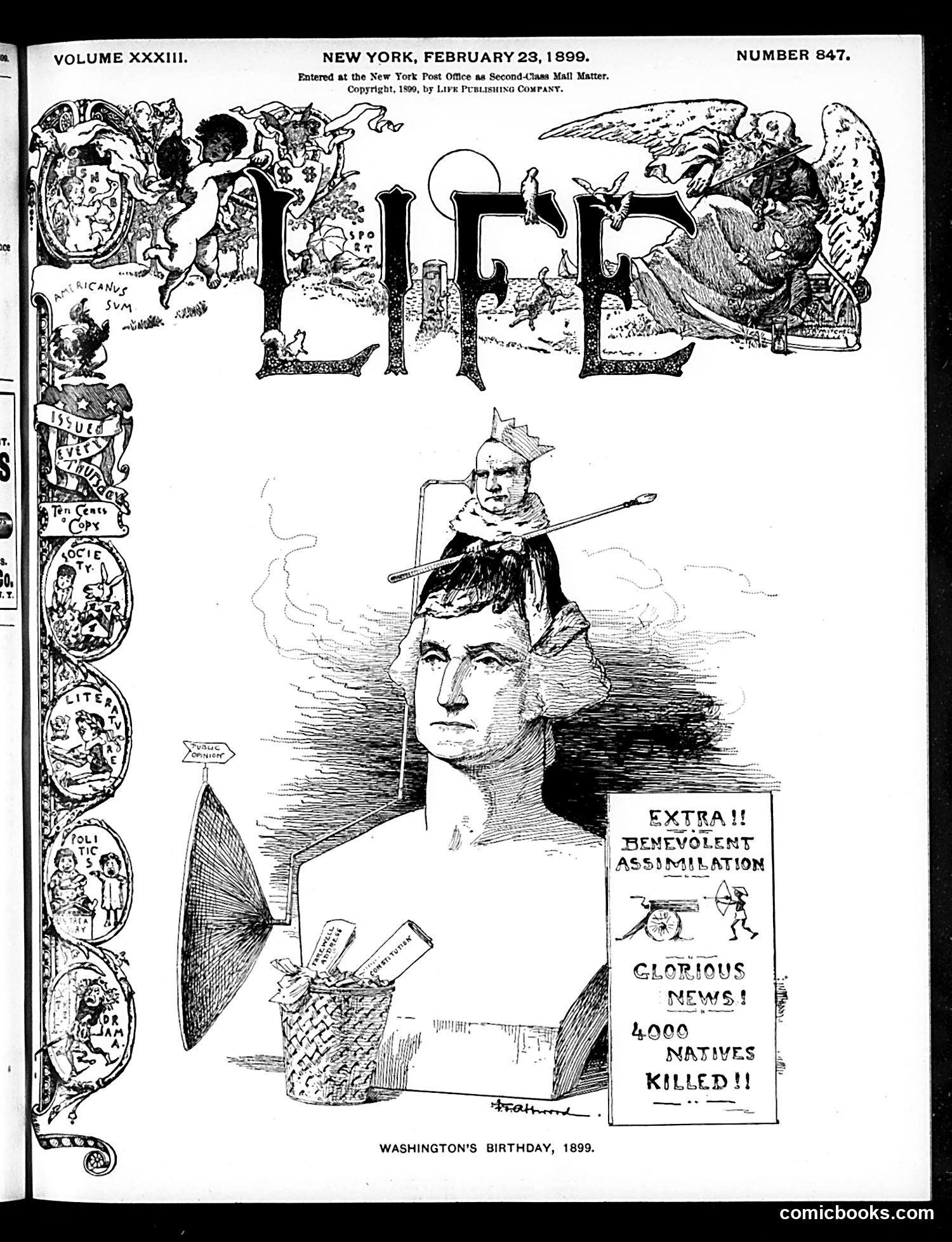
This satirical cartoon commemorates Washington's Birthday (1899) through a grotesque visual pun. A large head—appearing to represent George Washington or American leadership generally—sprouts a tiny uniformed soldier figure on top, wielding a rifle as if it were a hair ornament or plume. The accompanying text box announces "EXTRA!! BENEVOLENT ASSIMILATION" and "GLORIOUS NEWS! 4000 NATIVES KILLED!!" This references the Philippine-American War (1899-1902), mocking President McKinley's euphemistic phrase "benevolent assimilation" for colonial expansion. The satire criticizes American military aggression in the Philippines as contradicting Washington's legacy, while the grotesque imagery suggests the absurdity and moral corruption of the colonial project. The magazine presents this as darkly comedic commentary on American imperialism.
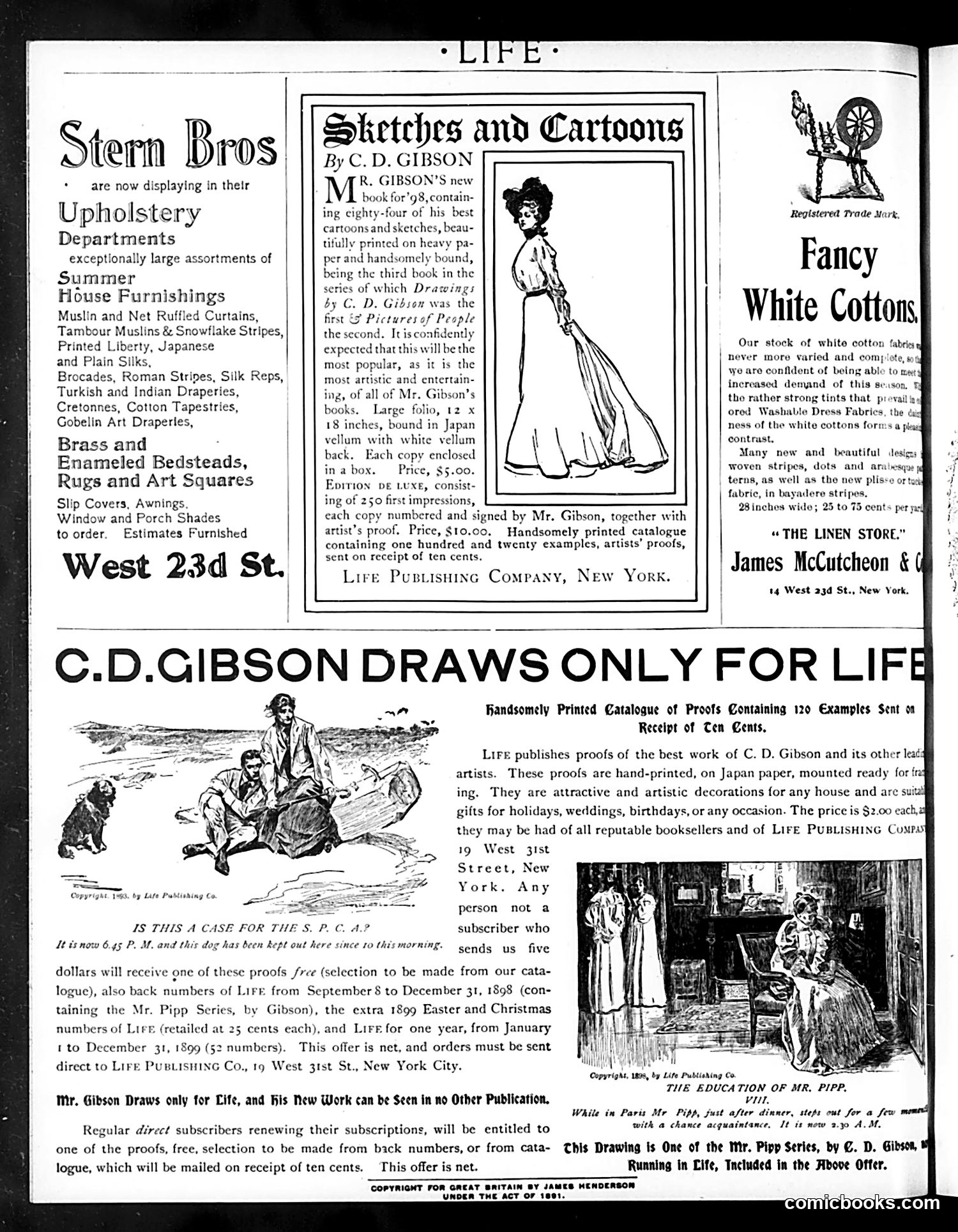
This page is primarily **advertising and promotional content** rather than political satire. The main elements are: 1. **Stern Bros. advertisement** (left): promoting summer house furnishings and upholstery goods 2. **C.D. Gibson promotion** (center): advertising a new book of his sketches and cartoons, with an elegant illustrated woman 3. **James McCutcheon & Co. advertisement** (right): promoting white cotton fabrics 4. **"C.D. Gibson Draws Only for Life"** (bottom): a large promotional section claiming Gibson's work appears exclusively in Life magazine, with sample cartoon showing figures outdoors The cartoons shown are decorative society sketches typical of Gibson's "Gibson Girl" style—fashionable, genteel subjects rather than political commentary. The page functions as a marketing tool establishing Life's prestige by featuring its exclusive relationship with the popular illustrator C.D. Gibson.
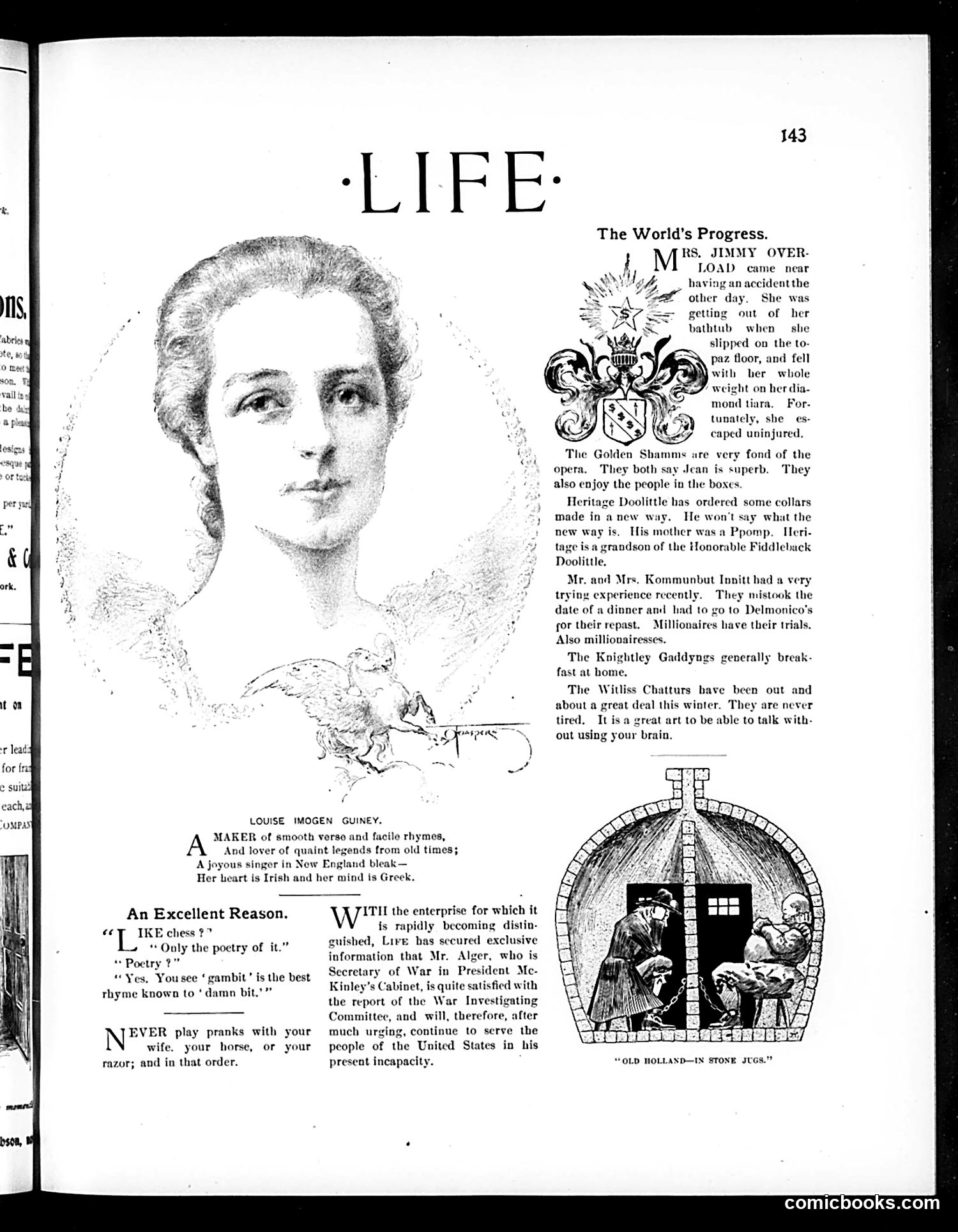
This page contains **social gossip and humor** rather than political satire. The main content includes: **"The World's Progress"** section: Brief society news items about upper-class figures—Mrs. Jimmy Overload's accident, the Golden Shams' opera attendance, Heritage Doolittle's fashion innovations, and the Kommanbust family's dining mishap. These appear to be **fictional satirical names** mocking wealthy society types and their trivial concerns. **Louise Imogen Guiney portrait**: A biographical sketch of the poet and writer, praising her work with Irish and Greek themes. **"An Excellent Reason"** and **"Old Holland—In Stone Jug"**: Brief humorous anecdotes unrelated to current events. The page's satire targets **upper-class social vanity and pretension** through invented society names and trivial gossip, typical of Life magazine's humor genre.
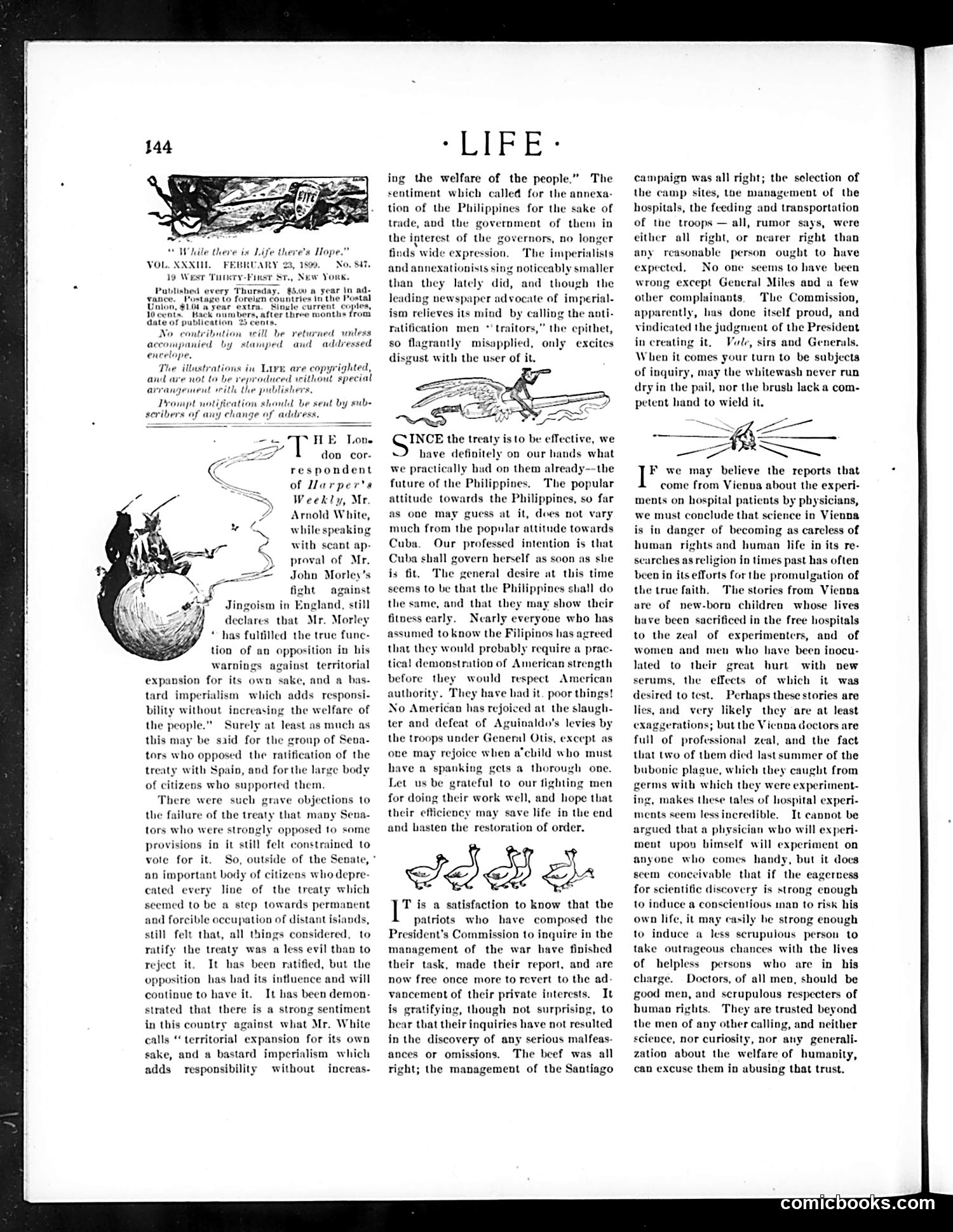
This page contains political commentary on U.S. imperialism and the Philippine-American War. The text critiques American expansion, referencing debates over Philippine governance and territorial control. It mentions "Mr. Arnold White" discussing imperialism and "Mr. John Morley's" opposition to territorial expansion. The small illustrations appear to be decorative elements rather than specific political cartoons—they show birds and insects typical of Life's ornamental style. The editorial argues against American imperial adventures, warning that imperialism undermines stated democratic values. It defends critics of expansionism and expresses concern about experiments on human subjects in Vienna hospitals, connecting medical ethics to broader questions about respecting human rights. The tone is satirical, mocking imperial justifications while defending anti-imperial senators and questioning American conduct.
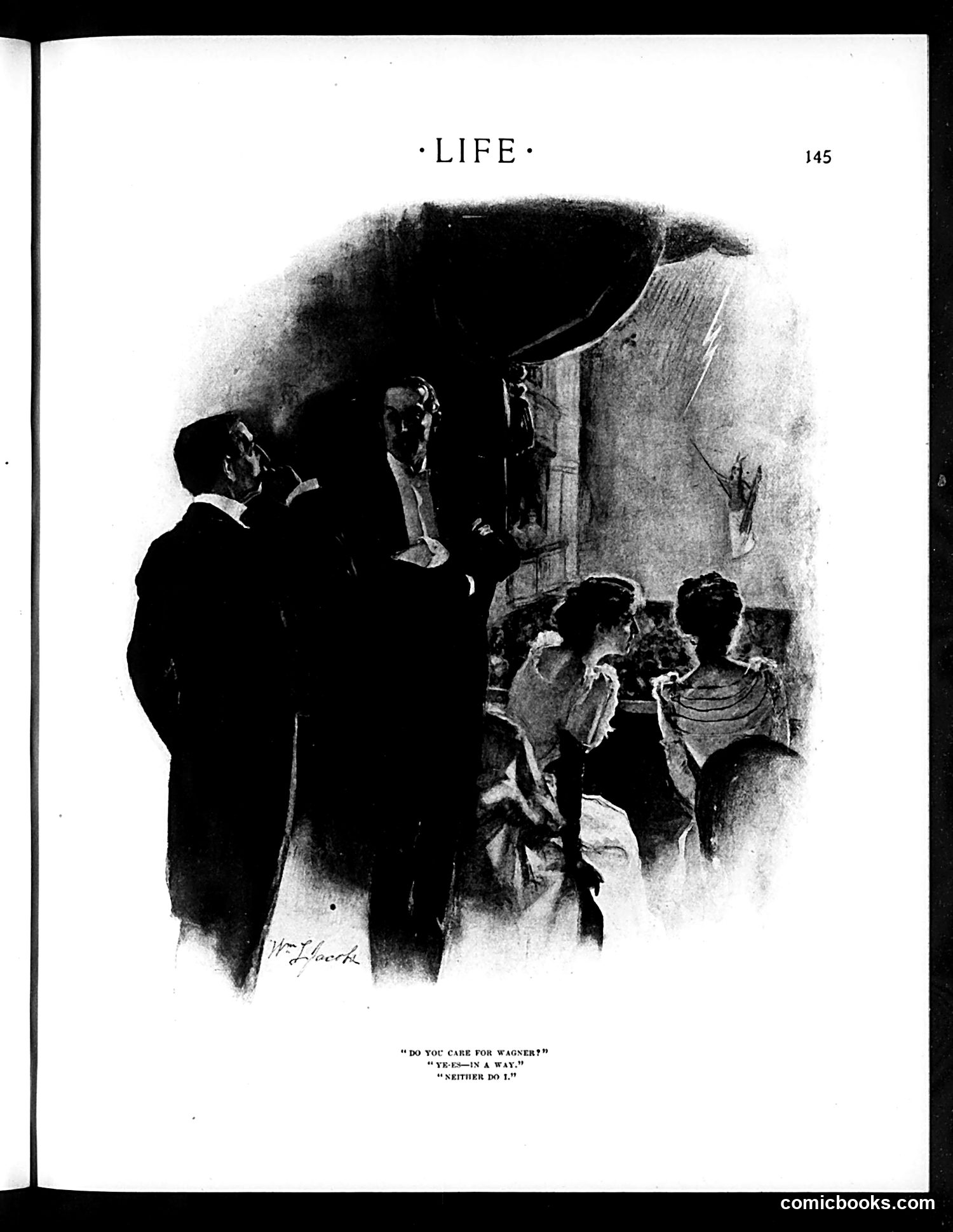
This Life magazine page (page 145) contains a satirical cartoon depicting what appears to be a political or social scene. The image shows well-dressed men in formal attire (likely representing authority figures or politicians) speaking with working-class individuals, including women and children in simpler clothing. The caption reads: "DO YOU CARE FOR WAGNER?" / "YES—IN A WAY." / "NEITHER DO I." This likely references Wagner labor legislation—possibly the National Labor Relations Act (Wagner Act) of 1935, which protected workers' rights to organize. The joke appears to satirize politicians who claim indifference to labor protections while speaking with working people, mocking their hypocrisy or the gap between political rhetoric and actual policy positions on worker welfare during this labor-contentious era.
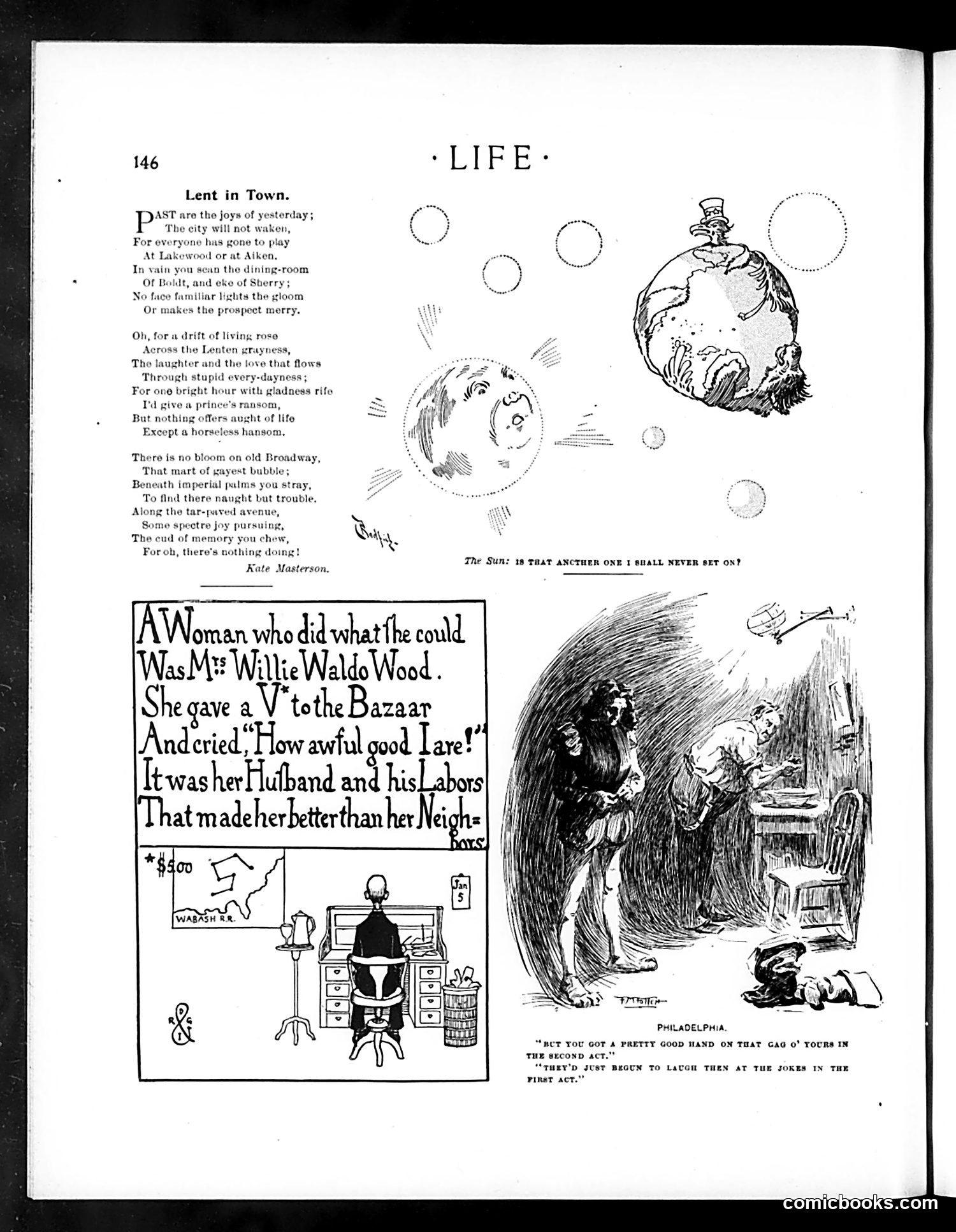
This page contains poetry and satirical illustrations reflecting early 20th-century urban life and social commentary. **"Lent in Town"** by Kate Masterson is a poem lamenting the emptiness of city life during Lent—when wealthy residents leave for country estates (Lakewood, Aiken), leaving the city spiritually and socially barren. **The Willie Waldo Wood cartoon** appears to satirize wealth disparities, describing a wealthy woman whose husband's labor made her superior to neighbors—likely mocking class pretensions and the nouveau riche. **The Philadelphia illustration** shows what appears to be a theatrical scene with dialogue about stage performance, likely referencing contemporary theater or vaudeville. **The celestial imagery** at top (the sun and moon as faces) suggests philosophical commentary on constancy versus change. The overall tone critiques urban materialism and social artificiality.
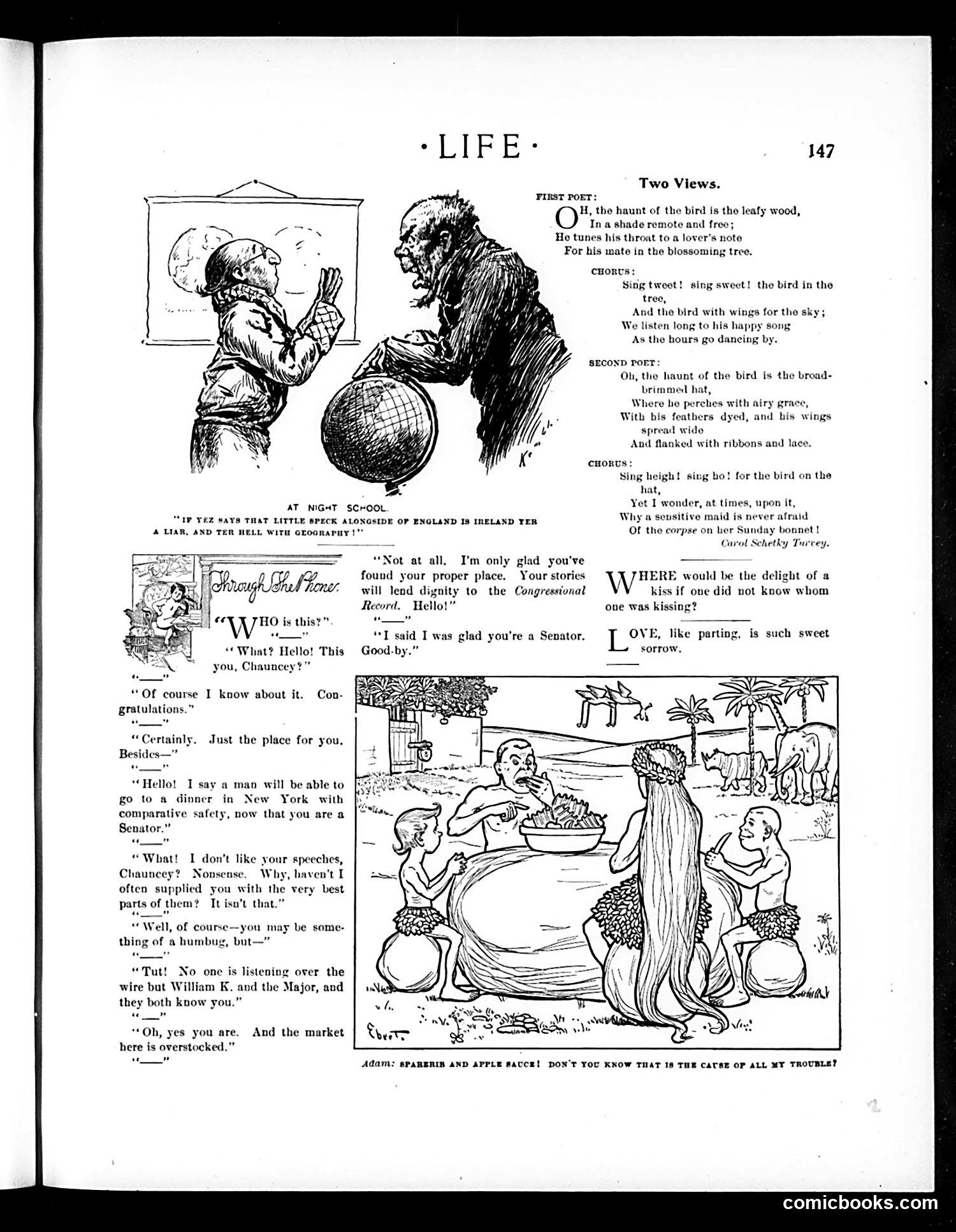
This cartoon satirizes a senator's claim that "if tee says that Linen speck of England is Ireland, ter a liar, and ter hell with geography!" The joke targets the senator's geographical ignorance—he apparently conflates Ireland and England, yet speaks with confident authority. The dialogue shows a working-class character (possibly an immigrant or laborer) congratulating the senator on his position, only to be rebuffed for lacking proper credentials. The satire mocks both the senator's blustering incompetence and his class pretension—he dismisses someone's genuine knowledge while being geographically illiterate himself. The "at night school" caption suggests the senator should return to basics education. This reflects Progressive Era criticism of political figures lacking substantive knowledge.
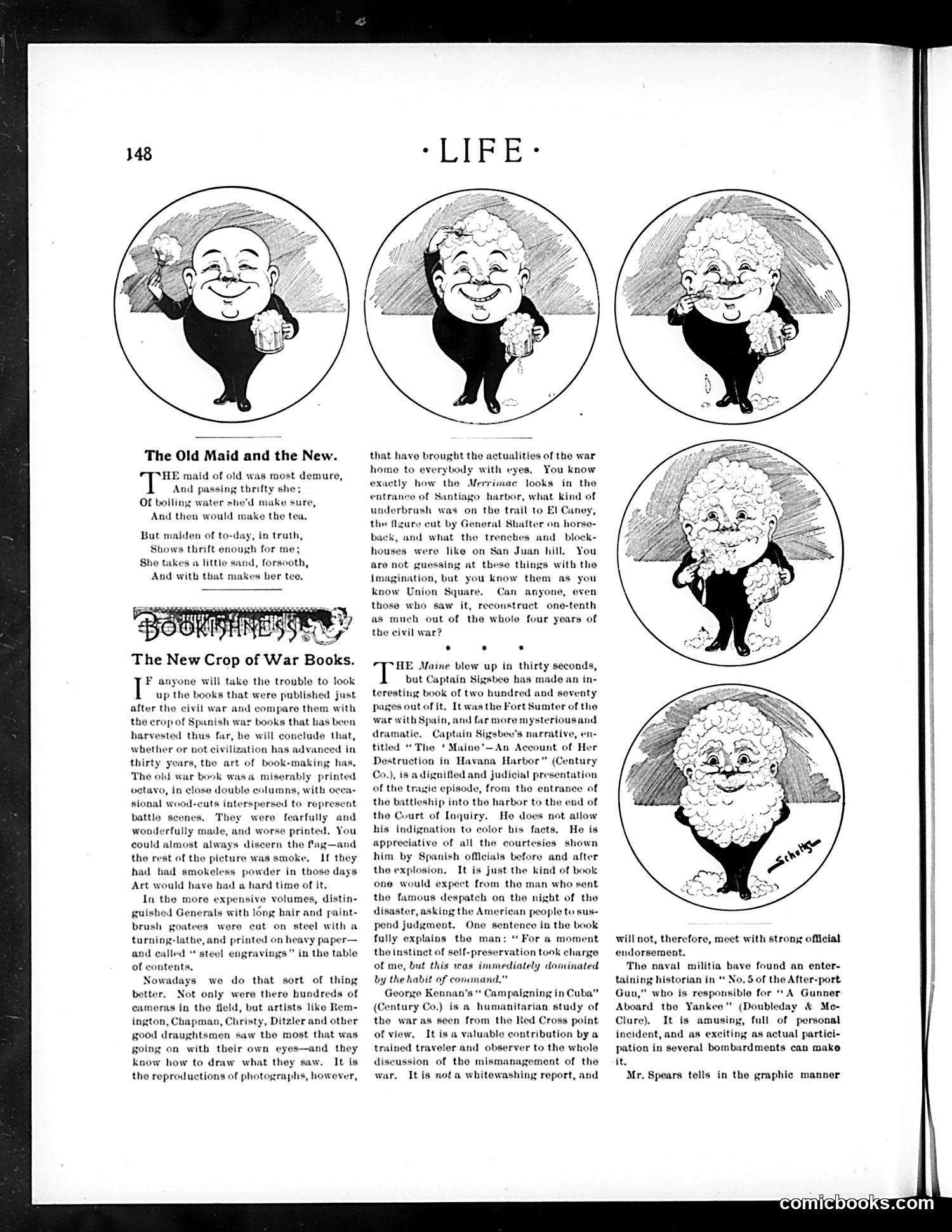
This page contains three sections: a poem titled "The Old Maid and the New," a book review section called "The New Crop of War Books," and four cartoon illustrations of a rotund, smiling character holding a beer mug. The cartoons appear to satirize post-WWI attitudes. The character—likely representing a German or Austrian—is depicted in four poses, all cheerfully drinking beer despite wartime destruction. The accompanying text discusses newly published war narratives, including Captain Sigsbee's account of the *Maine's* destruction in Havana Harbor (referencing the 1898 Spanish-American War) and other war books gaining popularity after World War I. The satire suggests: despite the horrors documented in these war accounts, certain populations remained unbothered and continued enjoying life's pleasures, oblivious to or unconcerned with the suffering war caused.
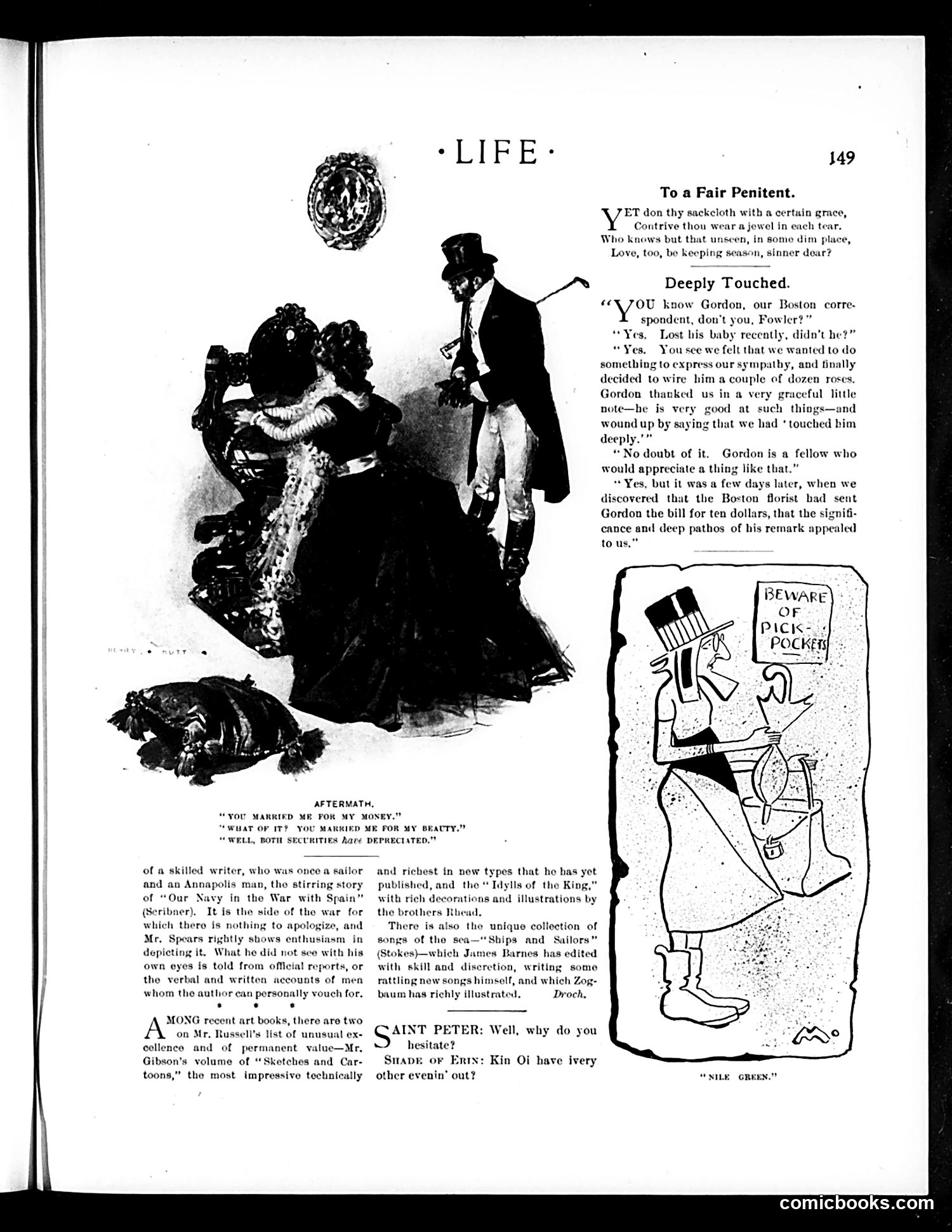
The main illustration titled "Aftermath" depicts a couple in formal dress after what appears to be a financial dispute—the caption reads "You married me for my money," "What of it? You married me for beauty," "Well, both securities have depreciated." This satirizes marriage during economic hardship, likely the post-WWI period or Great Depression era, suggesting both partners' "assets" (wealth and beauty) have diminished in value. The small cartoon "Beware of Pickpockets" shows a pickpocket warning someone to be careful—an ironic reversal where the thief lectures about theft. The surrounding text discusses recent art books and literary works, making this primarily a satirical social commentary page rather than political commentary. The humor targets marital economics and crime rather than specific politicians or events.
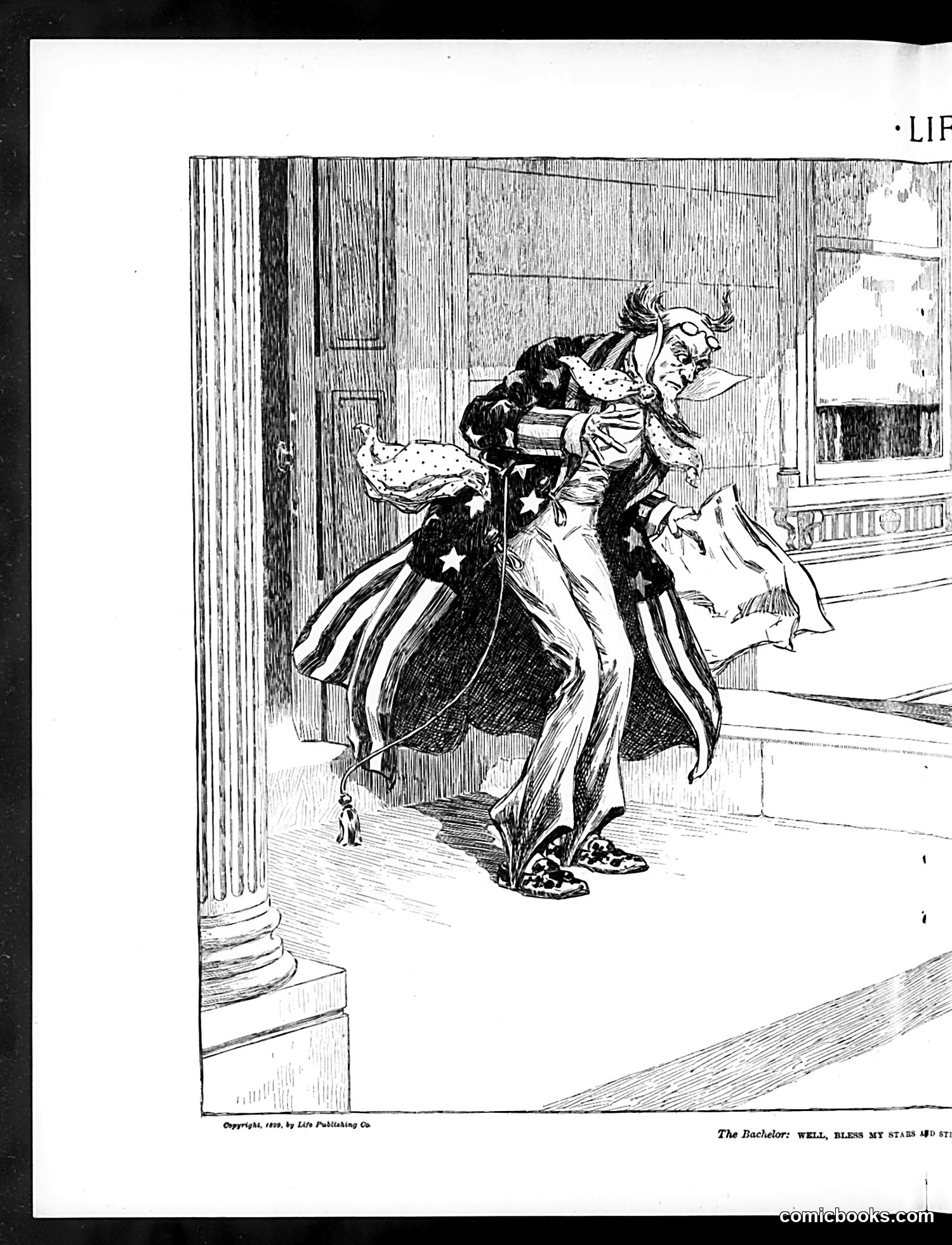
This is a satirical illustration titled "The Bachelor: Well, Bless My Stars and S[tars]" (text cut off). The cartoon depicts a caricatured male figure in an exaggerated pose, wearing a star-spangled cape or cloak and what appears to be formal attire, striking a dramatic stance in an ornate interior setting with classical columns. The satire likely mocks bachelor lifestyle or unmarried men, given the title. The star-spangled imagery and theatrical posturing suggest pomposity or self-importance being ridiculed. The specific political or social reference remains unclear without additional context, though the elaborate costume and dramatic gesture indicate the figure is meant to appear absurdly pretentious or vain. The copyright attribution reads "Life Publishing Co."
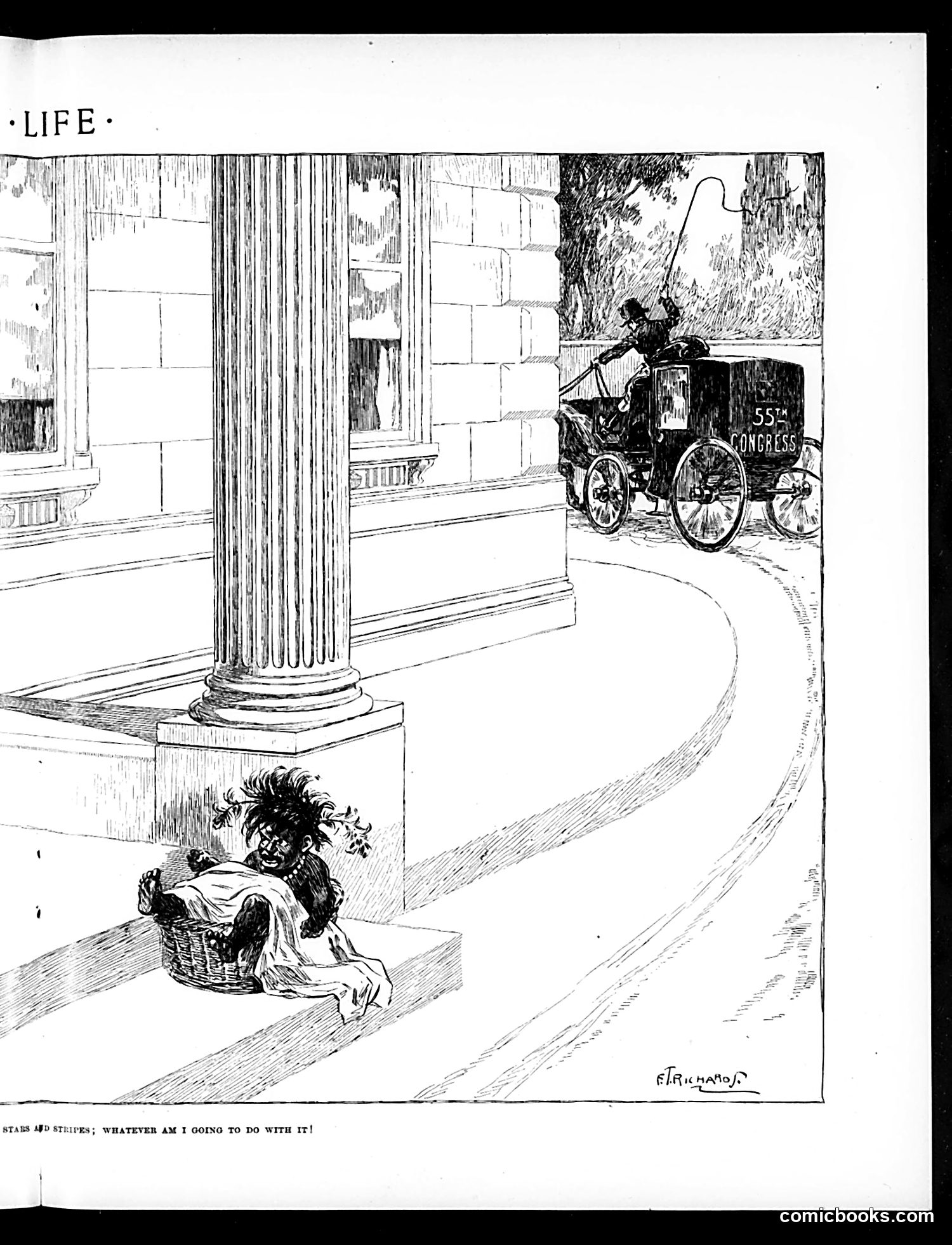
This Life magazine illustration depicts social class contrast through stark visual juxtaposition. In the foreground, a disheveled beggar sits in a basket near a classical column, appearing impoverished and desperate. In the background, a well-dressed figure operates a motorized "Congress" delivery wagon—suggesting wealth, progress, and modern commerce. The caption reads "RAGS AND RICHES; WHATEVER AM I GOING TO DO WITH IT!"—likely sarcastic commentary on wealth disparity and economic inequality during the early 20th century. The cartoon satirizes the coexistence of extreme poverty alongside industrial prosperity and political/commercial advancement (represented by "Congress"). The artist questions what society will do about this stark inequality, using the contrast between transportation methods (immobile beggar versus motorized vehicle) to emphasize their different social positions.
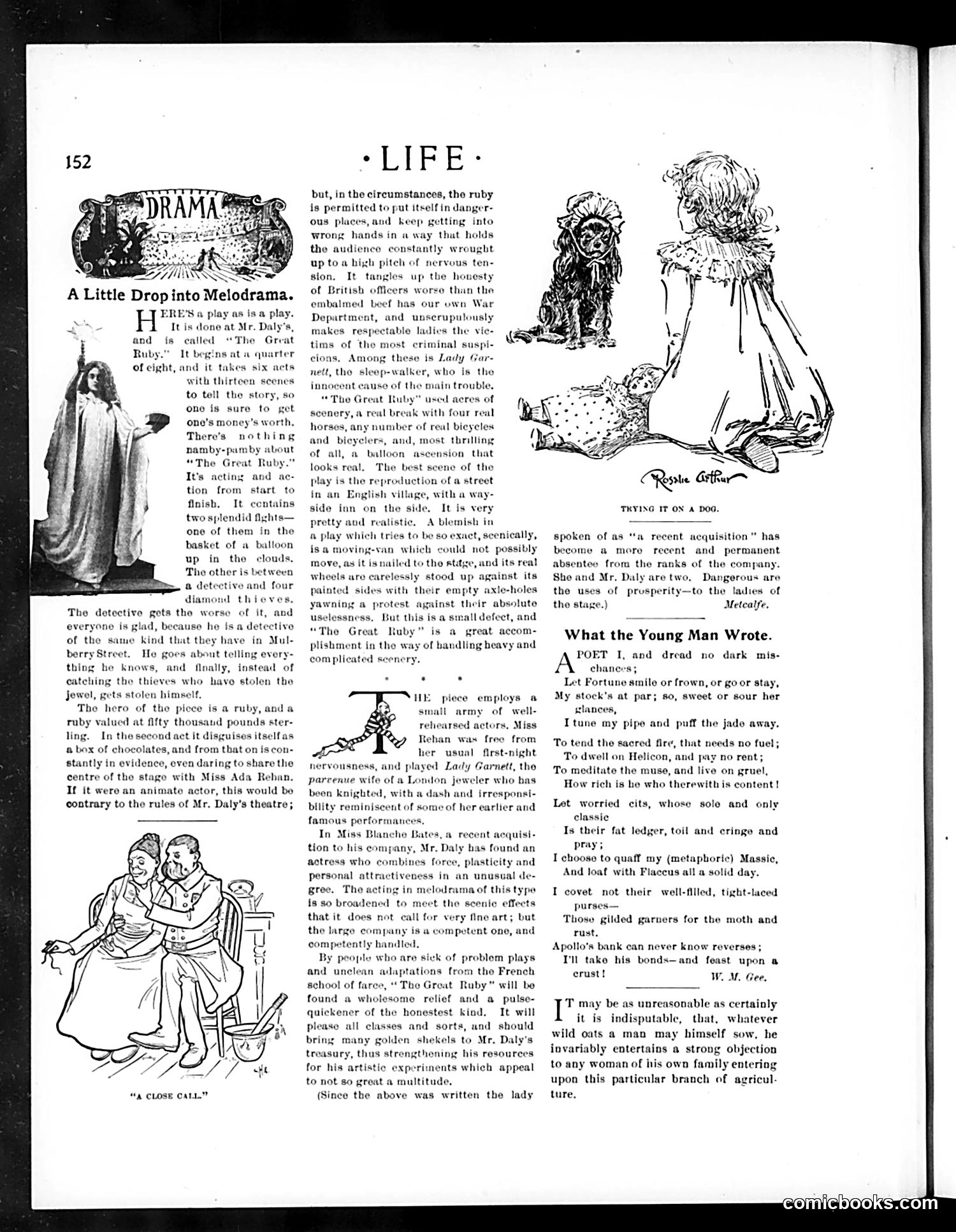
This page from *Life* magazine contains theater reviews. The main cartoon titled "A Little Drop into Melodrama" critiques theatrical productions of the era. The text discusses "The Great Ruby," a melodrama at Mr. Daly's theater featuring actress Miss Reihan. The review satirizes the play's absurd plot devices—stolen jewels, a detective protagonist, and overwrought scenery including "a street in an English village" with a "way-side inn." The accompanying illustrations mock melodramatic acting and staging conventions. One sketch labeled "Trying it on a Dog" depicts an actress demonstrating her performance to an animal, satirizing the artificiality of theatrical gestures. The reviews criticize how melodramas relied on heavy-handed props, complicated machinery, and implausible scenarios rather than genuine artistry—a common complaint about popular entertainment of the period.
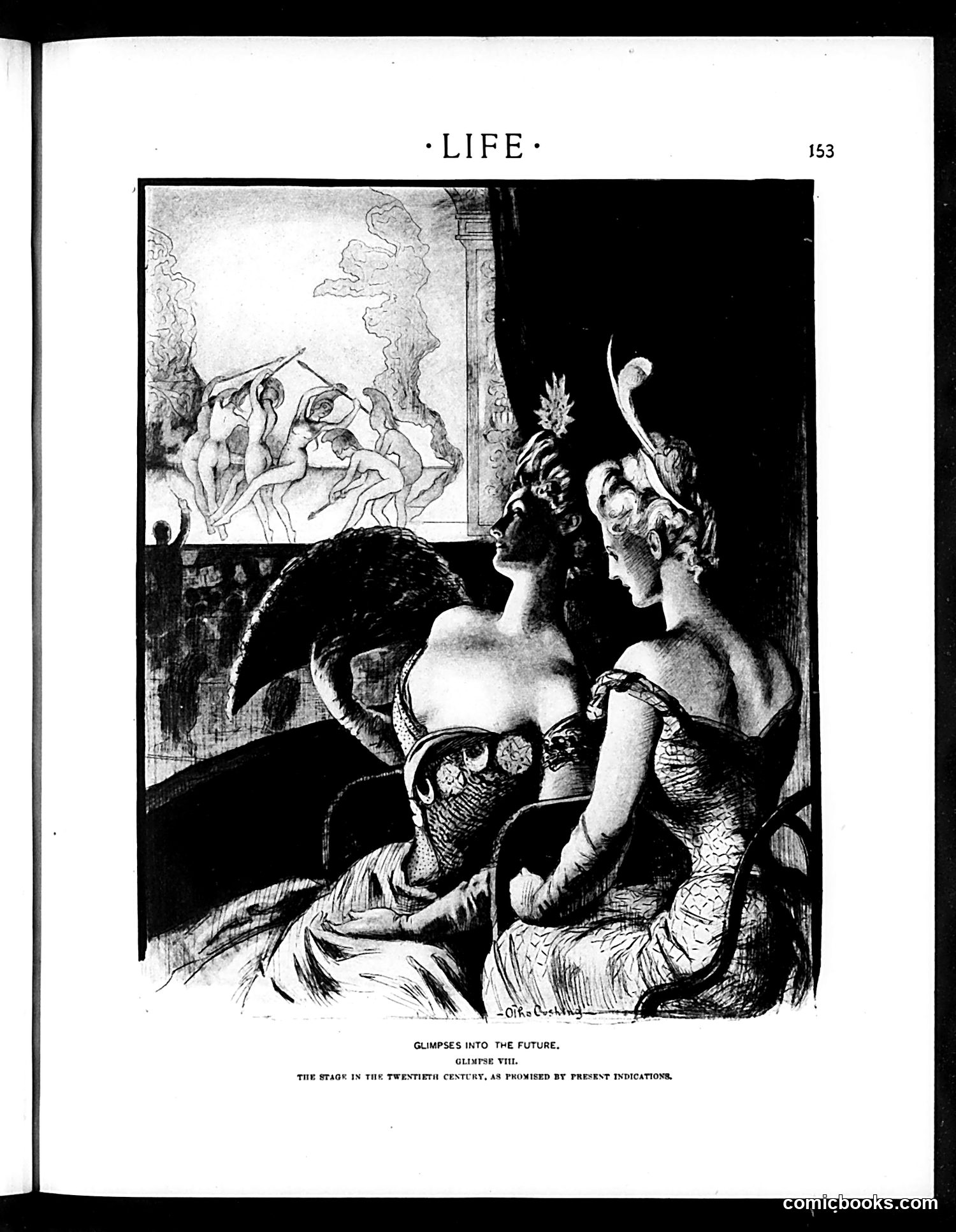
This satirical illustration imagines theatrical entertainment in the future (the 20th century, from Life's perspective). Two elaborately costumed women with feathered headdresses sit in the foreground, apparently as audience members or performers. Behind them, a stage depicts simplified nude figures engaged in what appears to be primitive or chaotic action. The satire likely critiques contemporary trends in theater—suggesting that if current trajectories continue, future stage productions will devolve into increasingly crude, minimalist performances stripped of artistry and decorum. The contrast between the women's ornate costumes and the bare figures on stage emphasizes this degradation. The work reflects turn-of-the-century anxieties about modernism and cultural decline, using theatrical evolution as a vehicle for social commentary on changing standards of taste and propriety.
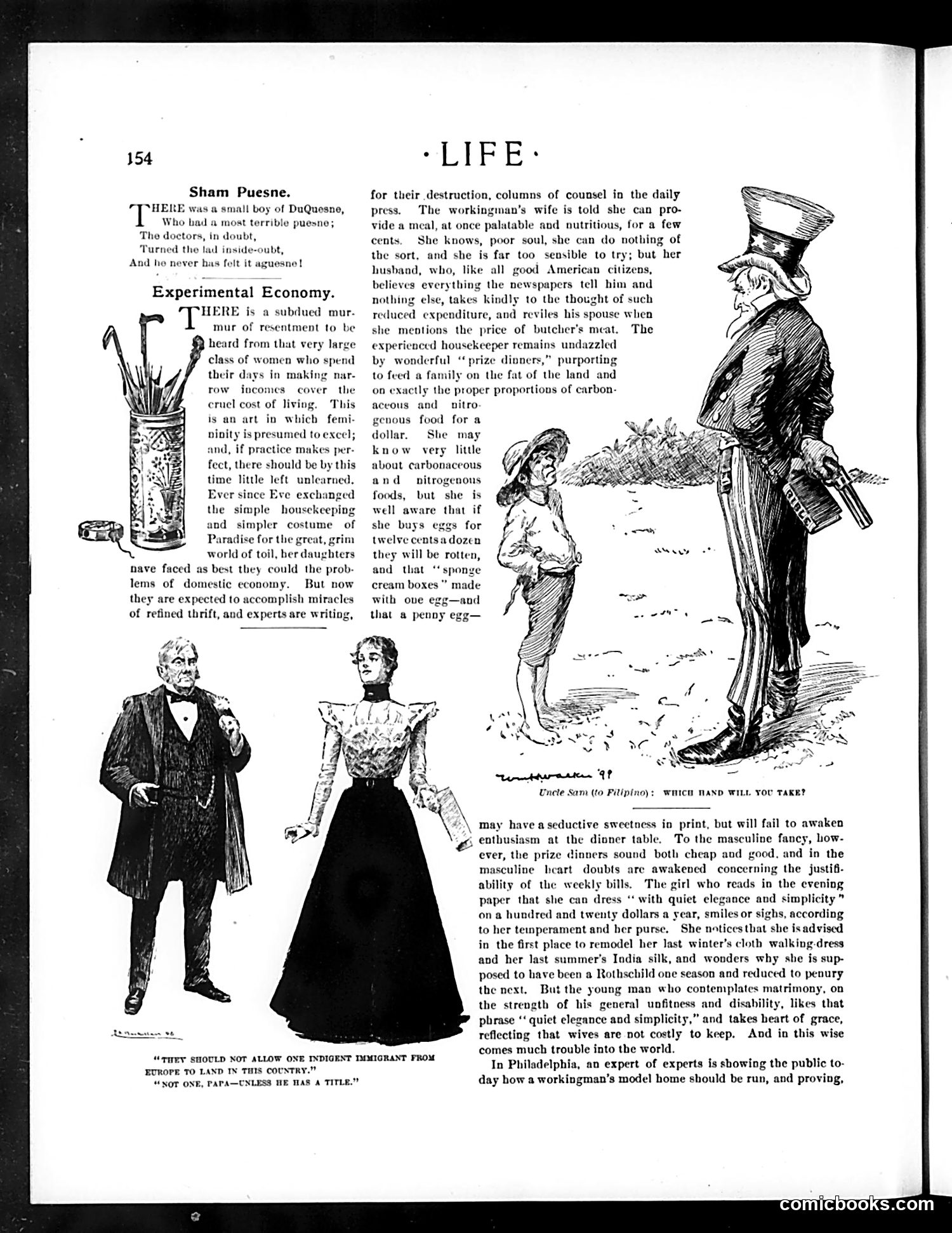
This page contains two satirical pieces: **"Sham Puesne"** is a humorous limerick mocking a boy from DuQuesne with a persistent ailment. **"Experimental Economy"** satirizes advice columns promoting impossibly cheap meal plans for working-class families. The text criticizes how newspapers sell husbands on "prize dinners" costing mere cents, making wives seem wasteful for actual grocery expenses. The satire targets both the unrealistic expert advice and husbands who believe newspaper claims over their wives' domestic experience. **The cartoon** shows Uncle Sam offering a Filipino figure a choice between two hands—likely referencing the Philippine-American War and American imperialism. The caption quote about not allowing "indigent immigrants" unless they have a "title" satirizes American class prejudice and selective immigration attitudes. The page overall mocks three targets: false economy schemes, credulous male consumers of newspaper advice, and American imperial pretensions—typical themes for Life's satirical approach.
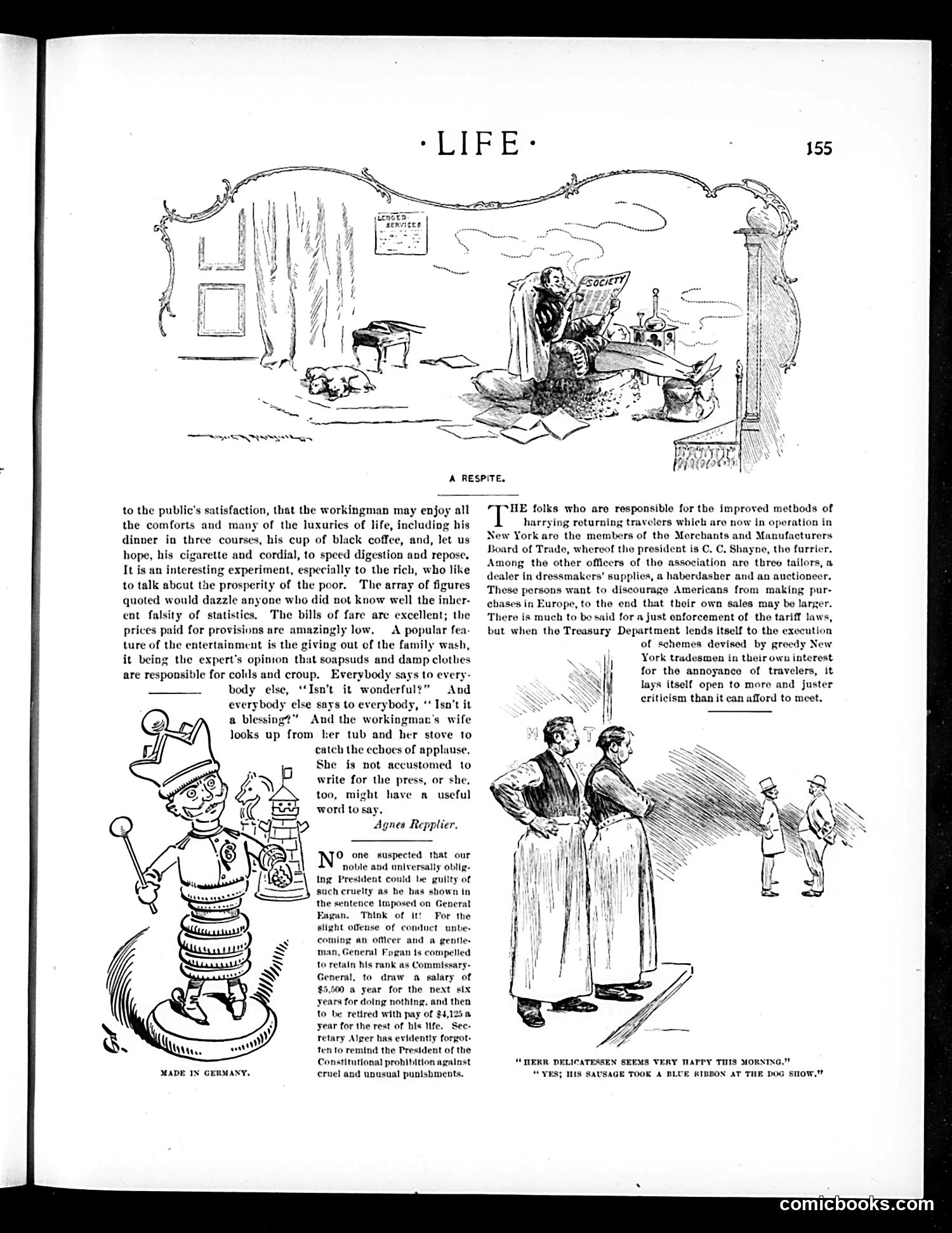
This *Life* magazine page contains two distinct satirical pieces: **"A Respite"** (top): Agnes Repplier's essay mocks the celebration of workers' improved conditions as hollow propaganda. She argues that statistics about workingmen enjoying three-course dinners and luxuries are deliberately misleading, designed to impress the rich while the workingman's wife—exhausted from laundry and cooking—receives no voice in the press to contradict the false narrative. **General Fagan cartoon** (lower left): This satirizes President McKinley's "cruel" punishment of General Fagan: forcing him to retain his rank, collect $5,500 annually for six years doing nothing, then retire on $4,125/year for life—sarcastically framing generous compensation as "unusual punishment." **Bottom right cartoon**: Shows two men discussing a delicatessen's happy pig; one notes its sausage won a "blue ribbon at the dog show"—dark humor implying the meat comes from dogs, not pigs, mocking food quality standards.
This page contains a humorous short story about a young man named George who awkwardly attempts to profess his love to a woman. The joke hinges on a misunderstanding of the word "ditto." George tells his sweetheart he loves her. She responds only with "ditto"—meaning "the same" or "I agree." George, unfamiliar with the term, is confused and hurt. Later, his brother officers explain "ditto" by pointing to a cabbage-head and saying the nearby one is "ditto" (identical). George is mortified, believing his girlfriend called him a cabbage-head rather than understanding she simply returned his declaration of love. The satire mocks masculine ignorance and social awkwardness—a common theme in *Life* magazine's humor. The story plays on class/educational differences; an uneducated working man like George wouldn't recognize common literary vocabulary, leading to romantic disaster through sheer misunderstanding.
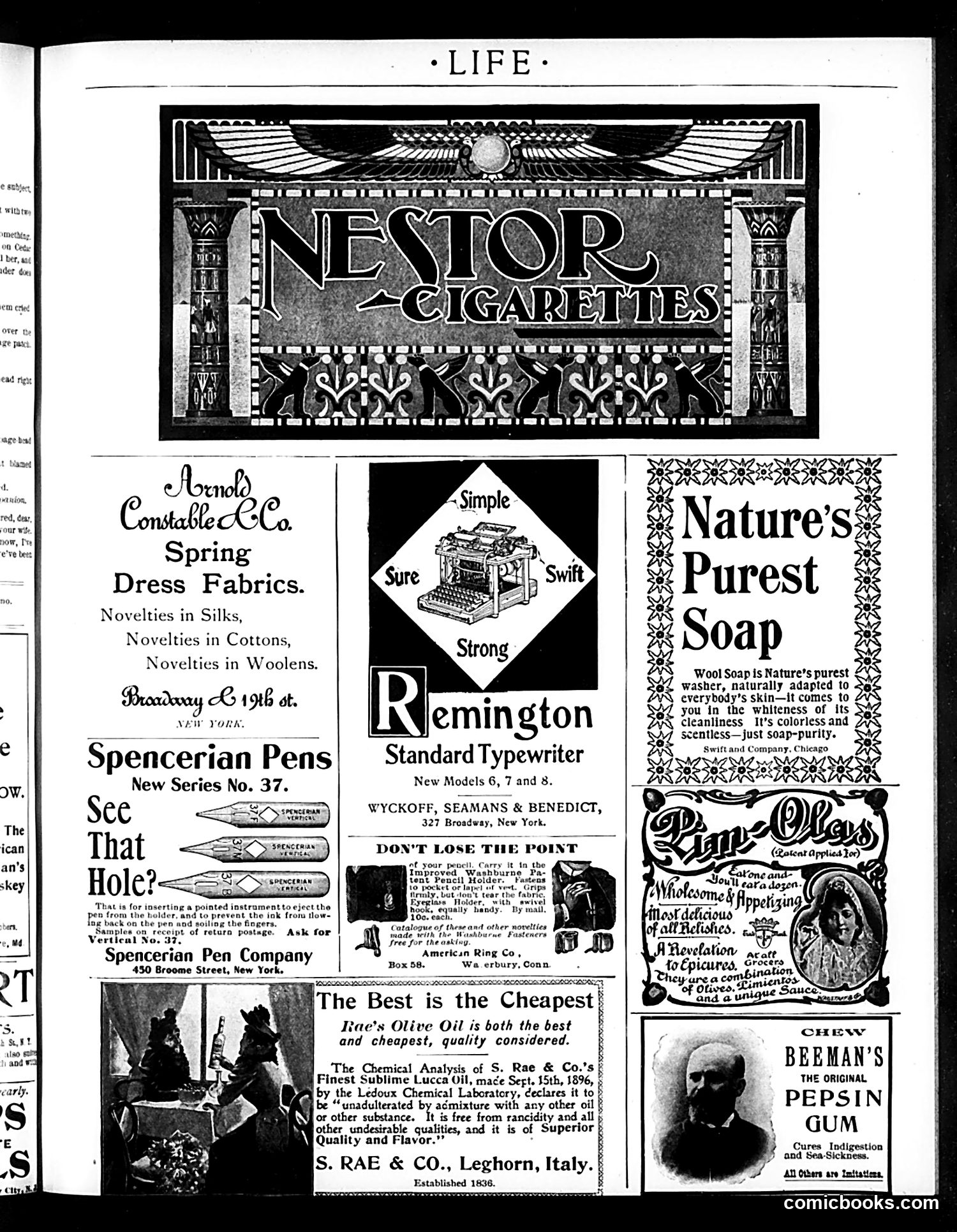
This is primarily an **advertising page**, not a satirical cartoon page. It contains commercial advertisements from circa 1916 for various consumer products: Nestor Cigarettes, dress fabrics, Spencerian Pens, Remington typewriters, Nature's Purest Soap, Rae's Olive Oil, Pimm's (an appetizing drink), Breman's Pepsin Gum, and office supplies. The only visual content approaching editorial material is the decorative **Nestor Cigarettes masthead** at the top—an ornate Art Deco-style design with Egyptian motifs and winged imagery typical of luxury cigarette branding of that era. The advertisements reflect **early 20th-century consumer culture**: emphasis on quality claims ("The Best is the Cheapest"), scientific validation (chemical analysis for olive oil), and products addressing digestive complaints (pepsin gum for indigestion). There is no political satire or social commentary visible on this particular page.
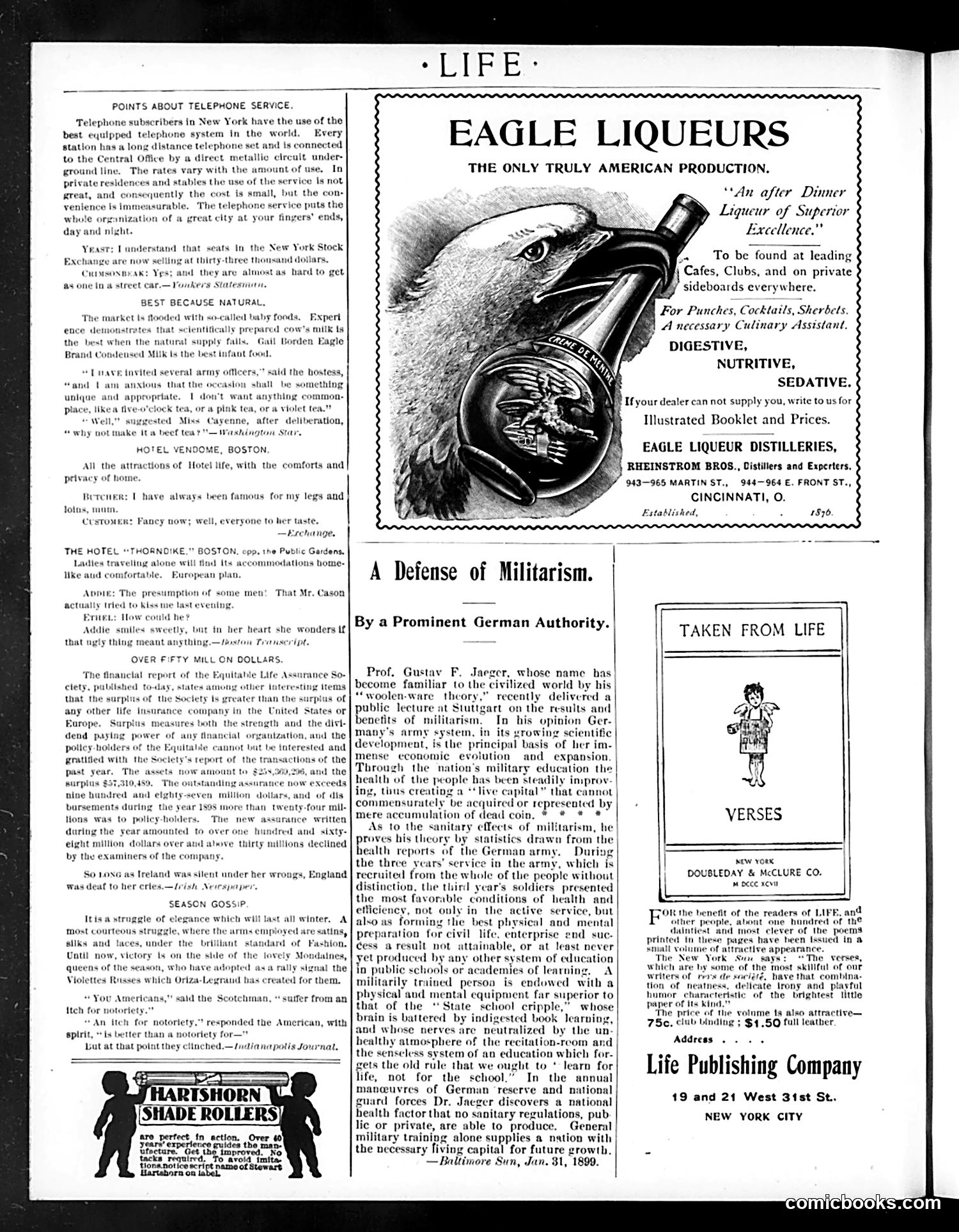
This page from *Life* magazine (circa 1890, based on references) is primarily **advertising and miscellaneous social commentary** rather than political cartoons with clear satirical targets. **Key Content:** The main advertisement features **Eagle Liqueurs** from Cincinnati, marketing themselves as "the only truly American production" for after-dinner drinks—positioning American-made spirits against European competitors. **Social humor snippets** include: - A joke about New York Stock Exchange seats being as hard to obtain as streetcar seats - Exchanges about ladies' tea parties and Army officers (mocking social pretension) - A brief flirtation dialogue suggesting gender-relations humor **Substantive article:** "A Defense of Militarism" by German authority Prof. Gustav Jaeger argues militarism produces healthier citizens through mandatory service and creates "live capital" for national growth—reflecting 1890s debates about military systems and public health. The **"Verses" section** advertises Life Publishing Company's poetry collection. Overall, this is a **commercial/entertainment page** with light satire rather than pointed political commentary. The militarism piece is the only serious content, presenting pro-military arguments typical of the era.
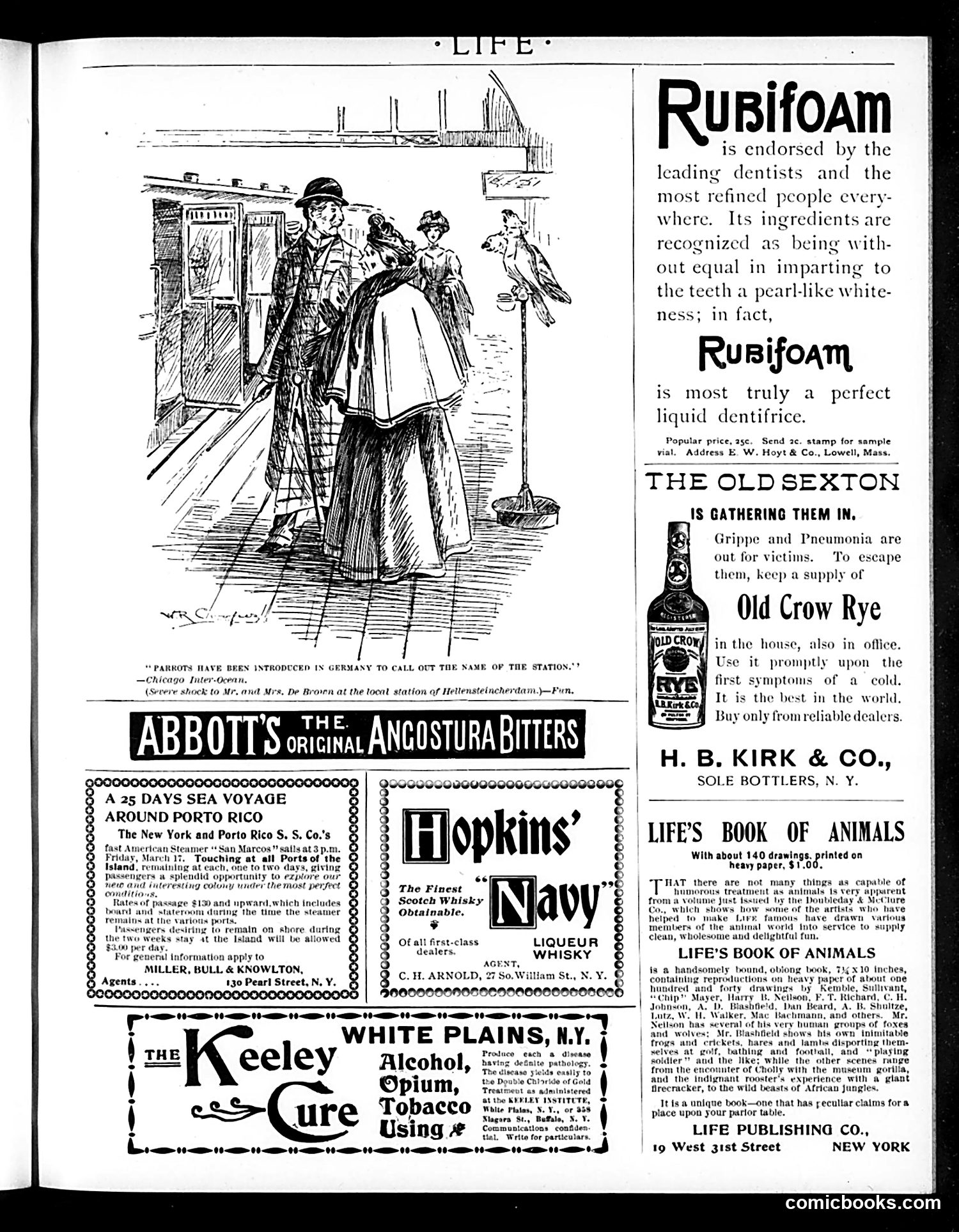
The main cartoon satirizes a practical joke or unintended consequence: parrots introduced in Germany to call out train station names at Hellenstein-Eicheldam station. The humor lies in the absurdity—birds being trained as public announcements systems. The caption credits the *Chicago Inter-Ocean* newspaper and references a couple ("Mr. and Mrs. De Brown") supposedly shocked by this novelty at their local station. This reflects turn-of-the-century amusement with new technologies and the Victorian era's fascination with animals performing trained tricks. The joke mocks both the impracticality of using birds for mundane tasks and the gullibility of readers who might believe such a scheme. The surrounding page consists entirely of period advertisements (toothpaste, whisky, steamship travel, tobacco) typical of *Life* magazine's revenue model, with no additional editorial content beyond this single cartoon.
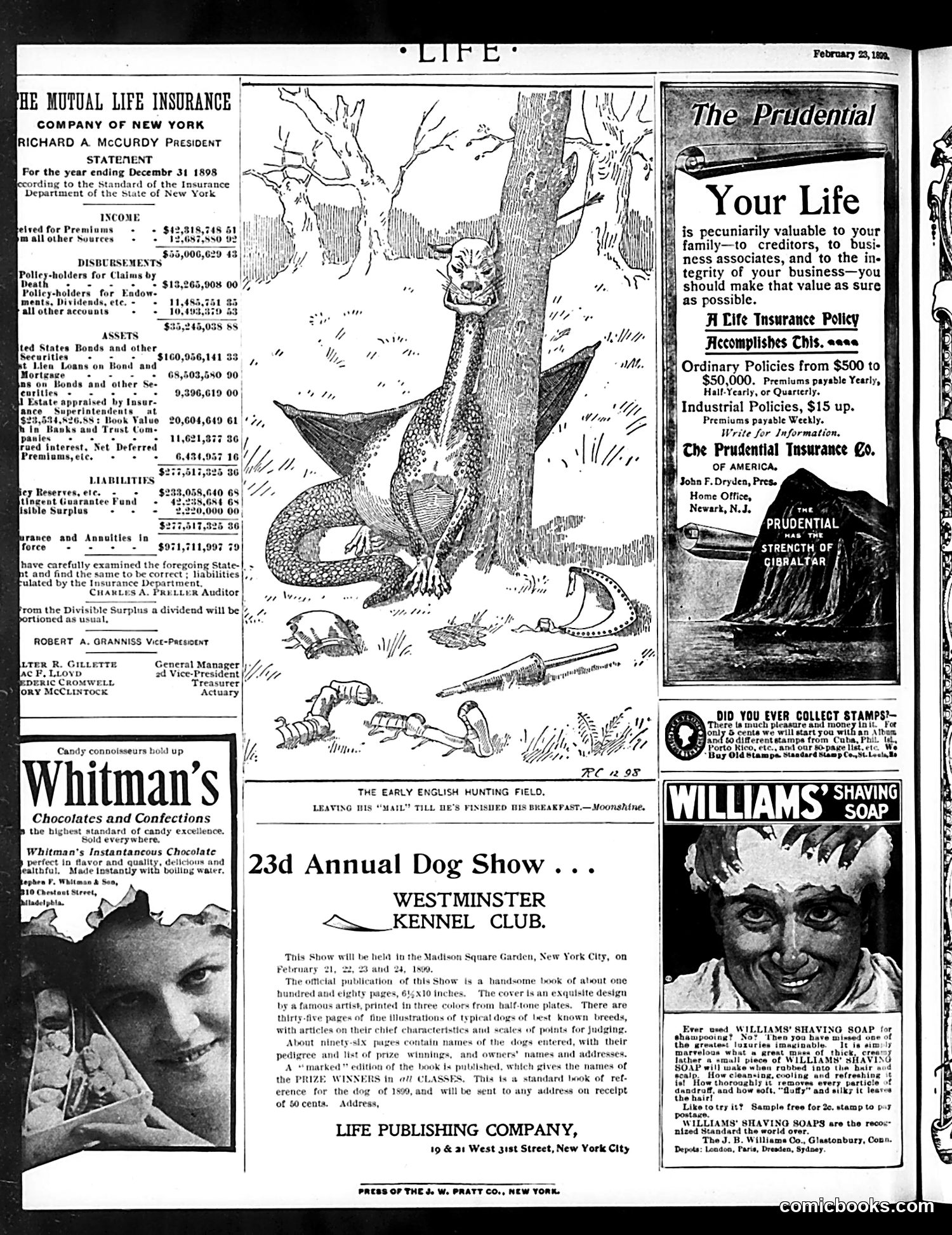
This page mixes financial statements with satirical content. The dominant cartoon shows a large dinosaur or prehistoric creature eating its breakfast ("leaving his 'mail' till he's finished his breakfast"), labeled "Moonshine." This appears to be a satirical jab at big business excess—likely referencing the bloated profits and indulgences of large corporations of the Gilded Age. The page is dominated by insurance company advertisements and a financial statement from Mutual Life Insurance (with President Richard McCurdy listed). The juxtaposition of the dinosaur cartoon with insurance industry promotions suggests Life magazine was poking fun at insurance companies' massive assets and their predatory nature—comparing them to prehistoric monsters consuming everything in sight. The other advertisements (Whitman's chocolates, Williams shaving soap, the dog show) are standard commercial content typical of the era's magazines.