
Life, 1899-02-23 · page 12 of 20
Life — February 23, 1899 — page 12: what you’re looking at
What you’re looking at
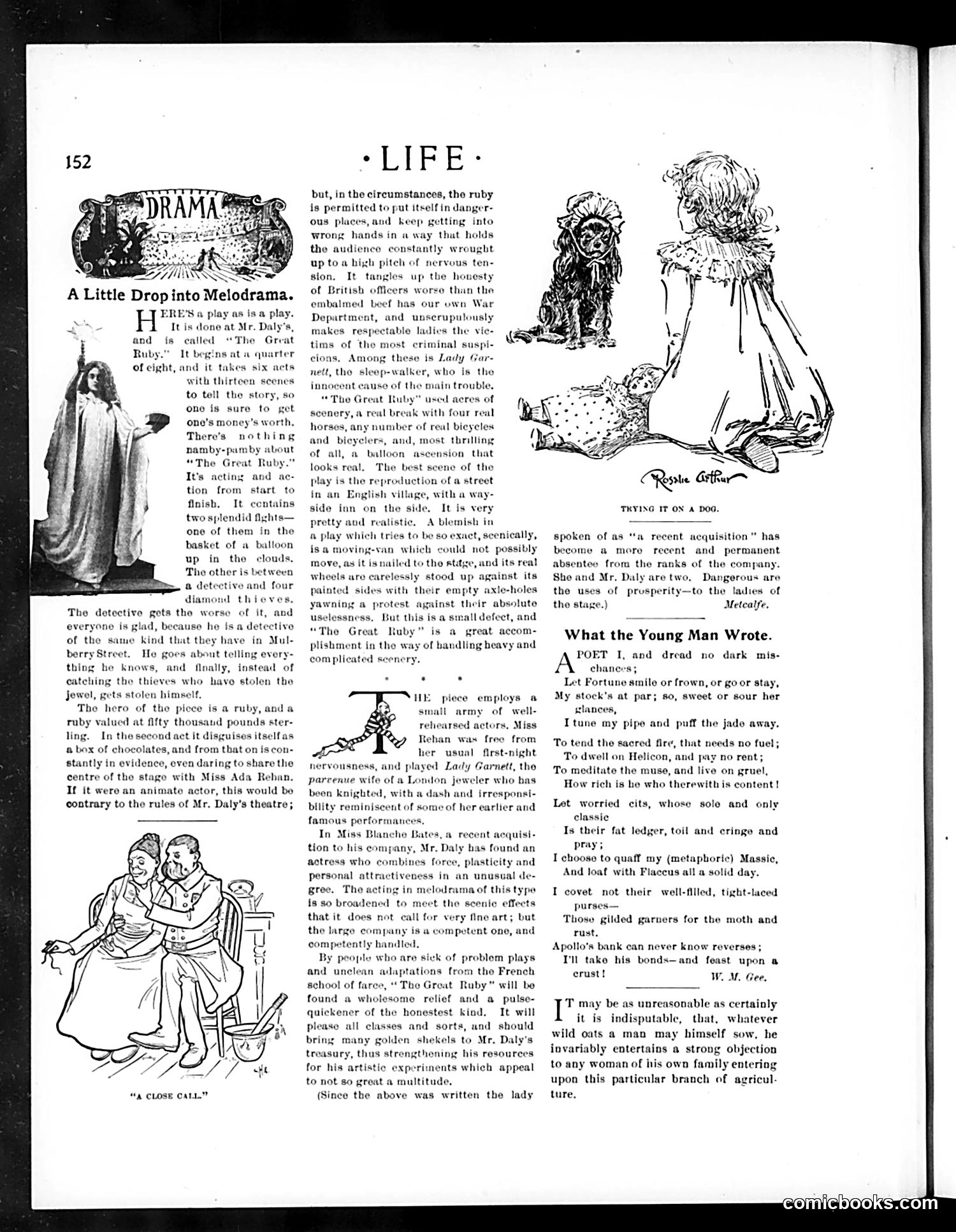
This page from *Life* magazine contains theater reviews. The main cartoon titled "A Little Drop into Melodrama" critiques theatrical productions of the era. The text discusses "The Great Ruby," a melodrama at Mr. Daly's theater featuring actress Miss Reihan. The review satirizes the play's absurd plot devices—stolen jewels, a detective protagonist, and overwrought scenery including "a street in an English village" with a "way-side inn." The accompanying illustrations mock melodramatic acting and staging conventions. One sketch labeled "Trying it on a Dog" depicts an actress demonstrating her performance to an animal, satirizing the artificiality of theatrical gestures. The reviews criticize how melodramas relied on heavy-handed props, complicated machinery, and implausible scenarios rather than genuine artistry—a common complaint about popular entertainment of the period.
📄 Transcribed text from this page (OCR, searchable)
Machine-transcribed from the original scan — historical spelling and the odd misread are preserved.
BE 77/\\\ RS A Little Drop into Melodrama. ERE’S a play as is a play, It is done at Mr. Daly and is called “The Great Ruby It begins at a quarter ofcight, and it takes six acts with thirteen scenes to tell the story, so one is sure to get one’s money’s wo! There's nothing namby-pamby about “The Great Ruby. It's acting and ac- tion from start to finish, It contains two splendid Oghts— one of them in the basket of a balloon up in the clouds, Tho other is between a detective and four diamond thieves, The detective gots the worse of it, and everyone is glad, because he is a detective of the same kind that they have in Mul- berry Street. He goes about telling every- thing he knows, and foally, instead of catching the thieves who havo stolen the Jewol, gets stolen himse Tho hero of tho picce is a ruby, and a ruby valued at fifty thousand pounds ster- ling. In the second act it disguises itselfas a box of chocolates, and from that on is con- stantly in evidence, even daring to share the centre of the stage with Miss Ada Rehan. If it were an animate actor, this would be contrary to tho rules of Mr. Daly's theatre; “a CLOSE CALL.” “LIFE * but, in the circumstances, the ruby is permitted to put itself in danger- ous places,and keep getting into wrong hands in a way that holds the audience constantly wrought up toa high pitch of nervous ten- sion. It tangles up the houesty of British officers worse than the embalmed beef has our own War Department, and unserupulously makes respectable ladies the vic tims of the most erim 1s. Among these is Lady Gar- tho sleep-walker, who is the innocent cause of the main trouble, “The Great Ruby" used acres of ry, a real break with four real 3, any number of real bicycles. and bicyclers, and, most thrilling of all, a balloon looks real. The best scene of the play is the reproduction of a street in an English village, with a way- side inn on the side, It is very pretty aud realistic, A blemish in a play which tries to be so exact, scenically, isa moving-van which could not possibly move, as it is nailed to the Ktitge, and its real wheels are carelessly stood up against its painted sides with their empty axle-holes yawning a protest against their absolute uselessness, But this is a small defect, and “The Great Rub: is a great accom- plishment in the way of handling heavy and com plica suspi- ascension that d seener: HE piece e small army of rehearsed actors, Miss Rehan was free from her usual first-night nervousness, and played Lady Garnett, tho parvenue wife of a London jeweler who bas beon knighted, with a dash and irresponsi- bility reminiscent of some of her earlier and famous performances. In Miss Blanche Bates, a recent acquisi- tion to his company, Mr. Daly bas found an actress who comb $0, ie id personal attractiveness in an unusual d The actin, ndrama of this typ the scenic effects that it does not call for very fine art; but tho large com is a competent one, and competently handled, By people who are sick of problem plays and unclean adaptations from tho French school of faree, “The Great Ruby” will bo found a wholesome relief and a pulse- quickener of the honestest kind. It will please all classes and sorts, and should bring many golden shekels to Mr. Daly's treasury, thus strengthening his resources for his artistic experiments which appeal to not so great a multitude. (Since the above was written the lady loys a well- TRYING IT ON A DOO. spoken of as a recent acquisition” has become a more recent and permanent absentes from the ranks of the company. Sho and Mr. Daly are two, Dangerous are the uses of prosperity—to the ladies of the stage.) Metcalfe. What the Young Man Wrote. An I, and dread no chances; Let Fortune smile or frown, or go or stay, My stock's at par; so, sweet or sour her glances, Itune my pipe and puff the jado away. dark mis- To tend the sacred fire, that needs no fuel; To dwell on Helicon, and pay no rent; To meditate the muse, and live on gruel, How rich is he who therewith is content! Let worried cits, whose solo and only classic Is their fat ledger, toil and cringo and pray; I choose to quaff my (metaphoric) Massic, And loaf with Flaccus all a solid day. I covet not their well-filled, tight-laced purses Those gilded garners for the moth and rust. Apollo's bank can never know reverses ; I'l take his bonds—and feast upon a crust! W. M. Gee. T may be as unreasonable as certainly it is indisputable, that, whatever wild oats a man may himself sow, he invariably entertains a strong objection to any woman of his own family entering upon this particular branch of agricul- ture,