
Life, 1899-02-23 · page 4 of 20
Life — February 23, 1899 — page 4: what you’re looking at
What you’re looking at
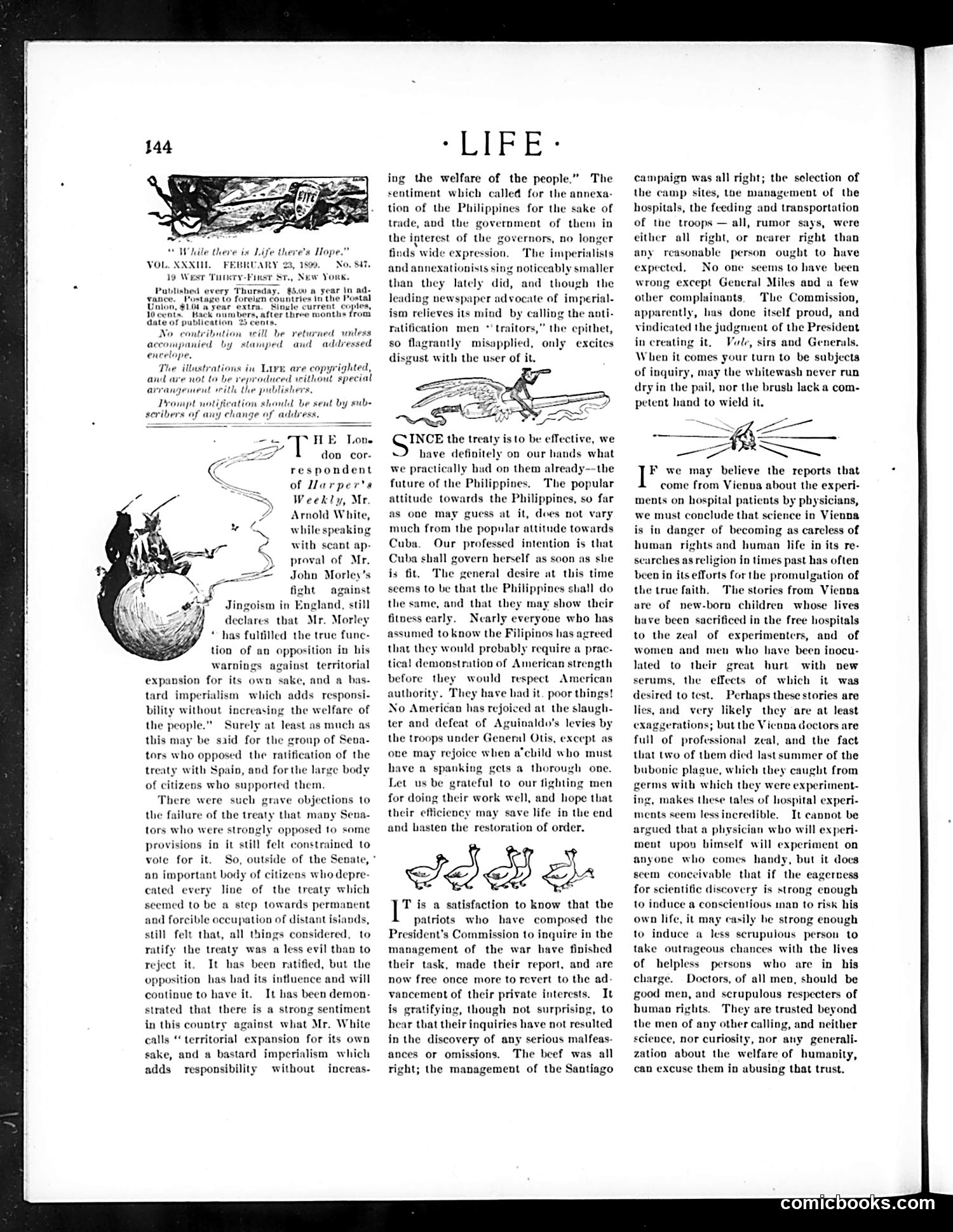
This page contains political commentary on U.S. imperialism and the Philippine-American War. The text critiques American expansion, referencing debates over Philippine governance and territorial control. It mentions "Mr. Arnold White" discussing imperialism and "Mr. John Morley's" opposition to territorial expansion. The small illustrations appear to be decorative elements rather than specific political cartoons—they show birds and insects typical of Life's ornamental style. The editorial argues against American imperial adventures, warning that imperialism undermines stated democratic values. It defends critics of expansionism and expresses concern about experiments on human subjects in Vienna hospitals, connecting medical ethics to broader questions about respecting human rights. The tone is satirical, mocking imperial justifications while defending anti-imperial senators and questioning American conduct.
📄 Transcribed text from this page (OCR, searchable)
Machine-transcribed from the original scan — historical spelling and the odd misread are preserved.
While there is Life tu VOL. XXXII FEL 19 West Publish will be returned unless aud addressed tribution accompanied by stamped ape. he illustrations in Lire are copyrighted, and are not to be reproduced without special arrangement irith the publishers, Prompt notification should be sent by subs scribers of any change of address, YT HE Lone don cor- respondent of Harper's Weekly, Mr. Arnold White, while speaking with scant ap- proval of Mr. John Morley’s fight against Jingoism in England, still declares that Mr. Morley * has fulfilled the true fune- tion of an opposition in his warnings against territorial expansion for its own sake, and a bas- tard imperialism which adds responsi- bility without increasing the welfare of the people.” Surely at least as much as this may be said for the group of Sena- tors who opposed the ratification of the treaty with Spain, and forthe large body of citizens who supported them. There were such grave objections to the failure of the treaty that many Sena- tors who were strongly opposed to some provisions in it still felt constrained to vote for it. So, outside of the Senate, an important body of citizens who depre- cated every line of the treaty which seemed to be a step towards permanent and forcible occupation of distant isiands, still felt that, all things considered, to ratify the treaty was a less evil than to reject it. It bas been ratified, but the opposition has bad its influence and will continue to have it. It has been demon- strated that there is a strong sentiment in this country against what Mr. White calls ‘territorial expansion for its own sake, and a bastard imperialism which adds responsibili without increas- “Lire * ing the welfare of the people.” The sentiment which called for the annexa- tion of the Philippines for the ec of trade, and the government of them in the pterest of the governors, no longer finds wide expression. The imperialists and annexationists sing noticcably smaller than they lately did, and though the leading newspaper advocate of imperial- ism relieves its mind by calling the anti- ratification men *' traitors,” the epithet, so flagrantly misapplied, only excites disgust with the user of it. INCE the treaty is to be effective, we SD have definitely on our hands what we practically hud on them already--the future of the Philippines. The popular attitude towards the Philippines, so far as one may guess at it, dees not vary much from the popular attitude towards Cuba. Our professed intention is that Cuba shall govern herself as soon as she is fit. The general desire at this time seems to be that the Philippines shall do the same, and that they may show their fitness early. Nearly everyone who has assumed to know the Filipinos has agreed that they would probably require a prac- tical demonstration of American strength before they would respect: American authority. They have had it. poor things! No American has rejoiced at the slaugh- ter and defeat of Aguinaldo's levies by the troops under General Otis, except one may rejoice when a’child who must have a spanking gets a thorough one. Let us be grateful to our fighting men for doing their work well, and hope that their efficiency may save life in the end and hasten the restoration of order. T is a satisfaction to know that the patriots who have composed the President's Commission to inquire in the management of the war have finished their task, made their report, and are now free once more to revert to the ad vancement of their private interests. It is gratifying, though not surprising, to hear that their inquiries have not resulted in the discovery of any serious malfeas- ances or omissions. The beef was all right; the management of the Santiago campaign was all right; the selection of the camp sites, the management of the hospitals, the feeding and transportation of the troops — all, rumor says, were either all right, or nearer right than any reasonable person ought to have expected, No one seems to have been wrong except Gencral Miles and a few other complainants. The Commission, apparently, has done itself proud, and vindicated the judgment of the President in creating it, Vole, sirs and Generals. When it comes your turn to be subjects of inquiry, may the whitewash never run dry in the pail, nor the brush lack a com- petent hand to wield it. . Zo =, ies we may believe the reports that come from Vienna about the experi- ments on hospital patients by physicians, we must conclude that science in Vienna is in danger of becoming as careless of human rights and human life in its re- searches as religion in times past has often been in its efforts forthe promulgation of the true faith. The stories from Vienna are of new-born children whose lives have been sacrificed in the free hospitals to the zeal of experimenters, and of women and men who have been inocu- lated to their great burt with vew serums, the effects of which it was desired to test. Perhaps these stories are lies, and very likely they ‘are at least exaggerations; but the Vienna doctors are full of professional zeal, and the fact that two of them died last summer of the bubonic plague, which they caught from germs with which they were experiment- ing, makes these tales of hospital experi- ments seem less incredible. It cannot be argued that a physician who will experi- ment upon himself will experiment on anyone who comes handy, but it docs seem conceivable that if the eagerness for scientific discovery is strong enough to induce a conscientious nan to risk his own life, it may easily be strong enough to induce a less scrupulous person to take outrageous chances with the lives of helpless persons who are in his charge. Doctors, of all men, should be good men, and scrupulous respecters of human rights. They are trusted beyond the men of any other calling, and neither science, nor curiosity, nor any generali- zation about the welfare of humanity, can excuse them in abusing that trus comicbooks.com