
Life, 1899-02-23 · page 8 of 20
Life — February 23, 1899 — page 8: what you’re looking at
What you’re looking at
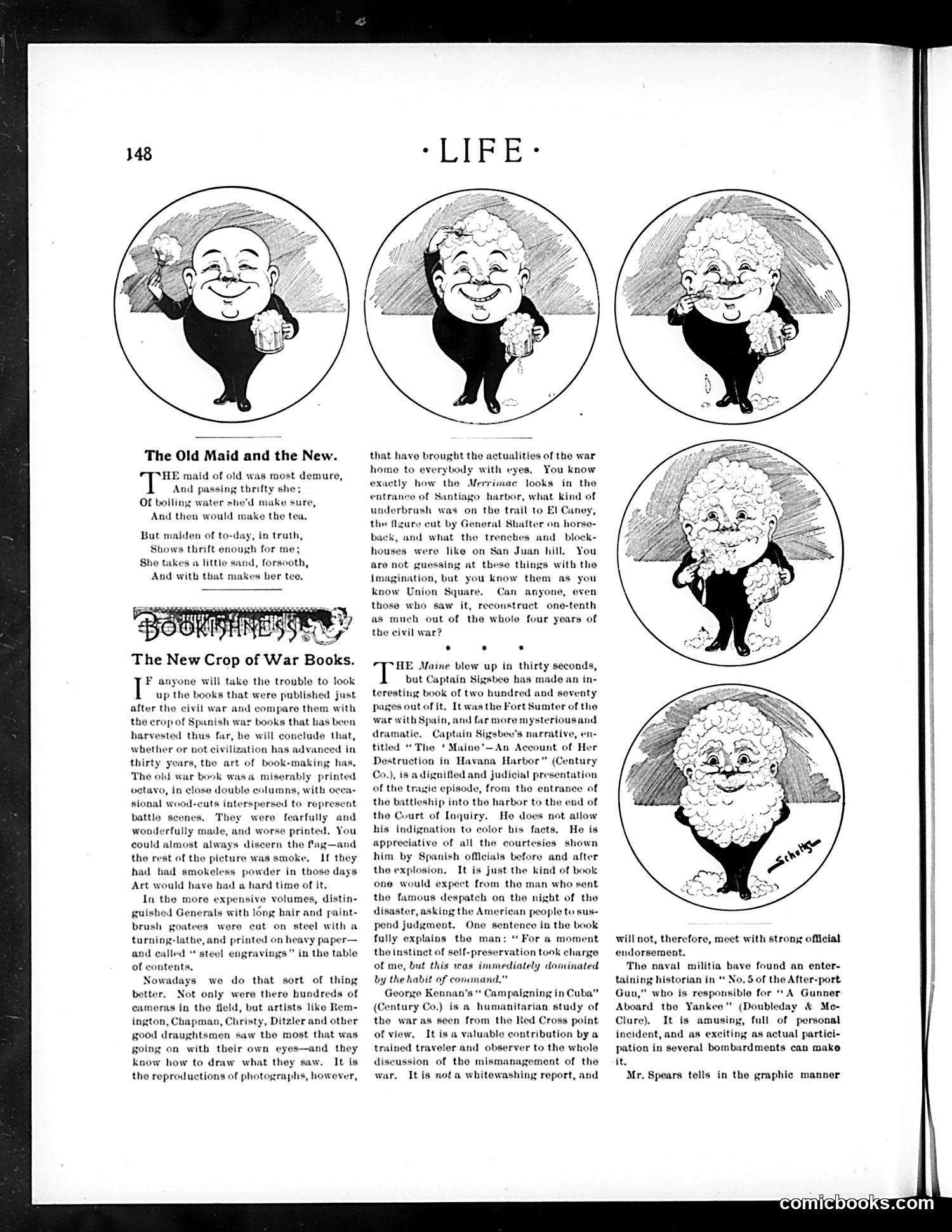
This page contains three sections: a poem titled "The Old Maid and the New," a book review section called "The New Crop of War Books," and four cartoon illustrations of a rotund, smiling character holding a beer mug. The cartoons appear to satirize post-WWI attitudes. The character—likely representing a German or Austrian—is depicted in four poses, all cheerfully drinking beer despite wartime destruction. The accompanying text discusses newly published war narratives, including Captain Sigsbee's account of the *Maine's* destruction in Havana Harbor (referencing the 1898 Spanish-American War) and other war books gaining popularity after World War I. The satire suggests: despite the horrors documented in these war accounts, certain populations remained unbothered and continued enjoying life's pleasures, oblivious to or unconcerned with the suffering war caused.
📄 Transcribed text from this page (OCR, searchable)
Machine-transcribed from the original scan — historical spelling and the odd misread are preserved.
The Old Maid and the New. HE maid of old was most demure, And passing thrifty she; Of boiling water she'd make sure, And then would make the tea, But maiden of to-day, in truth, thrift enough for me She takes a little sand, forsooth, And witb that makes ber tee, The New Crop of War Books. F anyone will take the trouble to look up the books that were published just after the civil war and compare them with the crop of Spanish war books that bas been harvested thus far, he will conclude that, whether or not civilization has advanced in thirty years, the art of book-making has, The old war book wasa miserably printed votavo, in close double columns, with occa sional wood-cuts interspersed to represent They were fearfully and wonderfully made, and worse printed, You could almost always discern the fag—and the rest of the picture was smoke, If they had bad smokeless powder in those days Art would have bad a hard time of it. In the more expensive volumes, distin- guished Generals with long hair and paint- brush goatees were cat on steel with a turning-latbe,and printed on heavy paper— and called “ steel engravings” in the table of contents, Nowadays we do that sort of thing better, Not only were there hundreds of cameras in the fleld, but artists like Rem- ington, Chapman, Christy, Ditzler and other good draughtsmen saw the most that was going on with their own eyes—and they know how to draw what they saw. It is the reproductions of photographs, however, battle scenes, that have brought the actualities of the war home to everybody with eyes, You know exuetly how the Merrimac looks in the entrance of Santiago harbor, what kind of underbrush was on the trail to El Caney, the flgure cut by General Shafter on horse- back, and what the trenebes and bloc! houses were like on San Juan hill, You are not guessing at these things with the imagination, but you know them as you know Union Square. Can anyone, even those who saw it, reconstruct one-tenth as much out of the whole four years of the civil war? T HE Maine blew up in thirty seconds, but Cuptain Sigsbee has made an in- teresting book of two bundred and seventy pages out of it, It was the Fort Sumter of the war with Spain, and far more mysteriousand dramatic. Captain Sigsbee’s narrative, en- titled “The *Maine’—An Account of Her Destruction in Havana Harbor” (Century Co.), is adignifled and judicial presentation of the tragic episode, from the entrance of the battleship into the harbor to the end of the Court of Inqu He does not allow his indignation to color his facts. He is appreciative of all the courtesies shown him by Spanish oMcials before and after the explosion, It is just the kind of book one would expect from the man who sent the famous despatch on the night of the disaster, asking the American people to sus- pend judgment. One sentence in the book fully explains the man: “For a moment tho instinct of self-preservation took charge of mo, but this was immediately dominated by the habit of conmand,.” George Kennan’s “ Campaigning in Cuba” (Century Co.) is a humanitarian study of the war as seen from the Red Cross point of view. It is a valuable contribution by a trained traveler and observer to the whole diseussion of the mismanagement of the war, Itis nota whitewashing report, and will not, therefore, meet with strong official endorsement. Tho naval militia bave found an enter- taining historian in “ No. 5 of the After-port Gun,” who is responsible for A Gunner. Aboard the Yankee” (Doubleday & Mo- Clure), It is amusing, full of personal incident, and as exciting as actual partici pation in several bombardments can make it. Mr. Spears tells in the graphic manner