
A complete issue · 20 pages · 1899
Life — January 12, 1899
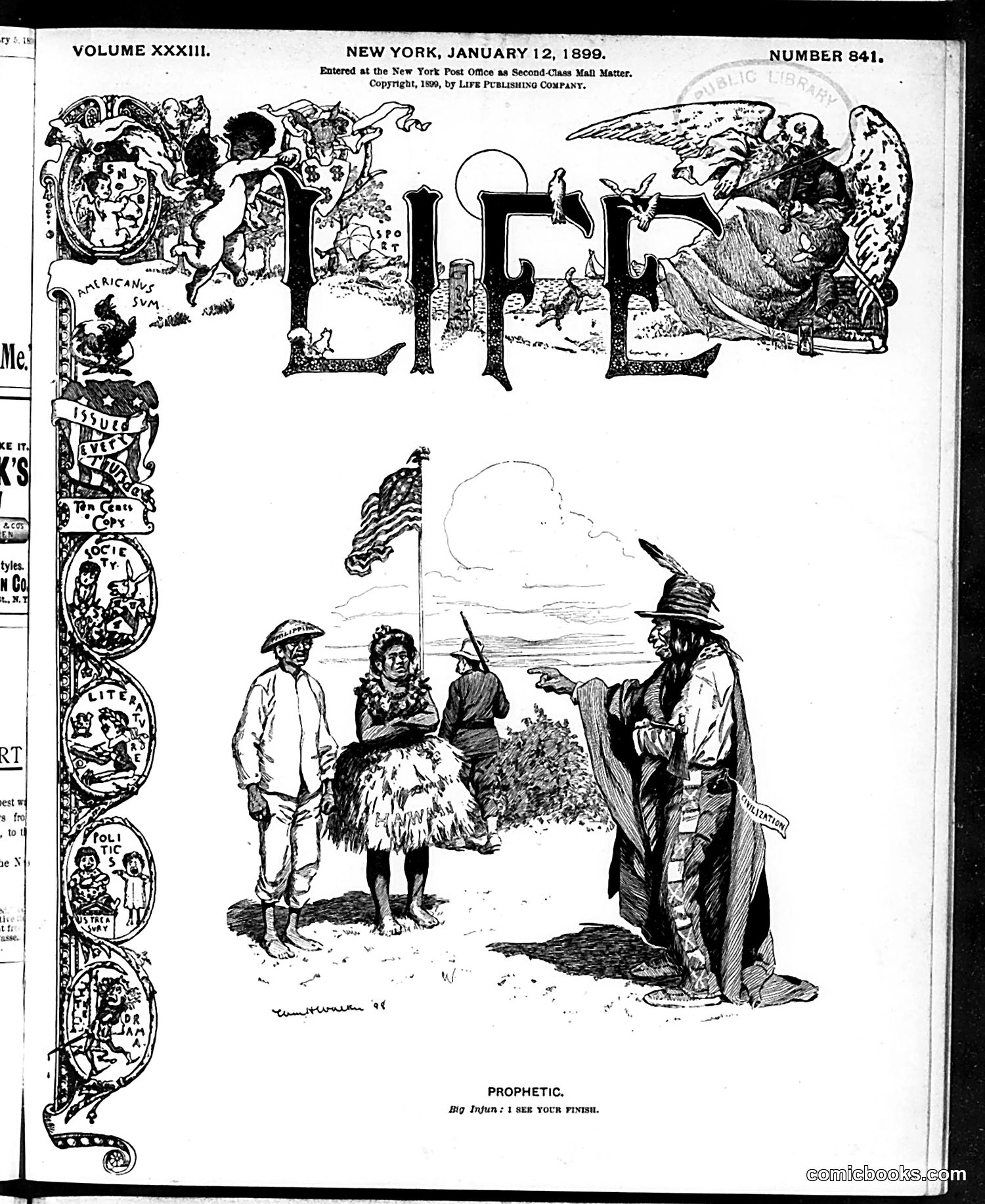
This cartoon satirizes predictions about the future. The caption reads "PROPHETIC" with the subtitle "Big Injun: I SEE YOUR FINISH." The scene depicts a Native American figure (labeled "Big Injun") on the right, pointing while speaking to three other figures including what appears to be a woman and men in period dress. The Native American is making a dire prediction about their fate. The satire likely comments on late-19th-century anxieties—either mocking sensationalism about Native American prophecies, or ironically presenting indigenous peoples' actual historical perspective on American expansion and their own disappearance. The "prophecy" frame appears designed for comedic effect, though the specific political context remains unclear without additional historical documentation of contemporary events from January 1899.
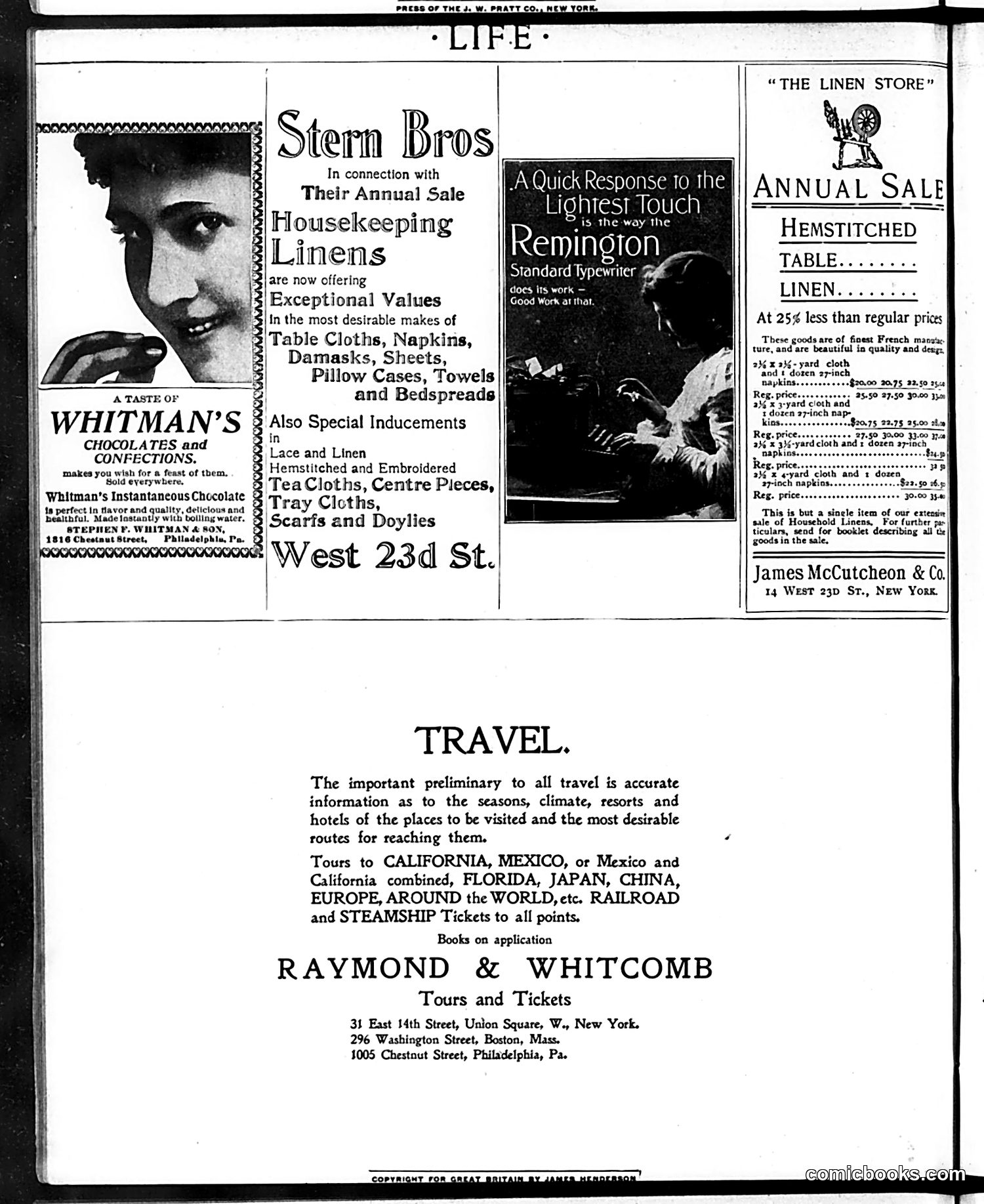
This page is **primarily advertising** rather than political satire. The top section contains three advertisements: 1. **Stern Bros.** promotes a housekeeping linens sale on West 23rd Street 2. **Whitman's Chocolate Confections** ad (Philadelphia) 3. **"The Linen Store"** announces a hemstitched linen sale by James McCutcheon & Co. The center features a **Remington typewriter advertisement** showing someone at a typewriter. Below the ads is a **Travel section** promoting Raymond & Whitcomb's tour services, offering tickets and tours to California, Mexico, Florida, Japan, China, Europe, and worldwide destinations. There is **no political cartoon or satirical content** visible on this page—it represents typical early-20th-century *Life* magazine advertising and travel information.
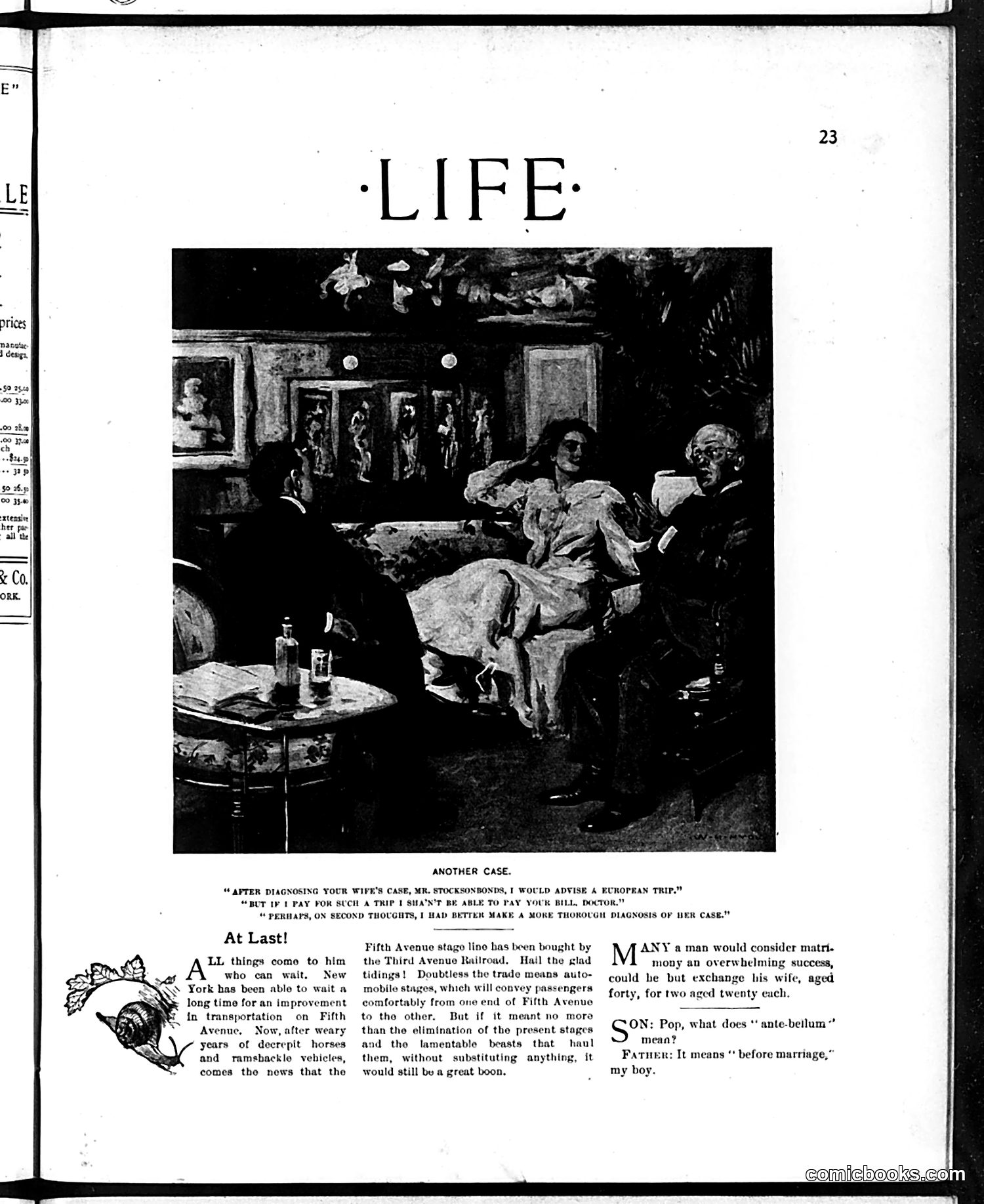
This page contains two sections: an illustration titled "Another Case" depicting a domestic medical consultation scene, and a brief article "At Last!" about Fifth Avenue acquiring a stage line from the Third Avenue Railroad. The illustration satirizes a common social scenario: a wealthy husband consults a doctor about his wife's health, then asks if she needs a European trip. When the doctor suggests a thorough diagnosis first, the husband balks at the cost. The humor lies in mocking affluent husbands' readiness to spend lavishly on travel while resisting medical expenses—exposing priorities and marital dynamics of the era's upper class. The "At Last!" section celebrates replacing horse-drawn stages with motorized vehicles, framing this as progress after "weary years of decrepit horses and ramshackle vehicles."
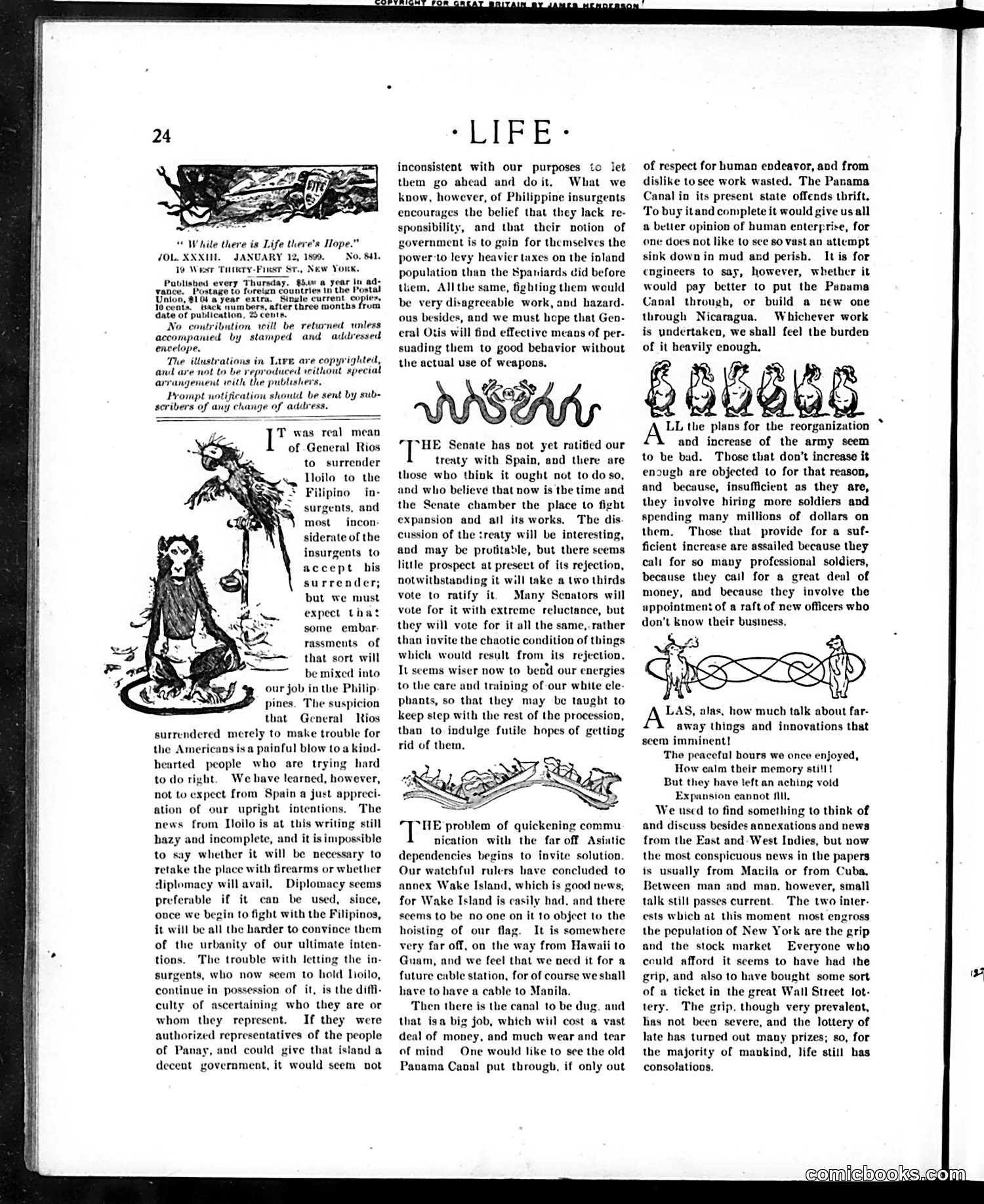
This page from Life (January 12, 1899) contains editorial commentary on the Philippine-American War and a cartoon depicting General Rios's surrender to American forces fighting Filipino insurgents. The text critiques American military strategy in the Philippines, arguing against harsh taxation of civilians and advocating instead for proper soldier training. It defends General Otis's leadership while expressing skepticism about Senate ratification of a Spain treaty. The cartoon on the left depicts a surrendering Filipino general or insurgent leader, likely General Rios mentioned in the text. The caricatured figures—appearing grotesque in period style—represent the "insurgents" the U.S. military faced. The imagery reflects contemporary American attitudes toward Filipino resistance to colonial rule.
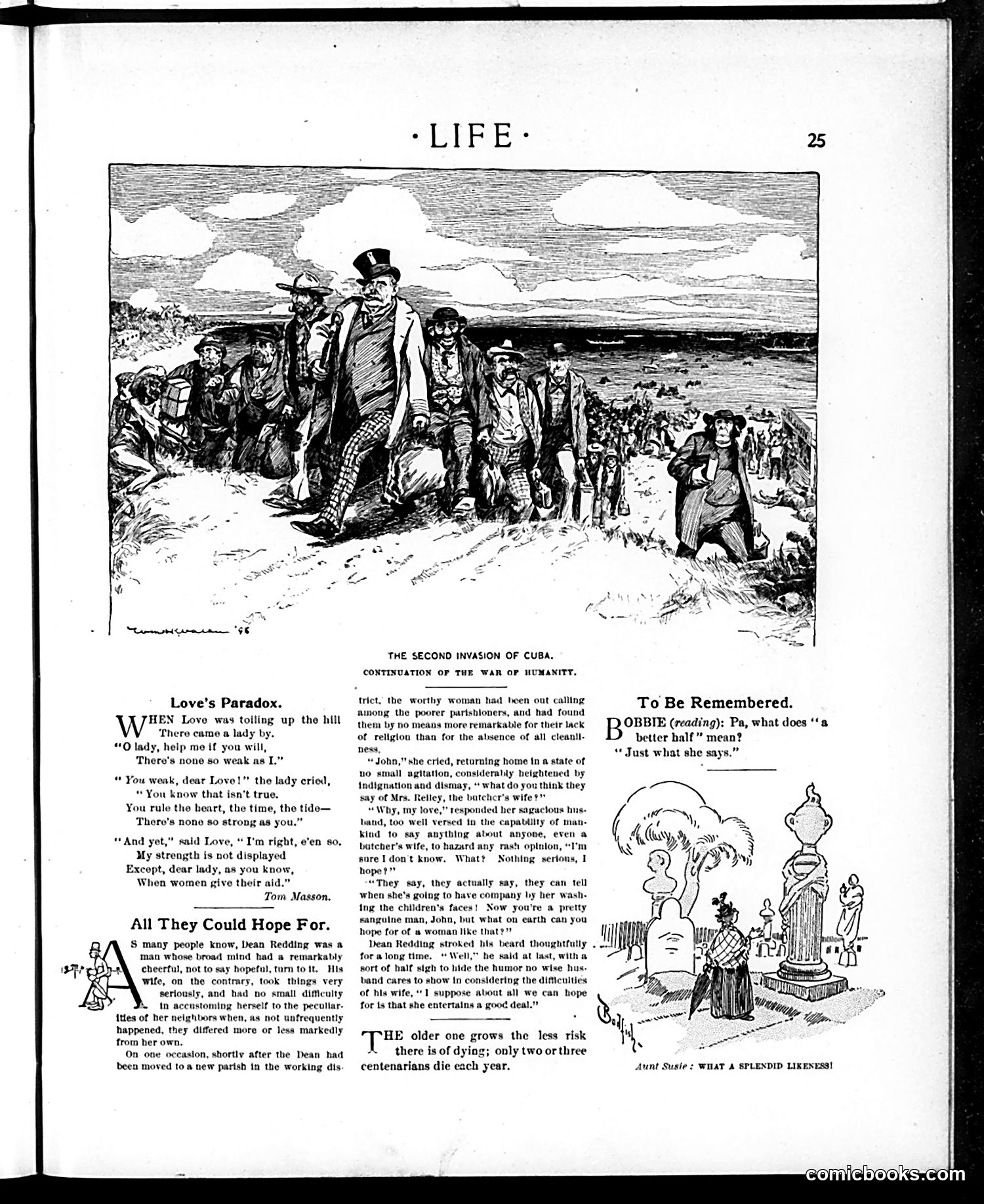
**Main Illustration:** "The Second Invasion of Cuba" depicts what appears to be a military or humanitarian expedition landing on a beach, with numerous figures disembarking. The caption frames this as "Continuation of the War of Humanity," suggesting American intervention in Cuba—likely referencing the Spanish-American War era (1898) or subsequent American involvement there. **Left Column Content:** "Love's Paradox" and "All They Could Hope For" are short humorous pieces about gender dynamics and marriage, typical of Life's satirical social commentary. They mock romantic notions and domestic realities. **Right Column:** "To Be Remembered" is a brief joke about appearance and aging. The page satirizes American imperial ambitions in Cuba while also containing standard period humor about relationships and social expectations.
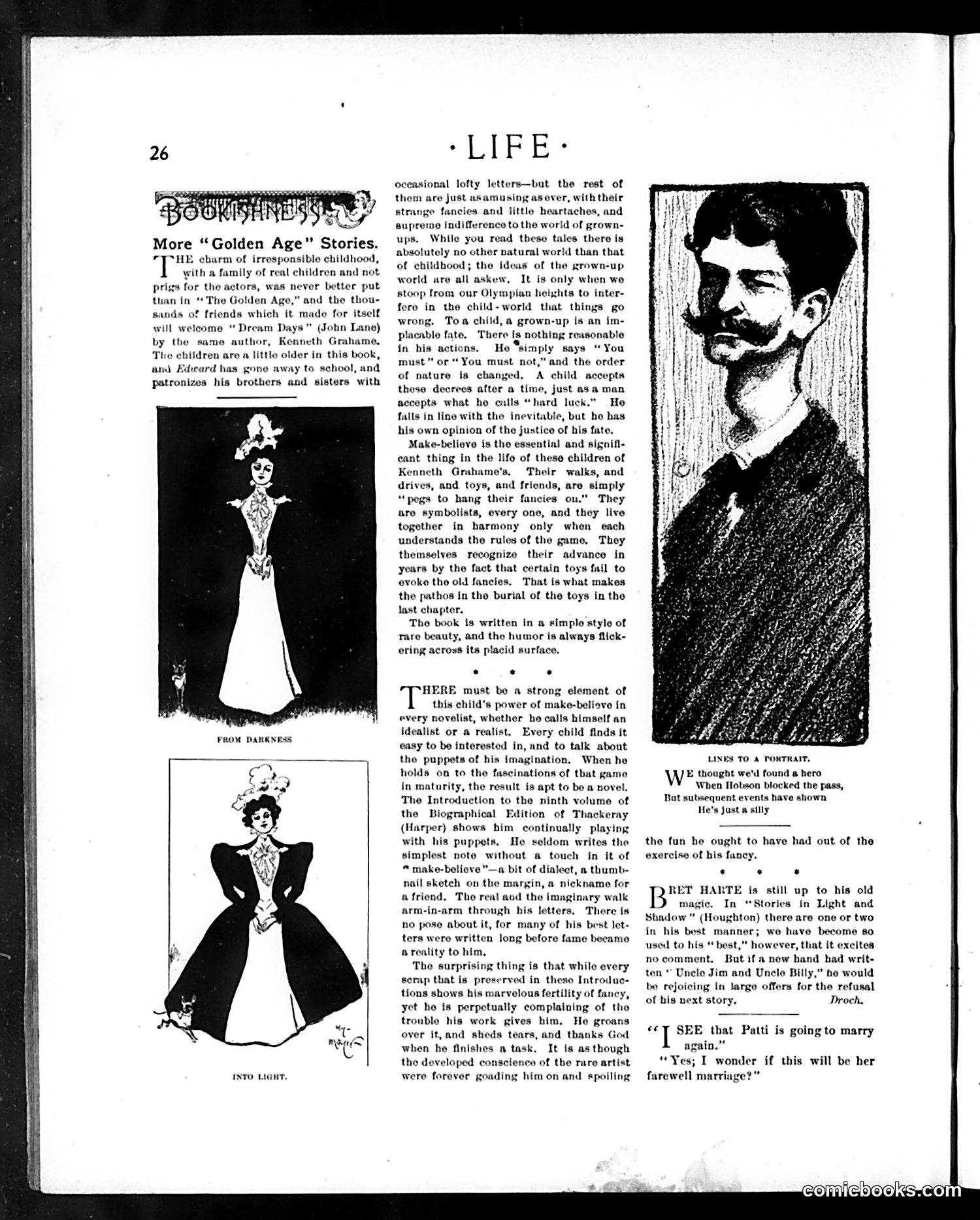
This page reviews Kenneth Graham's children's books, praising their imaginative quality and the author's ability to capture childhood perspectives. The two illustrations labeled "FROM DARKNESS" and "INTO LIGHT" appear to be character sketches from Graham's works, showing elegantly dressed figures in late Victorian/Edwardian style. The text emphasizes how Graham's child characters accept their fates philosophically and find meaning through imagination and play. A portrait of what appears to be the author himself occupies the right side. The bottom section quotes dialogue about a character named Patti's marriage, suggesting satirical commentary on romance or social conventions among the literary class. The overall tone celebrates Graham as a master of children's literature who maintains artistic integrity despite commercial pressures.
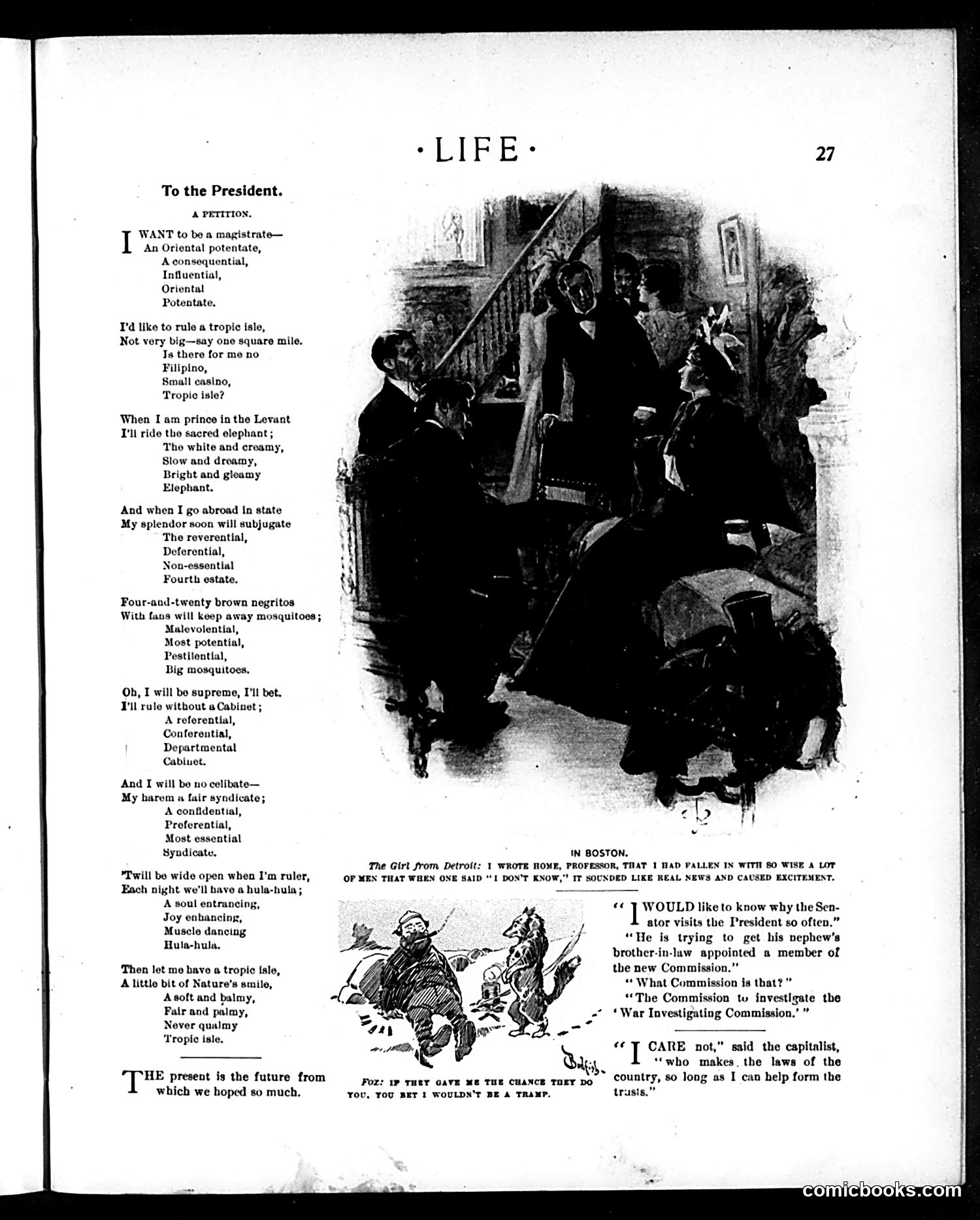
This satirical poem mocks an ambitious bureaucrat petitioning the President for increasingly grandiose titles and power—from "magistrate" to ruling a "tropic isle" to commanding "four-and-twenty brown negritos" with fans to keep away mosquitoes. The humor escalates absurdly through invented administrative ranks ("Deferential, Non-essential Fourth estate"). The accompanying illustration shows a crowded interior scene, likely depicting the petitioner presenting his ridiculous demands to officials or the President. A separate cartoon below features caricatured figures discussing a "War Investigating Commission"—suggesting contemporary political scrutiny or scandal investigation. The satire critiques administrative overreach, colonial ambition, and the self-aggrandizing nature of political appointees seeking ever-greater positions and perks.
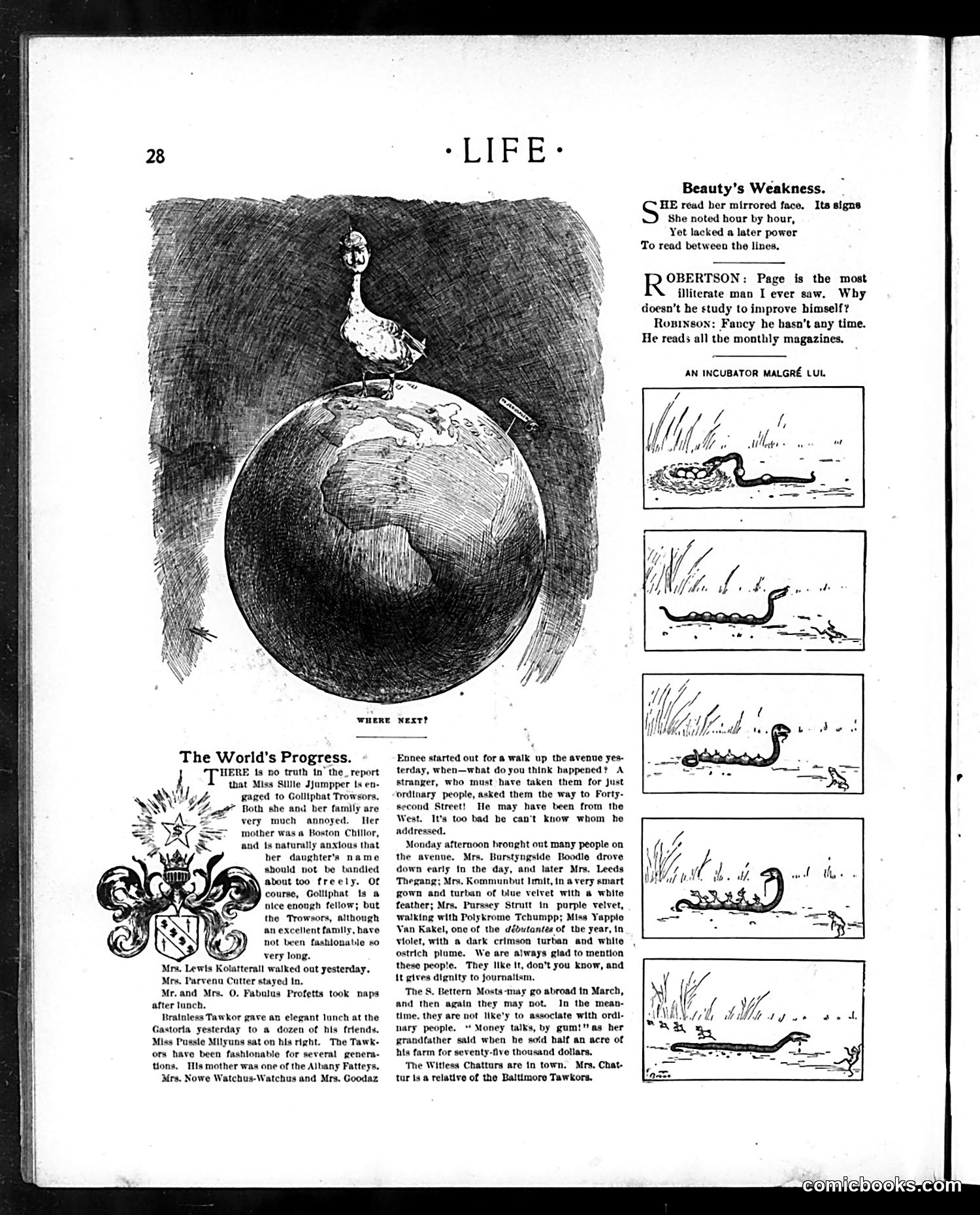
**Main Cartoon ("Where Next?"):** A bird stands atop a globe, seemingly surveying the world. The caption asks "WHERE NEXT?" — this appears to be Cold War-era political commentary about American or international expansion/intervention, suggesting uncertainty about which region will be the next focus of geopolitical attention. **"Beauty's Weakness":** A brief satirical exchange mocking a woman who reads her mirrored face hourly but lacks deeper intellectual capacity—she reads magazines but cannot study to improve herself. This reflects period attitudes about women's vanity. **"An Incubator Malgré Lui":** A comic strip showing what appears to be a duck or waterfowl sequence, likely humorous commentary on animal behavior or parenting. The page demonstrates Life's mix of political satire and social commentary.
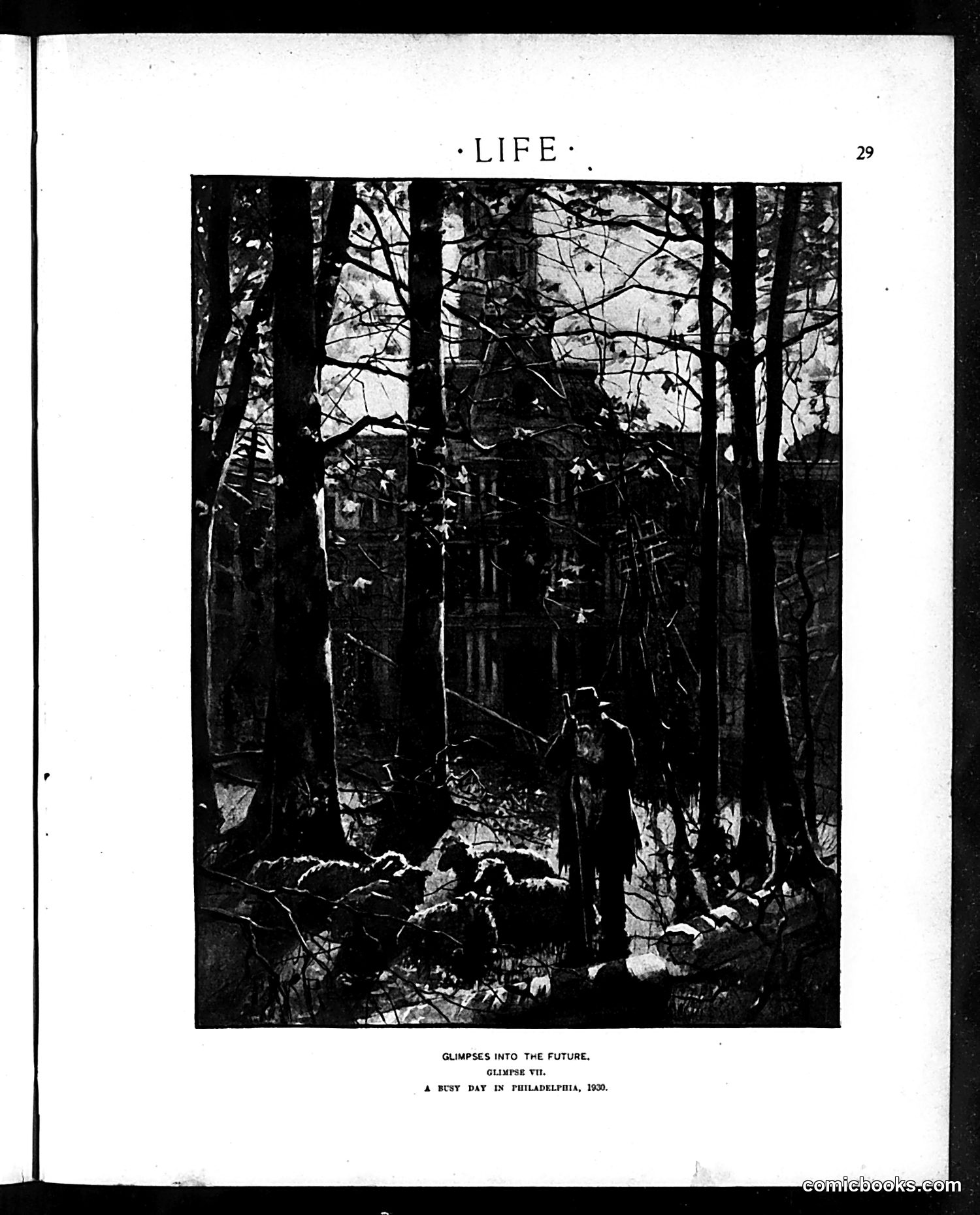
This is a page from *Life* magazine (page 29) featuring a black and white photograph labeled "Glimpses into the Future: Glimpse VII. A Busy Day in Philadelphia, 1920." The image shows what appears to be a forest or wooded area with tall trees and several human figures visible among the vegetation and undergrowth. The photograph's satirical intent—suggested by the "Glimpses into the Future" framing—appears to be social commentary about Philadelphia's urban development or environmental conditions. However, without additional context about 1920s Philadelphia or clearer visibility of specific details in the photograph, I cannot definitively identify what particular political or social condition is being satirized. The humor likely relies on contemporary readers recognizing a specific reference to Philadelphia's situation that is now historically obscure.
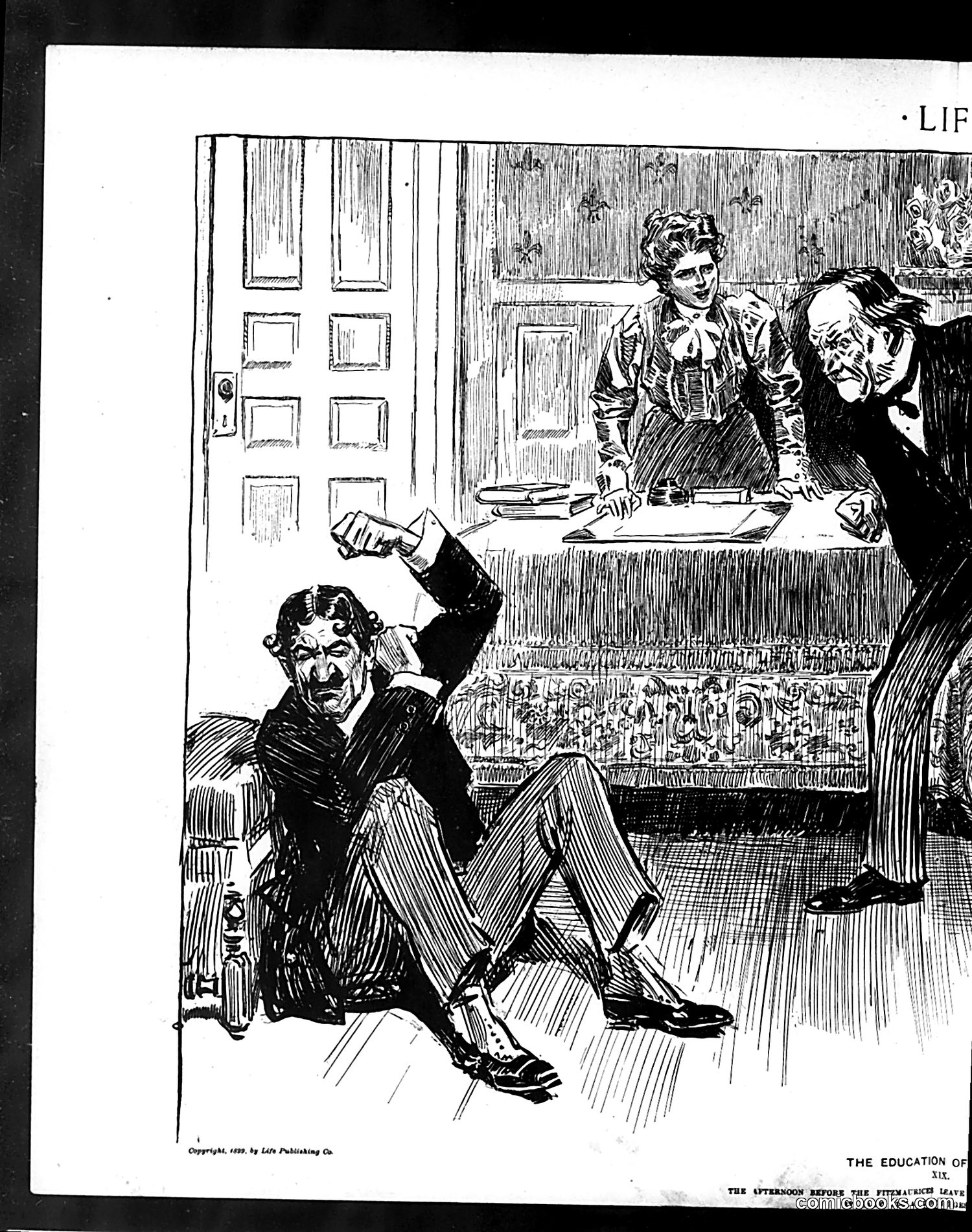
This is a satirical cartoon titled "The Education of" (full title cut off at bottom). It depicts a man sitting on the floor in an office, appearing distressed or angry with his fist raised, while three well-dressed figures (two men and a woman) stand behind a desk observing him. The cartoon likely satirizes a workplace discipline or dismissal scene—possibly an employee being fired or reprimanded by management. The man's exaggerated facial expression and aggressive posture suggest he's reacting poorly to bad news or criticism from his superiors. Without the complete title or publication date visible, the specific political or social commentary remains unclear. However, the "education" reference suggests the cartoon comments on how harsh workplace realities serve as a lesson to workers about their position in the social hierarchy.
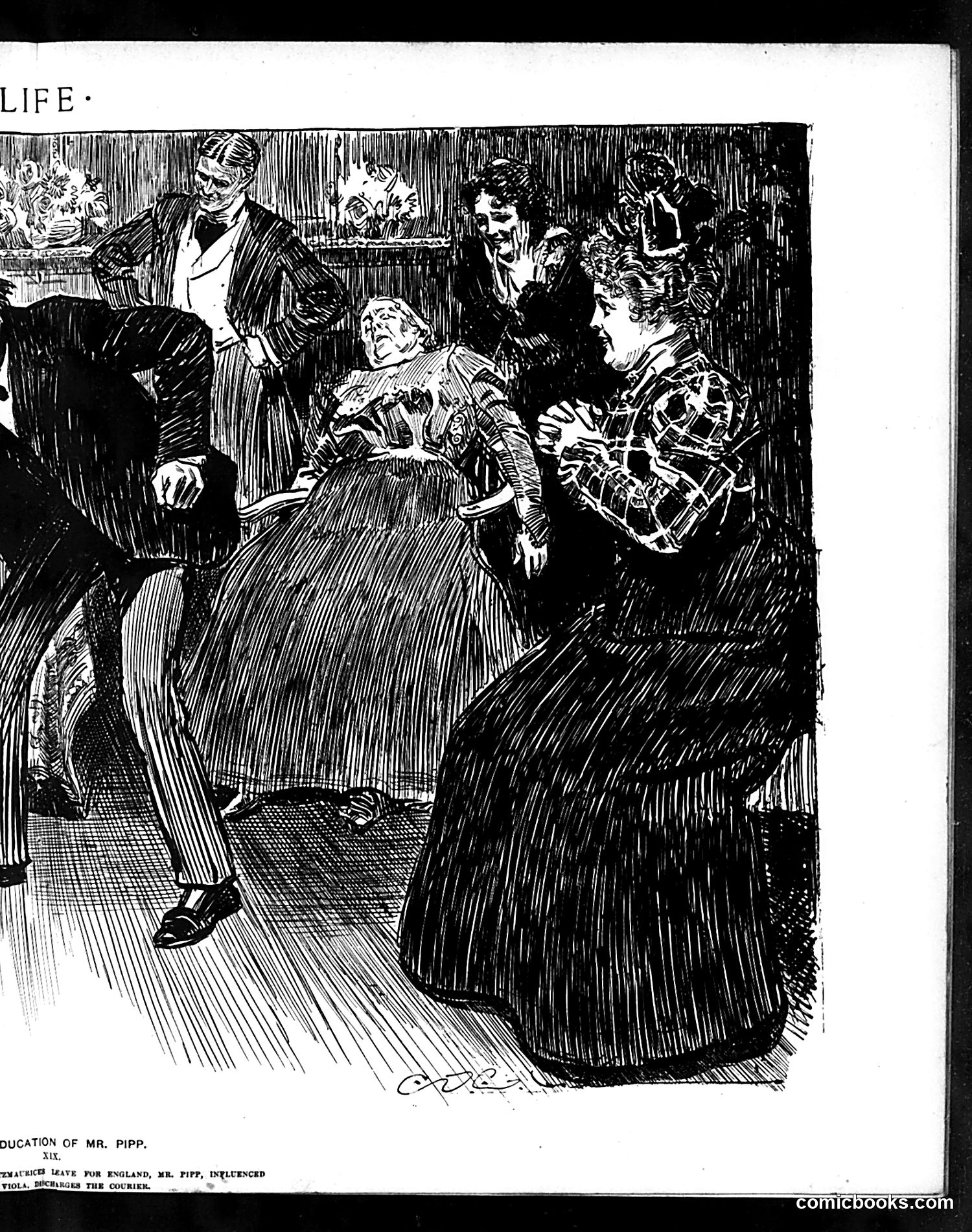
This satirical cartoon depicts a social scene where a well-dressed man (Mr. Pipp) sits surrounded by fashionable women in an elegant interior setting. The caption indicates he is being "influenced" or educated by these women, with specific mention that they are "discharged the cuckler" (likely a garbled OCR rendering of period slang). The satire appears to mock a man of apparent social standing being schooled or manipulated by fashionable society women—a commentary on male susceptibility to female influence in high society. The elaborate clothing and interior setting emphasize the superficiality of this "education." The joke likely plays on contemporary anxieties about gender dynamics and social climbing in Gilded Age or early 20th-century American society.
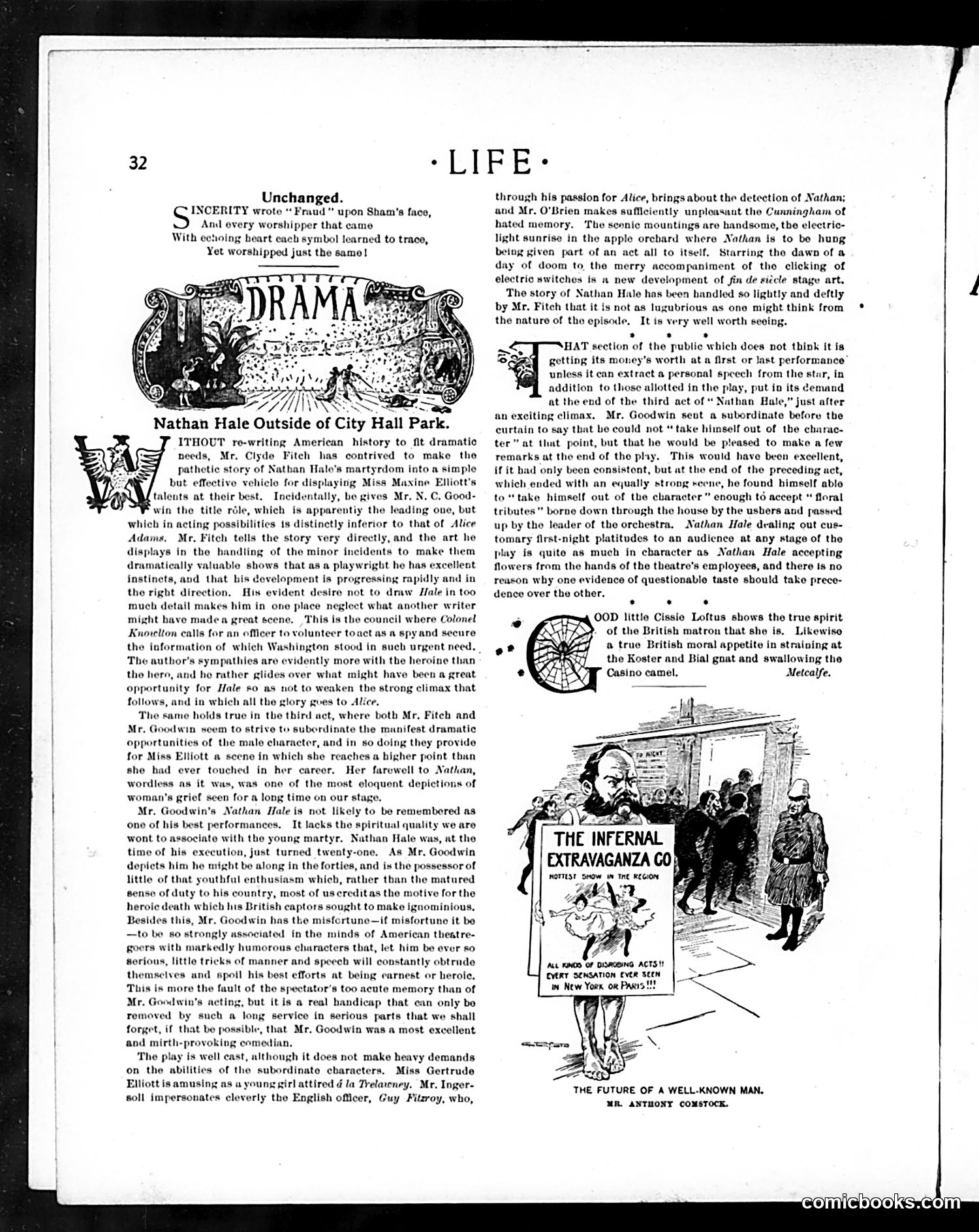
This page reviews theatrical productions, focusing on "Nathan Hale Outside City Hall Park," a play about the American Revolutionary martyr Nathan Hale. The text praises Mr. Fitch's direction and the cast's performances, particularly Miss Maxine Elliott's portrayal. Two illustrated advertisements appear: 1. "The Infernal Extravagance" — a satirical play advertisement mocking wasteful spending in New York 2. "The Future of a Well-Known Man" by Anthony Comstock — appears to be social commentary, likely critiquing Comstock's involvement in censorship The page exemplifies *Life* magazine's role as a forum for theatrical criticism and social satire about American culture, morality, and public figures of the era.
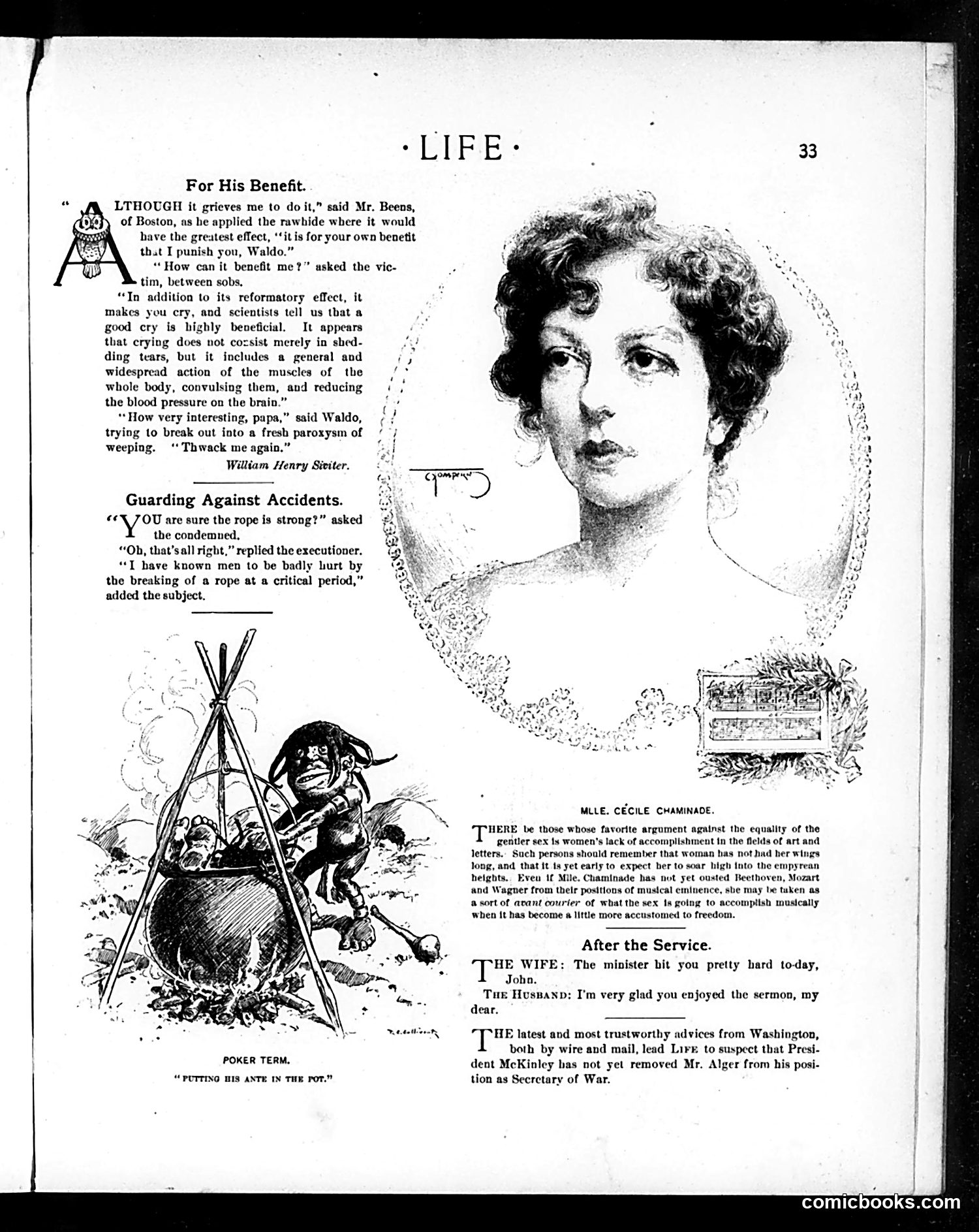
This page contains multiple satirical pieces typical of early Life magazine humor: **"For His Benefit"** mocks pseudo-scientific justifications for corporal punishment. A father (Mr. Beens) beats his son while claiming crying has health benefits, citing dubious scientific authority. The son, understanding the "logic," asks to be hit again—absurdist satire exposing how parents rationalize abuse. **"Guarding Against Accidents"** is dark humor about execution: a condemned man worries the executioner's rope might break and injure him, treating the execution as a safety concern rather than a death sentence. **Mlle. Cecile Chaminade** section defends women's artistic capability, arguing that women haven't yet achieved musical eminence like Beethoven because they've only recently gained freedom—not lack of talent. This addresses contemporary debates over women's rights and accomplishments. **"After the Service"** shows a wife praising a sermon that criticized her husband, who graciously accepts the dig. The **McKinley/Alger reference** (bottom) suggests political pressure to remove Secretary of War Russell Alger from office, likely over Civil War mismanagement.
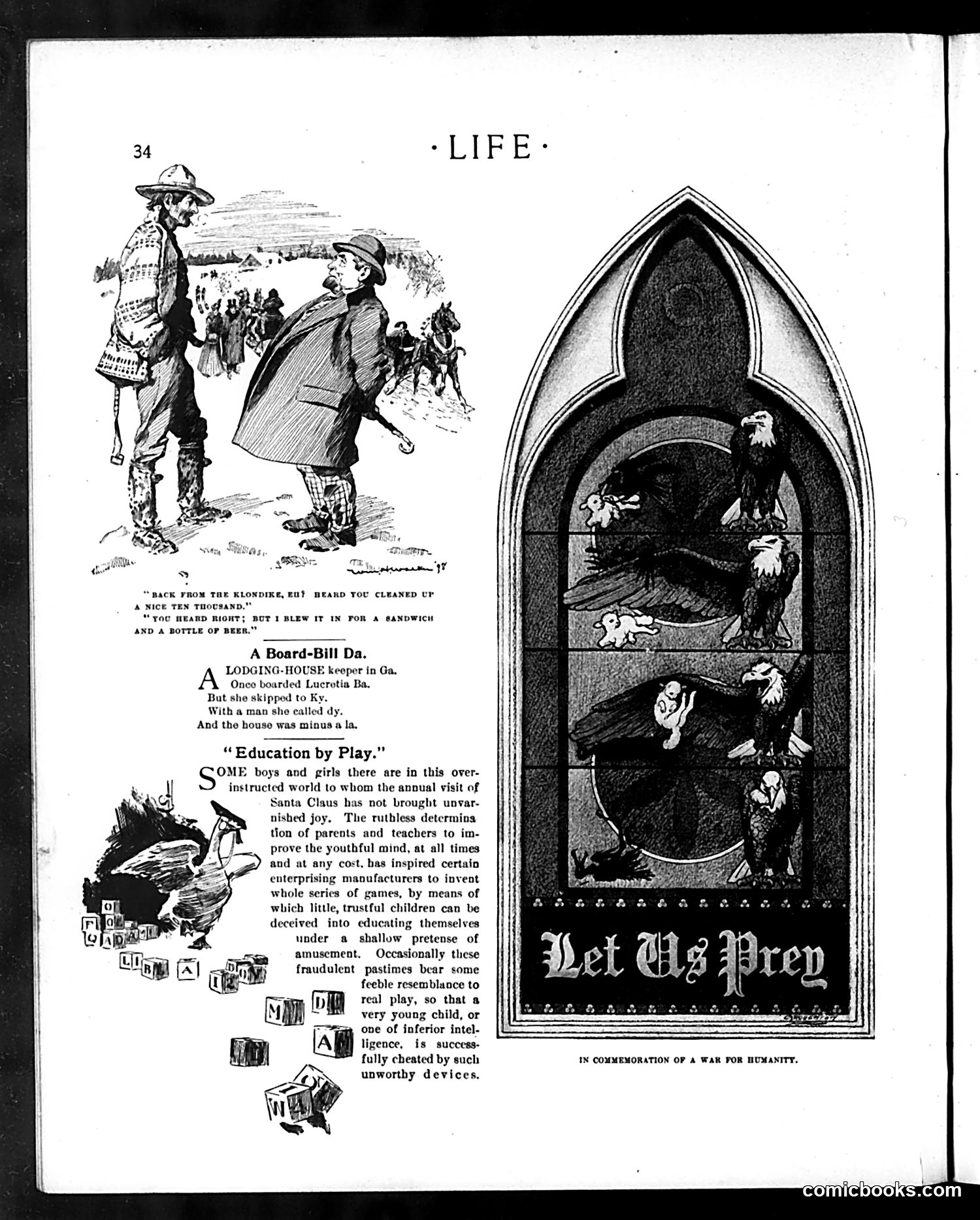
**Top Cartoon:** Two prospectors discuss a Klondike gold rush returnee who claims to have struck it rich ("cleaned up a nice ten thousand") but immediately squandered it on a sandwich and beer. The satire mocks the get-rich-quick mentality of the 1890s gold rush era—the absurdity of finding fortune only to waste it on trivial consumption. **"A Board-Bill Da" (verse):** A humorous poem about a Georgia lodging-house keeper who boarded a tenant named Lucretia who skipped town with a man, leaving the proprietor unpaid. It's a light joke about deadbeat renters. **"Education by Play" (article):** Satirizes manufacturers selling educational games disguised as toys to trick children into learning. The piece criticizes parents and teachers who prioritize self-improvement over genuine childhood enjoyment, condemning these games as "fraudulent pastimes" that deceive young or less-intelligent children into unwilling education. **Right Image:** "Let Us Prey"—depicts predatory birds in a Gothic arch, titled "In Commemoration of a War for Humanity," likely satirizing militarism or hypocrisy surrounding a contemporary conflict.
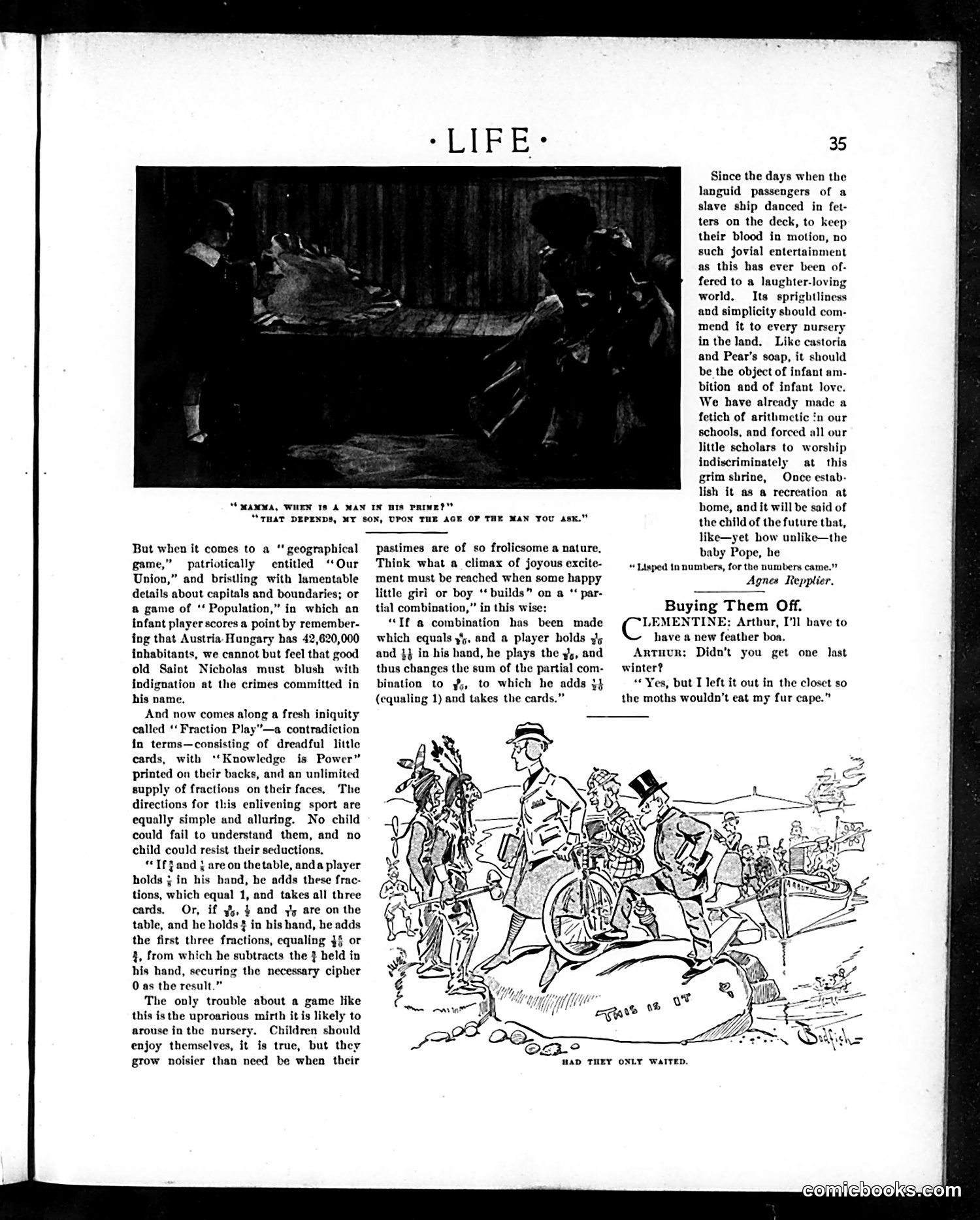
This page satirizes the over-intellectualization of children's games and entertainment. The main text mocks a new card game called "Fraction Play" that disguises arithmetic lessons as fun—featuring complex fractional equations printed on cards allegedly designed for nursery amusement. The satire's bite lies in the comparison: the author sarcastically suggests this joyless "educational" entertainment is unprecedented since enslaved people were forced to dance on slave ships. The implication is cutting—both involve coerced, performative "enjoyment." The accompanying cartoon shows two men on a bicycle built for two, illustrating the caption "Had They Only Waited"—likely commenting on waiting for better times or solutions rather than purchasing items hastily. The brief "Buying Them Off" dialogue jokes about marital compromise: a wife requests a feather boa; the husband notes she recently got one; she reveals she abandoned it to protect her fur cape from moths—suggesting frivolous reasoning for constant new purchases.
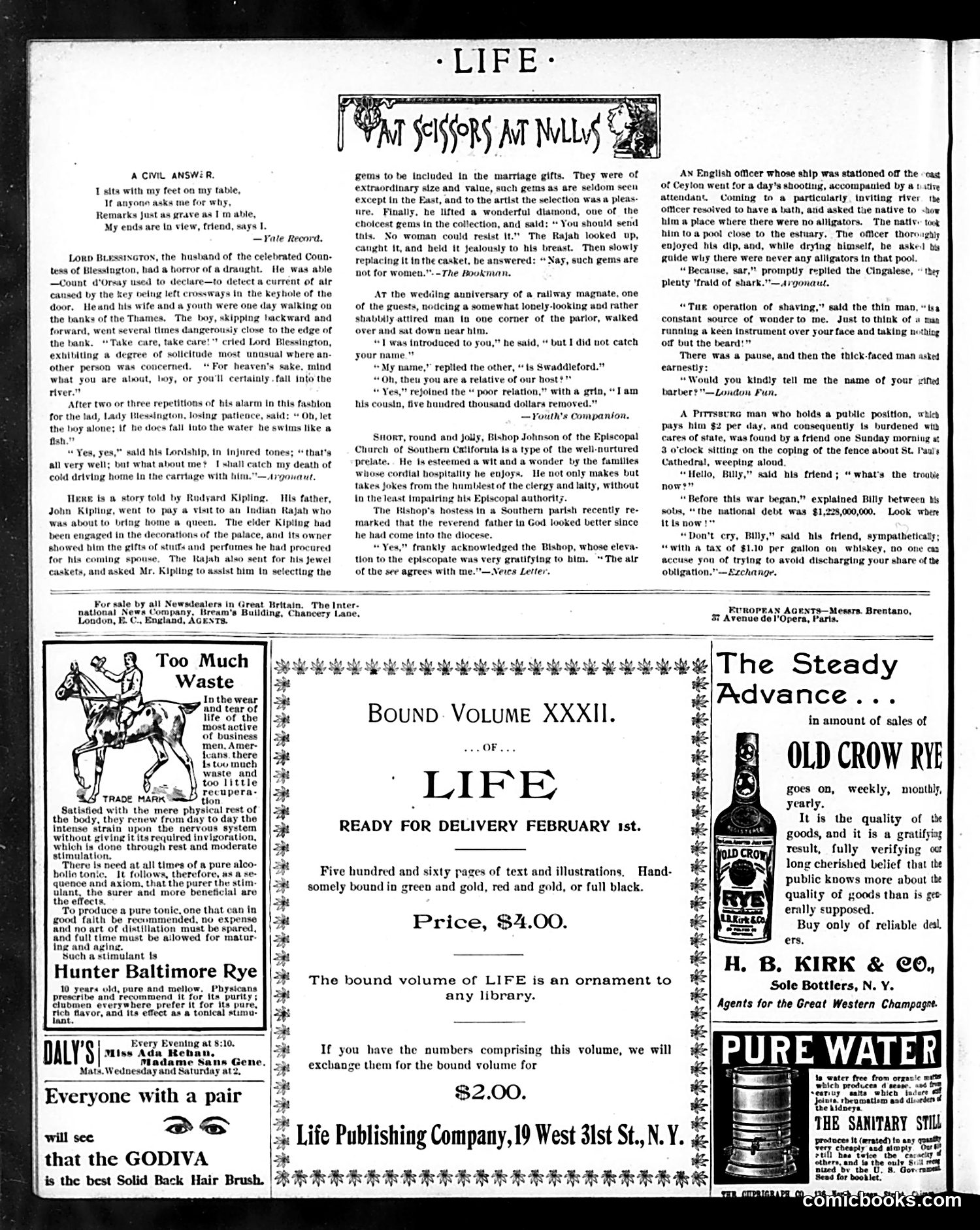
This page is primarily **humorous anecdotes and advertisements** rather than political cartoons. The "satire" consists of short jokes illustrating human selfishness and vanity: **Key Stories:** 1. **"A Civil Answer"**: A man props his feet on a table—when asked why, he gives pompous justification. The joke mocks pretentious self-importance. 2. **Lord Blessington anecdote**: A hypochondriac nobleman obsesses over drafts while ignoring his stepson's danger near water—satirizing misplaced priorities and self-centeredness. 3. **Rajah's diamond**: A wealthy man refuses to give his most prized gem to his bride because he values possessions more than generosity—mocking greed. 4. **The "poor relation"**: Humorous acknowledgment of family embarrassment. The overall theme: **human selfishness, vanity, and material obsession**. These are gentle Victorian-era jokes aimed at social hypocrisy rather than specific political figures. The page also advertises bound volumes of *Life* magazine itself.
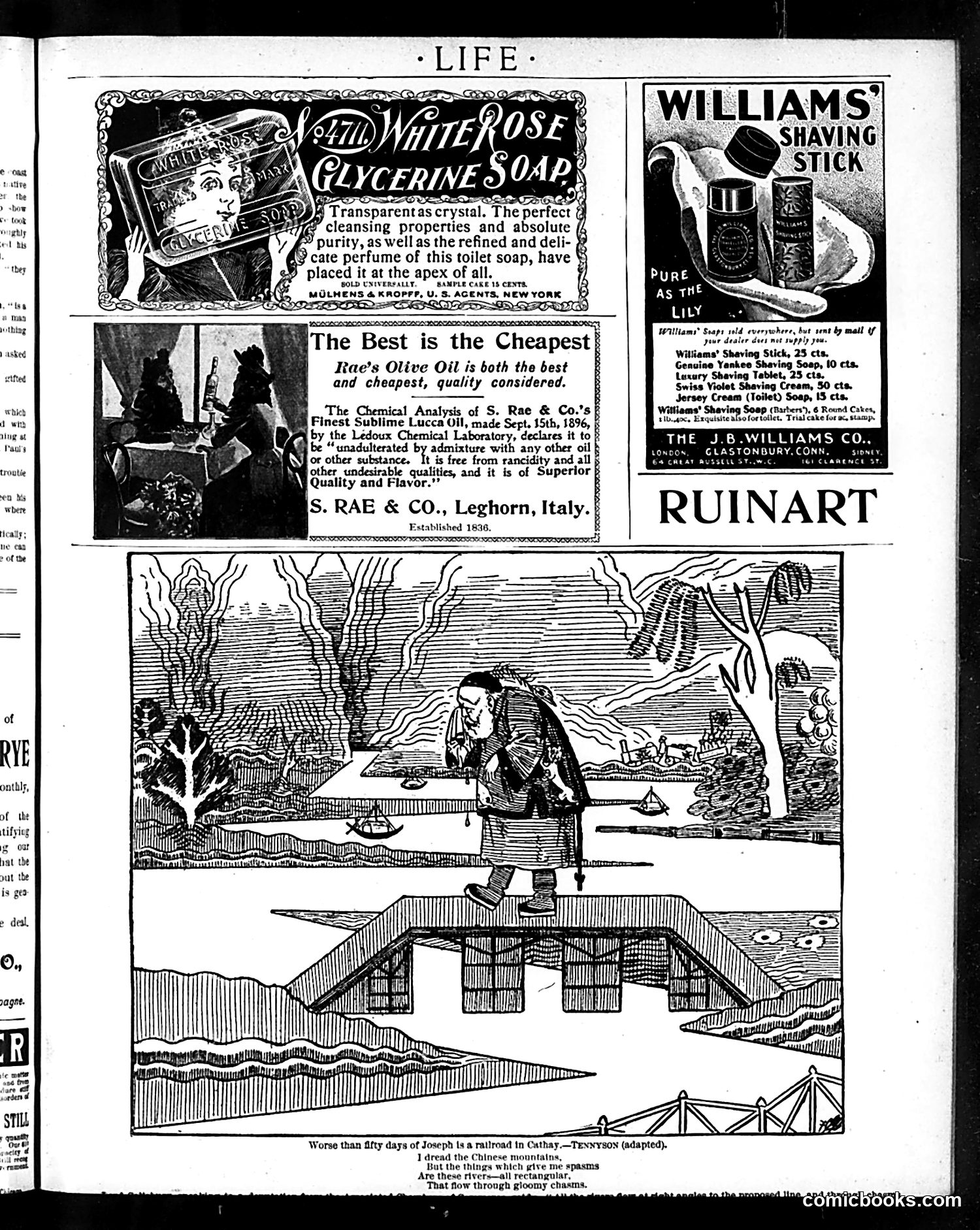
This page is primarily **advertising** for toiletries (White Rose Glycerine Soap, Williams' Shaving Stick, Rae's Olive Oil) typical of early 20th-century Life magazine content. The notable satirical element is the **bottom illustration and caption**, which parodies **Tennyson's poem** (likely "The Brook"). The cartoon depicts a figure crossing rectangular, geometric rivers in China, humorously adapting Tennyson's romantic verse to mock Chinese landscape features as absurdly rectilinear and unnatural compared to Western rivers. The joke relies on Western stereotypes of China as exotic and bizarre—the satirist presents Chinese geography itself as comically artificial and uninviting. The modified quote attributes the sentiment to "Tennyson (adapted)," making clear this is a playful literary parody rather than genuine criticism. The overall page reflects early 1900s American attitudes: mixing consumer goods with casual cultural mockery of non-Western nations.
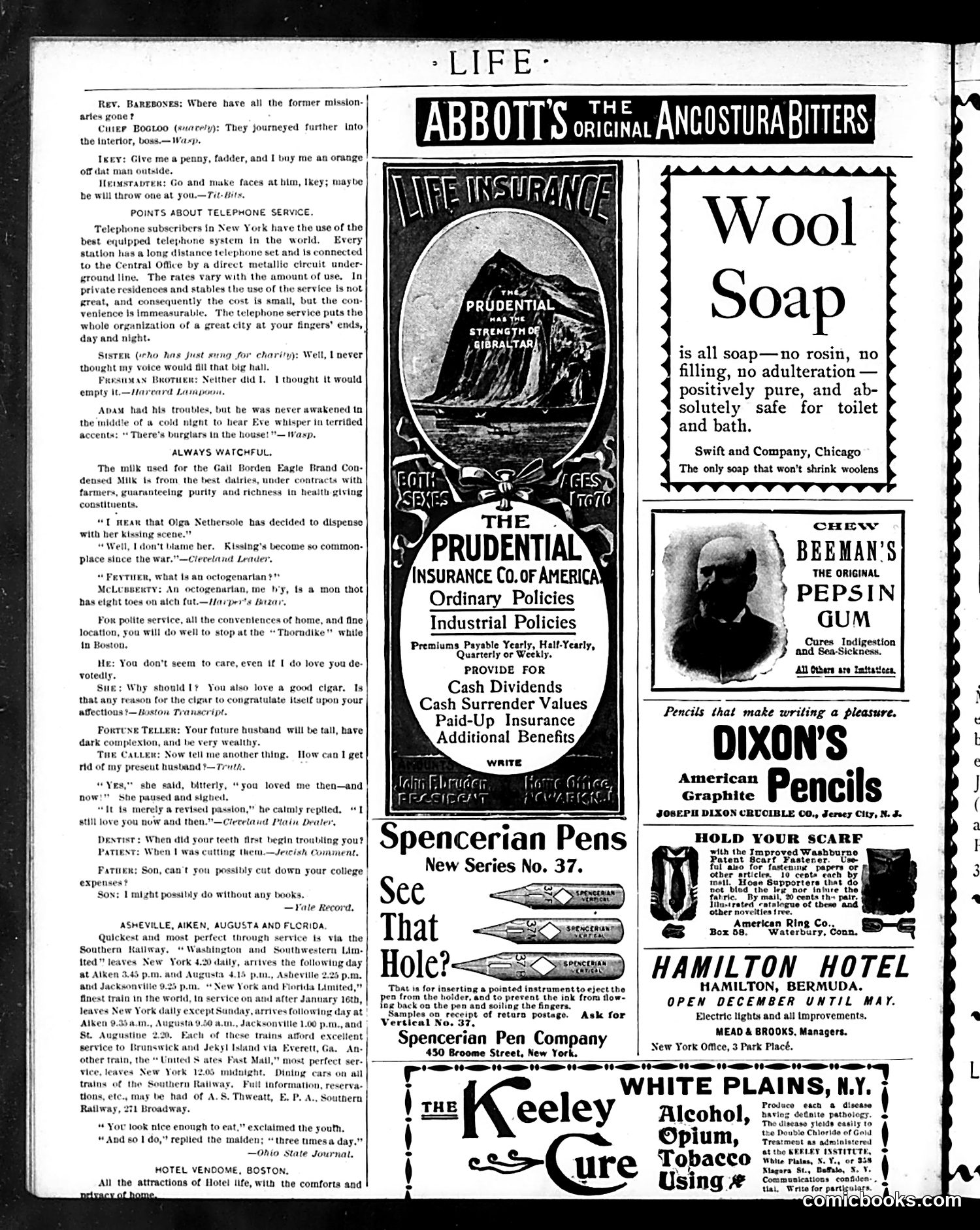
This page from *Life* magazine (likely early 1900s based on style) is primarily **advertising and humor columns**, not political satire. The small jokes scattered throughout are typical period humor: - A dialogue between "Rev. Bargones" and "Curer Bootoo" appears to mock missionary work and dialect humor (using "boss" and broken English, reflecting the era's casual racism) - Various domestic humor: a child asking father for money, marriage jokes, dental humor The bulk of the page features **advertisements** for products like Abbott's Angostura Bitters, Wool Soap, Pepsin Gum, Spencerian Pens, and hotel/railroad services—standard commercial content with period typography and illustrations. There is **no significant political cartoon or satirical commentary** visible. The page reflects early 20th-century magazine layout: advertisements subsidizing humorous domestic vignettes and travel notices, with no broader social critique apparent.
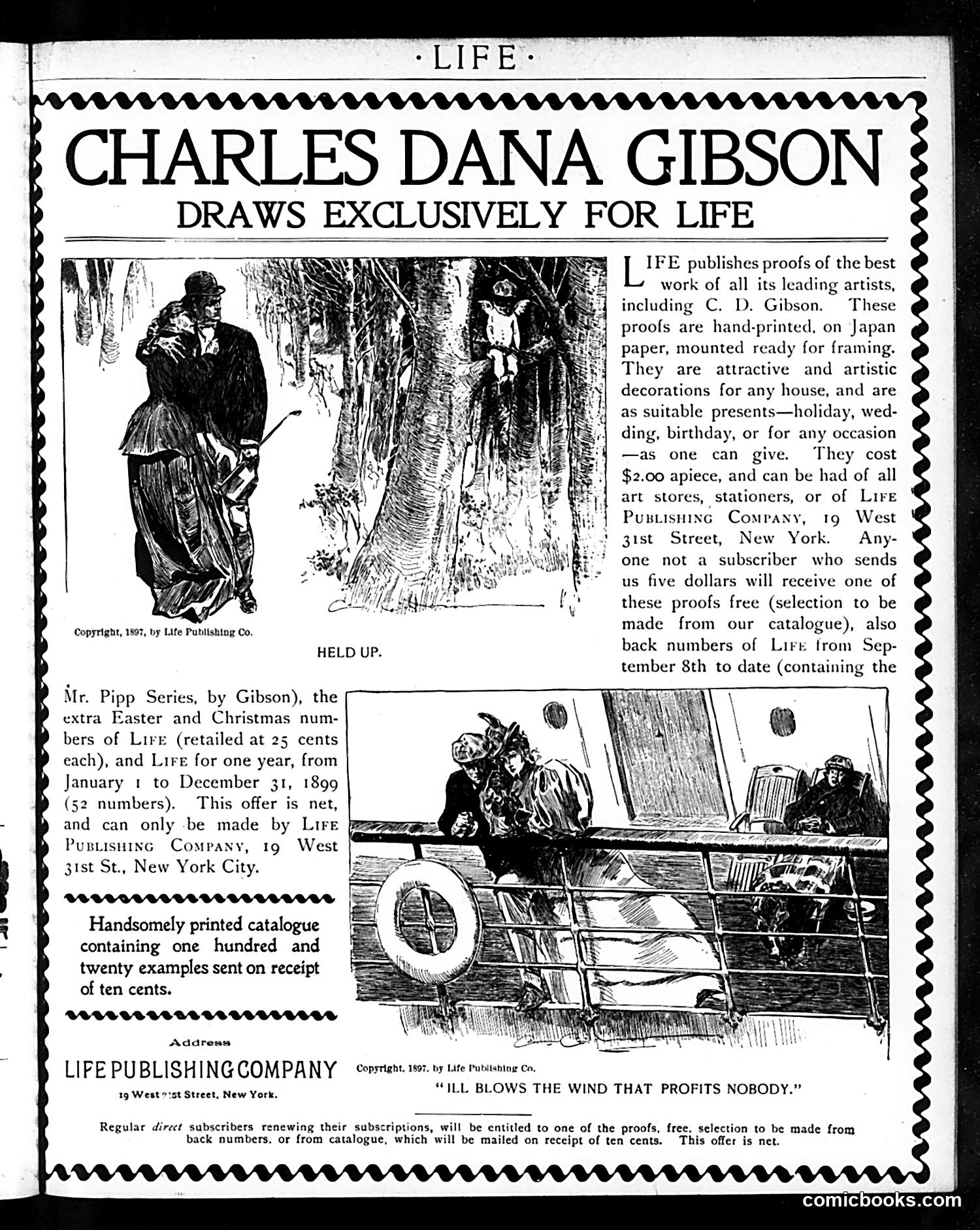
This page is primarily **advertising** for Life Publishing Company's art prints by Charles Dana Gibson, the famous illustrator known for the "Gibson Girl." The two illustrations are untitled cartoons: 1. **"Held Up"** (top): Shows a figure confronting another against a tree, likely depicting a robbery or mugging—a common urban crime concern of the 1890s. 2. **"Ill Blows the Wind That Profits Nobody"** (bottom): Depicts people on what appears to be a ship or boat in rough conditions, suggesting hardship or misfortune. These cartoons exemplify Gibson's satirical style but lack clear political commentary visible here. The page emphasizes that Life sells hand-printed proofs of Gibson's work for $2 each, targeting middle-class home decoration. A subscription offer provides free prints and back issues for five dollars—a marketing strategy to build readership during this period of American magazine expansion.
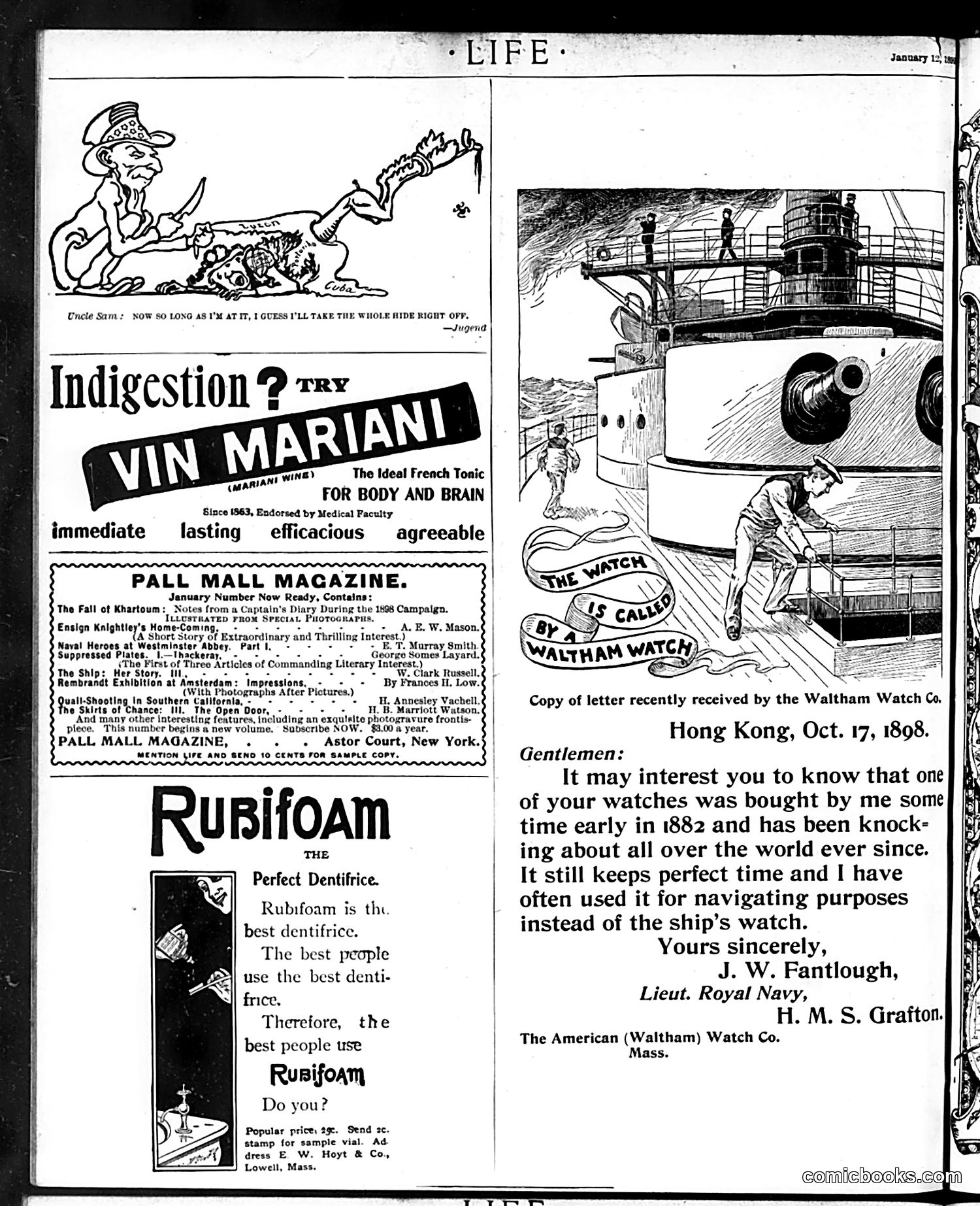
The main cartoon depicts **Uncle Sam** with a knife, threatening to remove a "hide"—a reference to the **Spanish-American War of 1898**. The caption's casual tone ("now so long as I'm at it, I guess I'll take the whole hide right off") satirizes American imperial expansion beyond Cuba. After defeating Spain, the U.S. acquired territories including the Philippines, Guam, and Puerto Rico. The joke critiques how American intervention, ostensibly limited in scope, ballooned into widespread territorial acquisition. The cartoon reflects contemporary debate over whether the U.S. should become an imperial power. Life magazine's satirical stance questions American interventionism masquerading as humanitarian action. The remainder of the page consists of period advertisements (Vin Mariani tonic, Pall Mall Magazine, Rubifoam dentifrice) and a testimonial letter praising Waltham watches' reliability, typical of Life's advertising content.