
Life, 1899-01-12 · page 6 of 20
Life — January 12, 1899 — page 6: what you’re looking at
What you’re looking at
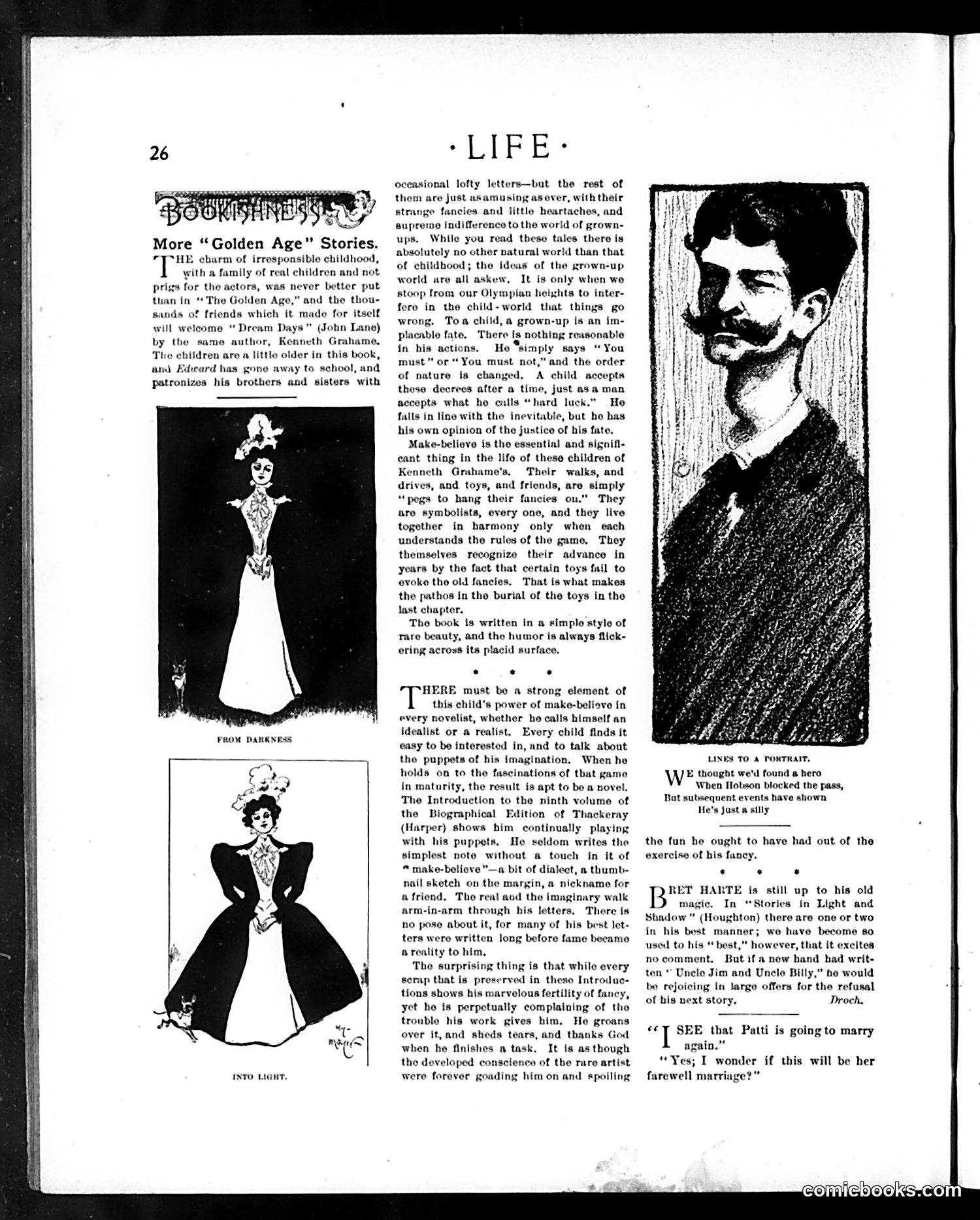
This page reviews Kenneth Graham's children's books, praising their imaginative quality and the author's ability to capture childhood perspectives. The two illustrations labeled "FROM DARKNESS" and "INTO LIGHT" appear to be character sketches from Graham's works, showing elegantly dressed figures in late Victorian/Edwardian style. The text emphasizes how Graham's child characters accept their fates philosophically and find meaning through imagination and play. A portrait of what appears to be the author himself occupies the right side. The bottom section quotes dialogue about a character named Patti's marriage, suggesting satirical commentary on romance or social conventions among the literary class. The overall tone celebrates Graham as a master of children's literature who maintains artistic integrity despite commercial pressures.
📄 Transcribed text from this page (OCR, searchable)
Machine-transcribed from the original scan — historical spelling and the odd misread are preserved.
More “Golden Age” Stories. TTPHE charm of irresponsible childhood, I vith a family of real children and not prigs for the actors, was never better put than In “The Golden Age,” and the thou- sands of friends which it made for itself will welcome “ Dream Days” (Jobn Lane) by the same author, Kenneth Grahame. The children are a little older in this book, and Edward has gone away to school, and patronizes his brothers and sisters with INTO LIGHT. *LIFE* occasional lofty letters—but the rest of thom are just asamusing asover, with their strange fancies and little heartaches, and supremo indifference to the world of grown- While you read these tales there is absolutely no other natural world than that of childhood; the ideas of the grown-up world are all askew, It is only when we stoop from our Olympian heights to inter- fero in the child-world that things go wrong. Toa child, a grown-up is an im- placablo fate, ‘There is nothing reasonable in his actio Ho “simply says “You must" or You must not,” and the order of nature {8 changed. A child accepts these decrees after a time, just as a man accepts what ho culls “hard luck.” Ho falls in line with tho inevitable, but ho bas his own opinion of the justice of his fate. Make-believe is the essential and signif- cant thing in the life of theso children of nneth Grahame'’s, Their walks, and drives, and toys, and friends, are simply “pegs to hang their fancies ou.” They aro symbolists, every ono, and thoy live together in harmony only when each understands the rules of the gume, Thoy themselves recognize their advance in years by the fact that certain toys fail to evoke the old fancies. That is what makes the pathos in tho burial of the toys in tho last chapter. Tho book is written in a simplo style of rare beauty, and the humor is always flick- ering across its placid surface. ups. . . . HERE must be a strong element of this child's power of make-believe in every novelist, whether be calls himself an idealist or a realist. Every child finds it easy to be interested in, and to talk about the puppets of his imagination. When he holds on to the fascinations of that game. in maturity, the result is apt to bo a novel, The Introduction to the ninth volume of the Biographical Edition of Thackeray (Harper) shows him continually playing with his puppets. He seldom writes the simplest note without a touch in it of * make-believe "—a bit of dialect, a thumb- nail sketch on the margin, a nickname for afriond., The real and the imaginary walk arm-in-arm through his letters. There is no pose about it, for many of his best let- ters were written long before fame becamo a reality to him. Tho surprising thing is that while every scrap that is preserved in these Introduc- tions shows his marvelous fertility of fancy, yet ho is perpetually complaining of tho trouble his work gives him. He groans over it, and sheds tears, and thanks God when he finishes a task. It is asthough tho developed conscience of the rare artist were forever goading him on and spoiling LINKS TO A PONTRAIT, WE thought we'd found a hero When Hobson blocked the pass, Bat subsequent events have shown He's just a silly the fun he ought to have had out of the exercise of his fancy. RET HARTE is still up to his old magic. In “Stories in Light and Shadow ” (Houghton) there are one or two in his best manner; we have become 80 used to his “ best,” however, that it excites, no comment. But if a new hand had writ- ten “ Unclo Jim and Unclo Billy,” ho would be rejoicing in largo offers for the refusal of bis next story. Droch. ‘¢7 SEE that Patti is going to marry again.” “Yes; I wonder if this will be her farewell marriage