
Life, 1899-01-12 · page 12 of 20
Life — January 12, 1899 — page 12: what you’re looking at
What you’re looking at
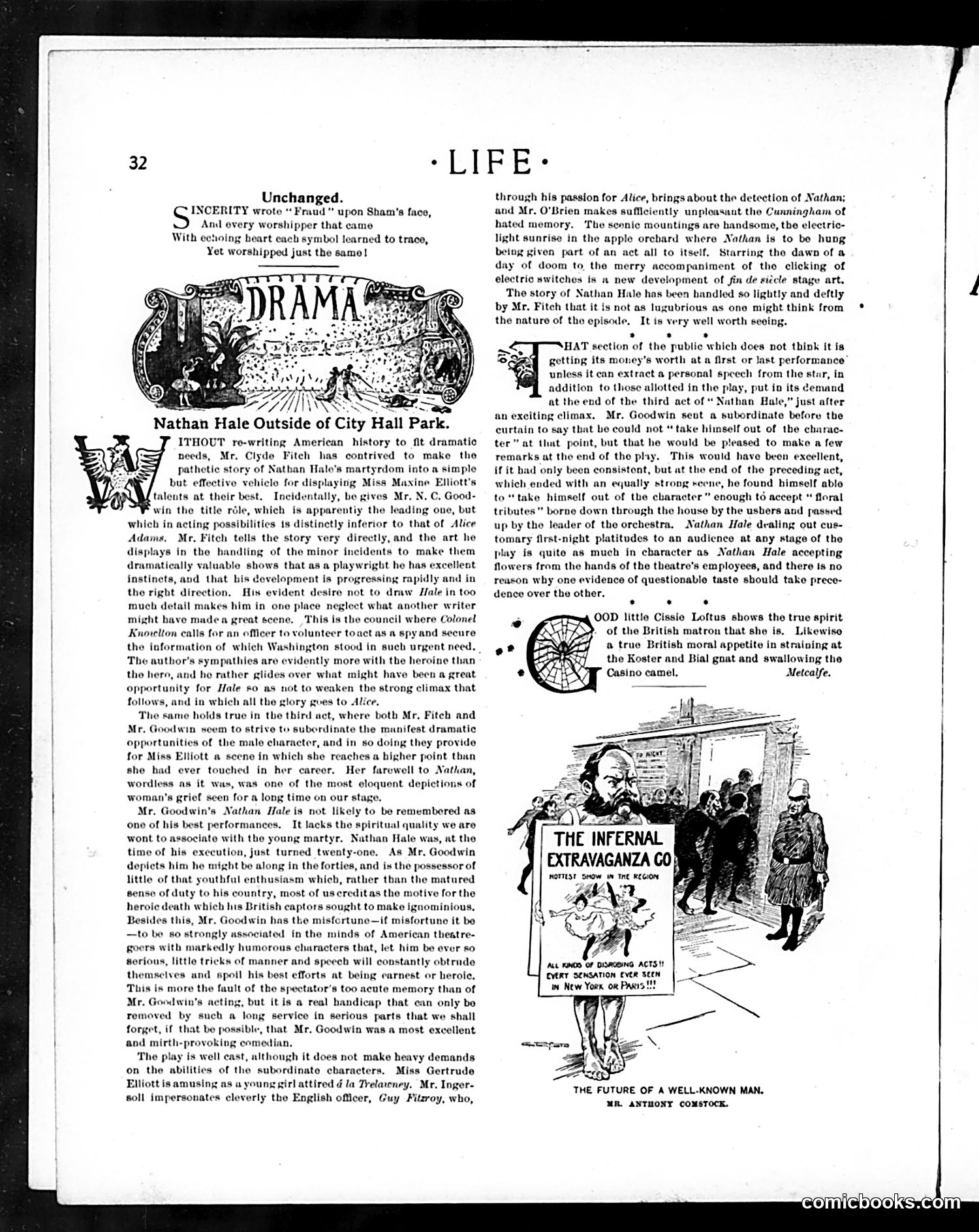
This page reviews theatrical productions, focusing on "Nathan Hale Outside City Hall Park," a play about the American Revolutionary martyr Nathan Hale. The text praises Mr. Fitch's direction and the cast's performances, particularly Miss Maxine Elliott's portrayal. Two illustrated advertisements appear: 1. "The Infernal Extravagance" — a satirical play advertisement mocking wasteful spending in New York 2. "The Future of a Well-Known Man" by Anthony Comstock — appears to be social commentary, likely critiquing Comstock's involvement in censorship The page exemplifies *Life* magazine's role as a forum for theatrical criticism and social satire about American culture, morality, and public figures of the era.
📄 Transcribed text from this page (OCR, searchable)
Machine-transcribed from the original scan — historical spelling and the odd misread are preserved.
Unchanged. INCERITY wrote “Fraud” upon Sham’s face Anil every worshipper that came oing heart cach symbol learned to trace, Yet worshipped just the samo! With Nathan Hale Outside of City Hall Park. ITHOUT ro-writing American history to fit dramatic needs, Mr. Clyde Fitch has contrived to make the pathetic story of Nathan Halo’s martyrdom into a simple r/ but effective vehicle for displaying Miss Maxine Elliott's talents at their best. Incidentally, be gives Mr. N.C. Good- win tho title role, which is apparentiy the leading ove, but which in acting possibilities 1s distinctly inferior to that of Alice Adams, Mr, Fitch tells the story very directly, and the art he displays in the handling of the minor incidents to make them dramatically valuable shows that as a playwright he has excellent instincts, and that bis development is progressing rapidly and in the right direction. His evident desire not to draw Hale in too much detail makes him in one place neglect what another writer might have made a great scene, This is the council where Colonel Knovlton calls for an officer to volunteer toact as a spy and secure the fnformation of which Washington stood in such urgent need, The author's sympathies are evidently more with the heroine than tho hero, and he rather glides over what might have been a great opportunity for Hale so as not to weaken the strong climax that follows, and in which all the glory gues to Alice, The same holds true in the third act, where both Mr, Fiteb and Mr. alwin seem to strive to subordinate the manifest dramatic opportunities of the male character, and in so doing they provide for Miss Elliott a scene in which she reaches a higher point than she had ever touched in her careor. Her farewell to Nathan, wordless as it was, was one of the most eloquent depictions of woman's grief seen for a long time on our stage. Mr. Goodwin’s Nathan Hale is not likely to be remembered as one of his best performances. It Jacks the spiritual quality we are wont to associate with the young martyr. Nathan Hale was, at the time of his execution, just turned twenty-one. As Mr. Goodwin depicts him he might be along in the forties, and is the possessor of little of that youthfal enthusiasm which, rather than the matured nse of duty to his country, most of uscreditas the motive forthe heroic death which hts British captors sought to make ignominious, Besides this, Mr, Goodwin has the misfortune—it misfortune it be —to bo so strongly associated in the minds of American thestre- goers with markedly humorous characters that, let him be ever so. serious, little tricks of manner and speech will constantly obtrude themscives and spoil his best efforts at being earnest or heroic. This is more the fault of the spectator’s too acute memory than of Mr. Goodwin's acting, but it is a real bandicap that can only bo removed by such a long service in serious parts that we shall forget, if that be possible, that Mr. Goodwin was a most excellent and mirth-provoking comedian. ‘The play is well cast, although it does not make heavy demands on the abilities of the subordinate cbaracters. Miss Gertrude Elliott is amusing as a young girl attired dla Trelaweney. Mr. Inger- soll impersonates cleverly the English officer, Guy Fitzroy, who, * LUPE through his passion for Alice, brings about the detection of Nathan; and Mr, O'Brien makes sufficiently unploasaut the Cunningham of hated memory. The scenic mountings are handsome, the electric- light sunrise in the apple orcbard where Nathan is to bo hung betog given part of an act all to itself. Starring the dawn of a day of doom to the merry accompaniment of tho clicking of electric switches is 1 new development of fin de sitcle stage art. Tho story of Nathan Hale has been handled $0 lightly and deftly by Mr. Fitch that it {s not a8 lugubrious as ono might think from the nature of the episode, It is very well worth seeing. * * * HAT section of the public which does not think it is getting its money's worth at a first or Jast performance unless it can extract a personal speech from the star, in addition to those allotted in the play, put in its demand at the end of the third act of “Nathan Hale,” just after an exciting climax. Mr. Goodwin sent a subordinate before the curtain to say that be could not “take himself out of the charac- ter at that point, but that he would be pleased to mako a few remarks at the end of the ply, This would have been excellent, if it had only been consistent, but at the end of the preceding act, which ended with an equally strong scene, he found himself able to “take himself out of the character” enough to accept “ floral tributes” borne down through the house by the usbers and passed up by the leader of the orchestra, Nathan Hale dealing out cus- tomary first-night platitudes to an audience at any stage of the play is quite as much in character as Nathan Hale accepting flowers from the hands of the theatro’s employees, and there 18 no reason why one evidenco of questionable taste should take prece- dence over the other. oy . 8 8 emg OOD little Cissio Loftus shows the true spirit Nes, of the British matron that sho is. Likewiso EN Ze a true British moral appetite in straining at Lest — the Koster and Bial gnat and swallowing the Casino camel. Metcalfe. AL RINGS OF DISAOBING ACTS! EVERY SENSATION EVER SEEN iw New Yorn on Pagis !!! THE FUTURE OF A WELL-KNOWN MAN. MR. ANTHONY COMSTOCK.