
A complete issue · 20 pages · 1898
Life — December 8, 1898
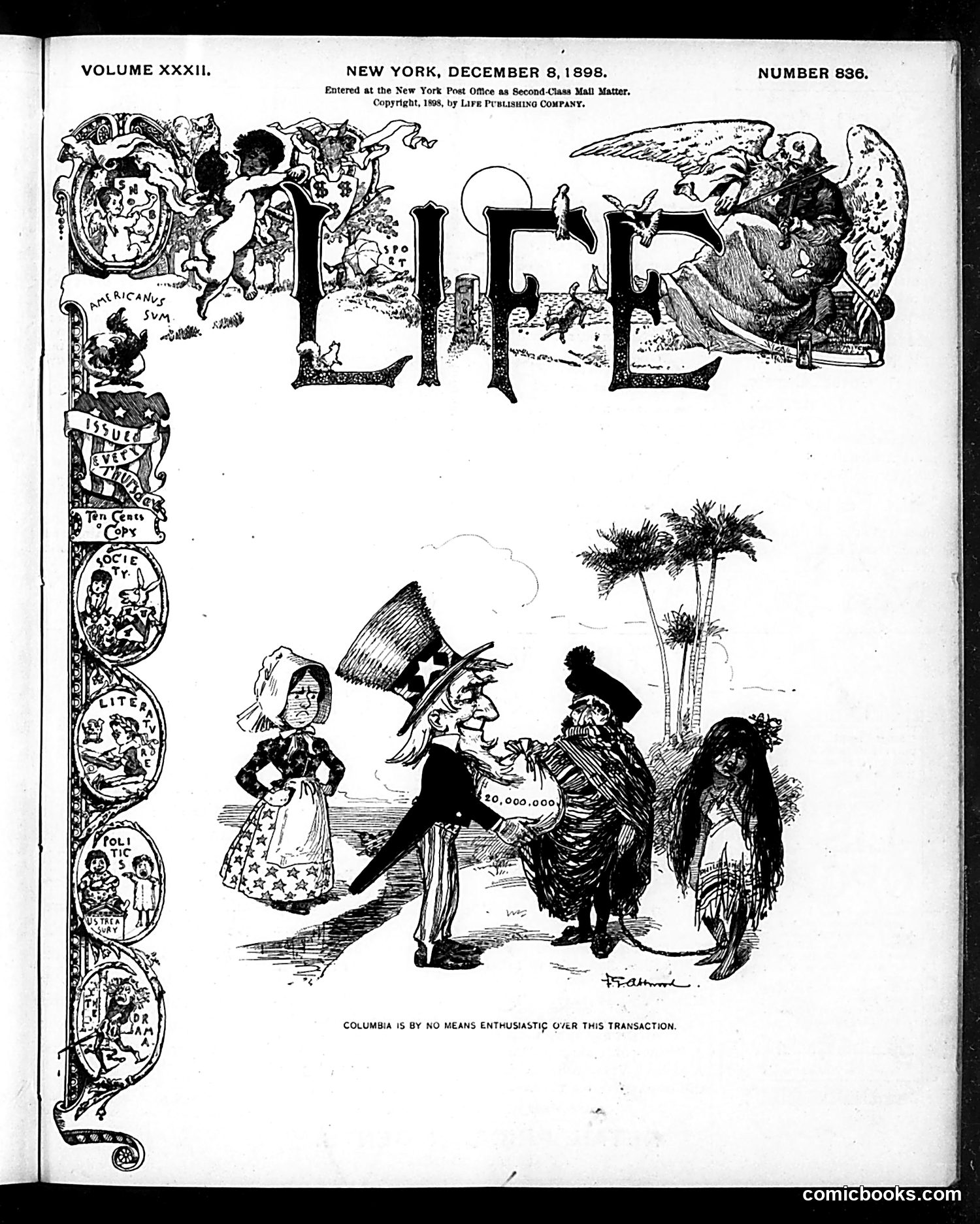
This cartoon satirizes the acquisition of the Philippines following the Spanish-American War. The central figures appear to represent America (the woman in the bonnet) and Uncle Sam negotiating with what seem to be Filipino or colonial representatives, with a bag labeled "20,000,000" (the purchase price). The caption—"Columbia is by no means enthusiastic over this transaction"—indicates skepticism about American imperial expansion. Columbia, personifying the United States, appears reluctant about acquiring the Philippines as a territory. The cartoon critiques contemporary American imperialism and the costs (both financial and moral) of colonial acquisition, reflecting domestic debate over whether the U.S. should become an imperial power in the Pacific.
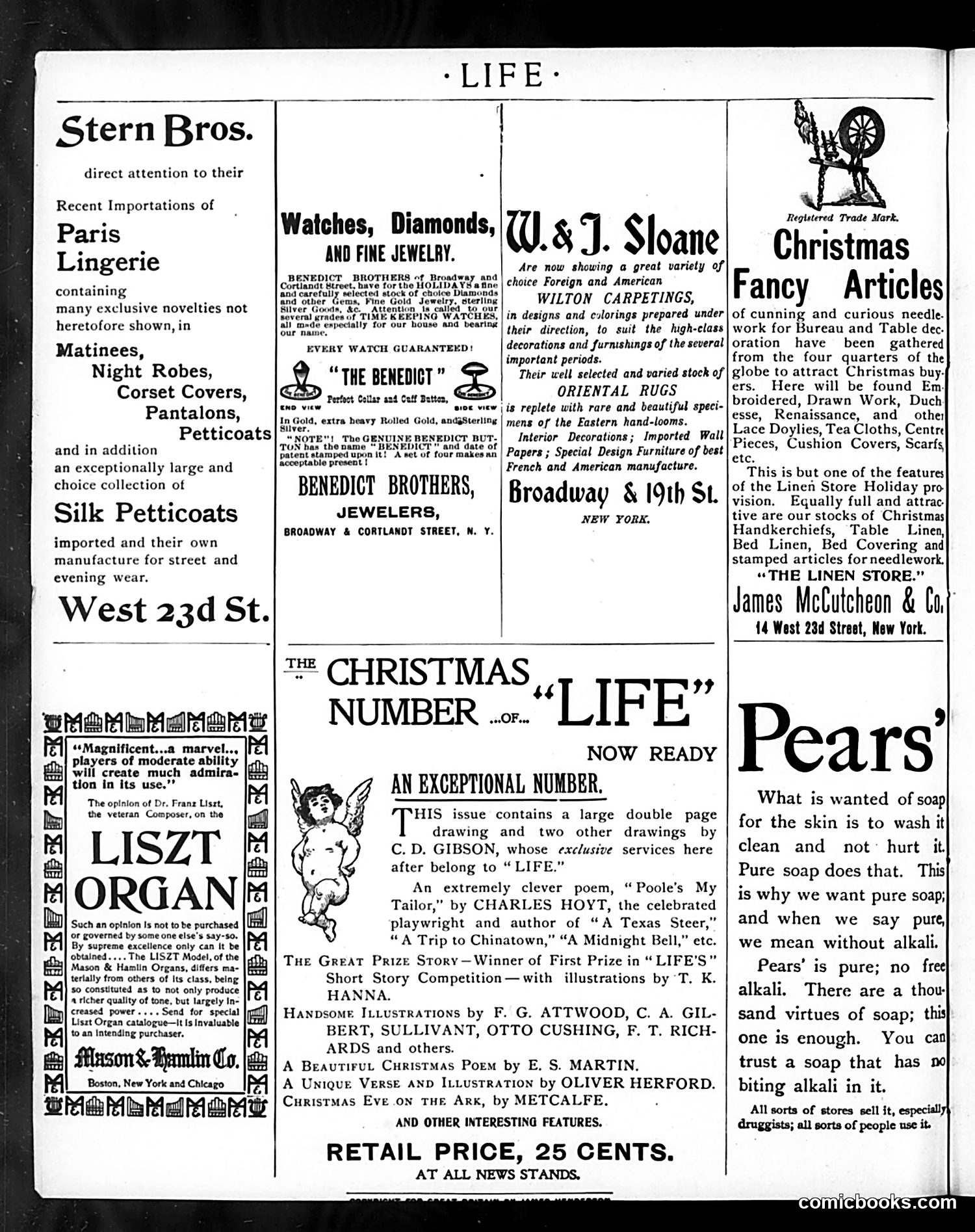
This page is **primarily advertising** with minimal satirical content. The dominant feature is a large announcement for Life magazine's Christmas Number, featuring a cherub illustration and listing contents including works by Charles Hoyt and C.D. Gibson. The page contains advertisements for luxury goods—Stern Bros. lingerie, Benedict Brothers jewelry, W. & J. Sloane furnishings, and James McCutcheon fancy articles—typical of Life's wealthy readership in this era. The only potentially humorous content is a "Liszt Organ" advertisement with ornamental borders, though it appears to be straightforward promotion rather than satire. The Pears' soap advertisement emphasizes purity and safety, reflecting period concerns about product quality. **No clear political cartoons or satirical commentary is evident on this page.**
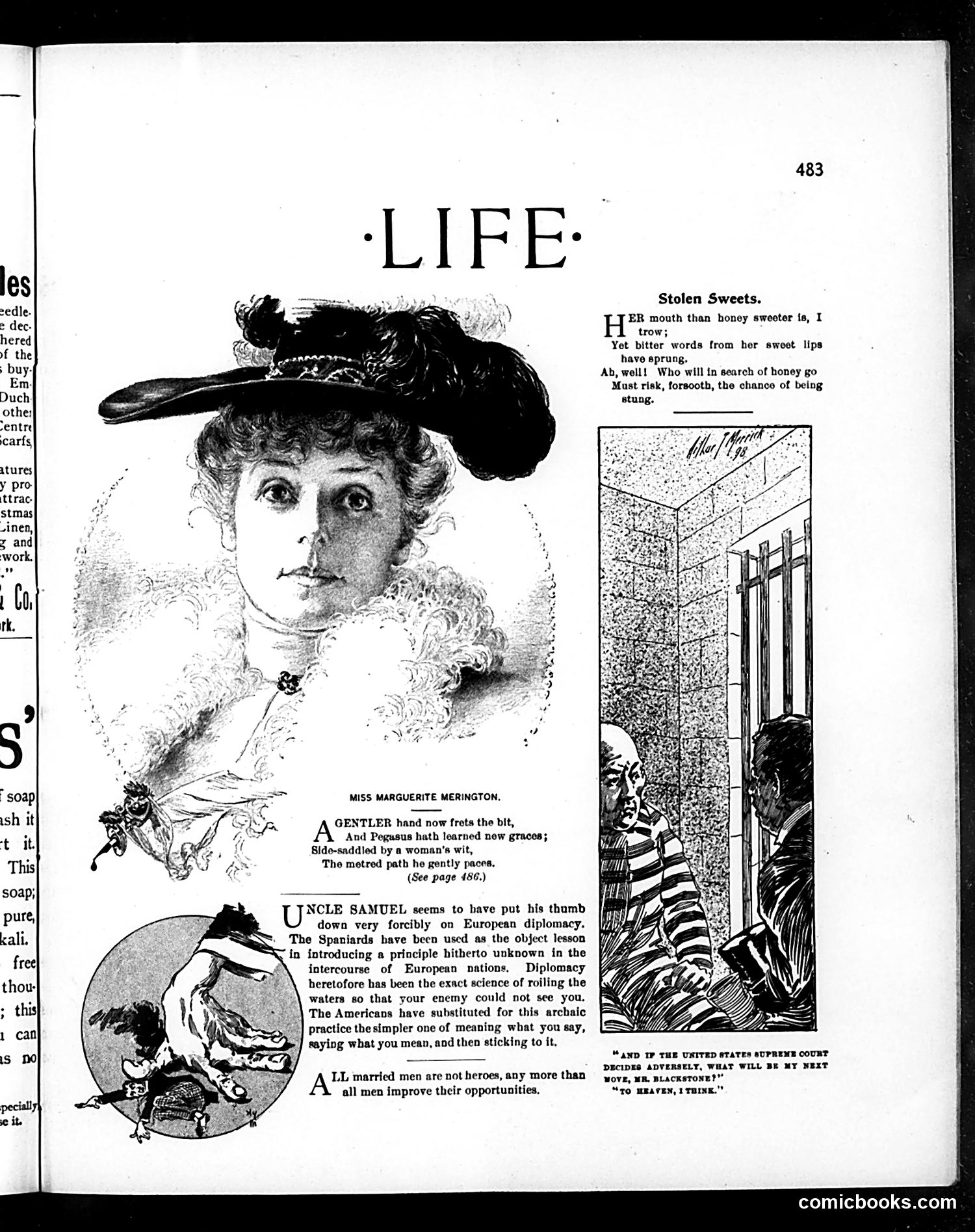
This page features satirical content about early 1900s politics and society. The main portrait shows Miss Marguerite Merington, likely a public figure of the era. The text references "Uncle Samuel" (Uncle Sam) critiquing European diplomacy, suggesting Americans are adopting a practice of "mealing what you say" rather than the European tradition of deceptive rhetoric—a commentary on American diplomatic style versus European sophistication. The small illustration depicts a figure at a doorway, accompanying commentary about married men and heroism, with a quote from what appears to be a Supreme Court decision. The "Stolen Sweets" poem above mocks romantic pursuit, suggesting the risks of seeking honeyed words from women. Overall, the page satirizes American foreign policy pretensions and gender relations through humor typical of Life's editorial approach.
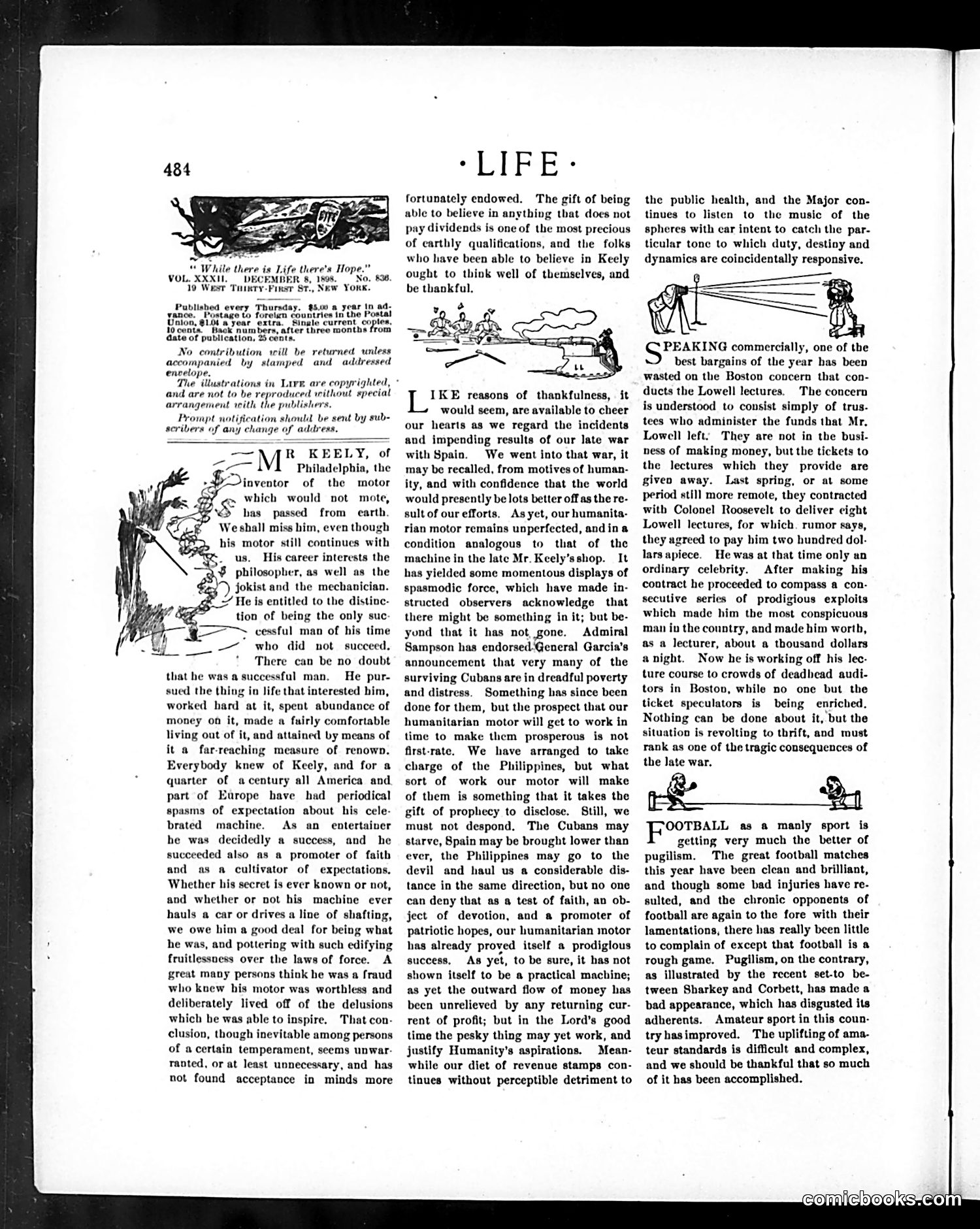
This page contains **editorial commentary rather than political cartoons**. The main illustration depicts **Mr. Keely**, labeled as "Inventor of the motor which would not work," shown as an elderly man with distinctive features. The text discusses Keely's failed motor invention and draws a parallel to the humanitarian outcomes of the recent Spanish-American War. The author argues that despite Keely's unsuccessful machine, he deserves credit for attempting something ambitious—similarly, the U.S. humanitarian motor (its war effort) may not have produced perfect results for Cuba and the Philippines, but the intent was good. The page also briefly addresses **football** and the Lowell lectures in Boston, noting improved standards in amateur athletics.
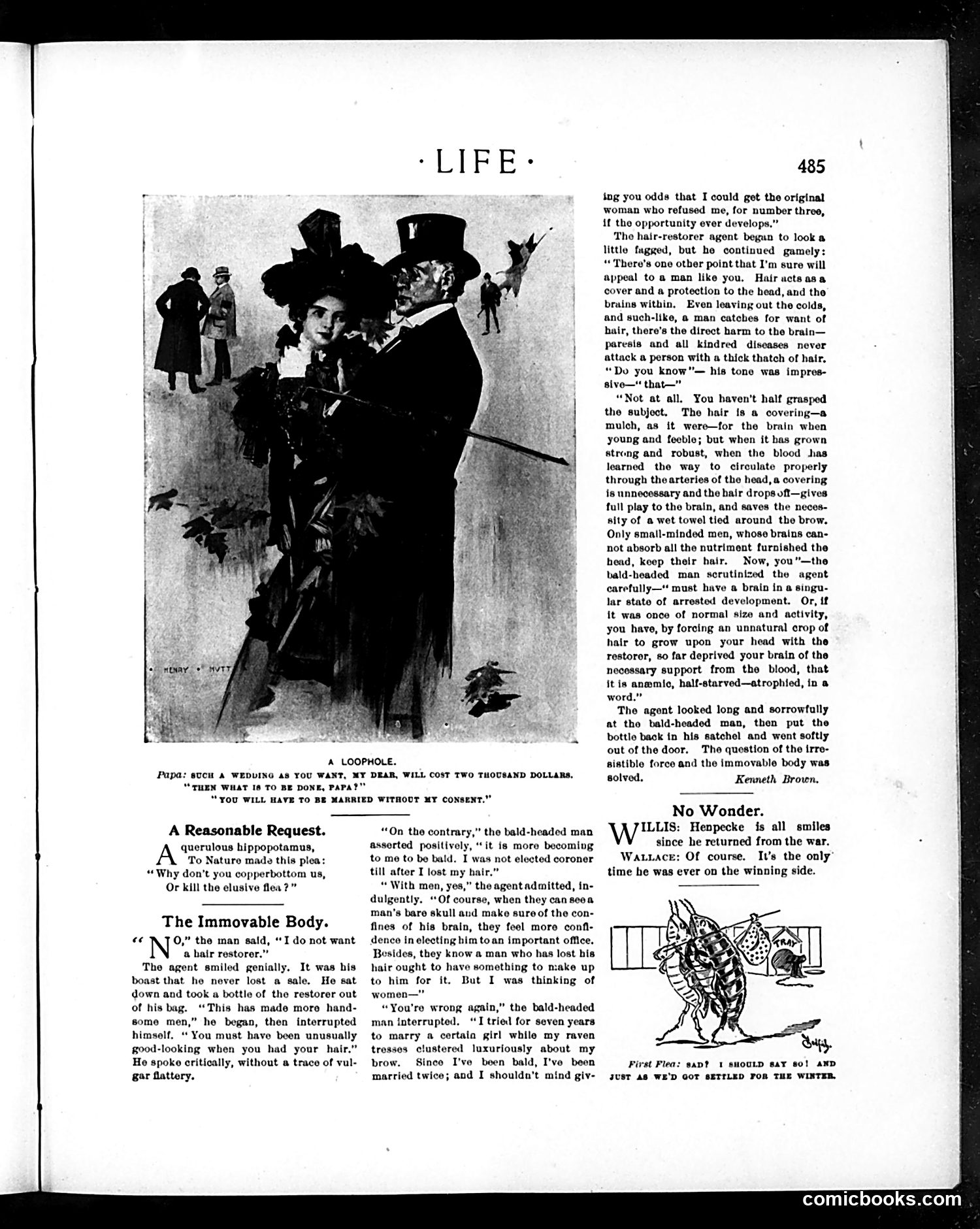
This page contains three separate humorous pieces: **"A Loophole"** (top illustration): A satirical cartoon about wedding costs. A couple negotiates with what appears to be a clergyman or official about an expensive wedding, with the man asking if they can do it more cheaply. The caption jokes about finding a loophole to avoid the high expense. **"A Reasonable Request"** and **"The Immovable Body"**: Two short comedic stories. The first involves a hippopotamus making an unusual request. The second features a bald man consulting a "hair restorer" agent about regrowing his hair, with extended dialogue about the science (or pseudoscience) of hair loss and male baldness. **"No Wonder"** (bottom right): A brief joke about a character named Hespeckle returning from war and remaining on the "winning side," illustrated with a small cartoon. The page reflects early 20th-century concerns about marriage expenses, baldness remedies, and domestic humor.
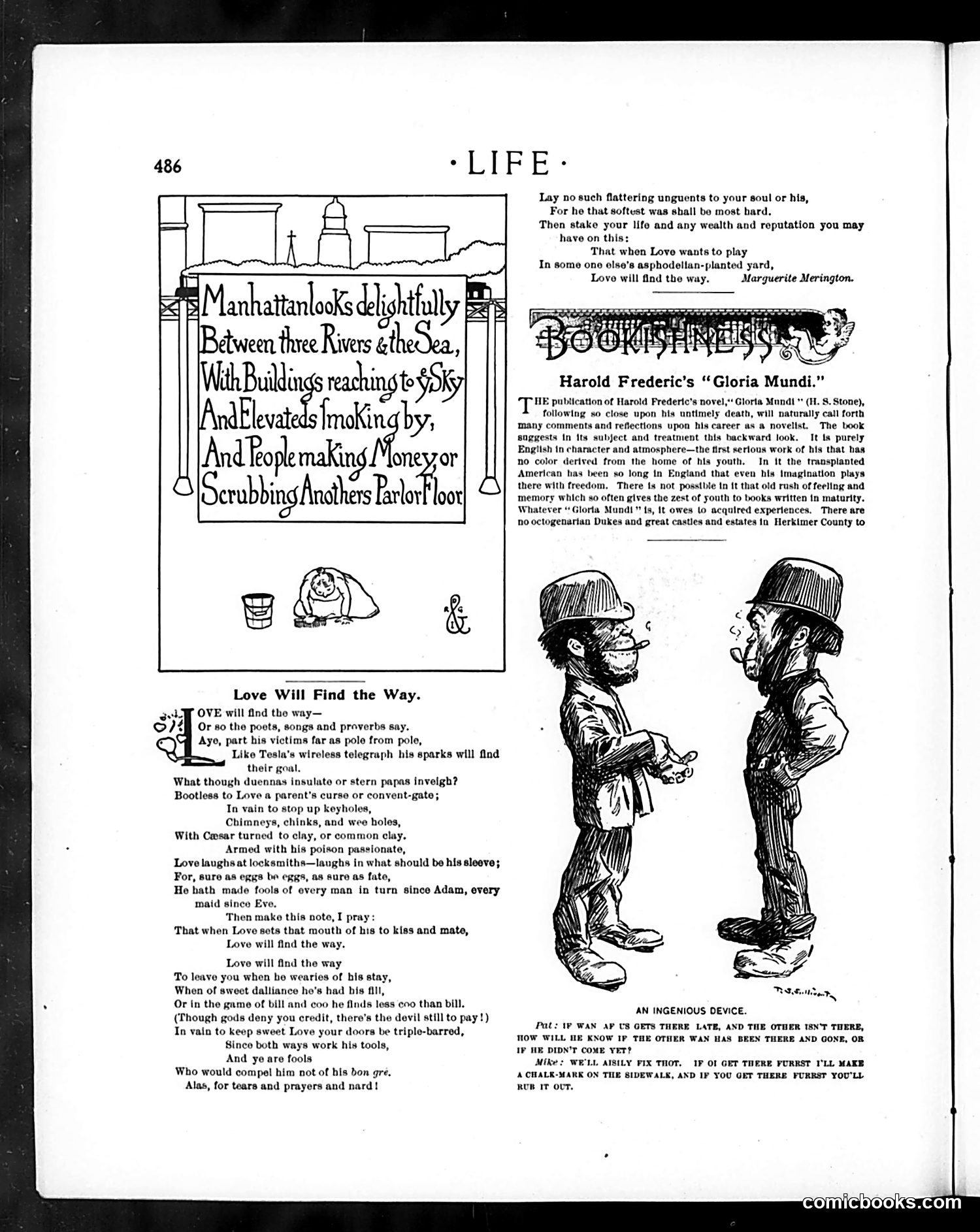
**Left side:** An ornate advertisement for Manhattan, celebrating the city's rivers, buildings, and commercial activity. The decorative text emphasizes New York's economic vitality and urban landscape. **Right side:** A review of Harold Frederic's novel "Gloria Mundi" (H.S. Stone publisher), praising its portrayal of English character and atmosphere. The review suggests the book captures youthful freedom and lacks the heavy social structures of traditional English literature. **Bottom cartoon:** Two working-class men in conversation, captioned "An Ingenious Device." The dialogue suggests a scheme to ensure mutual accountability between two people—likely satirizing either trust between laborers or a con-artist setup. The humor appears to rely on the characters' dialect and working-class perspective rather than clear political commentary.
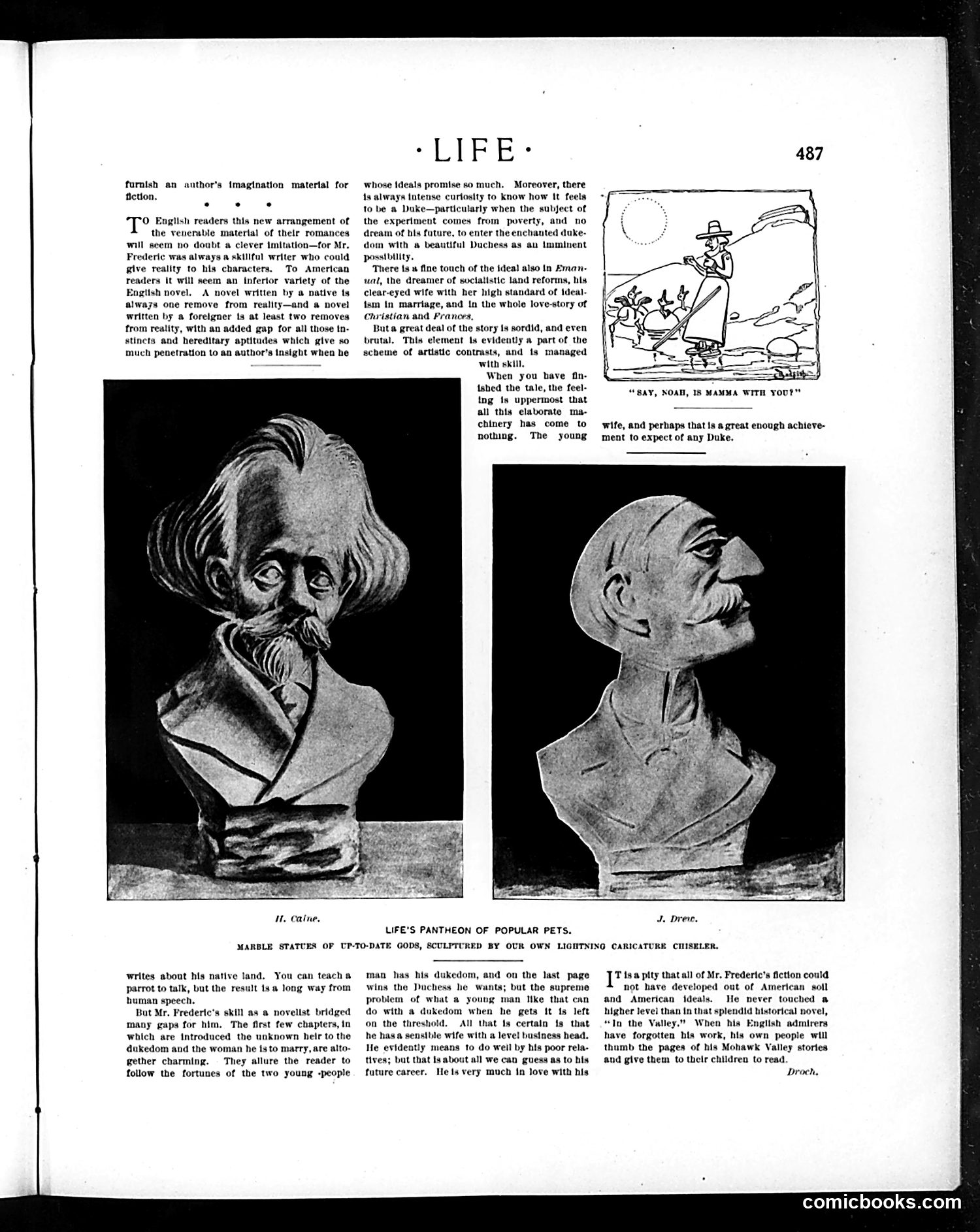
This page discusses literary criticism of Mr. Frederic's fiction, praising his skill at character development and narrative construction. The two marble busts below the text are labeled "H. Chine" and "J. Brice," presented as "Life's Pantheon of Popular Pets"—a satirical feature depicting prominent public figures as sculptural monuments. The small cartoon in the upper right shows a figure on horseback with the caption "Ray, road, is mamma with you?" This appears to be a humorous domestic scene, though the specific reference is unclear from the visible context. The page's primary satire targets literary pretension and the cult of personality surrounding popular authors of the era.
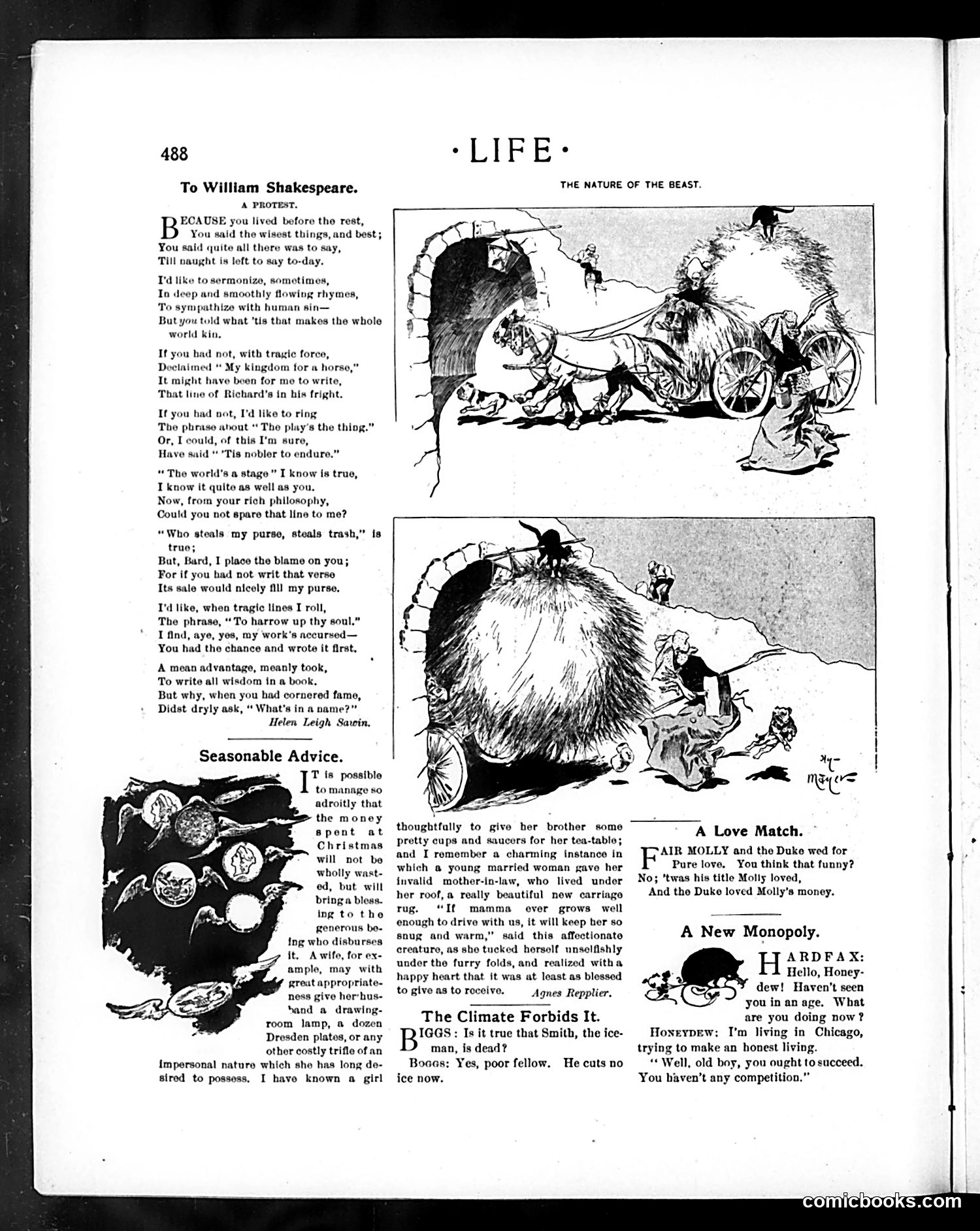
The top two illustrated panels appear to satirize human behavior through animal imagery. The first shows various figures (including what appears to be nobility or upper-class individuals) interacting with a large beast or monster. The second panel depicts similar chaos around another creature. The accompanying text sections include "Seasonable Advice," "A Love Match," "A New Monopoly," and "The Climate Forbids It"—brief humorous pieces typical of Life's satirical format. Without clearer visual details or dated context, the specific political or social targets remain unclear, though the overall theme suggests commentary on human folly, class behavior, or contemporary social absurdities through animal metaphor—characteristic of Life's satirical approach.
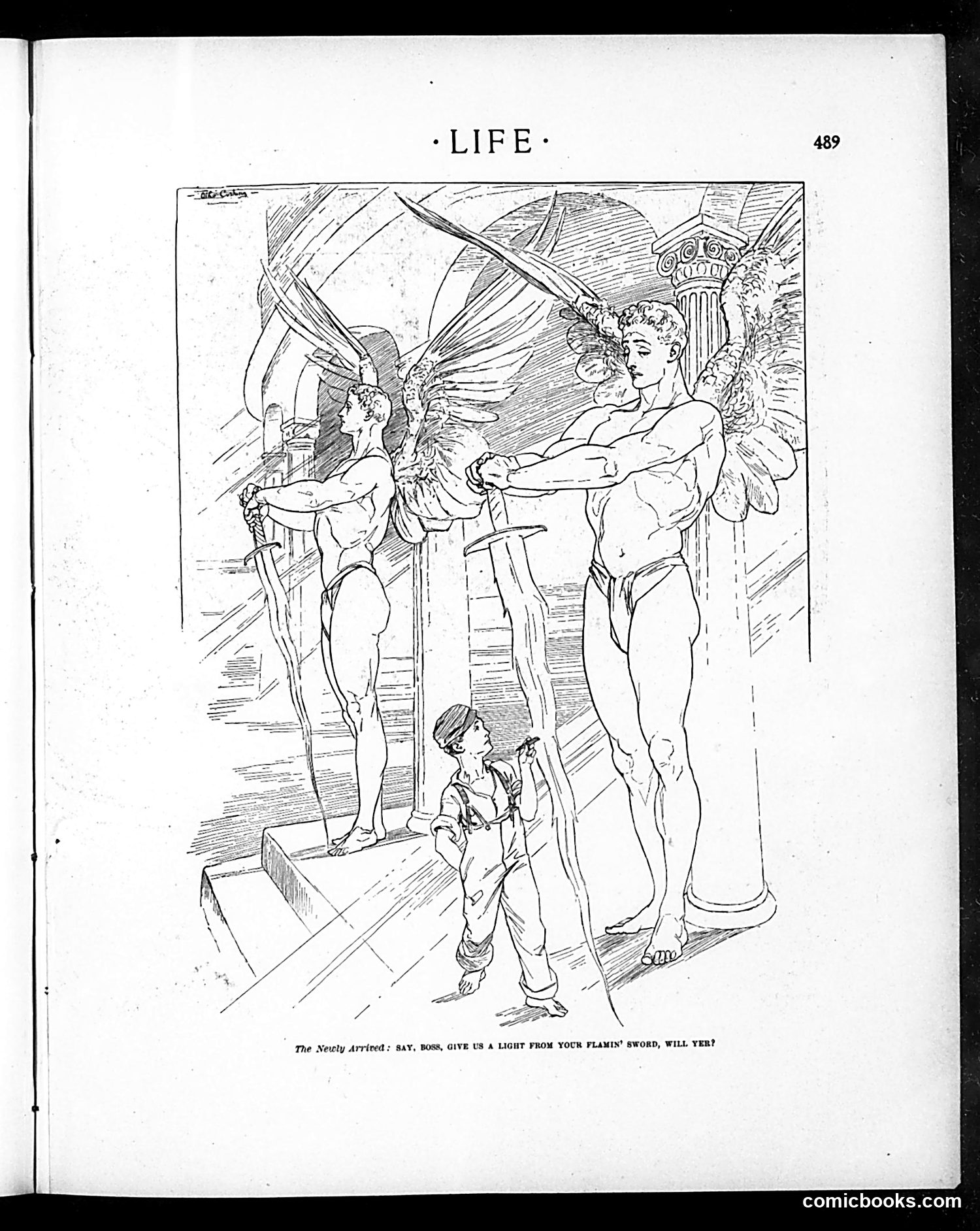
This is a satirical illustration from Life magazine (page 489) titled "The Newly Arrived," with the caption: "Say, Boss, give us a light from your flaming sword, will ya?" The cartoon depicts three winged angelic or cupid-like figures and a small boy in what appears to be a classical architectural setting. The joke plays on a biblical or mythological reference—likely to angels or divine beings wielding "flaming swords" (as found in Genesis). The humor derives from the contrast between the grandiose, classical imagery and the casual, modern slang ("Say, Boss," "will ya?")—the newly arrived figure treats the celestial scene with irreverent familiarity rather than reverence. This appears to be satirizing either pretentiousness, immigration, or the collision between classical ideals and American informality, though without publication date context, the specific target remains unclear.
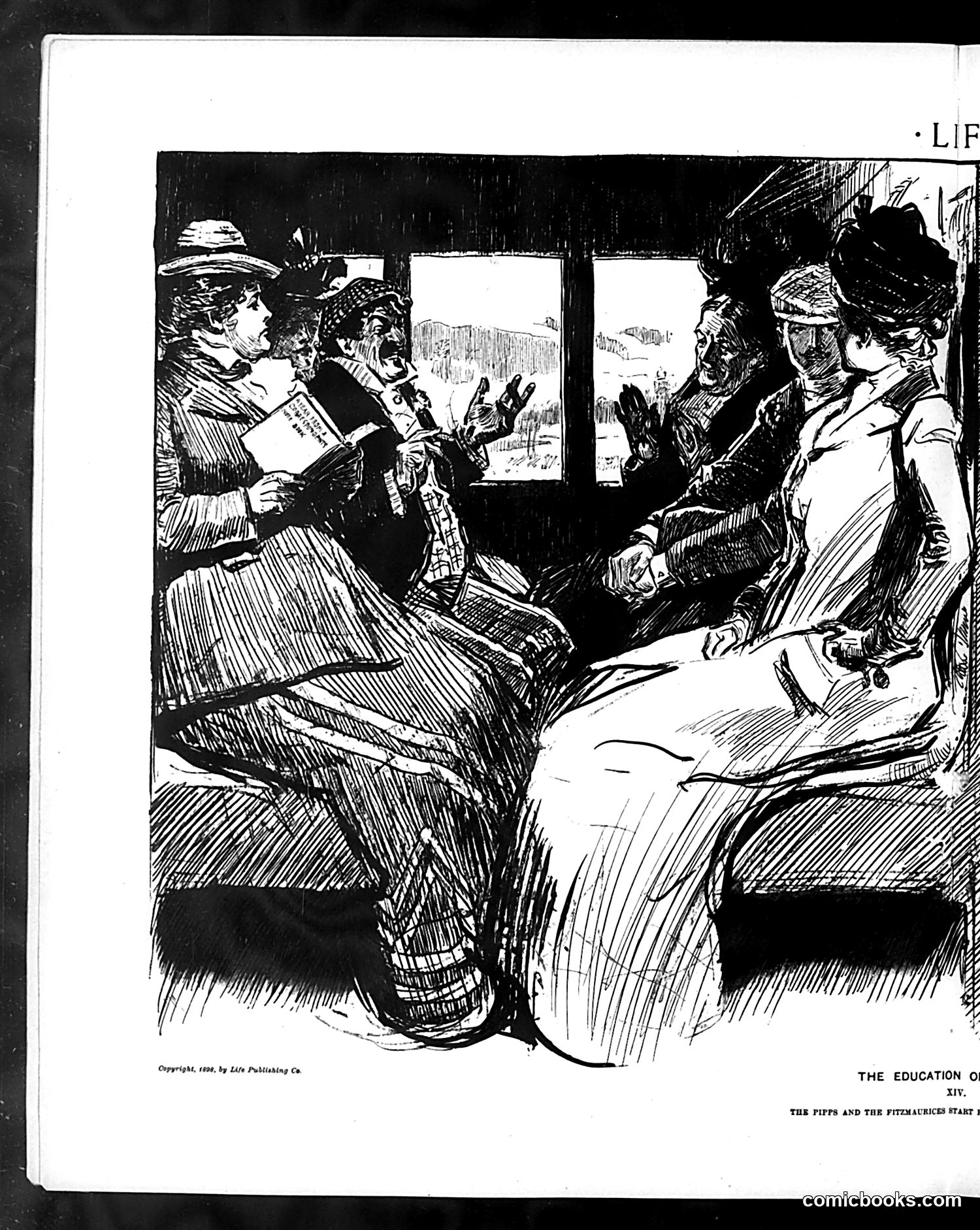
This 1898 Life Publishing Co. illustration satirizes "The Education of Mr. [Sit]" (text partially visible). The cartoon depicts what appears to be wealthy or upper-class figures—identifiable by their formal attire and hats—seemingly instructing or lecturing to another figure, likely representing a naive or uninitiated person being "educated." The setting suggests an interior space, possibly a train or formal venue. The composition emphasizes the contrast between the instructors and the student, with the former appearing condescending or performative. The satirical intent likely mocks either social pretension, class instruction, or political indoctrination of the era. Without the full caption text visible, the specific targets remain unclear, though the overall mockery of artificial social "education" or influence is evident.
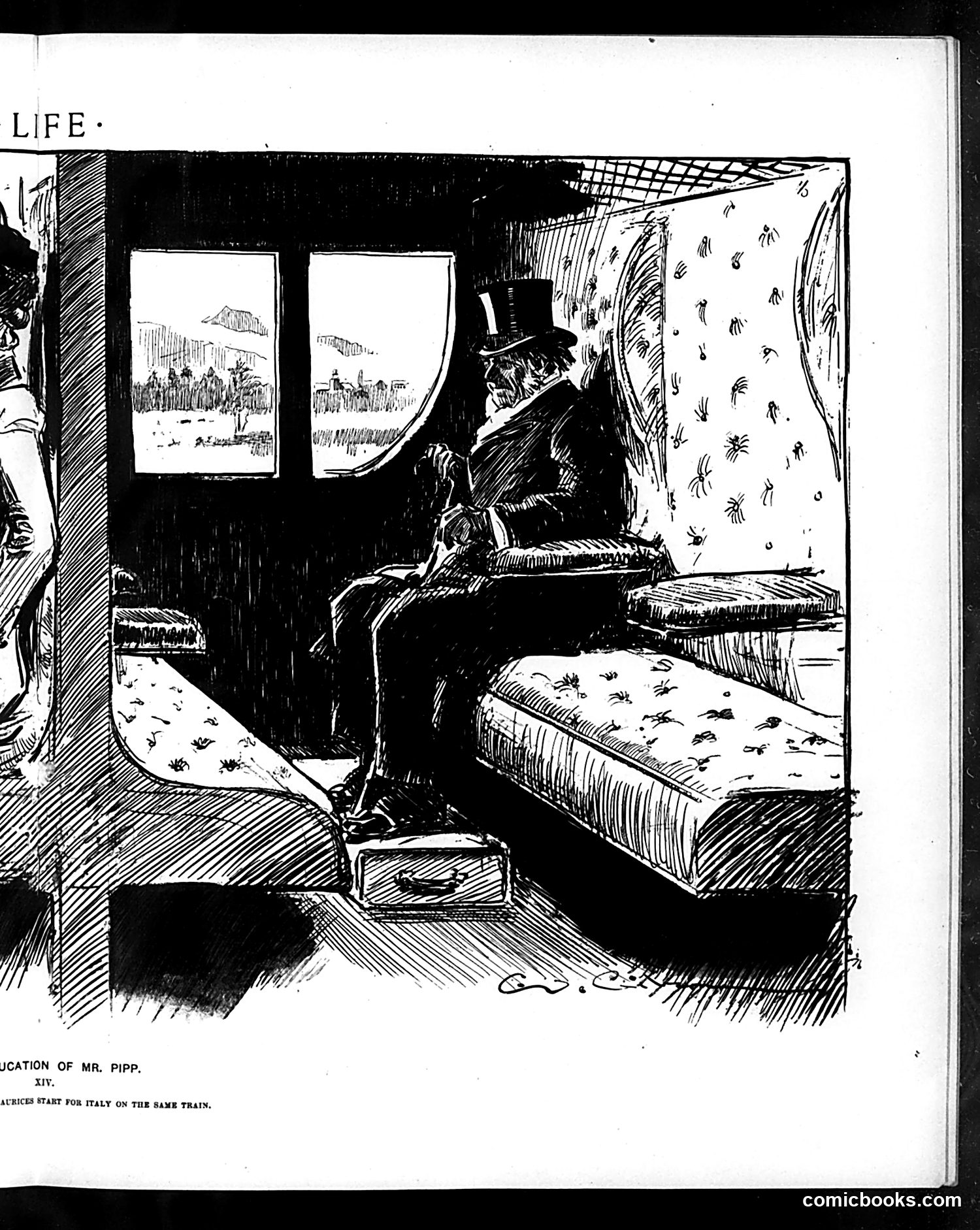
This appears to be from Life magazine's satirical comic section. The illustration shows a well-dressed gentleman in a top hat sitting in what appears to be a train compartment, gazing out the window at a distant landscape with a bridge. The caption references "THE EDUCATION OF MR. PIPP" (section XIV) and mentions "MAURICE START FOR ITALY ON THE SAME TRAIN." This is part of a serialized comic strip following a character named Mr. Pipp. The satire likely concerns his travel experiences or romantic misadventures—a common theme in early 20th-century Life magazine humor. Without additional context from surrounding pages, the specific joke remains unclear, though his contemplative expression suggests either anticipation or melancholy about the journey ahead or his traveling companion Maurice.
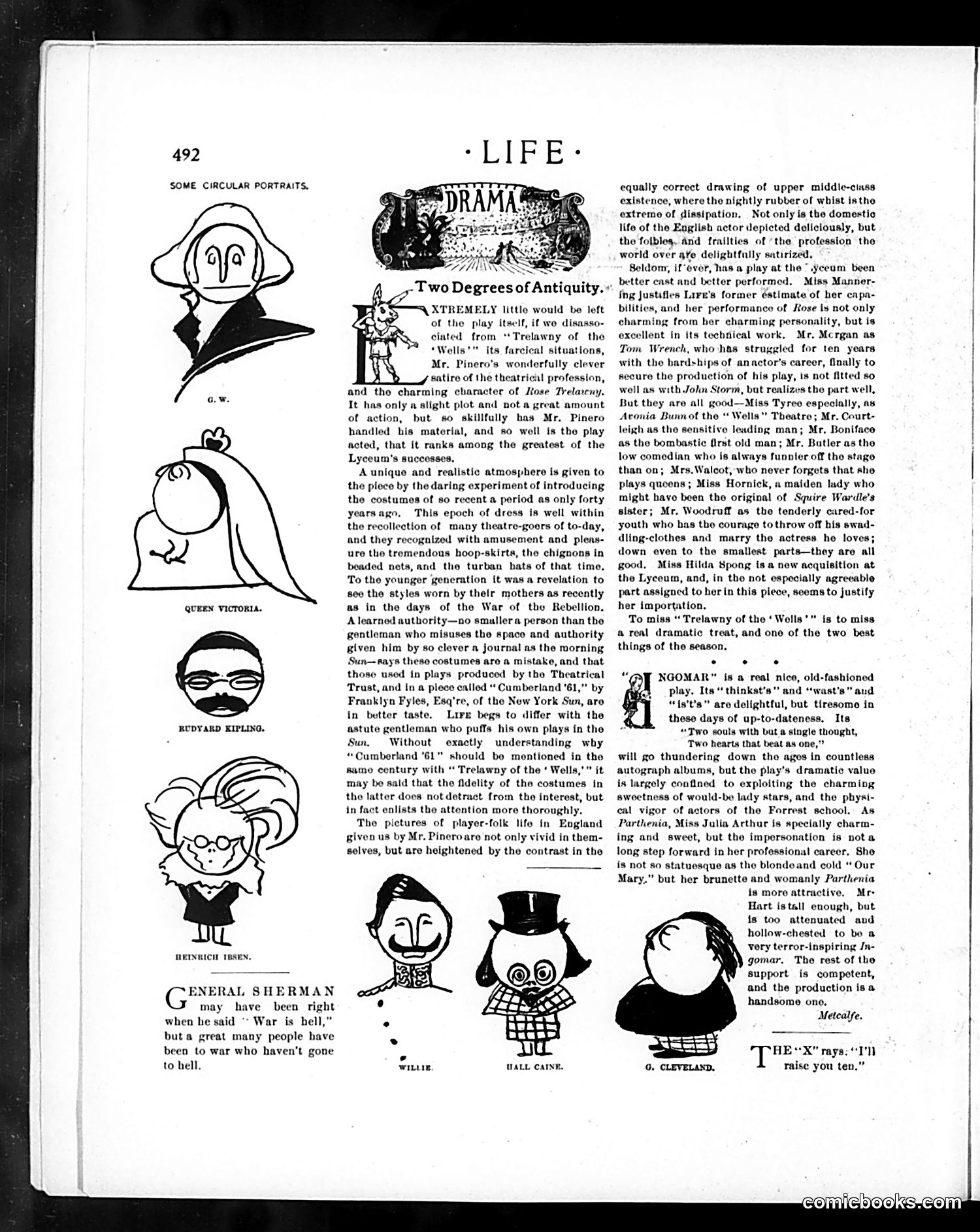
This page contains **circular portrait caricatures** of prominent figures and a **theater review** of "Two Degrees of Antiquity." The caricatures include labeled figures: **Queen Victoria, Rudyard Kipling, Heinrich Ibsen, Willie, Hall Caine, and G. Cleveland** (likely President Grover Cleveland). These are satirical drawings emphasizing distinctive features—Victoria's stern expression, Kipling's characteristic styling, Ibsen's beard, etc. The main text reviews a play set in the 1860s, praising its costumes and ensemble cast while critiquing lead actor Hart as "too attenuated" for his role. The review includes a quote from General Sherman about war being hell, and concludes with a theatrical one-liner: "The 'X' rays: 'I'll raise you ten.'" This appears to be **entertainment and cultural criticism** aimed at educated readers familiar with contemporary theater and public figures.
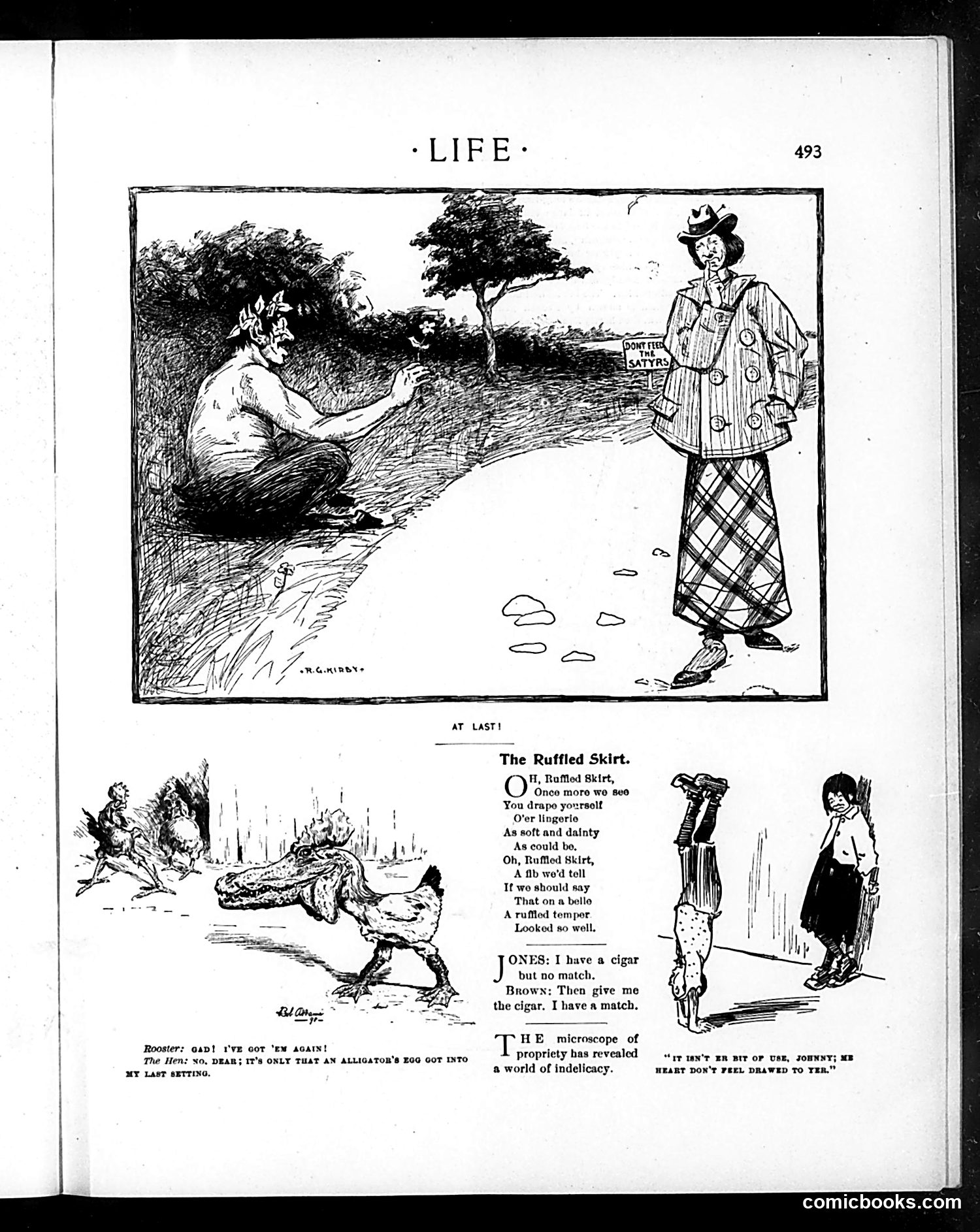
This page contains period humor targeting early 20th-century fashion and social conventions. **"The Ruffled Skirt"** (top) satirizes the return of ruffled skirts as fashionable, while implying women wearing them have "ruffled tempers"—a play on the double meaning suggesting the style doesn't actually improve feminine disposition. **Lower cartoons** employ crude domestic humor: A rooster has repeatedly gotten into a hen's nesting materials (misidentified as "alligator's egg" in the caption), suggesting sexual impropriety has become visible through microscopic inspection. The joke relies on the period's anxiety about hidden moral indecency being revealed by modern science. **"Ones/Brown"** presents a simple joke about trading a cigar for a match—wordplay on exchange. **"Johnny" scene** shows rejected romance, with the woman unable to develop affection despite the man's efforts. The humor reflects early-1900s concerns about fashion morality, animal behavior metaphors for human conduct, and emerging scientific scrutiny of private matters.
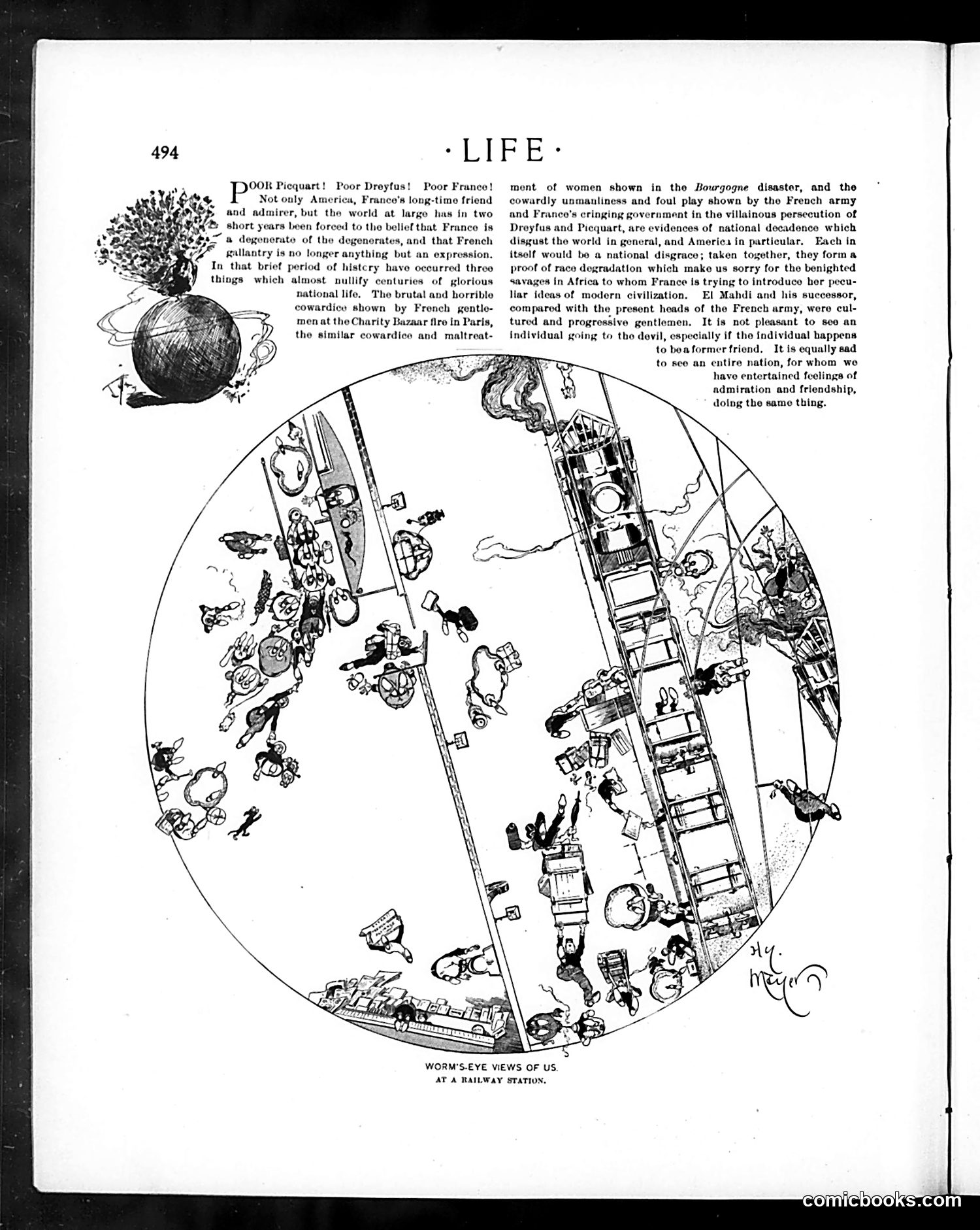
This page criticizes France's reputation through three recent scandals: the 1897 Charity Bazaar fire (where French gentlemen allegedly behaved cowardly), the *Bourgogne* maritime disaster (involving mistreatment of women), and most significantly, the **Dreyfus Affair**—the persecution of Captain Alfred Dreyfus and Major Picquart by the French military and government. The text expresses American dismay that France, long admired as a friend, has revealed itself as morally degraded. The satire compares French leadership unfavorably to African colonial subjects ("El Mahdi"), suggesting France has lost all claim to civilizational superiority. The circular illustration titled "Worm's-Eye Views of Us at a Railway Station" appears to show an overhead perspective of crowded railway activity, likely satirizing the chaos or disorder of modern life. The article mourns France's fallen status—a former ally now revealed as fundamentally corrupt.
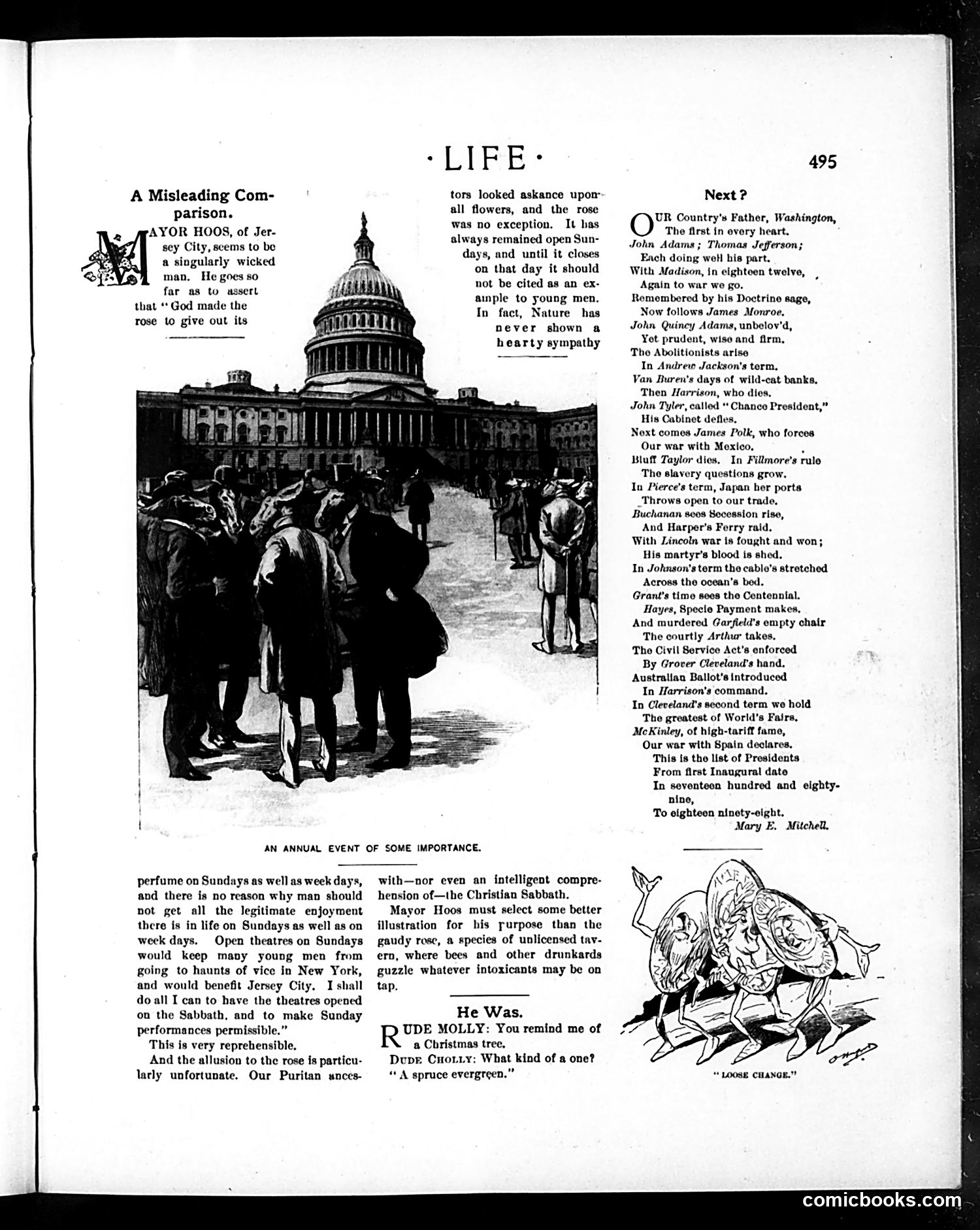
**"A Misleading Comparison"** critiques Mayor Hoos of Jersey City for claiming "God made the rose to give off its perfume." The text argues this is wickedly untrue—roses don't naturally perfume Sundays or weekdays equally, contradicting the mayor's apparent argument for opening theaters on the Sabbath. **The Capitol Building illustration** (captioned "An Annual Event of Some Importance") depicts crowds gathered, likely referencing a presidential inaugural ceremony or Congress in session—a standard civic event. **"Next?"** and **"He Was"** appear to be separate poem and joke features typical of Life's satirical format. The page primarily targets the mayor's flawed logic in a religious/moral debate about Sunday entertainment—a significant social controversy of the era.
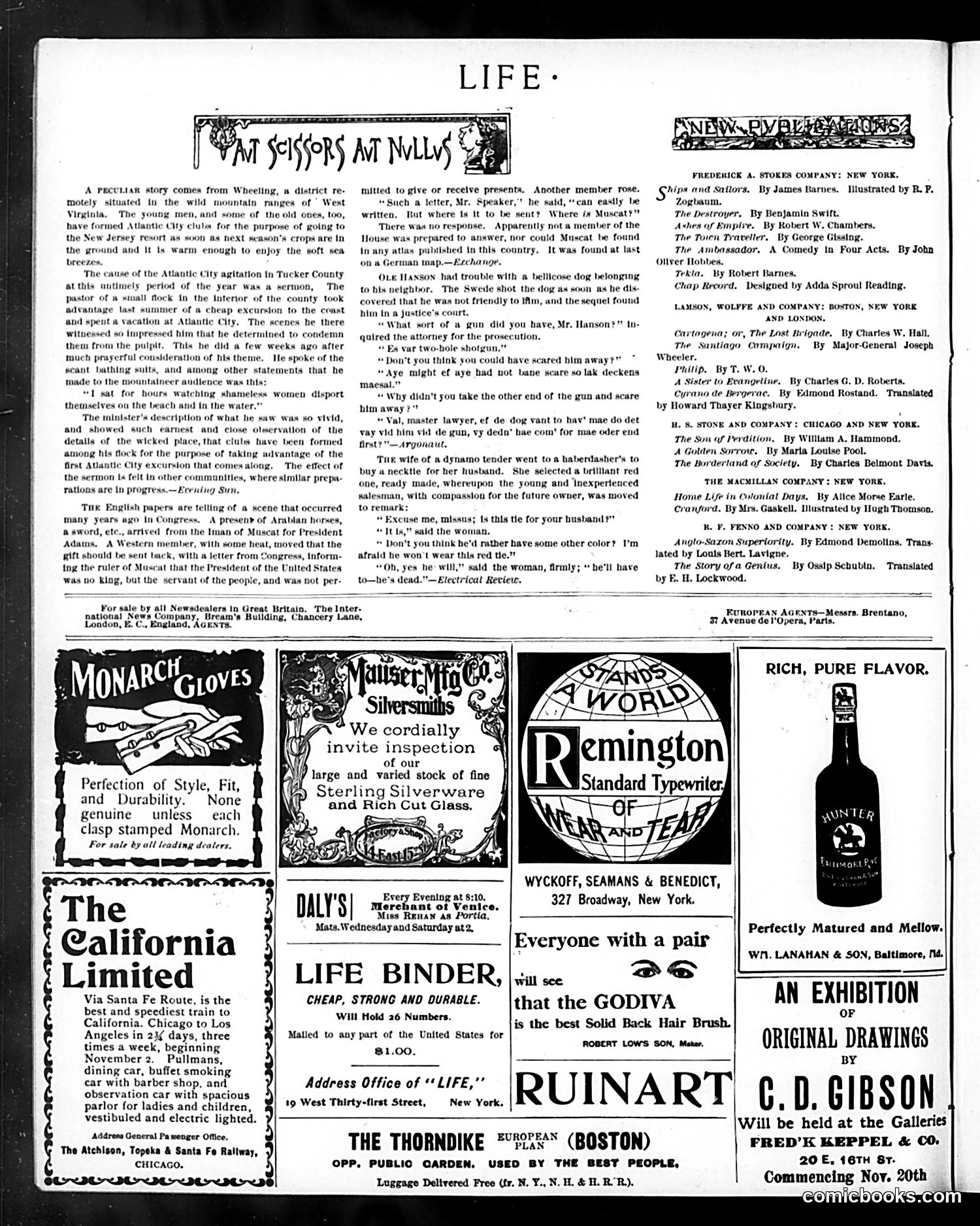
This page is primarily **advertisements and book notices**, not political cartoons. The main article content consists of three brief humorous anecdotes: 1. **The Atlantic City sermon**: A West Virginia pastor visited Atlantic City, was scandalized by women's bathing attire, and preached against it so vividly that his congregation formed clubs to visit Atlantic City themselves—the ironic effect opposite to his intent. 2. **The Congressional geography gaffe**: A Western congressman objects to President Adams accepting Arabian horses as gifts, but cannot locate Muscat on any American map (it's found only on a German map)—satirizing American geographical ignorance. 3. **The Swede and the dog/The necktie anecdote**: Brief dialect-humor stories featuring a Swedish immigrant and a newlywed's marital conflict over a red tie. These are light social satires typical of Life magazine's humor—mocking small-town moralism, congressional incompetence, and domestic situations. The page is otherwise filled with product advertisements (typewriters, silverware, gloves, trains) and book announcements from major publishers.
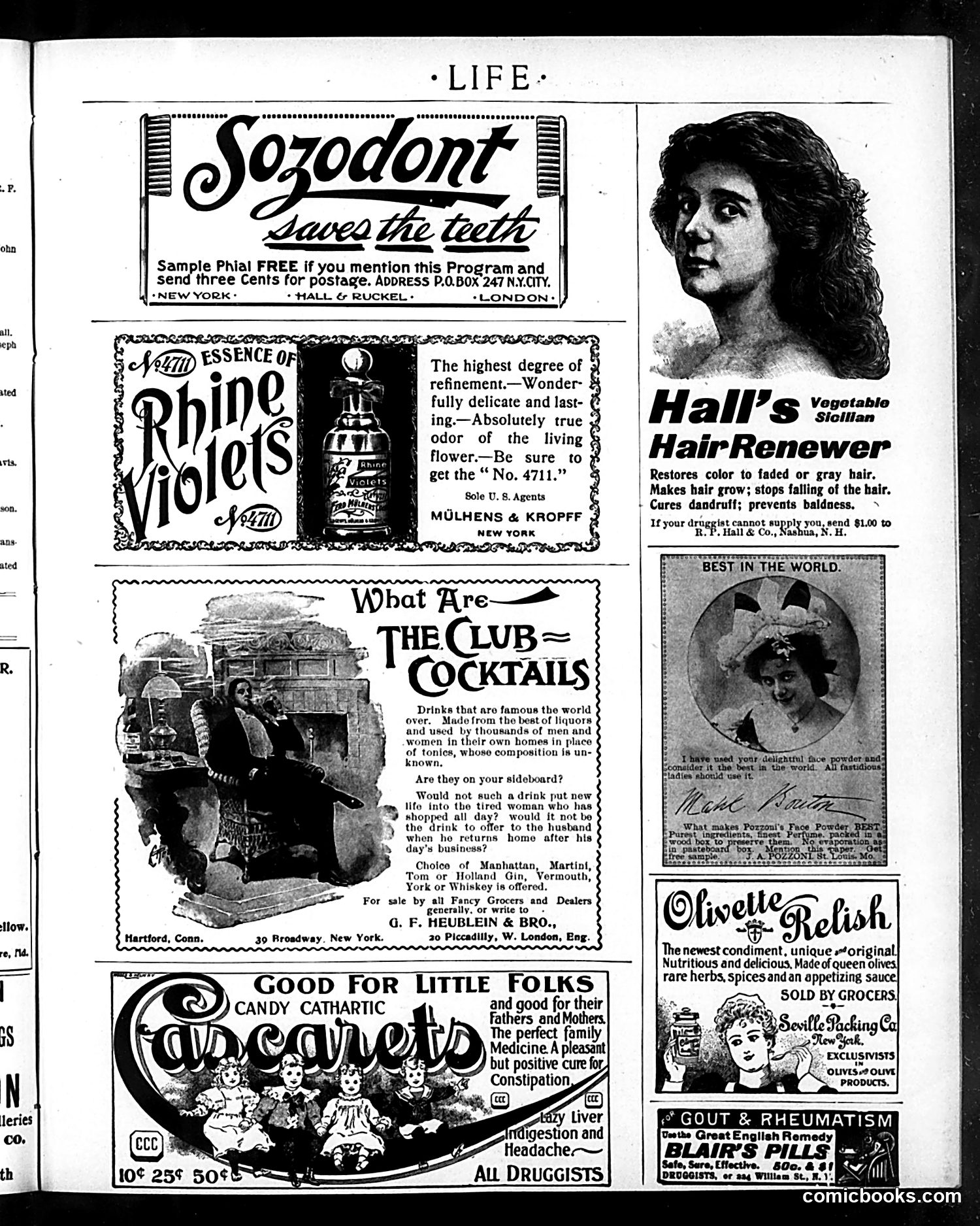
This page consists entirely of **advertisements**, not editorial content or satire. It showcases early 20th-century product marketing targeting various concerns: **Sozodont** promotes tooth powder via mail sample (3¢ postage). **Rhine Violets** perfume advertises "Essence of" fragrance, emphasizing refinement and authenticity. **Hall's Hair Renewer** addresses gray hair and baldness—common anxieties for the era. **Club Cocktails** market pre-mixed drinks as convenient home beverages for "tired women" and returning husbands, normalizing domestic cocktail consumption. **Cascarets** candy laxative targets children and families as a "perfect family medicine." **Olivette Relish** and **Blair's Pills** complete the page. The satire here is **unintentional but evident to modern readers**: these ads reveal period attitudes about gender roles, bodily insecurity, medicinal snake oil, and casual alcohol promotion to housewives. The paternalistic tone and pseudo-medical claims reflect pre-FDA regulation standards, making the page a historical document of marketing practices rather than deliberate political commentary.
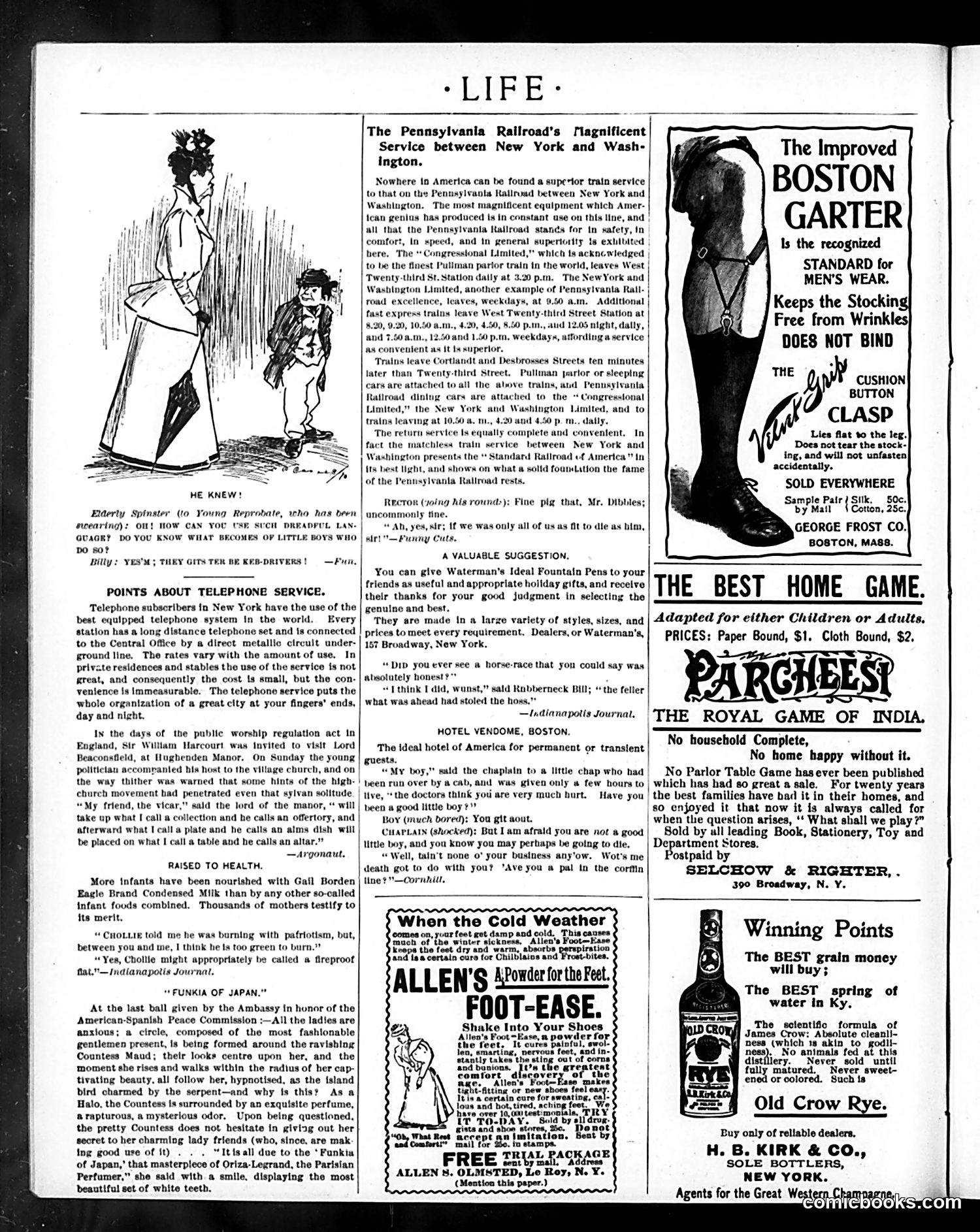
This page contains several short humorous pieces typical of early 20th-century satirical magazines: **Main Cartoon ("He Knew!"):** An elderly woman scolds a young man for swearing, warning him that bad boys "become cab-drivers." He replies they actually become "red-drivers" (likely "bed-drivers," though the OCR is unclear). The joke relies on period class snobbery—cab-driving was considered a low, disreputable profession, making it a threat used to scare children into good behavior. **Other Content:** The page is mostly advertisements and brief comic anecdotes. One joke mocks an overly patriotic man as "too green to burn" (too inexperienced). Another describes a woman's mysterious attractiveness attributed to Japanese perfume, playing on contemporary fascination with exotic "Oriental" goods. The page reflects early 1900s attitudes: class hierarchies, xenophobic exoticism, and assumptions that readers would find certain professions inherently comedic or shameful.
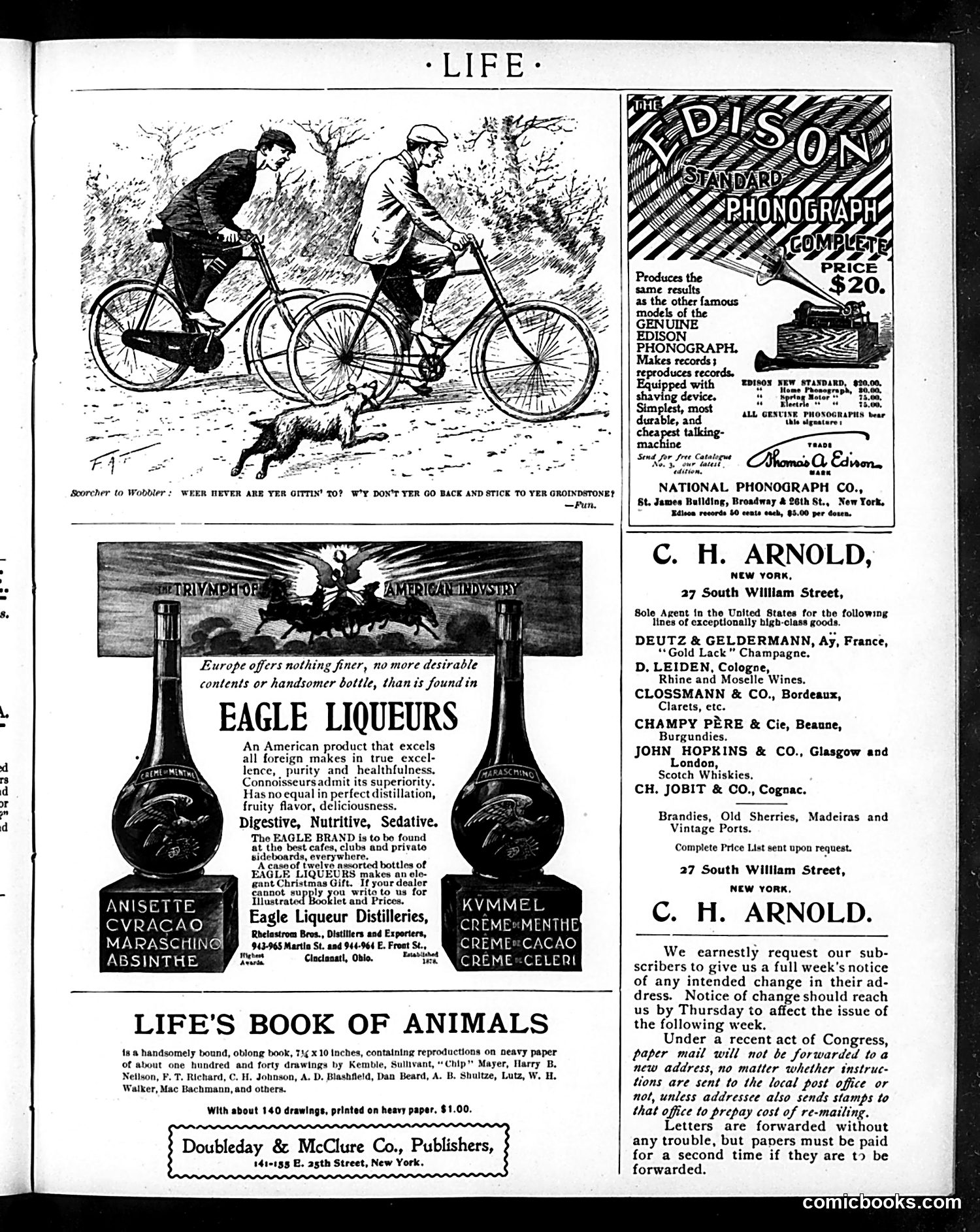
**The Main Cartoon:** The illustration shows two men on bicycles being chased by a dog, with the caption "SEARCHER TO WOBBLER: 'WEER NEVER ARE YER GITTIN' TO? WHY DON'T YER GO BACK AND STICK TO YER GRINDSTONE?'" This appears to be satirizing the bicycle craze of the 1890s-early 1900s. The "wobbler" (inexperienced cyclist) is being mocked by a "searcher" (skilled rider) for abandoning productive work ("grindstone" = labor/responsibility) to pursue leisure cycling. The joke mocks both the faddish adoption of bicycles among the working class and the social anxiety this caused—bicycles were seen as frivolous entertainment diverting people from honest work. **The Rest of the Page:** Mostly advertisements for Edison phonographs, Eagle Liqueurs, wines, and a book about animals. These are period commercial content, not satirical material.
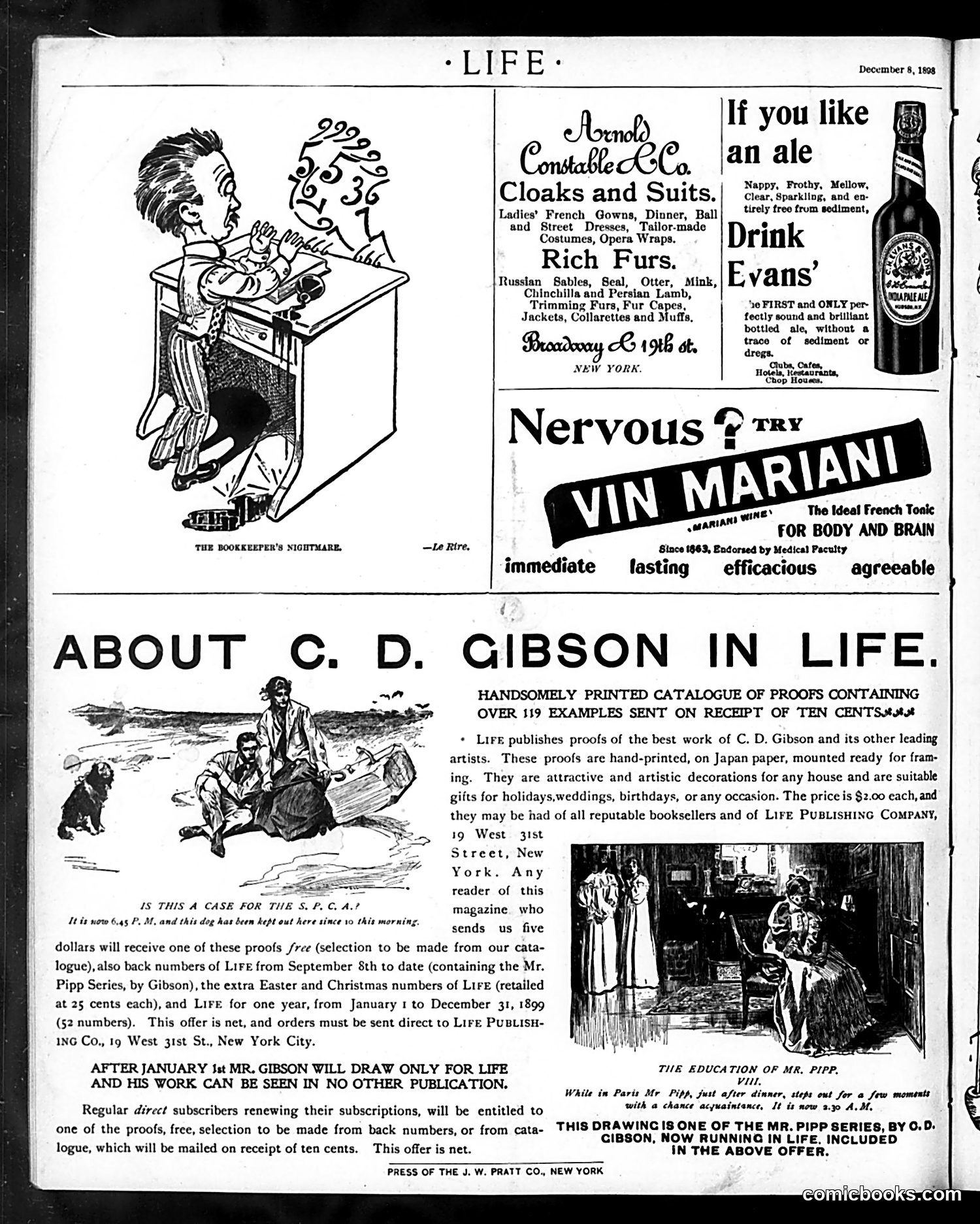
**Main Content: "The Bookkeeper's Nightmare"** The cartoon depicts a man at a desk surrounded by floating numbers and ledgers, appearing distressed. This satirizes the common Victorian anxiety about accounting work—the mental strain of managing figures and financial records. The caricature suggests the tedium and stress of clerical labor. **Secondary Cartoon: "Is This a Case for the S.P.C.A.?"** Shows a dog left outside since 10 a.m. (now 6:45 p.m.). This references the Society for the Prevention of Cruelty to Animals, satirizing either animal neglect or the tendency to invoke the S.P.C.A. for minor incidents. **Advertisements** The page features period ads for luxury goods (Arnold Constable furs and clothing), Evans ale, and Vin Mariani (a cocaine-containing wine marketed as a medicinal tonic—legal and widely advertised then). **Gibson Content** Text promotes C.D. Gibson's illustration proofs for sale, establishing him as Life's major artist. The "Mr. Pipp Series" mentioned became Gibson's signature work.