
Life, 1898-12-08 · page 12 of 20
Life — December 8, 1898 — page 12: what you’re looking at
What you’re looking at
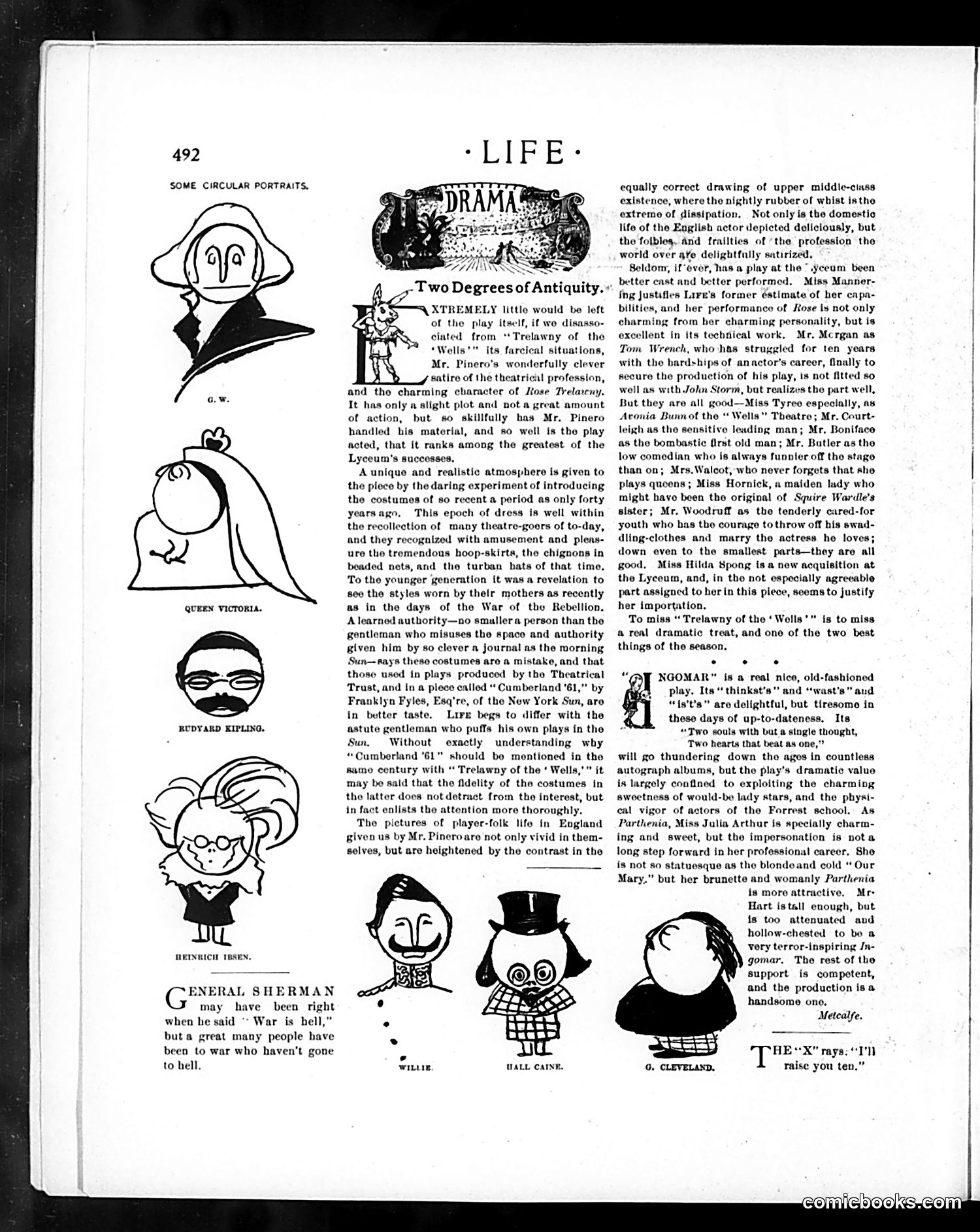
This page contains **circular portrait caricatures** of prominent figures and a **theater review** of "Two Degrees of Antiquity." The caricatures include labeled figures: **Queen Victoria, Rudyard Kipling, Heinrich Ibsen, Willie, Hall Caine, and G. Cleveland** (likely President Grover Cleveland). These are satirical drawings emphasizing distinctive features—Victoria's stern expression, Kipling's characteristic styling, Ibsen's beard, etc. The main text reviews a play set in the 1860s, praising its costumes and ensemble cast while critiquing lead actor Hart as "too attenuated" for his role. The review includes a quote from General Sherman about war being hell, and concludes with a theatrical one-liner: "The 'X' rays: 'I'll raise you ten.'" This appears to be **entertainment and cultural criticism** aimed at educated readers familiar with contemporary theater and public figures.
📄 Transcribed text from this page (OCR, searchable)
Machine-transcribed from the original scan — historical spelling and the odd misread are preserved.
492 SOME CIRCULAR PORTRAITS, of the play itself, if wo diaaaso- ciated from “Trelawny of tho ‘Wolls'” its farcical situations, Mr. Pinero’s wonderfully clever satire of the theatrical profession, and tho charming character of Kose Trelareny. It has only a slight plot and not a great amount of action, but so skillfully has Mr, Pinero handled bis material, and so well is tho play acted, that it ranks among the greatest of the Lyceum’s successes. ‘A unique and realistic atmosphere Is given to the pleco by the daring experiment of introducing the costumes of so recent a period as only forty yearsago. This epoch of dress is well within the recollection of many theatre-goors of to-day, and they recognized with amusement and pleas- ure tho tromendous hoop-skirts, the chignons in beaded nets, and the turban hats of that time, To tho younger generation it was a revelation to seo the styles worn by thelr mothers as recently as in the days of the War of tho Rebellion. A learned authority—no smullera person than the gentloman who misuses the space and authority given him by 80 clover a journal as the morning ‘Sun—eays these costumes aro a mistake, and that thoso used in plays produced by the Theatrical Trust, and in a piece called * Cumberland ’61," by Franklyn Fyles, Esq're, of tho New York Sun, aro in better taste. Lire begs to differ with the astute gentleman who puffs his own plays in tho Sun, Without exactly understanding why “Cumberland '61” should bo mentioned in tho samo century with “ Trelawny of the ‘ Wells,"” it may be sald that tho fidelity of tho costumes in the latter does not detract from the interest, but in fact enlists the attention more thoroughly. Tho pictures of player-folk life in England given us by Mr. Pineroaro not only vivid in them- solves, but are heightened by the contrast in the QUEEN VICTORIA. & RUDYARD KIPLING. G NERAL SHERMAN may have been right when he said “ War is hell buta great many people have been to war who haven't gone to bell. TALL CAINE. wiLue, equally correct drawing of upper middle-class existence, where the nightly rubber of whist istho extremo of dissipation, Not only is the domestic life of the English actor depicted deliciously, but the foibles, and frailties of ‘the profession tho world over aYe delightfully satirized, Seldom, if*dvor, has a play at the “.yceum been better cast and better performed, Miss Manner- ing Justifles Lrre’s former éstimate of her capa- bilities, and her performance of Kose ts not only charming from ber charming personality, but is excellent in its tecbnical work, Mr, Mcrgan as Tom Wrench, who has struggled for ten years with the bard-hips of anactor’s career, finally to secure the production of his play, is not fitted so woll as with John Storm, but realizes tho part well, But they are all good—Miss Tyree especially, as Avonia Bunnot the “ Wells” Theatro; Mr. Court- leigh as tho sensitive leading man; Mr. Bonifaco as the bombastic first old man; Mr. Butler as tho low comedian who is always funnier off tho stago than on; Mrs.Walcot, who never forgets that sho plays queens ; Miss Hornick, a maiden lady who might havo been the original of Squire Wardle’s sister; Mr. Woodruff as tho tenderly cared-for youth who has the courage to throw off his swad- dling-clothes and marry the actress he loves; down even to the smallest parts—they are all good. Miss Hilda Spong is a now acquisition at the Lycoum, and, in the not especially agreeable part assigned to her in this piece, seems to justify her importation. To miss “ Trelawny of the ‘ Wells ’” is to miss a real dramatic treat, and ono of the two best things of the season. . . . NGOMAR” is a real nico, old-fashioned play, Its“ thinkst’s” and “wast’s” aud “Is't’s” aro dolightful, but tiresomo in these days of up-to-dateness, Ite “Two souls with but a single thought, Two hearts that beat as one,” will go thundering down tho agos in countless autograph albums, but the play's dramatic valuo is largely confined to exploiting the charming swoetness of would-be lady stars, and the physi- cal vigor of actors of tho Forrest school. As Parthenia, Miss Julia Arthur is specially charm- ing and sweet, but the impersonation is nota long step forward in her professional career. Sho is not 80 statuesque as the blondeand cold “Our Mary,” but her brunette and womanly Parthenia is more attractive, Mr- Hart istall enough, but is too attenuated and hollow-chested to be a very terror-inspiring Jn- gomar, The rest of the support is competent, and the production is a handsome ono. Metcalfe. HE“X" rays: “I'l @, CLEVELAND, raise you ten.”