
Life, 1898-12-08 · page 4 of 20
Life — December 8, 1898 — page 4: what you’re looking at
What you’re looking at
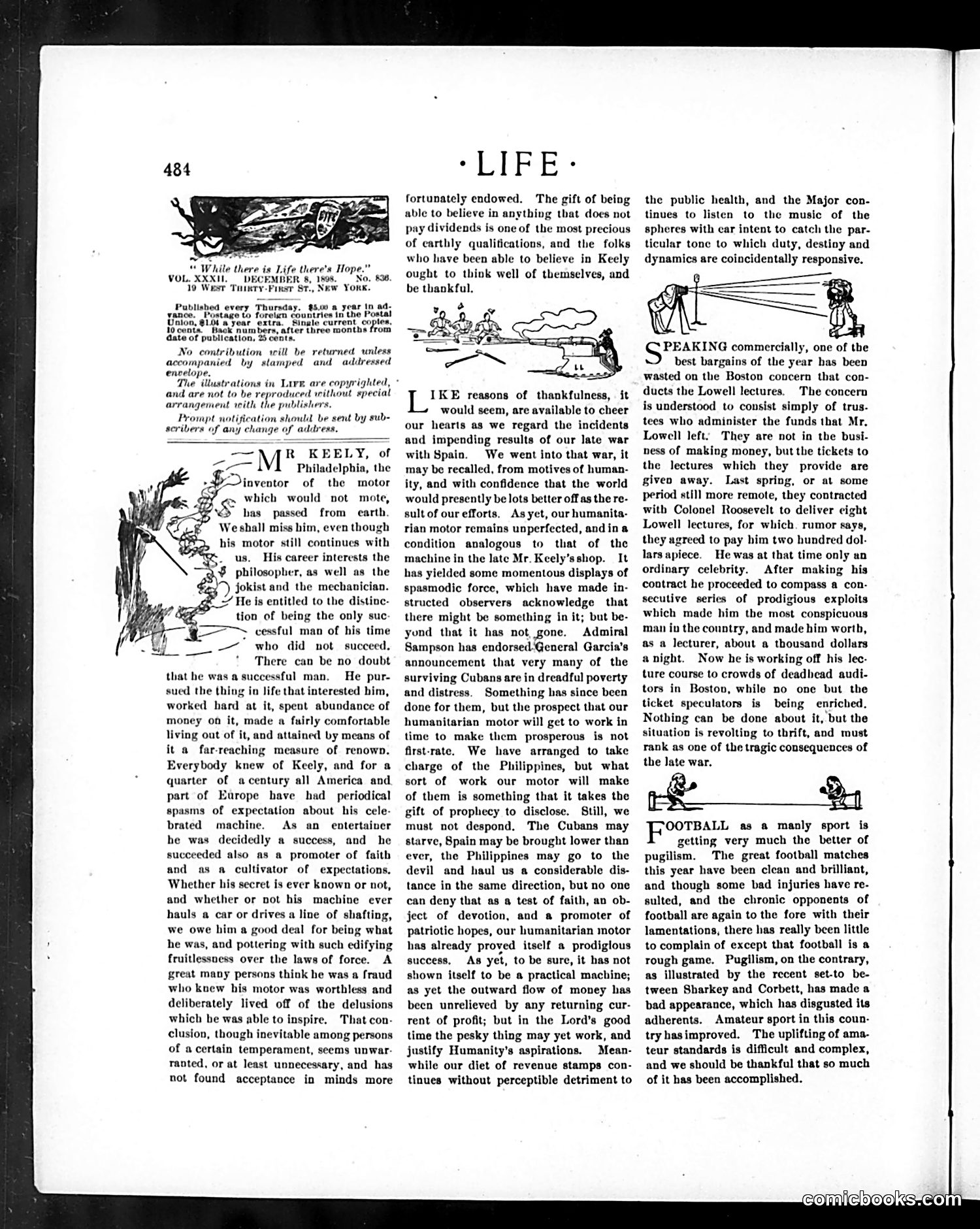
This page contains **editorial commentary rather than political cartoons**. The main illustration depicts **Mr. Keely**, labeled as "Inventor of the motor which would not work," shown as an elderly man with distinctive features. The text discusses Keely's failed motor invention and draws a parallel to the humanitarian outcomes of the recent Spanish-American War. The author argues that despite Keely's unsuccessful machine, he deserves credit for attempting something ambitious—similarly, the U.S. humanitarian motor (its war effort) may not have produced perfect results for Cuba and the Philippines, but the intent was good. The page also briefly addresses **football** and the Lowell lectures in Boston, noting improved standards in amateur athletics.
📄 Transcribed text from this page (OCR, searchable)
Machine-transcribed from the original scan — historical spelling and the odd misread are preserved.
a White there i: VOL. XXXII, DEC 19 West Tarmry Tife there's Tore. ER 8, No. 38, Published every Thursday. $5.00 a year in ad- ance, tage to foreln countries in the Postal Union. $104 a year extra. Single current copter. Jocents. Back numbers, after three months fr ate of publication, 25 No contribution will be returned unless accompanied by stamped and addressed envelope. cents. The illustrations in Lave are copyrighted, * and are not to be reproduced without special arrangement with the publishers. Prompt notification should be sent by sub- scribers of any change of address. R KEELY, of 55M Philadelphia, the yDinventor of the motor «x Which would not mote, ‘> bas passed from earth We shall miss him, even though his motor still continues with . us, His career interests the {8 philosopher, as well as the jokist and the mechanician. > He is entitled to the distinc- tion of being the only suc cessful man of his time — who did not succeed. There can be no doubt that he was a successful man, He pur- sued the thing in life that interested him, worked hard at it, spent abundance of money of it, made a fairly comfortable living out of it, and attained by means of it a far-reaching measure of renown. Everybody knew of Keely, and for a quarter of acentury all America and part of Europe have had periodical spasms of expectation about his cele- brated machine. As an entertainer he was decidedly a success, and he succeeded also as a promoter of faith and as a cultivator of expectations, Whether his secret is ever known or not, and whether or not his machine ever hauls a car or drives a line of shafting, we owe him a good deal for being what he was, and pottering with such edifying fruitlessness over the laws of force. A great many persons think he was a fraud who knew his motor was worthless and deliberately lived off of the delusions which be was able to inspire, That con- clusion, though inevitable among persons of acertain temperament, seems unwar- ranted, or at least unnecessary, and has not found acceptance in minds more LIFE fortunately endowed. The gift of being able to believe in anything that does not pay dividends is one of the most precious of carthly qualifications, and the folks who have been able to believe in Keely ought to think well of themselves, and be thankful. @ abg See. IKE reasons of thankfulness, it would seem, are available to cheer our hearts as we regard the incidents and impending results of our late war with Spain. We went into that war, it may be recalled, from motives of human- ity, and with confidence that the world would presently be lots better off as the re- sult of our efforts, As yet, our humanita- rian motor remains unperfected, and in a condition analogous to that of the machine in the late Mr. Keely’sshop. It has yielded some momentous displays of spasmodic force, which have made in- structed observers acknowledge that there might be something in it; but be- yond that it has not gone. Admiral Sampson has endorsed-General Garcia's announcement that very many of the surviving Cubans are in dreadful poverty and distress. Something has since been done for them, but the prospect that our humanitarian motor will get to work in time to make them prosperous is not first-rate. We have arranged to take charge of the Philippines, but what sort of work our motor will make of them is something that it takes the gift of prophecy to disclose. Still, we must not despond. The Cubans may starve, Spain may be brought lower than ever, the Philippines may go to the devil and haul us a considerable dis- tance in the same direction, but no one can deny that as a test of faith, an ob- ject of devotion, and a promoter of patriotic hopes, our humanitarian motor has already proved itself a prodigious success, As yet, to be sure, it has not shown itself to be a practical machine; as yet the outward flow of money has been unrelieved by any returning cur- rent of profit; but in the Lord’s good time the pesky thing may yet work, and justify Humanity’s aspirations. Mean- while our diet of revenue stamps con- tinues without perceptible detriment to the public health, and the Major con- tinues to listen to the music of the spheres with car intent to catch the par- ticular tone to which duty, destiny and dynamics are coincidentally responsive. c— 4, PEAKING commercially, one of the best bargains of the year has been wasted on the Boston concern that con- ducts the Lowell lectures. The concern is understood to consist simply of trus- tees who administer the funds that Mr, Lowell left. TI are not in the busi- ness of making money, but the tickets to the lectures which they provide are given away. Last spring, or at some period still more remote, they contracted with Colonel Roosevelt to deliver eight Lowell lectures, for which. rumor says, they agreed to pay him two hundred dol- lars apiece. He was at that time only an ordinary celebrity. After making his contract he proceeded to compass a con- secutive series of prodigious exploits which made him the most conspicuous man iv the country, and made him worth, as a lecturer, about a thousand dollars anight. Now he is working off his lec- ture course to crowds of deadhead audi- tors in Boston, while no one but the ticket speculators is being enriched, Nothing can be done about it, but the situation is revolting to thrift, and must rank as one of the tragic consequences of the Jate war. res By OOTBALL as a manly sport is getting very much the better of pugilism. The great football matches this year have been clean and brilliant, and though some bad injuries have re- sulted, and the chronic opponents of football are again to the fore with their lamentations, there has really been little to complain of except that football is a rough game. Pugilism, on the contrary, as illustrated by the recent set-to be- tween Sharkey and Corbett, has made a bad appearance, which has disgusted its adherents. Amateur sport in this coun- tryhasimproved. The uplifting of ama- teur standards is difficult and complex, and we should be thankful that so much of it has been accomplished.