
A complete issue · 20 pages · 1898
Life — September 29, 1898
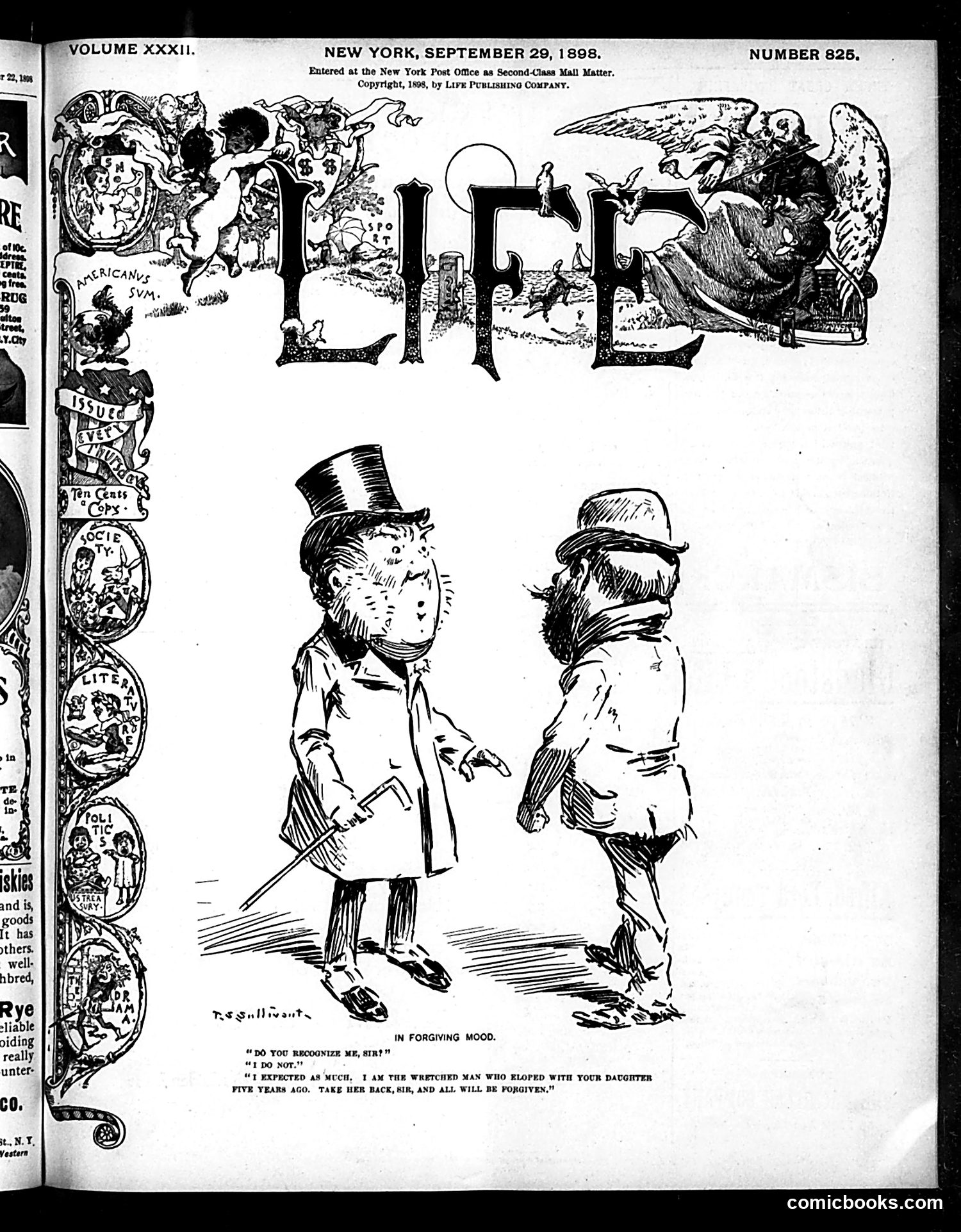
This political cartoon depicts two caricatured figures in formal dress meeting in reconciliation. The caption reads: "Do you recognize me, sir?" / "I do not." / "I expected as much. I am the wretched man who eloped with your daughter five years ago. Take her back, sir, and all will be forgiven." The satire appears to target a contemporary political or social scandal involving an elopement from five years prior (circa 1893). The cartoon mocks the absurdity of the wrongdoer returning to demand forgiveness while offering to "return" the daughter—reversing typical expectations of who should apologize. The exaggerated facial features and formal attire emphasize the ridiculous nature of this "forgiving" proposition. Without additional context, the specific individuals referenced remain unclear.
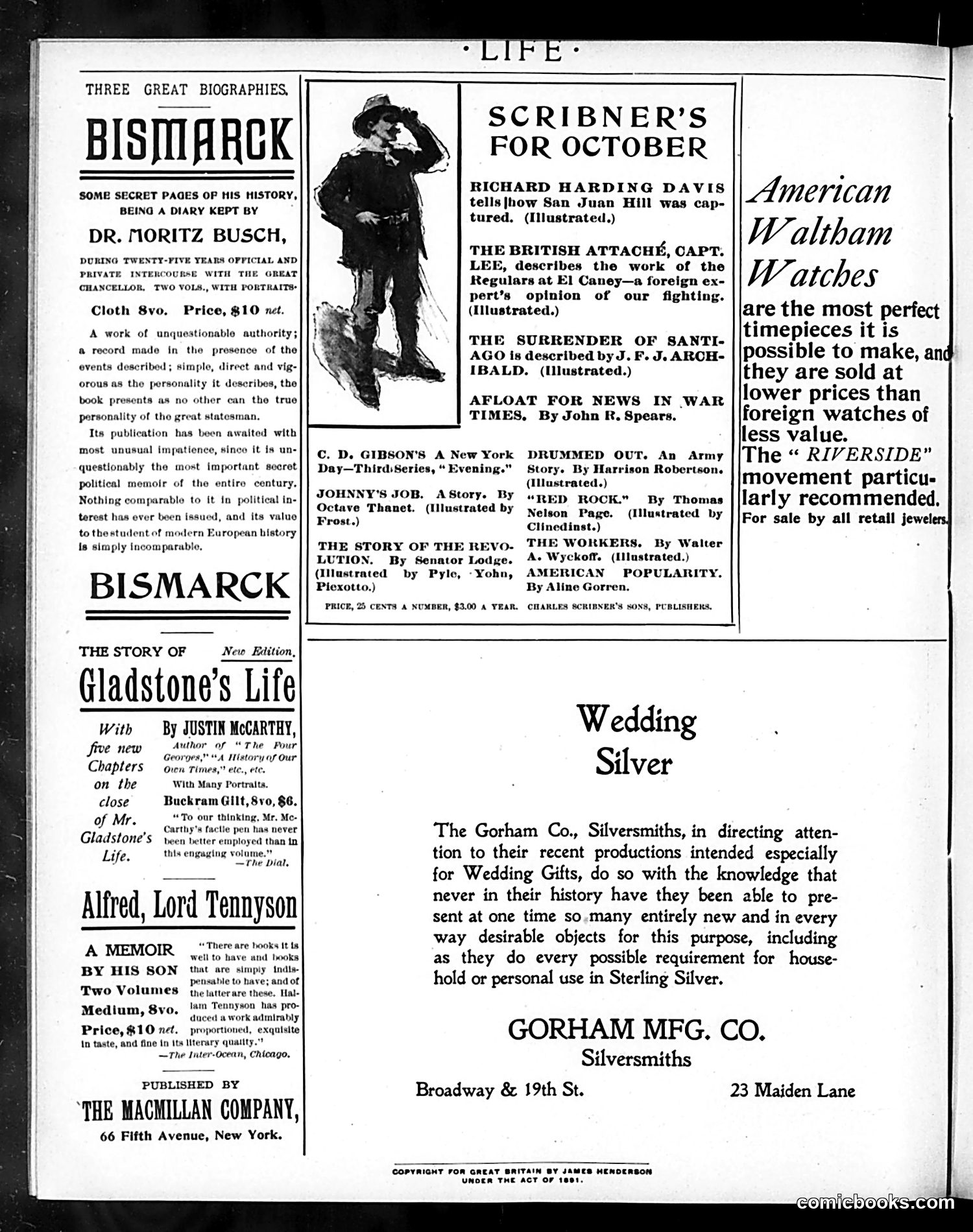
This page is primarily **advertising and book promotion** rather than political satire. The main content features: **Left side:** Advertisements for three biographical works—*Bismarck* by Dr. Moritz Busch (described as presenting "secret pages" of Bismarck's history), *Gladstone's Life* by Justin McCarthy, and a memoir of Alfred, Lord Tennyson. **Center:** Scribner's Magazine advertisements listing upcoming October articles, including pieces by Richard Harding Davis and accounts of wartime events. **Right side:** An advertisement for American Waltham Watches and a Gorham Manufacturing Company promotion for wedding silver. The page reflects late 19th/early 20th-century publishing and consumer culture rather than satirical political commentary. No specific political cartoon or identifiable caricature appears prominently.
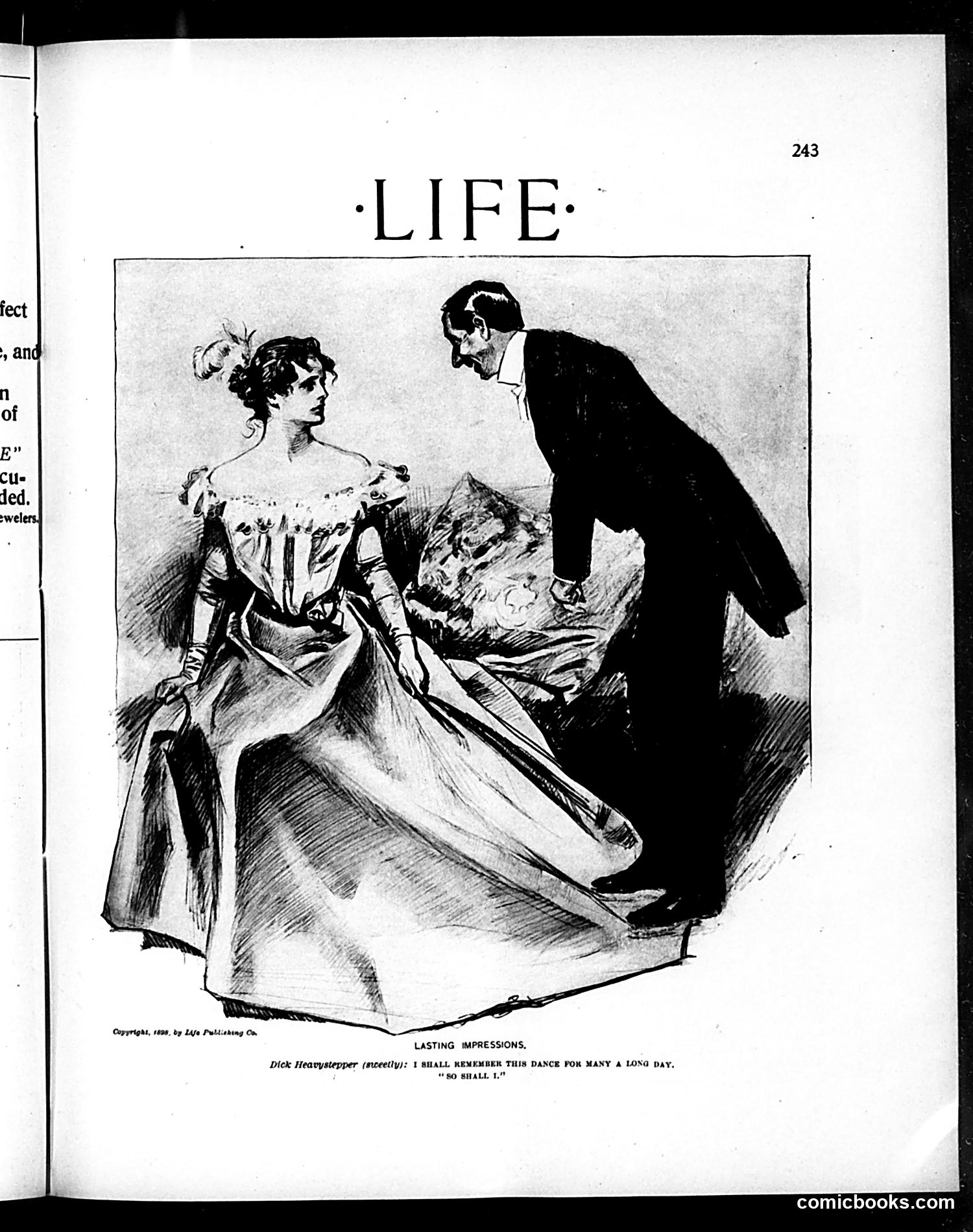
This cartoon depicts a couple dancing. The caption reads: "Dick Heartstopper (sincerely): 'I SHALL REMEMBER THIS DANCE FOR MANY A LONG DAY.' 'SO SHALL I.'" The satire appears to target romantic clichés and insincere declarations of affection. "Dick Heartstopper" is a generic comic character name suggesting melodramatic earnestness. The joke hinges on the woman's unspoken agreement with his sentiment—but for an entirely different reason. She likely intends to "remember" the dance because he stepped on her feet repeatedly or danced poorly, whereas he believes she'll treasure the memory of his romantic charm. This reflects early 20th-century Life magazine's characteristic humor: exposing the gap between pretense and reality in social interactions.
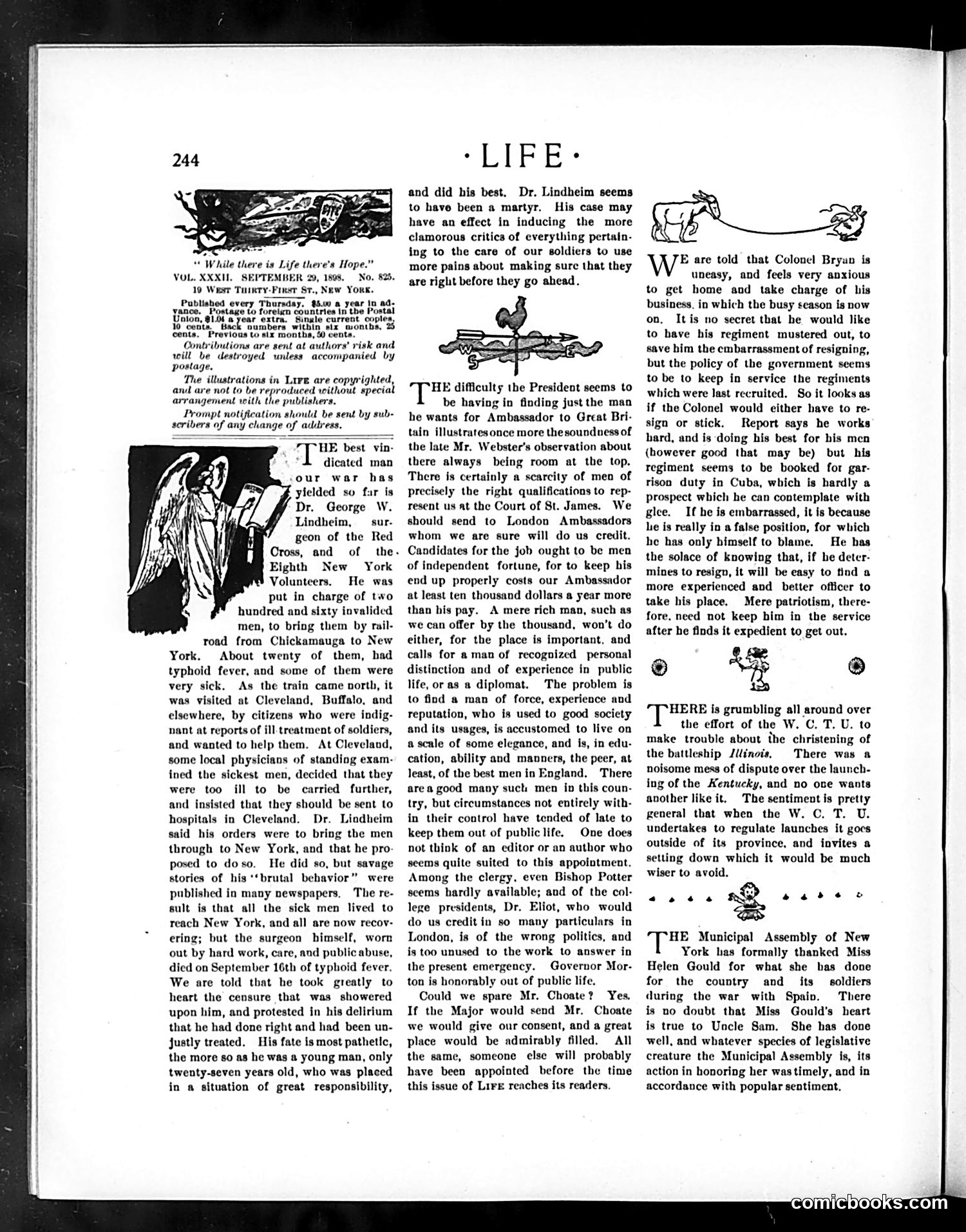
The page contains three distinct editorial pieces discussing World War I-era personnel and policy issues. **The main cartoon** (upper left) depicts an angel figure labeled "While there is Life there's Hope," published by Life Magazine at 19 West Thirty-First Street, New York. This appears to reference Dr. George W. Lindheim of the Red Cross's Eighth New York Volunteers, whom the text criticizes for alleged mismanagement of soldier care and transportation. **The editorial content** addresses the difficulty in finding qualified ambassadors to Great Britain, and discusses Colonel Bryan's anxiety about returning home. A final section mentions grumbling over the battleship *Illinois* and thanks Miss Helen Gould for supporting soldiers. The satire primarily targets bureaucratic incompetence in wartime administration rather than specific political figures.
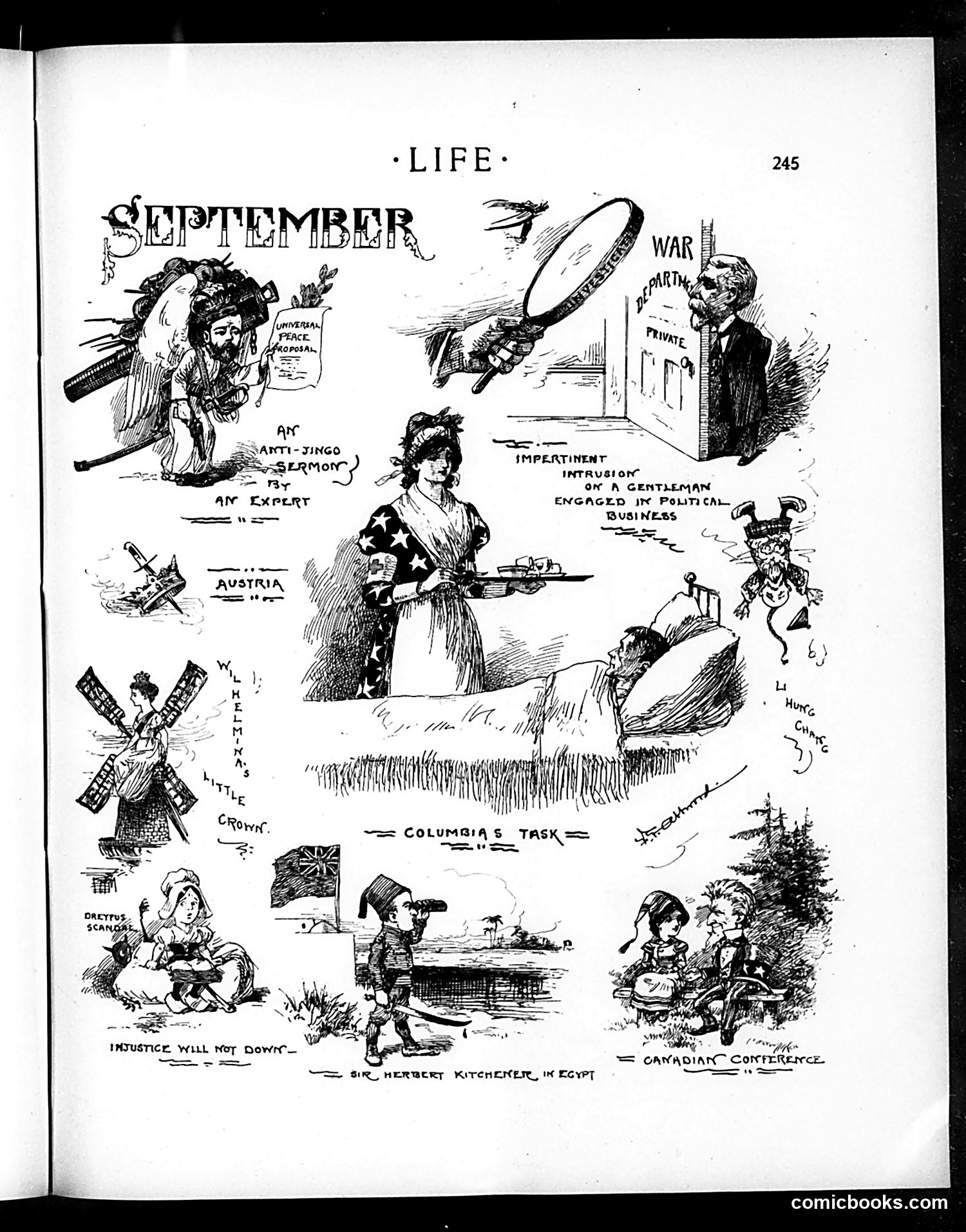
This September 1901 page satirizes several contemporary political issues through allegorical figures: **Top section**: "Art Anti-Jingo Sermon by an Expert" mocks artistic pretension regarding imperialism and jingoism—likely critiquing pacifist intellectuals during the Boer War era. **Central figure**: A woman (possibly representing Columbia/America) serves various international "dishes" to competing interests, labeled "War Department Private" and other references to political business dealings. **Lower panels**: Include "Columbia's Task," "Justice Will Not Down" (with cactus scandal reference), "Sir Herbert Kitchener in Egypt," and "Canadian Conference"—all addressing contemporary imperial conflicts and political maneuvering. The overall message appears critical of American interventionism, military expansionism, and the blending of politics with commercial interests during the early 20th century imperialism period.
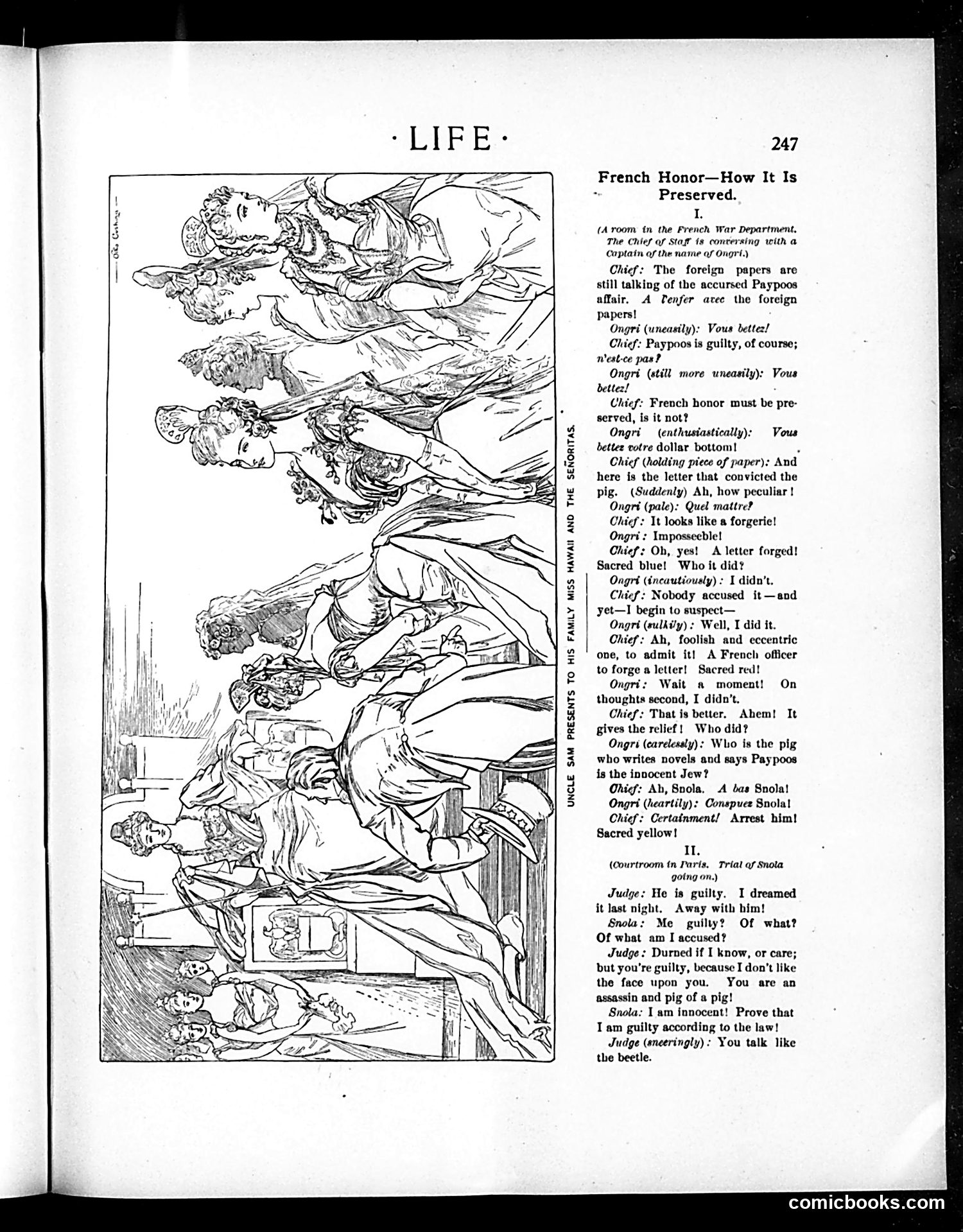
This satirical dialogue mocks French military corruption during World War I. The sketch depicts officers in the French War Department discussing the "Paypoos affair"—an apparent scandal involving forged documents. The humor centers on how French honor is supposedly "preserved": when a pig (Paypoos) is accused of forgery, the officers deflect blame between themselves. One admits to forging a letter, another admits to creating the pig as a scapegoat, yet all insist French honor remains intact. The cartoon ridicules institutional dishonesty and circular blame-shifting—officers confessing crimes while maintaining that French military credibility is somehow preserved through these admissions. It's satirizing how bureaucracies protect reputations through absurd logic rather than actual accountability.
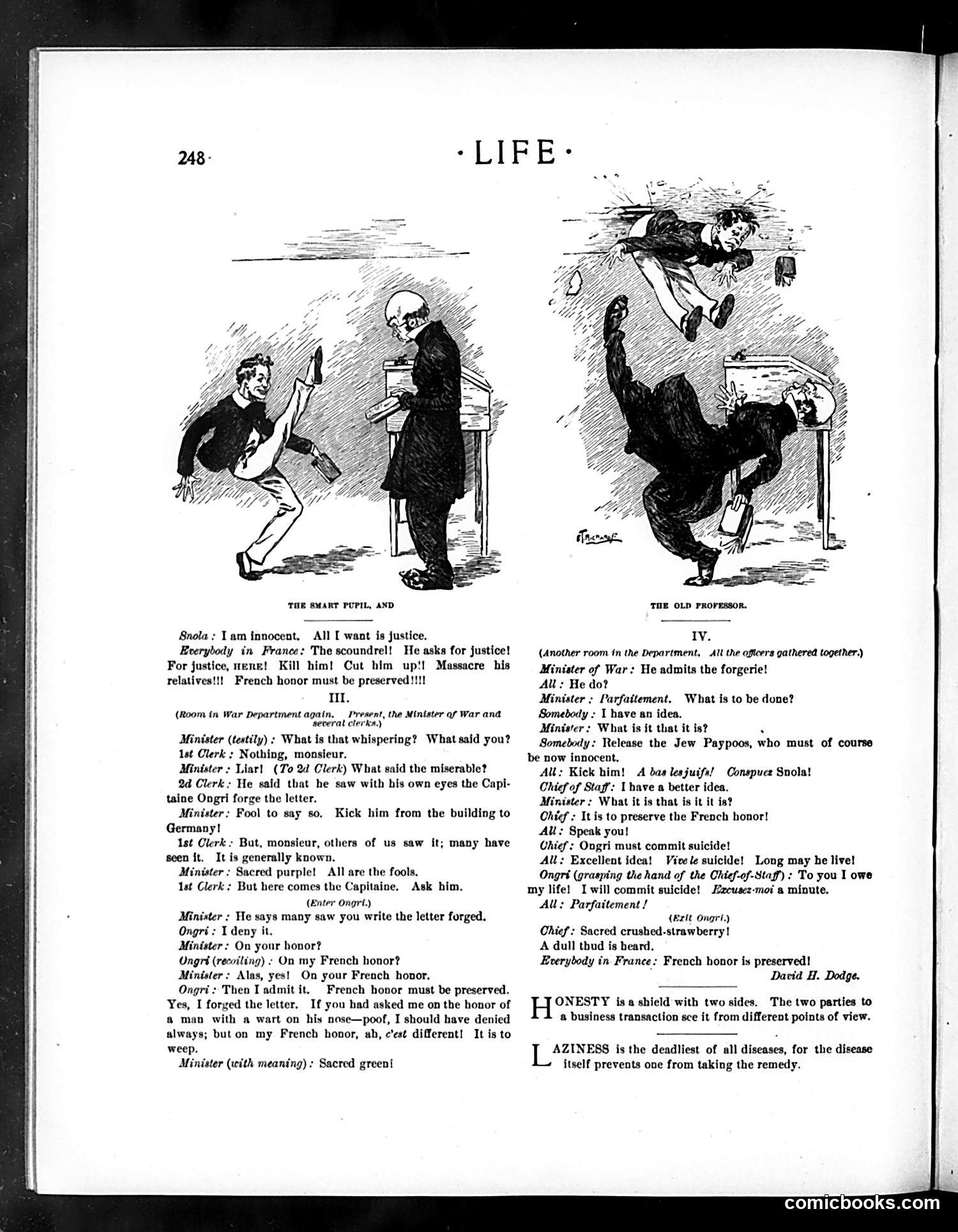
This page presents two sketches critiquing French and German wartime conduct, likely from World War I era. **Left cartoon ("The Smart Pupil, and"):** A French official punishes a young boy for forging a letter, while lecturing about French honor and justice—yet the dialogue reveals France itself is fabricating false documents (a forged capitaine's letter is mentioned). The satire: France hypocritically demands moral standards while committing the same dishonesty it punishes. **Right cartoon ("The Old Professor"):** An elderly German professor teaches a Jewish student (Onogri) that he must commit suicide to preserve German honor. The satire mocks German militarism's absurd demands for "honor" through violence and scapegoating. Both cartoons ridicule warring nations' propaganda about morality while engaging in brutality and deception.
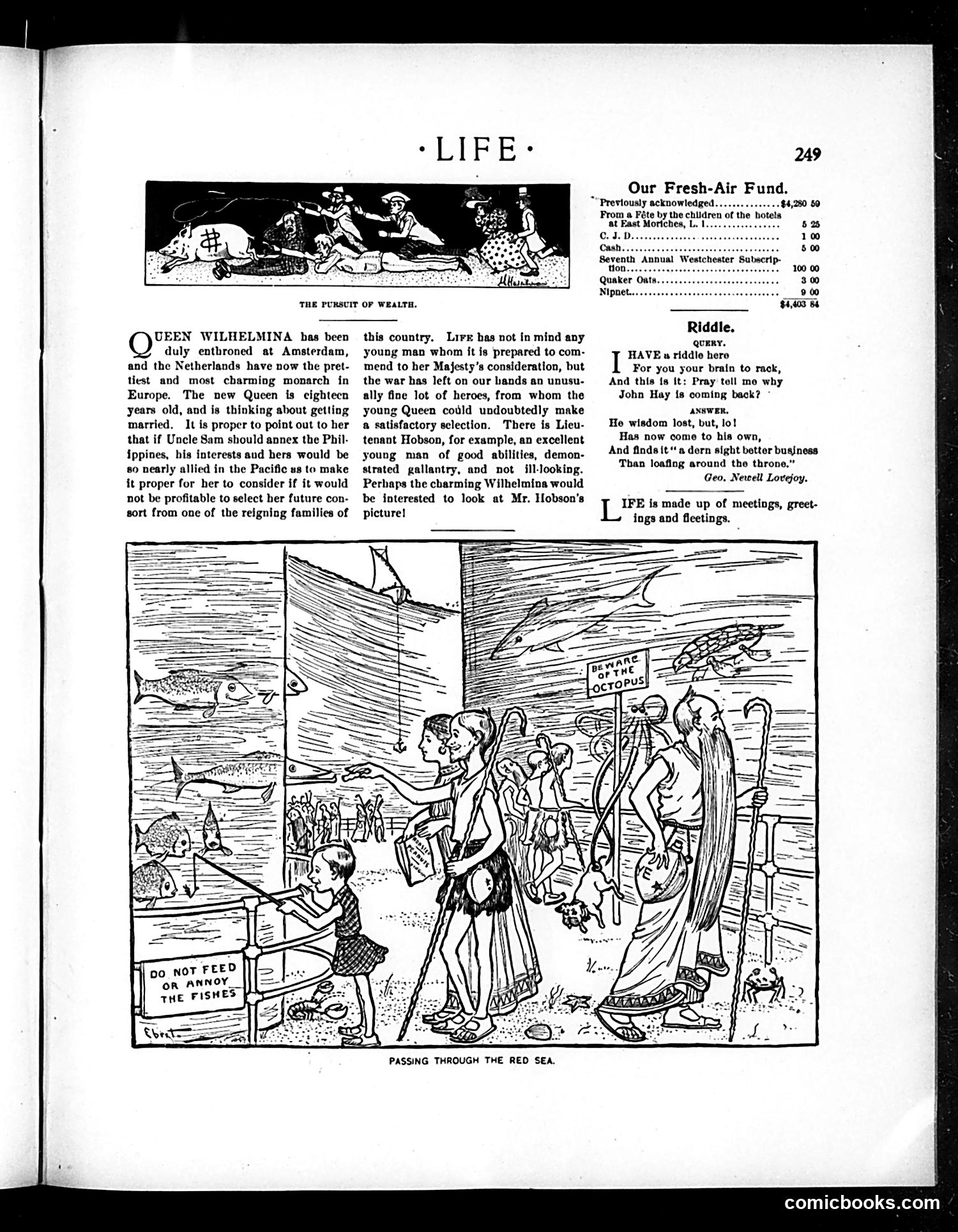
**Top Section - "The Pursuit of Wealth":** This editorial discusses Queen Wilhelmina of the Netherlands, recently crowned at age 18. The piece suggests she should consider marrying a suitable European nobleman—specifically mentioning Mr. Hobson as a potential match for the future security of her throne. This reflects late 19th-century dynastic marriage politics among European royalty. **Bottom Cartoon - "Passing Through the Red Sea":** This whimsical illustration depicts biblical Israelites crossing the Red Sea with fantastical sea creatures. The joke appears satirical: there's a sign warning "Beware of Octopus" and another reading "Do Not Feed or Annoy the Fishes," suggesting modern tourist warnings humorously imposed on ancient scripture—a gentle mockery of contemporary safety culture applied to biblical narrative.
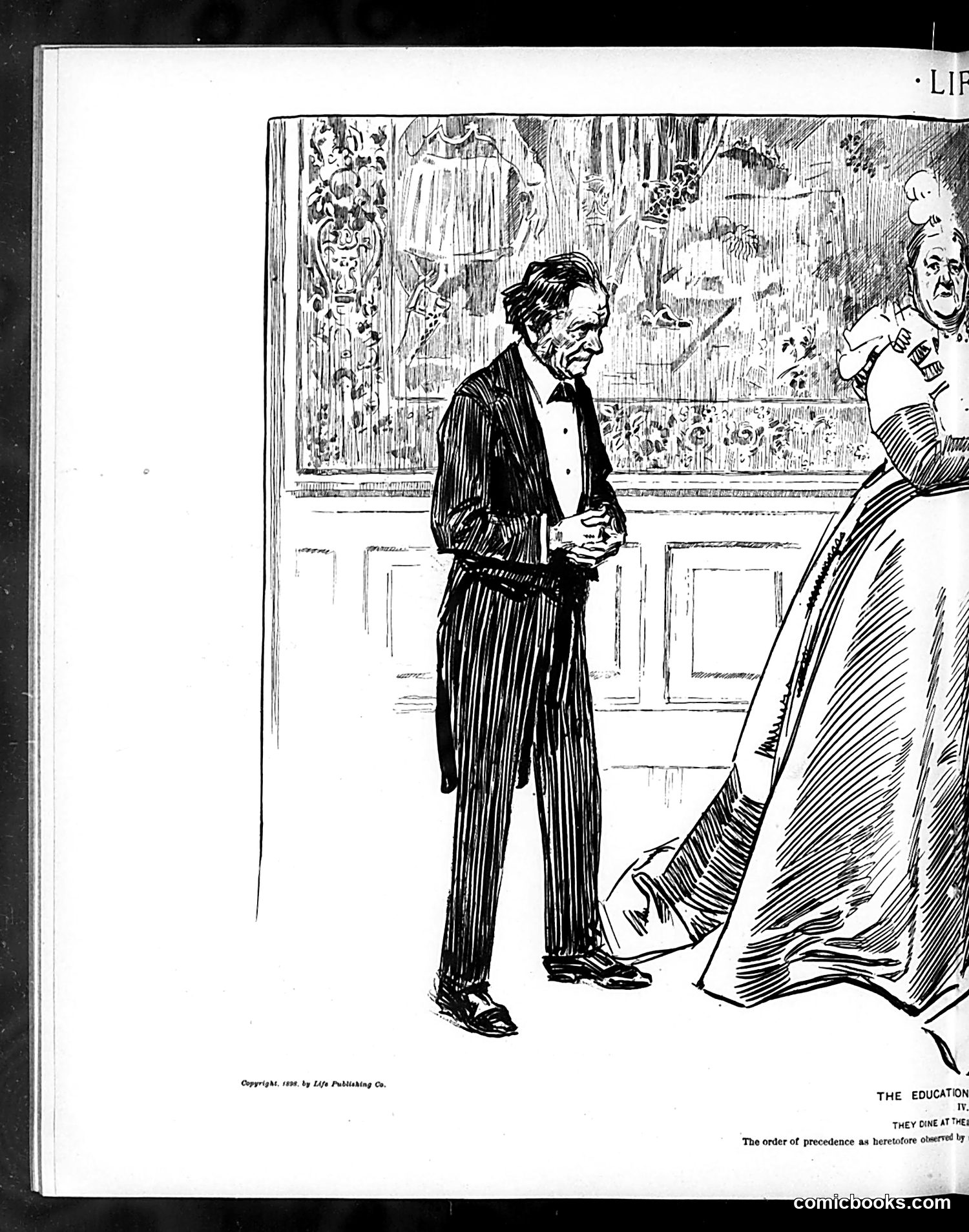
This appears to be a satirical cartoon about social hierarchy and etiquette in formal settings. The image shows a thin, gaunt gentleman in formal evening wear (tuxedo) standing uncomfortably while larger, more robust figures in elaborate dress observe him. The visible caption references "THE EDUCATION" and mentions "The order of precedence as heretofore observed by" — suggesting this satirizes rules of social precedence at formal dinners or court functions. The cartoon likely mocks either: - An awkward social climber unfamiliar with proper etiquette - Absurd formality and rigid class distinctions - The contrast between refined appearance and actual social standing The exaggerated caricature style and the gentleman's uncomfortable posture emphasize the satirical target, though the specific historical context remains unclear without the complete caption.
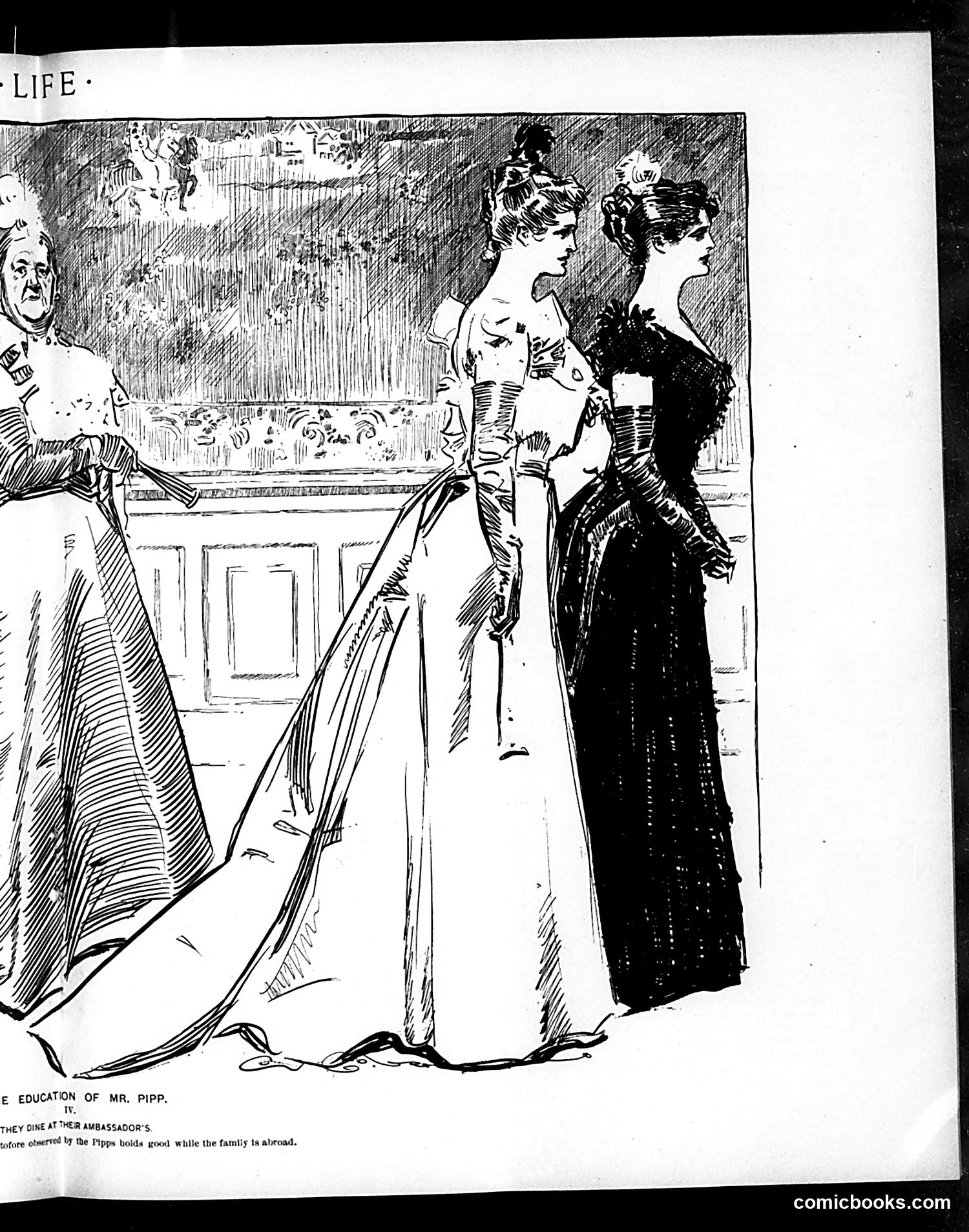
This appears to be Part IV of a serial story titled "The Education of Mr. Pipp." The caption reads: "THEY DINE AT THEIR AMBASSADOR'S / before observing how the Pipps hold good while the family is abroad." The illustration shows a formal diplomatic dinner scene with elegantly dressed women in early 1900s gowns and an older man on the left. The satire likely concerns Mr. Pipp, apparently a nouveau riche or socially ambitious character, learning proper etiquette in high society while his family is traveling. The scene depicts the contrast between refined diplomatic circles and the Pipps' social aspirations—a common satirical theme in Life magazine about American social climbing and the clash between old money/aristocracy and newly wealthy Americans trying to gain acceptance.
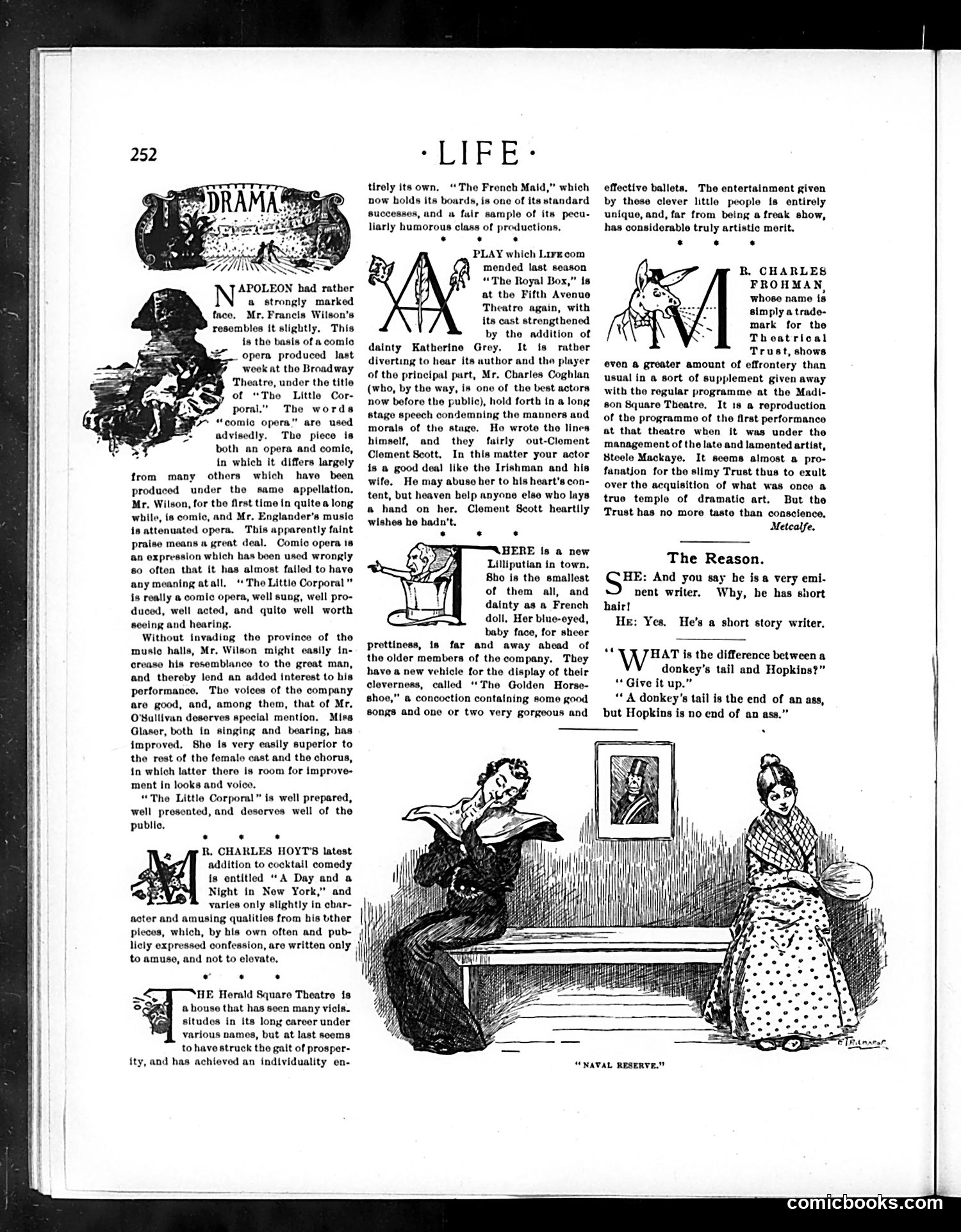
This page combines theatrical reviews with a visual joke titled "Naval Reserve." The cartoon depicts a man reclining on a chair while a woman stands nearby—the humor hinges on a pun: "naval" (relating to the navy) versus "navel" (belly button), with her polka-dotted dress emphasizing her midsection. The theatrical content discusses performances including "The Royal Box" at the Fifth Avenue Theatre and Charles Hoyt's comedy "A Day and a Night in New York." The reviews praise actor Charles Frohman and critique various productions' merits. A sidebar joke about a "short story writer" uses a donkey metaphor that's mildly crude by modern standards but typical of period humor. The satire targets theatrical performance quality and writer pretension rather than political issues.
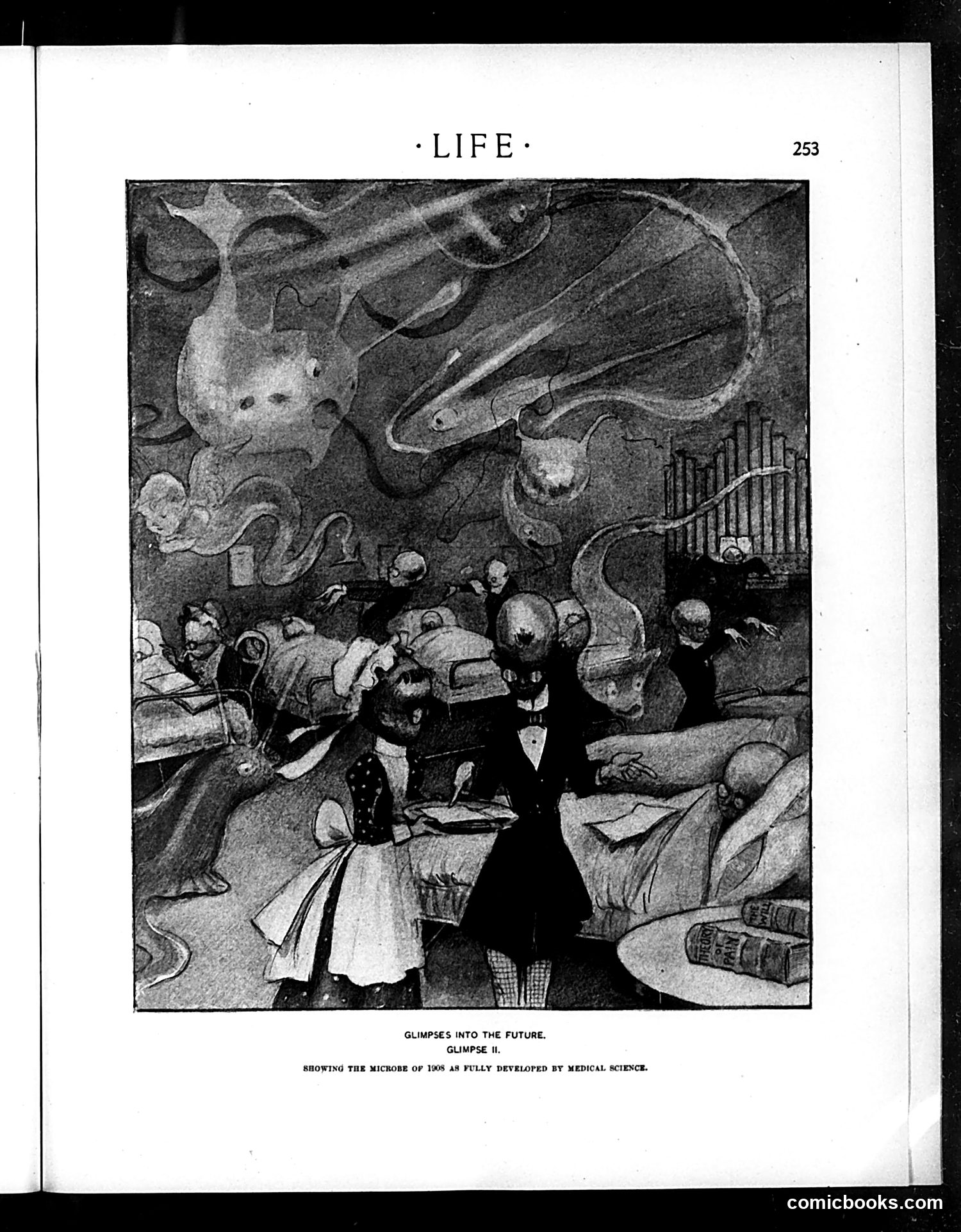
This satirical illustration depicts a fantastical future scenario where microbes have evolved into grotesque, oversized creatures. The caption references "1908," suggesting this is early 20th-century satire about the rapid advancement of medical microscopy. The scene shows well-dressed Victorian figures observing enormous, alien-like organisms in what appears to be a scientific exhibition or laboratory setting. The satire likely mocks contemporary anxieties about newly-discovered microscopic pathogens and the fear that medical science's revelations about invisible disease-causing organisms might make them seem even more monstrous when "fully developed." The exaggerated, surreal creatures represent a humorous extrapolation of germ theory—popular but still somewhat mysterious to the general public. The formal observers suggest both scientific pride and public apprehension about these invisible threats to health.
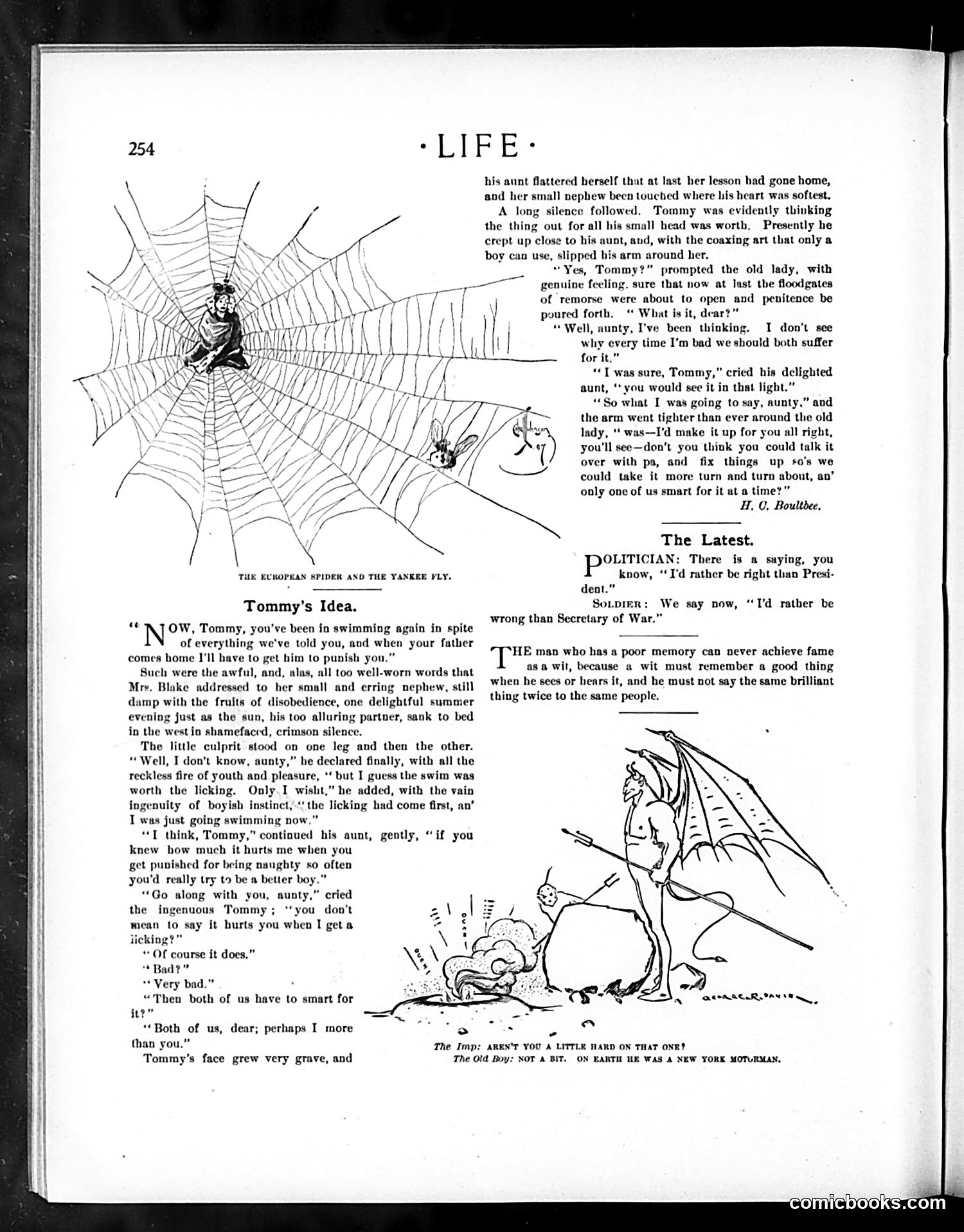
**"Tommy's Idea"** is a humorous story about a boy punished for swimming despite warnings. When his aunt explains that his misbehavior hurts *her* emotionally, Tommy proposes a solution: alternating who gets punished—suggesting his aunt take the licking instead sometimes. The joke exploits Tommy's literal, self-serving logic: if punishment is shared pain, why not share the actual punishment? **"The European Spider and the Yankee Fly"** (top illustration) depicts a spider web with European and American figures, likely representing diplomatic tensions or conflict between Europe and America, though specific context is unclear without dating. **"The Latest"** contains two brief political jokes mocking the Secretary of War position (likely referencing early 20th-century U.S. military leadership disputes) and a commentary on wit requiring good memory. The bottom cartoon references a reincarnated "New York motorman" (streetcar operator), suggesting social commentary on labor or urban life.
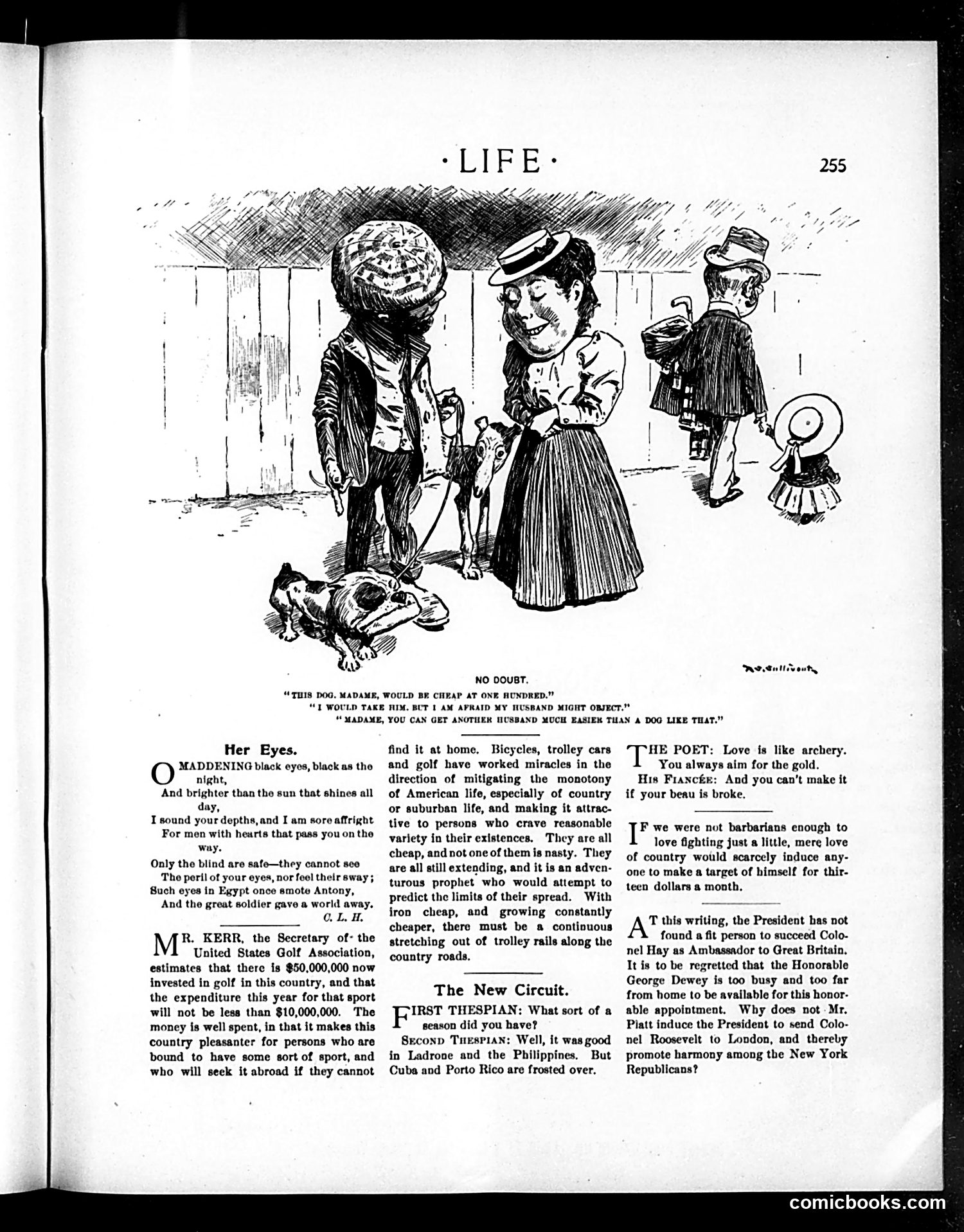
The main cartoon satirizes marriage and consumer priorities. A well-dressed man tries to sell an elegant dog to a woman, claiming it's a bargain at 100 dollars. She's interested but hesitates, saying her husband might object. The salesman's punchline—"you can get another husband much easier than a dog like that"—jokes that husbands are disposable while quality dogs are not. The humor reflects turn-of-the-century anxieties about marriage and women's agency. It suggests wives view their husbands as replaceable nuisances, while prizing material possessions. The cartoon mocks both domestic relationships and the emerging consumer culture that prioritizes owning fine goods over spousal harmony. The page also includes poetry, golf economics, theater gossip, and political commentary (noting Theodore Roosevelt should be appointed Ambassador to Britain).
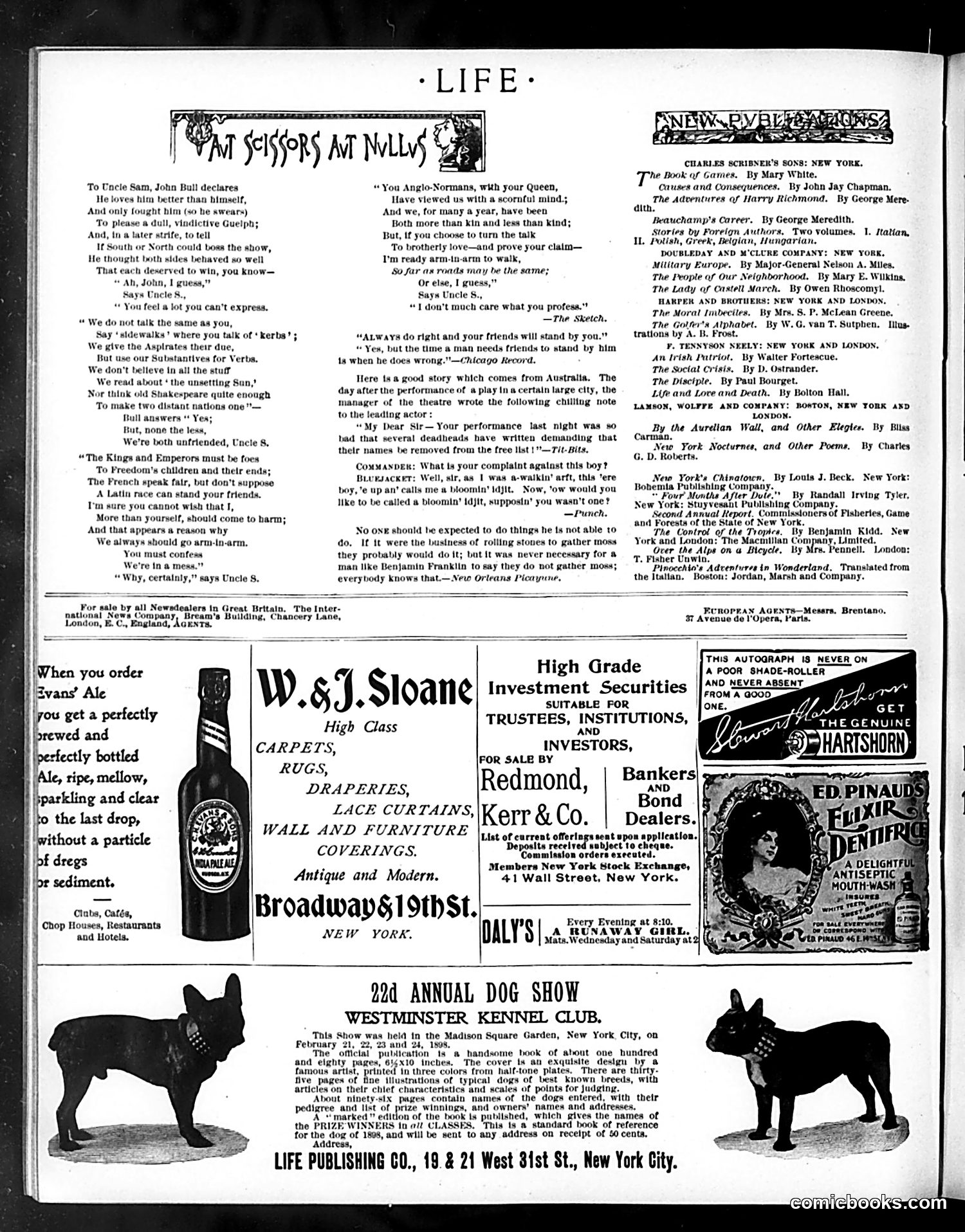
This page features a satirical dialogue between **Uncle Sam** (personification of America) and **John Bull** (personification of Britain). The poem addresses Anglo-American relations in the 1890s. **The satire's point:** Despite Britain's declarations of affection toward the United States, the two nations remain fundamentally estranged. John Bull claims they should be allies against republican threats (France) and monarchical rivals, yet Uncle Sam remains skeptical of British sincerity, noting their historical scorn ("both more than kin and less than kind"). **Key context for modern readers:** This reflects genuine tensions between the nations despite cultural ties. The poem mocks British hypocrisy—John Bull wants American friendship for strategic advantage while pretending emotional closeness. Uncle Sam's practical skepticism suggests America won't be manipulated by sentiment. **The joke:** Real friendship requires more than rhetoric; nations act in self-interest, not brotherly love.
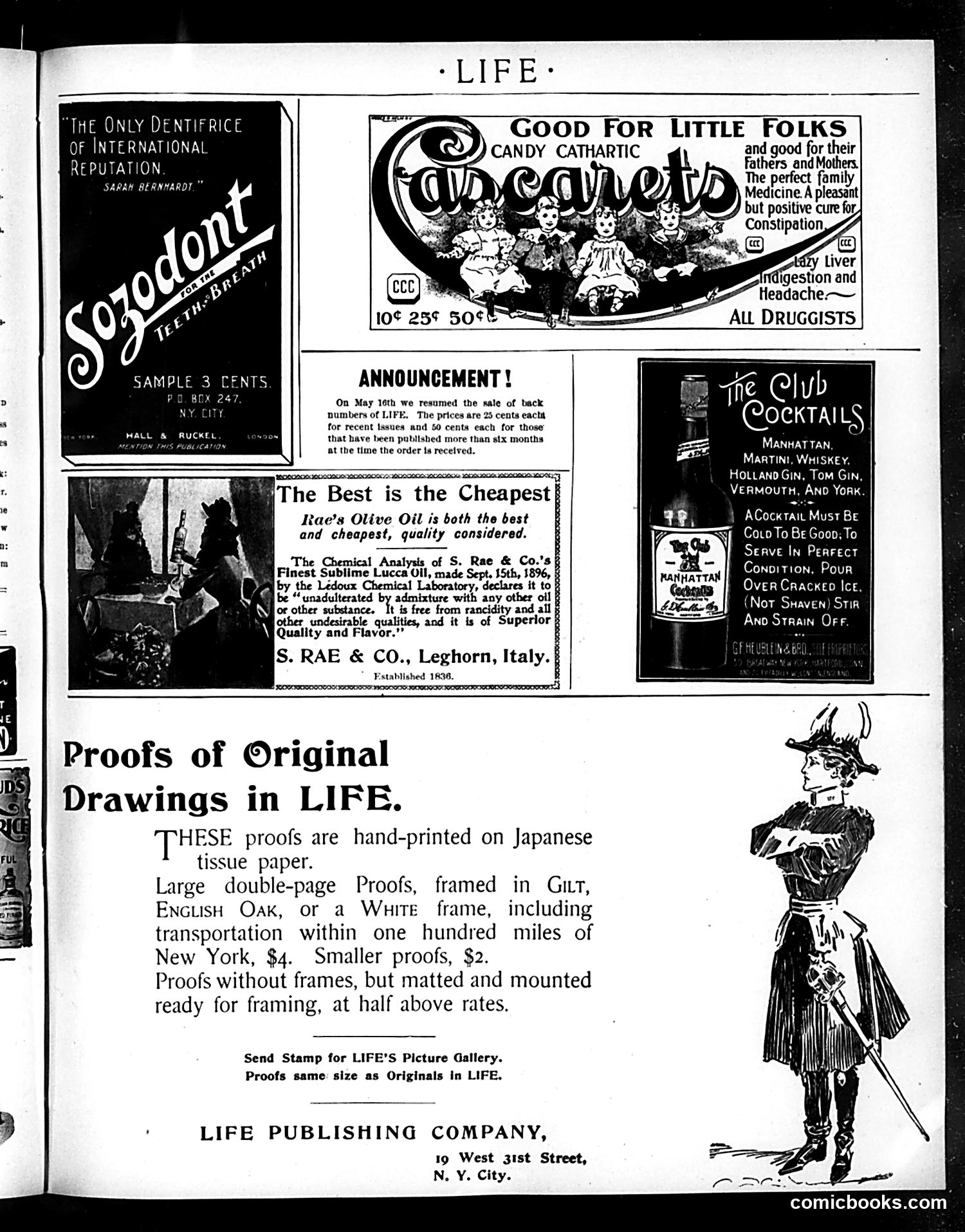
This page is primarily **advertising content** rather than satirical cartoons. It contains multiple product advertisements typical of early 20th-century American magazines: 1. **Sozodont toothpaste**: Claims endorsement from actress Sarah Bernhardt as "the only dentifrice of international reputation"—a common advertising tactic using celebrity testimonials. 2. **Caducet candy**: Marketed as a family laxative for children, representing the era when patent medicines and candies with medicinal claims were commonplace and unregulated. 3. **Rae's Olive Oil**: Italian product emphasizing purity and quality. 4. **The Club Cocktails**: Advertises pre-mixed cocktail ingredients, reflecting Prohibition-era or post-Prohibition marketing. The page also announces **Life Publishing Company's back-issue sales** and offers **framed proofs of magazine artwork** for purchase—a direct monetization of their editorial content. The elegant illustration of a fashionable woman represents typical Life magazine aesthetic advertising rather than political satire.
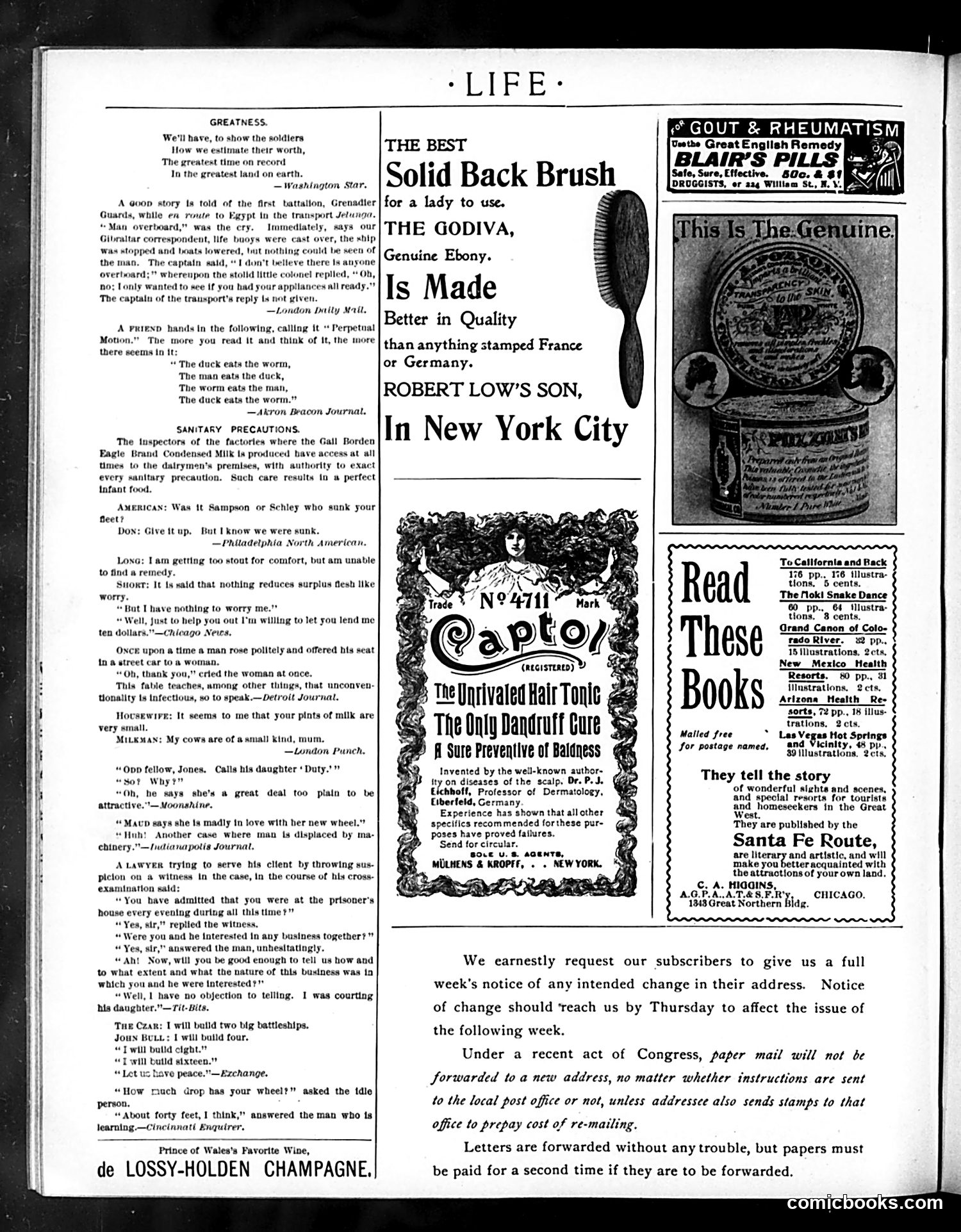
This page consists primarily of **humorous anecdotes and advertisements** rather than political cartoons. The jokes reflect turn-of-the-century American humor: **Notable Content:** - A quip about the Spanish-American War (Sampson vs. Schley sinking a fleet) - Czar Nicholas II and Britain's John Bull engaged in an arms race, building battleships in escalating numbers—satirizing pre-WWI tensions - Domestic humor about weight loss, courtship, and class relations - Product advertisements (hair tonic, brushes, champagne, railroad travel guides) **The Satire:** The battleship joke criticizes the militaristic rivalry between Russia and Britain, mocking their competitive military buildup as absurd and destabilizing. This reflects genuine contemporary anxiety about imperial powers arming themselves. Most other material is lighthearted social commentary about marriage, class differences, and modern conveniences rather than serious political critique.
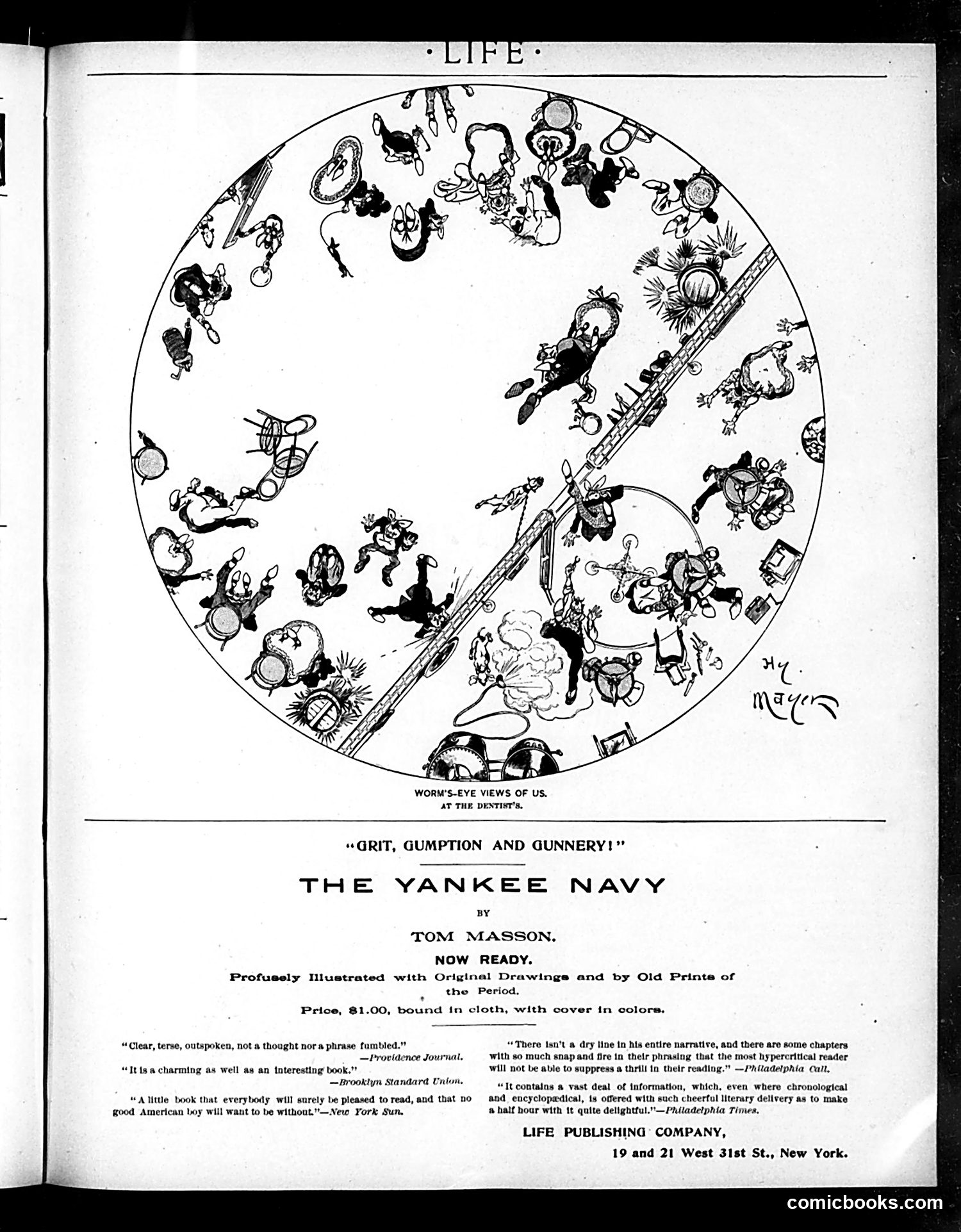
This is primarily a **book advertisement** for Tom Masson's *The Yankee Navy*, published by Life Publishing Company. The circular illustration at top depicts a humorous "worm's-eye view" of a **dental office** — showing patients and dentist from an insect's perspective, with figures scattered around as if viewed from below. The satirical title "Grit, Gumption and Gunnery!" creates a patriotic double meaning: the phrase evokes American naval strength, while the dental context makes it absurdly literal (grit in teeth, gumption to endure the dentist, "gunnery" as a pun on tooth extraction). The book itself appears to be a humorous illustrated history of the U.S. Navy, combining original period engravings with contemporary (presumably early 1900s) satirical commentary. Multiple testimonials praise its entertaining yet informative approach—"snap and fire," "charming," "vast deal of information." The advertisement positions the book as appealing to patriotic American readers, particularly boys, combining military history with accessible humor.
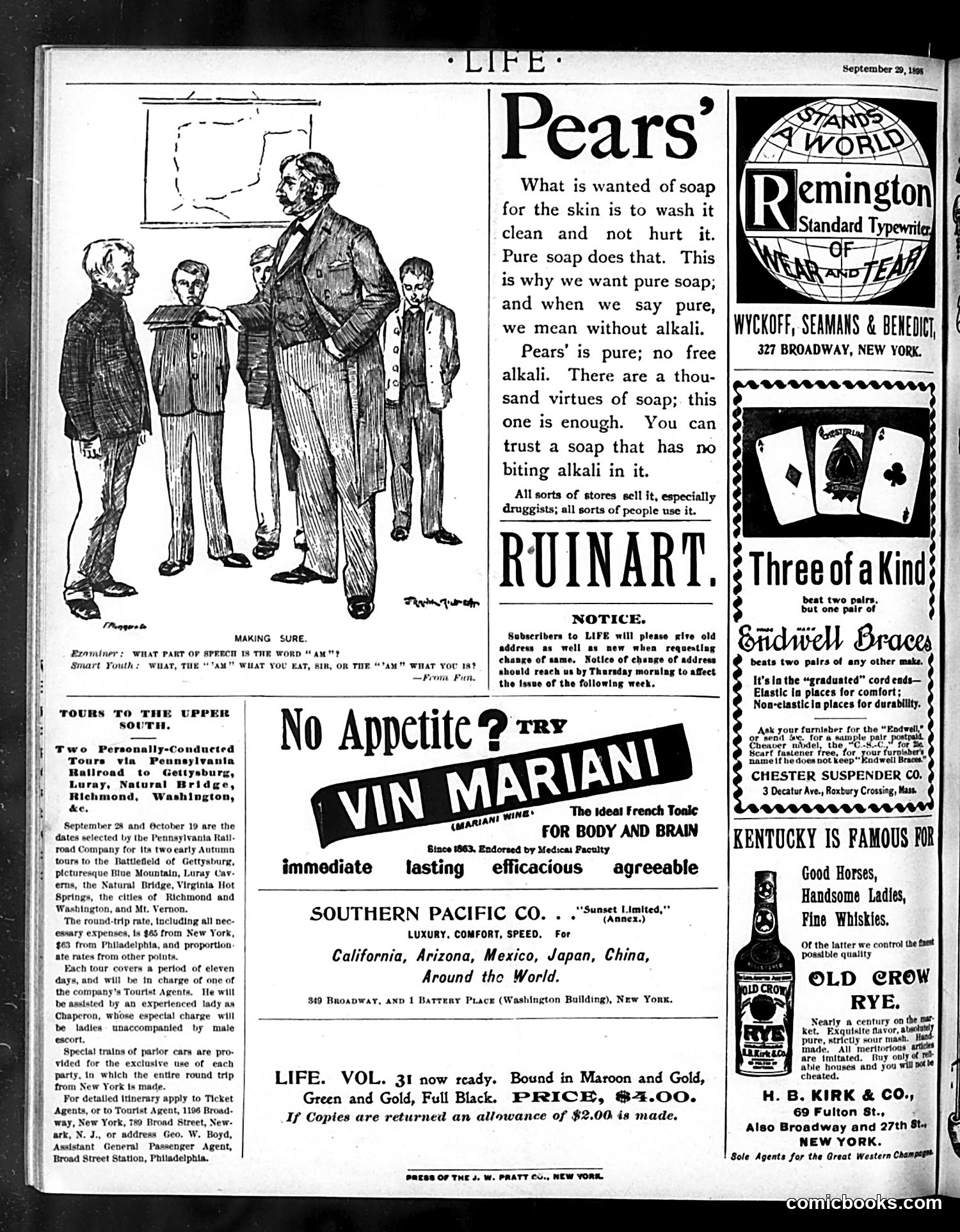
The main cartoon, titled "Making Sure," depicts a school examination scene. A stern examiner questions a working-class boy about grammar—specifically the article "an." The youth gives a comic response suggesting "an" means food ("what you eat, sir"). **The satire**: This mocks the gap between formal education and practical street knowledge. The boy's impoverished appearance and vernacular speech contrast with the examiner's attempt at teaching abstract grammar rules. The joke reflects 19th-century anxieties about class, education, and whether poor children could truly benefit from schooling focused on elite linguistic standards. The page is primarily filled with period advertisements (Pears' soap, Vin Mariani tonic, railroad tours, typewriters) typical of *Life's* mixed content format. The source attribution "From Fun" suggests this cartoon was reprinted from another publication.