
Life, 1898-09-29 · page 4 of 20
Life — September 29, 1898 — page 4: what you’re looking at
What you’re looking at
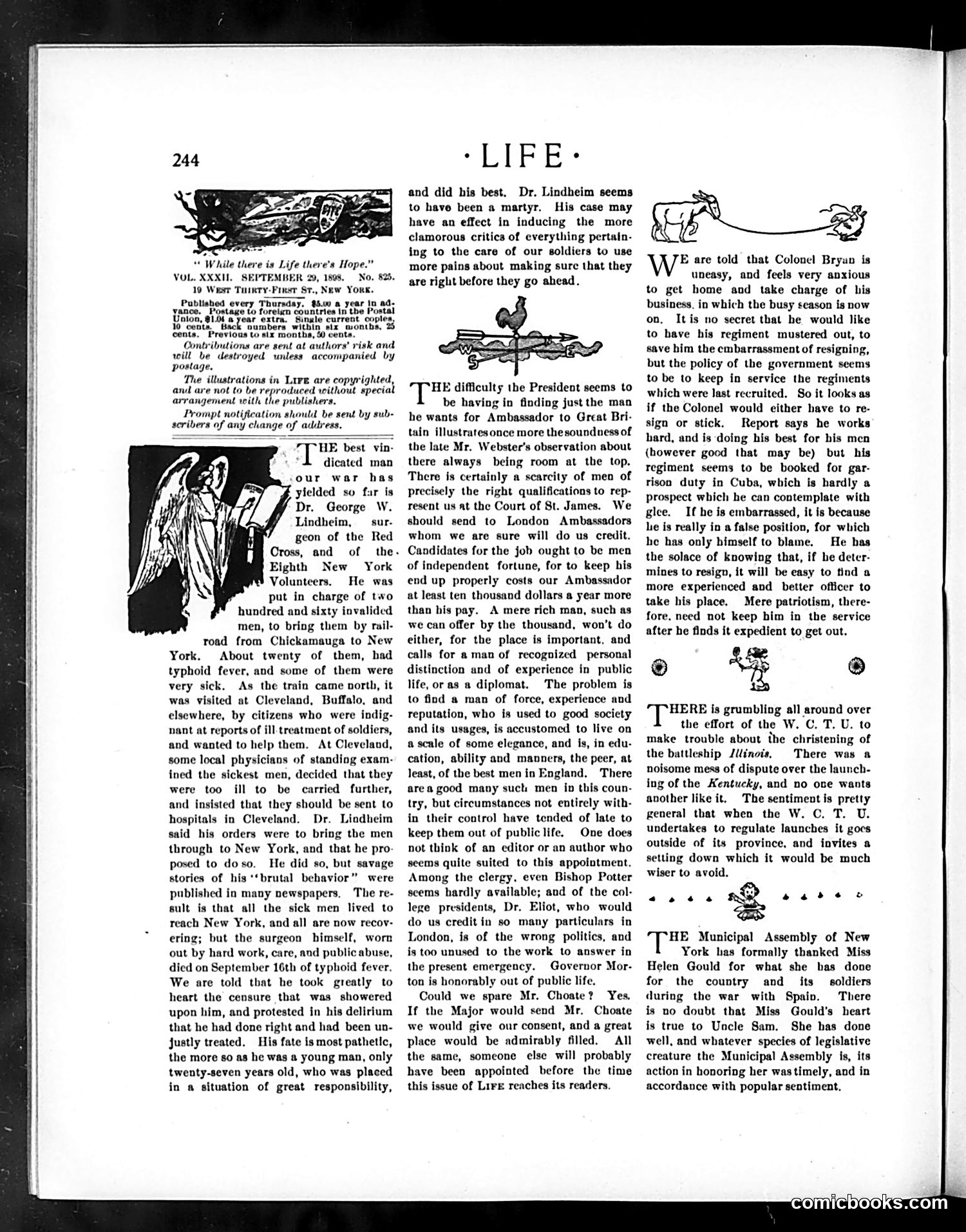
The page contains three distinct editorial pieces discussing World War I-era personnel and policy issues. **The main cartoon** (upper left) depicts an angel figure labeled "While there is Life there's Hope," published by Life Magazine at 19 West Thirty-First Street, New York. This appears to reference Dr. George W. Lindheim of the Red Cross's Eighth New York Volunteers, whom the text criticizes for alleged mismanagement of soldier care and transportation. **The editorial content** addresses the difficulty in finding qualified ambassadors to Great Britain, and discusses Colonel Bryan's anxiety about returning home. A final section mentions grumbling over the battleship *Illinois* and thanks Miss Helen Gould for supporting soldiers. The satire primarily targets bureaucratic incompetence in wartime administration rather than specific political figures.
📄 Transcribed text from this page (OCR, searchable)
Machine-transcribed from the original scan — historical spelling and the odd misread are preserved.
“ While here is Life there's Hope.’ VUL. XXXII. SEPTEMBER 29, 1898. 19 West Tuiety-Pinst St., New YORK. Published every Thursday. $5.00 a year in ad- vance. “Postage to foreicn countries In the Pos: Union, $1.00 year extra. Single current. coples, 10 cent. Back numbers within six months, 23 cents. Previous to six months, 0 cents. Contributions are sent at authors’ risk and will be destroyed unless accompanied by postage. The illustrations in Lire are copyrighted, and are not to be reproduced without special arrangement with the publishers. Prompt notification should be sent by sub- scribers of any change of address. HE best vin- dicated man our war has yielded so far is George W. Lindheim, — sur- geon of the Red [fq Cross, and of the. Eighth New York Volunteers. He was put in charge of two hundred and sixty invalided men, to bring them by rail- road from Chickamauga to New York. About twenty of them, had typhoid fever, and some of them were very sick. As the train came north, it was visited at Cleveland, Buffalo, and elsewhere, by citizens who were indig- nant at reports of ill-treatment of soldiers, and wanted to help them. At Cleveland, some local physicians of standing exam- ined the sickest men, decided that they were too ill to be carried further, and insisted that they should be sent to hospitals in Cleveland. Dr. Liodheim said his orders were to bring the men through to New York, and that he pro posed to doso. He did so, but savage stories of his ‘brutal bebavior” were published in many newspapers, The re- sult is that all the sick men lived to reach New York, and all are now recov- ering; but the surgeon himself, worn out by hard work, care, and public abuse, died on September 16th of typhoid fever. We are told that he took greatly to heart the censure that was showered upon him, and protested in his delirium that he had done right and had been un- justly treated. His fate is most pathetic, the more so as he was a young man, only twenty-seven years old, who was placed in a situation of great responsibility, *LEP'E » and did his best. Dr. Lindheim seems to have been a martyr. His case may have an effect in inducing the more clamorous critica of everything pertain- ing to the care of our soldiers to use more pains about making sure that they are right before they go ahead. HE difficulty the President seems to be having in finding just the man he wants for Ambassador to Great Bri- tain illustrates once more thesoundness of the late Mr. Webster’s observation about there always being room at the top. There is certainly a scarcity of men of precisely the right qualifications to rep- resent us at the Court of St. James. We should send to London Ambassadors whom we are sure will do us credit. Candidates for the job ought to be men of independent fortune, for to keep his end up properly costs our Ambassador at least ten thousand dollars a year more than his pay. A mere rich man, such as we can offer by the thousand, won't do either, for the place is important, and calls for a man of recognized personal distinction and of experience in public life, or as a diplomat. The problem is to find a man of force, experience and reputation, who is used to good society and its usages, is accustomed to live on ascale of some elegance, and is, in edu- cation, ability and manners, the peer, at least, of the best men in England. There area good many such men in this coun- try, but circumstances not entirely with- in their control have tended of late to keep them out of public life. One does not think of an editor or an author who seems quite suited to this appointment. Among the clergy, even Bishop Potter seems hardly available; and of the col- lege presidents, Dr. Eliot, who would do us credit in so many particulars in London, is of the wrong politics, and is too unused to the work to answer in the present emergency. Governor Mor- ton is honorably out of public life. Could we spare Mr. Choate? Yes. If the Major would send Mr. Choate we would give our consent, and a great place would be admirably filled. All the same, someone else will probably have been appointed before the time this issue of Lire reaches its readers. E are told that Colonel Bryan is uneasy, and feels very anxious to get home and take charge of his business, in which the busy season is now on. Itis no secret that he would like to have his regiment mustered out, to save him the cmbarrassment of resigning, but the policy of the government seems to be to keep in service the regiments which were last recruited. So it looks as if the Colonel would either have to re- sign or stick. Report says he works hard, and is doing his best for his men (however good that may be) but his regiment seems to be booked for gar- rison duty in Cuba, which is hardly a prospect which he can contemplate with glee. If he is embarrassed, it is because he is really in a false position, for which he has only himself to blame. He bas the solace of knowing that, if be deter- mines to resign, it will be easy to tind a more experienced and better officer to take his place. Mere patriotism, there- fore, need not keep him in the service after he finds it expedient to get out. ° HERE is grumbling all around over the effort of the W. C. T. U. to make trouble about the christening of the battleship JUinois, There was a noisome mess of dispute over the launch- ing of the Kentucky, and no ove wants another like it, The sentiment is pretty general that when the W. C. T. U. undertakes to regulate launches it gocs outside of its province, and invites a setting down which it would be much wiser to avoid, so 4s a saree T= Municipal Assembly of New York has formally thanked Miss Helen Gould for what she bas done for the country and its soldiers during the war with Spain. There is no doubt that Miss Gould’s heart is true to Uncle Sam. She has done well, and whatever species of legislative creature the Municipal Assembly is, its action in honoring her wastimely, and in accordance with popular sentiment. ®