
A complete issue · 20 pages · 1898
Life — August 18, 1898
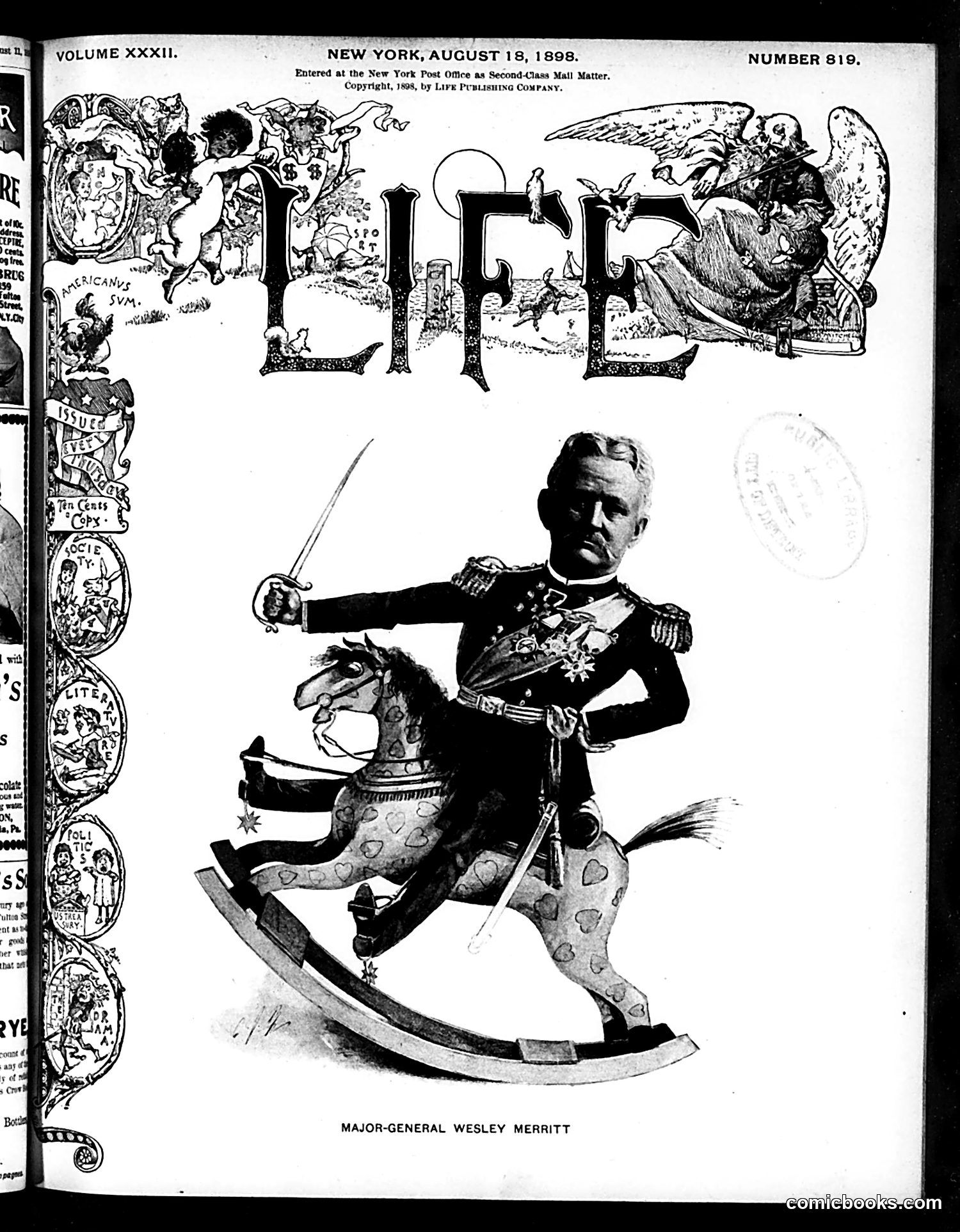
**Date:** August 18, 1898 This cover features **Major-General Wesley Merritt** depicted as a uniformed military officer riding a rocking horse—a visual pun on his name and rank. The satirical image appears to mock Merritt during the Spanish-American War era, when he commanded U.S. forces in the Philippines. The rocking horse suggests childishness or instability, likely critiquing his military leadership or decisions. The ornate military dress uniform and sword contrasts absurdly with the toy horse, emphasizing the satire. The elaborate decorative border and fantastical masthead design are typical of *Life* magazine's aesthetic style from this period, known for sharp political commentary through humorous visual metaphor.
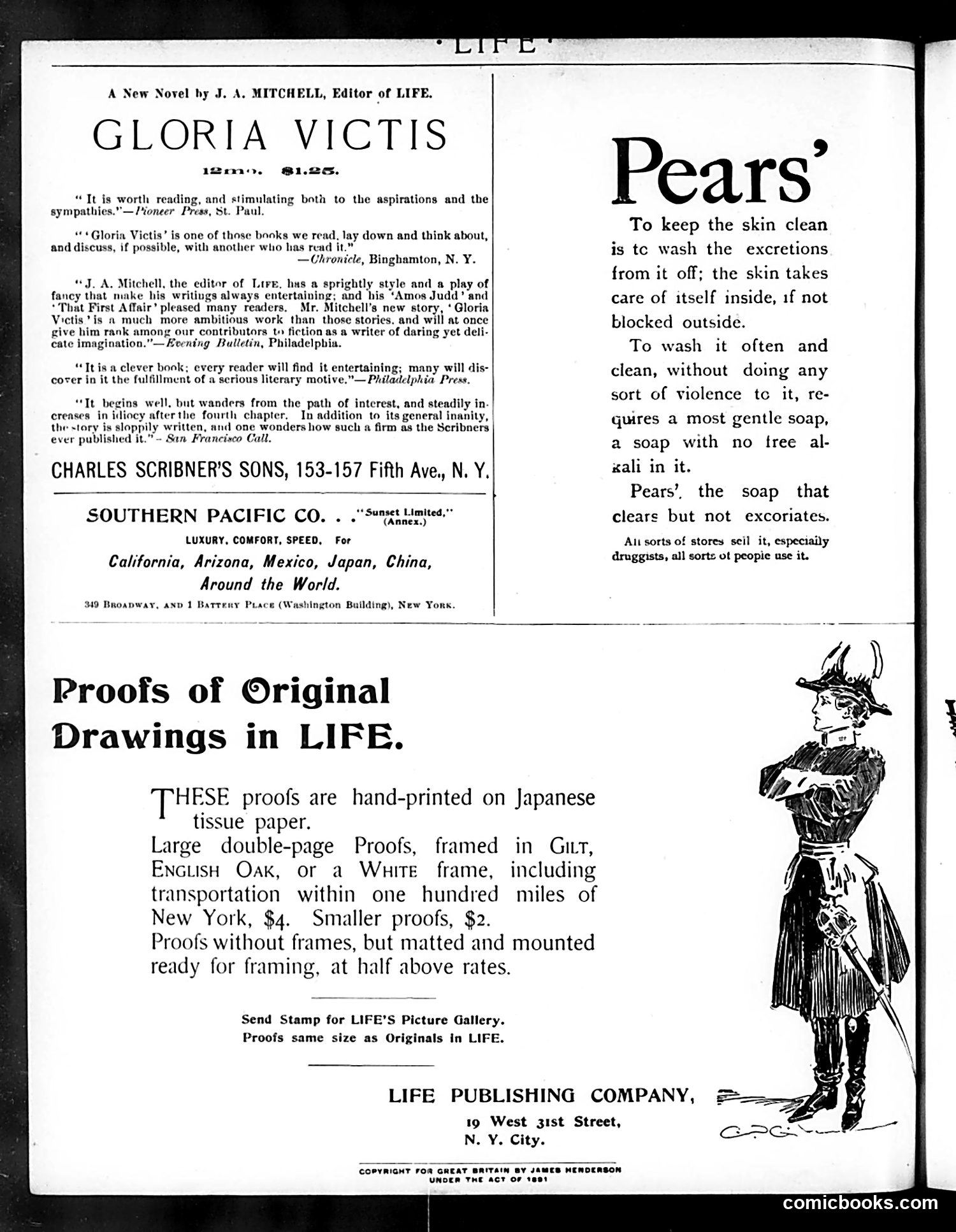
This page is primarily **advertising**, not political satire. The content includes: 1. **Book advertisement** for "Gloria Victis" by J.A. Mitchell (Life's editor), priced $1.25, with favorable reviews from newspapers. 2. **Pears' soap advertisement** emphasizing gentle cleansing without irritation—a common product pitch of the era. 3. **Southern Pacific Co. travel advertisement** promoting luxury rail service to California, Arizona, Mexico, Japan, and China. 4. **LIFE Publishing Company promotion** for framed proofs of original drawings, printed on Japanese tissue paper, available for $2-$4 depending on size and framing. The illustration shows a fashionable woman in early 1900s attire with a large feathered hat—typical decorative imagery for the period's consumer advertisements rather than satirical commentary.
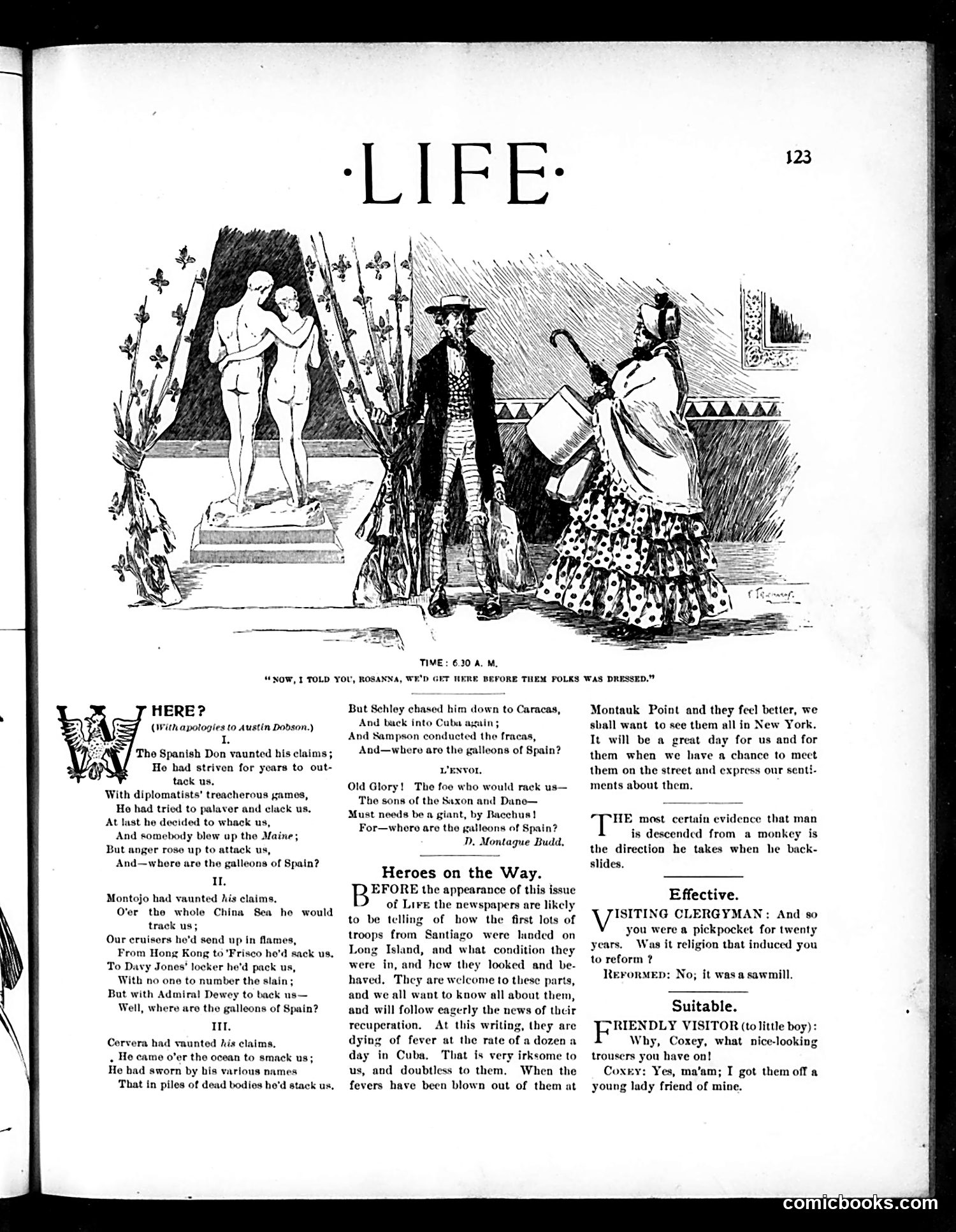
This page contains satirical poetry and brief humorous dialogues rather than traditional political cartoons. The main illustration shows what appears to be a museum or gallery scene with classical nude statuary and period-dressed visitors. The poetry sections reference Spanish colonial history, mentioning figures like Montejo, Cortés, and Sohley in contexts of conquest and military campaigns. The text appears to mock imperial boasting about conquests in Spain and Cuba. The brief dialogues at bottom—"Effective," "Suitable"—are disconnected comic quips about pickpockets and children's clothing, typical of Life's miscellaneous humor format. The specific historical references are unclear without additional context about when this was published, though references to Cuba suggest late 19th or early 20th century.
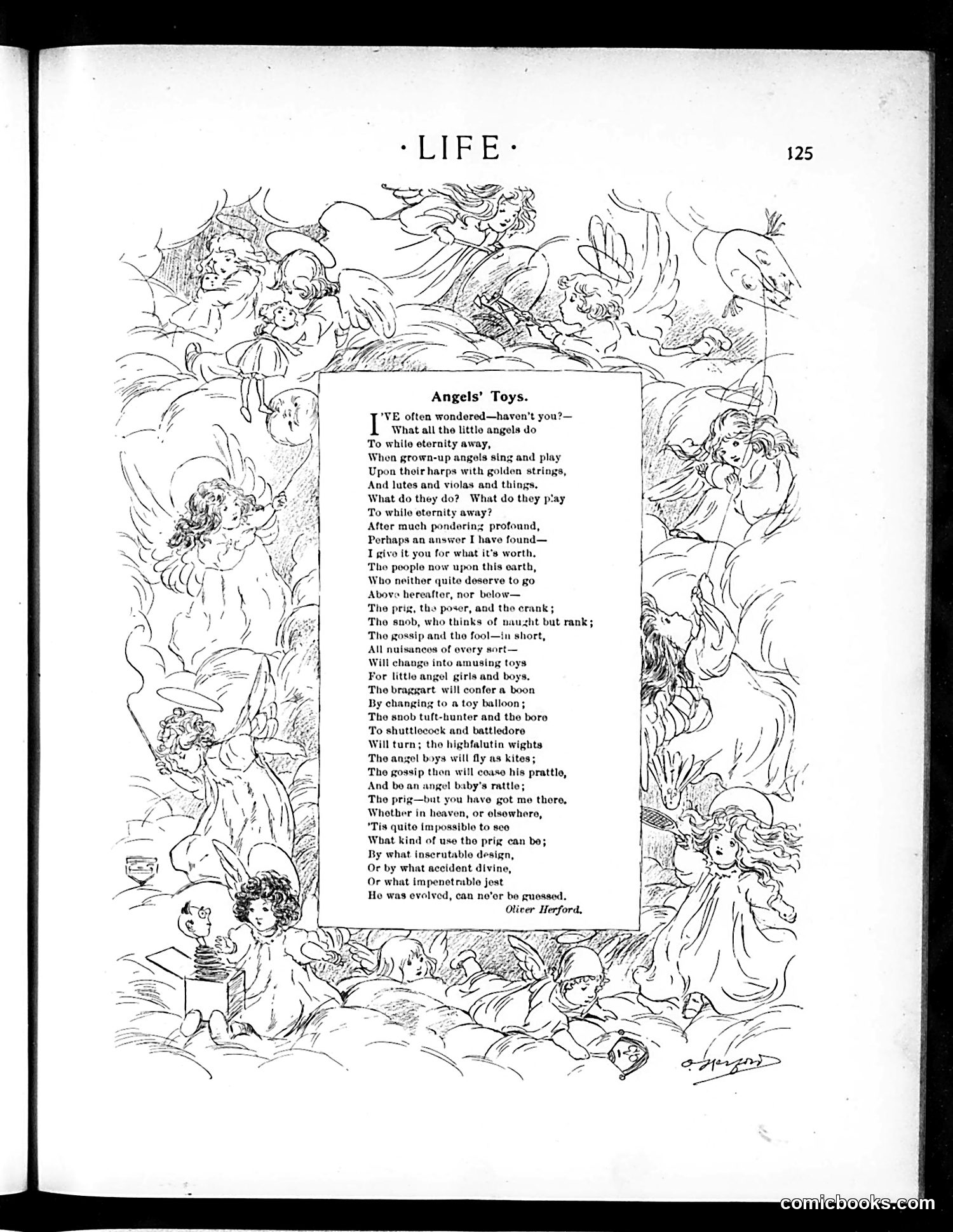
This is a whimsical poem by Oliver Herford, not political satire. The illustrated piece imagines what angels do to pass eternity—they transform human vices into toys for amusement. The poem's conceit is that celestial beings reshape earthly character flaws (pride, power, rank-consciousness, gossip, foolishness) into playthings: toy balloons, shuttlecocks, and rattles. The humor lies in this theological joke—that human failings are so trivial from heaven's perspective that angels treat them as children's diversions. The elaborate border of cherubs and angelic figures is decorative rather than satirical. This appears to be a light, philosophical piece reflecting on human nature's insignificance, rendered in Herford's characteristic whimsical style.
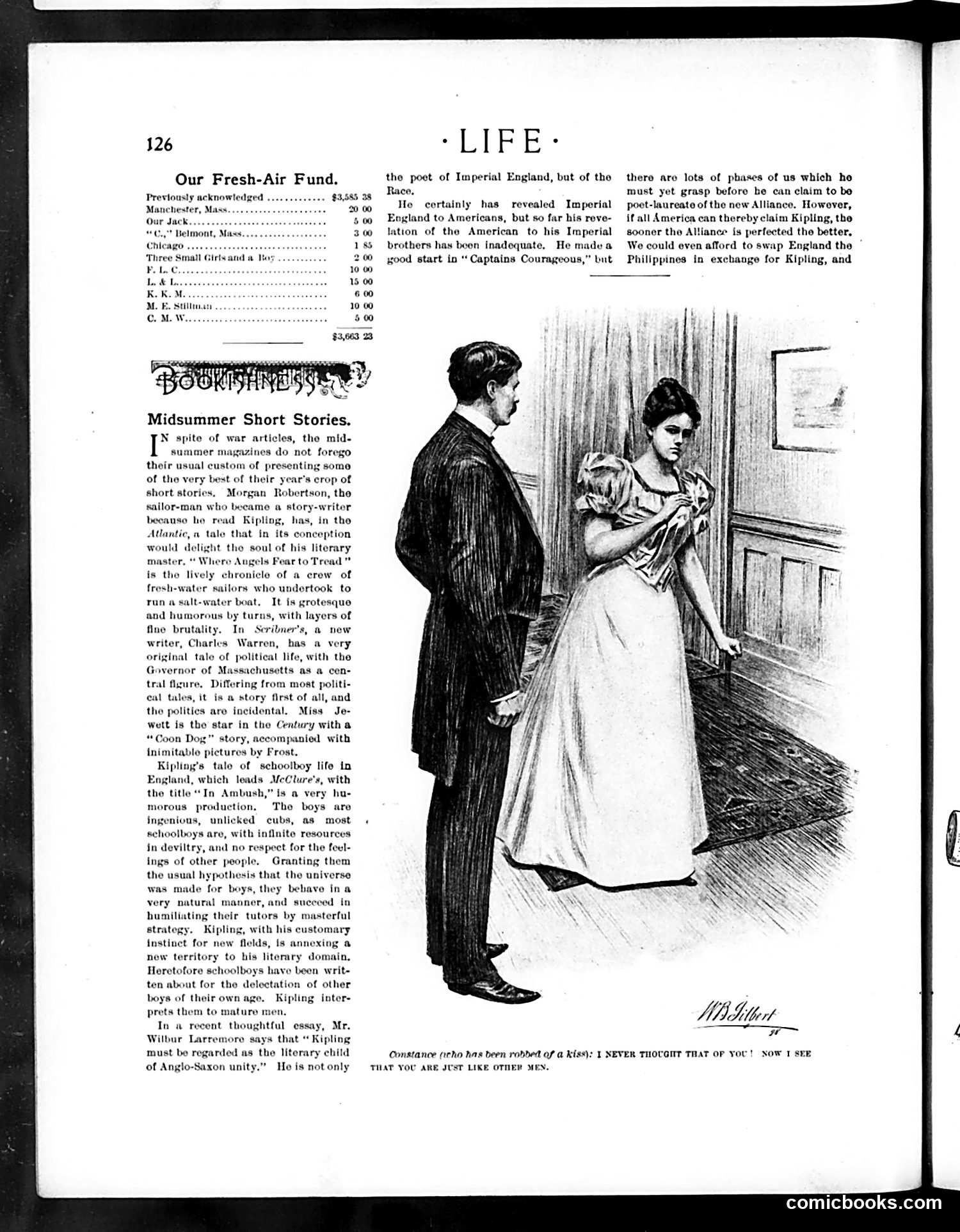
This page contains a literary article titled "Midsummer Short Stories" discussing contemporary fiction by authors like Morgan Robertson, Charles Warren, and Rudyard Kipling. The accompanying illustration depicts a romantic or dramatic scene between a man and woman, with the caption: "Constance (who has been robbed of a kiss): I NEVER THOUGHT THAT OF YOU! NOW I SEE THAT YOU ARE JUST LIKE OTHER MEN." The cartoon illustrates a moment of social transgression—a man has kissed a woman without permission, violating her expectations of his character. The humor derives from the woman's disappointed realization that this supposedly exceptional man behaves like "other men," suggesting prevailing attitudes about male behavior and romance in early 20th-century society. It's satirizing both masculine behavior and feminine idealization.
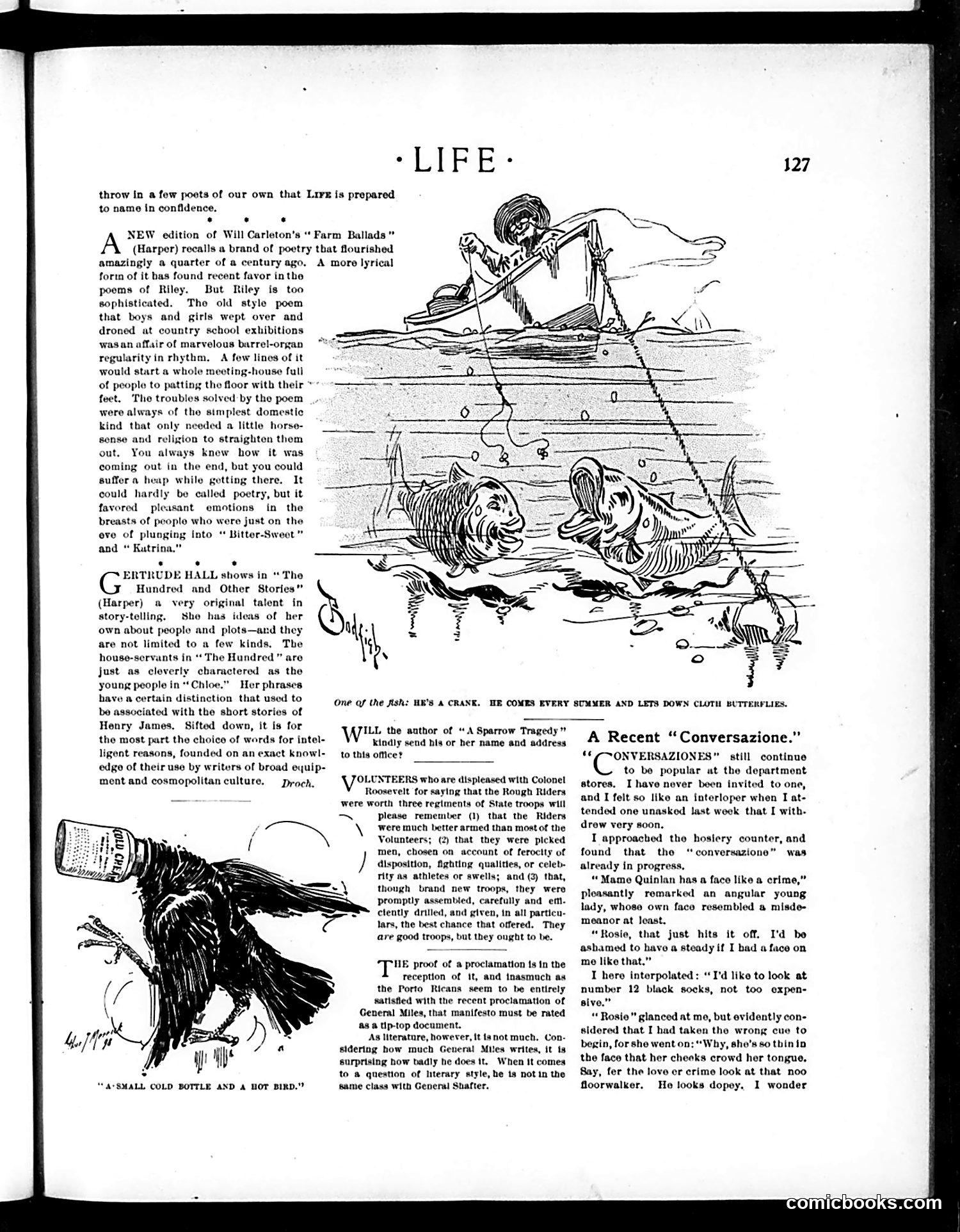
This page contains three distinct sections: 1. **"Farm Ballads" Review** (top left): A literary critique of Will Carleton's poetry, noting it appeals to rural nostalgia but lacks sophistication for educated readers. 2. **"It's a Crane" Illustration** (center): A humorous fishing scene showing a person attempting to fish while two fish below examine the bait with skepticism. The joke appears to be about failed fishing attempts—the "crane" (a wading bird or perhaps a pun on the fishing method) cannot catch fish despite effort. 3. **"A Small Cold Bottle and a Hot Bird" Cartoon** (bottom left): Shows a bottle and bird in an unclear satirical scenario, likely making a pun or social commentary unclear without additional context. The page focuses on literary and leisure-time humor typical of early 20th-century American satire.
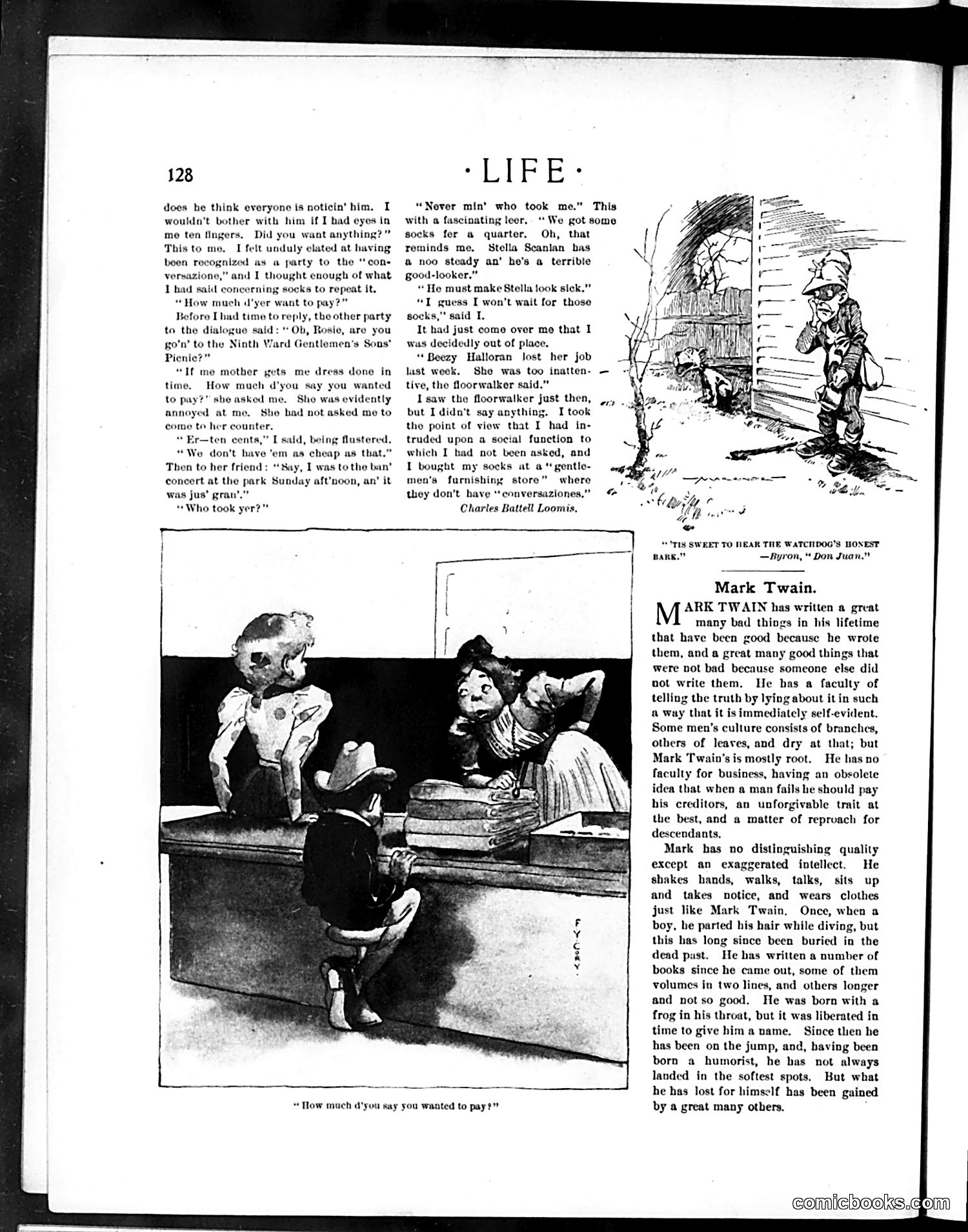
The page contains two distinct elements: **Upper section:** A humorous anecdote about a woman being recognized at a social function where she wasn't invited, and subsequent awkward social negotiations about socks and payment. This appears to be general social satire rather than political commentary. **Lower section:** A biographical essay about Mark Twain with accompanying photograph. The text critiques Twain's character and writing, noting his facility for telling truths "by lying about it" and his lack of business sense. The essay catalogs his various character traits and life experiences in a somewhat unflattering but admiring tone. The page appears to be primarily literary/cultural commentary rather than political satire. Both pieces use humor to examine social behavior and American literary figures.
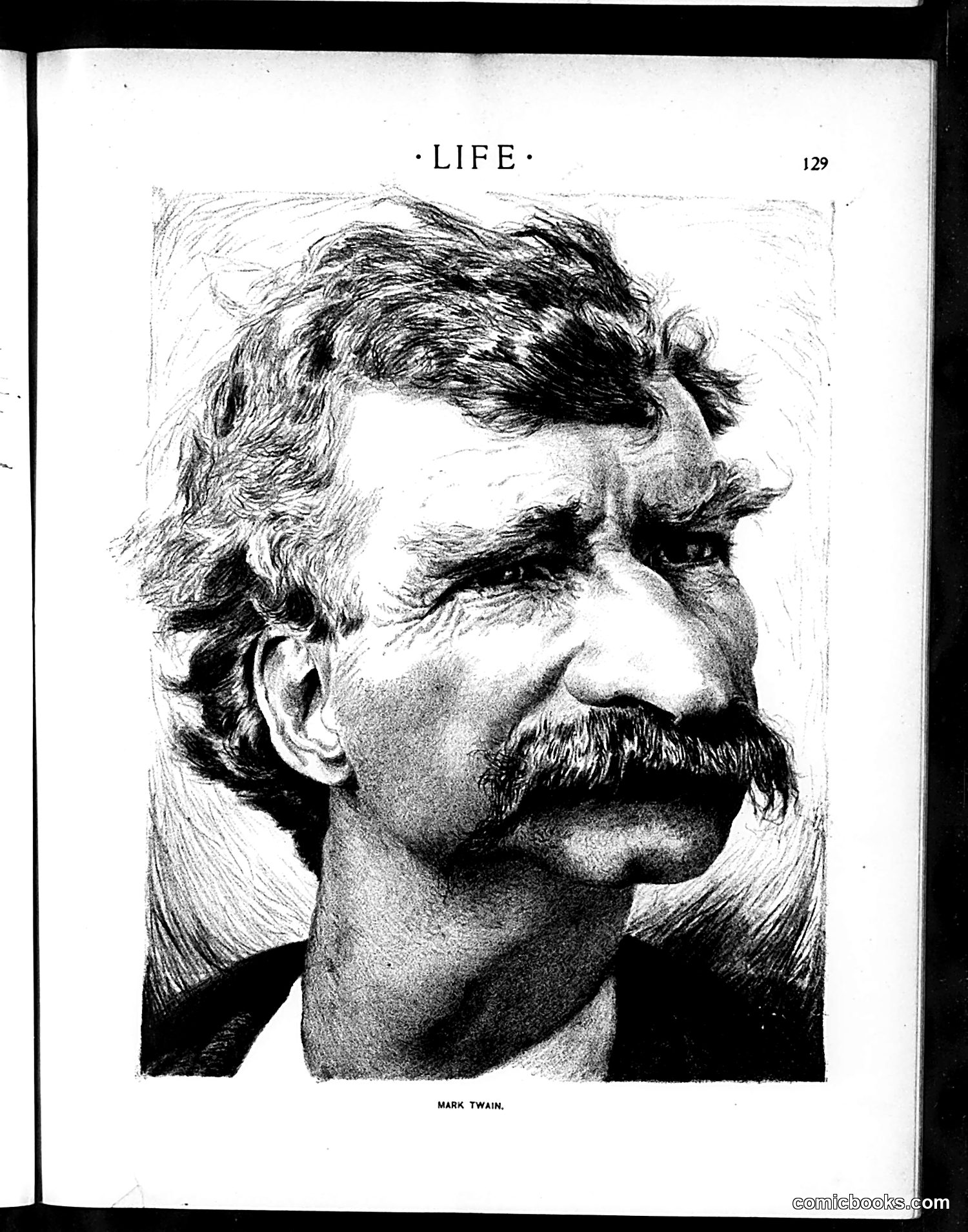
This page from *Life* magazine (page 129) features a portrait labeled "MARK TWAIN," the renowned American writer and humorist. The image is a detailed sketch showing Twain in profile, distinctive for his characteristic wild, curly hair and prominent mustache—features he was famous for in life. Rather than containing political satire or a joke, this appears to be a straightforward portrait illustration, likely accompanying an article about Twain. The inclusion in *Life*, a satirical magazine known for commentary on public figures, suggests Twain was a subject of cultural interest worthy of editorial attention, though the portrait itself serves primarily as a pictorial representation rather than as satirical commentary.
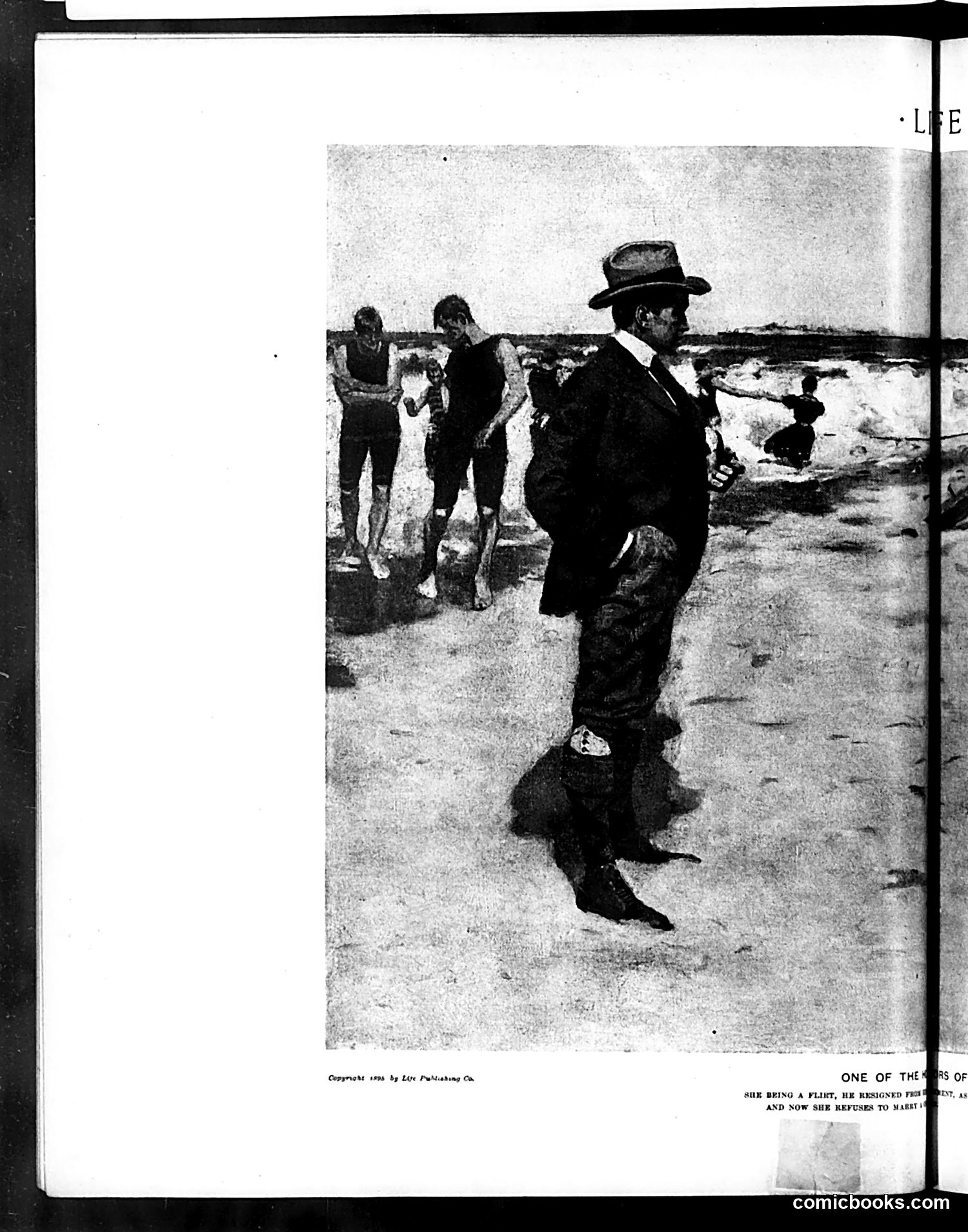
This appears to be a Life magazine photograph from 1904 (based on copyright notice) showing a beach scene. The caption mentions "SHE BEING A FLIRT, HE RESIGNED FROM CONGRESS, AND NOW SHE REFUSES TO MARRY HIM!" The image depicts a formally dressed man in a hat and suit standing in shallow water, appearing somewhat awkward or uncomfortable, while women in swimming attire stand in the background. The satirical point targets early 1900s social hypocrisy: a congressman supposedly resigns over romantic entanglement (presenting himself as honorable), yet the woman refuses him anyway. The humor lies in the contrast between his formal, dignified presentation and the undignified beach setting—mocking both his apparent self-sacrifice and the woman's rejection of it. It's commentary on scandal, romantic expectations, and political theater of the Edwardian era.
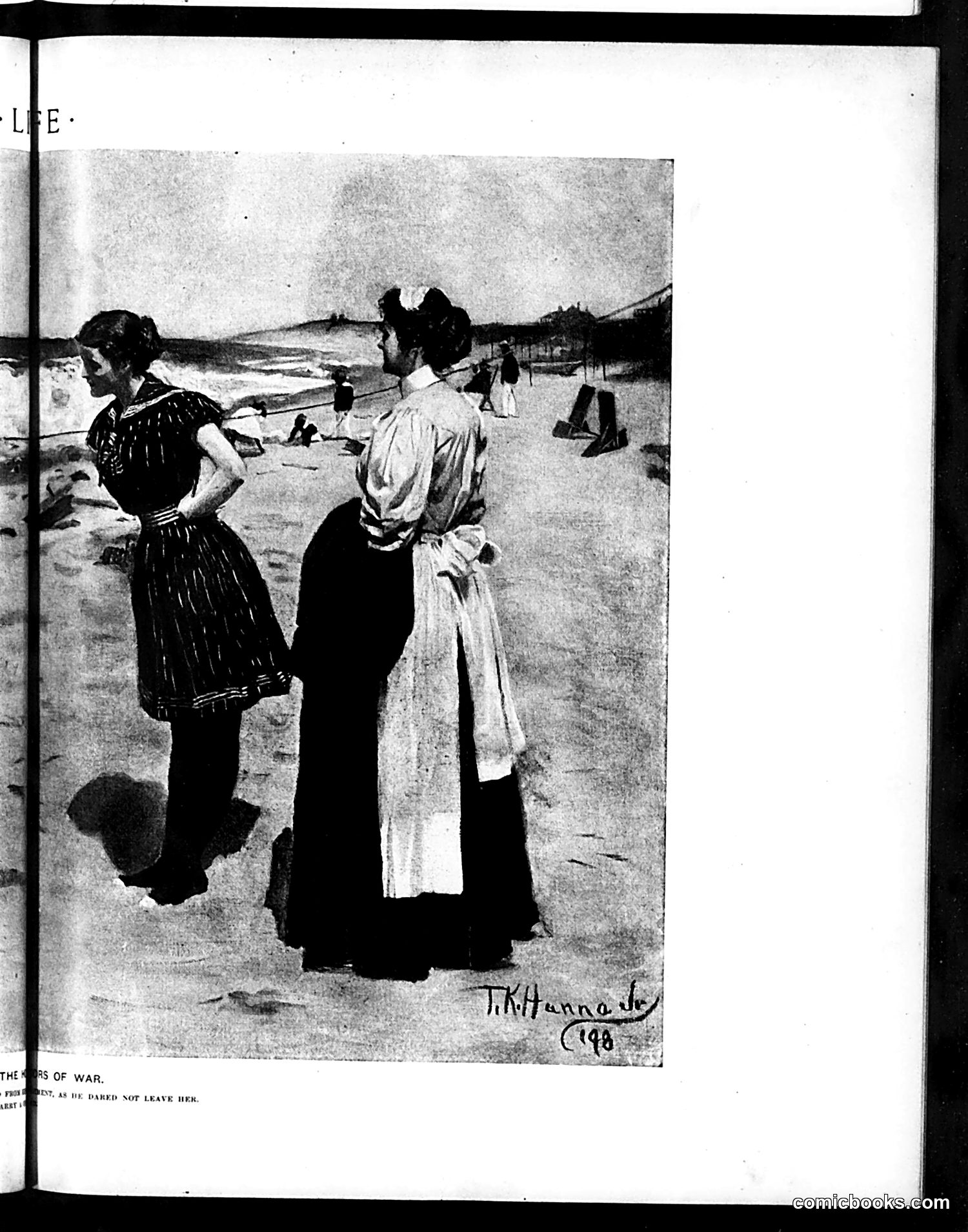
This appears to be a photograph rather than a cartoon, showing women on a beach. The signature reads "T.R. Hanna Jr" with what appears to be "1898" or similar dating. The partial text visible at bottom reads "THE ILLS OF WAR" and mentions someone who "DARED NOT LEAVE HER," suggesting this is commentary on wartime separation or the domestic impact of military conflict. The image depicts women in period dress (late 1890s based on styling) gathered at a seaside location. Without the complete caption or article text, the specific satirical point remains unclear, but the heading "ILLS OF WAR" suggests this illustrates how conflict affected civilians—particularly women—on the home front during whatever conflict was current when published. The photograph's inclusion in *Life* magazine indicates it carried social or political commentary for contemporary readers.
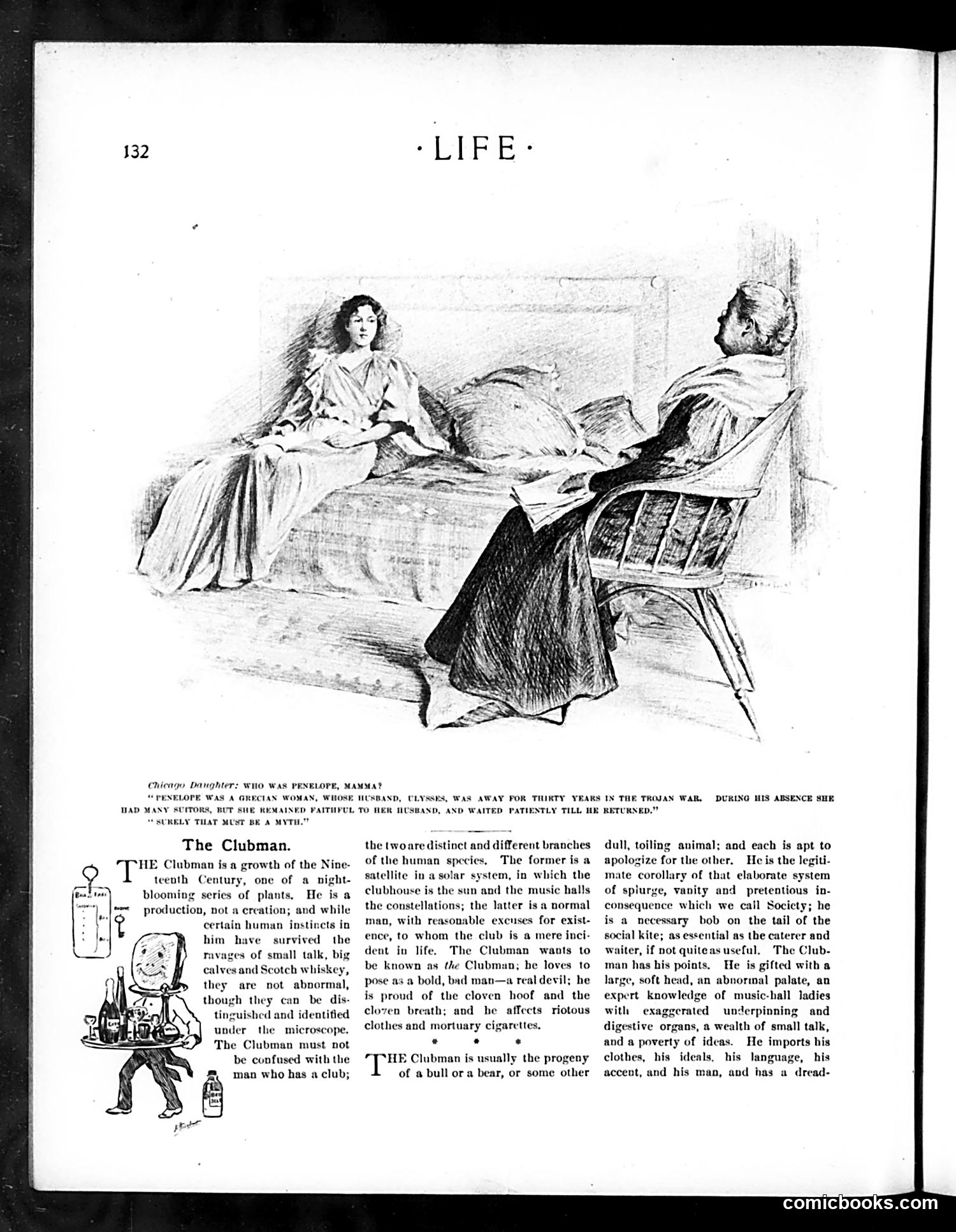
This page contains a sketch and essay about "The Clubman," a social type from the Nineteenth Century. The illustration shows a man in a chair conversing with a woman on a sofa—a domestic or social scene. The essay characterizes the Clubman as a distinct human subspecies: a man devoted to club life who is "bold, but man—a real devil" and affects "riotous clothes and mortuary cigarettes." The satire mocks this figure as superficial and self-absorbed, contrasting him with society's essential workers (catering staff, waiters). The joke targets upper-class male idleness and pretense—the Clubman poses as sophisticated and important while contributing nothing valuable. His exaggerated clothing, mannerisms, and complete devotion to leisure mark him as ridiculous rather than admirable to the satirical magazine's readers.
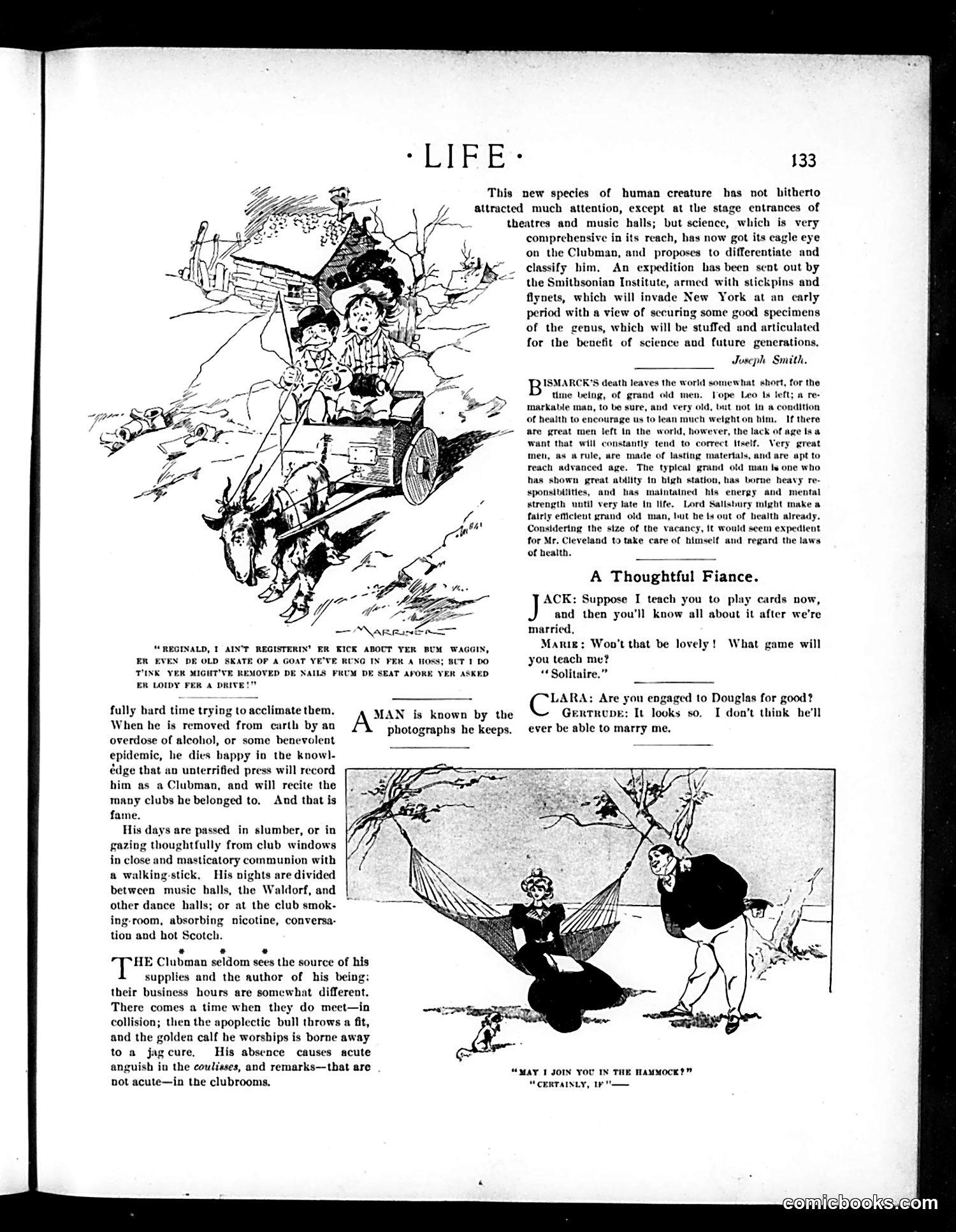
This page contains three distinct satirical pieces mocking upper-class American society. **Top illustration**: A Smithsonian Institution expedition hunts "Clubmen" like specimens, armed with stickpins and nets. The satire suggests wealthy club-members are exotic creatures worthy of scientific classification—a jab at their isolation from normal society. **Middle text**: Reflects on deaths of great statesmen (Bismarck is mentioned), contrasting them with living leaders like Pope Leo XIII and President Cleveland, criticizing their health and vigor. **Bottom cartoons**: Two brief dialogues mock courtship and engagement. "A Thoughtful Fiancé" jokes that a man teaches his fiancée solitaire—implying their marriage will be lonely. The second dialogue suggests a woman doubts her fiancé Douglas will ever actually marry her, despite their engagement. Overall, the page satirizes wealthy bachelors, aging politicians, and the hollowness of upper-class social life and romance.
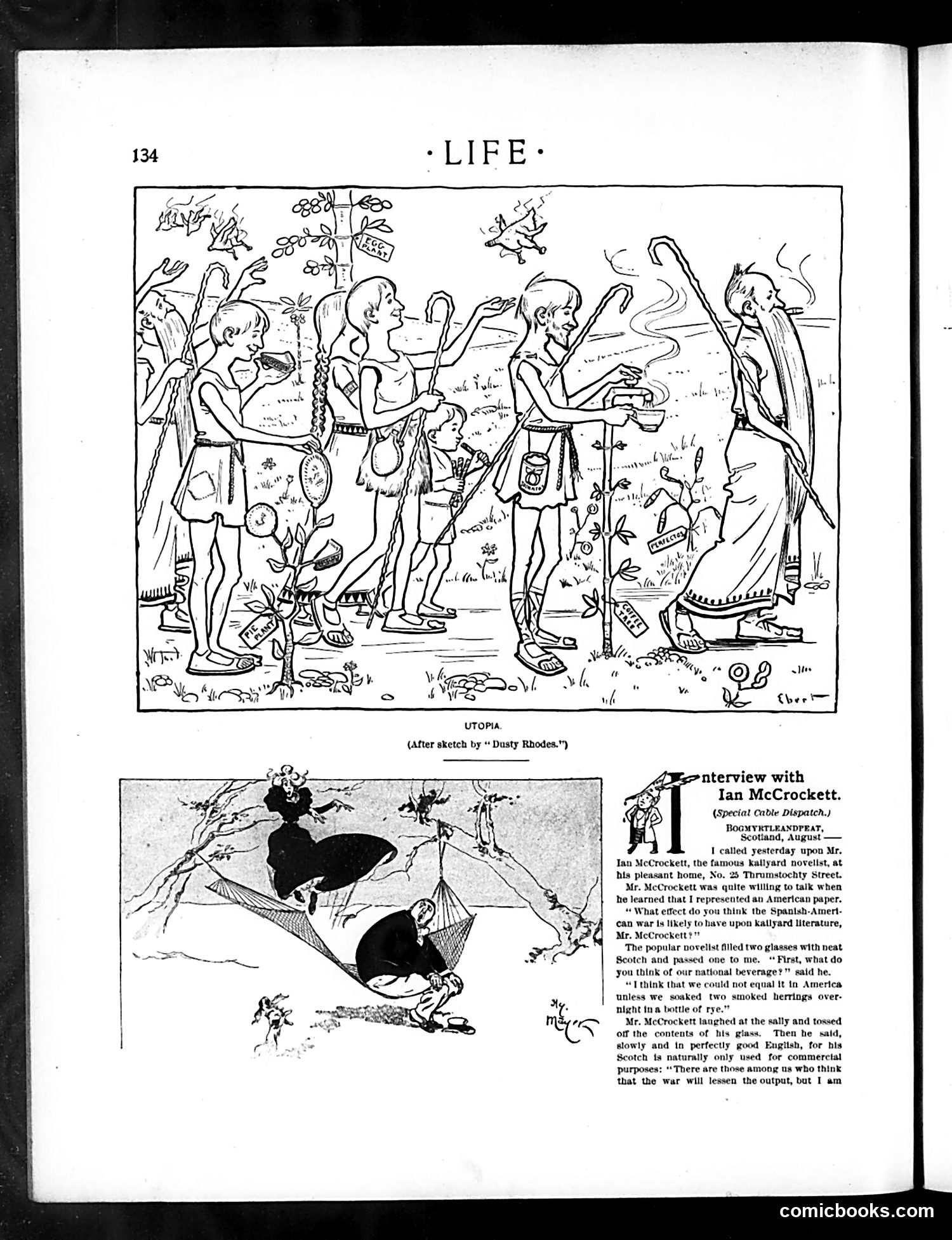
This page features a satirical interview with Ian McCrockett, presented as a famous Scottish "kailyard" novelist (a real literary genre focused on Scottish rural life). The top cartoon titled "UTOPIA" depicts an idealized pastoral scene where shepherds and their flock coexist harmoniously—a fantasy of perfection. The interview below mocks Scottish literary pretension and national stereotypes. McCrockett is portrayed as affected: he affects rough Scottish dialect for commercial purposes while speaking "perfectly good English" otherwise. The joke centers on national character—when asked about Spanish-American War's effect on Scottish literature, he instead pushes Scotch whisky on the American interviewer, reinforcing the stereotype of Scots as whisky-obsessed. The American's quip about needing "two smoked herrings overnight in a bottle of rye" to match Scotch quality plays on both whisky appreciation and Scottish food stereotypes. The satire targets literary pretension, national clichés, and commercial exploitation of ethnic identity.
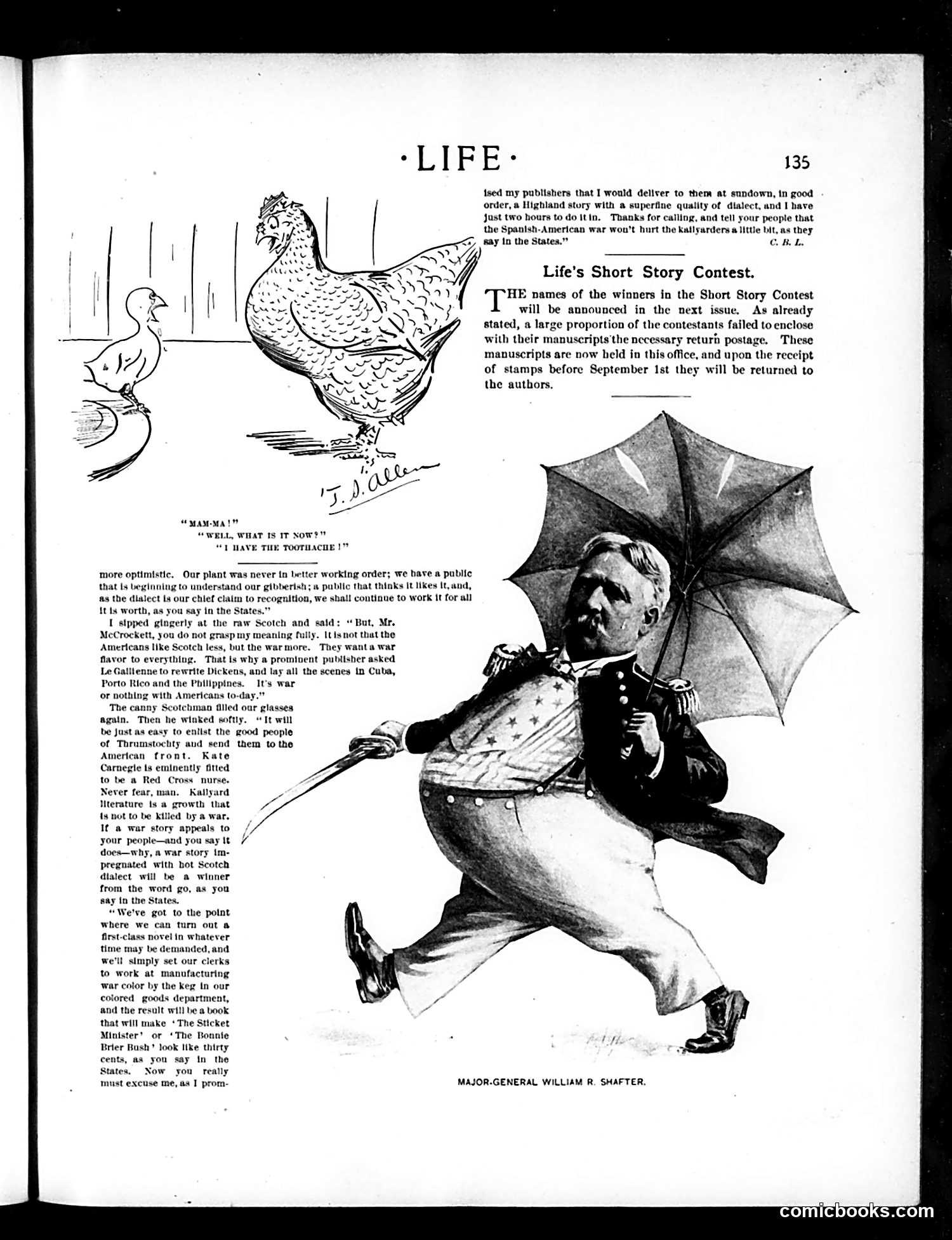
This page satirizes the Spanish-American War's grip on American publishing and culture. The main illustration depicts **Major-General William R. Shafter** (identified in caption), the war's commanding general, windblown and undignified—mocking military authority. The text dialogue concerns a Scottish publisher pressured to inject war themes into Highland dialect fiction to satisfy American readers' sudden appetite for war stories. The satire's point: American publishers are so obsessed with war content that they'll retrofit existing literary genres with military flavor, even nonsensical combinations like transplanting Dickens to Cuba or sending Scottish village characters to the front. The small cartoon above shows a hen with chicks, captioned "Mamma! Well, what is it now? I have the toothache!"—likely mocking civilian anxieties during wartime. The page reflects *Life*'s critique of how the 1898 war temporarily dominated American cultural and commercial interests, with publishers chasing profit by grafting war narratives onto unrelated genres.
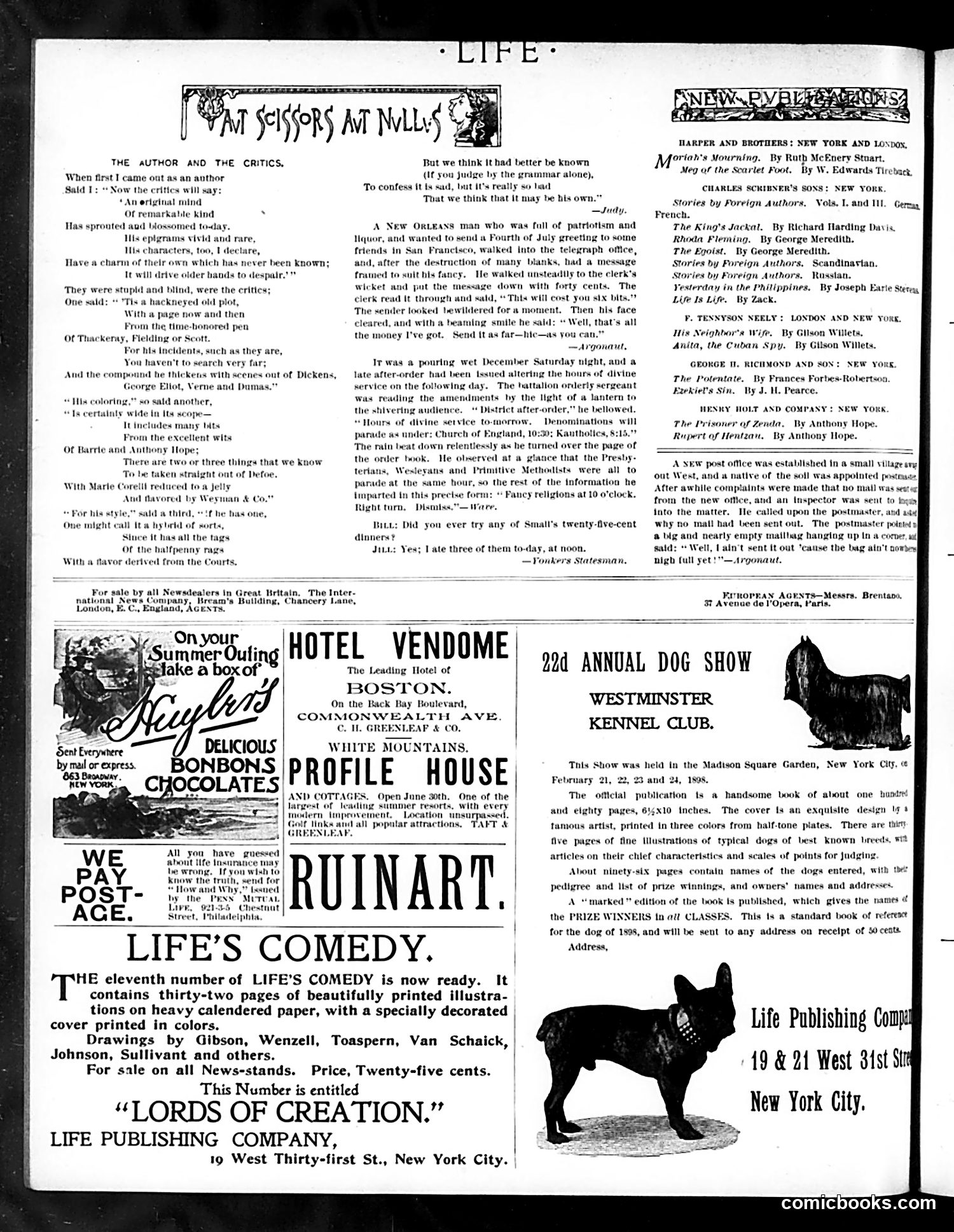
This page is primarily **advertisements and book notices** rather than political satire. The main content includes: **Upper section:** A poem titled "The Author and the Critics," a self-deprecating piece where a writer describes how critics initially praised his work as original, then later dismissed it as derivative of Defoe, Dickens, and other established authors. The satire targets critical inconsistency and the literary establishment's tendency to find fault regardless. **Humor items:** Three brief anecdotes—a drunk man sending a telegram, a military chaplain's garbled service announcement, and a postmaster with an empty mailbag—are generic period jokes without specific political content. **Lower section:** Entirely commercial—advertisements for Hotel Vendome, Skylar's chocolates, Ruinart champagne, Life's Comedy publication, and the 22nd Annual Dog Show. A dog illustration appears near the Life Publishing Company address. **Context:** This appears to be a back page from an early 1900s Life magazine issue, mixing light literary satire with period advertising. Nothing here references specific political figures or events.
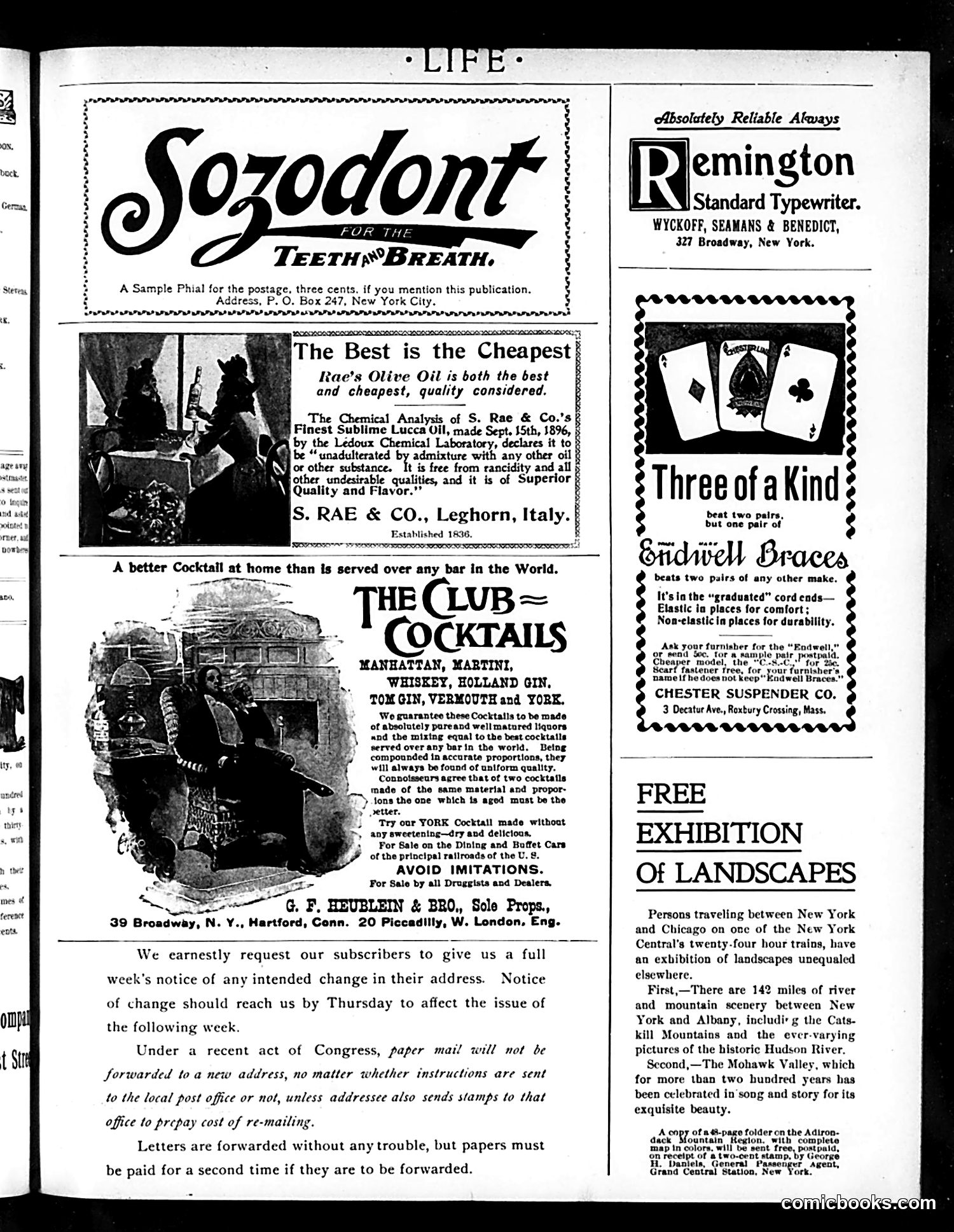
This is primarily a **advertising page** from an early Life magazine (circa 1896, based on dates visible in ads). There are no political cartoons or satire on this page—rather, it's a collection of period product advertisements and a publisher's notice. The ads promote: - **Sozodont** toothpaste/breath freshener - **Remington typewriters** - **S. Rae & Co.'s olive oil** (imported from Italy, certified pure) - **The Club Cocktails** by Heublein & Bros (various liquor-based drinks sold on railroad dining cars) - **Kendwell Braces** (suspenders with elastic/non-elastic cord sections) - A **free New York Central Railroad exhibition** of Hudson River and Mohawk Valley landscapes The editorial note addresses postal regulations: under recent Congressional law, forwarded mail requires prepayment of re-mailing costs by the addressee, not the publisher. These ads reflect 1890s consumer culture—imported luxury goods, rail travel amenities, and modern products like typewriters.
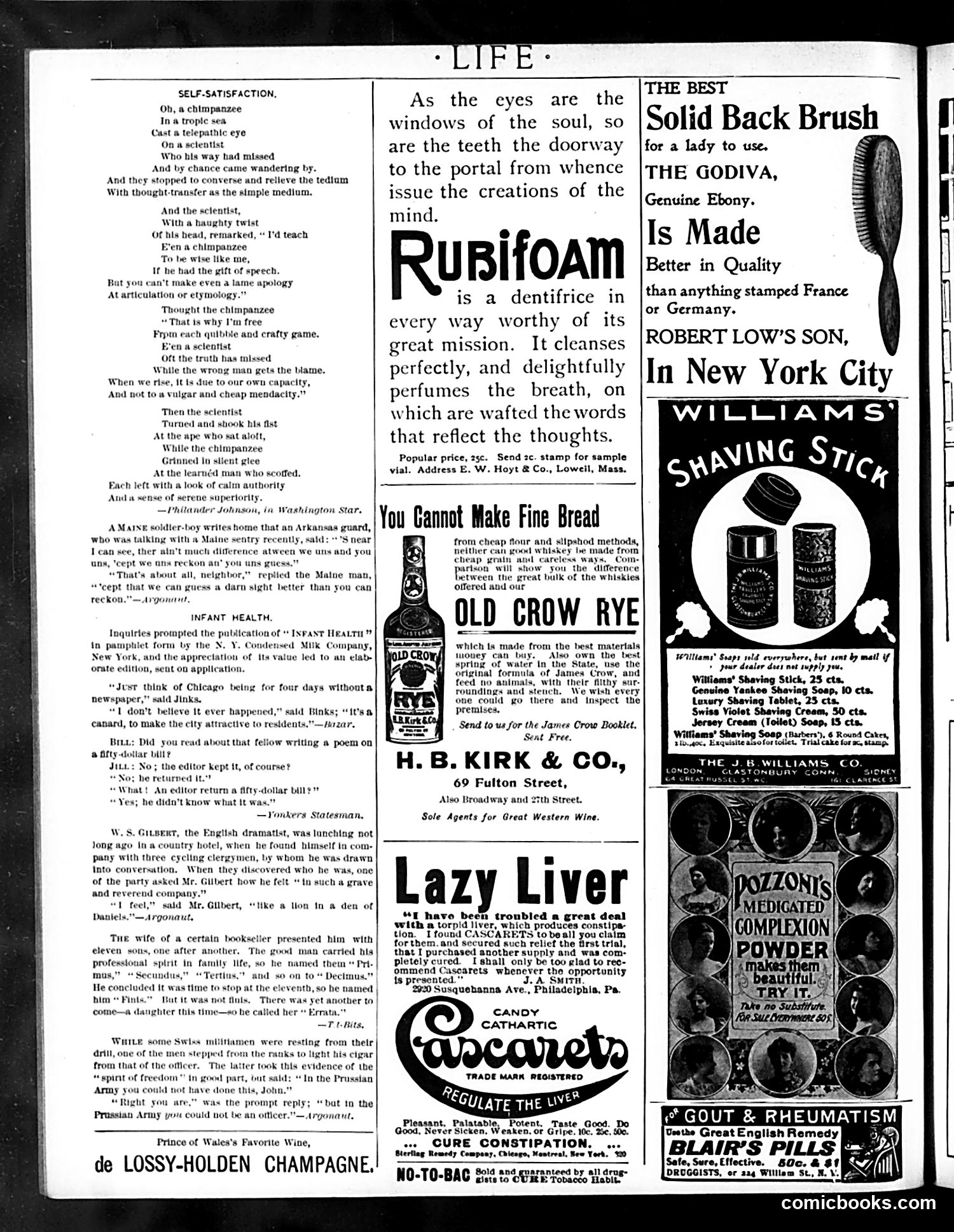
This page is primarily **advertisements and humorous anecdotes** rather than political cartoons. The main content is a poem titled "Self-Satisfaction" by Philander Johnson, depicting a conversation between a scientist and a chimpanzee. The satire critiques human intellectual arrogance: the scientist boasts he could teach the ape wisdom if only it could speak, yet the chimp observes that humans waste their intelligence on sophistry and blame-shifting rather than truth-seeking. The joke inverts expectations—the "dumb" animal demonstrates moral superiority through honest simplicity, while the educated man uses his learning to obscure rather than clarify. Below are brief humorous anecdotes about miscommunications between soldiers from different regions, editorial mishaps, and social awkwardness—typical light fare for *Life* magazine's satirical humor section. The remainder consists of period advertisements for products like Rubifoam toothpaste, Old Crow Rye whiskey, and Williams' Shaving products—standard commercial content of the era.
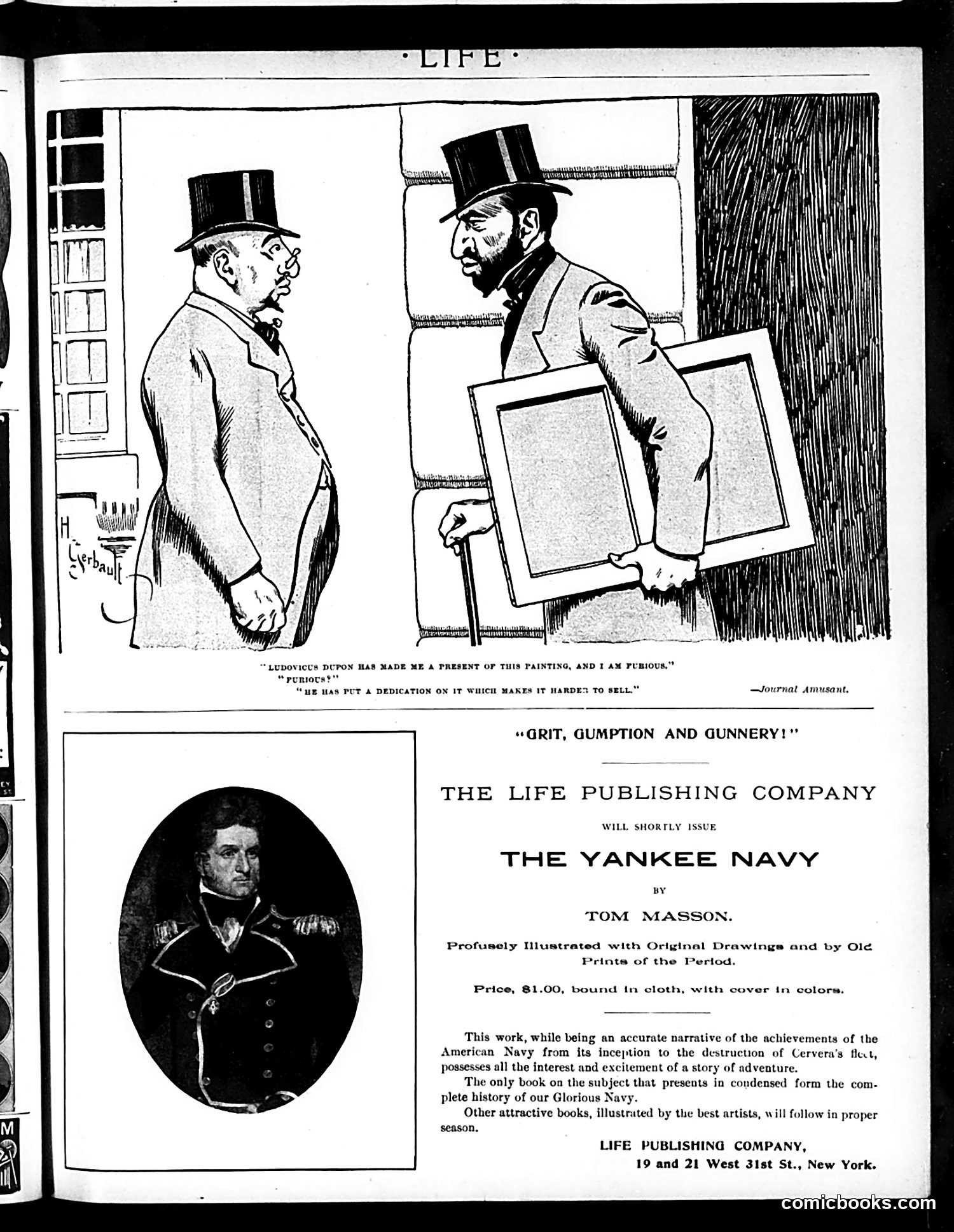
The top cartoon satirizes art collecting and patronage. Two well-dressed men in top hats discuss a painting: one has received it as a gift from "Ludovicus Dupon" (likely a French aristocrat) and is furious because a dedication inscribed on it makes the artwork harder to sell. The joke mocks wealthy collectors who value art primarily for resale profit rather than artistic merit, and the awkwardness of unwanted gifts with permanent inscriptions. The lower half is primarily advertising for *The Yankee Navy* by Tom Masson, published by Life Publishing Company. It promotes the book as an illustrated history of American naval achievements, including the Spanish-American War's destruction of Cervera's fleet. The portrait appears to be a historical naval figure. This page blends satirical humor with commercial promotion, typical of Life magazine's format.
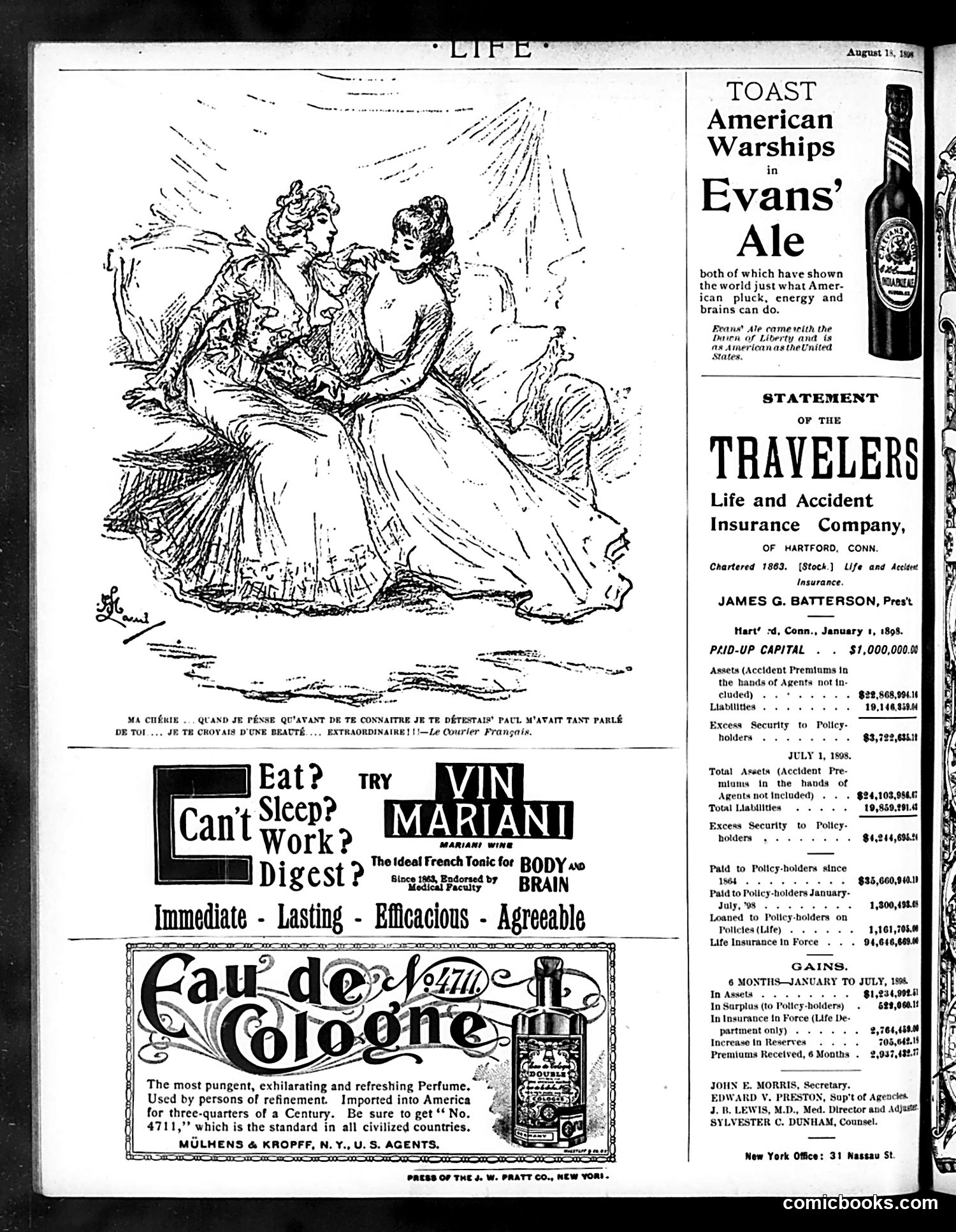
The main cartoon depicts a French woman telling a man that she previously despised him based on what "Paul" had said, but now finds him extraordinarily beautiful—a romantic reversal joke playing on gossip and first impressions. The French caption and attribution to *Le Courier Français* suggests this is a reprinted European cartoon. The page is primarily **advertising**, featuring promotions for Mariani Wine (a French tonic claimed to improve body and brain function), Eau de Cologne perfume, and Evans' Ale. The Evans' ad references American warships and patriotic pride, likely alluding to the Spanish-American War (1898), which had recently concluded. The Travelers Insurance Company statement provides financial information. This is a typical *Life* magazine page mixing light humor with period advertisements and business notices.