
Life, 1898-08-18 · page 6 of 20
Life — August 18, 1898 — page 6: what you’re looking at
What you’re looking at
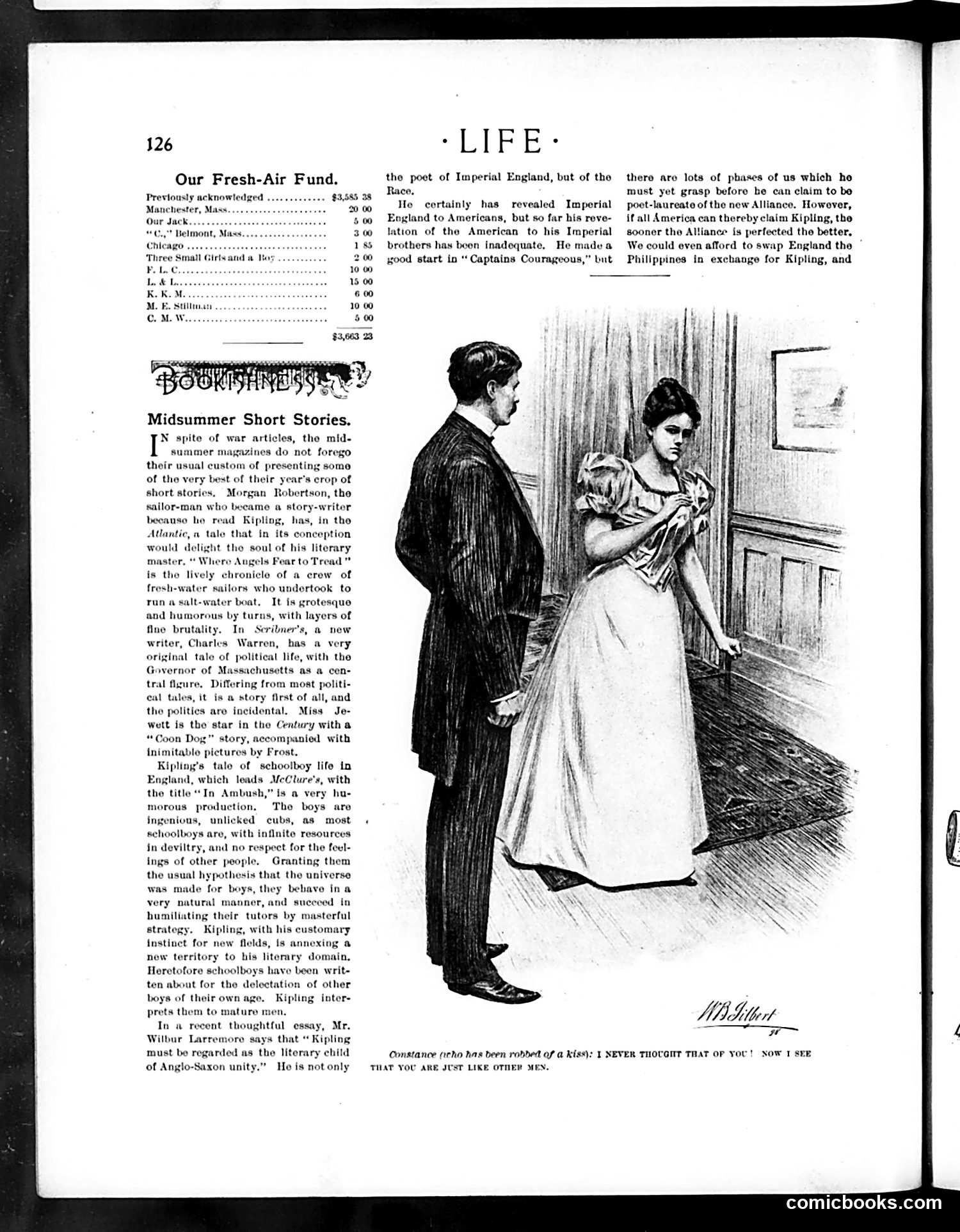
This page contains a literary article titled "Midsummer Short Stories" discussing contemporary fiction by authors like Morgan Robertson, Charles Warren, and Rudyard Kipling. The accompanying illustration depicts a romantic or dramatic scene between a man and woman, with the caption: "Constance (who has been robbed of a kiss): I NEVER THOUGHT THAT OF YOU! NOW I SEE THAT YOU ARE JUST LIKE OTHER MEN." The cartoon illustrates a moment of social transgression—a man has kissed a woman without permission, violating her expectations of his character. The humor derives from the woman's disappointed realization that this supposedly exceptional man behaves like "other men," suggesting prevailing attitudes about male behavior and romance in early 20th-century society. It's satirizing both masculine behavior and feminine idealization.
📄 Transcribed text from this page (OCR, searchable)
Machine-transcribed from the original scan — historical spelling and the odd misread are preserved.
126 Our Fresh-Air Fund. Previously acknowledged , & 0. matt Midsummer Short Stories. N of war articles, the mid- I summer magazines do not forego their usual custom of presenting somo of the very best of their year’s crop of short stories, Morgan Robertson, the sailor-man who became a story-writer becauso ho read Kipling, has, in tho Atlantic, a tale that in its conception would delight the soul of his literary master, * Wh rls Fear to Tread” is the live clo of a crew of fresh-water sailors who undertook to Tun a salt-water boat. It is grotesque and humorous by turns, with layers of fine brutalit, In Scribner's, a new writer, Charles Warren, has a very original tale of political life, with the Governor of Massachusetts as a cen- tral figure, Differing from most politi- cal tales, it is a story first of all, and the politics are incidental. Miss Je- wett is the star in the Century witha “Coon Dog” story, accompanied with inimitable pictures by Frost. Kipling’s tale of schoolboy life in England, which leads MeClure’s, with the title “In Ambush,” is a very hu- morous production, The boys are ingenious, unlicked cubs, as most schoolboys are, with inflnite resources in deviltry, and no respect for the feel- ings of other people. Granting them the usual hypothesis that the universe was made for boys, they bebave in a very natural manner, and suecced in humiliating their tutors by masterful strategy. Kipling, with his customary instinct for new flelds, ts annexing a new territory to bis literary domain, Heretofore schoolboys have been writ- ten about for the delectation of other boys of their own age. Kipling inter- prets them to mature men, In a recent thoughtful essay, Mr. Wilbur Larremore says that “ Kipling must be regarded as the literary child of Anglo-Saxon unity.” He is not only »- LIFE - tho poet of Imperial England, but of tho Race. He cortainly has revealed Imperial England to Americans, but so far his reve- lation of the American to his Imperial brothers has beon inadequate, He made a good start in “Captains Courageous,” but there aro lots of phases of us which ho must yet grasp before be can claim to bo poot-laureate of the new Alliance. However, if all America can thereby claim Kipling, the sooner tho Alliance is perfected tho better, We could even afford to swap England the Philippines in exchange for Kipling, and Constance firho has deen robbed of a kiss): 1 NEVER THOUGHT THAT OP YoU! THAT YOU ARE JUST LIKE OTHER MEN. NOW T SEE comicbooks.com