
A complete issue · 20 pages · 1898
Life — June 23, 1898
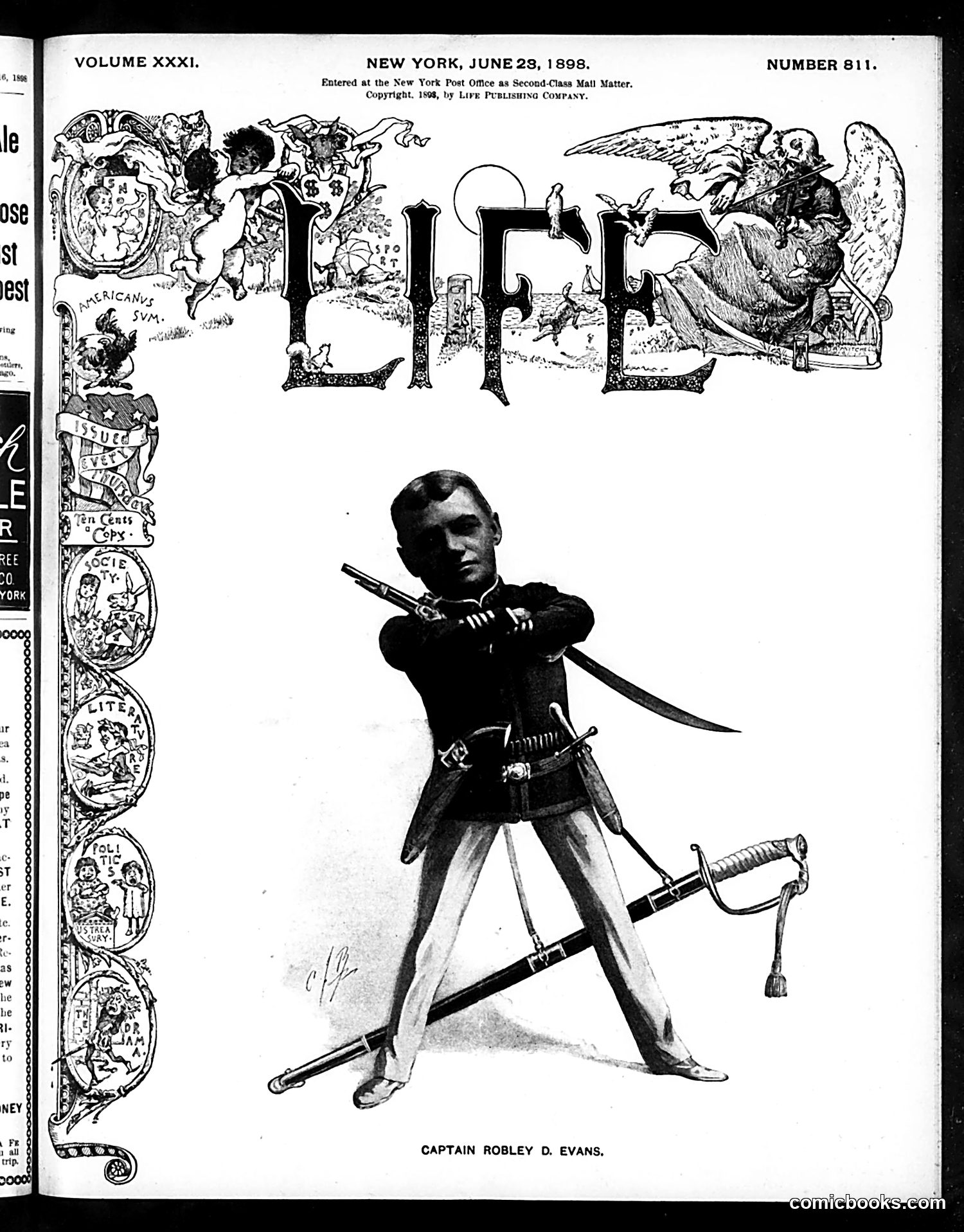
This cover features **Captain Robley D. Evans**, a U.S. Navy officer, depicted as a swashbuckling swordsman wielding multiple large blades. The exaggerated martial pose and weaponry appear to celebrate American naval power during the Spanish-American War (which began in April 1898). The title "LIFE" is integrated into decorative lettering at the top. The ornate left border contains classical medallions typical of Life's artistic style. Evans appears to have been noteworthy enough in 1898 to merit this prominent satirical treatment—likely due to naval victories or prominent role in the recent war. The cartoon playfully aggrandizes him as a warrior figure, reflecting contemporary American triumphalism following military success against Spain.
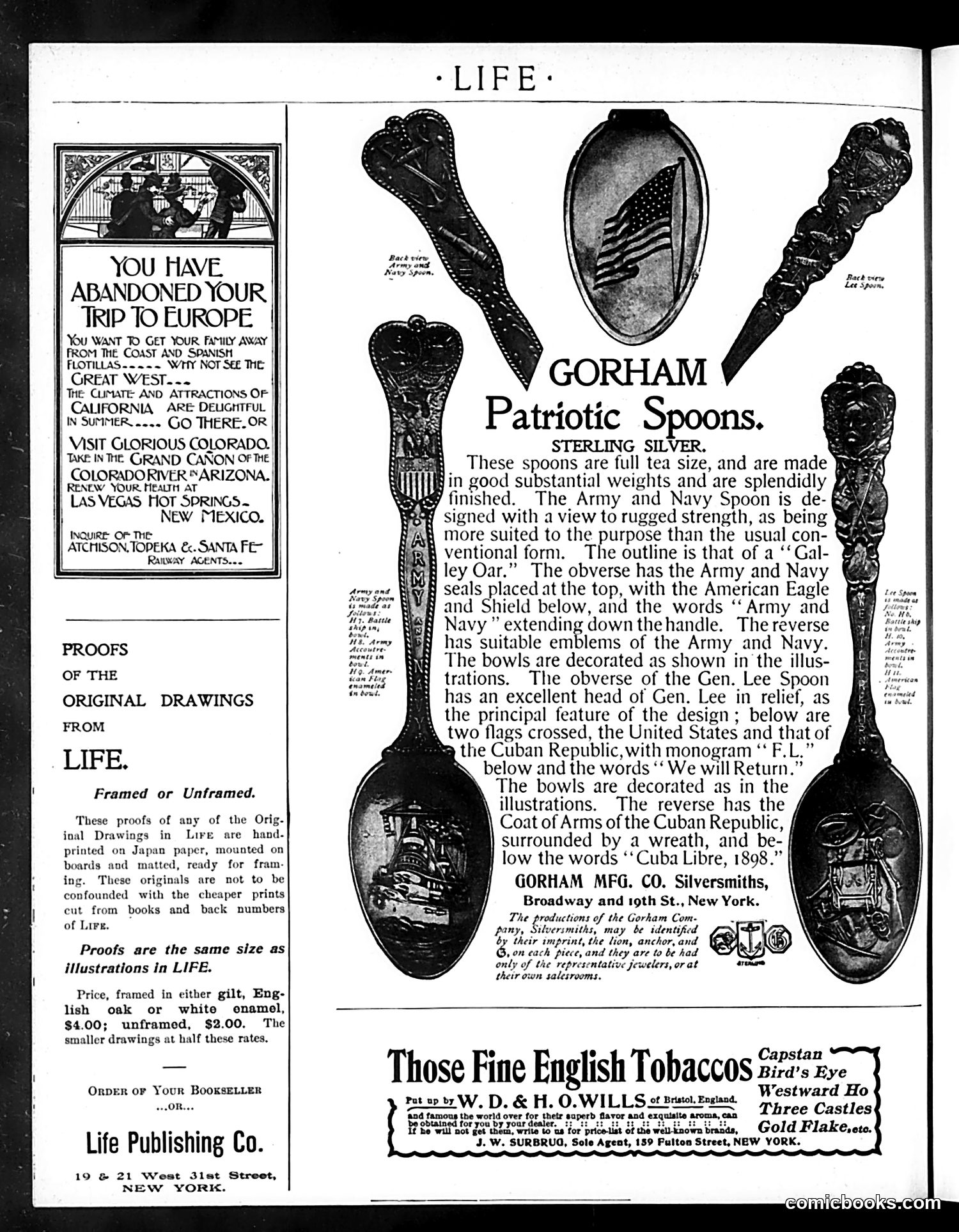
This page is primarily **advertising** rather than political satire. The left column advertises travel destinations (Europe, Florida, Colorado, Las Vegas) and Life magazine's original drawings available for purchase as framed proofs. The main content features an advertisement for **Gorham Patriotic Spoons** in sterling silver. These decorative spoons commemorate American military figures and patriotic themes, including designs featuring General Lee and Army/Navy insignia. One spoon depicts the Cuban Republic (marked "Cuba Libre, 1898"), suggesting this publication dates to the Spanish-American War era or shortly after. The bottom advertises English tobacco products. The page reflects early-1900s consumer culture and American patriotic merchandise rather than political commentary.
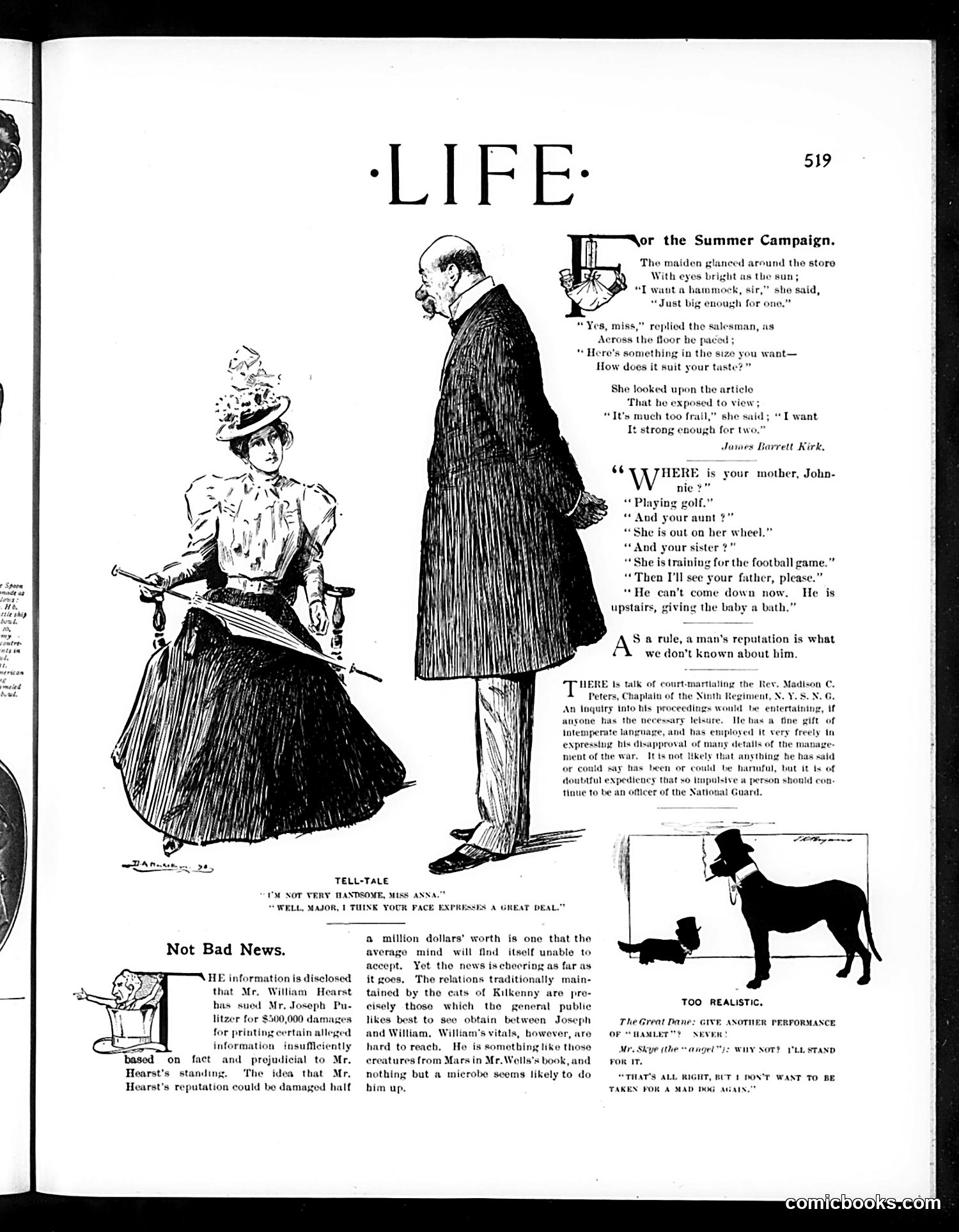
**"Tell-Tale" Cartoon (top):** A woman in Edwardian dress shows a tall, thin man a hammock, asking if it suits his taste. The satire likely mocks either marital discord or class pretensions—the woman's elaborate hat and confident demeanor suggest she's testing the man's approval, possibly commenting on gender dynamics or consumer culture of the era. **"Not Bad News" (bottom left):** References William Hearst's reputation and a $500,000 damages lawsuit. The joke suggests Hearst's reputation is already so damaged that further harm is minimal—a common satirical jab at powerful figures. **"Too Realistic" (bottom right):** A dog refuses a performance, with text humorously suggesting the dog won't perform because it doesn't want "to be taken for a mad dog again"—likely referencing contemporary anxieties about war (given "Summer Campaign" header).
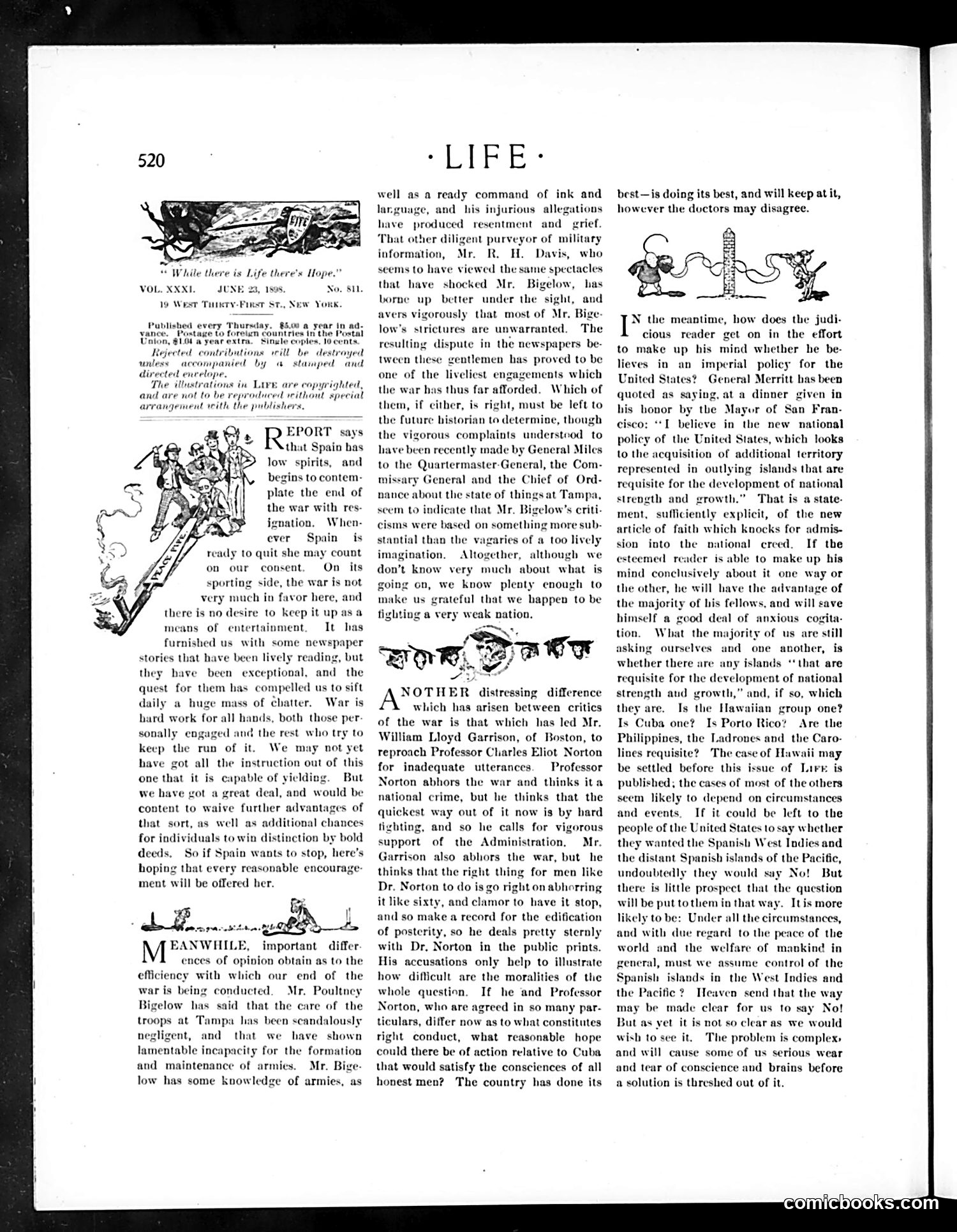
This page contains editorial commentary on the Spanish-American War, which was ongoing at this time. The text references disputes among military leadership regarding war conduct, specifically mentioning General Miles (Quartermaster General), General Merritt, and critiques from Professor Charles Eliot Norton regarding "inadequate utterances" about the war's justification. The illustrated cartoons appear to depict Spain in a weakened state—likely satirizing Spain's military vulnerability. The editorial debates whether the U.S. should annex Spanish colonial territories (Cuba, Hawaii, Philippines) for "national development," reflecting the imperial expansion debate of 1898. The overall tone is patriotic but somewhat skeptical of both military leadership competence and the moral justification for territorial acquisition.
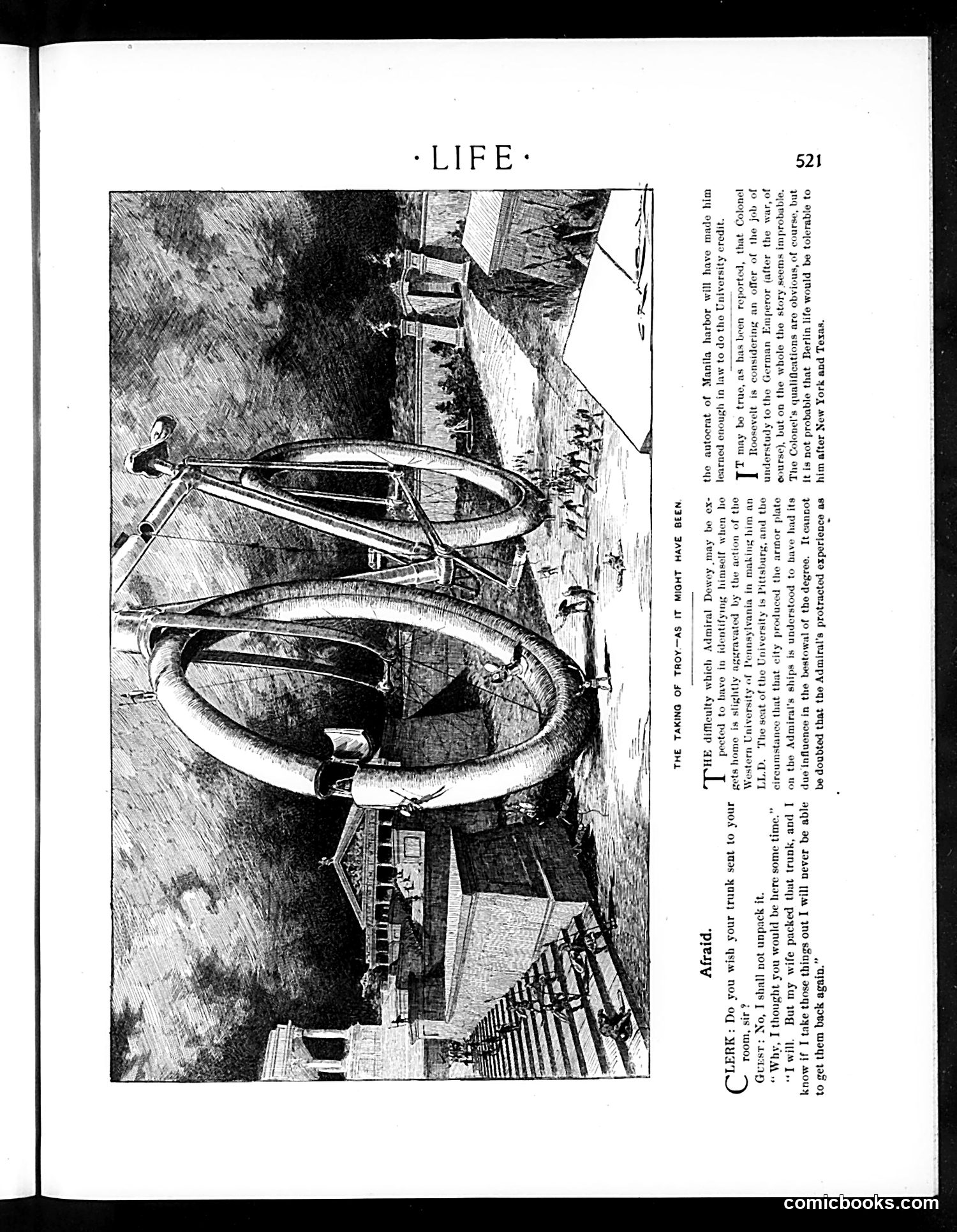
This page features a satirical cartoon titled "Afraid" depicting what appears to be a large mechanical or structural installation. The accompanying text discusses fears about new technology or industrial development, mentioning concerns about German engineering and potential threats. The cartoon critiques public anxiety regarding industrial progress and possibly foreign innovation. The large mechanical apparatus suggests either a weapon, industrial machine, or engineering marvel that sparked contemporary fear or controversy. Without clearer context about the specific date or historical event referenced, I cannot definitively identify which technological development or German engineering project prompted this satire. The overall message appears to mock public panic over modernization, suggesting the fears may be exaggerated or unfounded—typical of Life magazine's satirical approach to contemporary anxieties.
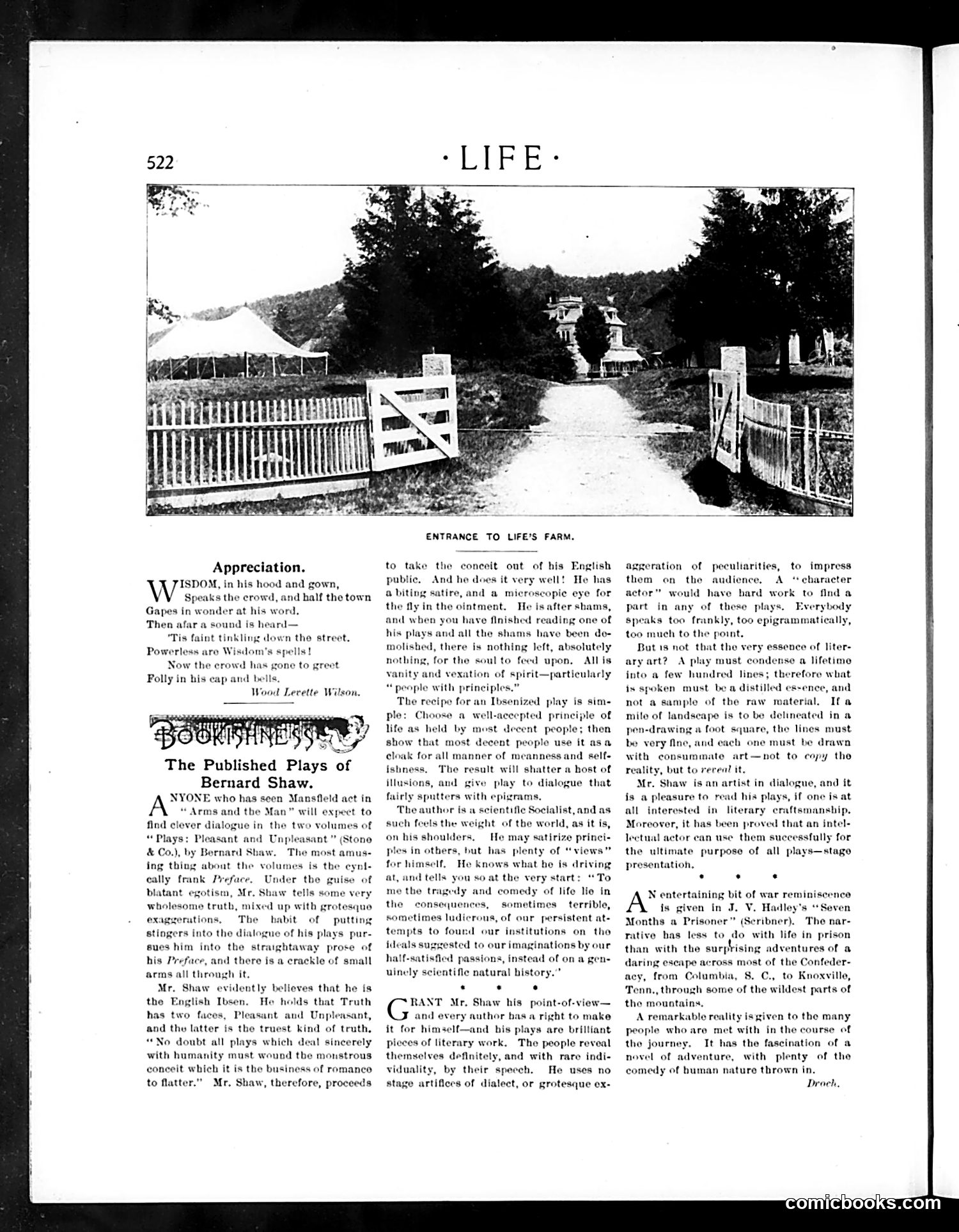
This page contains literary criticism rather than political satire. It features an article titled "Appreciation" discussing playwright Bernard Shaw's work, particularly his published plays. The photograph shows "Entrance to Life's Farm," depicting a pastoral country scene with white picket fencing and gates—likely referencing *Life* magazine's own property or illustrating the rural setting Shaw valued. The text praises Shaw as an artist in dialogue who reveals character through speech rather than stage artifice. It discusses how his plays expose human nature and social institutions, noting his satirical approach to examining "meanness and selfishness" in society. This is a straightforward literary appreciation piece rather than political cartooning—focused on Shaw's dramatic technique and social commentary through theatrical work.
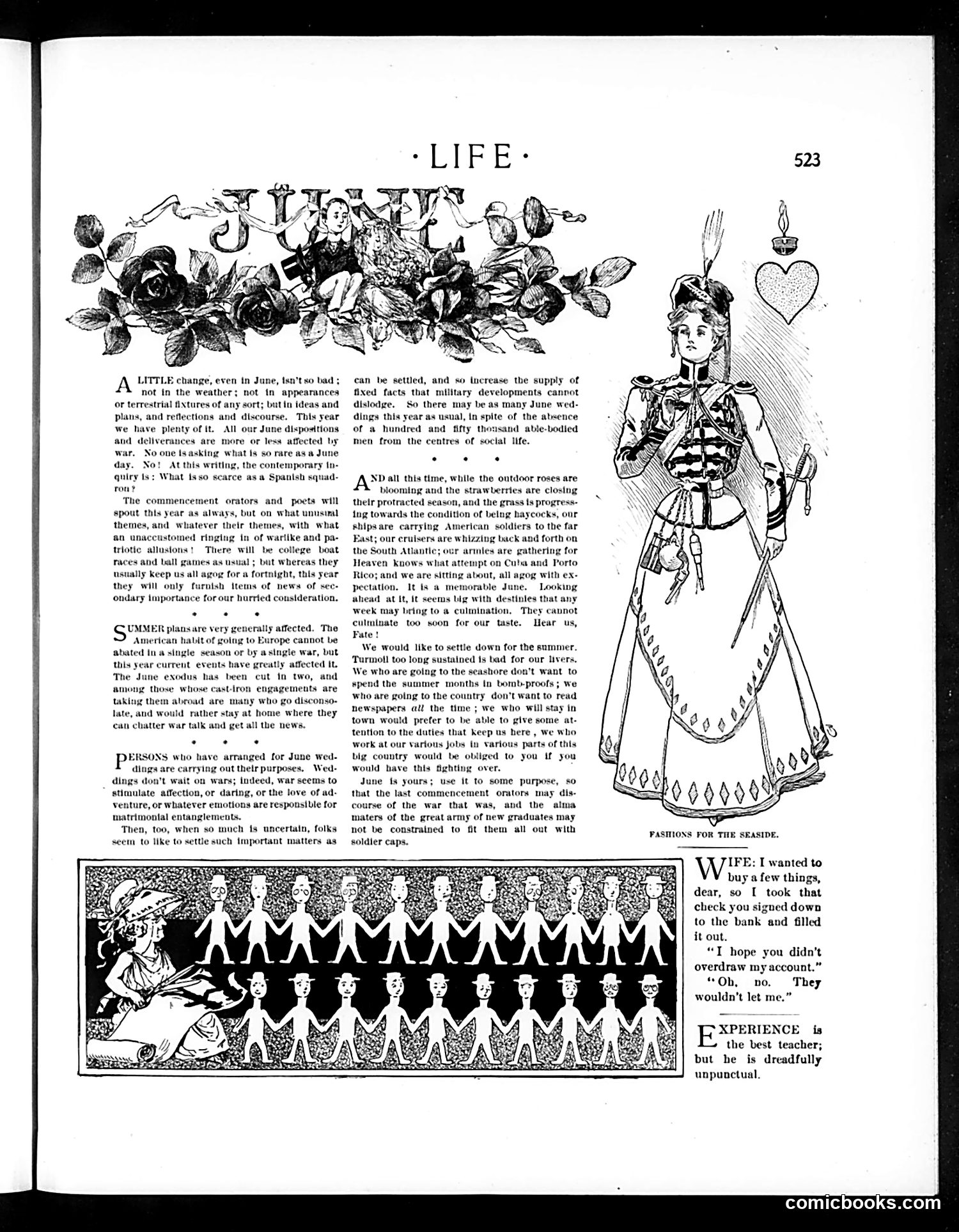
This page from *Life* magazine (a satirical publication) addresses June wartime conditions, likely WWI era. The main article discusses how little changes seasonally during wartime, despite military developments and social disruptions affecting summer plans. The **large illustration** labeled "Fashions for the Seaside" depicts a woman in an elaborate, impractical dress decorated with daggers and weapons—a sardonic commentary on how fashion magazines continue promoting frivolous seasonal clothing while the nation is engaged in serious military conflict. The **bottom cartoon** shows paper dolls in two rows, appearing to satirize mass production or conformity, possibly critiquing how war affects society's individuality. The page's tone suggests frustration that civilian life, including fashion concerns, continues unchanged despite wartime's gravity.
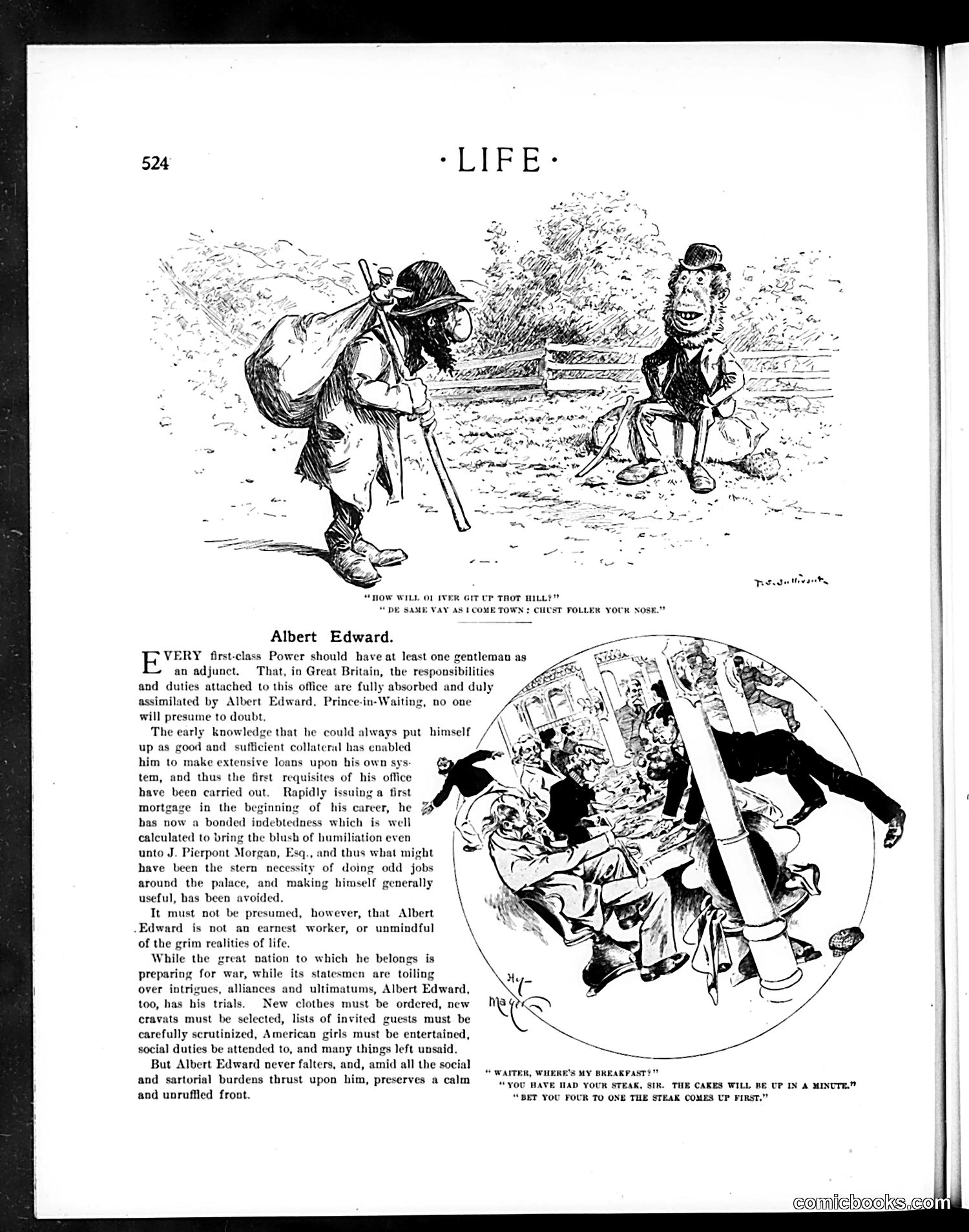
This Life magazine page satirizes **Albert Edward, Prince of Wales** (later King Edward VII). The top cartoon shows a tramp asking a wealthy figure to give up "that hill," with the caption suggesting social class conflict. The main article criticizes Edward as an idle aristocrat who exploits credit and loans rather than working honestly. It mocks his social responsibilities—ordering wars, selecting guests, entertaining American heiresses—while suggesting he avoids genuine labor. The bottom cartoon humorously depicts a chaotic breakfast scene where servants scramble to serve food, with dialogue about steak timing. This satirizes the Prince's leisured lifestyle and demanding nature. The satire targets British aristocratic privilege and the frivolous concerns of high society during this period of imperial wealth disparity.
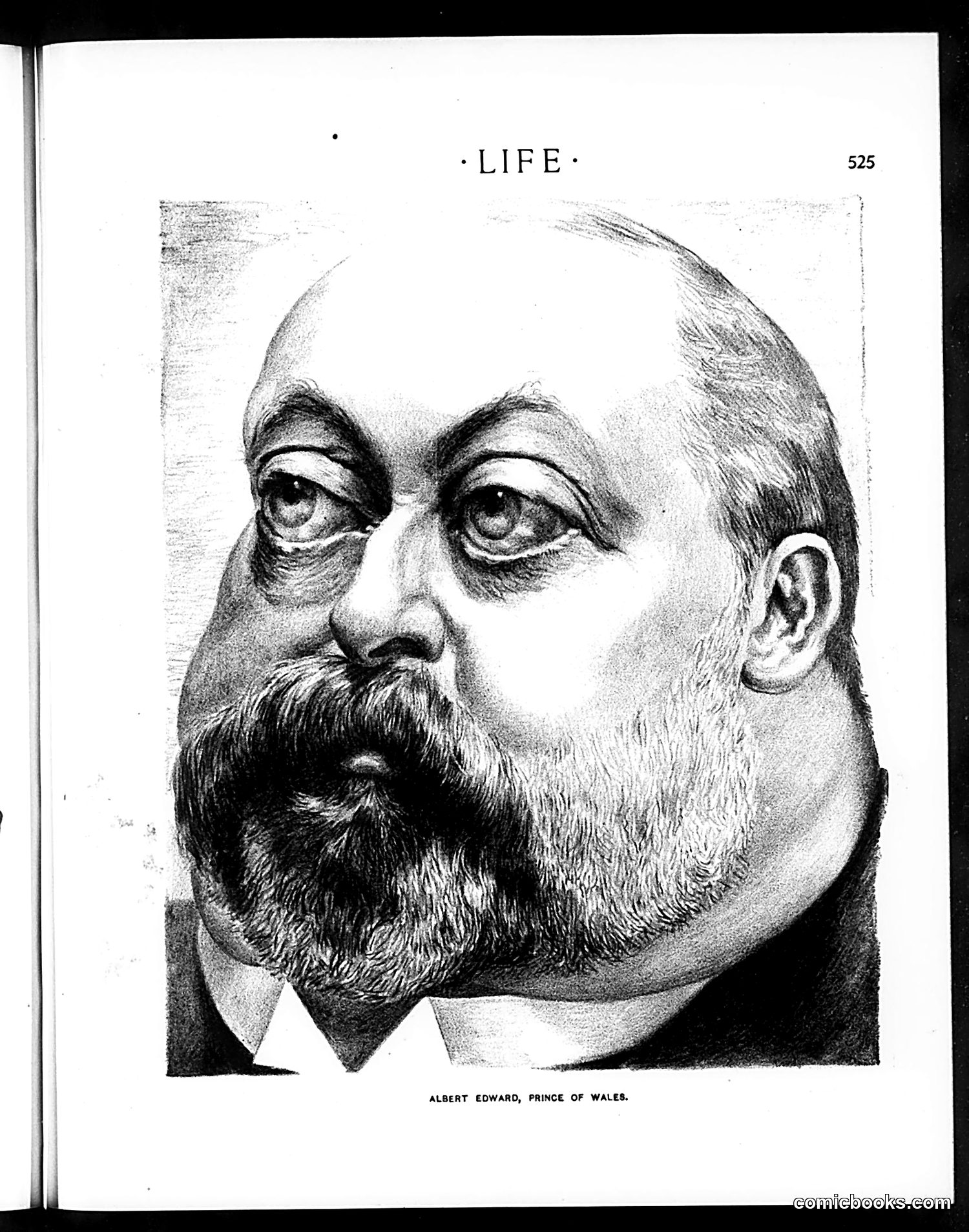
This is a portrait from *Life* magazine (page 525) showing **Albert Edward, Prince of Wales**, as identified by the caption. The image is a detailed engraving depicting a bearded man in formal attire. Without additional context on the page, the specific satirical point is unclear. However, *Life* was known for social and political commentary. The portrait's prominent placement suggests the Prince of Wales was newsworthy at the time of publication. The careful rendering emphasizes his distinctive facial features—particularly his full beard and expression. To determine the intended satire or commentary, one would need to see accompanying text, other illustrations on the page, or know the publication date and contemporary events involving the Prince.
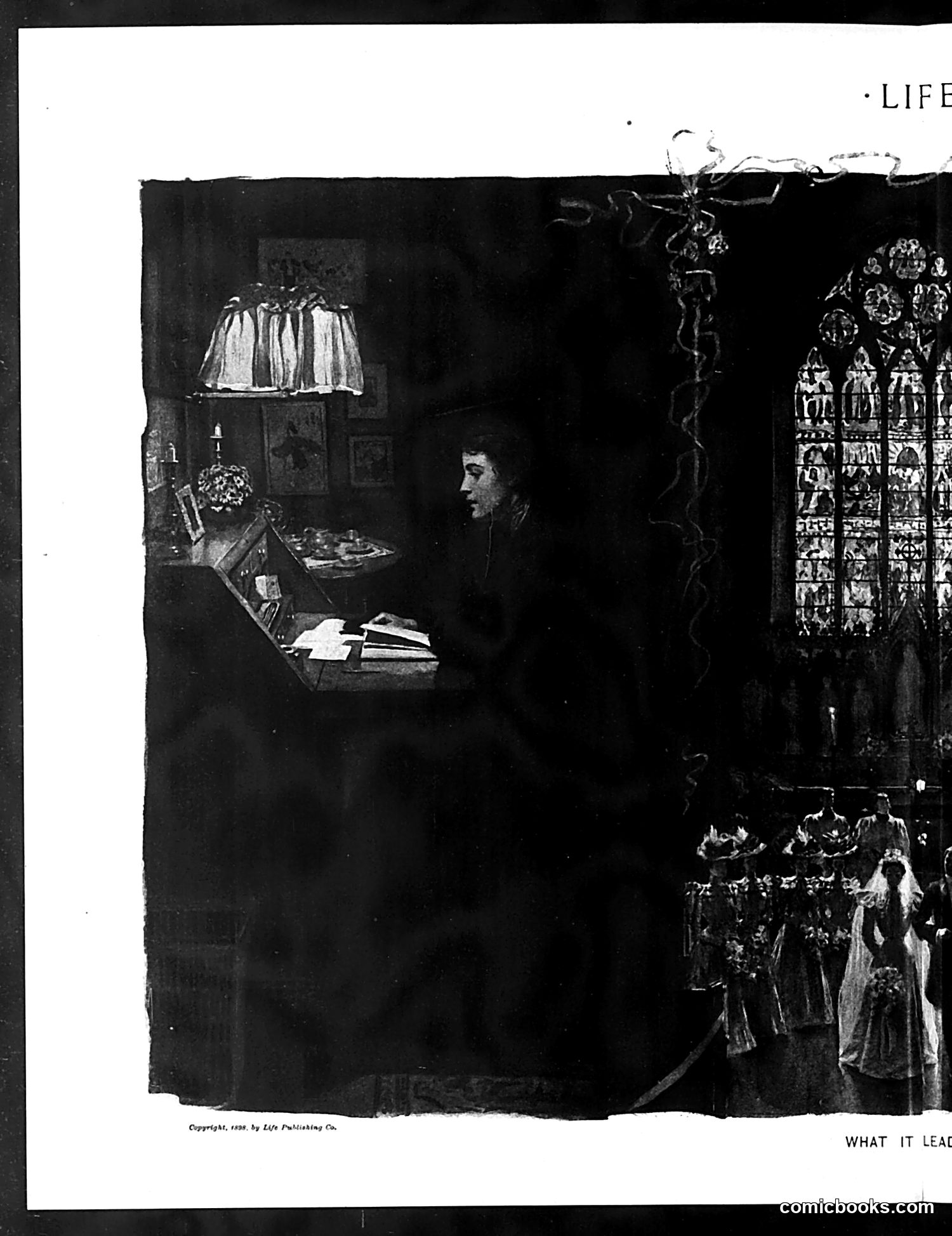
This appears to be a Life magazine page featuring a satirical illustration. The image shows a figure seated at a desk in a dimly lit room, working by lamplight while studying documents. To the right, there's an ornate stained-glass window and what appears to be religious or ceremonial figures in formal dress at the bottom right. The caption reads "WHAT IT LEAD" (likely "WHAT IT LED" with an OCR error), suggesting this cartoon comments on consequences of some action or policy. The contrast between the solitary, focused worker and the formal procession suggests commentary on how individual labor or decisions connect to larger institutional or political outcomes. Without additional context from the magazine's date and surrounding articles, the specific political reference remains unclear, though the religious imagery and formal ceremony suggest institutional or ecclesiastical themes.
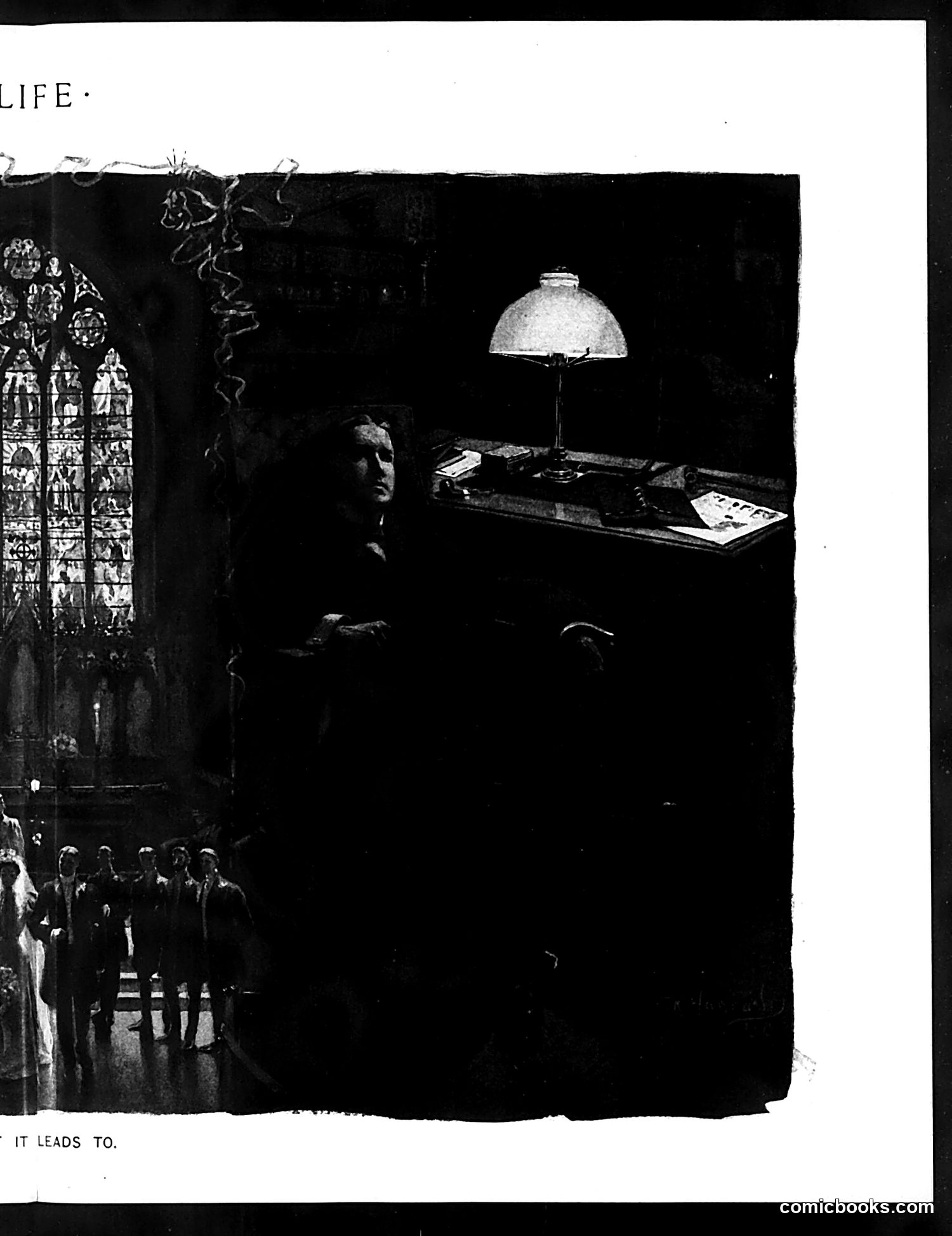
This page appears to be from *Life* magazine and shows a dramatic black-and-white illustration of a solitary figure seated at a desk under a desk lamp, positioned in what seems to be a cathedral or church setting (suggested by the ornate stained-glass window visible on the left). The figure appears contemplative or troubled. The partial text reads "LIFE:" at top and "IT LEADS TO." at bottom, suggesting this is part of a larger narrative or sequence about consequences or a journey. Without the complete text or caption, the specific political or social commentary remains unclear. The juxtaposition of isolated study/work within a sacred space might comment on devotion, burden, or existential questioning, but the exact satirical target cannot be determined from the visible portion alone.
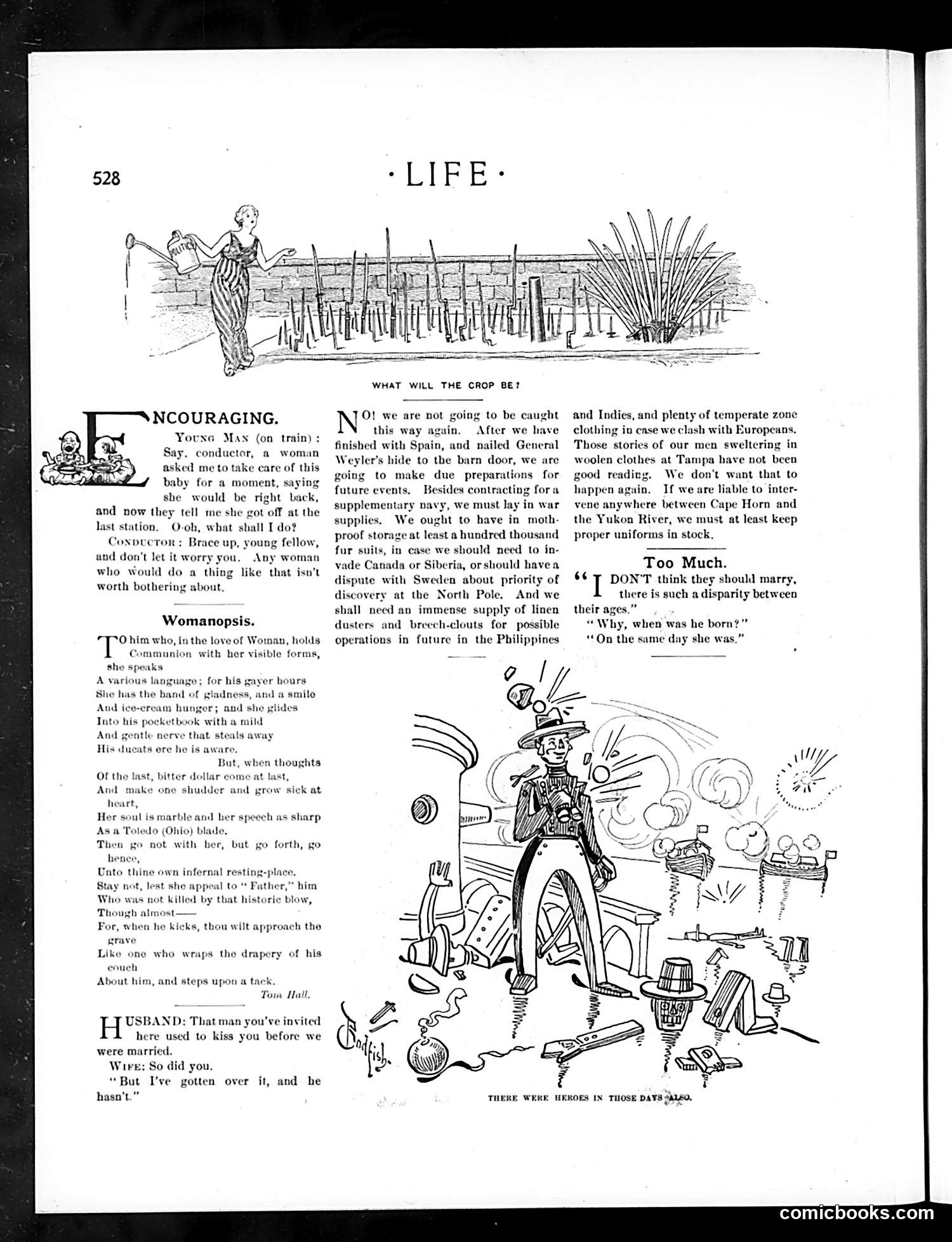
This page contains satirical commentary on American military preparedness, likely from the early 1900s. **"Encouraging"** section mocks a conductor reassuring a woman about naval readiness for potential conflicts with Spain and possible invasions of Canada or Siberia. The satire critiques overconfident military planning. **"Womanopsis"** is a poem about women's complex nature—comparing them to marble and sharp speech, yet capable of gentle deception. **"Too Much"** presents a brief marital joke about age differences at marriage. The large cartoon depicts a military officer amid explosions and chaos, illustrating incompetence or disaster, with the caption "THERE WERE HEROES IN THOSE DAYS." This appears to sarcastically contrast romanticized historical military heroism with contemporary military bungling or foolishness.
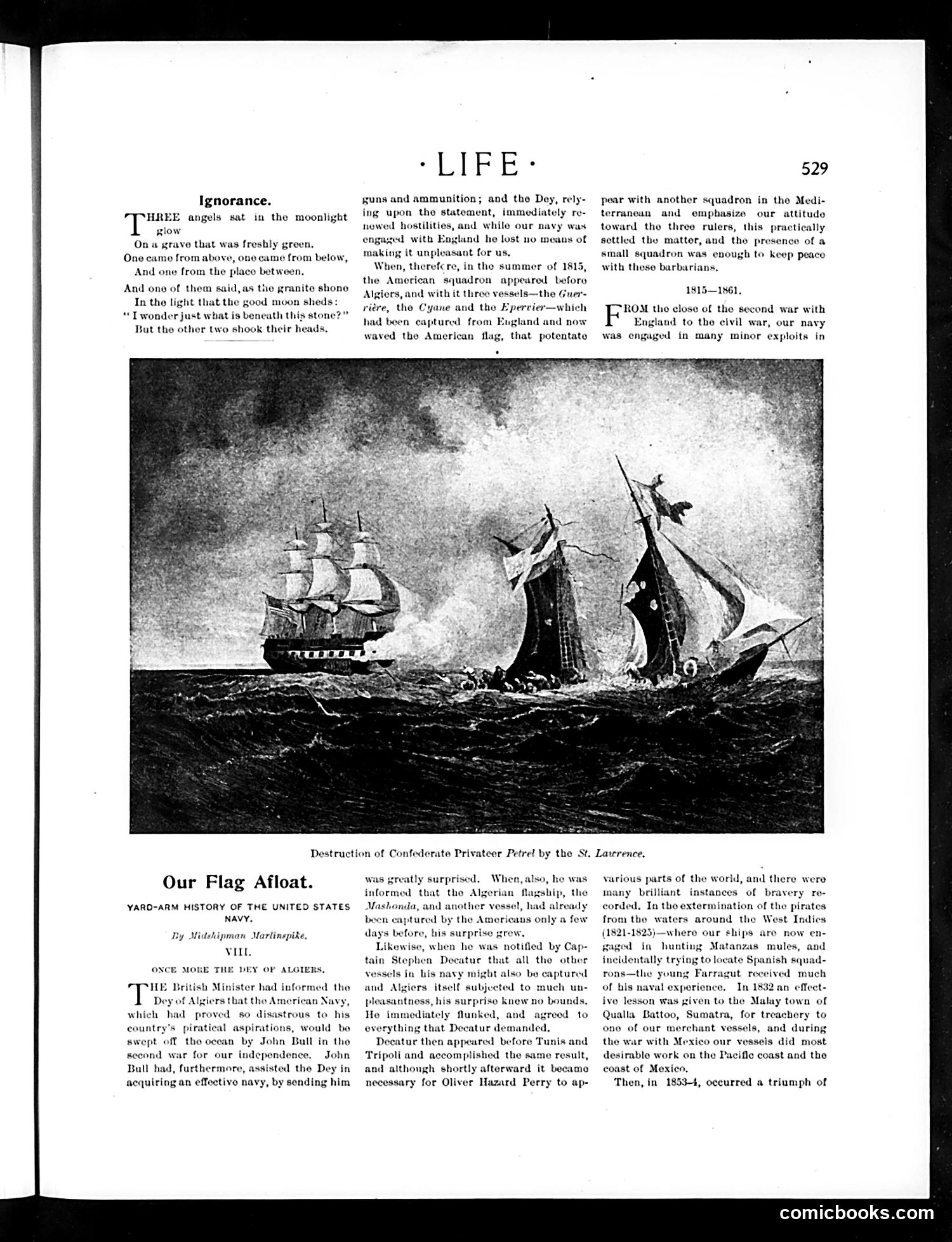
This page celebrates U.S. naval power during the early republic. The engraving depicts the destruction of the Confederate privateer *Petrel* by the *St. Lawrence*, illustrating American naval dominance. The text recounts how Commodore Stephen Decatur's 1815 squadron—displaying captured British ships (*Guerriere*, *Cyane*, *Epervier*)—intimidated the Dey of Algiers into ceasing piracy and hostilities. By demonstrating force, Decatur achieved diplomatic victories without major combat, then repeated success at Tunis and Tripoli. The article frames this period (1815-1861) as a time when American naval power enforced national interests globally—suppressing Caribbean pirates, disciplining foreign powers like Sumatra, and supporting expansion in Mexico. For modern readers: this is triumphalist history celebrating American military and economic dominance through naval strength, presenting imperialism as justified enforcement of order.
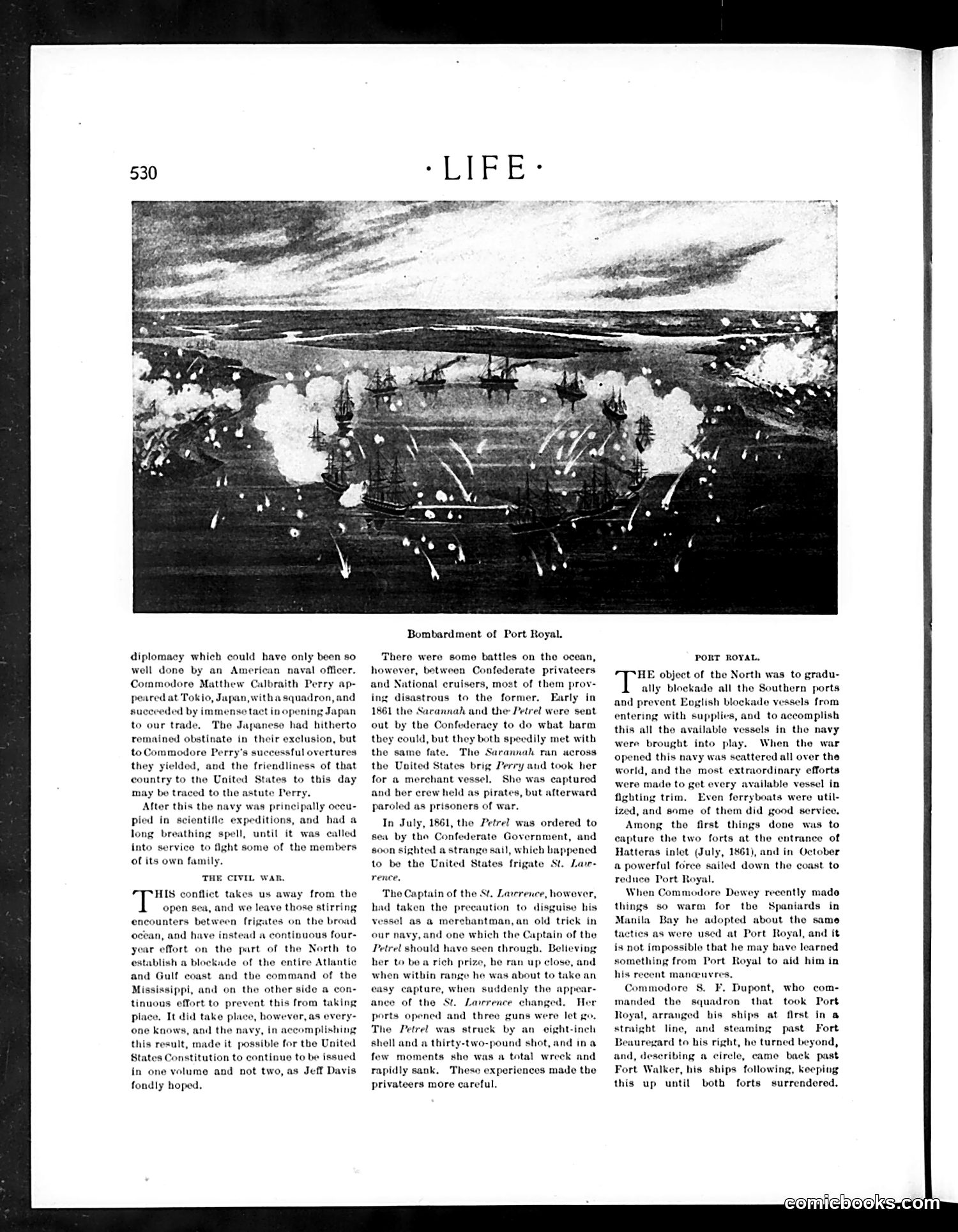
This page illustrates the Union Navy's Civil War strategy through a dramatic engraving showing the bombardment of Fort Royal (likely Fort Sumter area). The accompanying text explains the naval conflict's purpose: establishing a blockade of Confederate ports while preventing supplies from reaching the South. The narrative contrasts earlier peacetime naval achievements—notably Commodore Perry's opening of Japan through diplomacy—with the current fratricidal conflict. It details encounters between Union and Confederate vessels, including the Confederate privateers *Savannah* and *Petrel*, both defeated by Union forces. The Port Royal campaign exemplifies the Union's industrial superiority: converting ferryboats and merchant vessels into warships to overwhelm Confederate naval capacity. The text suggests this tactic later influenced Commodore Dewey's Manila Bay strategy (Spanish-American War), framing Union naval innovation as historically significant. The satire is implicit: Jeff Davis hoped the Constitution would "be issued in one volume and not two"—a grim joke about Southern secession being defeated by Northern naval might.
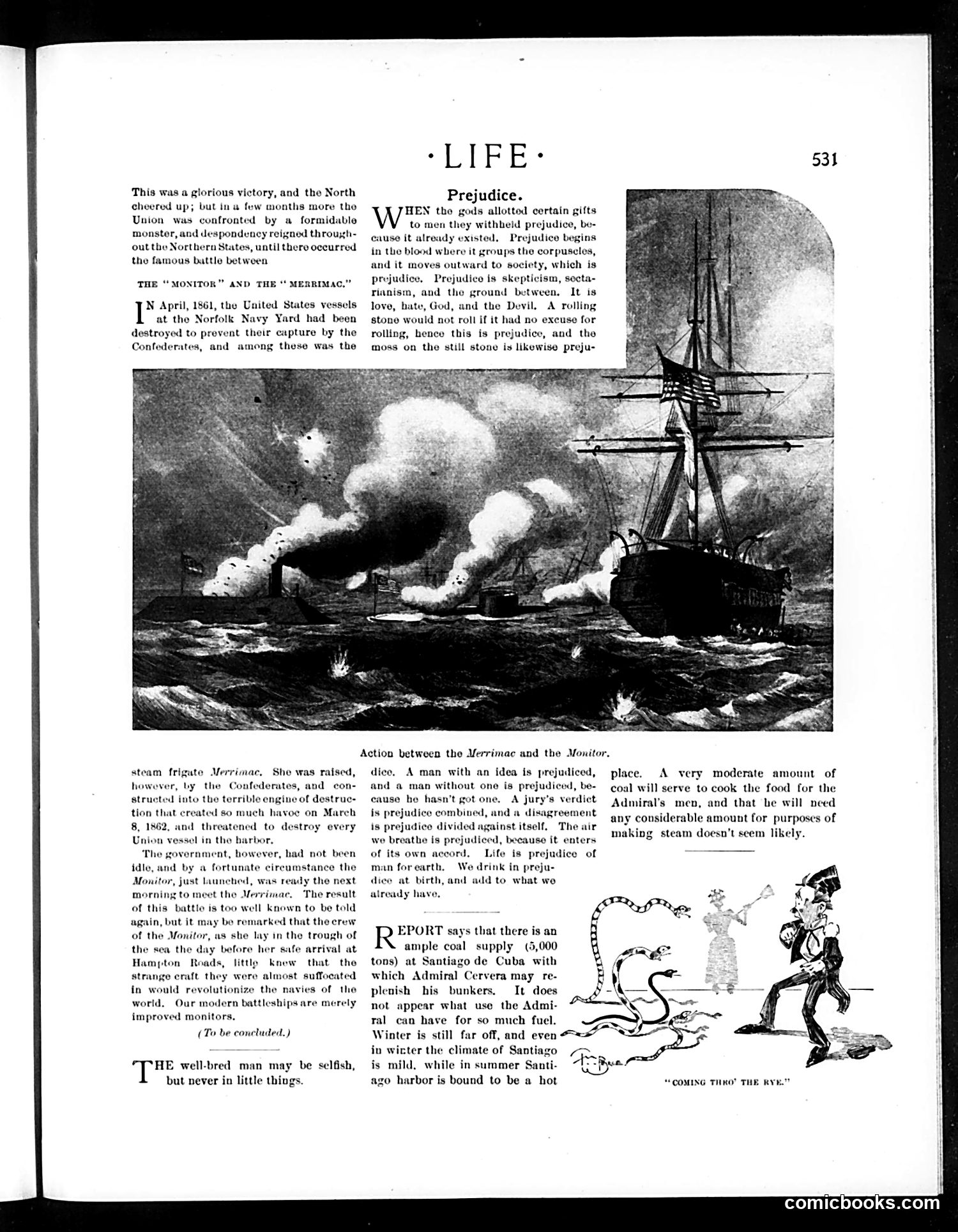
This page contains Civil War naval history and two distinct pieces of satirical content. **The Monitor-Merrimac Battle:** The lengthy article commemorates the famous March 1862 ironclad naval engagement, describing how the Confederate *Merrimac* (a salvaged Union ship) initially threatened Union vessels before the newly-launched *Monitor* defeated it the next day. The text notes this revolutionized modern warship design. **"Prejudice" Essay:** A philosophical satirical piece defining prejudice as fundamental to human nature—present in blood, society, logic, even the air we breathe. It's tongue-in-cheek social commentary suggesting prejudice is inescapable and universal. **Admiral Cervera Cartoon:** The small illustration and accompanying text mock Spanish Admiral Cervera's coal supply at Santiago de Cuba (likely referencing the Spanish-American War), sarcastically suggesting he needs far less fuel than reported since the climate is mild and cooking requires minimal coal. The illustration labeled "Coming Thro' the Rye" appears unrelated—a classical reference cartoon.
This page from *Life* magazine contains two satirical stories and period advertisements. **"Am Scissors at Nullus"** (top): A sentimental wartime romance where young Gerald must leave his sweetheart Claribel for military service. After five days apart, he returns to her, but the story's punchline reveals the "terrible thing" that happened was merely him smoking a cigar indoors—the smell was so awful it nearly drove her away. The satire mocks overwrought romantic melodrama and suggests soldiers' domestic complaints rival their battlefield concerns. **"Virtue Has Its Own Reward"** (middle): A children's morality tale about a poor young man rejecting a bribe to become a drunkard, despite needing money for marriage. He's rewarded with finding a million dollars in gold. The satire gently mocks simplistic Victorian moral lessons where virtue is rewarded through implausible fortune rather than realistic means. **Advertisements** occupy the lower half, promoting whiskey, ale, bicycles, and paper products typical of early 1900s commerce.
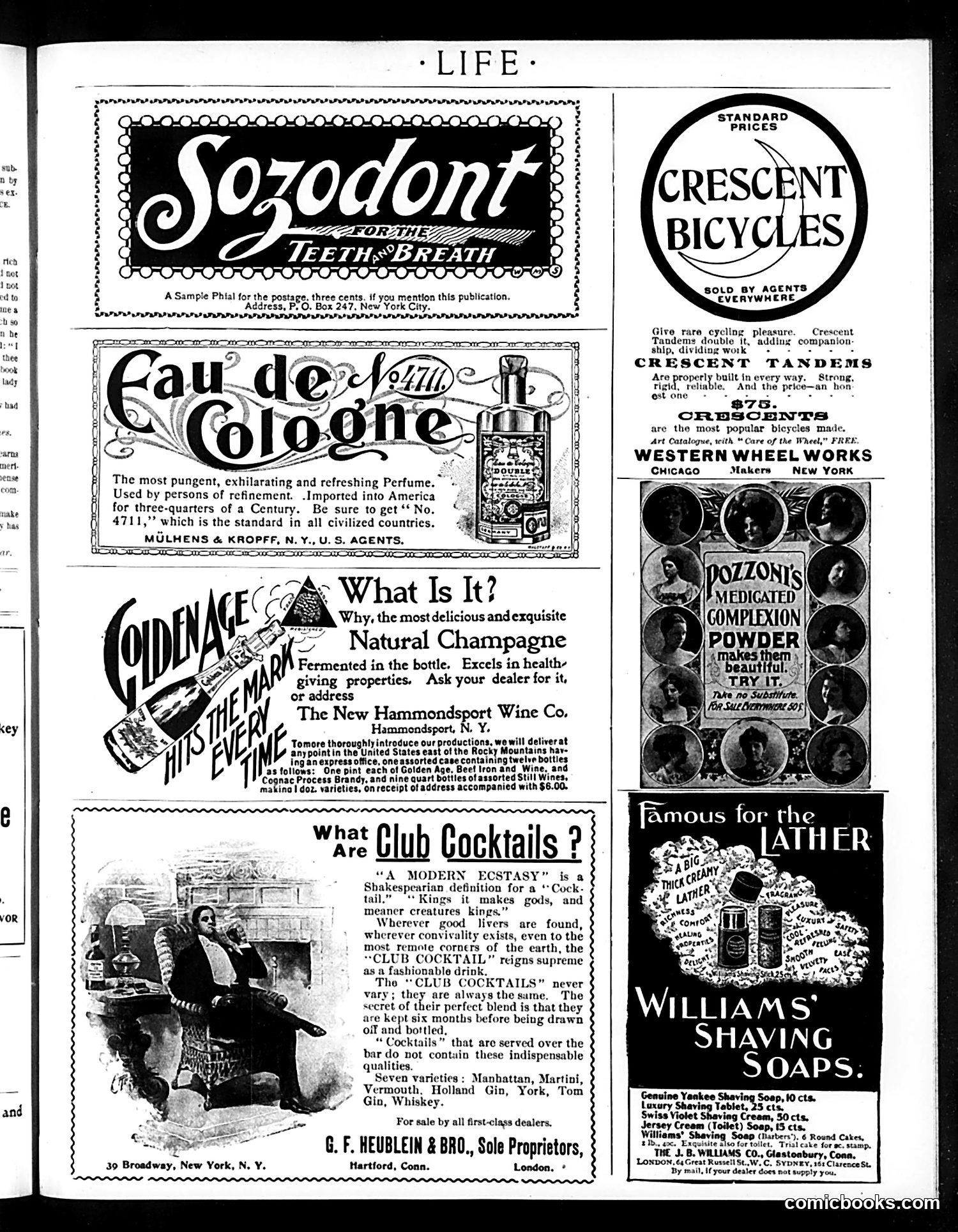
This is **primarily an advertising page**, not a satirical cartoon page. It contains early 20th-century product advertisements with minimal social commentary. ## Key Advertisements: **Sozodont** (teeth/breath product) and **Crescent Bicycles** dominate the upper portion—representing consumer goods marketed to middle-class Americans. **Eau de Cologne** by Mühlens & Kropff emphasizes Old World refinement ("used by persons of refinement" for "three-quarters of a Century"), appealing to aspirational consumers. **Club Cocktails** advertisement features a Victorian-era illustration of gentlemen, marketing cocktails as sophisticated "fashionable drink[s]" for "good livers." **Williams Shaving Soaps** advertises quality grooming products. The page reflects early 1900s consumer culture: bicycles as leisure technology, imported European perfumes as status symbols, and cocktails as markers of refined living. There is **no obvious political satire**—this is straightforward commercial messaging targeting affluent, genteel audiences.
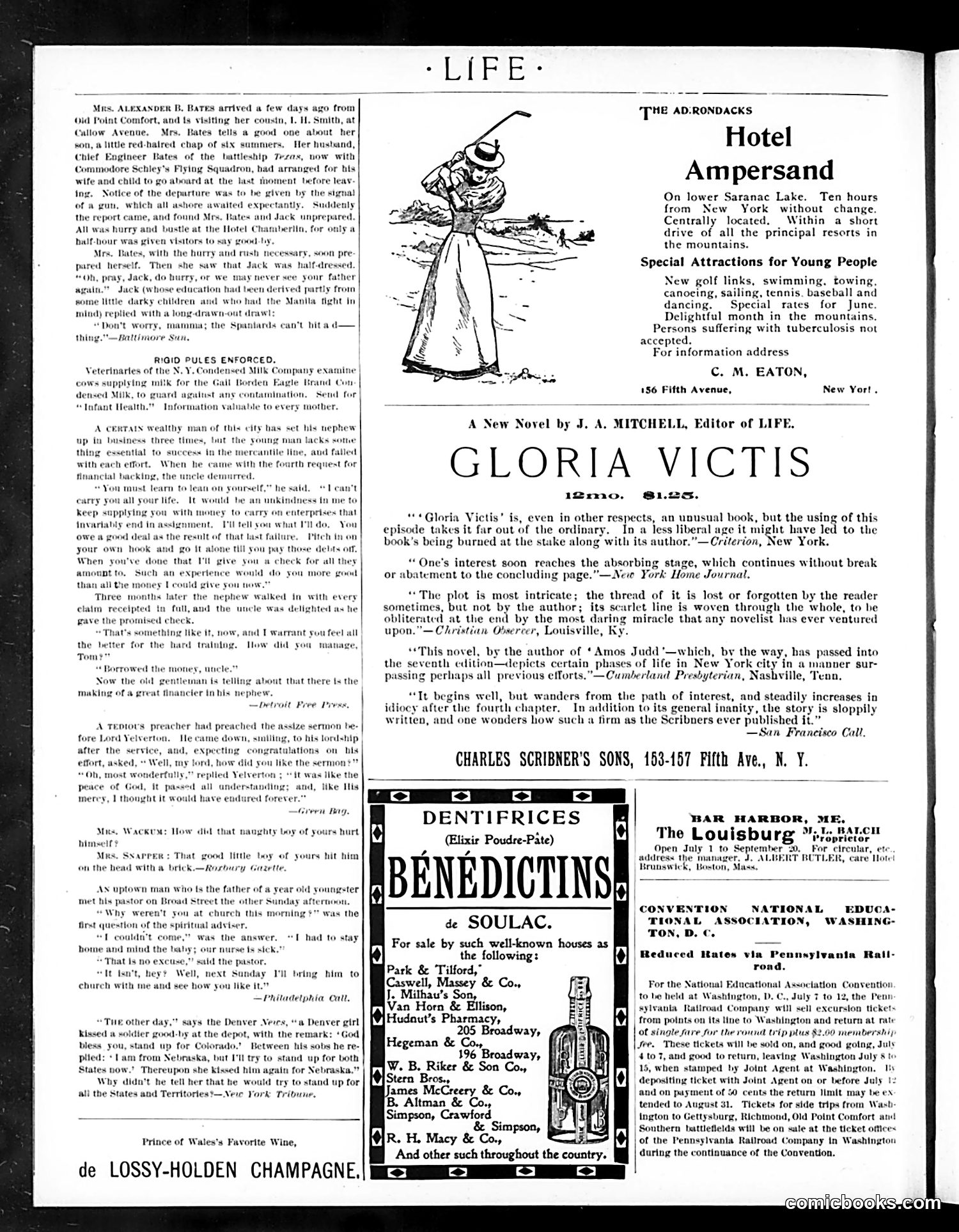
This page is primarily **advertisements and literary promotion** rather than political satire. The main content includes: **Central Feature:** A novel advertisement for "Gloria Victis" by J.A. Mitchell (Life's editor), with multiple glowing reviews praising its plot complexity and New York City setting. **Cartoon/Anecdote:** A small illustrated joke about a six-year-old boy named Jack, son of a naval officer. When his mother rushes him to say goodbye before his father's battleship departs, Jack calmly drawls, "Don't worry, mamma; the Spaniards can't hit a thing"—a reference to American naval superiority during the Spanish-American War. The humor lies in the child casually invoking recent military confidence. **Context:** This reflects early 1900s American optimism about naval power and Spanish-American War victory, presented as innocent childhood wisdom. The page otherwise contains hotel advertisements and miscellaneous social notes—typical Life magazine filler.
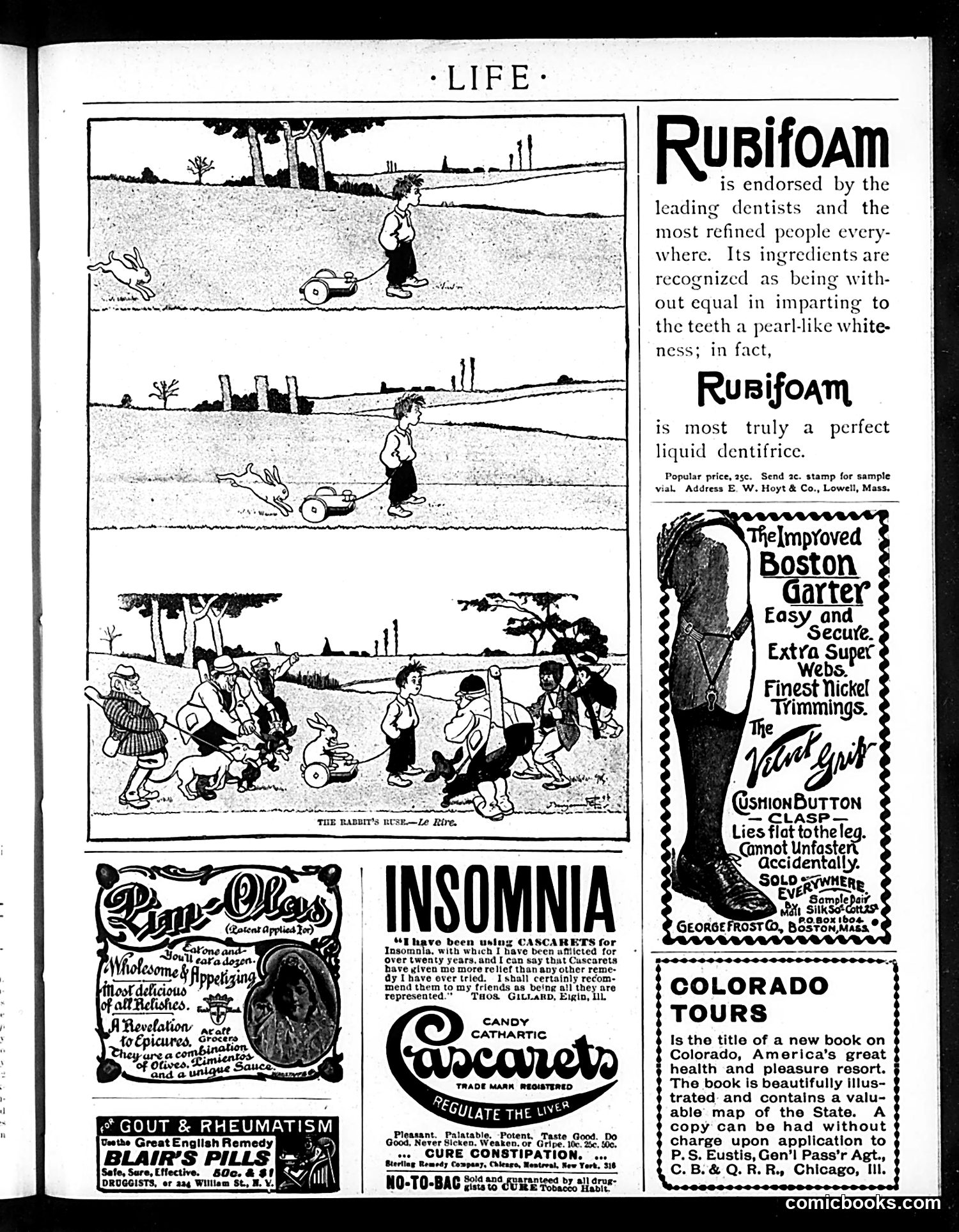
This page is primarily **advertising**, not political satire. It contains six product advertisements typical of early 20th-century American magazines: The top features a wordless comic strip showing children playing with a hoop, likely promoting childhood leisure or a toy product. The advertisements promote patent medicines and consumer goods: **Rubifoam** (tooth whitener), **Cascarets** (laxative for constipation and insomnia—note the testimonial claiming 20-year relief), **Pam-Oley's** (a food/sauce product), **Blair's Pills** (gout and rheumatism remedy), **No-To-Bac** (smoking cessation), a **Boston Garter** (men's hosiery with cushion buttons), and **Colorado Tours** (travel promotion). The satirical element is implicit: these advertisements reflect the era's unregulated patent medicine industry, where exaggerated health claims and dubious remedies were standard marketing. For modern readers, the page illustrates how differently consumer trust and advertising standards operated before FDA regulation and modern medical scrutiny.
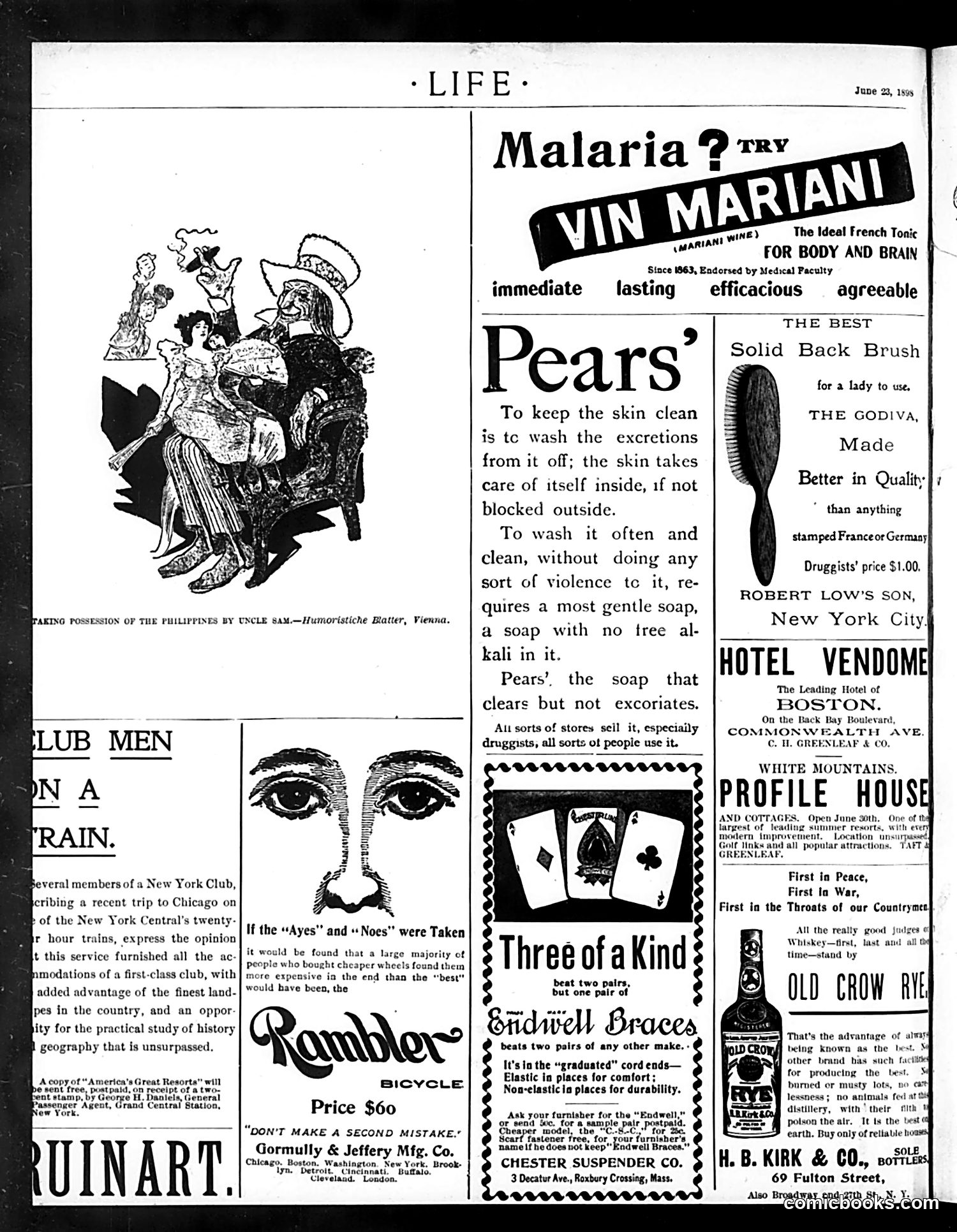
The main cartoon (upper left) depicts **Uncle Sam** attempting to claim ownership of the **Philippine Islands**, shown as an ornate Asian figure being "possessed" by the American character. The caption credits a Viennese satirical publication (*Humoristische Blätter*), indicating this is **European commentary on American imperialism**. This references the **Spanish-American War aftermath (1898)**, when the U.S. acquired the Philippines as a territory. The satire mocks America's assertion of control over the islands and their people—treating the Philippines almost as a theatrical performance or fake claim rather than legitimate governance. The cartoonist's critical perspective (German-Austrian, not American) suggests European skepticism toward U.S. imperial expansion in the Pacific. The rest of the page is primarily **period advertising** for bicycles, soaps, hotels, and patent medicines—typical Life magazine commercial content from 1895.