
Life, 1898-06-23 · page 14 of 20
Life — June 23, 1898 — page 14: what you’re looking at
What you’re looking at
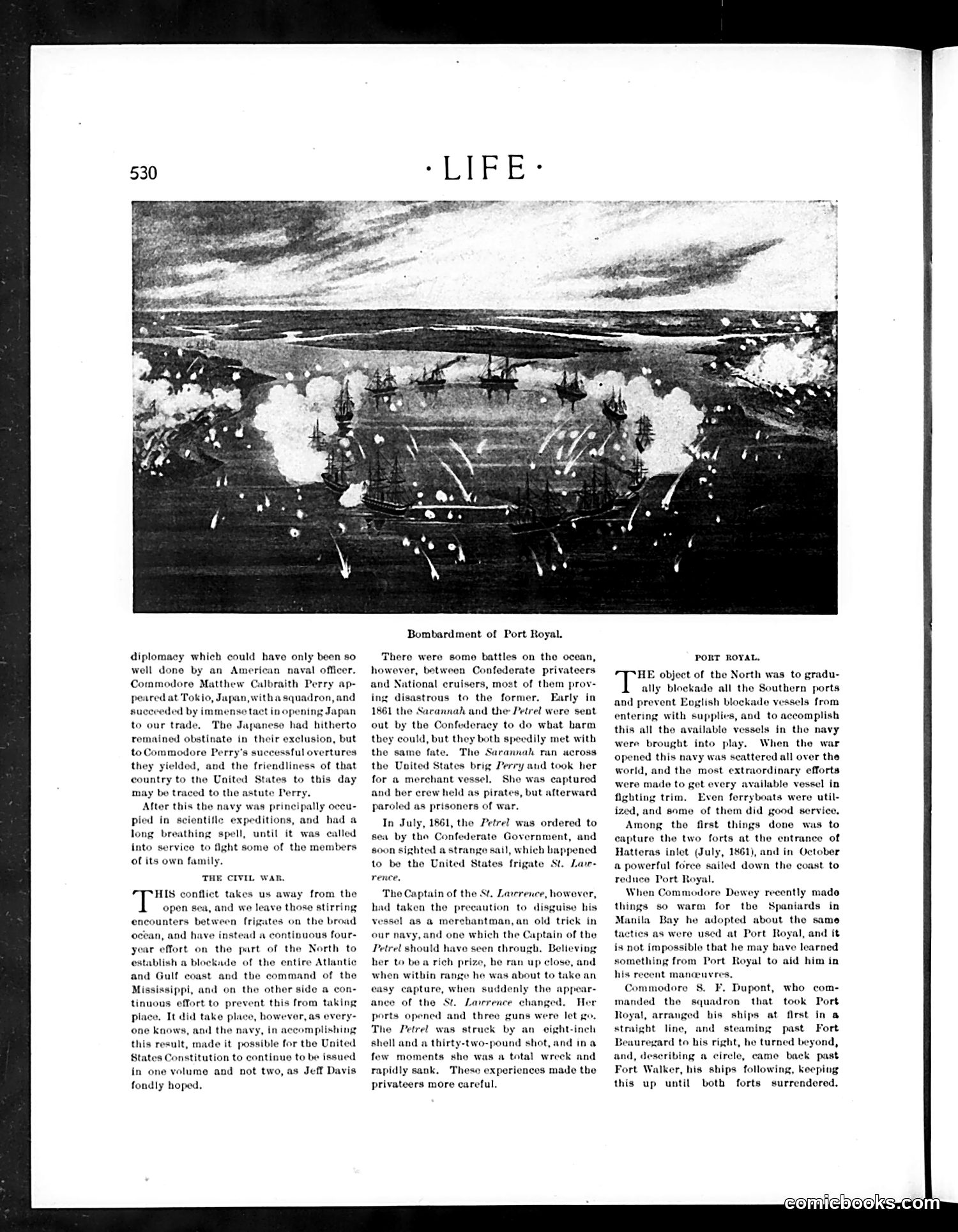
This page illustrates the Union Navy's Civil War strategy through a dramatic engraving showing the bombardment of Fort Royal (likely Fort Sumter area). The accompanying text explains the naval conflict's purpose: establishing a blockade of Confederate ports while preventing supplies from reaching the South. The narrative contrasts earlier peacetime naval achievements—notably Commodore Perry's opening of Japan through diplomacy—with the current fratricidal conflict. It details encounters between Union and Confederate vessels, including the Confederate privateers *Savannah* and *Petrel*, both defeated by Union forces. The Port Royal campaign exemplifies the Union's industrial superiority: converting ferryboats and merchant vessels into warships to overwhelm Confederate naval capacity. The text suggests this tactic later influenced Commodore Dewey's Manila Bay strategy (Spanish-American War), framing Union naval innovation as historically significant. The satire is implicit: Jeff Davis hoped the Constitution would "be issued in one volume and not two"—a grim joke about Southern secession being defeated by Northern naval might.
📄 Transcribed text from this page (OCR, searchable)
Machine-transcribed from the original scan — historical spelling and the odd misread are preserved.
diplomacy which could have only been 80 well done by an American naval officer. Commodore Matthew Calbraith Perry ap- peared at Tokio, Jupan, with a squadron,and suceceded by immense tact in opening Japan to our trade, The Japanese had hitherto remained obstinate in their exclusion, but to Commodore Perry's successful overtures they yielded, and the friendliness of that country to the United States to this day may be traced to the astute Perry, After this the navy was principally oceu- pied in scientifle expeditions, and had a long breathing spell, until it was called into service to fight some of the members of its own family. THE CIVIL Wan. HIS conflict takes us away from the open sea, and we leave those stirring encounters between frigates on the broad ocean, and have instead a continuous four- year effort on the part of the North to establish a blockade of the entire Atlantic and Gulf coast and the command of the Mississippi, and on the other side a con- tinuous effort to prevent this from taking place, It did take place, however, as & one knows, and the navy, in accomplishing this result, made it possible for the United States Constitution to continue to be issued in one volume and not two, as Jeff Davis fondly hoped. ory- Bombardment of Port Royal. Thero were some battles on the ocean, however, between Confederate privateers and National cruisers, most of them prov- ing d trous to the former, Early in 1861 the Sarannah and the: Petrel were sent out by the Confederacy to do what harm they could, but they both speedily met with the same fate. The Sarannah ran across the United States brig Perry aud took her for a merchant vessel. She was captured and her crew held as pirates, but afterward paroled as prisoners of war. In July, 1861, the Petrel was ordered to sea by tho Confederate Government, and s00n sighted a strange sail, which happened to be the United States frigate St. rence. The Captain of the St, Larrrence, however, had taken the precaution to disguise his a merehantman,an old trick in our navy,and one which the Captain of the Petrel should have seen through, Believing her to bea rich prize, he ran up close, and when within range he was about to take an easy capture, when suddenly the appear- ance of the St. Larrence changed. He ports opened and three guns were let go. The Petrel was struck by an eight-inch shell and a thirty-two-pound shot, and ina few moments she was a total wr and rapidly sank. These experiences made the privateers more careful. vessel PORT ROYAL, HE object of the North was to gradu- ally blockade all the Southern ports and prevent Eoglish block: entering with suppli this all the available s in the navy were brought inte 7 When the war opened this navy was scattered all over the world, and the most extraordinary efforts were made to get every available vessel in fighting trim. Even ferryboats were util- ized, and some of them did good service. Among the first things done was to capture the two forts at the entrance of Hatteras inlet (July, 1861), and in October a powerful force sailed down the coast to reduce Port Royal. When Commodore Dewey recently mado things so warm for the Spaniards in Manila Bay he adopted about the same tactics as were used at Port Royal, and it is not impossiblo that he may bave learned something from Port Royal to aid him in his ont manceuvre Commodore 8, F. Dupont, who com- manded the squadron that took Port Royal, arranged his ships at first in a straight line, and steaming past Fort Beauregard to his right, he turned beyond, and, desoribing a circle, came back past Fort Walker, his ships following, keeping this up until both forts surrendered. ssels from nd to accomplish