
Life, 1898-06-23 · page 6 of 20
Life — June 23, 1898 — page 6: what you’re looking at
What you’re looking at
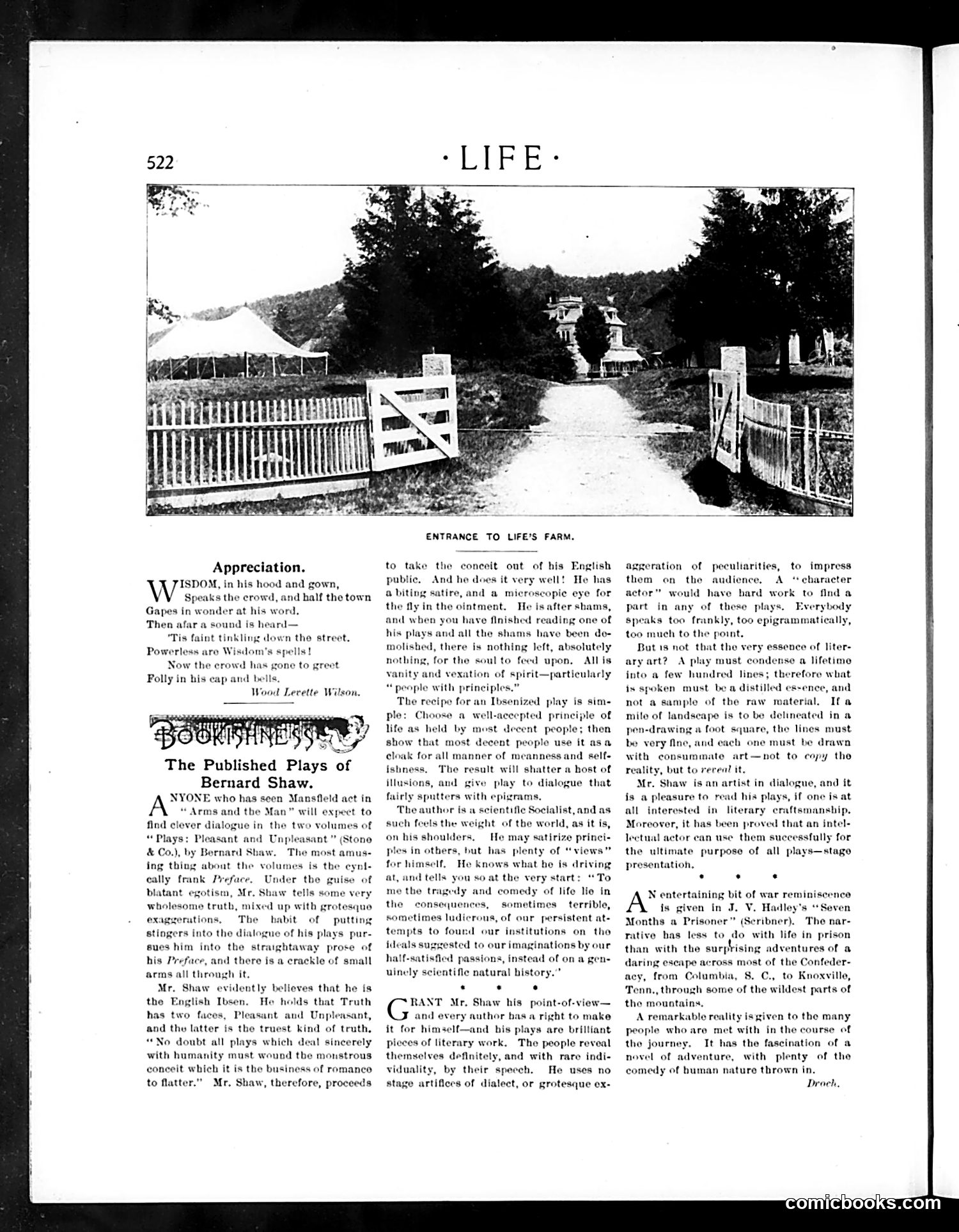
This page contains literary criticism rather than political satire. It features an article titled "Appreciation" discussing playwright Bernard Shaw's work, particularly his published plays. The photograph shows "Entrance to Life's Farm," depicting a pastoral country scene with white picket fencing and gates—likely referencing *Life* magazine's own property or illustrating the rural setting Shaw valued. The text praises Shaw as an artist in dialogue who reveals character through speech rather than stage artifice. It discusses how his plays expose human nature and social institutions, noting his satirical approach to examining "meanness and selfishness" in society. This is a straightforward literary appreciation piece rather than political cartooning—focused on Shaw's dramatic technique and social commentary through theatrical work.
📄 Transcribed text from this page (OCR, searchable)
Machine-transcribed from the original scan — historical spelling and the odd misread are preserved.
Appreciation. ISDOM, in his hood and gown, V Speaks the crowd, and half the town Gapes in wonder at his word. Then afar a sound is heard— ‘Tis faint tinkling down the stree Powerless aro Wisdom’s spells! Now the crowd has gone to g Polly in his cap and bells, Wood Levette Wilson, The Published Plays of Bernard Shaw. YONE who has seen Mansfleld act in Arms and the Man” will expect to find clever dialogue in the two volumes of 1 Unpleasant" (Stone . by Bernard Shaw, The most amus- ing thin; es is the eynl- cally frank Preface. Under the guise of blatant egotism, Mr. Shaw tells some ve jesome truth, m about the volur 1 up with grotesque The habit of putti stingers into the dialogue of his plays pur- sues him into the straightaway prose of his Preface, and there is a crackle of small arms all through it. Mr. Shaw ntly believes that he is the English Ibsen. Hoe holds that Truth has two faces, nd Unpleasant, and thy latter is the truest kind of truth, No doubt all plays which deal sincerely with humanity must wound tbe monstrous conceit which it is the business of romanco to flatter.” Mr. Shaw, therefore, proceeds ions, evide Pleasan to take the conceit out of his English public, And he does it very well! He has a biting satire, and a microseopie eye for the fly in the ointment. He is after shams, and when you have finished reading one of ys and all the shams have been de- J, there is nothing left, absolutely hing, for the soul to feed upon, Allis nity and vexation of spirit—particularly pe with principles.” The recipe for an Ibsenized play is sim- ple: Choose a well-accepted principle of life as held by t decent people; then show that most decent people use it asa cloak for all manner of meanness and self- ishness, The result will shatter a host of illusions, and give play to dialogue that fairly sputters with ¢ ‘The author is a scientifle Socialist, and as such feels the weight of the world, as it is, ‘on his shoulders, He may satirize princi ples in others, but has plenty of “views” for himself, He knows what he is driving at, and tells you so at the very start: “To me the tragedy and comedy of life lie in the consequences, sometimes terrible, netimes ludicrous, of our persistent at- tempts to found our institutions on tho ideals suggested to our imaginations by our stead of on a gen- uinely scientific natural history.” . . . RANT Mr, Shaw his point-of-view— and every author bas a right to make it for himself—and bis plays are brilliant pieces of literary work. The people reveal themselves definitely, and with rare indi- viduality, by their speech. He uses no sta; tiflees of dialect, or grotesque ex- his p molish ams, aggeration of peculiarities, to impress them on the audience, A ‘cbaracter actor” would have bard work to find a part in any of these plays. Everybody speaks too frankly, too epigrammatically, too much to the point. But 18 not that the very essence of liter- ary art? A play must condense a lifetime into a few hundred lines; therefore what is spoken must be a distilled essence, and not a sample of the raw material, Ifa milo of landscape is to be delineated in a pen-drawing a foot square, the lines must be very fine, and each one must be drawn with art—not to copy the reality, but to rerea? it. Mr. Shaw isan artist in dialogue, and it is a pleasure to read his plays, if one is at all interested in literary eraftss Moreover, it has been proved that an int ual actor can use them successfully for the ultimate purpose of all presentation, . . . consummate ‘ entertaining bit of war reminise A‘ given in J. V. Hadley's “Seven Months a Prisoner” (S native has less to do with life in prison than with the surphising adventures of a eribner), Tho nar- daring escape across most of the Confeder- acy, from Columbia, 8. C., to Ki Tenn., through some of the wildest parts of the mountains, A remarkable reality is given to the many people who aro met with in the course of the jour: It has the fascination of a novel of adventure, with plenty of the comedy of buman nature thrown in, Droch, oxvillo,