
Life, 1898-06-23 · page 4 of 20
Life — June 23, 1898 — page 4: what you’re looking at
What you’re looking at
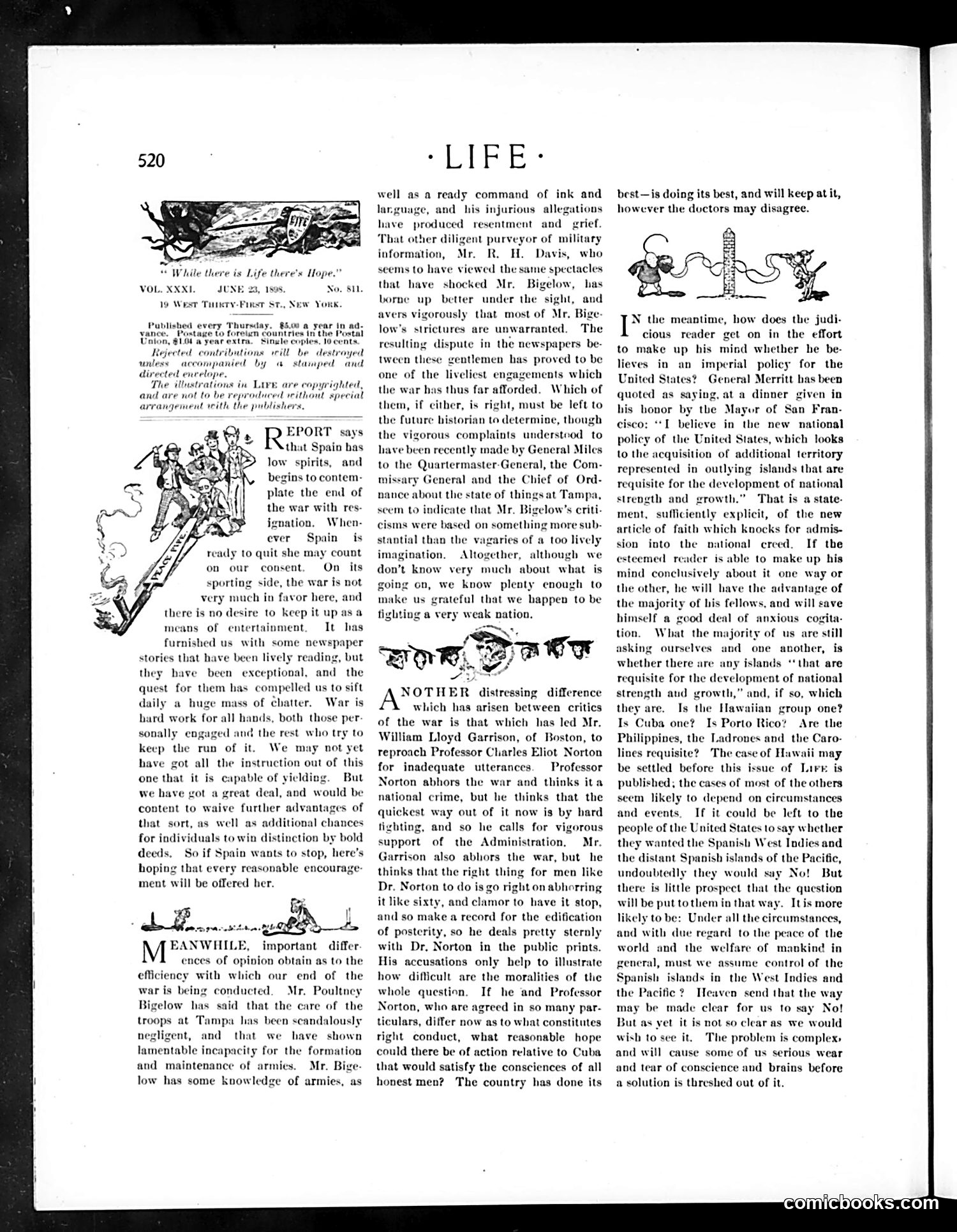
This page contains editorial commentary on the Spanish-American War, which was ongoing at this time. The text references disputes among military leadership regarding war conduct, specifically mentioning General Miles (Quartermaster General), General Merritt, and critiques from Professor Charles Eliot Norton regarding "inadequate utterances" about the war's justification. The illustrated cartoons appear to depict Spain in a weakened state—likely satirizing Spain's military vulnerability. The editorial debates whether the U.S. should annex Spanish colonial territories (Cuba, Hawaii, Philippines) for "national development," reflecting the imperial expansion debate of 1898. The overall tone is patriotic but somewhat skeptical of both military leadership competence and the moral justification for territorial acquisition.
📄 Transcribed text from this page (OCR, searchable)
Machine-transcribed from the original scan — historical spelling and the odd misread are preserved.
VOL. XXX1. 19 West Tu Published every Thursday. $5.00 a year in ad- vance. urn countries in the Postal Union, 81.04 a year extra, Single cnples. 10 cents Rejected contributions will be destroyed unless stamped and directed envelop The illustrations in Lave are copyrighted, and are not to be reproduced without special arrangement with the publishers. accompanied by a EPORT say that Spain bas low spirits, and begins to contem- plate the end of the war with res- ignation, When- ever Spain is ready to quit she may count on our consent. On its sporting side, the war is not very much in favor here, and there is no desire to keep it up asa means of entertainment. It has furnished us with some newspaper stories that have been lively reading, but they have been exceptional, and the quest for them has compelled us to sift daily a huge mass of Chatter. War i hard work for all hands, both those per. sonally engaged and the rest who try to keep the run of it. We may not yet have got all the instruction out of this one that it is capable of yieldii But we have got a great deal, and would be content to waive further advantages of that sort, as well as additional chances for individuals to win distinction by bold deeds. So if Spain wants to stop, here’s hoping that every reasonable encourage- ment will be offered her. . xO: Se EANWHILE, differ. important ences of opinion obtain as to the y with which our end of the efficien war is being conducted. Mr. Poultney Bigelow has said that the care of the troops at Tampa has been scandalously nt, and that have shown lamentable incapacity for the form and maintenance of armies. Mr. E low has some knowledge of armies, as we *LIFE: well as a ready command of ink and language, and his injurious allegations have produced resentment and grief. ‘That other diligent purveyor of military information, Mr. R. H. Davis, who seems to have viewed the same spectacles that have shocked Mr. Bigelow, has borne up better under the sight, and avers vigorously that most of Mr. Bi low’s strictures are unwarranted. The resulting dispute in the newspapers be- entlemen has proved to be jiveliest engagements which ‘ar afforded. Which of them, if cither, is right, must be left to the future historian to determine, though the vigorous complaints understeod to have been recently made by General Miles to the Quartermaster-General, the Com- missary General and the Chief of Ord- nance about the state of things at Tampa, scem to indicate that Mr. Bigelow’s criti- cisms were based on something more sub- stantial than the vagaries of a too lively imagination. Altogether, although we don’t know very much about what is going on, we know plenty enough to make us grateful that we happen to be fighting a very weak nation. Se oe x rd a ~ OTHER distressing difference which has arisen between critics of the war is that which has led Mr, William Lloyd Garrison, of Boston, to reproach Professor Charles Eliot Norton for inadequate utterances. Professor Norton abhors the war and thinks ita national crime, but he thinks that the quickest way out of it now is by bard fighting, and so he calls for vigorous support of the Administration, Mr. Garrison also abhors the war, but he thinks that the right thing for men like Dr. Norton to do is go right on abhorring it like sixty, and clamor to have it stop, and so make a record for the edification of posterity, so he deals pretty sternly with Dr, Norton in the public prints. His accusations only help to illustrate how difficult are the moralities of the whole question. If he and Professor Norton, who are agreed in so many par- ticulars, differ now as to what constitutes right conduct, what reasonable hope could there be of action relative to Cuba that would satisfy the consciences of all honest men? The country has done its tween these one of the the war bas thus best—is doing its best, and will keep at it, however the doctors may disagree. I the meantime, how does the judi- cious reader get on in the effort to make up his mind whether he be- lieves in an imperial policy for the United Stat General Merritt bas been quoted as saying, at a dinner given in his honor by the Mayor of San Fran- isco: “Tbe in the new national policy of the United States, which looks to the acquisition of additional territory represented in outlying islands that are requisite for the development of national strength and growth.” That is a state- ment, sufficiently explicit, of the new article of faith which knocks for admis- sion into the national creed, If the esteemed reader is able to make up his mind conclusively about it one way or the other, he will have the advantage of the majority of his fellows, and will save himself a good deal of anxious cogita- tion, What the majority of us are still ing ourselves und one another, is whether there are any islands ‘‘ that are requisite for the development of national strength aud growth,” and, if so, which they are. Is the Hawaiian group one? Is Cuba one? Is Porto Rico? Are the Philippines, the Ladrones and the Caro- lines requisite? The case of Hawaii may be settled before this issue of Lire is published; the cases of most of the others seem likely to depend on circumstances and events, If it could be left to the people of the United States to say whether they wanted the Spanish West Indies and the distant Spanish islands of the Pacitic, undoubtedly they would say No! But there is little prospect that the question will be put tothem in that w Itis more likely to be: Under all the circumstances, ‘d_to the peace of the world and the welfare of mankind in general, must we assume control of the Spanish islands in the West Indies and the Pacific 2 Heaven send that the way may be made clear for us to say No! But as yet it is not so clear as we would wish to see it, The problem is complex» and will cause some of us serious wear and tear of conscience and brains before a solution is threshed out of it. and with due reg