
A complete issue · 20 pages · 1898
Life — June 16, 1898
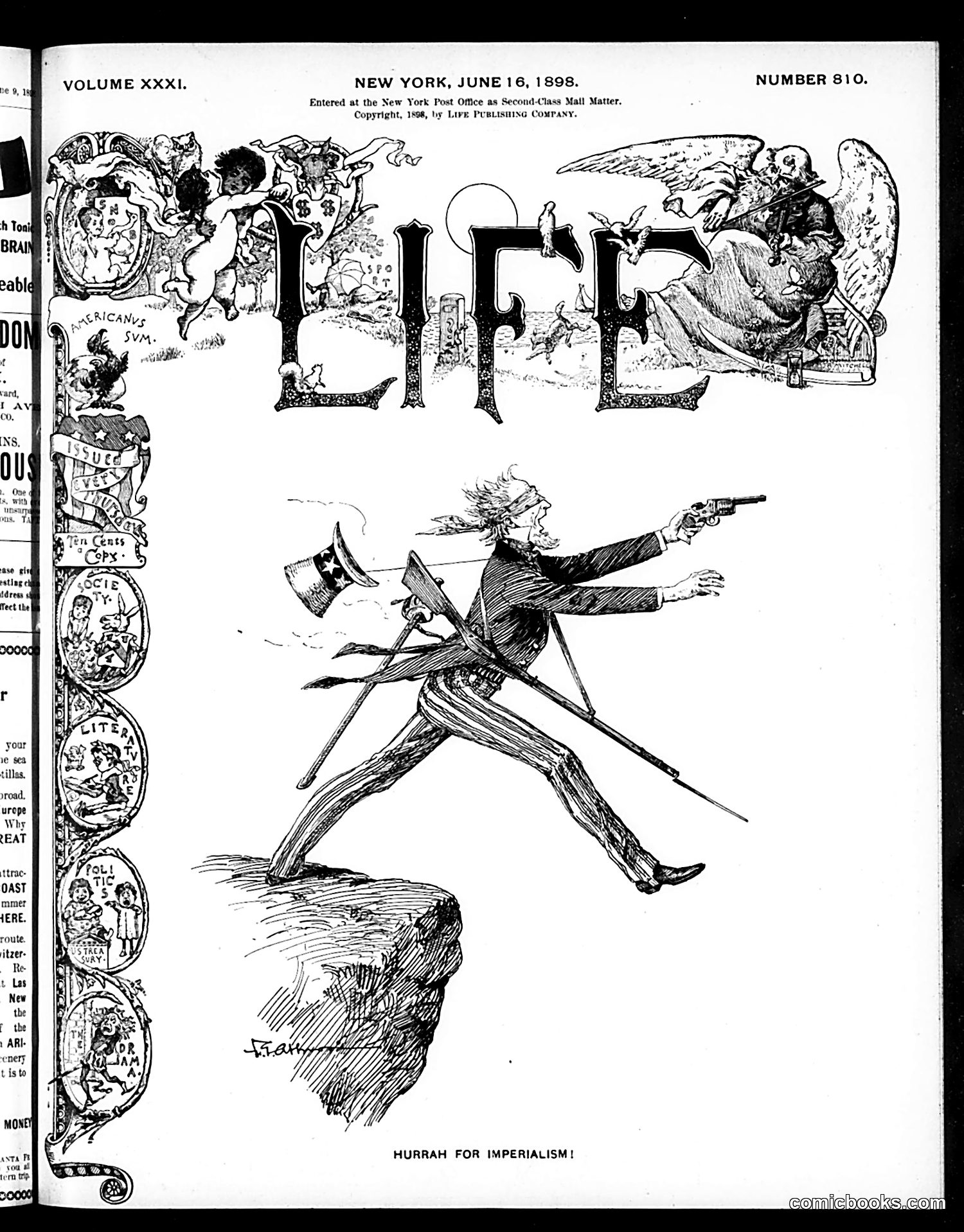
This cartoon satirizes American imperial ambitions during the Spanish-American War era. The main figure appears to be Uncle Sam (identifiable by his characteristic outfit and top hat), depicted as a wildly gesticulating politician wielding a gun while standing on a cliff edge. His dynamic, unbalanced pose suggests reckless abandon rather than careful statecraft. The caption "Hurrah for Imperialism!" delivers ironic criticism—the cartoon mocks the era's imperialist fervor by portraying such policies as chaotic and dangerous. The precarious cliff-edge positioning implies that aggressive imperial expansion threatens America's stability. This reflects contemporary debate over whether the U.S. should acquire overseas territories following its 1898 war with Spain.
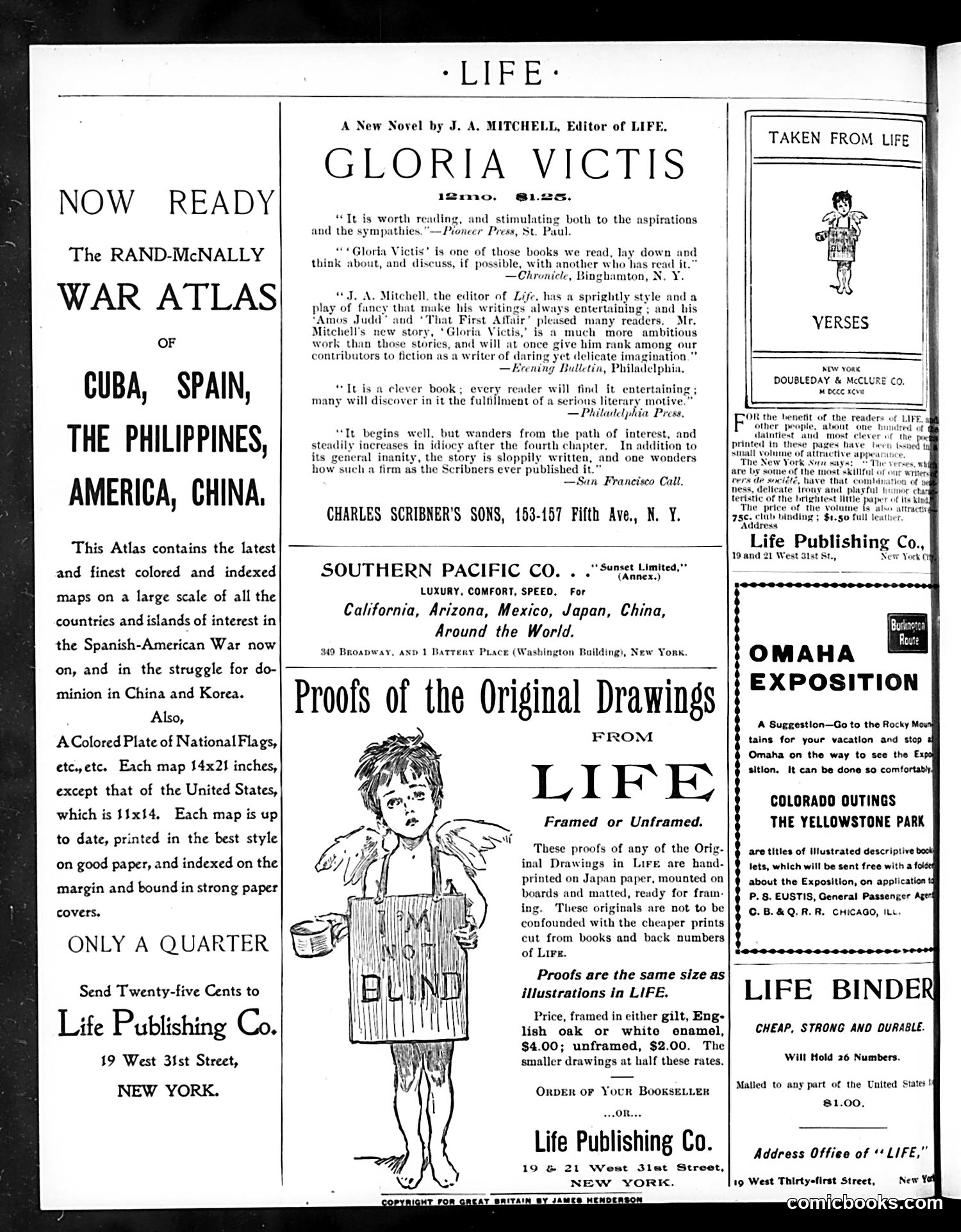
This page is primarily **advertising and announcements** rather than satirical content. The main elements include: 1. **War Atlas advertisement** (left): Promotes a Rand-McNally atlas covering Cuba, Spain, Philippines, America, and China—clearly referencing the Spanish-American War (1898) and contemporaneous conflicts in Asia. 2. **"Gloria Victis" novel advertisement** (center-top): Promotes a new novel by J.A. Mitchell, Life's editor, with positive reviews. 3. **Central illustration**: A childlike figure labeled "BLIND" holding a cane—appears to be advertising original drawings from Life, available framed or unframed. 4. **Right column**: Various advertisements including a poetry book, Life Binder, and Omaha Exposition details. The "Blind" figure's meaning is unclear from context alone—it may reference the quality of the artwork or be a visual pun, but the specific satirical point isn't evident.
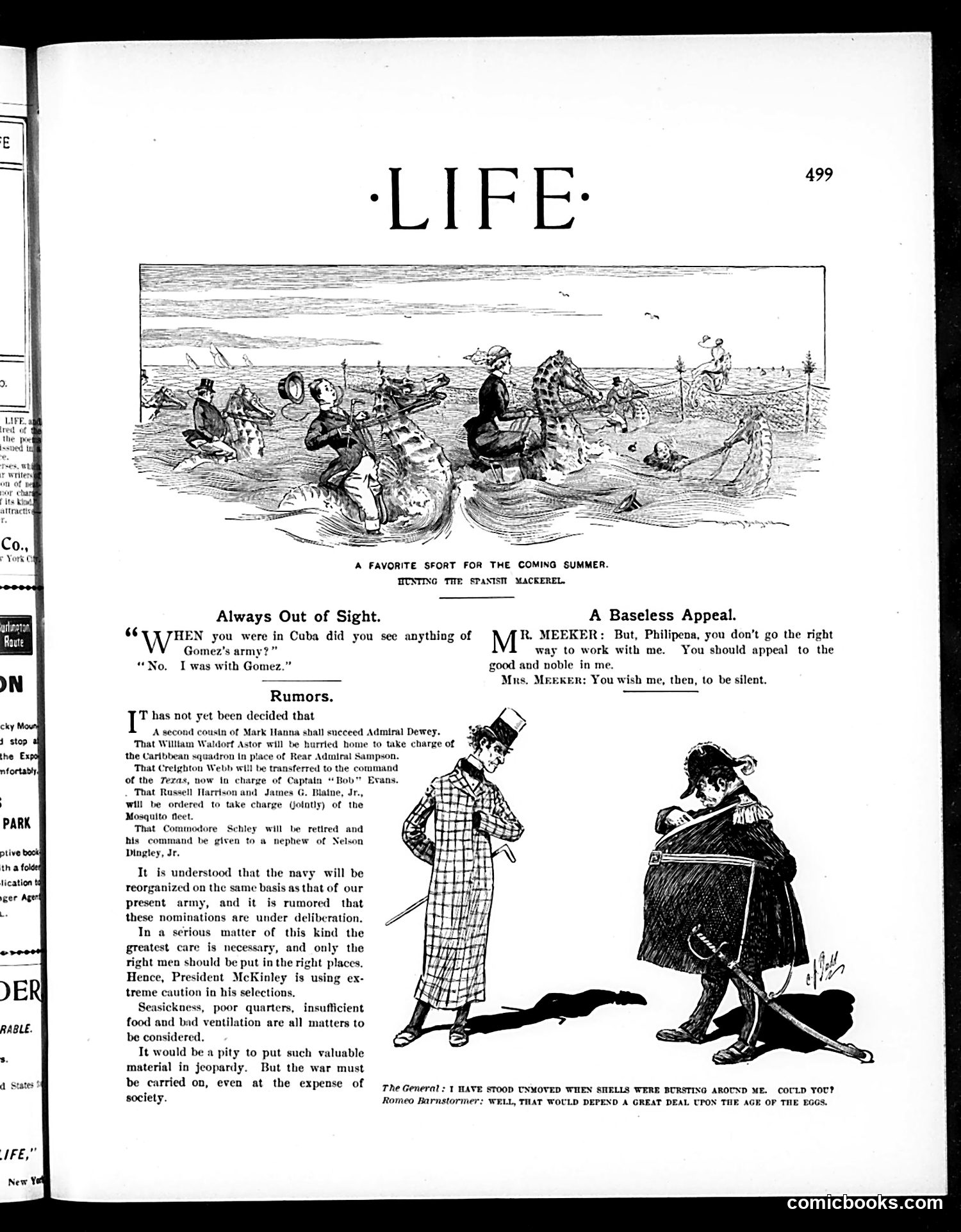
**Top Illustration:** "A Favorite Sport for the Coming Summer—Hunting the Speckled Mackerel" depicts people fishing from boats, a lighthearted summer recreation scene. **Three Pieces Below:** 1. **"Always Out of Sight"** and **"A Baseless Appeal"**: Appear to be brief comedic dialogues, likely social humor about domestic or military life. 2. **"Rumors":** A column discussing naval reorganization under President McKinley, mentioning officer appointments and fleet restructuring. The text critiques poor military conditions (inadequate quarters, food, ventilation), arguing that wartime requires competent leadership. 3. **Bottom Cartoon:** Shows two military figures—one in a checkered uniform (appearing foolish or unprepared) confronting another in darker uniform. The caption suggests military incompetence or leadership disputes during the period (appears to be Spanish-American War era, circa 1898).
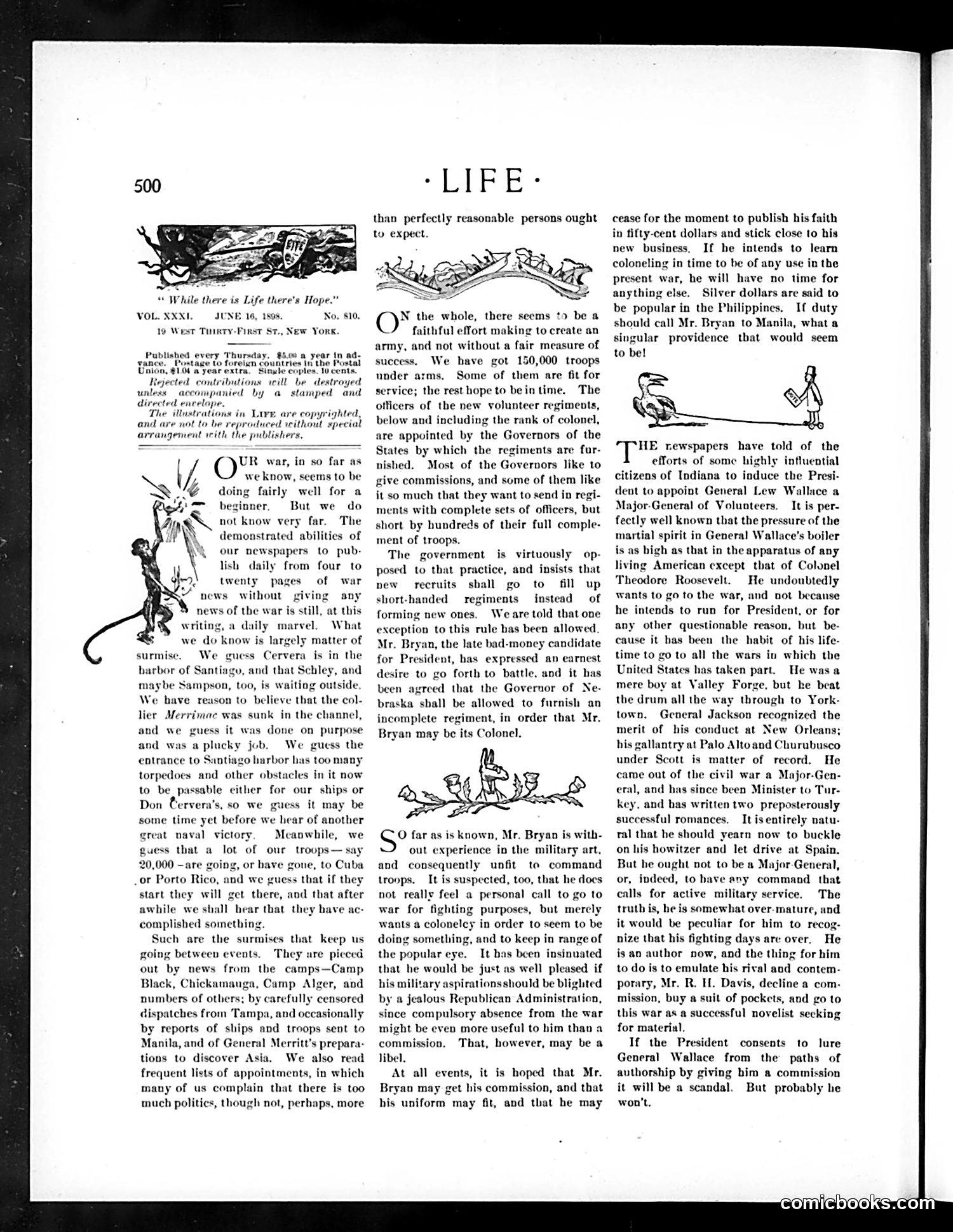
The page contains editorial commentary on the Spanish-American War and military recruitment, not political cartoons. The illustrated vignettes depict **newspaper editors** reporting on war news and **General Lew Wallace** (identified in text), who is being recruited or considered for a military commission. The satire criticizes: - Newspaper sensationalism in war coverage - The government's reliance on volunteer regiments with inexperienced officers - William Jennings Bryan's (mentioned) political ambitions disguised as patriotic military service The cartoons mock how editors fabricate dramatic stories without verified facts, and suggest prominent citizens like Wallace seek military commissions for political rather than patriotic reasons. The broader critique is about opportunism masquerading as wartime service.
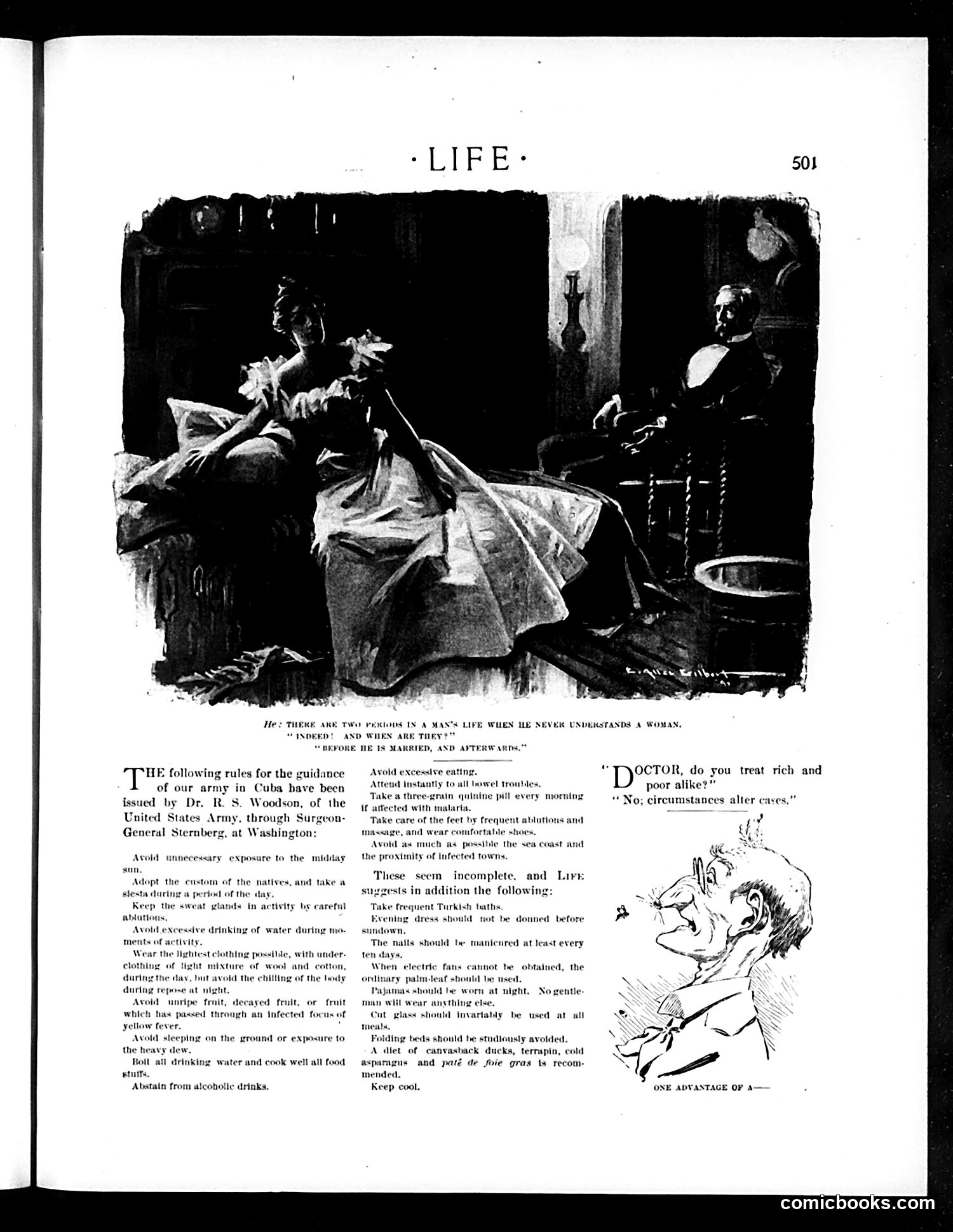
The main illustration depicts a domestic scene with a woman in elaborate dress reclining while a man in formal attire sits nearby. The caption quotes dialogue about "two foreign in a man's life"—likely referencing romantic or marital relationships. Below, the left column presents health guidelines for U.S. Army personnel stationed in Cuba, addressing practical concerns like sun exposure, hygiene, tropical diseases, and alcohol consumption—reflecting military medical wisdom of the era. The right section includes a doctor joke ("Do you treat rich and poor alike?" / "No, circumstances alter cases"), playing on class differences in medical treatment. The small sketch on the right appears to illustrate one advantage of something, though the context is cut off. This appears to be early 20th-century content mixing domestic humor with practical military health advice.
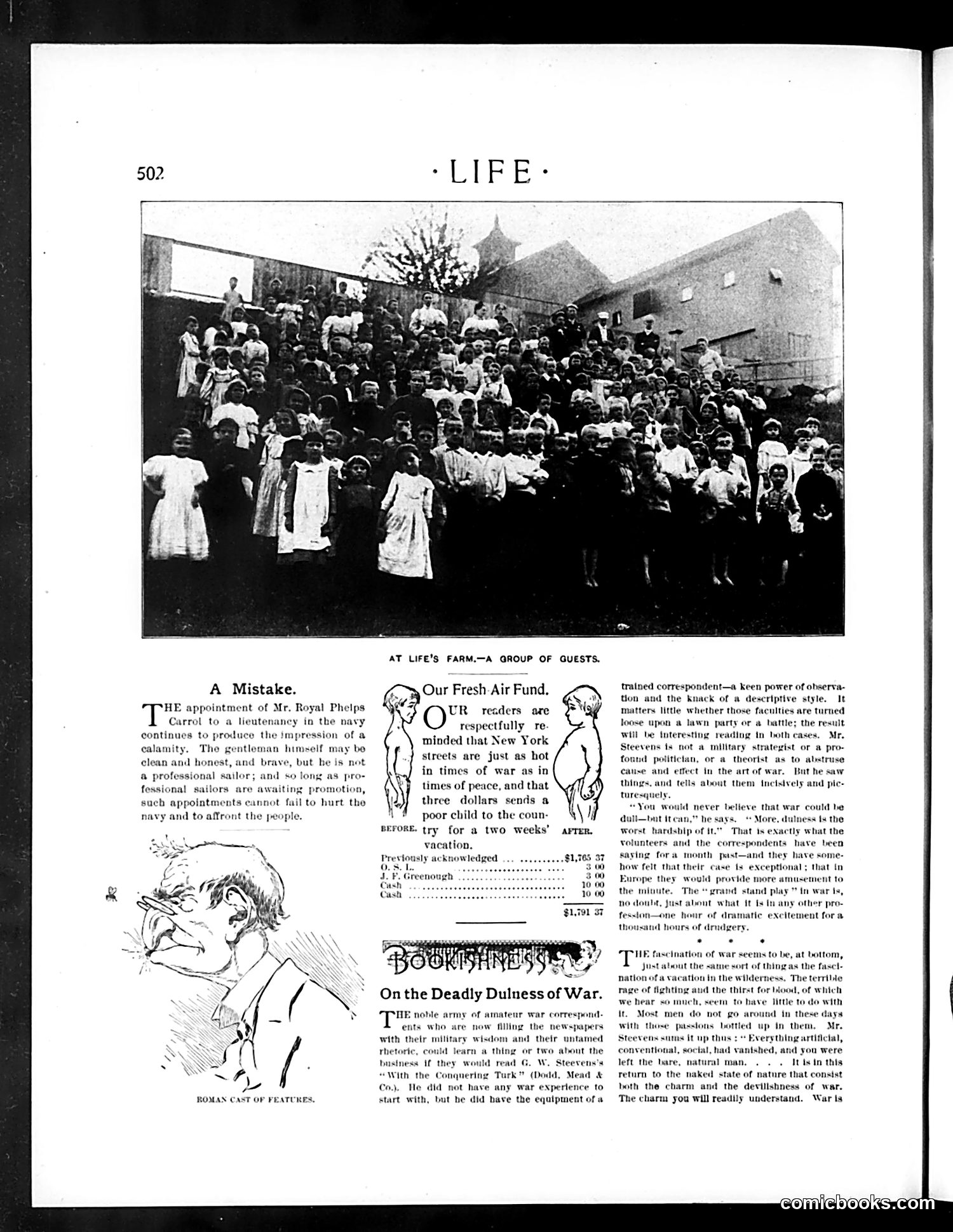
**Main Content:** This page contains three distinct pieces of social commentary: 1. **"A Mistake"** critiques Royal Phelps Carroll's appointment as a testimony witness, questioning his credibility as a "professional sailor" unsuited for public trust. 2. **"Our Fresh Air Fund"** satirizes New York's summer heat by suggesting three dollars could send a poor child to the country for two weeks—implying this modest charitable effort is inadequate response to urban poverty and dangerous conditions. 3. **"On the Deadly Dullness of War"** mocks amateur war correspondents now filing newspaper accounts with military "wisdom," suggesting they lack actual combat experience and peddle clichéd war rhetoric. The **"Roman Cast of Features"** illustration appears to be unrelated character study. The top photograph shows a large outdoor gathering, identified as "at Life's Farm—a group of guests."
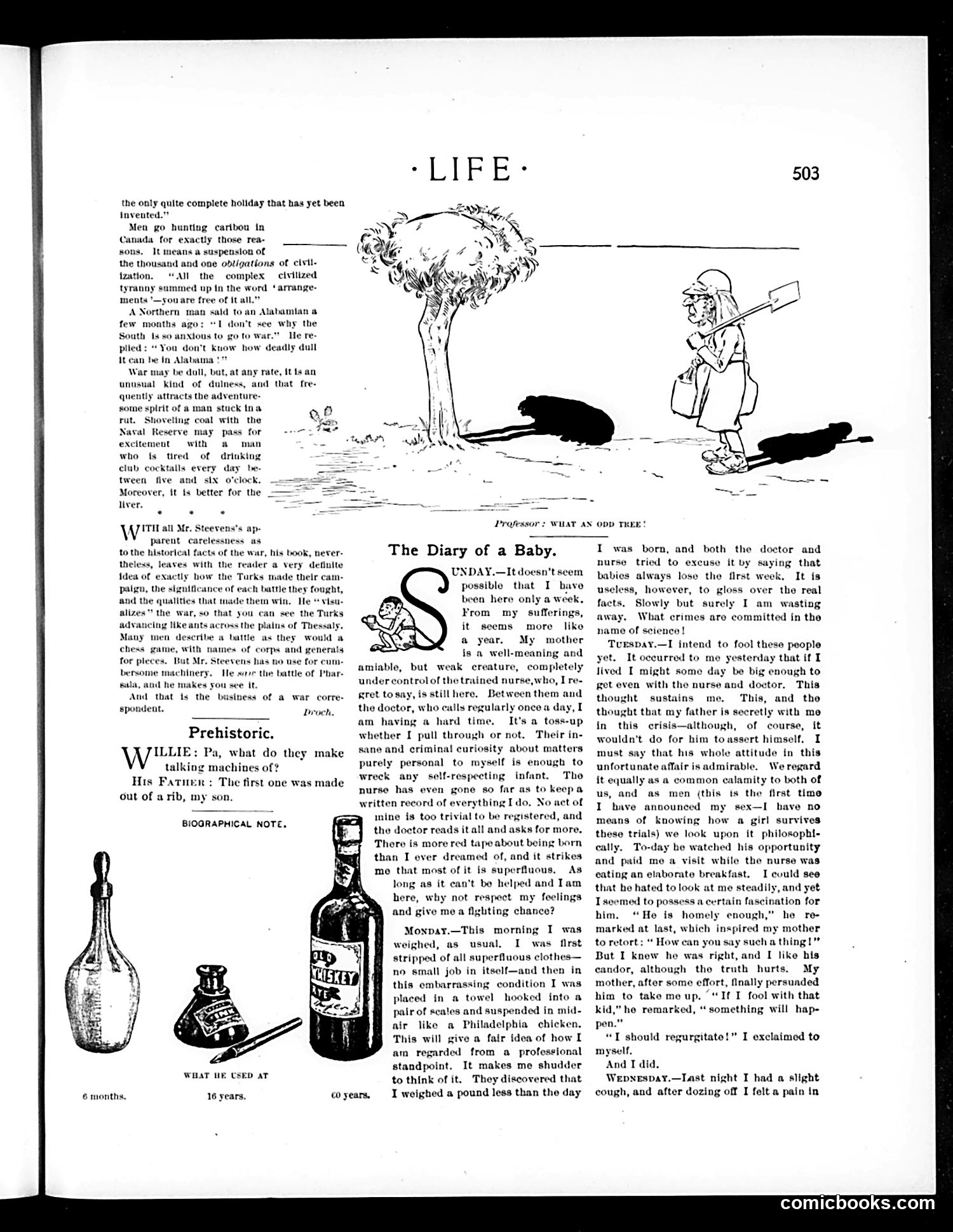
**Main Cartoon ("What an Odd Tree"):** Shows a professor observing two dark figures lying beneath a tree while a man with a gun stands nearby. The caption's ironic title suggests the professor is mistaking something sinister for natural scenery. This likely satirizes academic obliviousness to contemporary violence or social problems. **"Prehistoric" Section:** A humorous "biographical note" showing bottles of alcohol at life stages: 6 months, 16 years, and 60 years. This mocks the progression of drinking habits, suggesting alcohol consumption increases with age—a commentary on social drinking culture. **"The Diary of a Baby":** A satirical first-person account from an infant critiquing medical professionals, nurses, and parents. The humor derives from the baby's precocious observations about being weighed, examined, and discussed as if unconscious—mocking medical indifference and the infant's lack of agency.
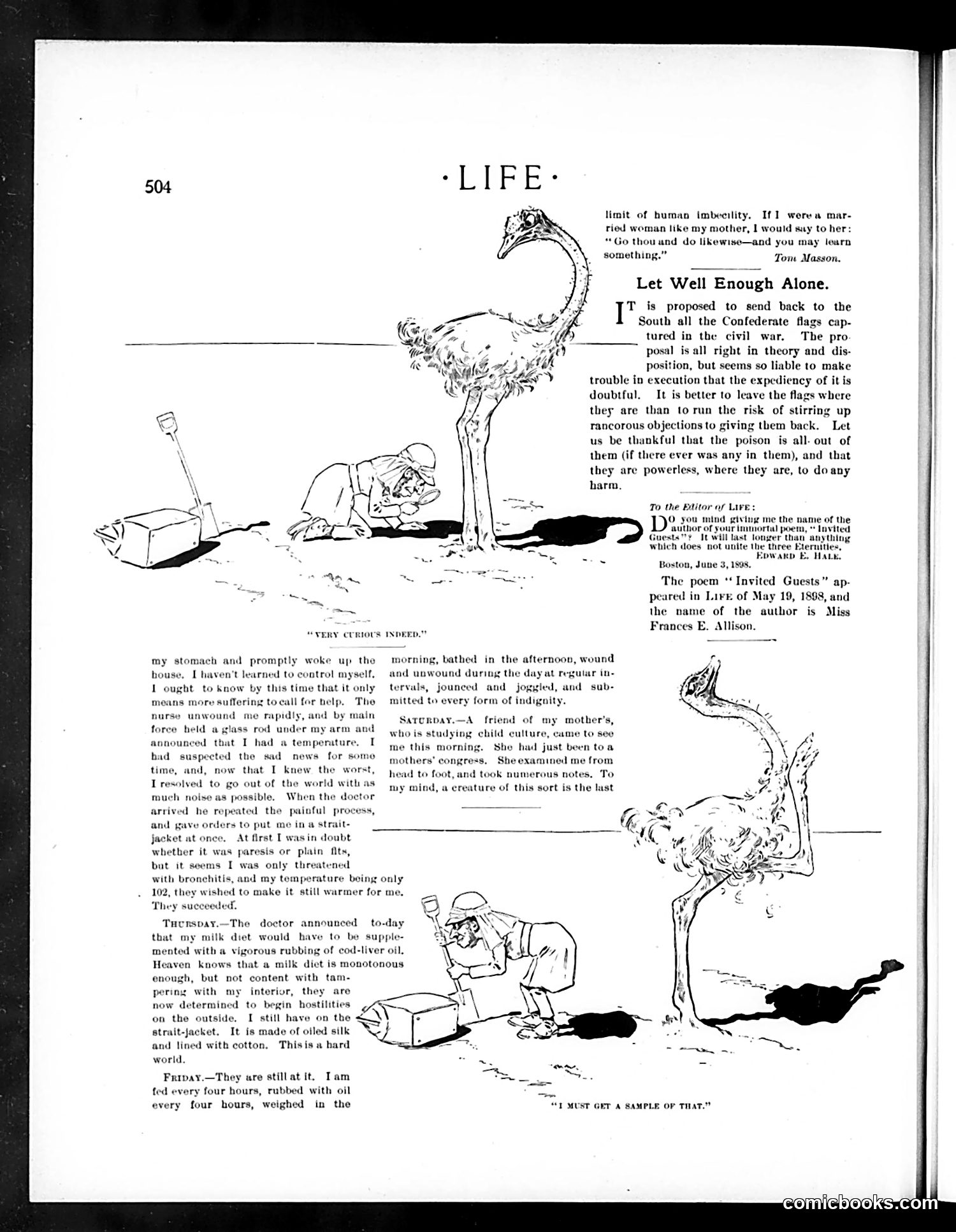
This 1908 *Life* magazine page satirizes a proposal to return Confederate flags captured during the Civil War to the South. The main cartoon depicts an ostrich (representing the proposal's supporters) alongside a soldier examining the flags, with the caption "Very Curious Indeed." The article argues against returning these flags, warning that doing so risks "stirring up rancorous objections" and that it's better to leave them where they are—powerless and forgotten. The cartoonist suggests that reviving these symbols would unnecessarily inflame sectional tensions decades after the Civil War's end. The accompanying sketches appear to satirize Southern reactions to the proposal, likely mocking resistance or opposition. The overall message: let sleeping dogs lie regarding Civil War memorabilia.
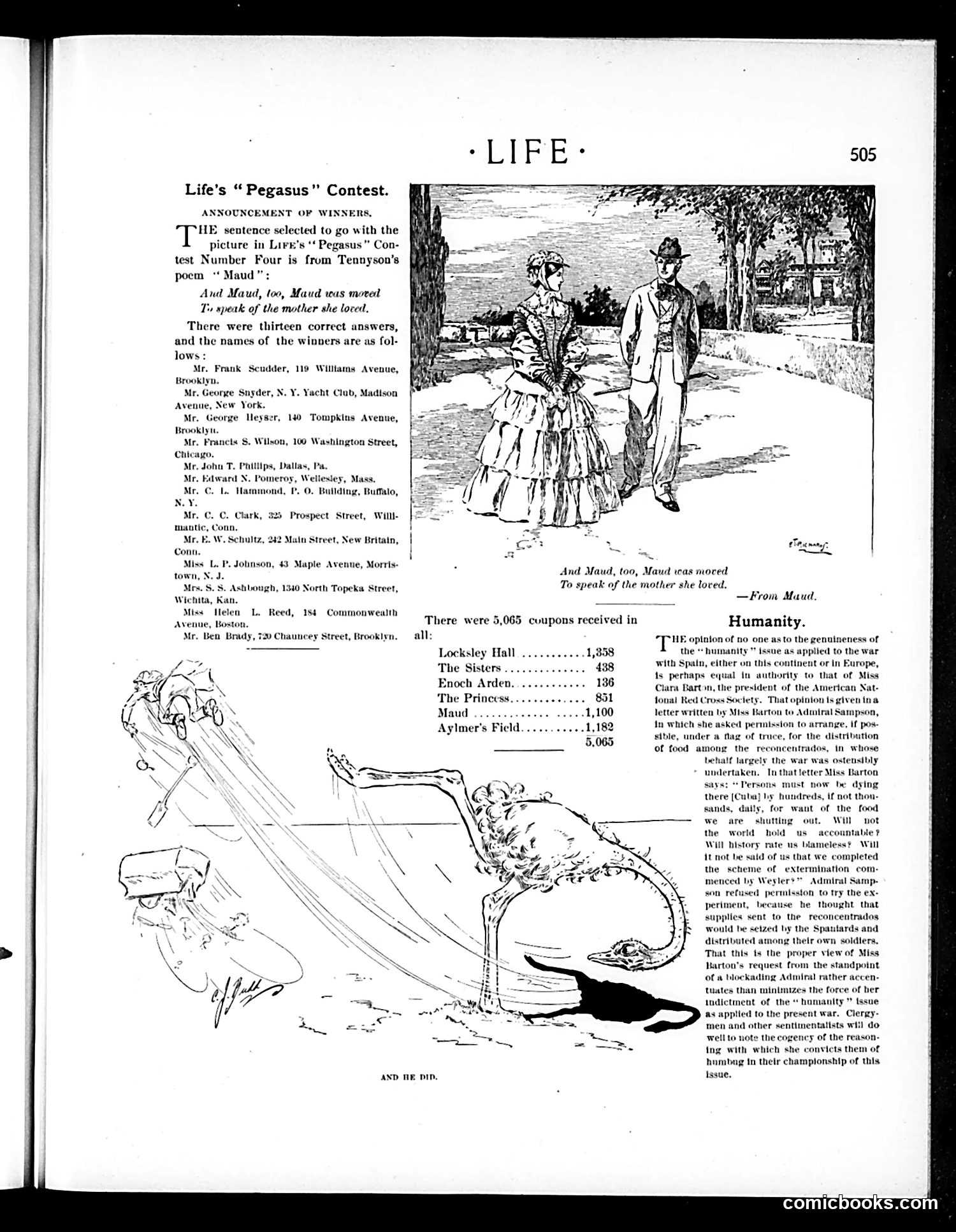
This page announces winners of Life's "Pegasus" Contest, selecting a sentence from Tennyson's poem "Maud" to accompany a picture. The contest received 5,065 coupons distributed across six publications. The upper illustration shows a Victorian-era couple in a romantic scene, with the caption quoting "Maud": "And Maud, too, Maud was moved / To speak of the mother she loved." The lower cartoon labeled "AND HE DID" depicts a figure in what appears to be a satirical scene, though its specific meaning is unclear from context alone. The "Humanity" article discusses Red Cross relief efforts during wartime, referencing Miss Barton and distribution of food supplies to war-affected regions, though specific dates or conflicts aren't stated.
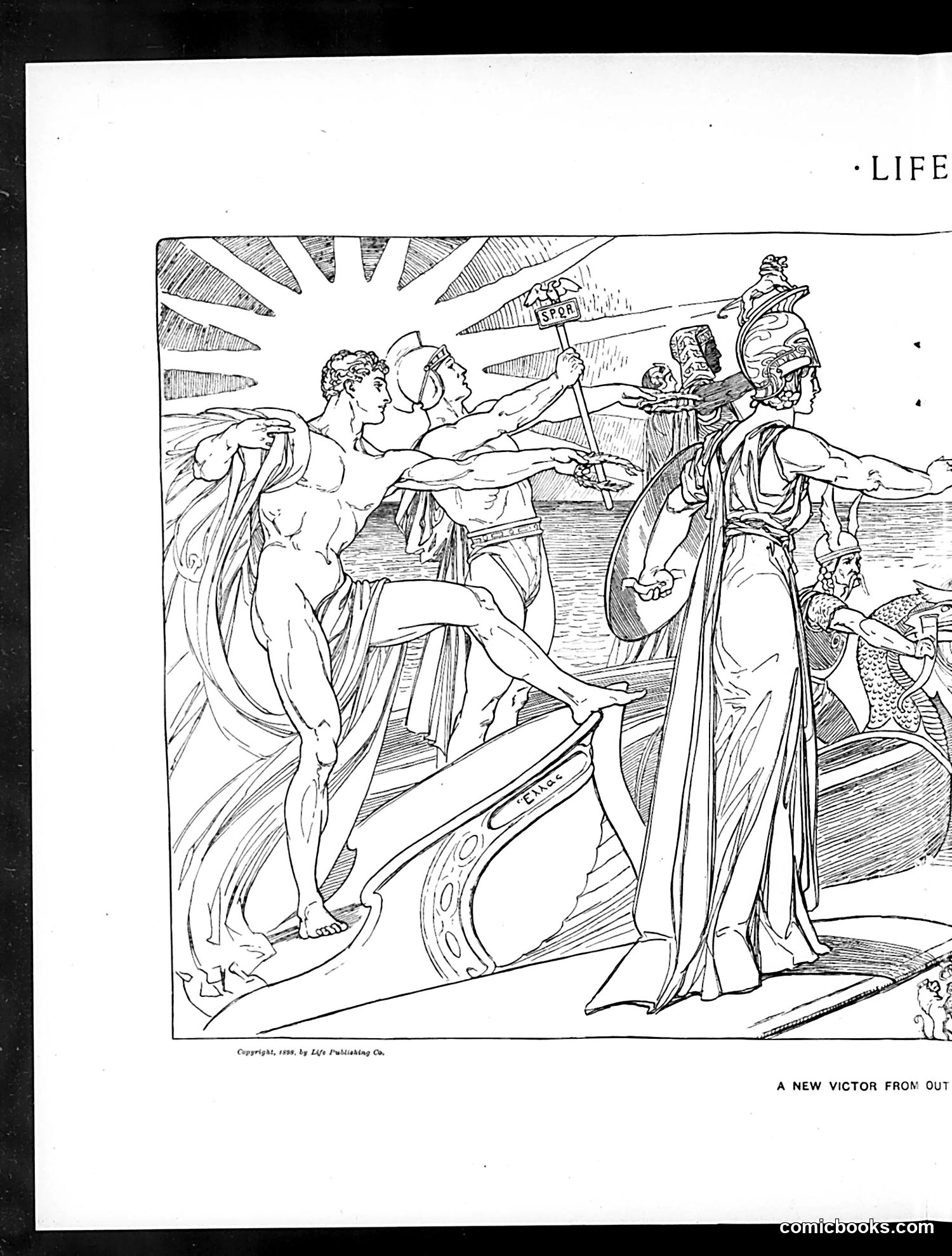
This classical allegorical illustration depicts a naval or maritime victory scene. The composition shows figures in Greco-Roman style: winged Victory personified on the left, classical warriors and officials in the center and right, with ships visible in the background beneath radiating sunbeams suggesting divine approval. The title "A New Victor From Out" suggests this celebrates a recent American naval or military triumph, though the specific event isn't identified on this page fragment. The classical artistic style was typical of Life's patriotic illustrations during periods of American military success. Without additional context or caption text, the precise historical event referenced remains unclear, though the iconography—Victory, classical warriors, ships—indicates a naval victory worth celebrating in 1906 or thereabouts.
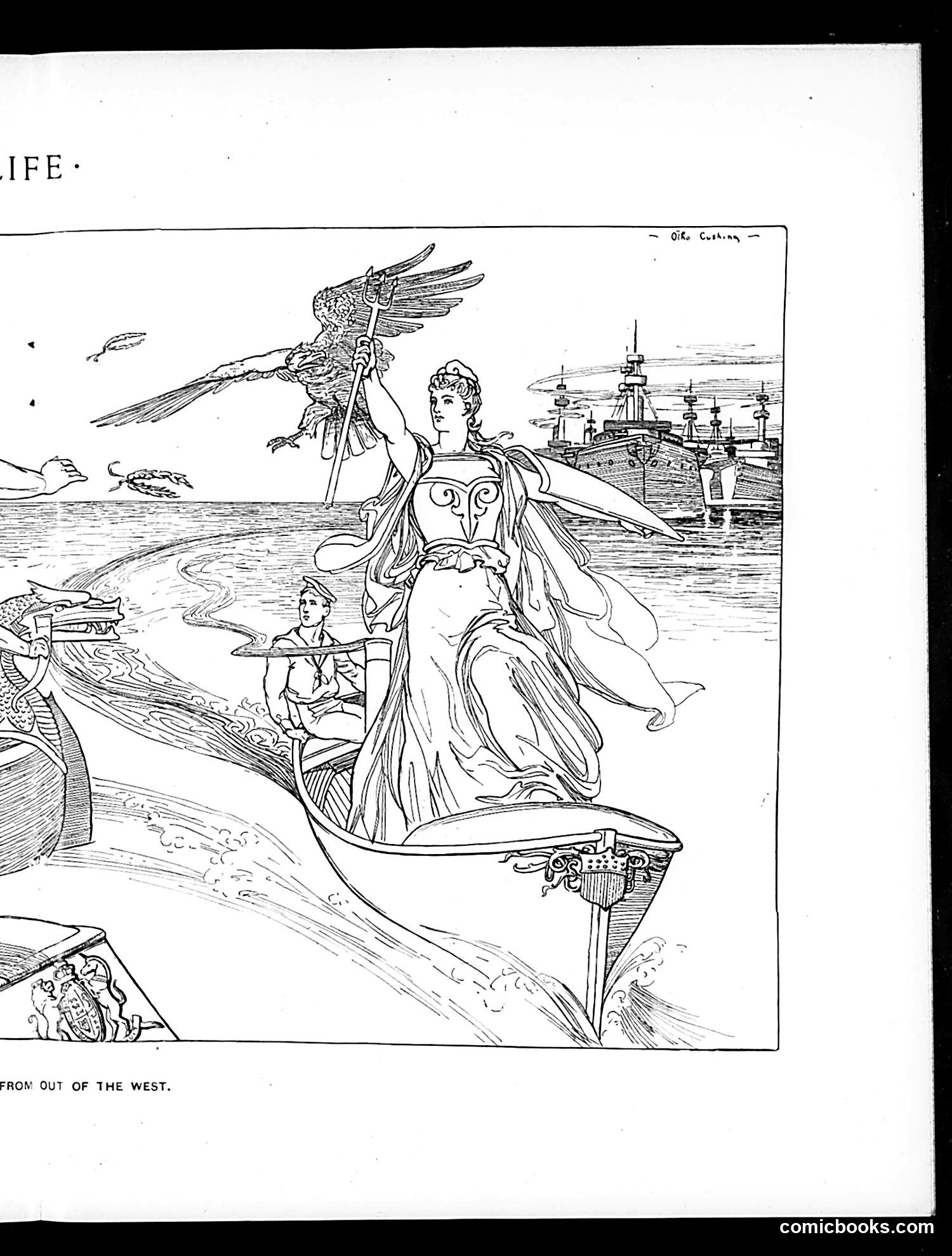
This illustration depicts **Britannia**, the female personification of Britain, standing prominently in a naval vessel. She holds a trident and is accompanied by an eagle (likely representing imperial power or possibly an American eagle, given the caption). A young cherub or putti figure sits beside her. The caption reads "FROM OUT OF THE WEST," suggesting this represents either American intervention or influence arriving to support British interests—possibly referencing American naval or military support during a conflict period. The warships visible in the background emphasize military/naval themes. The ornate heraldic shields on the left suggest imperial insignia. Without the magazine's publication date visible, the specific historical context remains unclear, though the imagery suggests WWI-era British-American alliance themes or earlier imperial power dynamics.
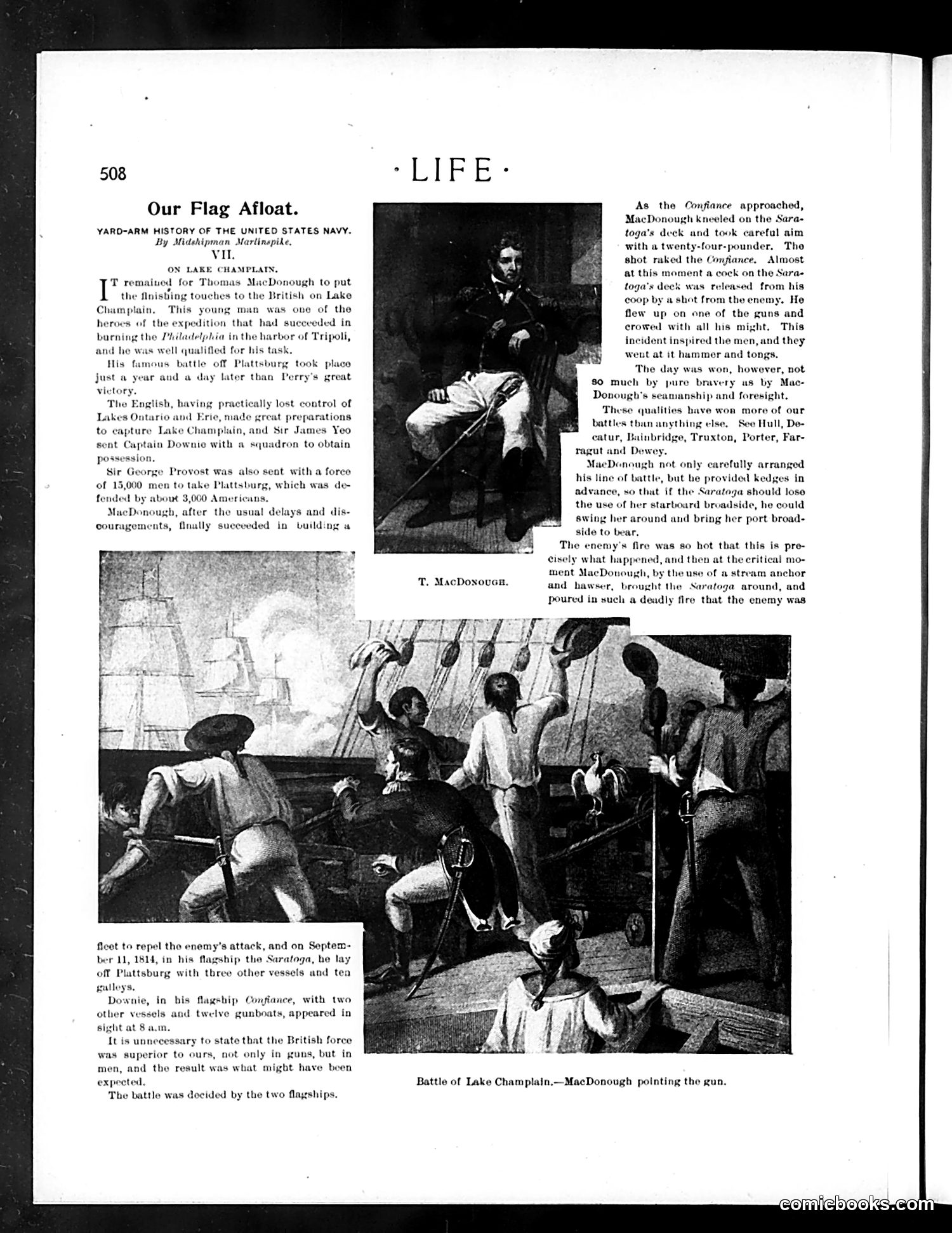
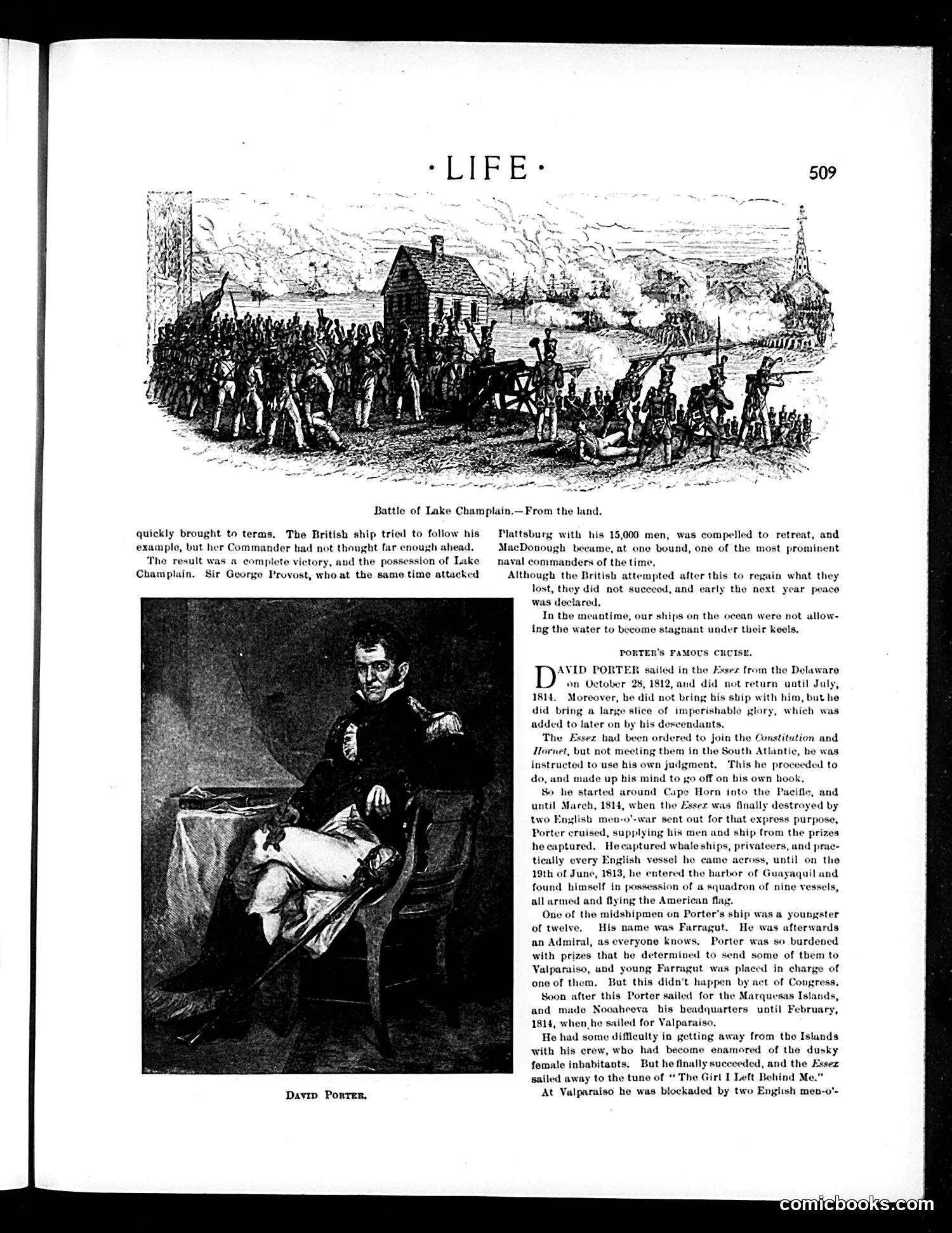
This page presents a historical narrative rather than satire. It chronicles Commodore Thomas MacDonough's naval victory on Lake Champlain during the War of 1812. The portrait shows MacDonough himself. The lower illustration depicts the "Battle of Lake Champlain," showing him directing cannon fire against British forces. The text emphasizes how MacDonough's superior seamanship and tactical foresight—particularly his use of a stream anchor and strategic positioning—enabled an outnumbered American force to defeat the British. This is celebratory military history, not political satire. Life magazine here functions as a patriotic publication showcasing American naval achievement. The content reflects early 20th-century American nationalism and pride in the navy's historical role.
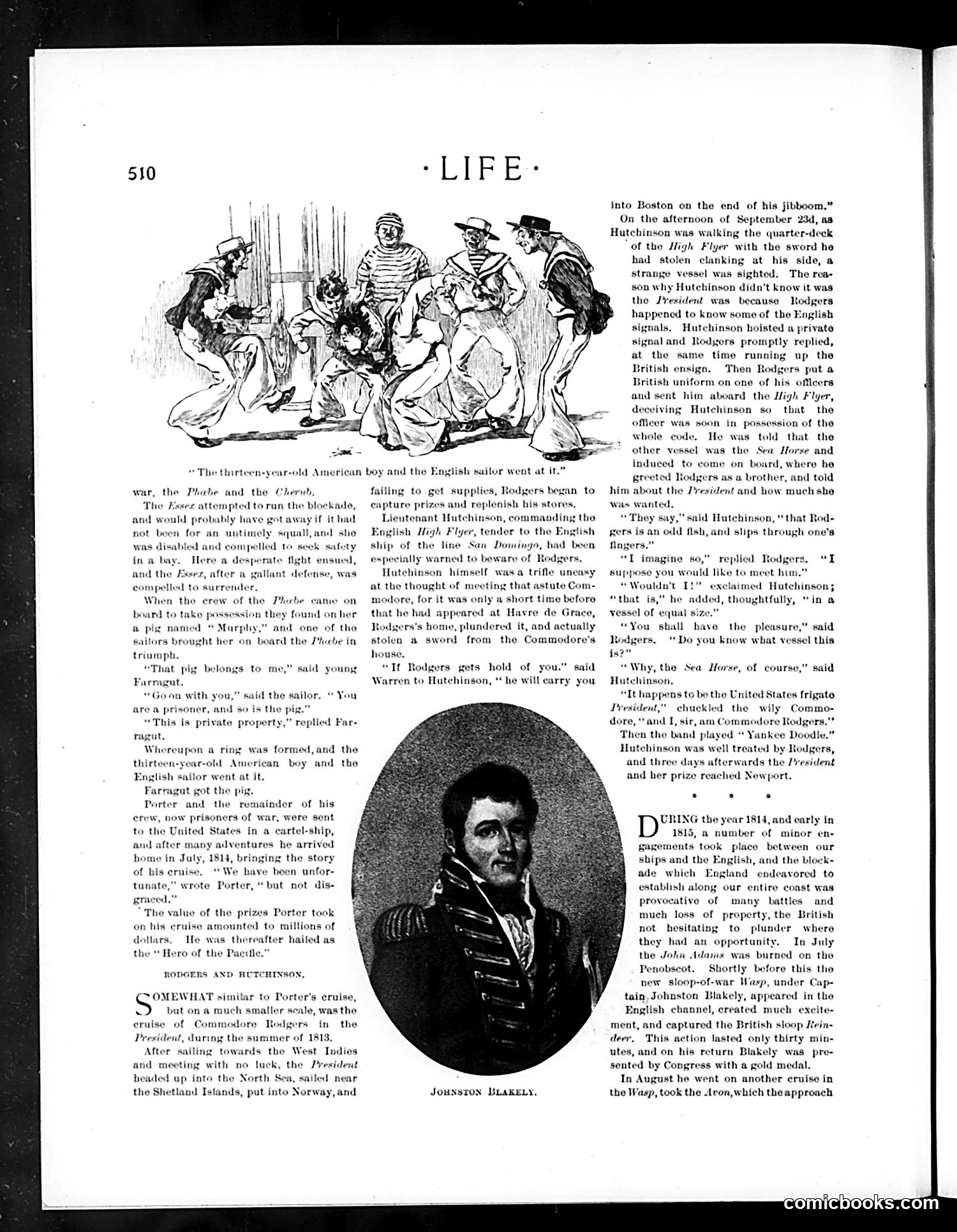
This page celebrates **David Porter**, a U.S. naval commander from the War of 1812. The portrait shows Porter in formal naval dress. The text describes Porter's remarkable 1812-1814 cruise aboard the USS *Essex* around Cape Horn into the Pacific. Rather than joining other American ships as ordered, Porter independently captured numerous British vessels (whalers, privateers, merchant ships) to supply his crew, effectively conducting commerce raiding. The article highlights that young **David Farragut**—later a famous Civil War admiral—served as a twelve-year-old midshipman under Porter and was placed in command of a captured prize ship. The satire's point appears to be admiration mixed with gentle humor about Porter's independence: he ignored orders, operated "on his own hook," and returned without his ship but with considerable "imperishable glory" and captured vessels. The reference to crew members reluctant to leave the Marquesas Islands (attracted to "dusky female inhabitants") adds lighthearted color to the adventure narrative.
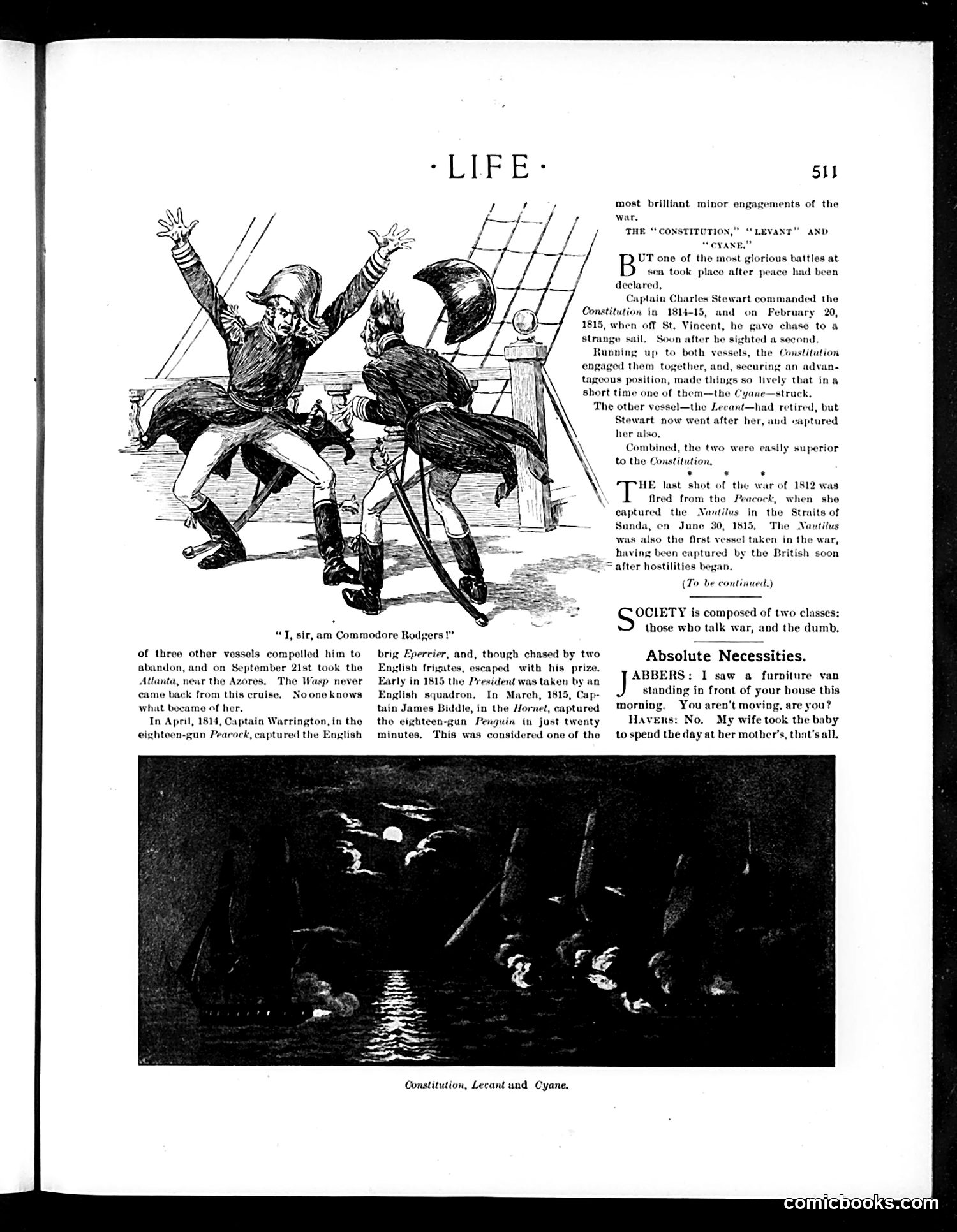
This page celebrates American naval commanders during the War of 1812, specifically Commodore Rodgers and Lieutenant Hutchinson's encounter. The text describes a deceptive capture: Rodgers, commanding the frigate *President*, disguised his vessel as the British *Sea Horse*, tricking the English captain Hutchinson of the *High Flyer* into boarding. The satirical humor derives from Hutchinson's embarrassment—he'd previously stolen a sword from Rodgers's home at Havre de Grace and boasted of evading him, only to be outwitted through clever deception. The portrait shown is Johnston Blakely, another celebrated American naval officer from the same period. The page constructs a narrative of American ingenuity and naval prowess against the British, presenting these encounters as victories of wit and courage. The earlier anecdote about young Farragut fighting an English sailor over a pig reinforces themes of American pluck versus British authority.
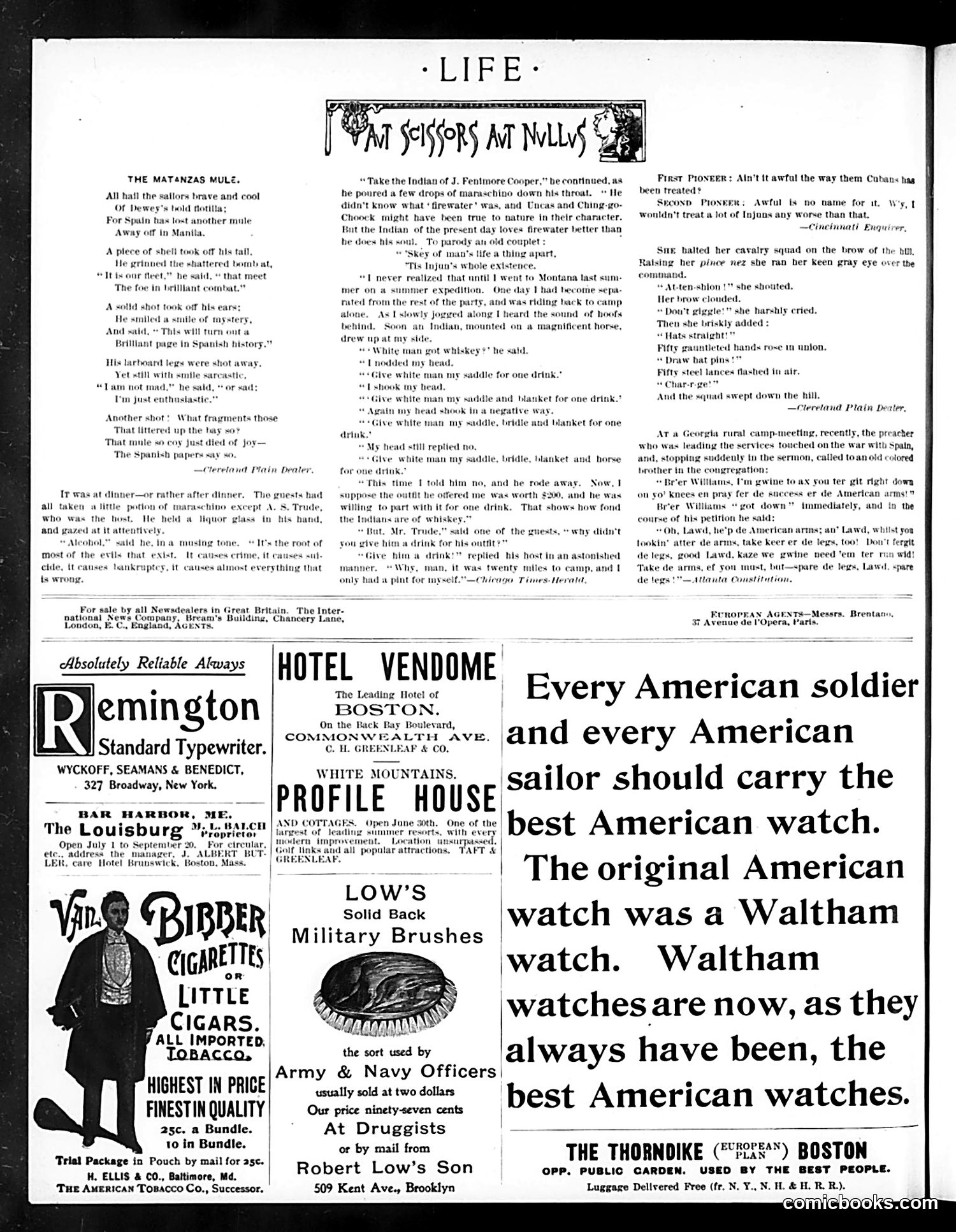
This page contains two distinct elements: **Upper portion:** A historical article about naval victories in the War of 1812, specifically Captain Charles Stewart's February 1815 engagement where the USS *Constitution* defeated two British vessels (*Cyane* and *Levant*) simultaneously—noteworthy because it occurred *after* peace was declared. The accompanying sketch shows sailors in combat on deck. **Lower portion:** An unrelated satirical cartoon titled "Absolute Necessities," depicting two men discussing a furniture van outside a house. The joke plays on marital dynamics: the husband claims his wife merely took their baby to her mother's house, but the presence of moving equipment suggests she's actually leaving him—a humorous commentary on domestic conflict and male obliviousness. The page also includes a cynical caption: "Society is composed of two classes: those who talk war, and the dumb"—typical of *Life* magazine's satirical tone about American society and military affairs.
This page contains **multiple satirical cartoons** mocking American attitudes toward the Spanish-American War and Native Americans. **"The Matanzas Mule"** (main cartoon) ridicules Spanish military incompetence by narrating how a mule, through absurd mishaps during battle, becomes a Spanish war hero. Each cannonball removes body parts, yet the mule remains "enthusiastic"—the joke being that Spain celebrates even pathetic military outcomes. **Secondary cartoons** include: - "Pioneers" debating whether treatment of Cubans versus Native Americans is worse—both groups portrayed as similarly disposable - A female cavalry officer leading an all-female squad ("Fifty gauntleted hands") - A Georgia preacher's prayer for American victory, with racial dialect humor The satire targets: Spanish military weakness, American indifference to colonial violence, and casual racism toward Native Americans and Black Americans. The cartoons assume readers share contempt for these groups while celebrating American military superiority during the 1898 war.
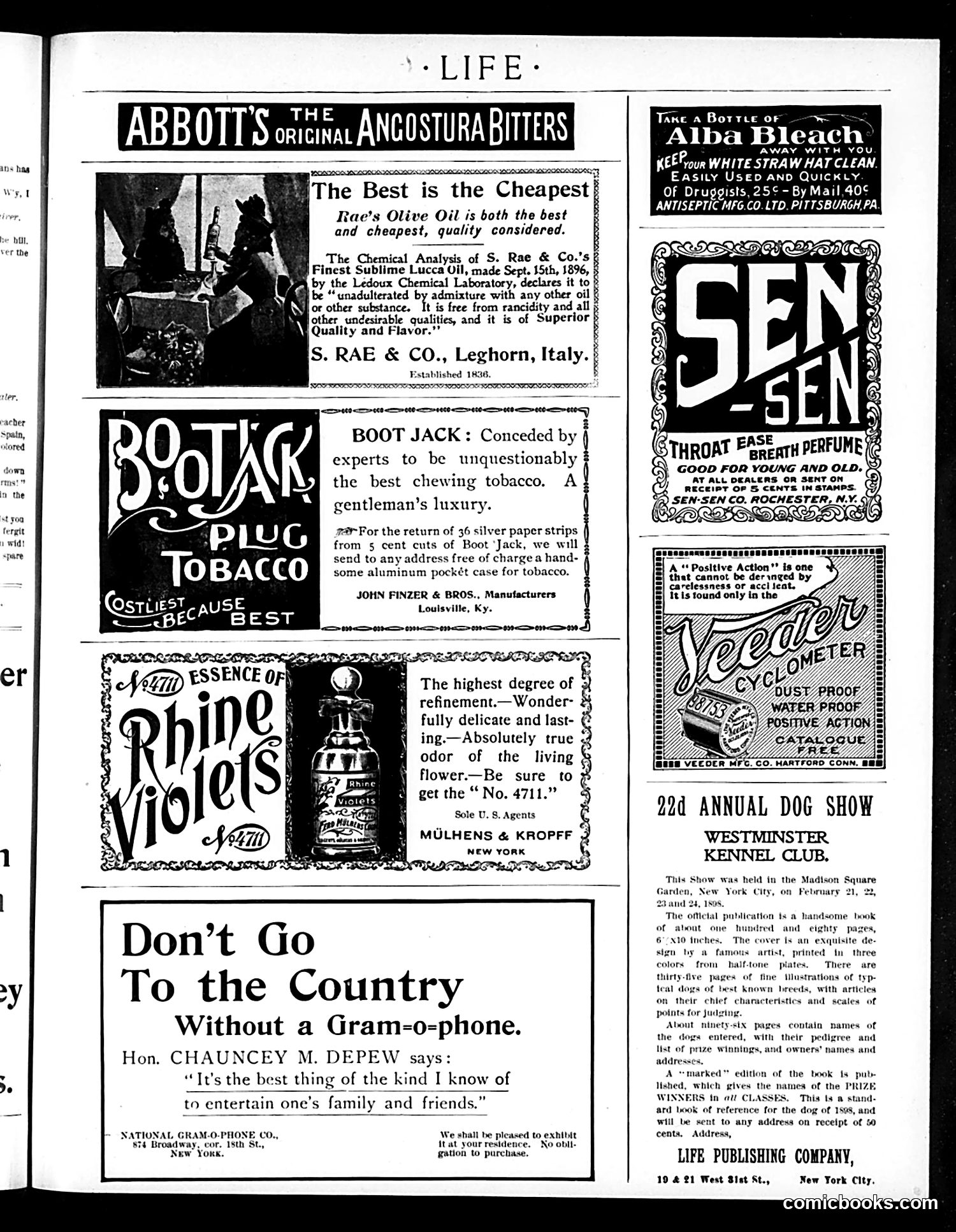
This is primarily an **advertising page**, not a political cartoon. It contains commercial advertisements typical of early 1900s Life magazine, including: - **Abbott's Angostura Bitters** and **S. Rae & Co.'s Olive Oil** (with chemical analysis claims) - **Boot Jack Plug Tobacco** (offering premium giveaways) - **Rhine Violets perfume** and other consumer products - **Alba Bleach** for hat cleaning - **Veeder Cyclometer** (bicycle odometer) - **Gram-o-phone** (early phonograph), endorsed by Hon. Chauncey M. Depew The only non-advertising content is an announcement of the **22nd Annual Westminster Kennel Club Dog Show** (February 1908). The page reflects early 20th-century consumer culture: patent medicines, tobacco products, and emerging technologies like phonographs were heavily advertised in magazines. The reliance on scientific endorsements and celebrity testimonials mirrors modern advertising tactics.
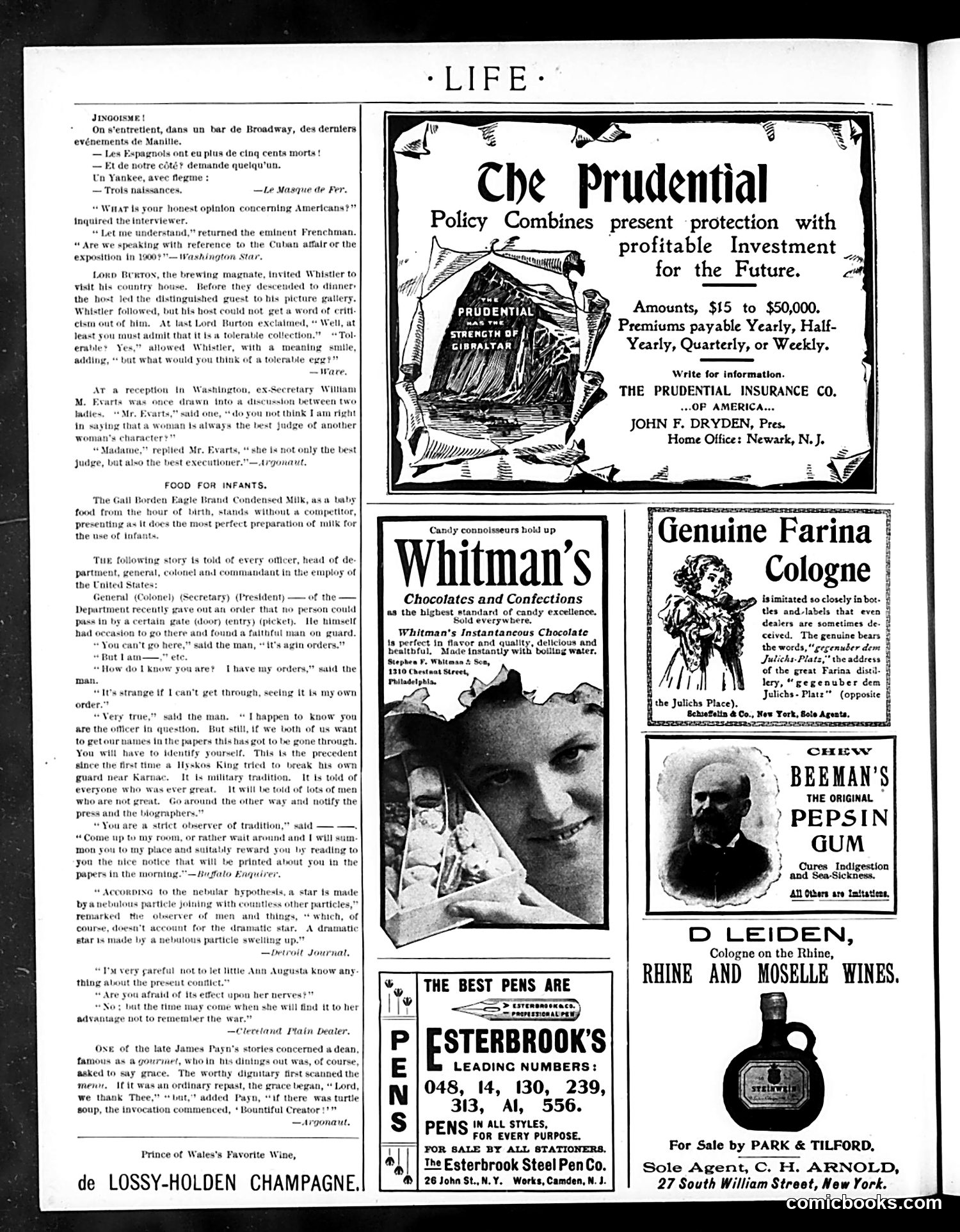
This is primarily an **advertising page** with brief satirical anecdotes in the margins. The main content consists of period product advertisements (insurance, chocolates, cologne, pens, champagne). The small jokes reference contemporary figures and events: - **Manila casualties**: A Franco-American exchange about Spanish losses in the Philippines (likely the Spanish-American War era, circa 1898-1900) - **Lord Brereton and Whistler**: References the famous American artist James McNeill Whistler visiting a British nobleman's art collection, known for his caustic wit - **Secretary Evarts anecdote**: Concerns William M. Evarts, a prominent 19th-century American politician and diplomat, in a discussion about women's judgment - **Military guard story**: A humorous tale about chain-of-command protocol and publicity-seeking The humor relies on wordplay, social commentary about propriety and vanity, and references to recognizable public figures of the era. The page format—mixing satirical content with advertisements—was typical of *Life* magazine's style as a genteel, urban-focused publication.
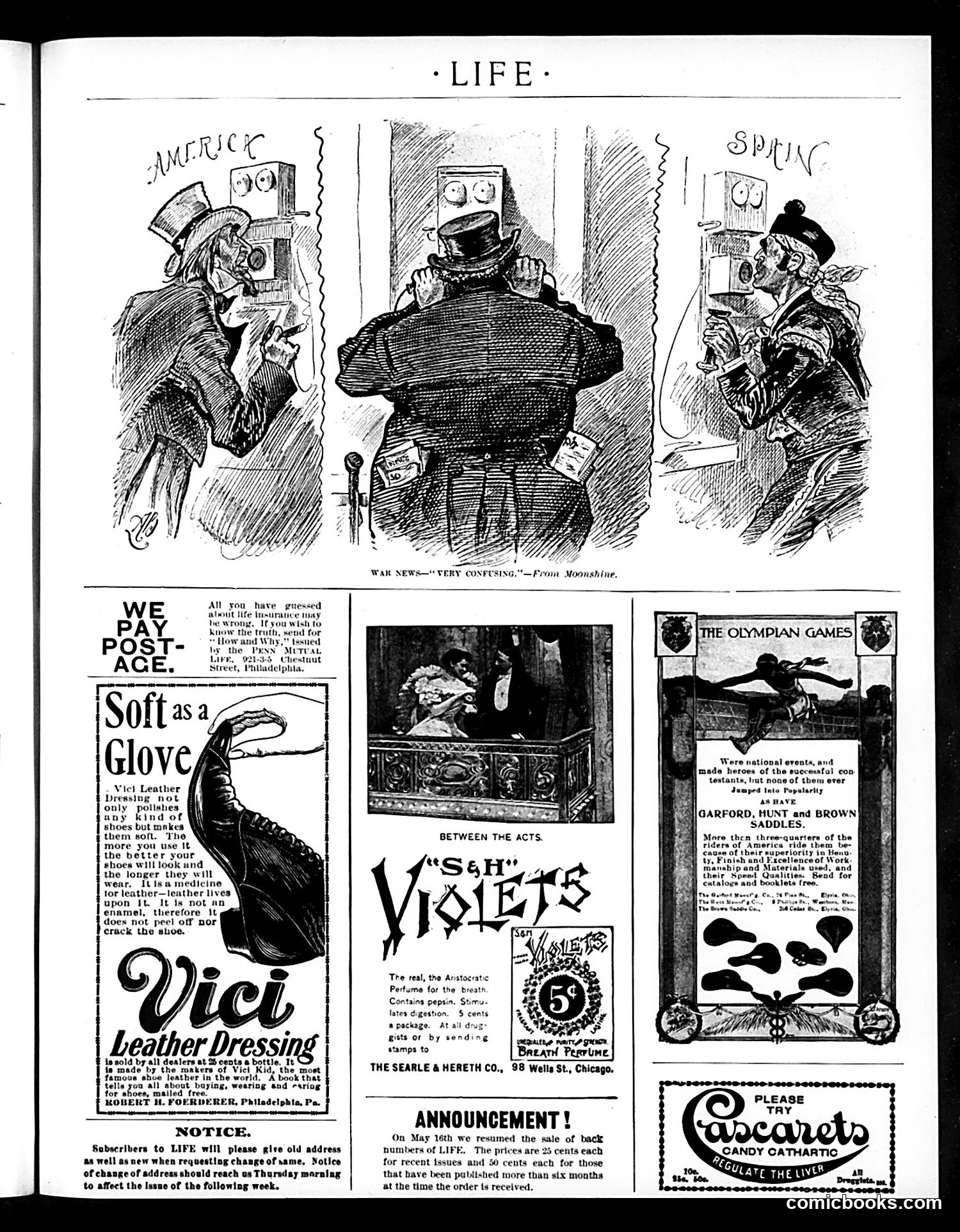
The top cartoon satirizes wartime news reporting during World War I. Three figures labeled "America," an unnamed center figure, and "Spring" appear to be receiving contradictory reports via telephone or communication devices mounted on walls. Each device displays confused faces, suggesting the news sources themselves are bewildered. The caption "War News—'Very Confusing'"—attributed to *Moonshine*—mocks the chaos and contradictions in battlefield dispatches reaching the home front. The satire critiques either: the unreliability of war correspondents, military censorship creating confusion, or the sheer incomprehensibility of modern industrial warfare to civilian audiences. The cartoon reflects American uncertainty about WWI, likely from early U.S. involvement (1917–1918), when citizens struggled to understand distant, rapidly changing military situations through incomplete or conflicting reports. The remainder of the page contains period advertisements and magazine notices, not satirical content.
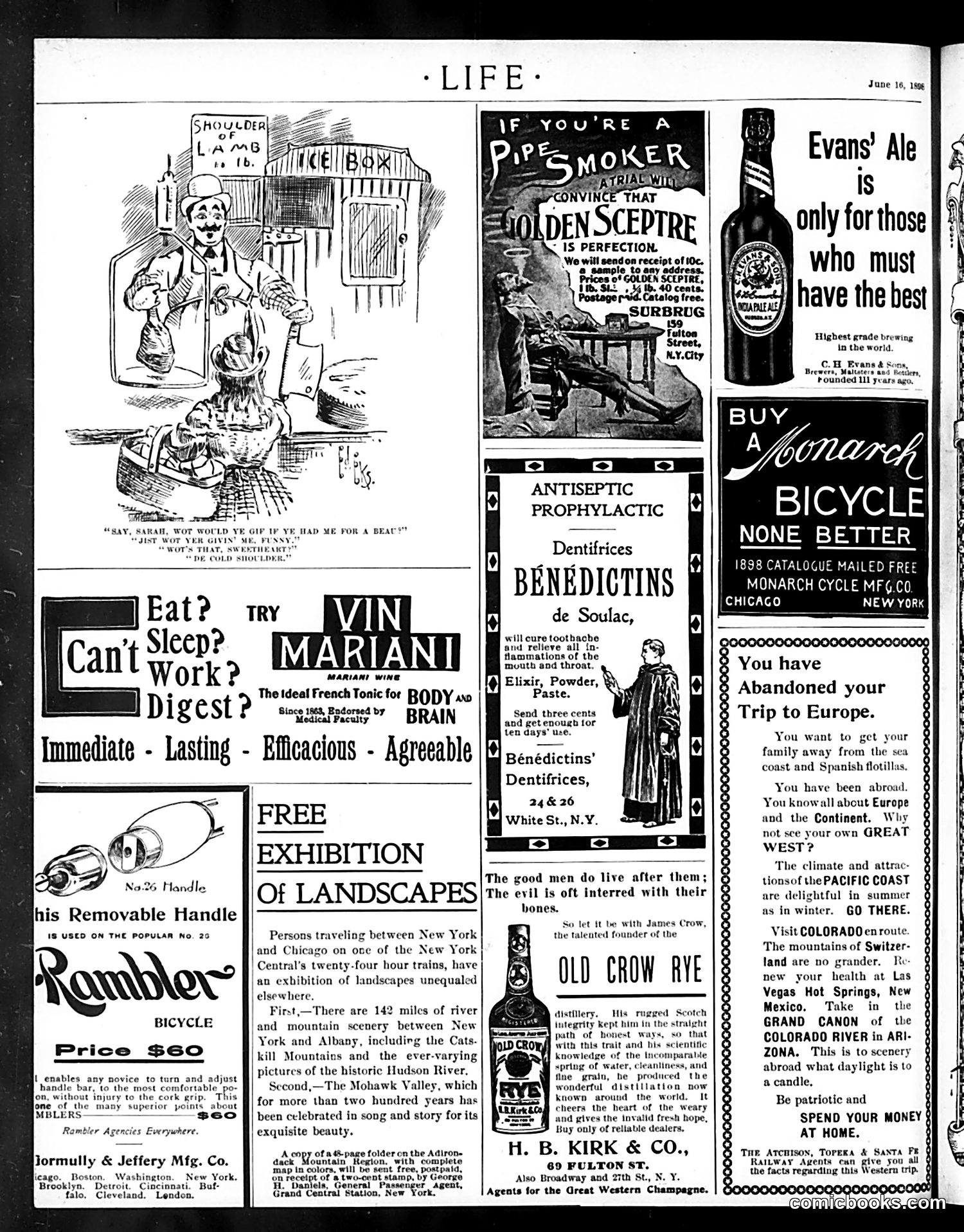
The main cartoon on the left depicts a butcher shop scene with working-class figures (appearing to be Irish or immigrant, based on dialect spelling). A butcher advertises "Shoulder Lamb," while a woman responds with exaggerated enthusiasm using heavy accent spelling ("Wot would ye gip iv ye had me for a beau?"). The satire targets **turn-of-the-century gender stereotypes and class humor**: the joke centers on a woman's mercenary interest in a suitor based on his meat-selling profession and ability to provide food. The crude dialect and caricatured figures reflect period attitudes toward working-class and immigrant communities as sources of comedic material. The page is primarily **advertisements** (bicycles, wines, tonics, toothpaste, spirits), typical of Life's revenue model. The 1898 date places this during the Spanish-American War era (referenced in the Colorado tourism ad suggesting Americans avoid Europe's coast due to Spanish naval threats).