
Life, 1898-06-16 · page 4 of 20
Life — June 16, 1898 — page 4: what you’re looking at
What you’re looking at
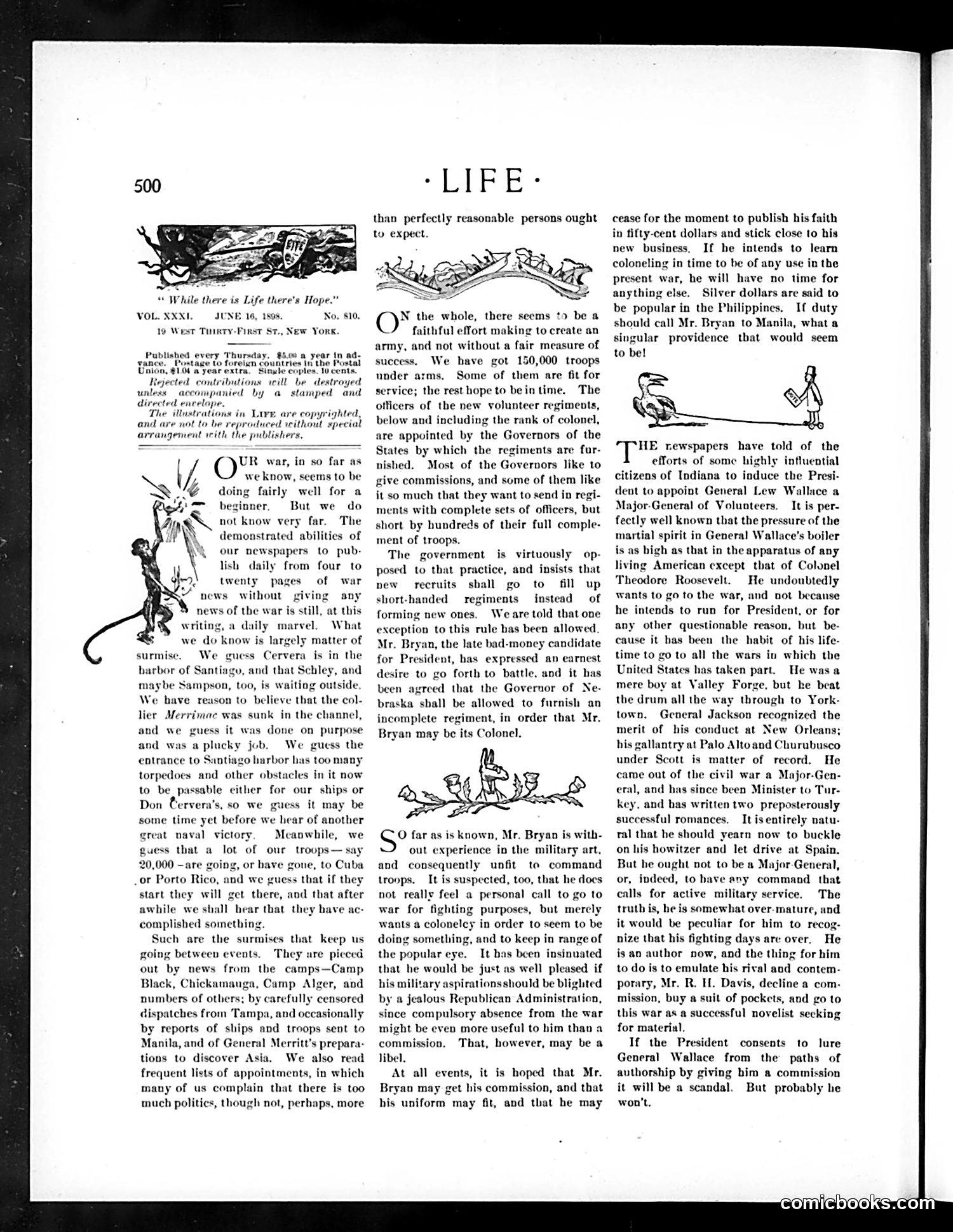
The page contains editorial commentary on the Spanish-American War and military recruitment, not political cartoons. The illustrated vignettes depict **newspaper editors** reporting on war news and **General Lew Wallace** (identified in text), who is being recruited or considered for a military commission. The satire criticizes: - Newspaper sensationalism in war coverage - The government's reliance on volunteer regiments with inexperienced officers - William Jennings Bryan's (mentioned) political ambitions disguised as patriotic military service The cartoons mock how editors fabricate dramatic stories without verified facts, and suggest prominent citizens like Wallace seek military commissions for political rather than patriotic reasons. The broader critique is about opportunism masquerading as wartime service.
📄 Transcribed text from this page (OCR, searchable)
Machine-transcribed from the original scan — historical spelling and the odd misread are preserved.
“ While there is Life there's Hope.” VOL. XXXI. JUNE 16, 1898, No. 810, 19 West Tuiety-First St., New York. Published every Thursday. $5.00 a year f Postage to forein countries in the 0, #10 a year extra. Si Weents. Rejected contributions will be destroyed unless accompanied by a stamped and directed enc The illustrations in Lave are copyrighted, and are not to be reproduced without special arrangement with the publisher: UR wear, in so far as we know, scems to be doing fairly well for a beginner, But we do not know very far. The demonstrated abilities of our newspapers to pub- lish daily from four to twenty pages of war news without giving an: news of the war is still, at this writing, a daily marvel. What we do know is largely matter of surmise, We guess Cervera is in the harbor of Santiagu, and that Schley, and maybe Sampson, too, is waiting outside We bave reason to believe that the col- lier Merrimac was sunk in the channel, and we guess it was done on purpose and was a plucky job. We guess the entrance to Santiago harbor has too many torpedoes and other obstacles in it now to be passable either for our ships or Don Cervera’s, so we guess it may be some time yet before we hear of another great naval victory Meanwhile, we guess that a lot of our troops— say 20,000 oing, or have gone, to Cuba .or Porto Rico, and we guess that if they start they will get there, and that after awhile we shall hear that they have ac- complished somethi Such are the surmises that keep us going between events, ‘They are picced out by news from the camps—Camp Black, Chickamauga, Camp Alger, and numbers of others; by carefully censored dispatches from Tampa, and occasionally by reports of ships and troops sent to Manila, and of General Merritt's prepara- tions to discover Asia, We also read frequent lists of appointments, in which many of us complain that there is too much politics, though not, perhaps, more - LIFE * than perfectly reasonable persons ought to expect. N the whole, there seems to be a faithful effort making to create an army, and not without a fair measure of success. We have got 150,000 troops under arms. Some of them are fit for service; the rest hope to bein time. The officers of the new volunteer regiments, below and including the rank of colonel, are appointed by the Governors of the States by which the regiments are fur- nished. Most of the Governors like to give commissions, and some of them like it so much that they want to send in regi- ments with complete sets of officers, but short by hundreds of their full comple- ment of troops. The government is virtuously op- posed to that practice, and insists that new recruits shall go to fill up short-handed regiments instead of forming new ones, Weare told that one exception to this rule bas been allowed. Mr. Bryan, the late bad-money candidate for President, bas expressed an earnest desire to go forth to battle, and it has been agreed that the Governor of N: braska shall be allowed to furnish an incomplete regiment, in order that Mr, Bryan may be its Colonel. O far as is known, Mr. Bryan is with- out experience in the military art, and consequently unfit to command troops. It is suspected, too, that he docs not really feel a personal call to go to war for fighting purposes, but merely wants a colonelcy in order to seem to be doing something, and to keep in range of the popular eye. It has been insinuated that he would be just as well pleased if his military aspirationsshould be blighted by a jealous Republican Administration, since compulsory absence from the war might be even more useful to him than a commission, That, however, may be a libel. At all events, it is hoped that Mr. Bryan may get his commission, and that his uniform may fit, and that he may cease for the moment to publish his faith in tifty-cent dollars and stick close to his new business, If he intends to learn coloneling in time to be of any use in the present war, he have no time for anything else. Silver dollars are said to be popular in the Philippines. If duty should call Mr. Bryan to Manila, what a singular providence that would seem to bel T= newspapers have told of the efforts of some highly influential citizens of Indiana to induce the Presi- dent to appoint General Lew Wallace a Major-General of Voluoteers. It is per- fectly well known that the pressure of the martial spirit in General Wallace's boiler is as high as that in the apparatus of any living American except that of Colonel Theodore Roosevelt. He undoubtedly wants to go to the war, and not becanse he intends to run for President, or for any other questionable reason, but be- cause it has been the habit of his life- time to go to all the wars in which the United States has taken part. He wasa mere boy at Valley Forge, but ke beat the drum all the way through to York- town. General Jackson recognized the merit of his conduct at New Orleans; his gallantry at Palo Altoand Churubusco under Scott is matter of record. He came out of the civil war a Major-Gen- eral, and has since been Minister to Tur- key, and has written two preposterously successful romances. It isentirely natu- tal that he should yearn now to buckle on his howitzer and let drive at Spain. But he ought not to be a Major-General, or, indeed, to have any command that calls for active military service. The truth is, he is somewhat over-mature, and it would be peculiar for him to recog- nize that his fighting days are over, He is an author now, and the thing for him to do is to emulate his rival and contem- porary, Mr. R. H. Davis, decline a com- mission, buy a suit of pockets, and go to this war as a successful novelist secking for material. If the President consents to lure General Wallace from the paths of authorship by giving bim a commission it will be a scandal. But probably he ‘won't.