
Life, 1898-06-16 · page 13 of 20
Life — June 16, 1898 — page 13: what you’re looking at
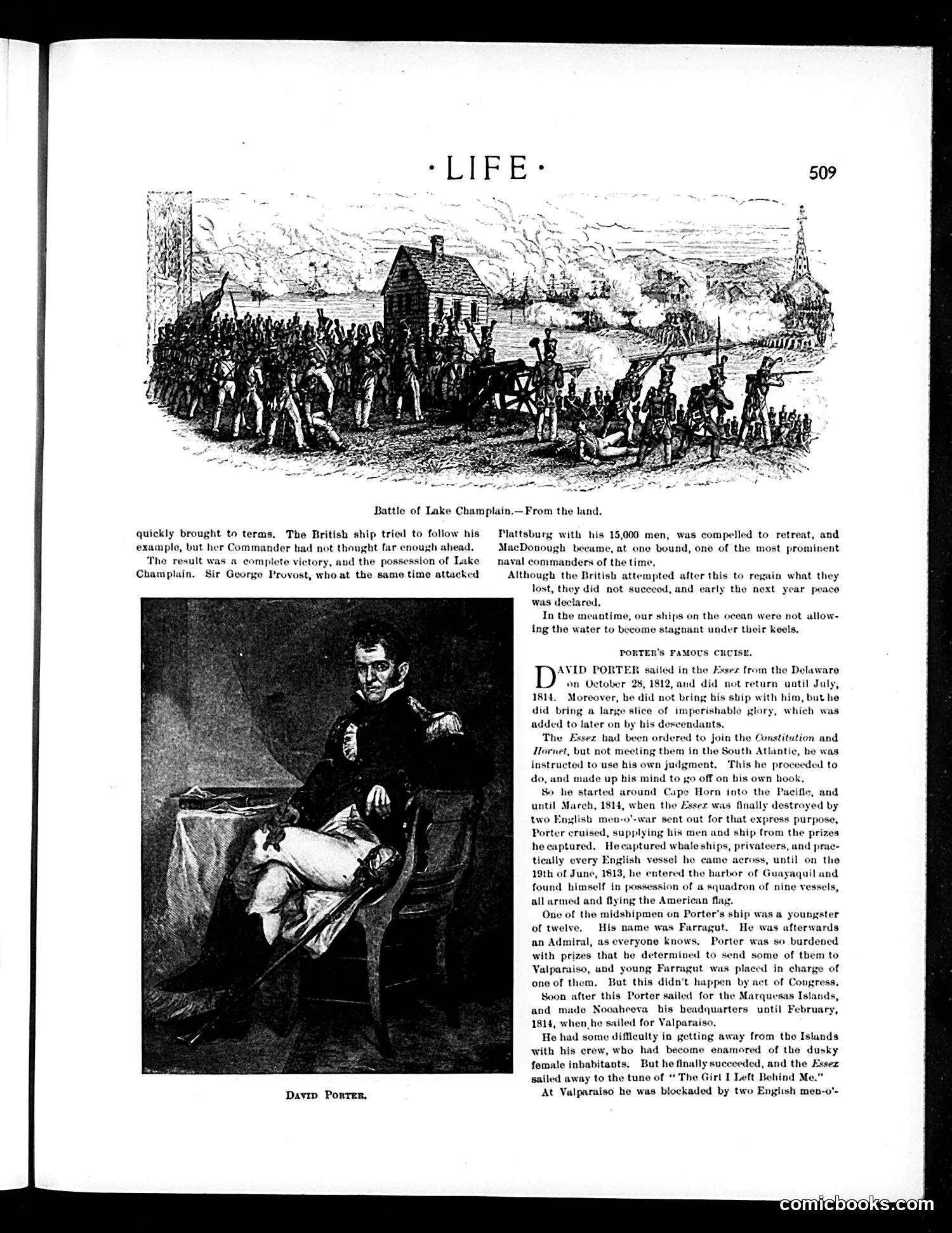
What you’re looking at
This page celebrates **David Porter**, a U.S. naval commander from the War of 1812. The portrait shows Porter in formal naval dress. The text describes Porter's remarkable 1812-1814 cruise aboard the USS *Essex* around Cape Horn into the Pacific. Rather than joining other American ships as ordered, Porter independently captured numerous British vessels (whalers, privateers, merchant ships) to supply his crew, effectively conducting commerce raiding. The article highlights that young **David Farragut**—later a famous Civil War admiral—served as a twelve-year-old midshipman under Porter and was placed in command of a captured prize ship. The satire's point appears to be admiration mixed with gentle humor about Porter's independence: he ignored orders, operated "on his own hook," and returned without his ship but with considerable "imperishable glory" and captured vessels. The reference to crew members reluctant to leave the Marquesas Islands (attracted to "dusky female inhabitants") adds lighthearted color to the adventure narrative.
📄 Transcribed text from this page (OCR, searchable)
Machine-transcribed from the original scan — historical spelling and the odd misread are preserved.
Battle of Lake Champlain.—From the land, quickly brought to terms. The British ship tried to follow his Plattsburg with his 15,000 men, was compelled to retreat, and example, but her Commander had not thought far enough ahead. — MacDonough became, at one bound, one of the most prominent Tho result was a complete victory, aud the possession of Lake — naval commanders of the time. Champlain. Sir George Provost, who at the same time attacked Although the British attempted after this to regain what they lost, they did not succeed, and early the next year peaco was declared. In the meantime, our ships on the ocean were not allow- ing the water to become stagnant under their keels, PORTER'S FAMOUS CRUISE. AVID PORTER sailed in the Essez from the Delaware on October 28, 1812, and did not return until July, 1814. Moreover, he did not bring his ship with him, buthe did bring a large slice of imperishable glory, which was added to later on by bis descendants. The Essez bad been ordered to join the Constitution and Hornet, but not meeting them in th uth Atlantic, he was instructed to use his own judgment, This he proceeded to do, and made up bis mind to go off on bis own hook, So he started around Cape Horn into the Pacifle, and until March, 1814, when the Esser was finally destroyed by two English mev-c ar sent out for that express purpose, Porter cruised, supplying his men and ship (rom the prizes he captured, Hecaptured whale ships, privateers, and prac- tically every English vessel he came across, until on the 19th of June, 1813, he entered the harbor of Guayaquil and found himself in possession of a squadron of nine vessels, all armed and flying the American flag, One of the midshipmen on Porter's ship was a youngster of twelve. His name was Farragut. He was afterwards an Admiral, as everyone knows, Porter was so burdened with prizes that he determined to send some of them to Valparaiso, und young Farragut was placed in charge of one of them, But this didn’t happen by act of Congress. Soon after this Porter sailed for the Marquesas Islands, and made Nooaheeva his headquarters until February 1814, when he sailed for Valparaiso, He had some difficulty in getting away from tho Islands with his crew, who had become enamored of the dusky female inbabitants. But he finally succeeded, and the Essez sailed away to the tune of “ The Girl I Left Behind Me.” Davip Porter, At Valparaiso he was blockaded by two English men-o'-