
A complete issue · 20 pages · 1898
Life — April 21, 1898
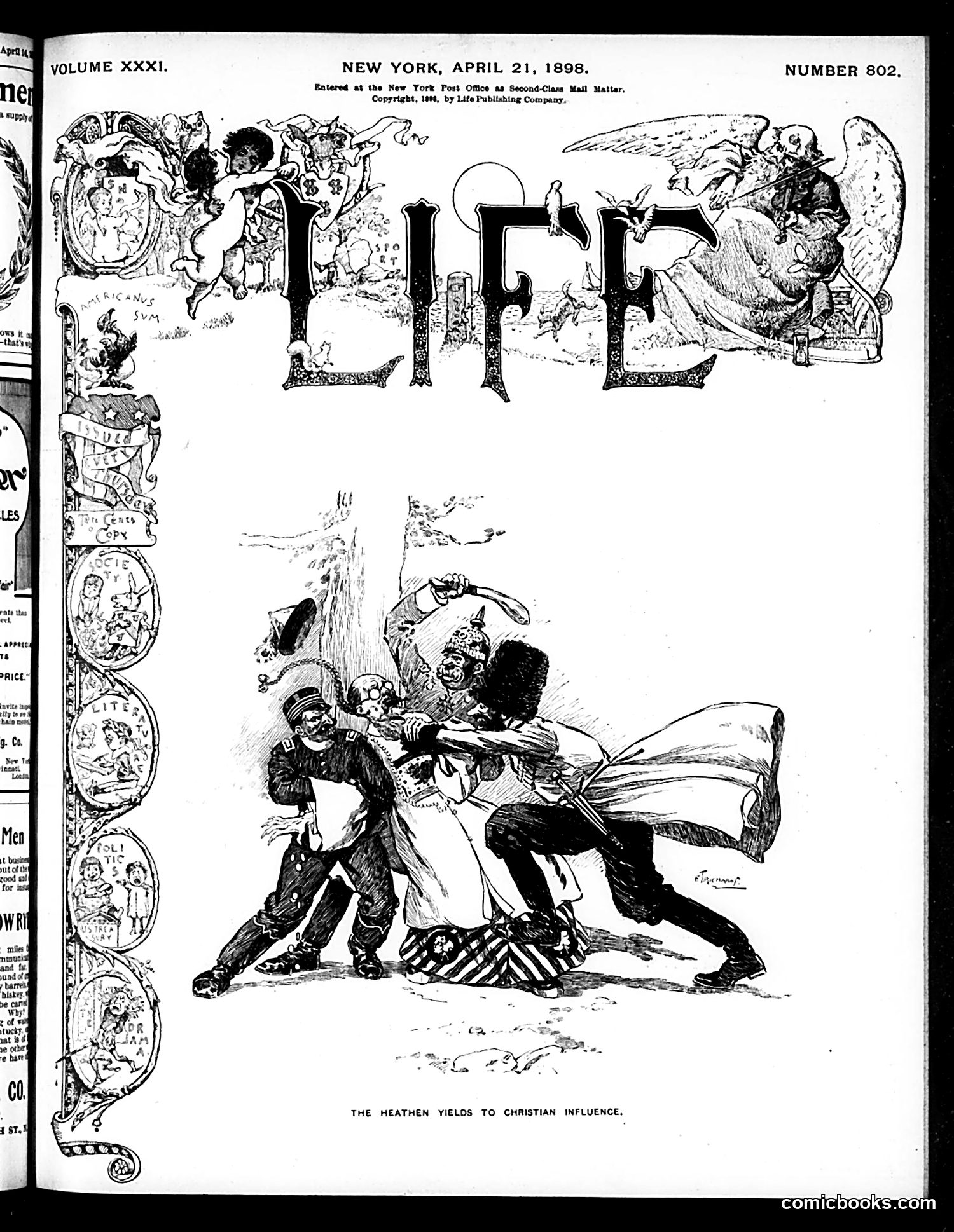
This is the cover of Life magazine's issue from April 21, 1898. The large decorative letters spelling "LIFE" frame two illustrated scenes. The bottom cartoon, captioned "THE HEATHEN YIELDS TO CHRISTIAN INFLUENCE," depicts a military figure (appearing to represent Christian/Western civilization) forcibly subduing a figure representing non-Christian peoples or nations. The imagery satirizes missionary work and Western imperialism by showing violent coercion rather than genuine spiritual conversion. The top ornamental border contains whimsical cherubs and classical imagery typical of the magazine's decorative style. The timing—spring 1898—coincides with the Spanish-American War, suggesting this cartoon critiques American military expansion under the guise of Christian missionary zeal and "civilizing" missions.
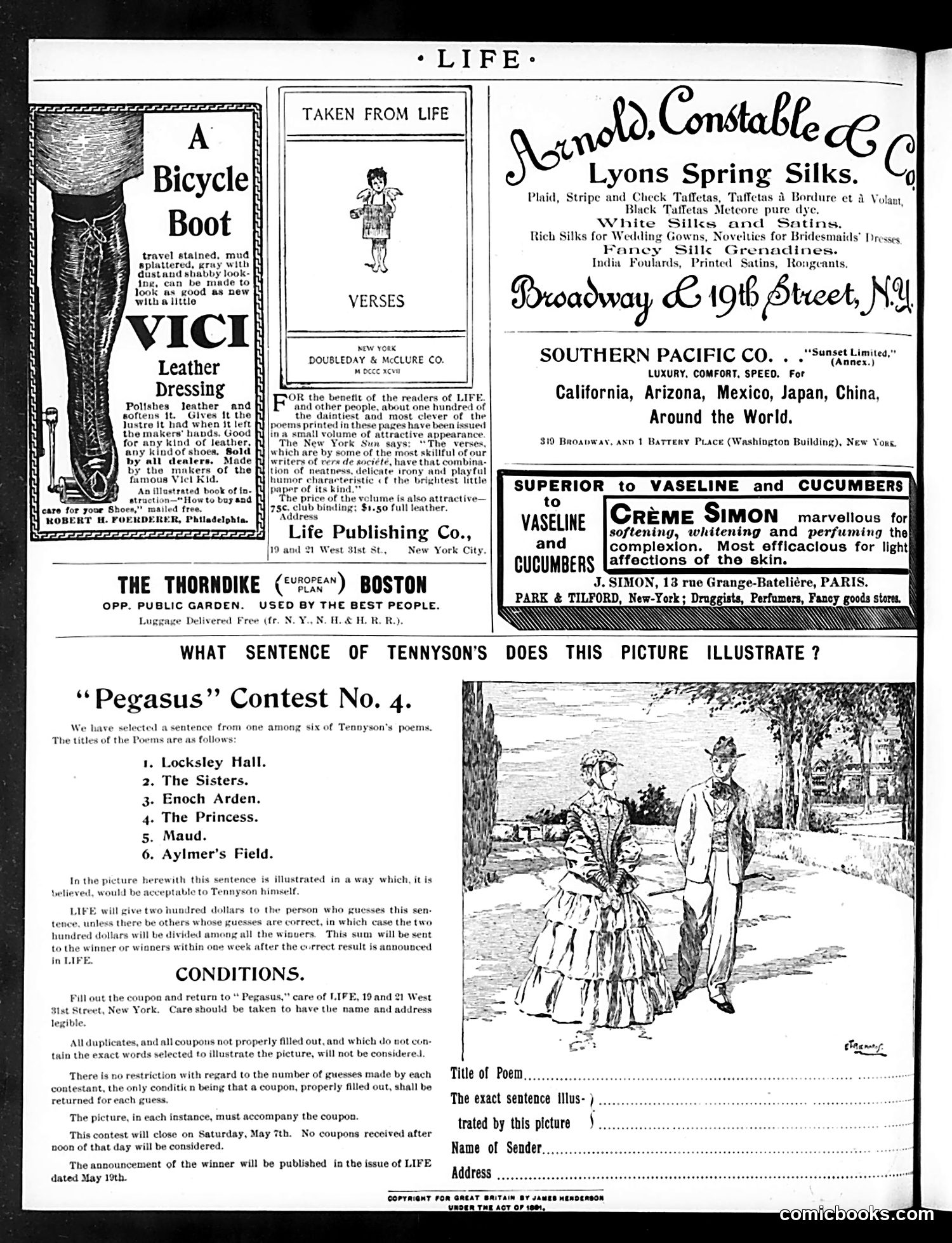
This page is primarily a **poetry contest**, not political satire. Life magazine invited readers to identify which sentence from one of six Tennyson poems is illustrated by the accompanying sketch. The illustration shows a **Victorian-era couple** (a woman in an elaborate dress and a man in formal attire) standing on a country road. The contest offered $200 to the winner, with prize money distributed among multiple correct guessers. The six possible source poems are listed: Locksley Hall, The Sisters, Enoch Arden, The Princess, Maud, and Aylmer's Field. Contestants had to match the visual scene to the correct Tennyson line and submit their answer by May 5th. This represents **19th-century literary engagement**—popular magazines used poetry knowledge as entertainment and competition for educated readers.
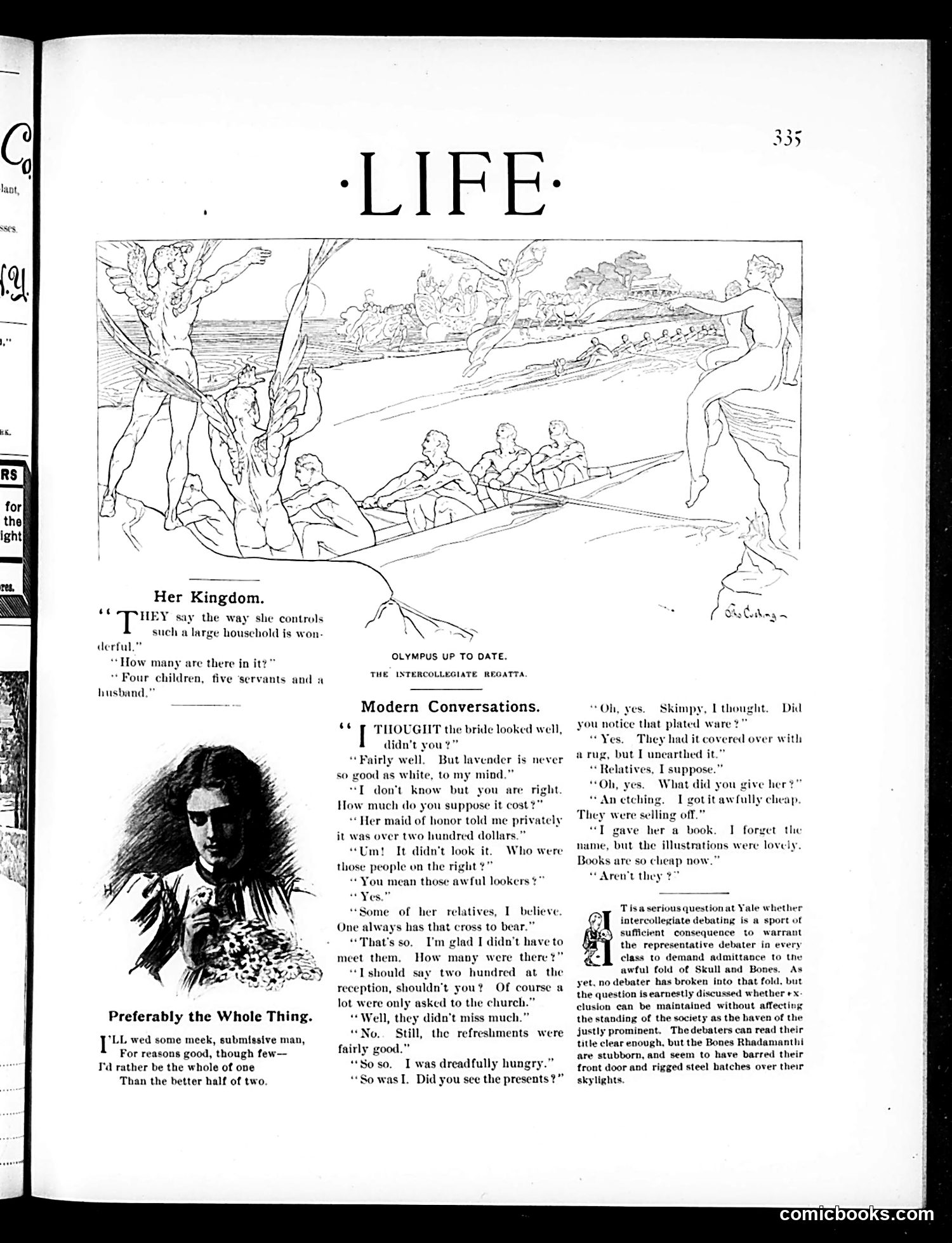
This page contains three distinct pieces: 1. **"Her Kingdom" (top illustration)**: A satirical cartoon about household management, depicting a woman controlling servants and family activities. The dialogue jokes about a woman managing "four children, five servants and a husband"—poking fun at domestic authority and the absurdity of calling household control "wonderful." 2. **"Olympus Up to Date" (center): References an intercollegiate regatta, depicting classical nudes in a rowing boat. This is likely satirizing the juxtaposition of elite college sports with classical ideals. 3. **"Modern Conversations" (lower section)**: A dialogue about wedding gifts and etiquette, with gentle mockery of bourgeois social conventions and gift-giving pretenses. The overall tone is lighthearted social satire targeting middle-class domesticity, gender dynamics, and social conventions—typical of Life magazine's satirical humor.
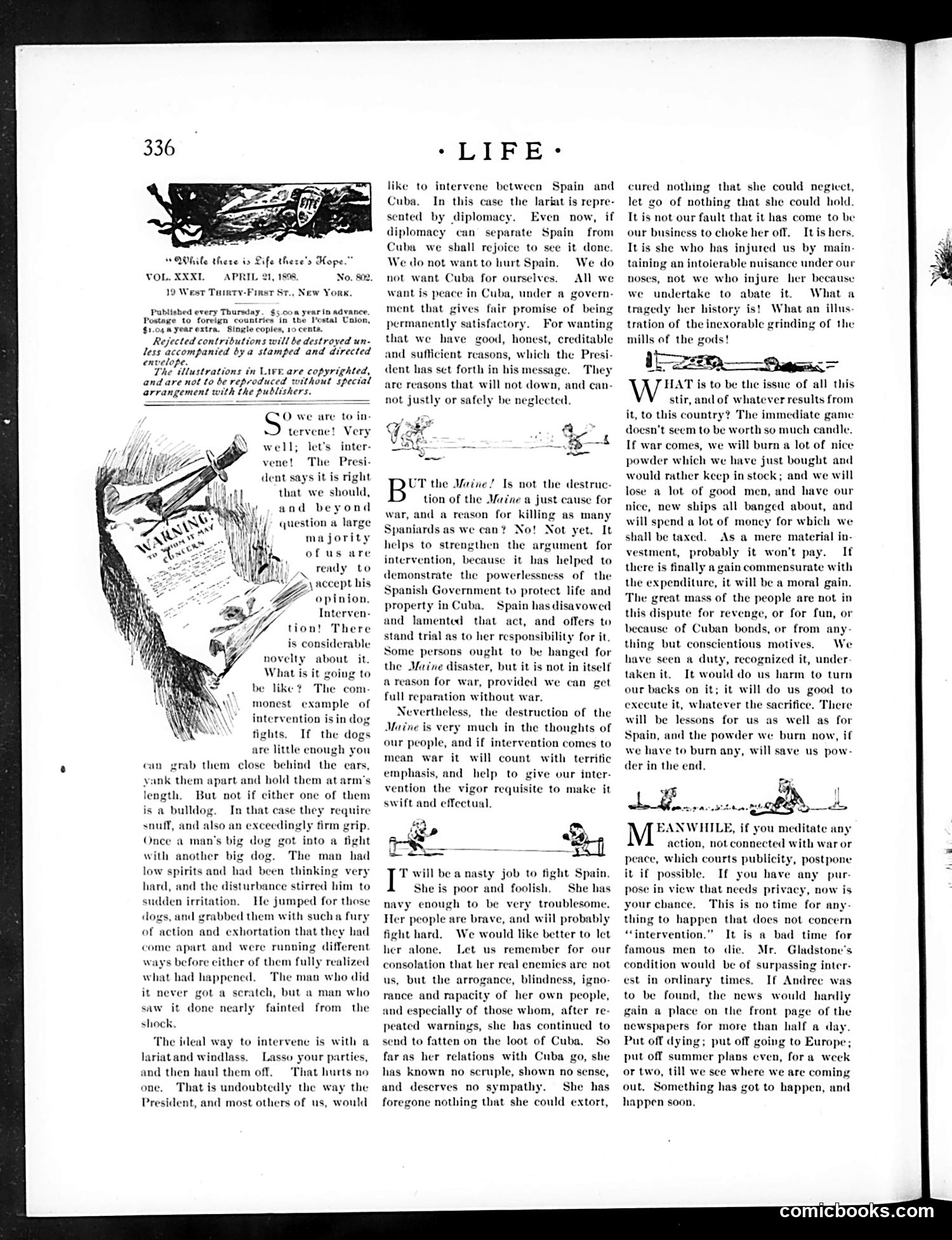
This page contains editorial commentary on U.S. intervention regarding Spain and Cuba. The text debates whether America should intervene militarily in Spain's conflict, arguing against involvement while acknowledging the destruction of the *Maine* (likely the 1898 USS Maine explosion that sparked the Spanish-American War). The left-side illustration shows a figure labeled "INTERVENTION" as a dog on a leash—a visual metaphor warning against unleashing military action. The cartoon suggests intervention is dangerous and difficult to control once started. The editorial advocates for diplomatic pressure ("lariat and windlass") rather than military force, warning that war with Spain would be costly and unwise, despite Spain's poor governance of Cuba. The overall message cautions restraint in foreign policy.
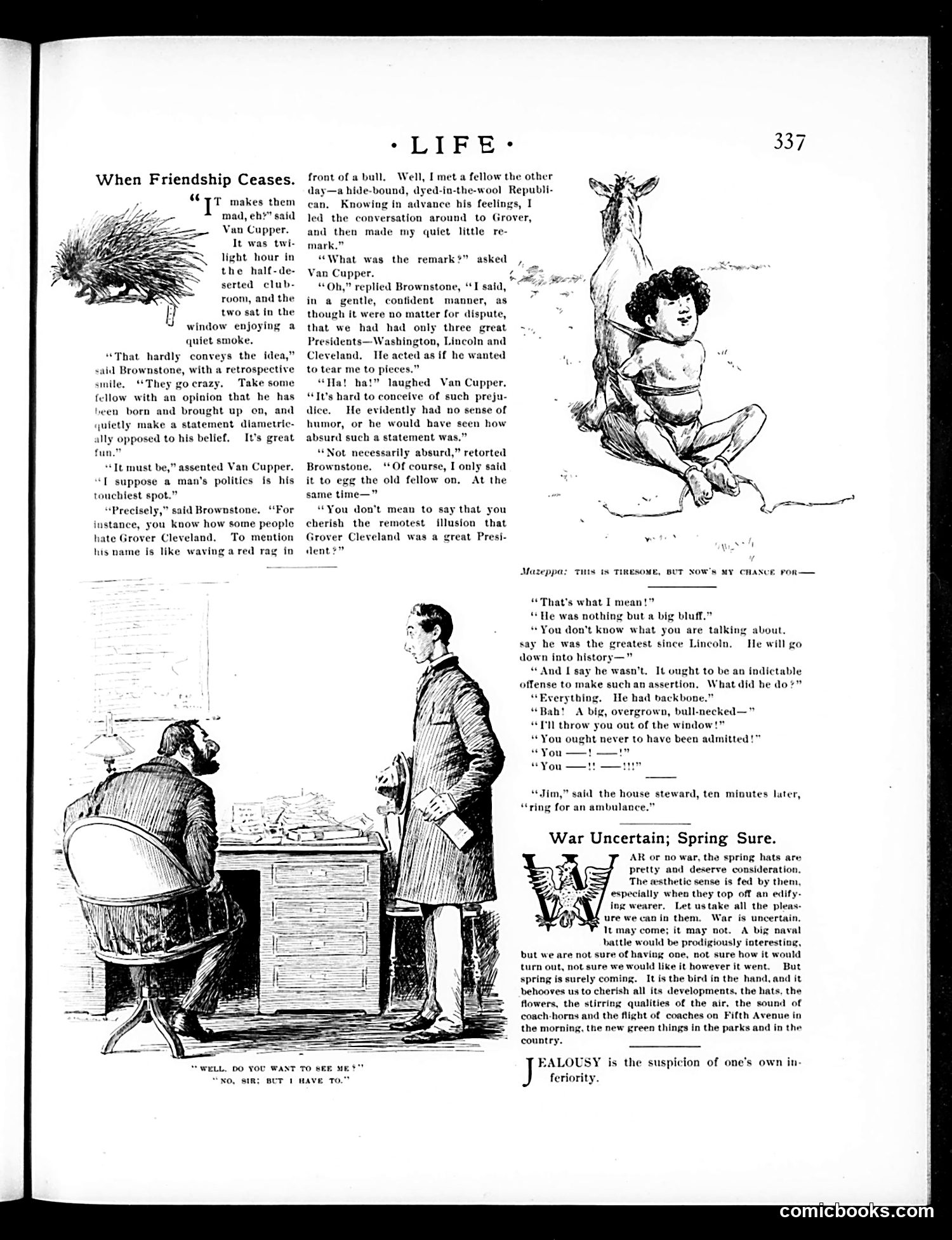
The page contains a satirical dialogue between two characters, Brownstone and Van Cupper, debating politics. Brownstone defends Grover Cleveland against Van Cupper's criticism, noting Cleveland was one of only three great Presidents alongside Washington and Lincoln. Van Cupper dismisses Cleveland as "a big bluff" who will be forgotten by history. The exchange ridicules Van Cupper's political certainty while defending Cleveland's legacy. The accompanying illustrations show two men in conversation and a cherub figure. A separate article titled "War Uncertain; Spring Sure" discusses spring's inevitable arrival contrasting with uncertain war prospects, likely referencing contemporary military tensions (possibly Spanish-American War era, given the magazine's period).
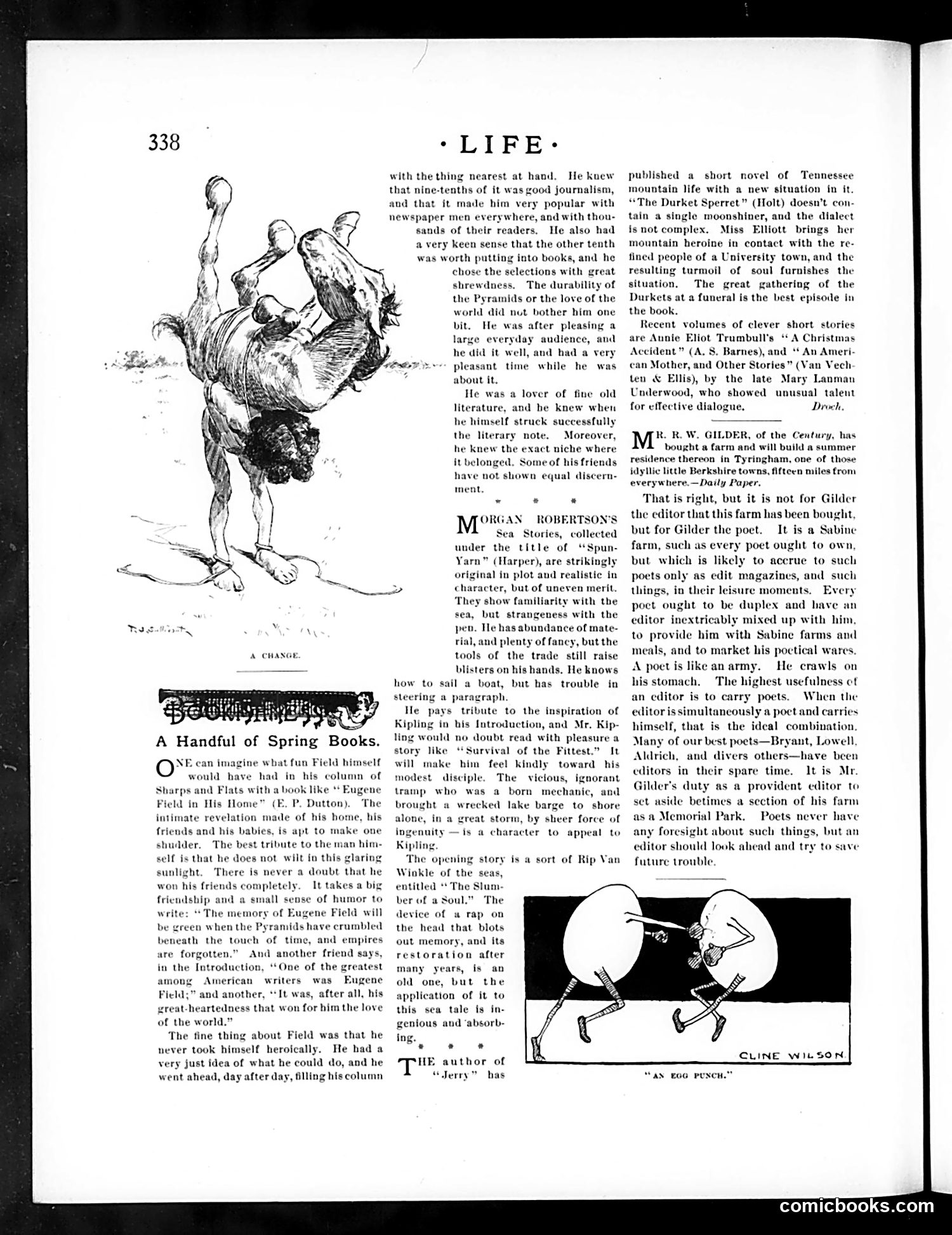
This page contains literary reviews rather than political cartoons. The main illustration shows a stylized figure in an contorted pose—labeled "A CHANGE"—that appears to be satirical commentary on physical transformation or awkward adaptation, though the specific reference is unclear from the image alone. The page reviews spring books, including works by Morgan Robertson ("Sea Stories"), Annie Eliot Trumbull, and others. There's also a small cartoon by Cline Wilson labeled "AS EGO PUNCH" showing two figures in confrontational poses. The content focuses on American literature and cultural commentary rather than explicit political satire. Without additional context about the publication date and specific literary controversies referenced, the precise targets of any satire remain unclear to modern readers.
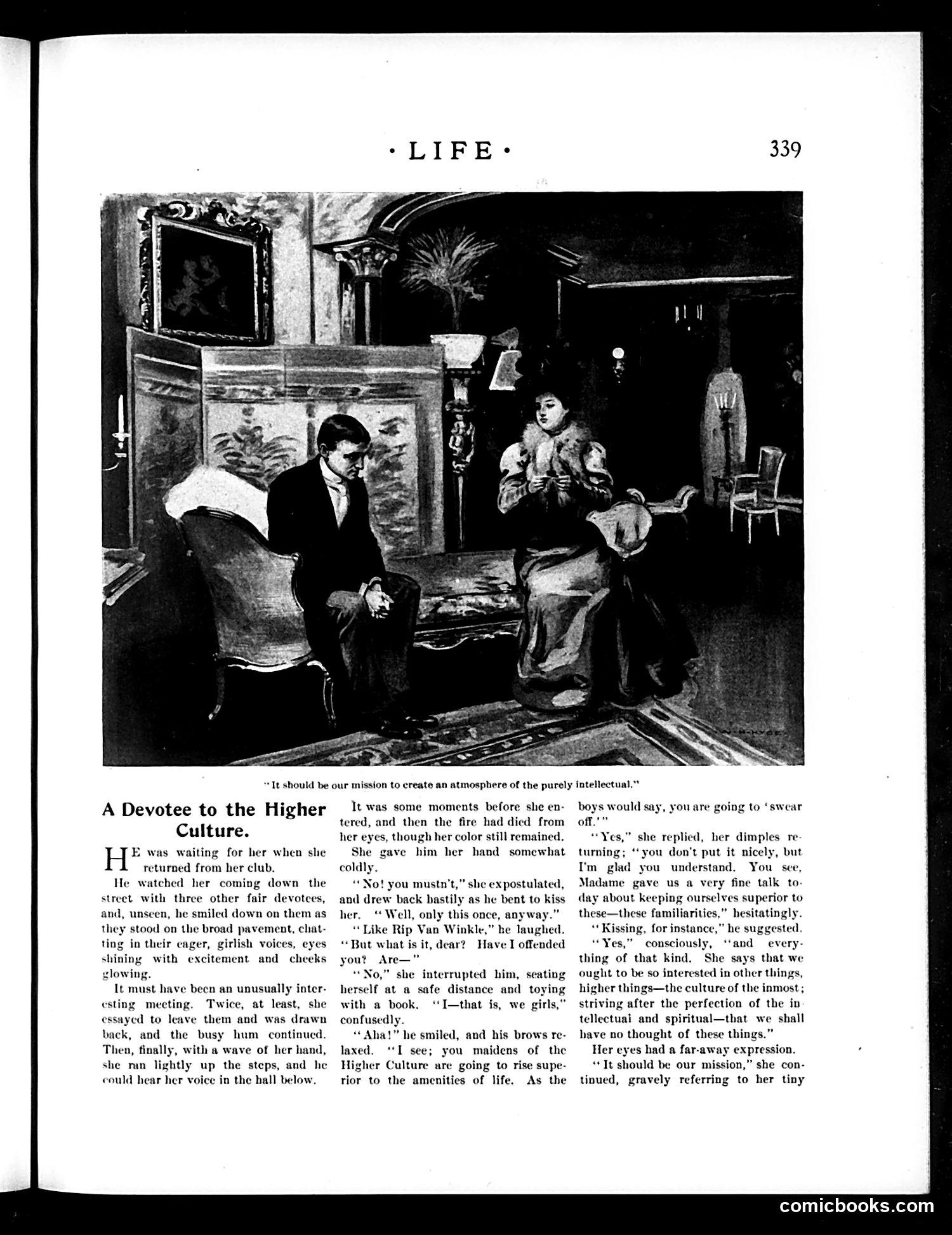
This satirical piece mocks pretentious intellectualism. The scene shows a man and woman in an elegant interior, where she's absorbed in a book while he attempts romantic advances. The humor centers on her pompous declaration that they must maintain "an atmosphere of the purely intellectual" and cultivate "Higher Culture" to elevate themselves above ordinary people. The satire targets those who use intellectual posturing as a shield against genuine human connection and emotion. Her repeated references to "the inmost, stirring after the perfection of the intellectual and spiritual" contrast absurdly with the mundane domestic moment—she's rejecting his kiss in the name of abstract sophistication. The joke: "culture" becomes an excuse for emotional coldness and social pretension.
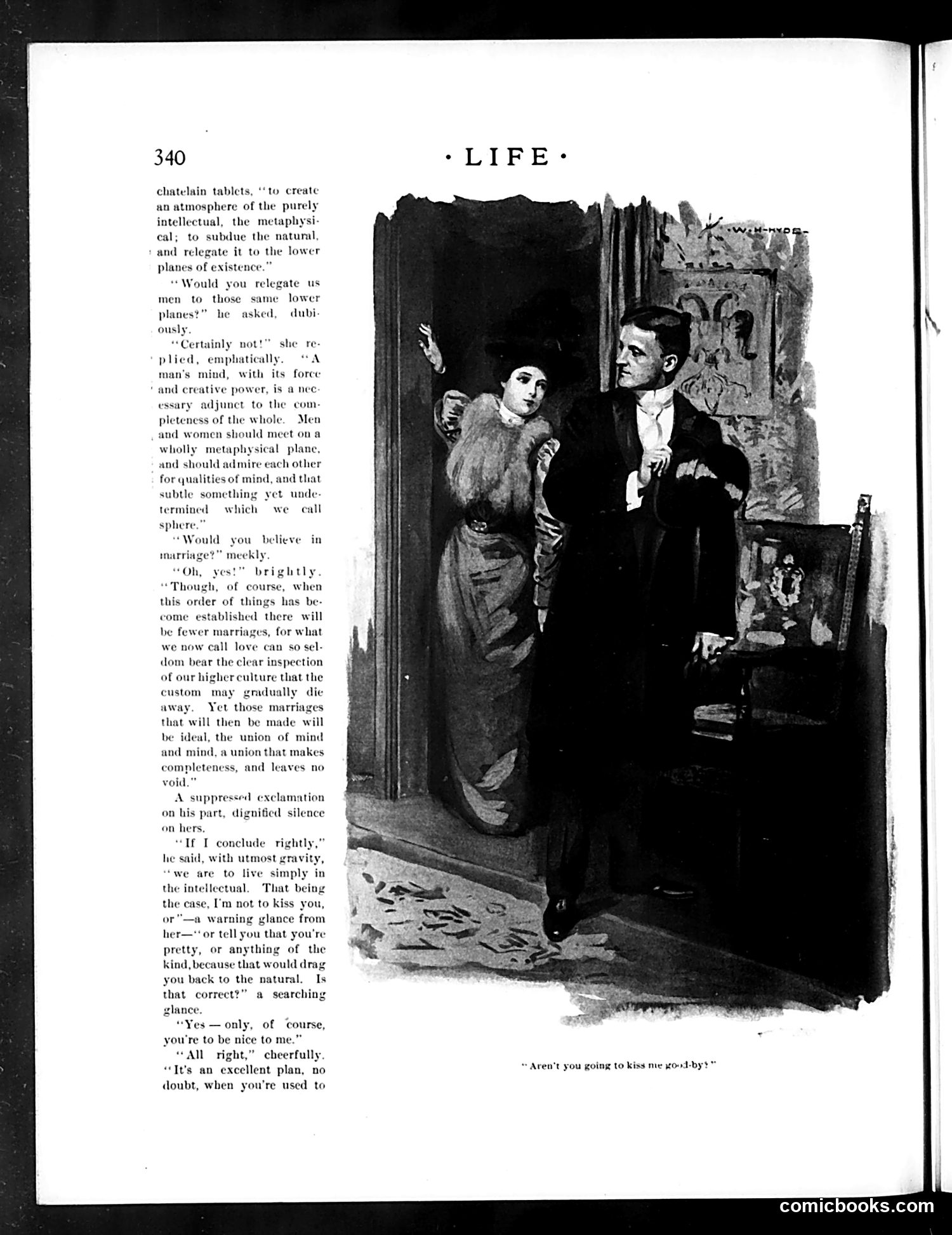
This page from *Life* magazine presents a dialogue about intellectual marriage and gender relations. The conversation—visible in the left column text—debates whether men and women should meet on a "wholly metaphysical plane" and whether marriages based on intellectual compatibility rather than physical attraction represent an ideal future society. The accompanying illustration shows a couple in what appears to be a domestic interior. The caption reads "Aren't you going to kiss me goodbye?"—which sarcastically undercuts the lofty intellectual discussion occurring in the adjacent text. The satire targets progressive ideas about purely intellectual marriage by juxtaposing them against the apparently unchanged human desire for physical affection. The cartoon suggests that despite philosophical arguments for elevating relationships above "the natural," actual couples still want conventional romantic gestures.
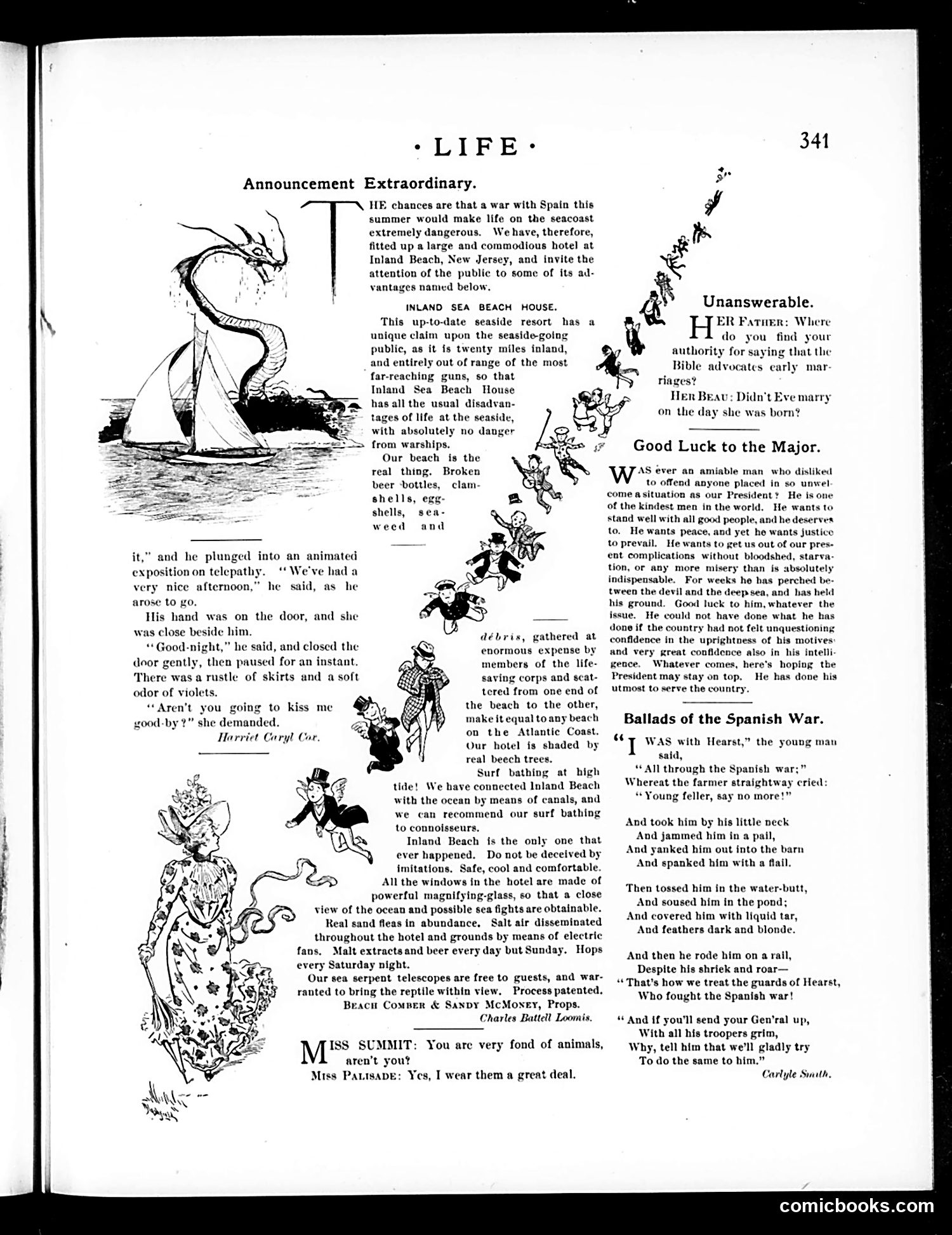
This page contains several satirical sections typical of *Life* magazine's format: **Top Left**: An "Announcement Extraordinary" advertises the Inland Sea Beach House in New Jersey as a safe seaside resort, humorously implying that war with Spain makes coastal living dangerous. The joke plays on contemporary anxieties about potential Spanish naval attacks on American shores. **Right Side**: Three brief satirical exchanges mock various social figures—including debates about Biblical interpretation and compliments about a Major's kindness. **Bottom**: "Ballads of the Spanish War" presents comic verse about the Spanish-American War, depicting soldiers' experiences in exaggerated, humorous fashion. The illustrations are whimsical line drawings typical of the magazine's style. The overall tone reflects *Life*'s role as a humor publication commenting on current events, particularly the Spanish-American War (1898).
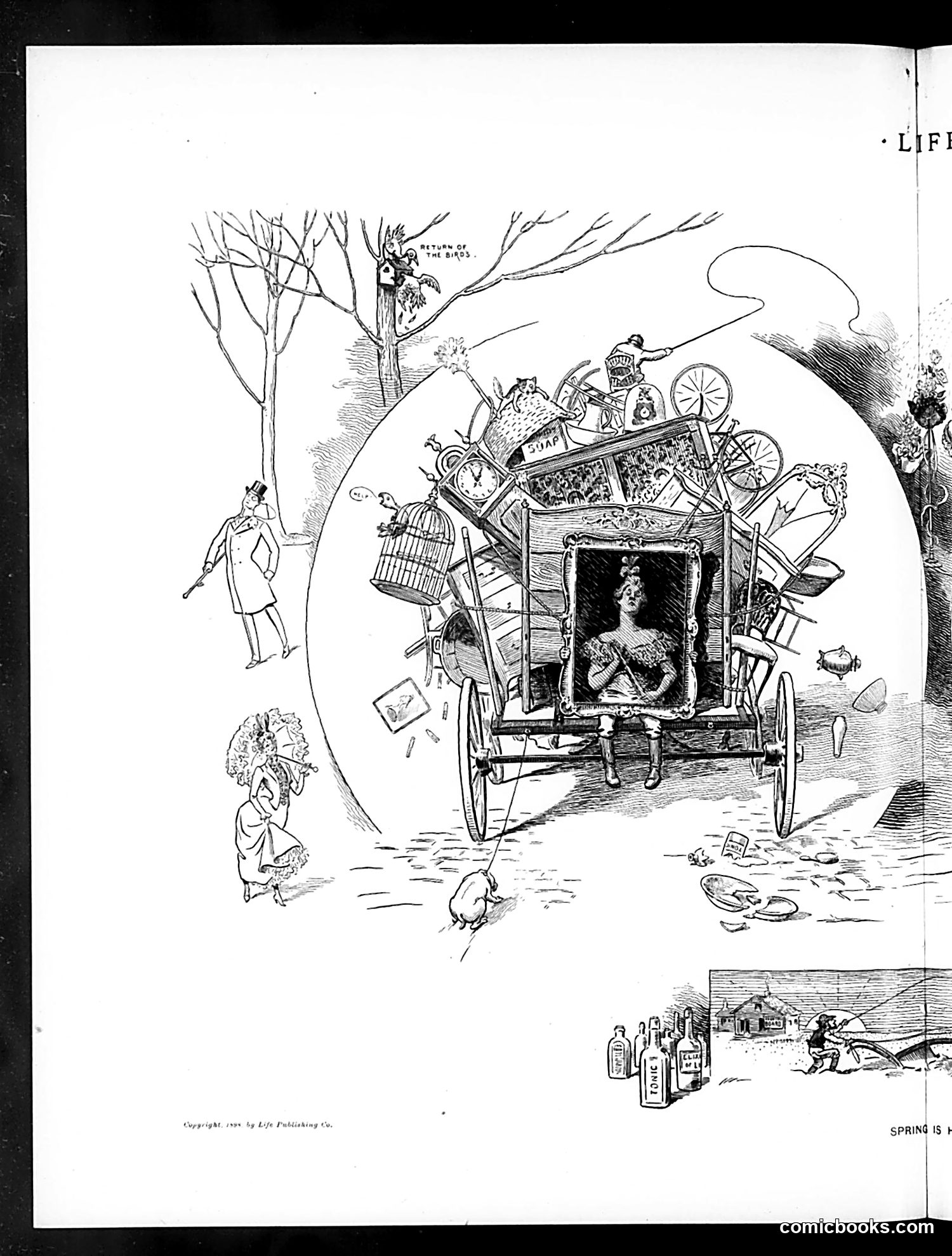
This satirical illustration depicts a heavily laden wagon or carriage driven by what appears to be a woman (visible in the central window), surrounded by various figures and objects. The composition suggests commentary on excessive consumerism or materialism during spring season. The text fragment "SPRING IS" (visible at bottom right) indicates this relates to spring themes. The scattered items—bottles, household goods, wheels, and various possessions piled haphazardly—suggest satire about spring cleaning, shopping habits, or domestic accumulation. A well-dressed man stands observing on the left, while other figures gesture toward or interact with the chaotic scene. The overall image appears to mock either spring shopping sprees, spring cleaning mania, or the burden of material possessions—likely contemporary social commentary from Life magazine's satirical perspective on American consumer culture.
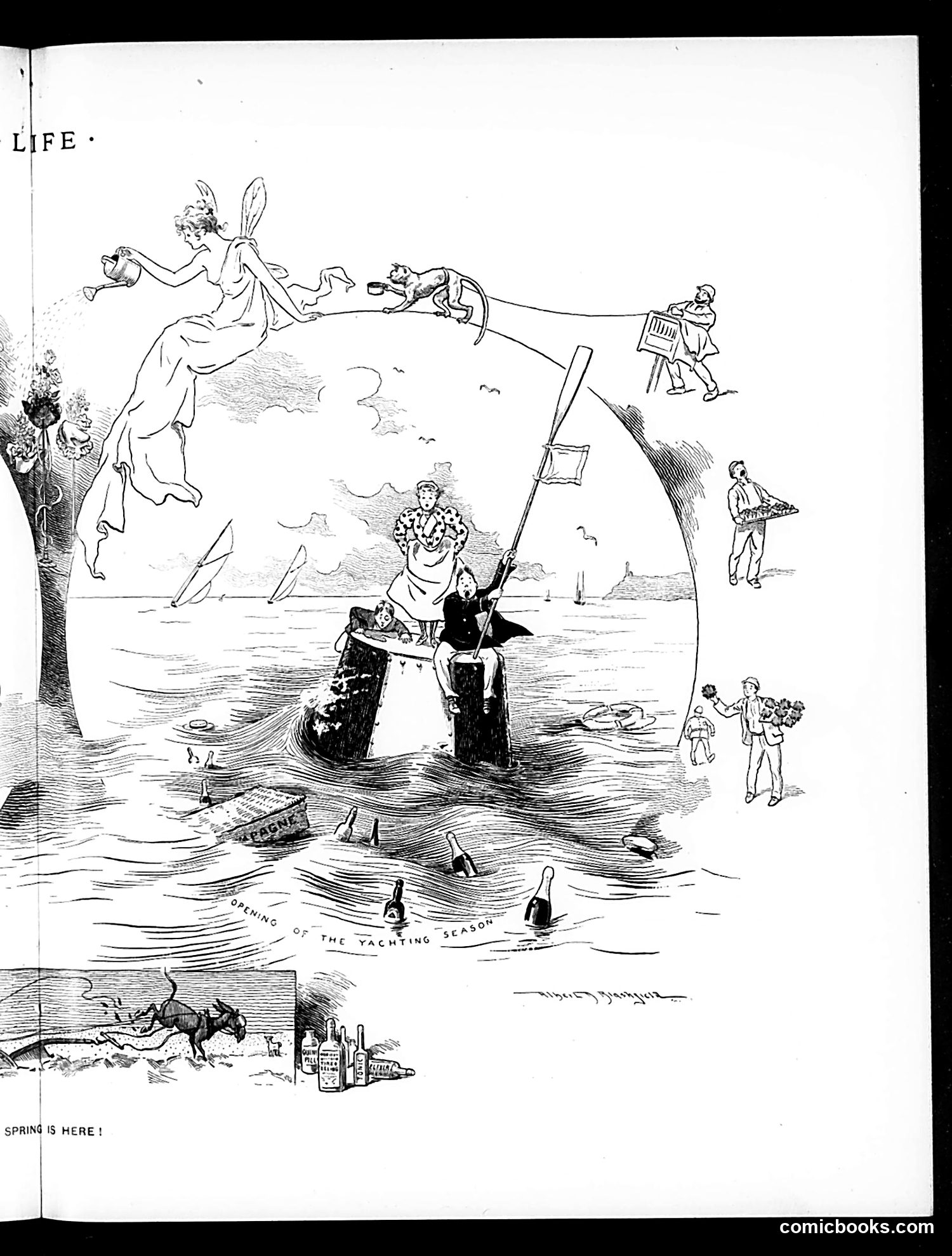
This satirical cartoon depicts the "Opening of the Yachting Season" with a wealthy gentleman standing in water, holding a net to catch fish or game. The figure appears to represent upper-class leisure activities and excess. The key satire involves **Spring's arrival** (noted at bottom) triggering wealthy pursuits. A winged allegorical female figure floats above, manipulating the scene like a puppeteer with various leisure-class figures engaged in recreational activities around him. The cartoon mocks the frivolous pastimes of the wealthy elite during early spring, contrasting their idle pursuits with broader society. The surrounding vignettes show different amusements—yachting, socializing, sporting—all suggesting the disconnected world of the privileged class. The overall message critiques wealth inequality and the self-absorbed nature of high society's seasonal rituals.
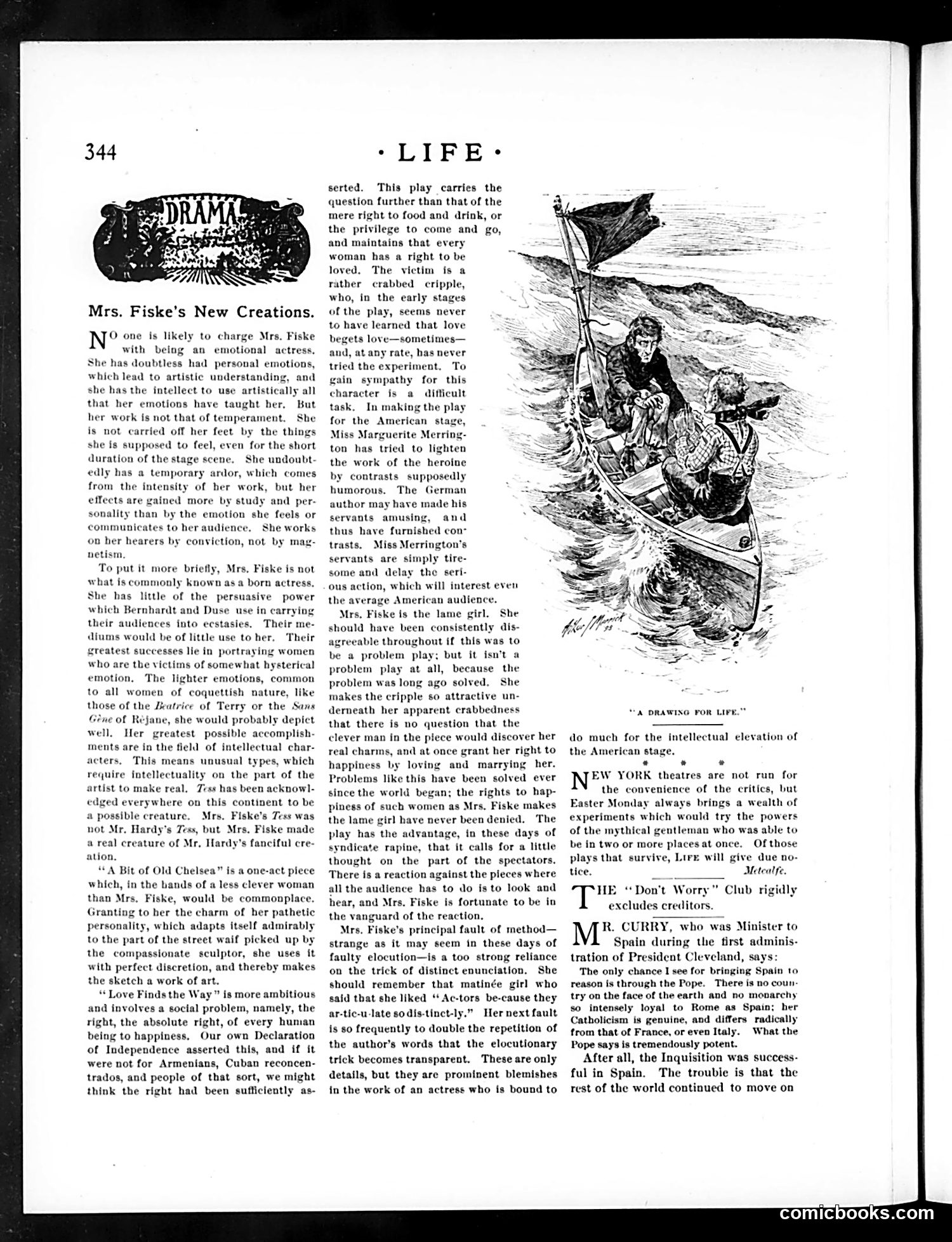
This page discusses **Mrs. Fiske's theatrical productions**, analyzing her acting style and dramatic choices. The article criticizes her approach as overly intellectual and reliant on "elocution" rather than naturalistic emotion. The accompanying sketch titled **"A Drawing for Life"** depicts a figure (appears to be a character from one of Mrs. Fiske's plays) in period costume on a hillside, holding a flag. The drawing illustrates one of the theatrical works being reviewed. The lower section shifts to discussing **New York theaters** and mentions **President Cleveland** and **Spain** in relation to religious/political tensions, though the context is fragmentary. The satire primarily targets theatrical pretension and Mrs. Fiske's intellectual approach to acting, which the critic suggests alienates audiences rather than moving them emotionally.
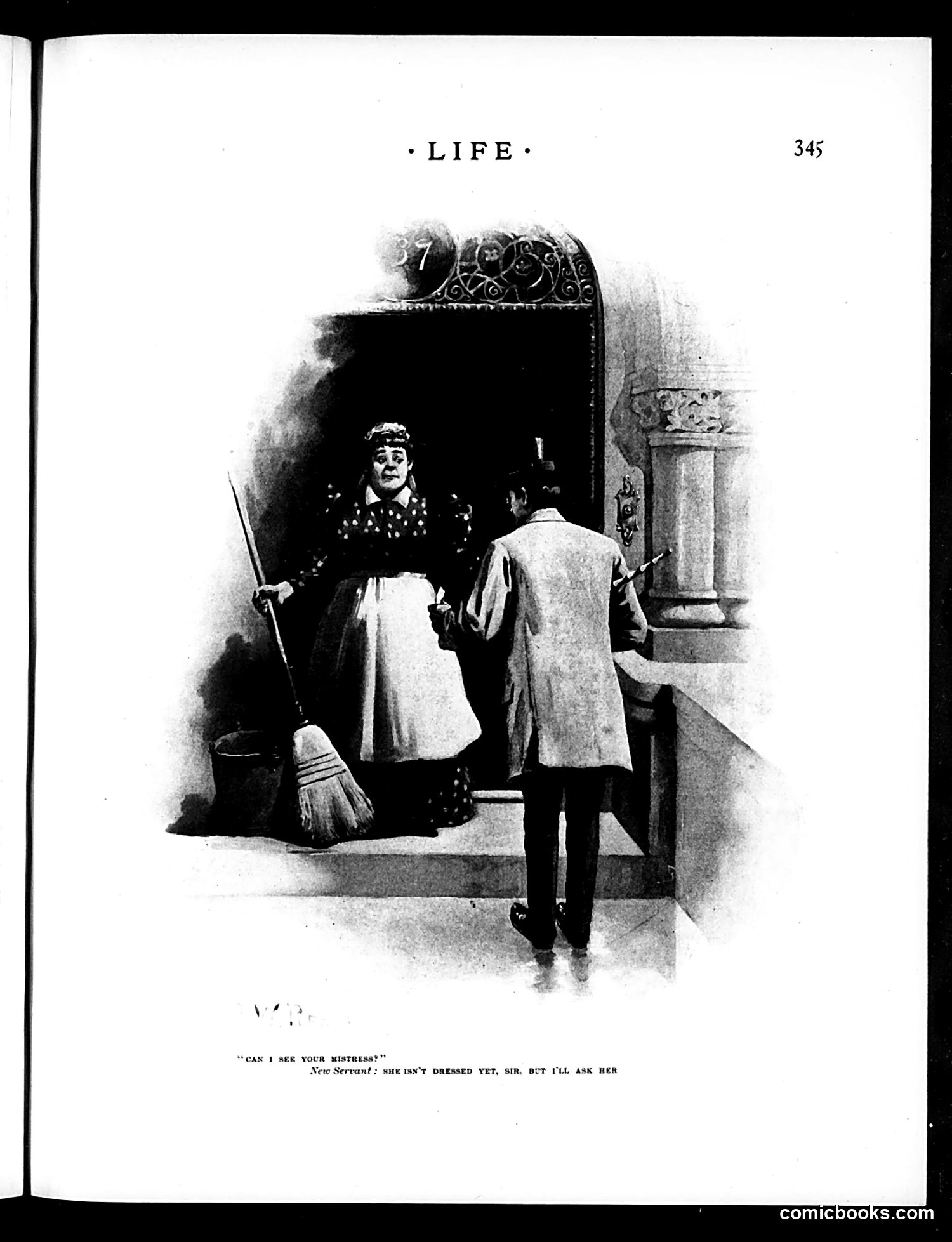
This is a single-panel domestic comedy cartoon satirizing class relations and servant culture. A well-dressed gentleman caller asks a new servant if he can see "your mistress." The servant replies that she isn't dressed yet but will ask her. The joke relies on deliberate misunderstanding: the caller assumes "mistress" means the lady of the house, but the servant's phrasing ("your mistress") suggests a kept woman or illicit partner rather than an employer. This double entendre creates humor by implying the caller may be visiting for improper purposes, while the servant's innocent response masks potential scandal. The cartoon mocks both the caller's potentially disreputable intentions and period social conventions around domestic service and propriety.
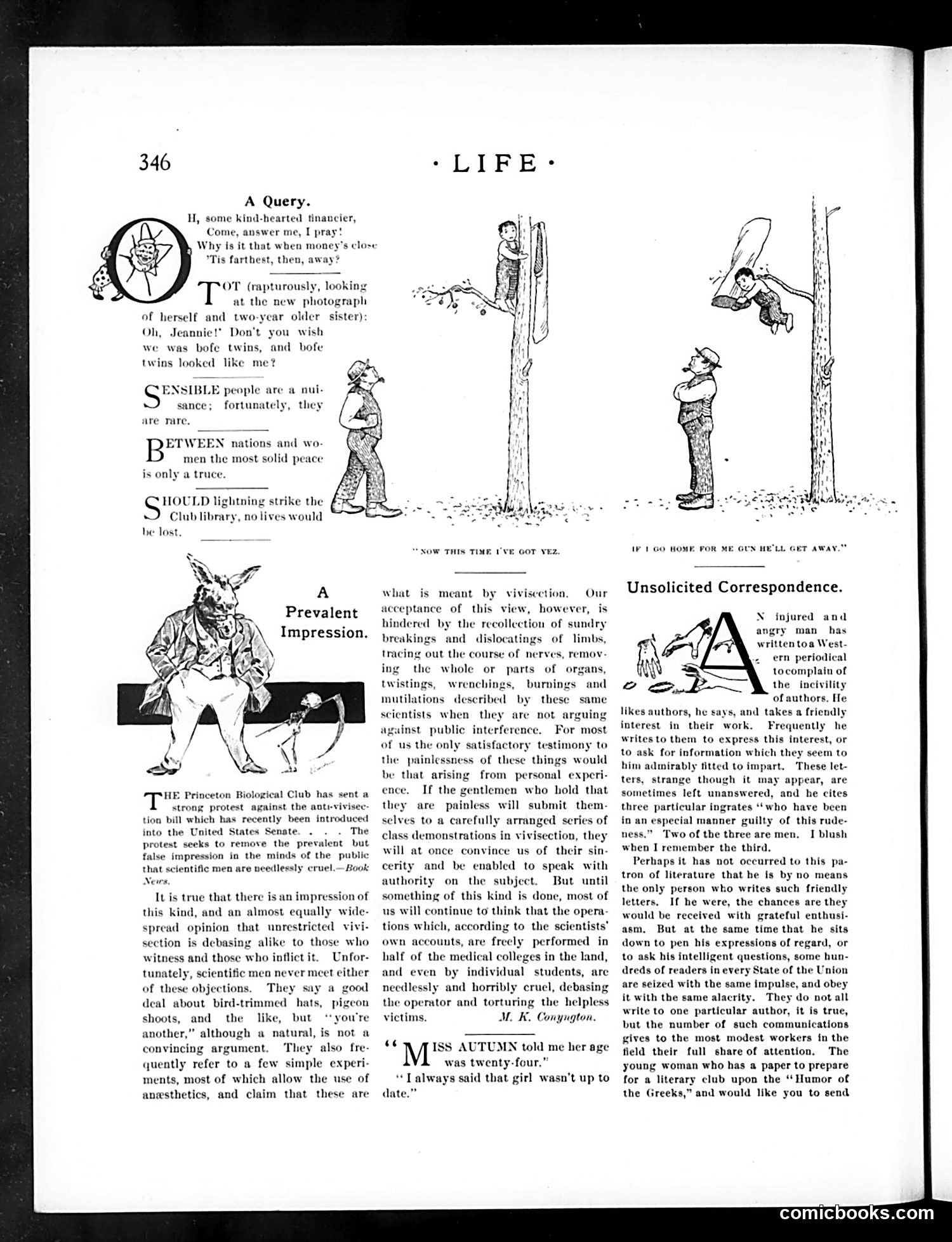
This page contains satirical content about several social issues of the era: **"A Query"** (top left): A cartoon mocking the paradox of finance—a financier cannot access money precisely when it's most needed ("tight money"). **"A Prevalent Impression"** (main article): Satirizes the vivisection debate. Scientists protested an antivivisection bill, claiming animal testing causes no suffering. The author sardonically suggests the only way to prove this would be for scientists to volunteer themselves for the same procedures performed on animals—a scathing indictment of what he describes as "needlessly and horribly cruel" laboratory practices. **Tree-climbing cartoon** (right): Illustrates the vivisection article, depicting what appears to be painful animal experiments. **"Unsolicited Correspondence"**: Humorously complains about authors who ignore fan mail. The writer notes hundreds of readers write to authors constantly, suggesting the angry correspondent is naïve to expect personal responses. The page reflects Progressive Era concerns about scientific ethics and animal welfare alongside lighter social commentary.
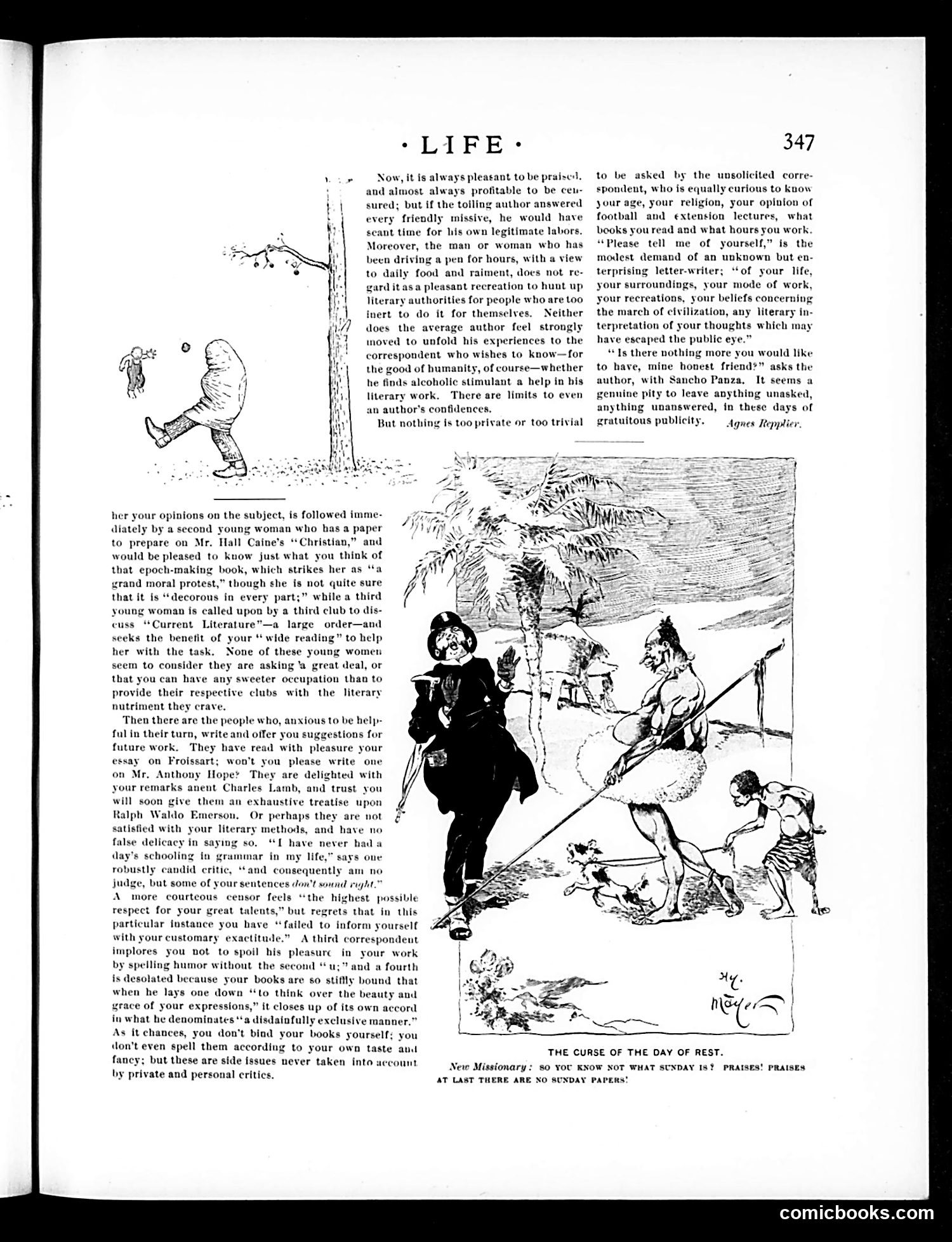
This page presents an editorial essay by **Agnes Repplier** (credited at bottom) critiquing the burden of unsolicited mail authors receive. The text satirizes intrusive reader requests: strangers demanding personal details (age, religion, hobbies), club members asking authors to research essay topics, and self-appointed critics offering unsolicited editorial advice. The accompanying illustration titled **"The Curse of the Day of Rest"** shows a missionary confronted by indigenous peoples, captioned with a Sunday newspaper joke about having "no Sunday papers"—likely satirizing how even missionary work can't escape modern intrusions. **The satire's target**: The late-19th-century culture of "gratuitous publicity" where readers feel entitled to authors' time and personal information, and where amateur critics freely dispense grammar corrections and moral judgments. Repplier argues authors have professional limits despite public curiosity. The piece defends artistic privacy against invasive fan mail culture—a surprisingly modern-sounding complaint about unsolicited public engagement.
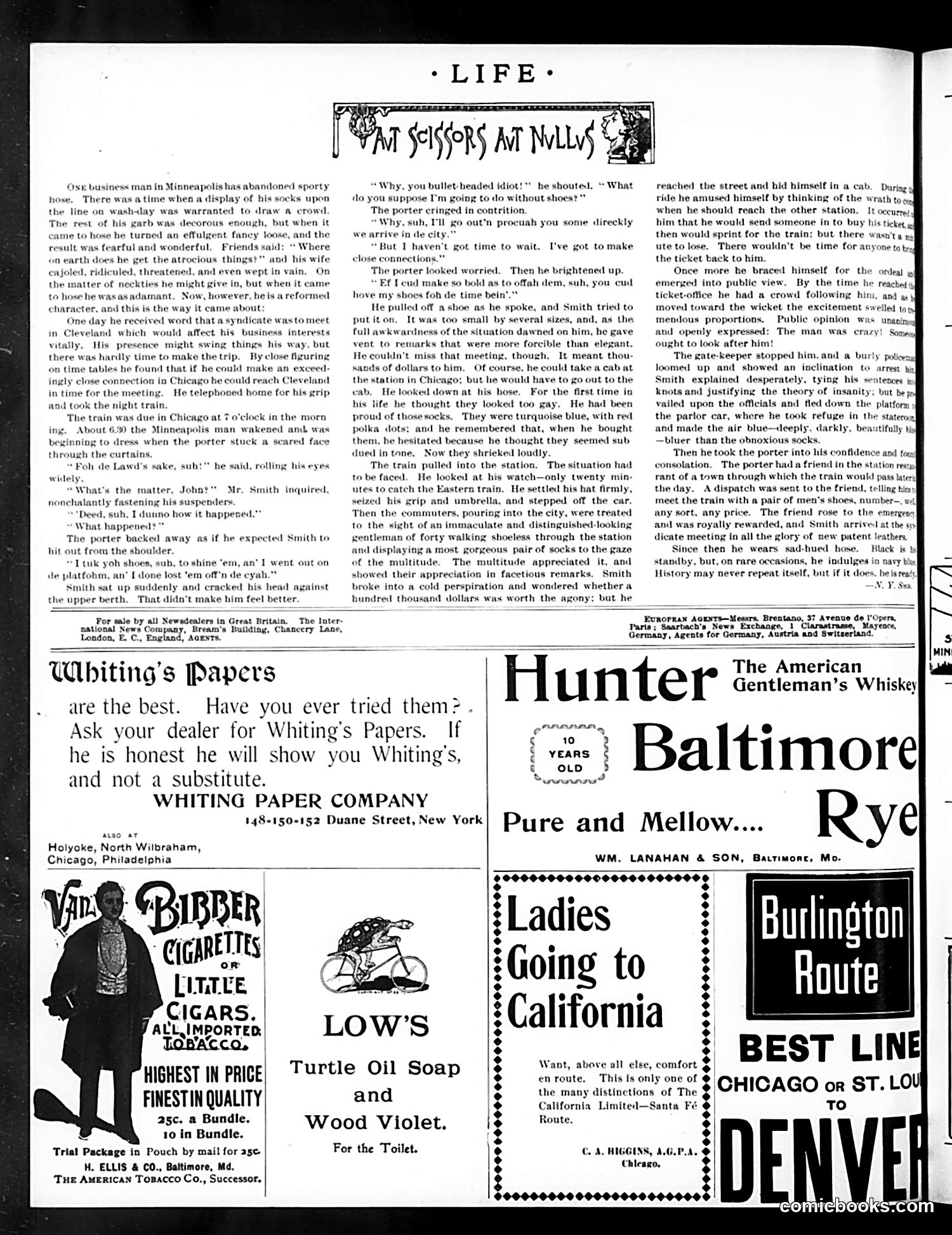
This page is primarily **advertisements** with one short satirical story titled "At Scissors at Nulls" (the title's meaning is unclear). The story mocks a Minneapolis man who abandoned his sporty house and socks display. The narrative concerns his embarrassing encounter at a train station where a porter criticizes his shoeless appearance. The man attempts to justify going without shoes as economical and comfortable, but the porter ridicules him, ultimately causing him to crack his head in frustration against the upper berth. The satire targets **vanity and social pretension**—mocking both the man's original display of status symbols (socks) and his later attempt to escape social judgment through casual dress. It's a commentary on American anxieties about appearing respectable in public spaces.
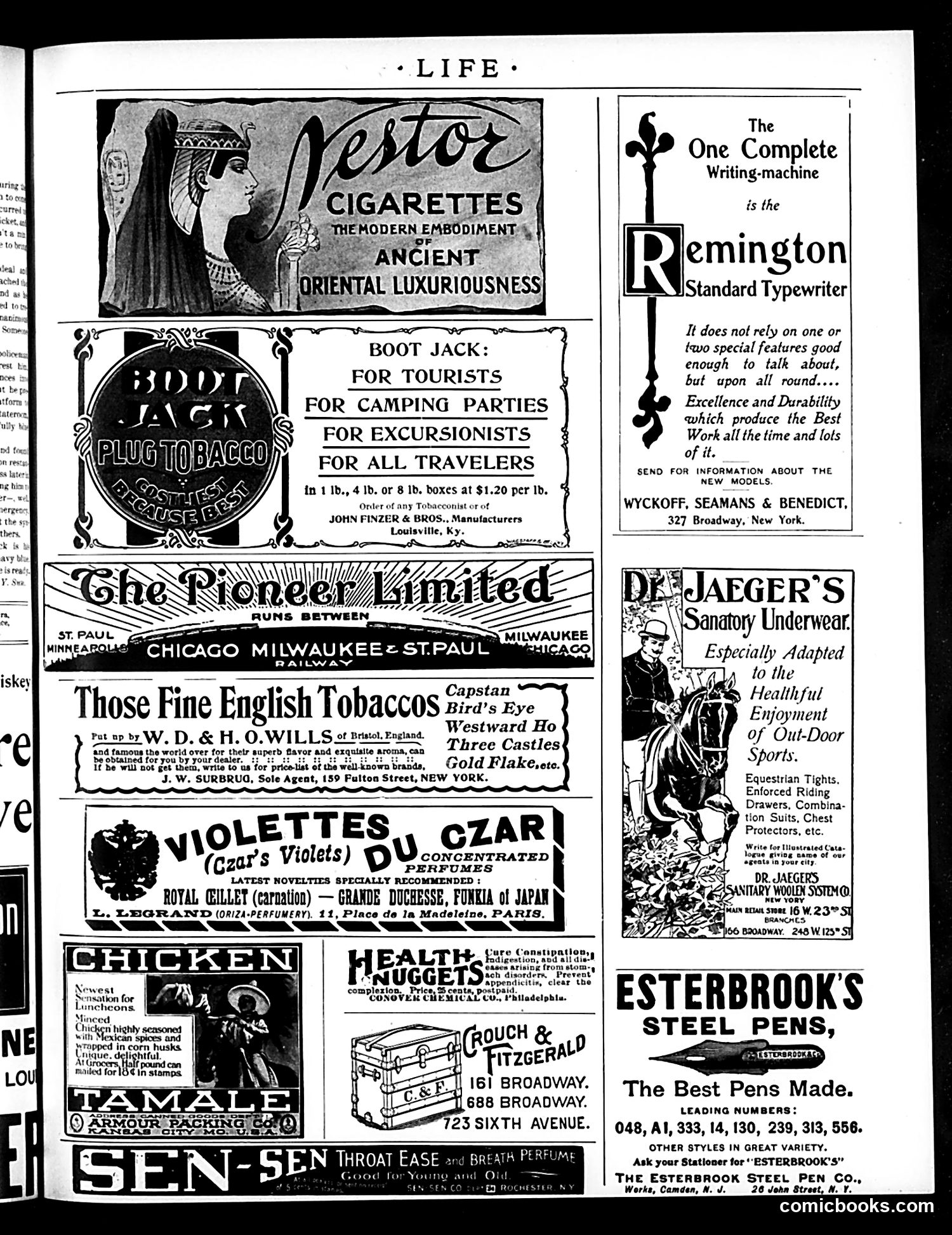
This is primarily an **advertising page** from Life magazine, not a satirical cartoon. It showcases various consumer products popular in the early 20th century: **Notable advertisements include:** - **Nestor Cigarettes** — marketed with Orientalist imagery - **Boot Jack tobacco** — positioned for travelers and campers - **The Pioneer Limited train** — running between Chicago, Minneapolis, and St. Paul - **English tobaccos** by W.D. & H.O. Wills - **Remington Standard Typewriter** — emphasizing durability - **Violettes du Czar perfume** — claiming royal endorsement - **Chicken/Tamale food products** by Armour - **Health Nuggets** — patent medicine - **Dr. Jaeger's sanitary underwear** — for outdoor sports - **Esterbrook steel pens** The page reflects consumer culture and advertising practices of the era, including period-typical Orientalism and health-product claims. There is **no political satire evident** — this appears to be standard magazine revenue through advertising.
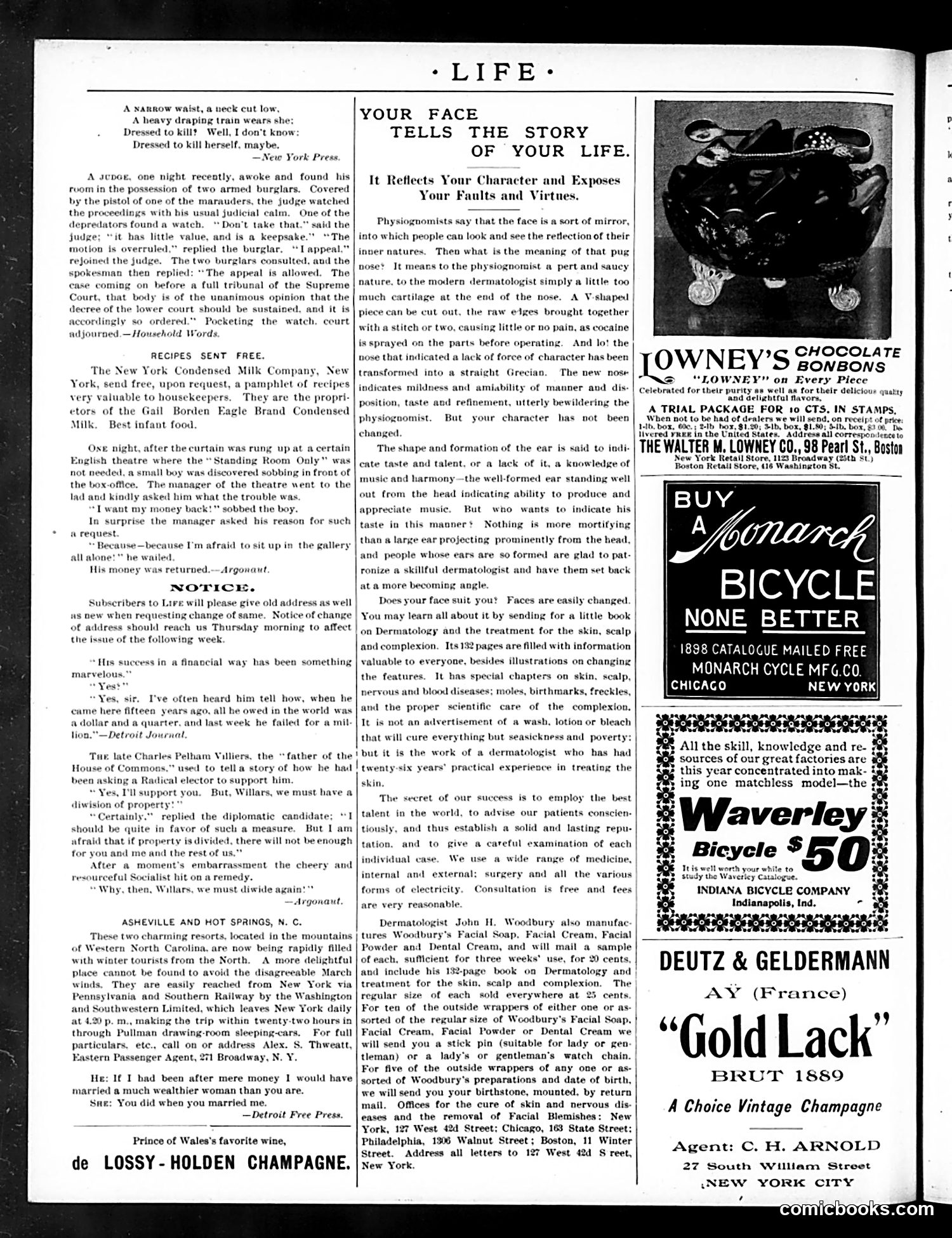
This page contains mostly **humorous anecdotes and advertisements** rather than political cartoons. The main satirical content includes: **The Judge and Burglars**: A joke about a judge's calm judicial demeanor even during a robbery. When burglars steal his watch, the judge attempts legal arguments ("I appeal"), which the burglars humorously "overturn" in their own mock court proceeding. The satire mocks legalistic formality. **Theatre Boy**: A child requests a refund because he's afraid to sit alone in the gallery—commentary on childhood fears and theater economics. **Charles Pelham Villiers dialogue**: A political joke about a Radical candidate supporting property division, then admitting it wouldn't leave enough for himself and others. A Socialist character jokes they should "divide again"—satirizing socialist redistribution rhetoric. **Fashion verse**: Opening lines mock women's fashionable tight corseting as literally self-destructive ("dressed to kill herself"). The page is primarily filled with **advertisements** for bicycles, chocolate, champagne, and other products, with humorous filler content between them.
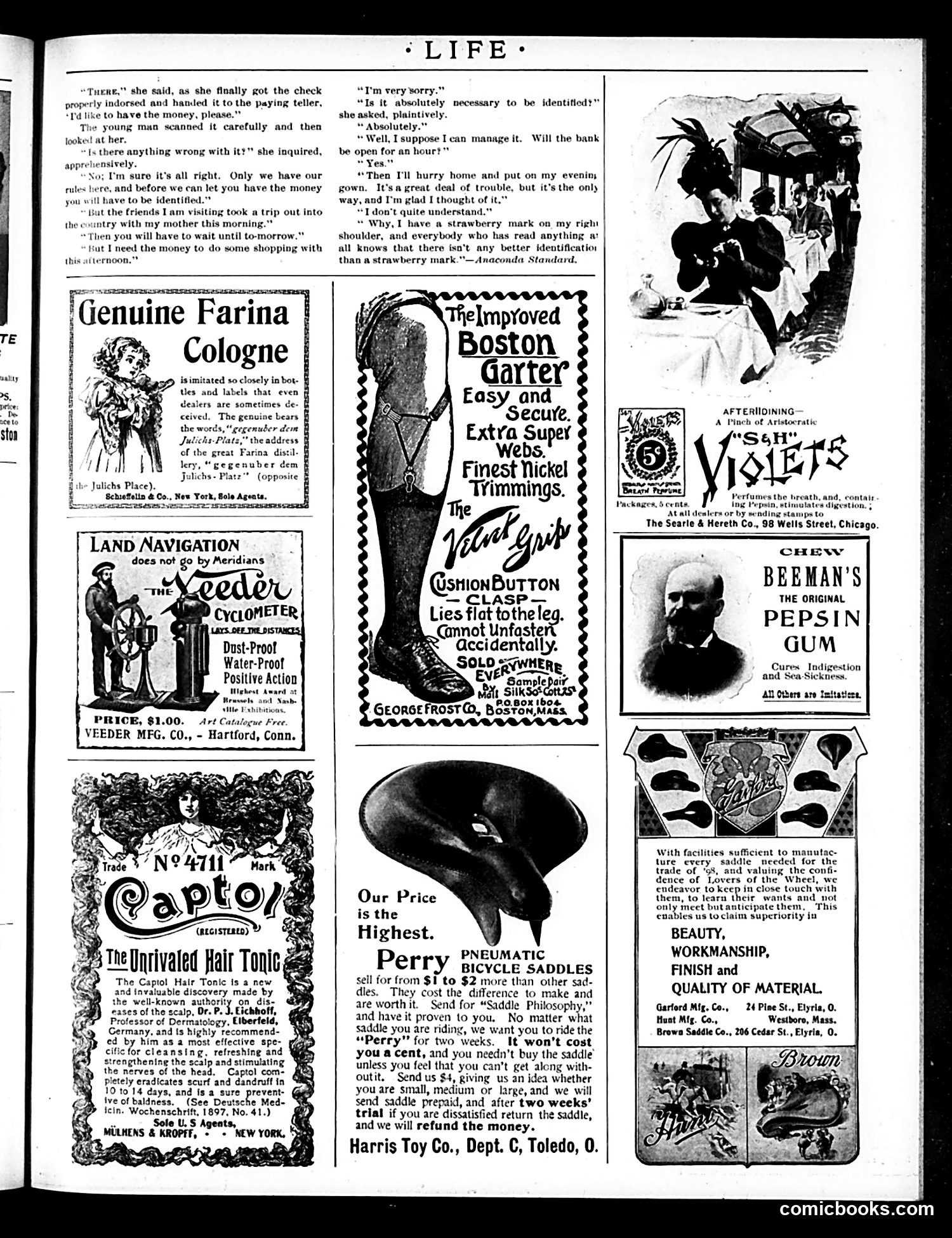
This page is primarily **advertising**, with one prominent cartoon joke at the top. ## The Main Cartoon The cartoon satirizes a woman's attempt to cash a check without proper identification. When told she needs to prove her identity, she says she'll go home and change into her evening gown because she has a **strawberry birthmark on her shoulder**—implying this distinctive physical mark is sufficient proof of identity. The joke relies on absurdist logic: the bank teller needs identification at that moment, not later, and a birthmark visible only when undressed would be impractical for a bank transaction. The woman's "solution" is comically illogical—she's misunderstood the entire purpose of identification requirements. ## Context This appears to satirize early-1900s banking procedures and, more broadly, the naive or illogical thinking sometimes attributed to women in the era. The humor targets the woman's reasoning rather than banking systems. The rest of the page contains period product advertisements (hair tonic, bicycle saddles, gum, cologne) typical of *Life* magazine's revenue model.
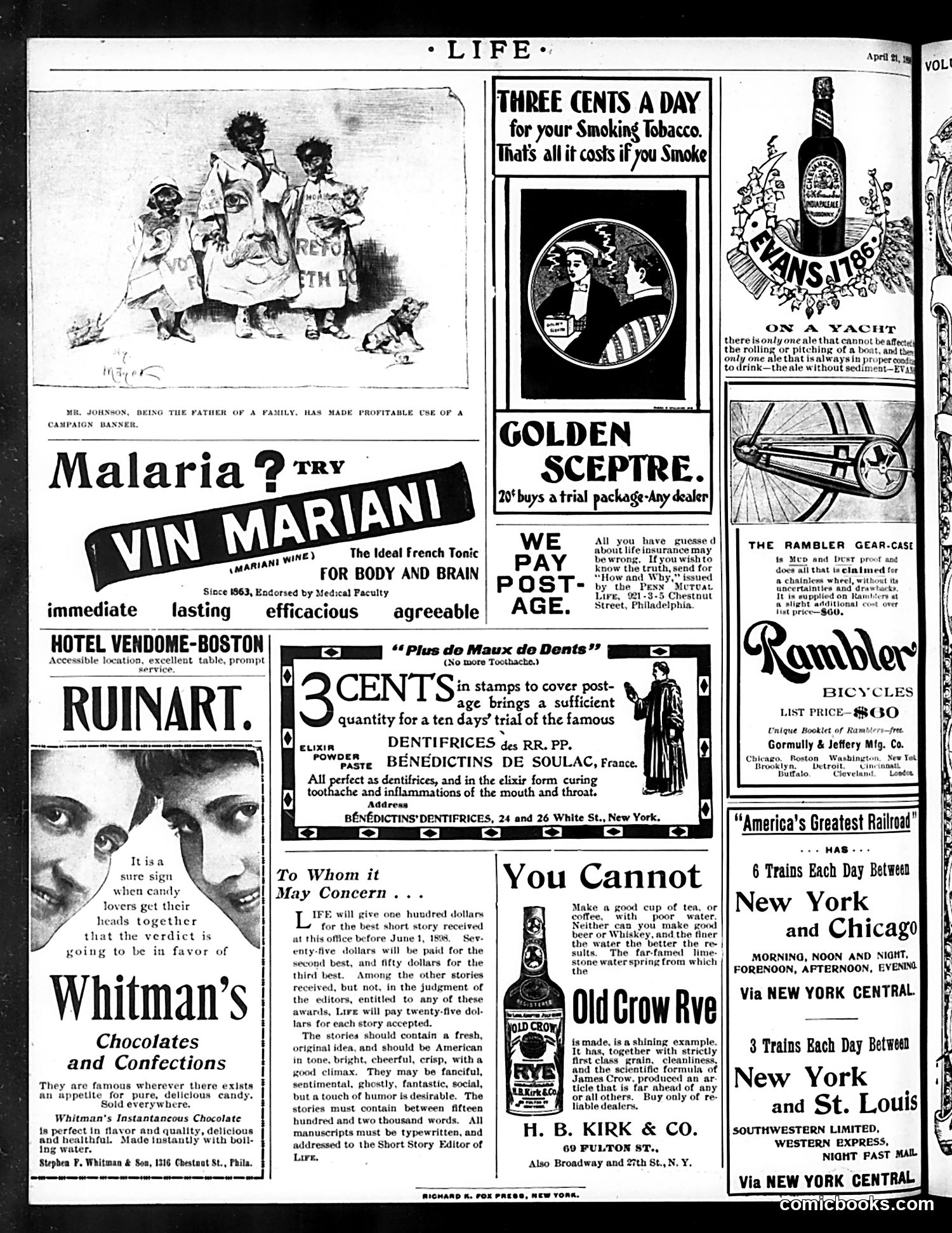
The top cartoon depicts **Mr. Johnson as "Father of a Family"** using a campaign banner to promote his product—a satirical jab at how politicians and businessmen exploit family imagery for profit. The sketch mocks the commercialization of domestic life and patriotic sentiment. The page is primarily **advertisements**, reflecting turn-of-the-century product marketing. Notable are patent medicines like **Vin Mariani** (a cocaine-laced French tonic "endorsed by Medical Faculty"), **Old Crow Rye whiskey**, and **Benedictins toothpaste**—products now recognized as fraudulent or harmful but then marketed as cures and tonics. The satirical edge appears in the **Life magazine short-story contest announcement**, offering $100 for stories emphasizing fresh ideas, humor, and specifically **American tone**—reflecting the magazine's editorial mission to promote American culture and satirize both foreign pretension and domestic absurdity. The overall page showcases the era's unregulated advertising landscape and Life's role as both satirist and commercial enterprise.