
Life, 1898-04-21 · page 14 of 20
Life — April 21, 1898 — page 14: what you’re looking at
What you’re looking at
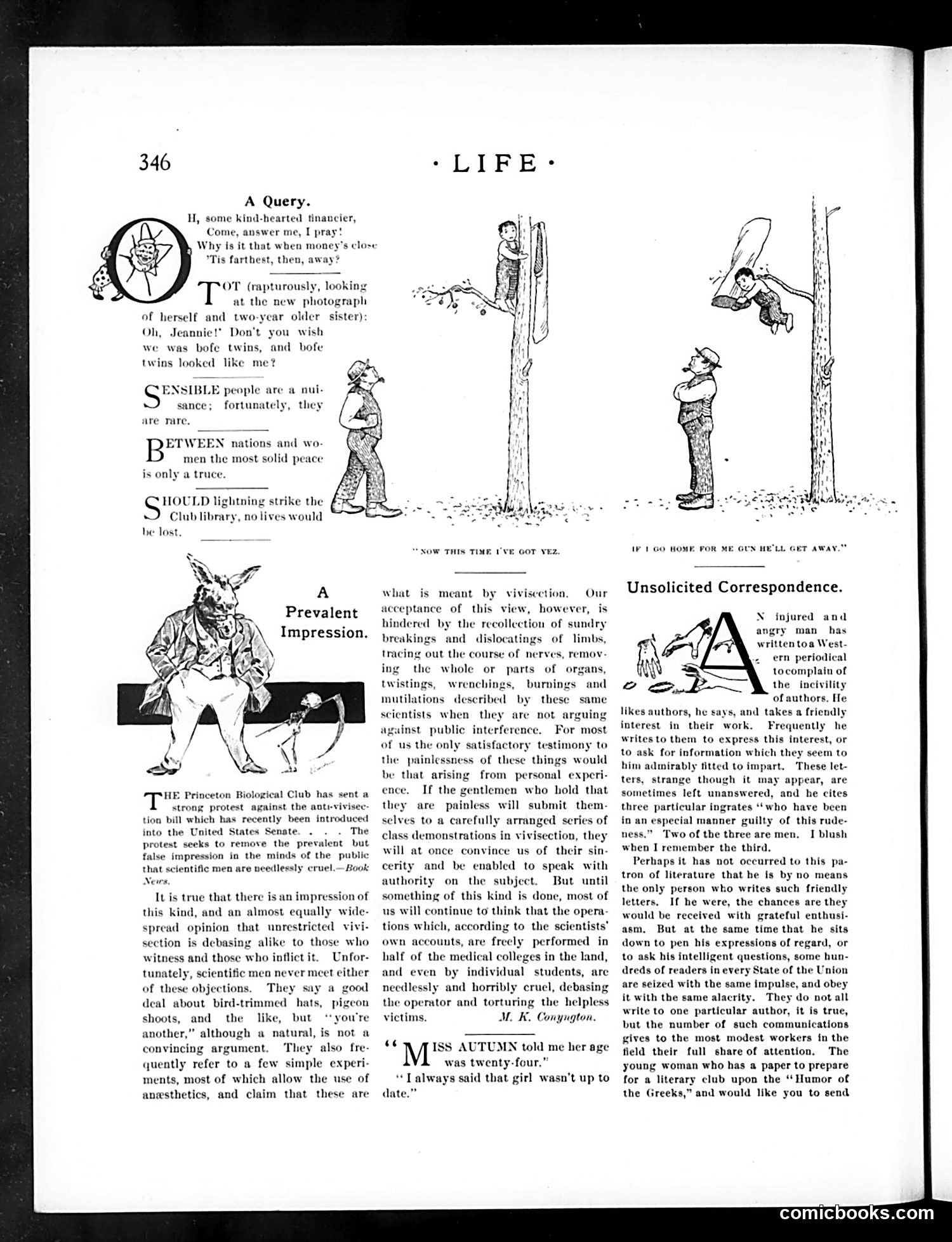
This page contains satirical content about several social issues of the era: **"A Query"** (top left): A cartoon mocking the paradox of finance—a financier cannot access money precisely when it's most needed ("tight money"). **"A Prevalent Impression"** (main article): Satirizes the vivisection debate. Scientists protested an antivivisection bill, claiming animal testing causes no suffering. The author sardonically suggests the only way to prove this would be for scientists to volunteer themselves for the same procedures performed on animals—a scathing indictment of what he describes as "needlessly and horribly cruel" laboratory practices. **Tree-climbing cartoon** (right): Illustrates the vivisection article, depicting what appears to be painful animal experiments. **"Unsolicited Correspondence"**: Humorously complains about authors who ignore fan mail. The writer notes hundreds of readers write to authors constantly, suggesting the angry correspondent is naïve to expect personal responses. The page reflects Progressive Era concerns about scientific ethics and animal welfare alongside lighter social commentary.
📄 Transcribed text from this page (OCR, searchable)
Machine-transcribed from the original scan — historical spelling and the odd misread are preserved.
A Query. H, some kind-hearted tinancier, Come, answer me, I pra: Why is it that when money's clo-e ‘Tis farthest, then, i fines (rapturously ing at the new photograph of herself and two-year older. sister): Oh, Jeannie!’ Don't you wish was bofe twins, and bofe twins looked like me? are rare. ETWE men the most solid peace is only a truce. SOE ea strike the S Club library, no lives would be lost. we SIBLE people are a nui- sance; fortunately, they ‘ nations and wo- Prevalent \\ Impression. HE Princeton Biological Club has sent a strong protest against the antivivisec tion bill which has recently been introduced into the United States Senate. The protest seeks to remove the prevalent but false impression in the minds of the public that scientific men are needlessly cruel.—Book News, It is true that there this kind, and an almost equa spread opinion that unrestricted v section is debasing alike to those who witness and those who inflict it. Unfor- tunately, scientific men never meet either of these objections. They say a good deal about bird-trimmed hats, pigeon shoots, and the like, but ‘you're another,” although a natural, is not a convincing argument, They also fre quently refer to a few simple expe! ments, most of which allow the use of anesthetics, and claim that these are an impression of ly wide- “NOW THIS TIME UV what is meant. by vivisection. acceptance of this view, hindered by the recollection of sundry breakings and dislocatings of limbs, tracing out the course of nerves, remov- ing the whole or parts of twistings, wrenchings, burnin mutilations described by these same scientists when they are not arguing against public interference. For most of us the only satisfactory testimony to the painlessness of these things would be that arising from personal experi- ence. If the gentlemen who hold that they are painless will submit them selves to a carefully arranged series of class demonstrations in vivisection, they will at once convince us of their sin- cerity and be enabled to speak with authority on the subject. But until something of this kind is done, most of us will continue to think that the opera- tions which, according to the scientists’ own accounts, are freely performed in half of the medical colleges in the land, and even by individual students, are needlessly and horribly cruel, debasing the operator and torturing the helpless victims. M. K. Conyngton. “M Our however, is SS AUTUMN told me her age was twenty-four,” ‘*T always said that girl wasn’t up to date.” Unsolicited Correspondence. N injured and angry man has written toa West- _ ern periodical tocomplain of the incivility of authors. He likes authors, he says, and takes a friendly interest in their work. Frequently he writes to them to express this interest, or to ask for information which they seem to him admirably fitted to impart. These let- ters, strange though it may appear, are sometimes left unanswered, and he cites three particular ingrates “who have been in an especial manner guilty of this rude- ness.” Two of the three are men, I blush when I remember the third. Perhaps it has not occurred to this pa- tron of literature that he is by no means the only person who writes such friendly letters. If he were, the chances are they would be received with grateful enthusi- asm, But at the same time that he sits down to pen his expressions of regard, or to ask his intelligent questions, some hun- dreds of readers in every State of the Union are seized with the same impulse, and obey it with the same alacrity. They do not all write to one particular author, it is true, but the number of such communications gives to the most modest workers in the field their full share of attention. The young woman who has a paper to prepare for a literary club upon the “Humor of the Greeks,” and would like you to send comicbooks.com