
Life, 1898-04-21 · page 12 of 20
Life — April 21, 1898 — page 12: what you’re looking at
What you’re looking at
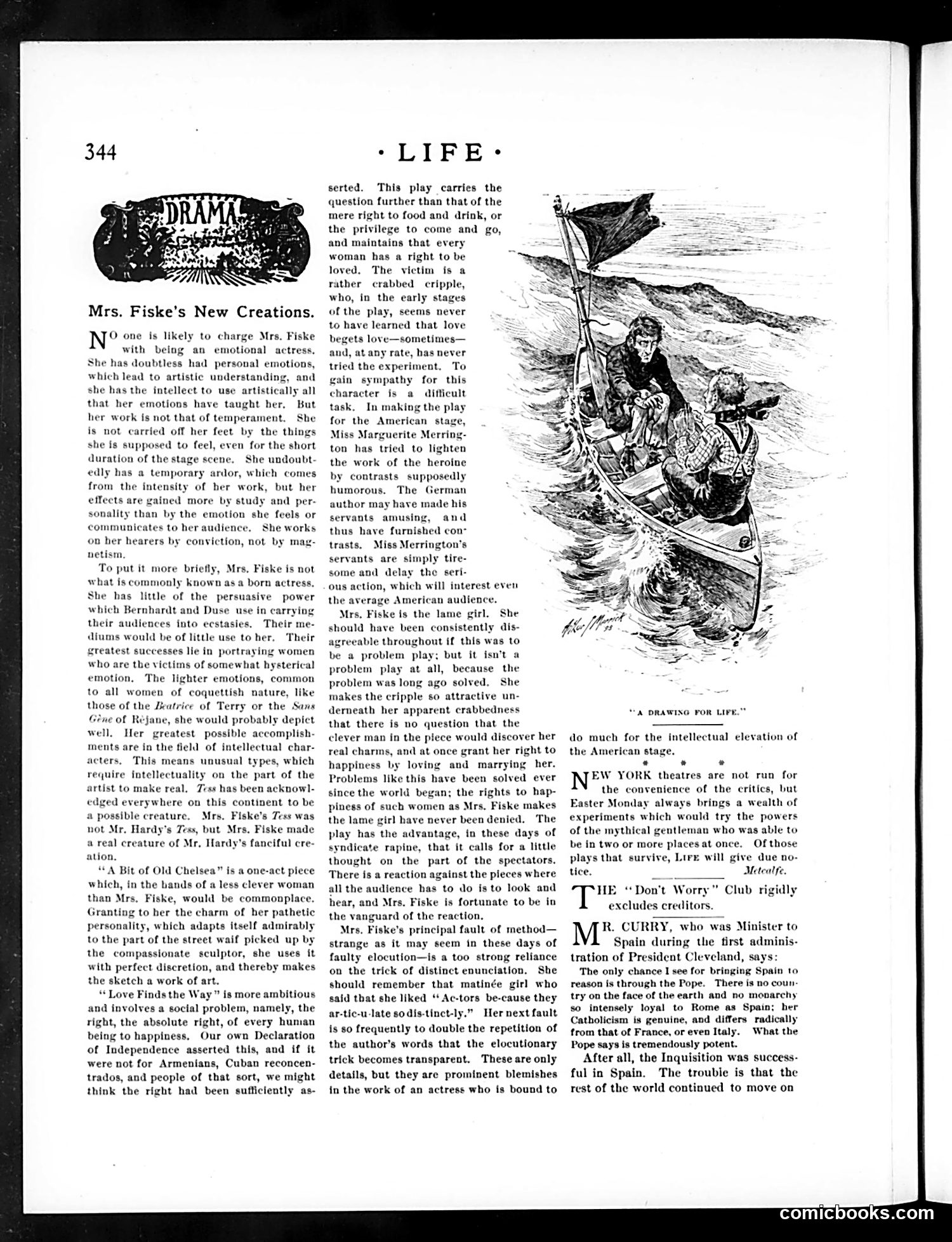
This page discusses **Mrs. Fiske's theatrical productions**, analyzing her acting style and dramatic choices. The article criticizes her approach as overly intellectual and reliant on "elocution" rather than naturalistic emotion. The accompanying sketch titled **"A Drawing for Life"** depicts a figure (appears to be a character from one of Mrs. Fiske's plays) in period costume on a hillside, holding a flag. The drawing illustrates one of the theatrical works being reviewed. The lower section shifts to discussing **New York theaters** and mentions **President Cleveland** and **Spain** in relation to religious/political tensions, though the context is fragmentary. The satire primarily targets theatrical pretension and Mrs. Fiske's intellectual approach to acting, which the critic suggests alienates audiences rather than moving them emotionally.
📄 Transcribed text from this page (OCR, searchable)
Machine-transcribed from the original scan — historical spelling and the odd misread are preserved.
Mrs. Fiske’s New Creations. © one is likely to charge Mrs. Fiske with being an emotional actress, She has doubtless had personal emotions, which lead to artistic understanding, and she has the intellect to us that her emotions have taught ber, her work is not that of temperament. is not carried off her feet by the things she is supposed to feel, even for the short duration of the stage scene. She undoubt- edly has a temporary ardor, which comes from the intensity of ber work, but her effects are by study and per- sonality than by the emotion she feels or communicates to her audience, She works on her hearers by conviction, not by mag- netism. To put it more briefly, Mrs, Fiske is not what is commonly known as a born actress. She bas little of the persuasive power which Bernhardt and Duse use in carrying their audiences into asies. Their me- diums would be of little use to her, Their greatest successes lie in portraying women who are the victims of somewhat hysterical emotion, The lighter emotions, common to all women of coquettish nature, like those of the Leatrice of Terry or the Gine of Rejane, she would probably depict well. Her greatest possible accomplish- ments are in the field of intellectual char- acters, This means unusual types, which require intellectuality on the part of the artist to make real, Zess has been acknowl- edged everywhere on this continent to be a possible creature. Mrs. Fiske’s Jess was not Mr, Hardy's Tess, but Mrs. Fiske made a real creature of Mr, Hardy's fanciful cre- jon. “A Bit of Old Chelsea” is a one-act piece which, in the bands of a less clever woman than Mrs, Fiske, would be commonplace. Granting to her the charm of her pathetic personality, which adapts itself admirably to the part of the street waif picked up by the compassionate sculptor, she uses it with perfect discretion, and thereby makes the sketch a work of art. “Love Finds the Way” is more ambitious and involves a social problem, namely, the right, the absolute right, of every human being to happiness, Our own Declaration of Independence asserted this, and if it were not for Armenians, Cuban reconcen- trados, and people of that sort, we might think the right had been sufficiently as- ined mot ans * LIFE: serted. This play carries the question further than that of the mere right to food and drink, or the privilege to come and go, and maintains that every woman has a right to be loved, The victim is a rather crabbed cripple, who, in the early stages ofthe play, seems never to have learned that love begets love—sometimes— and, at any rate, has never tried the experiment, To gain sympathy for this character is a difficult task. In making the play for the American stage, Miss Marguerite Merring- ton has tried to lighten the work of the heroine by contrasts supposedly humorous. The German author may have made his servants amusing, and thus have furnished con- trasts. Miss Merrington’s servants are simply tire- some and delay the seri- ous action, which will interest even the average American audience. Mrs, Fiske is the lame girl. She should have been consistently dis- agreeable throughout if this was to be a problem play; but it isn't a problem play at all, because the problem was long ago solved. She makes the cripple so attractive un- derneath her apparent crabbedness that there is no question that the clever man in the piece would discover her real charms, and at once grant her right to happiness by loving and marrying her. Problems like this have been solved ever since the world began; the rights to hap- piness of such women as Mrs, Fiske makes the lame girl have never been denied. The play has the advantage, in these days of syndicate rapine, that it calls for a little thought on the part of the spectators. ‘There is a reaction against the pieces where all the audience has to do isto look and hear, and Mrs, Fiske is fortunate to be in the vanguard of the reaction, Mrs. Fiske’s principal fault of method— strange as it may seem in these days of faulty elocution—is a too strong reliance on the trick of distinct enunciation, She should remember that matinée girl who said that she liked ‘Ac-tors be-cause they ar-tic-u-late sodis-tinct-ly.” Her next fault is so frequently to double the repetition of the author’s words that the elocutionary trick becomes transparent. These are only details, but they are prominent blemishes in the work of an actress who is bound to do much for the intellectual elevation of the American stage. « * * EW YORK theatres are not run for the convenience of the critics, but ster Monday always brings a wealth of experiments which would try the powers of the mythical gentleman who was able to be in two or more places at once. Of those plays that survive, Lire will give due no- tice. Metcalfe. HE “Don't Worry” Club rigidly excludes creditors. R. CURRY, who was M er to Spain during the first adminis- tration of President Cleveland, says: ‘The only chance I see for bringing Spain to reason is through the Pope. There is no coun try on the face of the earth and no monarchy so intensely loyal to Rome as Spain; her Catholicism is genuine, and differs radically from that of France, or even Italy. What the Pope says is tremendously potent. After all, the Inquisition was success- ful in Spain. The troubie is that the rest of the world continued to move on comicbooks.com