
Life, 1898-04-21 · page 6 of 20
Life — April 21, 1898 — page 6: what you’re looking at
What you’re looking at
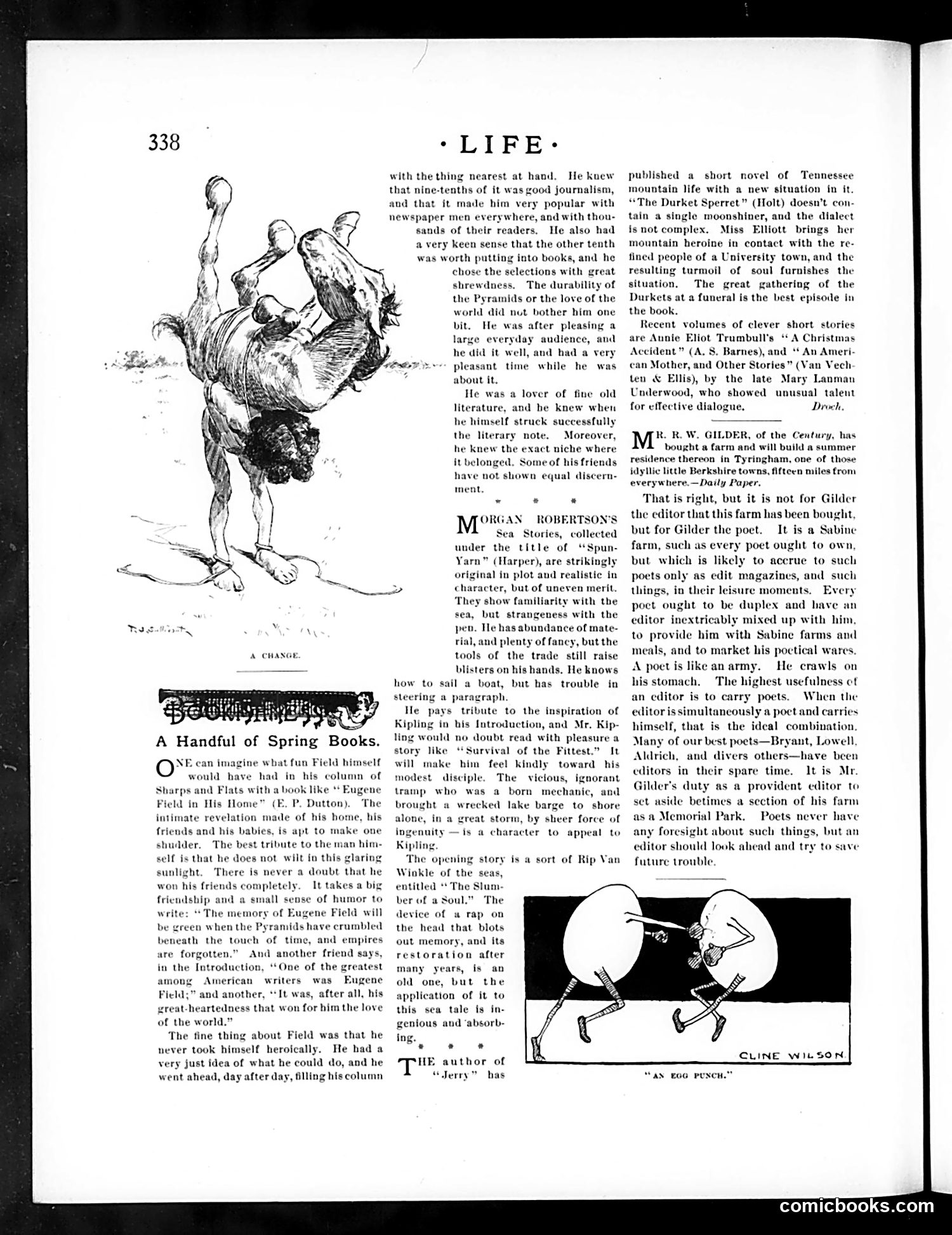
This page contains literary reviews rather than political cartoons. The main illustration shows a stylized figure in an contorted pose—labeled "A CHANGE"—that appears to be satirical commentary on physical transformation or awkward adaptation, though the specific reference is unclear from the image alone. The page reviews spring books, including works by Morgan Robertson ("Sea Stories"), Annie Eliot Trumbull, and others. There's also a small cartoon by Cline Wilson labeled "AS EGO PUNCH" showing two figures in confrontational poses. The content focuses on American literature and cultural commentary rather than explicit political satire. Without additional context about the publication date and specific literary controversies referenced, the precise targets of any satire remain unclear to modern readers.
📄 Transcribed text from this page (OCR, searchable)
Machine-transcribed from the original scan — historical spelling and the odd misread are preserved.
A CHANGE A Handful of Spring Books. NE can imagine what fun Field himself would have had in his column of Sharps and Flats with a book like Eugene Field in His Home” (E. P. Dutton). The intimate revelation made of his home, his friends and his babies, is apt to make one shudder, The best tribute to ther self is that he does not wilt in thi sunlight. There is neve won his friends completely friendship write: an hime aring a doubt that he It takes a big nd a small sense of humor to The memory of Eugene Field will be green when the Pyramids have crumbled beneath the touch of time, and empires are forgotten.” And another friend says, in the Introduction, ‘One of the greatest b rican writers Eugene Field;” and another, “It was, after all, his at-heartedness that won for him the love the world.” he fine thing about Field was that he never took himself heroically. He had a very just idea of what he could do, and he went ahead, day after day, fling his column was *> LIFE: with the thing nearest at hand. He kuew that nine-tenths of it was good journalism, and that it made him very popular with newspaper men everywhere, and with thou- sands of their readers, He also had ery keen sense that the other tenth worth putting into books, and he chose thi lections with great shrewdness. The durability of the Pyramids or the love of the world did nut bother him one bit. He fter pleasing a audience, and he did it well, and had a very pleasant time while he was about it, He was a lover of fine old literature, and be knew when he himself struck successfully the literary note. Moreover, he knew the exact niche where it belonged, Some of his friends have not shown equal discern- ment. . * * ORGAN ROBERTSON'S Sea Stories, collected under the title of “Spun. Yarn” (Harper), are striking! original in plot aud realistic in character, but of uneven merit. ‘They show familiarity with the sea, but strangeness with the pen, He has abundance of mate- rial, and plenty of fancy, but the tools of the trade still raise blisters on his hands, He knows how to sail a boat, but has trouble in steering a paragraph. He pays tribute to the inspiration of Kipling in bis Introduction, and Mr, Kip- ling would no doubt read with pleasure a story li Survival of the Fittest.” It will make him feel kindly toward his modest disciple. The vicious, ignorant tramp who was a born mechanic, and brought a wrecked lake barge to. shore alone, in a great storm, by sheer force of ingenuity — is a character to appeal to opening story is a sort of Rip Van Wiokle of the se: entitled * The Slum ber of a Soul.” The device of a rap on the head that blots out memory, and its restoration after many years, is an old one, but the application of it to this sea tale is in- genious and ‘absorb- author of “Jerry” has published a short novel of Tennessee mountain life with a new situation in it. “The Durket Sperret” (Holt) doesn’t con- tain a single moonshiner, and the dialect is not complex. Miss Elliott. brings her mountain heroine contact with the re- fined people of a University town, and the resulting turmoil of soul furnishes the situation. The great gathering of the Durkets at a funeral is the best episode in the book. Recent volumes of clever short stories are Aunie Eliot Trumbull's ‘A Christmas Accident” (A, Barnes), and ‘* An Ameri- n Mother, and Other Stories” (Van Vech ten & Ellis), by the late Mary Lanman Underwood, who showed unusual talent for effective dialogue. Droch, R. R.W. GILDER, of the Century, has bought a farm and will build a summer residence thereon in Tyringham, ove of those idyllic little Berkshire towns, fifteen miles from everywhere.—Daily Paper. That is right, but it is not for Gilder the editor that this farm has been bought, but for Gilder the poet. It is a Sabine farm, such as every poet ought to own, but which is likely to accrue to poets only as edit magazines, and s things, in their leisure moments. Every poet ought to be duplex and have an editor inextricably mixed up with him, to provide him with Sabine farms and meals, and to market his poctical wares. A poet is like an army. his stomach. The highest usefulness ct an editor is to carry poets. When the editor is simultancously a poct and carries himself, that is the ideal combination. Many of our best poets—Bryant, Lowell, Aldrich, and divers others—have been editors in their spare time. It is Mr. Gilder’s duty as a provident editor to set aside betimes a section of his farm as a Memorial Park, Poets never have any foresight about such things, but an editor should look ahead and try to save future trouble. He crawls on “ay coo PUNCH.” comicbooks.com