
A complete issue · 20 pages · 1898
Life — April 14, 1898
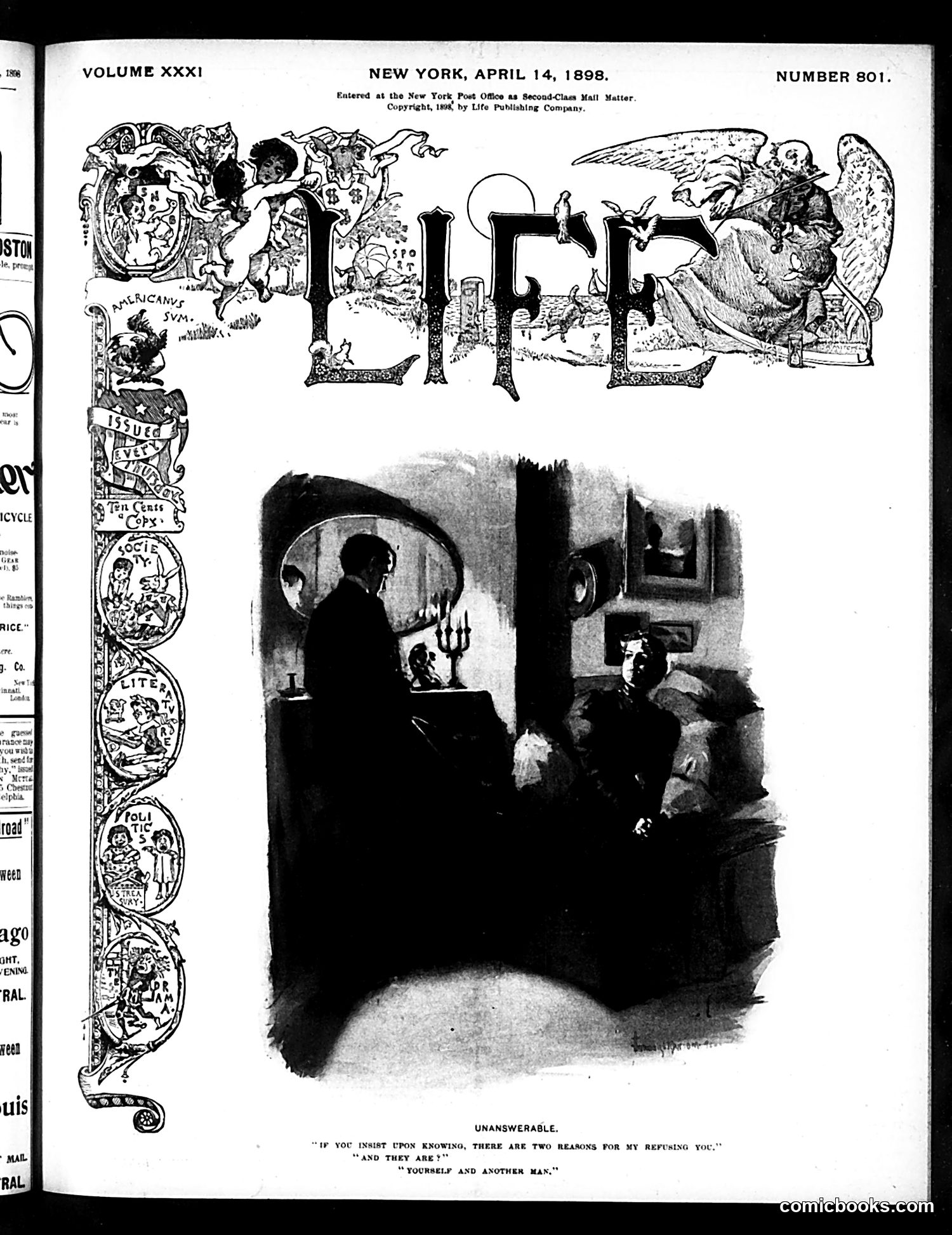
This cartoon illustrates a scene titled "Unanswerable," with the caption: "If you insist upon knowing these are two reasons for my refusing you" and "Yourself and another man." The image shows a romantic rejection scene. A man gazes at his reflection in a mirror while a woman sits nearby, apparently delivering her refusal of his romantic advances. The satire lies in her stated reasons for rejection: he cannot compete with his own reflection (vanity/self-absorption) and another rival suitor. The joke critiques masculine conceit—suggesting the rejected man is so self-absorbed that his own narcissism is his chief romantic obstacle. This reflects late-Victorian social commentary on courtship dynamics and male ego.
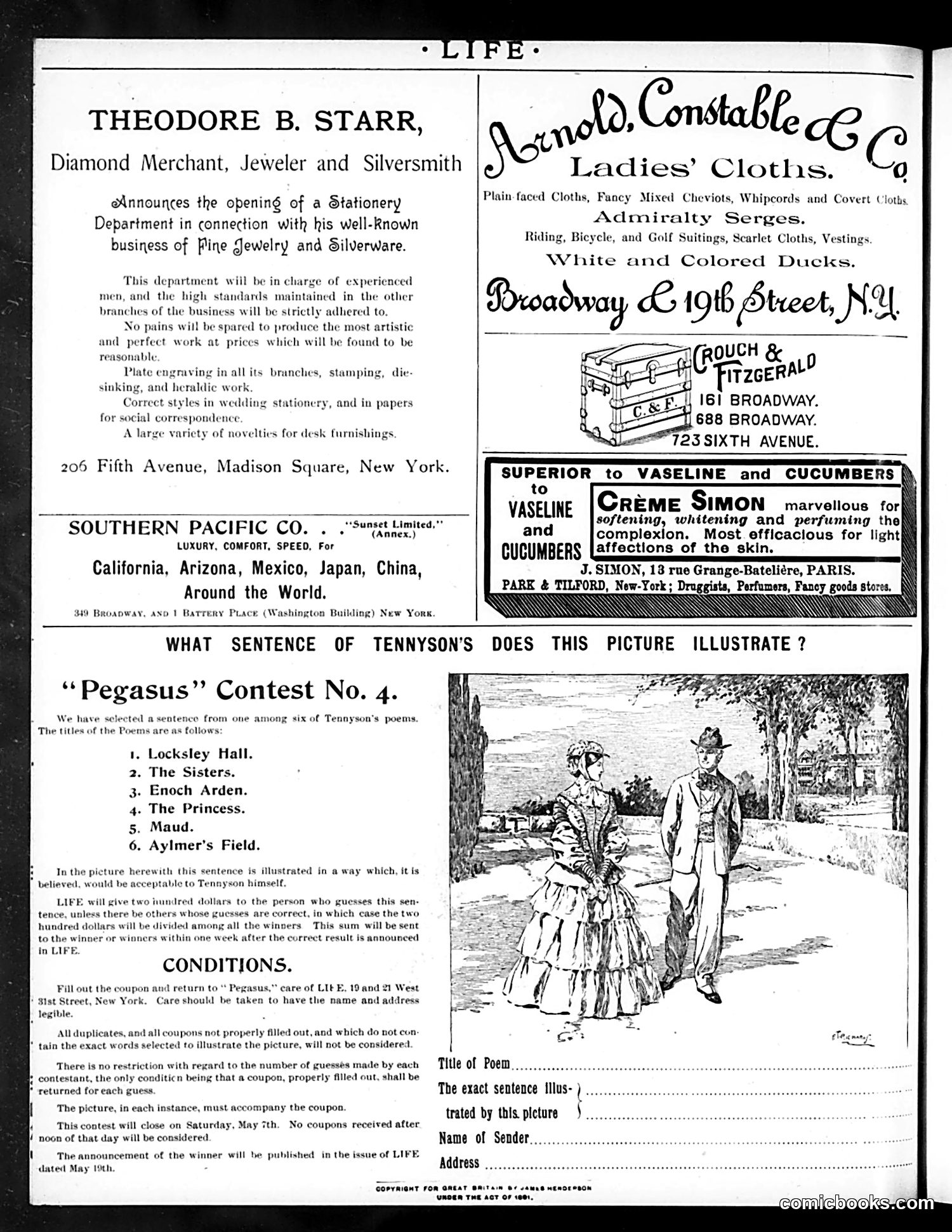
This page is primarily a **literary contest**, not political satire. Life magazine presents an illustration and asks readers to identify which sentence from one of six Tennyson poems it depicts. The six options are: Locksley Hall, The Sisters, Enoch Arden, The Princess, Maud, and Aylmer's Field. The sketch shows a Victorian-era couple on a country road—a woman in a full dress and a man in period clothing. Readers must match this scene to the correct Tennyson line. The contest offered **one hundred dollars** to the winning guesser, with rules requiring proper coupon submission by May 7th. This represents Life's use of literary knowledge as entertainment for educated, affluent readers familiar with canonical poetry.
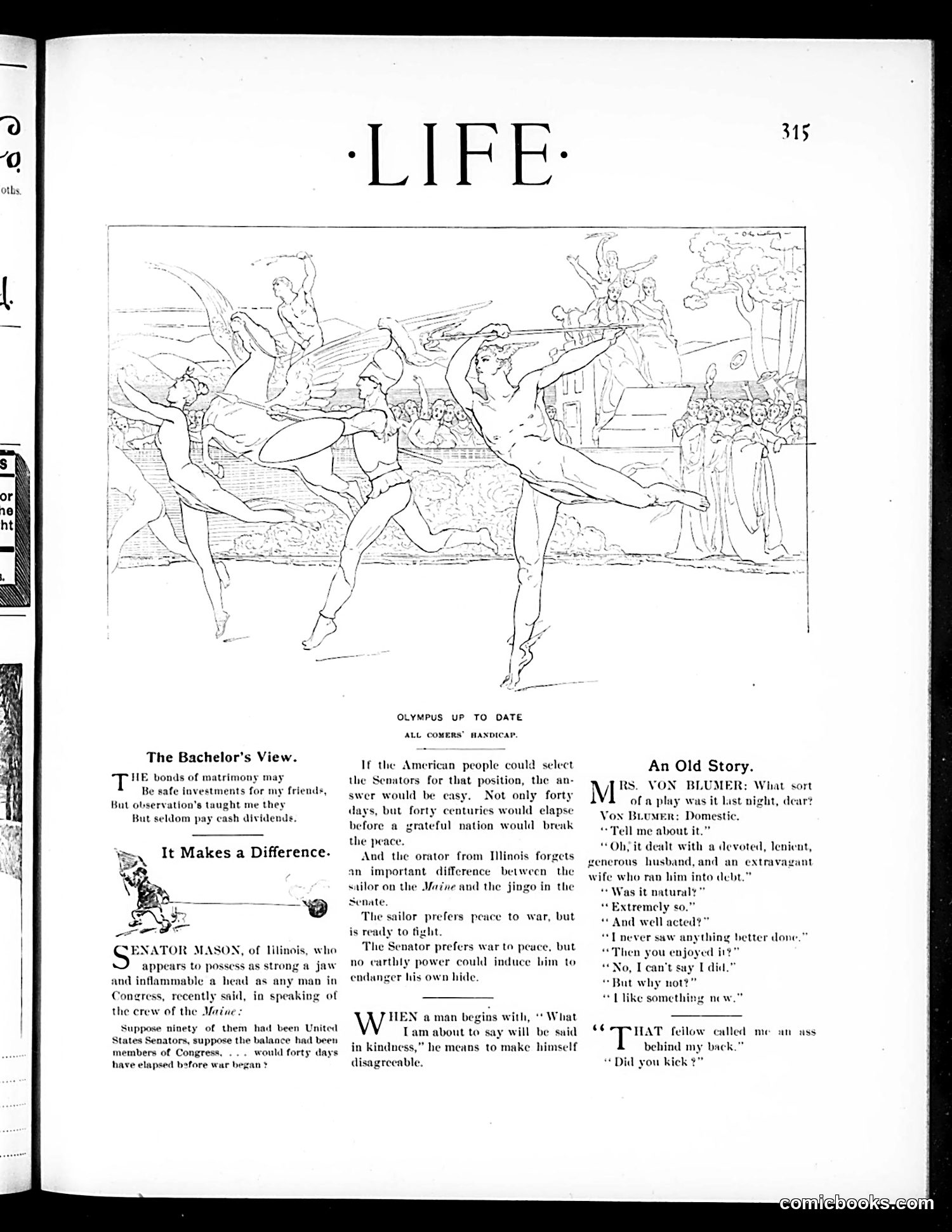
The top illustration, titled "Olympus Up to Date: All Comers' Handicap," depicts classical Olympic/mythological figures engaged in a modern athletic competition, satirizing contemporary sports and competition. Below, "It Makes a Difference" mocks Senator Mason of Illinois, contrasting military preferences: a sailor prefers peace but is ready to fight, while the Senator prefers war but lacks courage to endanger himself—satirizing political hypocrisy about military matters. "An Old Story" presents a domestic comedy dialogue about a husband with a "devoted, lenient, generous" wife who nonetheless ran away with someone else, poking fun at marital relationships and infidelity tropes. The page combines visual satire with text-based humor typical of Life's early satirical approach to politics, society, and human nature.
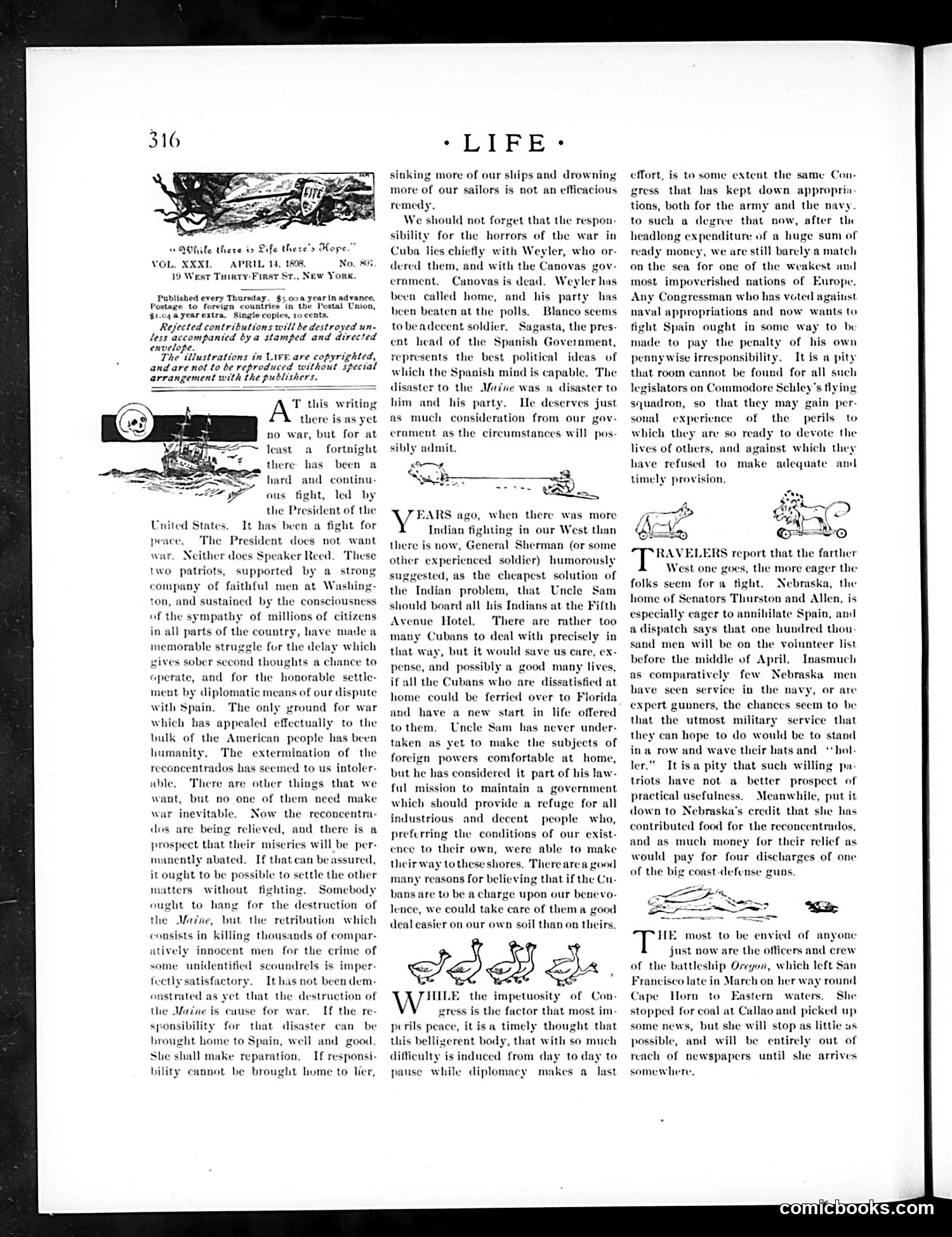
This page discusses the Spanish-American War and Cuban independence. The text critiques the Maine disaster (referenced as a cause for war) and debates whether the U.S. should annex Cuba or grant it independence. The decorative illustrations—ducks and small birds scattered throughout—appear to be generic ornamental elements rather than political cartoons with specific satirical meaning. The main satire is textual: the author argues that destroying Spain won't solve the Cuban problem, and questions whether the U.S. has the right to dictate Cuba's future. The piece advocates for Cuban self-determination rather than American imperial expansion, a position reflecting anti-imperialist sentiment during the 1898 war debates. No clearly identifiable caricatures of specific political figures appear on this page.
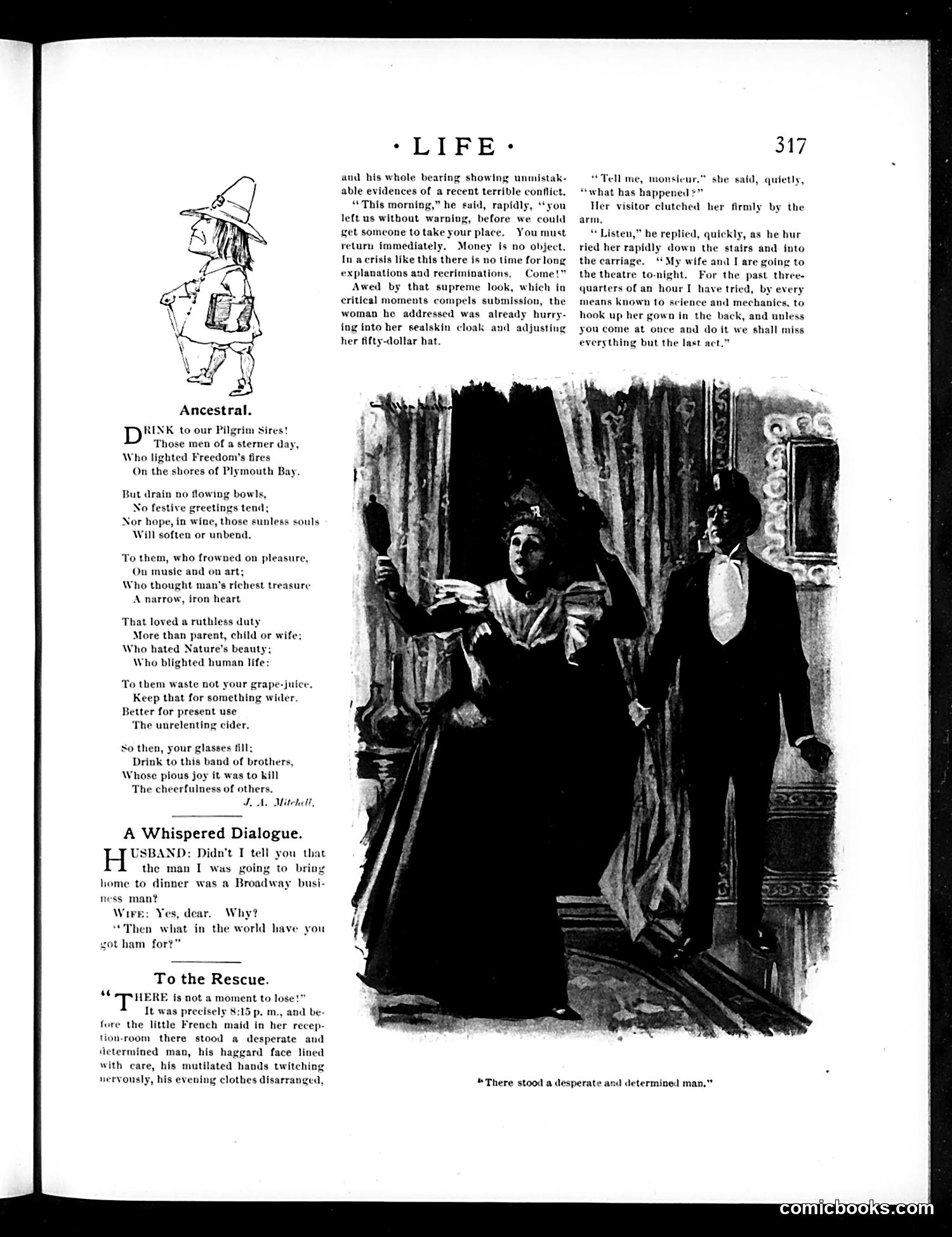
The page contains three literary pieces rather than political cartoons: 1. **"Ancestral"** - A humorous illustration of a character in period dress (hat, coat) accompanies a poem toasting "Pilgrim Sires" and the founding generation, satirizing reverence for ancestors while suggesting modern readers lack their character. 2. **"A Whispered Dialogue"** - A brief comic exchange between husband and wife about a dinner guest—the humor relies on domestic marital miscommunication. 3. **"To the Rescue"** - A dramatic prose passage describing a desperate, determined man in a woman's reception room, with accompanying illustration. The narrative appears to be sentimental Victorian fiction rather than satire. This page showcases Life's mixed content format of poetry, humor, and serialized fiction rather than primarily satirical cartooning.
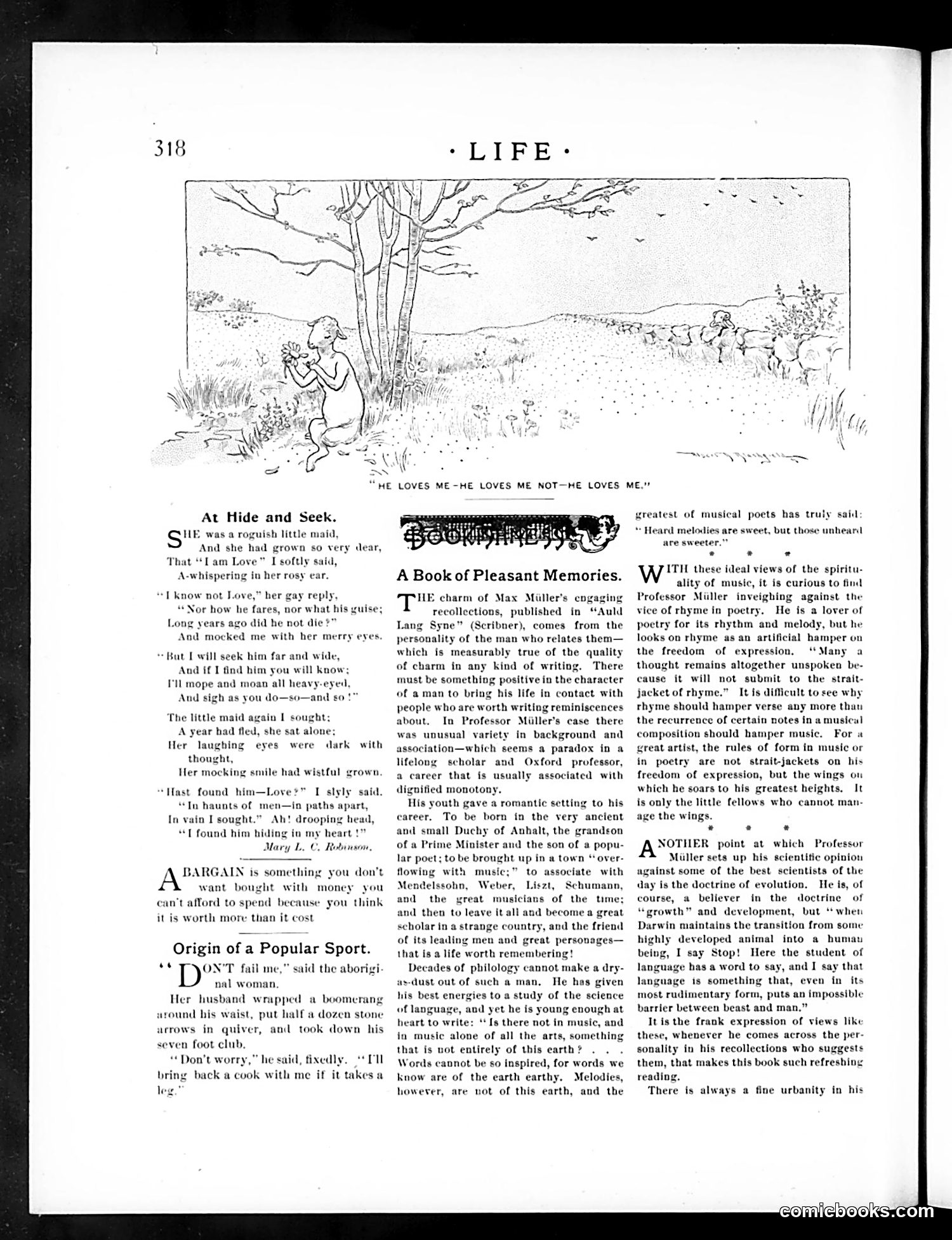
**The Main Cartoon** depicts a child playing "He loves me—he loves me not" while plucking flower petals beneath a tree. This is a straightforward illustration of childhood folklore, not political satire. **The Text Content** consists of three separate prose pieces: - "At Hide and Seek" — a sentimental poem about a maid and lost love - "A Book of Pleasant Memories" — discussing Max Müller's reminiscences and the relationship between music and poetry - "Origin of a Popular Sport" — explaining boomerang use by aboriginal women This page contains **no political cartoons or satire**. It's a mix of light verse, literary commentary, and humorous anecdotes typical of Life's satirical-but-genteel editorial content from this era.
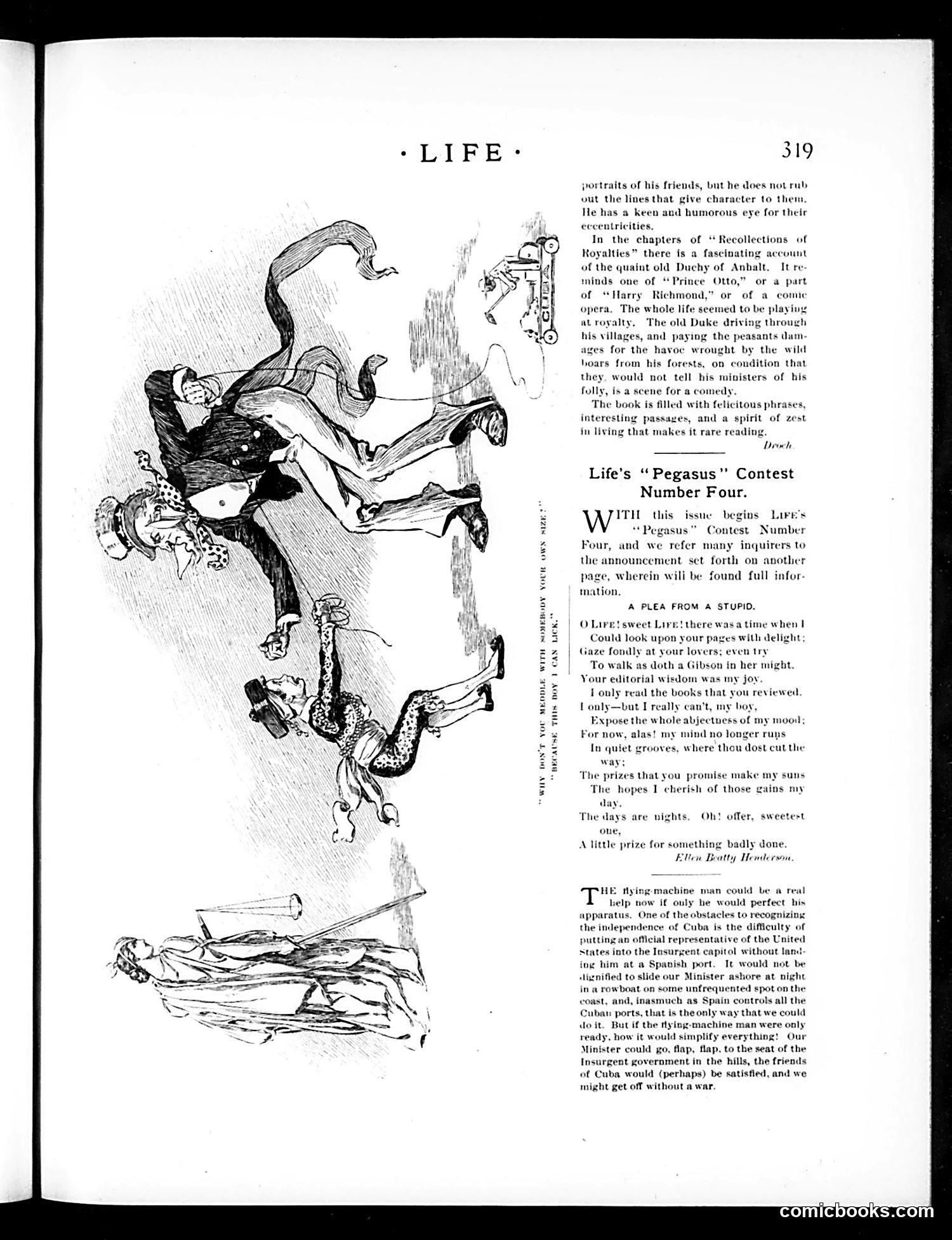
This page contains two distinct elements: **Upper illustration**: A surreal, tangled mass of serpentine or octopus-like creatures appears to depict chaos or confusion—possibly social or political disorder—though the specific reference isn't clear from context alone. **Lower section**: Titled "Life's 'Pegasus' Contest Number Four," this announces a poetry competition. The accompanying poem "A Plea from a Stupid" (attributed to Elsa Beatty Henderson) humorously presents a reader's complaint about Life's editorial policies, sarcastically suggesting the magazine no longer reviews books or maintains standards. **Political commentary**: The subsequent prose section discusses "the flying machine man" and Cuba policy, suggesting early 1900s concerns about aviation technology and U.S.-Spanish relations regarding Cuban independence. The page mixes satire with contest promotion typical of Life's format.
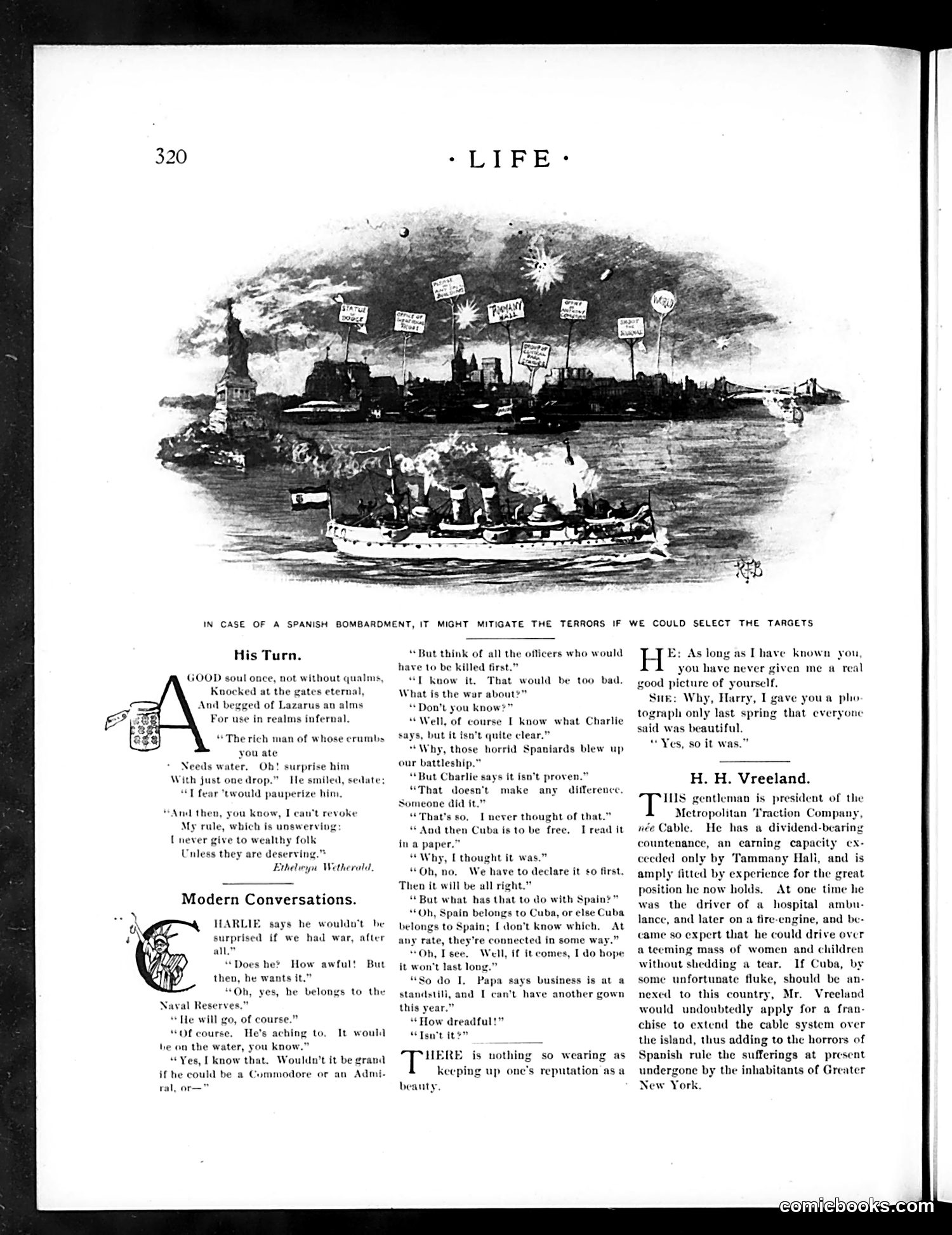
This page contains satirical commentary on Spanish-American geopolitical tensions, likely from the early 1900s when Cuba's independence status was contested between Spain and the United States. **The main cartoon** depicts a boat full of people on water near a cityscape and tree, with signs visible in the background—likely representing competing American and Spanish interests over Cuba's future. **"His Turn"** presents a dialogue about warfare and Cuba's status. Characters debate whether Cuba belongs to Spain or will become independent, with references to "Charlie" and discussions of battleships, suggesting military conflict or threat. **"Modern Conversations"** features Charlie and others discussing colonial possession and business interests. **The H.H. Vreeland profile** describes a Metropolitan Traction Company executive, contextualizing urban American concerns alongside imperial politics. The satire critiques imperial rivalry and commercial interests driving geopolitical decisions.
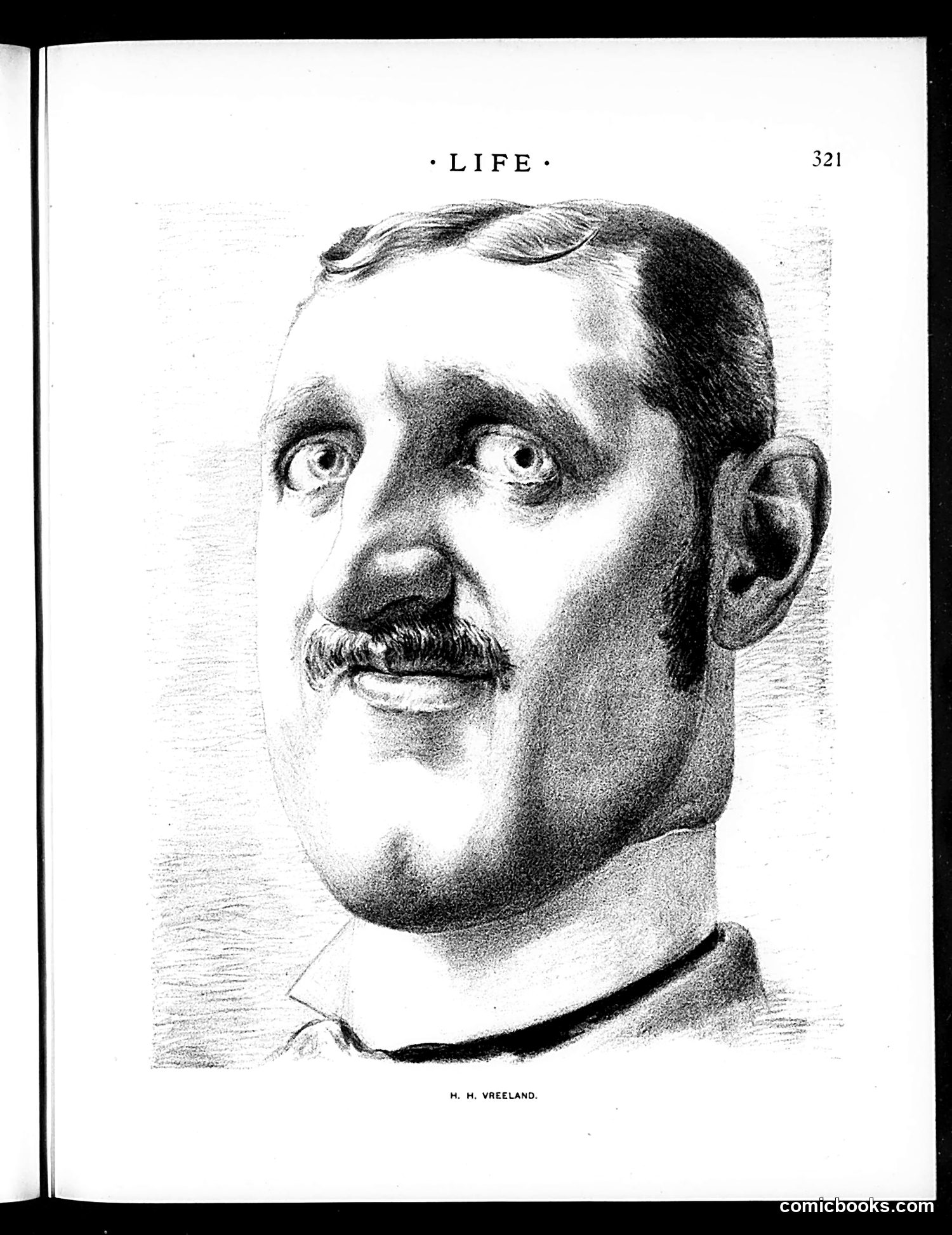
This page features a portrait sketch labeled "H. H. Vreeland" under the heading "LIFE." The detailed pencil drawing depicts a man with distinctive facial features: a prominent mustache, wide-set eyes with heavy shading beneath them, and slicked-back hair. He wears what appears to be a collared garment. Without additional context on the page, I cannot definitively identify who H. H. Vreeland was or the specific satirical intent. The artistic style suggests this is a character portrait rather than political commentary. Life magazine frequently featured caricatures of public figures, but the identity and significance of this particular subject remain unclear from the image alone.
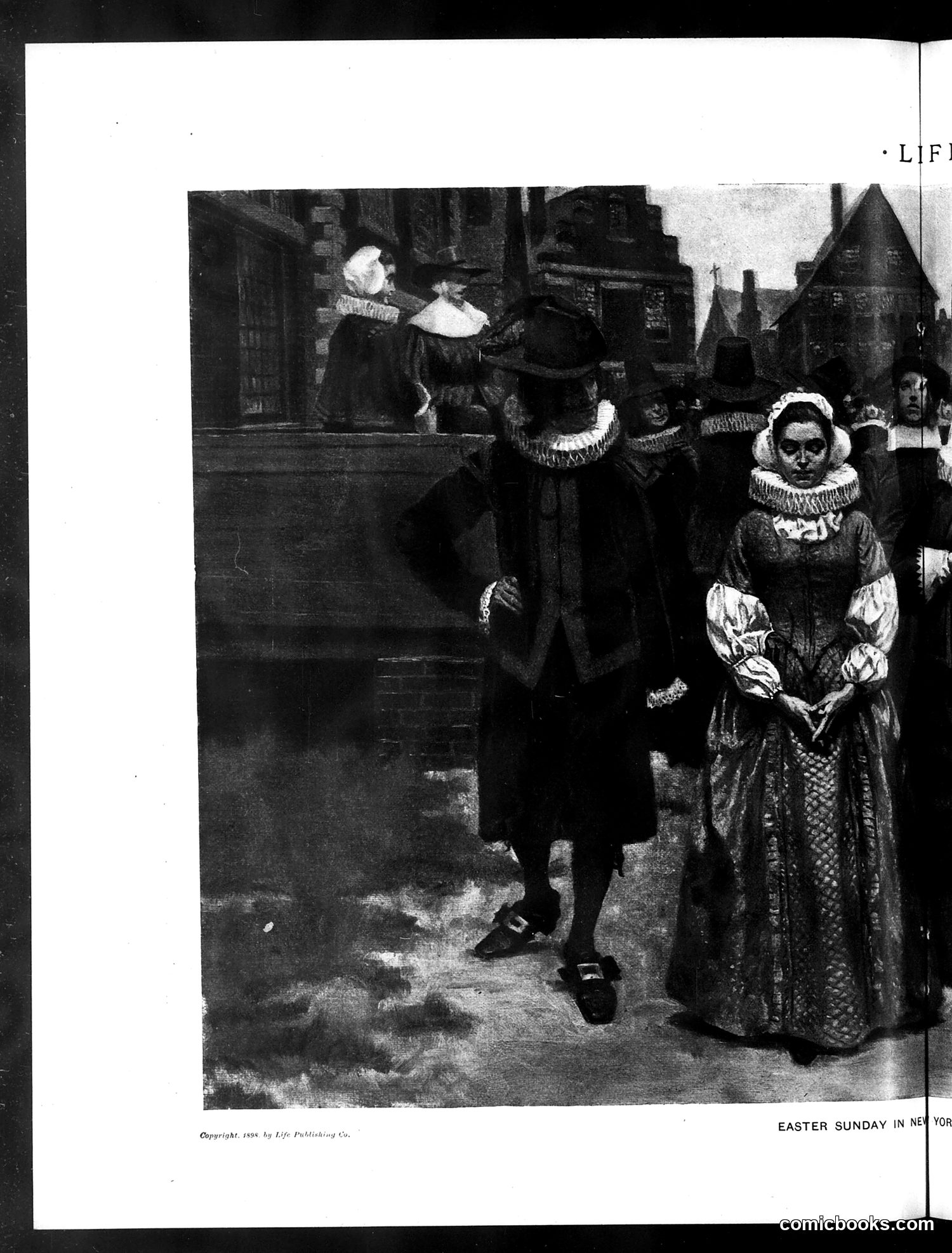
This appears to be a Life magazine photograph or illustration titled "Easter Sunday in New York" (visible at bottom right). It depicts a street scene with people in elaborate period costume—likely 17th-century Dutch or Elizabethan-era dress, based on the distinctive white collars, dark clothing, and ornate fabrics visible. The image satirizes Easter parade traditions in New York, where wealthy citizens displayed extravagant costumes. The joke likely criticizes the pretentiousness of these public displays or the disconnect between religious observance and ostentatious fashion. The historical costumes may mock the absurdity of such elaborate dress-up, positioning New York's Easter celebrations as theatrical rather than genuinely pious.
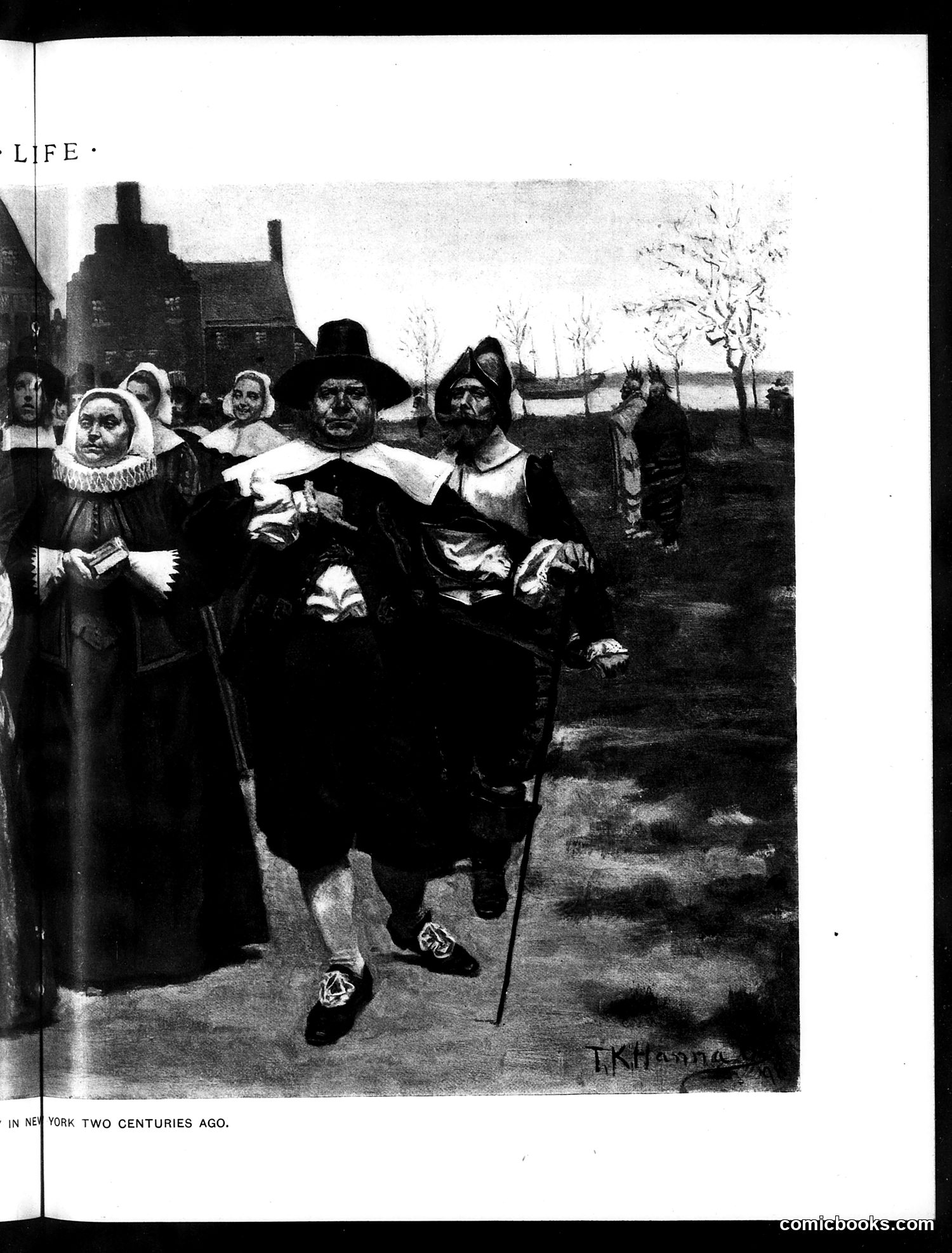
This illustration depicts "New York Two Centuries Ago" - a historical scene from early colonial America. The image shows figures in period dress (early 1600s) including women in white linen caps and men in dark clothing typical of Dutch and English settlers. The satire likely comments on the contrast between idealized historical narratives and actual colonial life, though the specific satirical point is unclear without additional context. The careful period-accurate costume details and formal composition suggest *Life* magazine's characteristic approach of using historical imagery to make commentary on contemporary society—possibly mocking romanticism about colonial America or making an implicit social critique through historical comparison. The artist's signature "T. Kittleson" is visible. The exact satirical target remains ambiguous from the image alone.
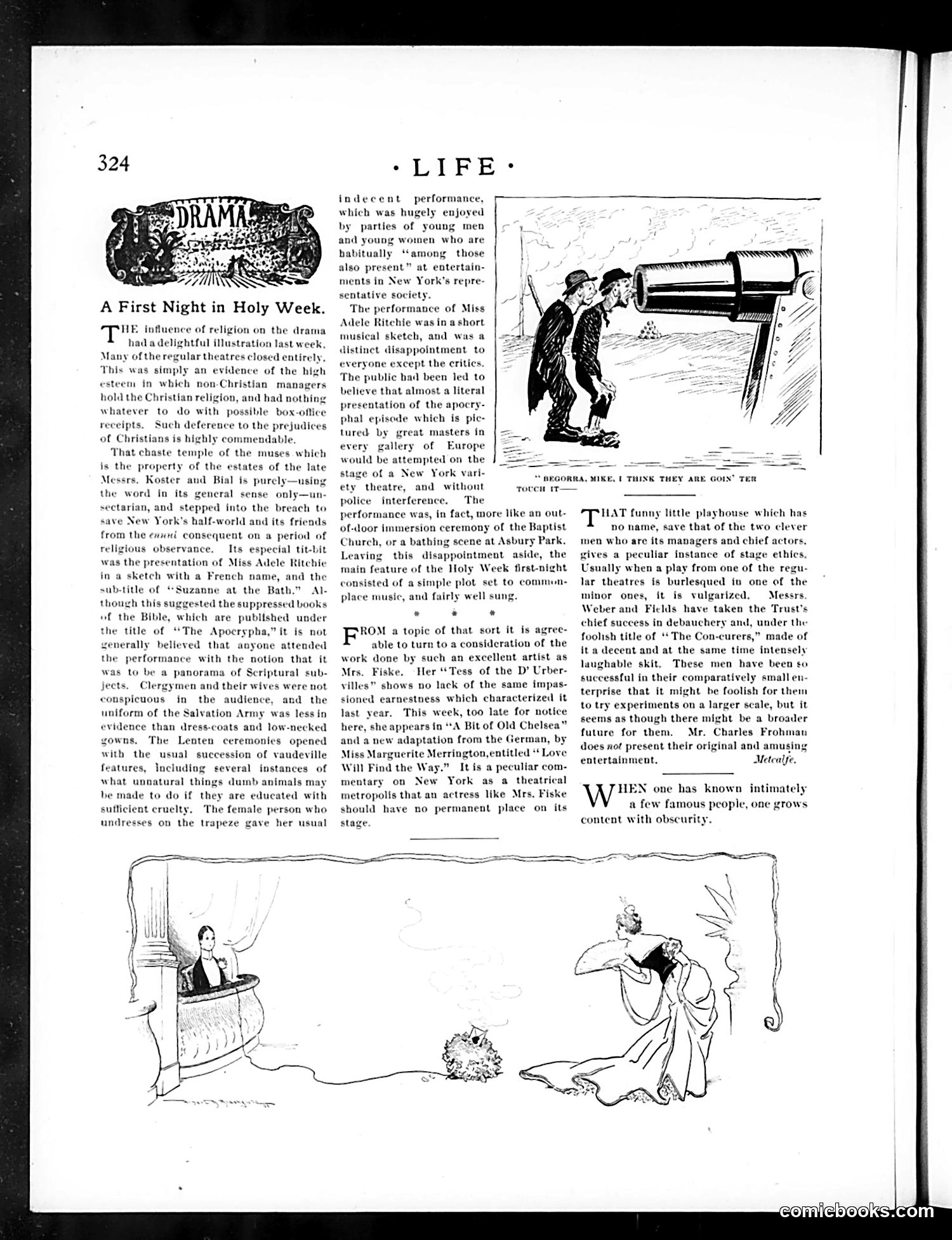
This page critiques theatrical performances during Holy Week. The main article "A First Night in Holy Week" attacks a drama that presented Biblical stories irreverently, calling it "highly commendable" mockery of Christian sensibilities. The piece criticizes the use of religious subjects for entertainment, particularly Adele Ritchie's performance in "Suzanne at the Bat." The text also reviews Mrs. Fiske's performance in "Tess of the D'Urbervilles," praising her talent while noting the theatrical world's bias against serious actresses. The bottom cartoon appears to be a humorous domestic scene, though details are unclear from the sketch alone. Overall, the page satirizes both the misuse of religion in theater and theatrical pretension during the early 1900s.
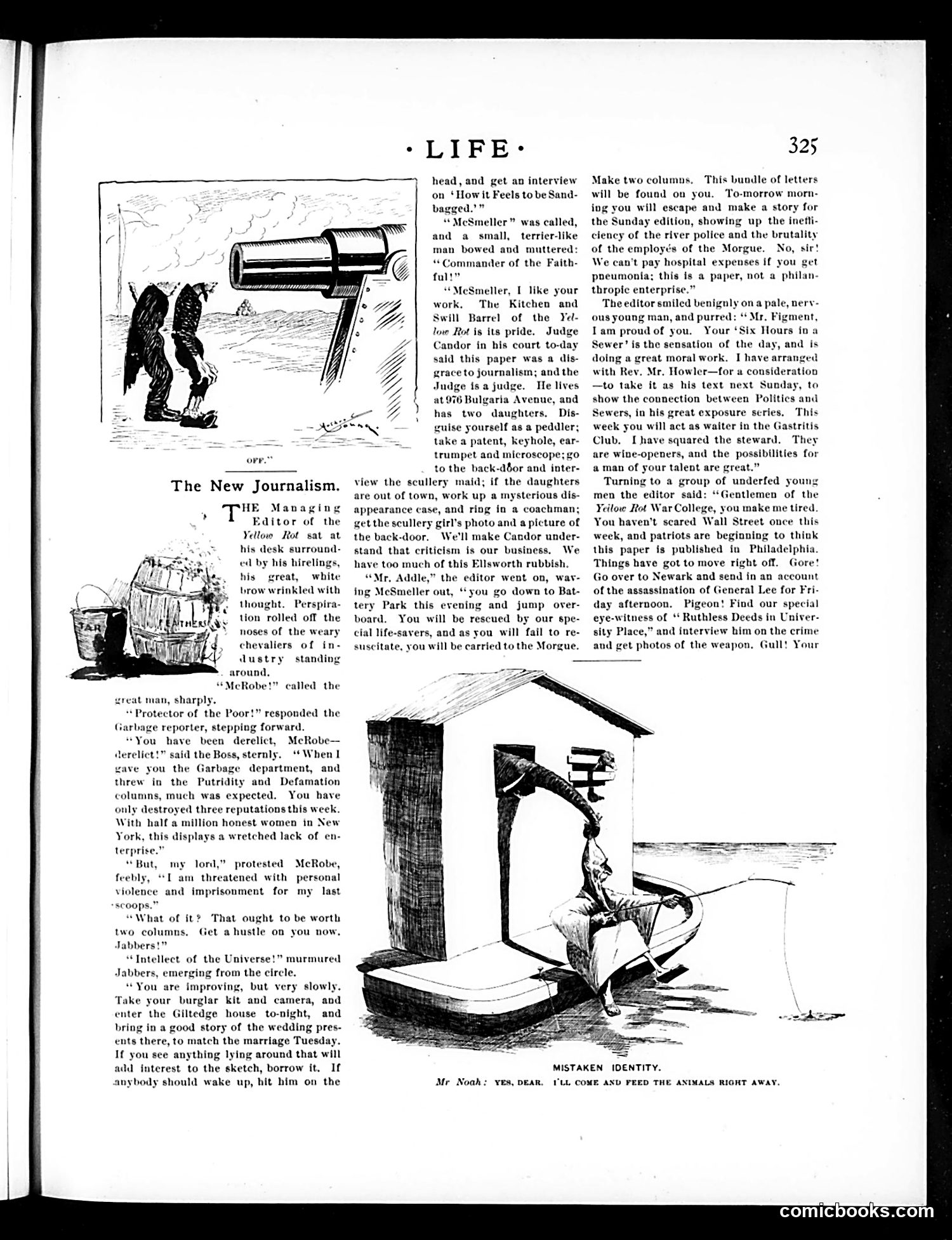
This satirizes "Yellow Journalism"—sensationalist newspapers of the 1890s-1900s that fabricated or exaggerated stories for circulation. The *Yellow Rot* (a play on actual papers like the *New York Journal*) is run by an editor who explicitly instructs reporters to: - Destroy reputations through false stories - Trespass and steal (burglarizing homes for "wedding present" gossip) - Fabricate scandals about judges and their families - Stage dangerous stunts (faking a drowning) for headlines - Manipulate clergy to legitimize false narratives The cartoon mocks how these papers prioritized sensationalism and profit over truth, ethics, or legality. Reporters are cynically rewarded for causing "personal violence and imprisonment" to themselves and others. The satire exposes that Yellow Journalism was fundamentally corrupt—manufacturing news rather than reporting it—a practice *Life* magazine explicitly condemned as destructive to journalism's credibility.
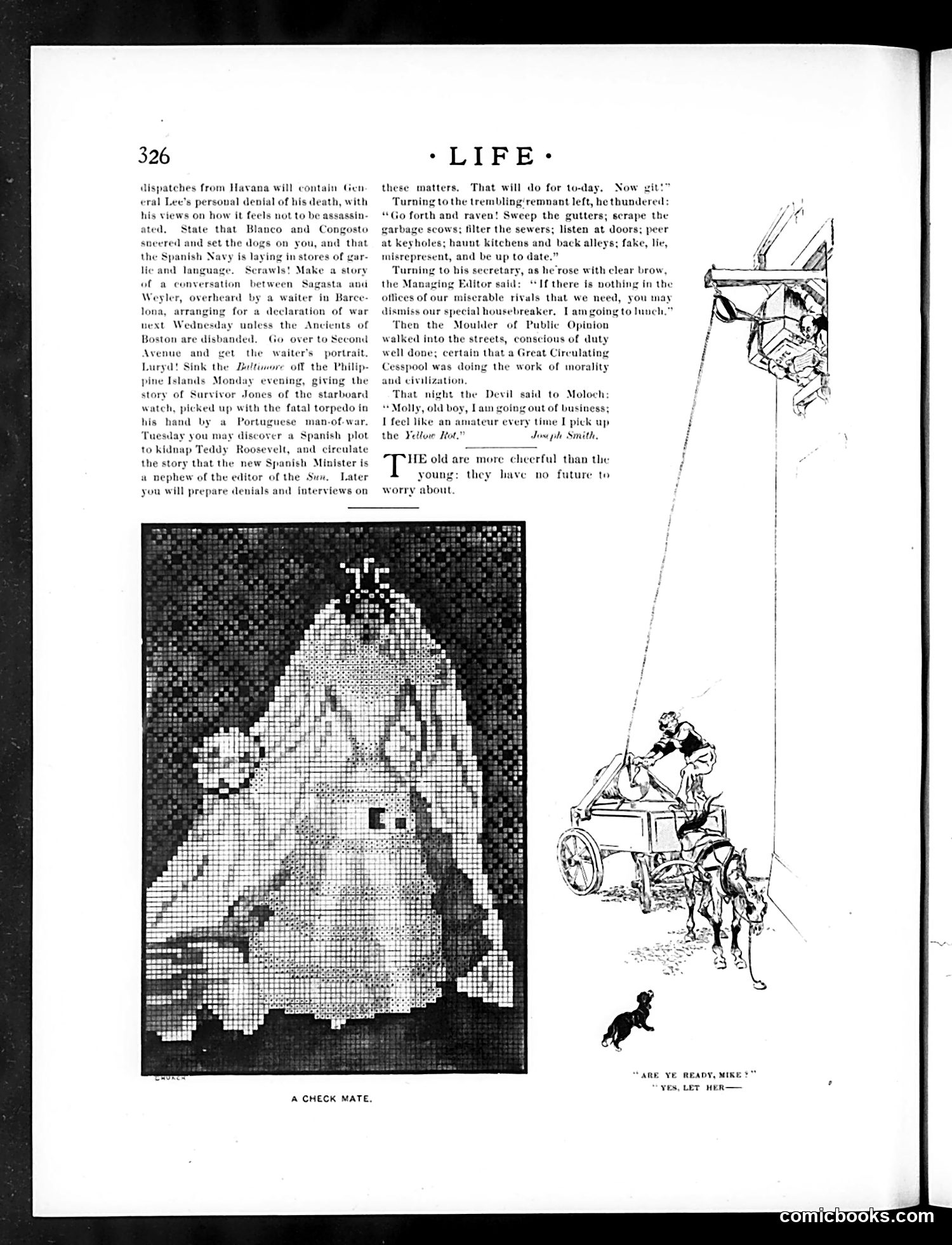
This Life magazine page satirizes **sensationalist newspaper practices** of the era (likely early 1900s, given Spanish-American War references). The text describes a cynical newspaper editor instructing reporters to fabricate stories—planting false narratives about Spanish naval movements, inventing "survivor" accounts, and employing spies—to manufacture news and boost circulation. The left illustration titled "A CHECK MATE" depicts a bishop in chess, likely symbolizing the Catholic Church or established institutions being outmaneuvered by the press's moral corruption. The right cartoon shows a man with a cart and dog labeled "ARE YE READY, MIKE?" suggesting the working-class complicity or exploitation in spreading these false stories. The concluding quote—the Devil going "out of business" because newspapers have become more corrupting than evil itself—is the satirical **punchline**: the press has surpassed even damnation in moral degradation. This attacks yellow journalism's grip on public opinion.
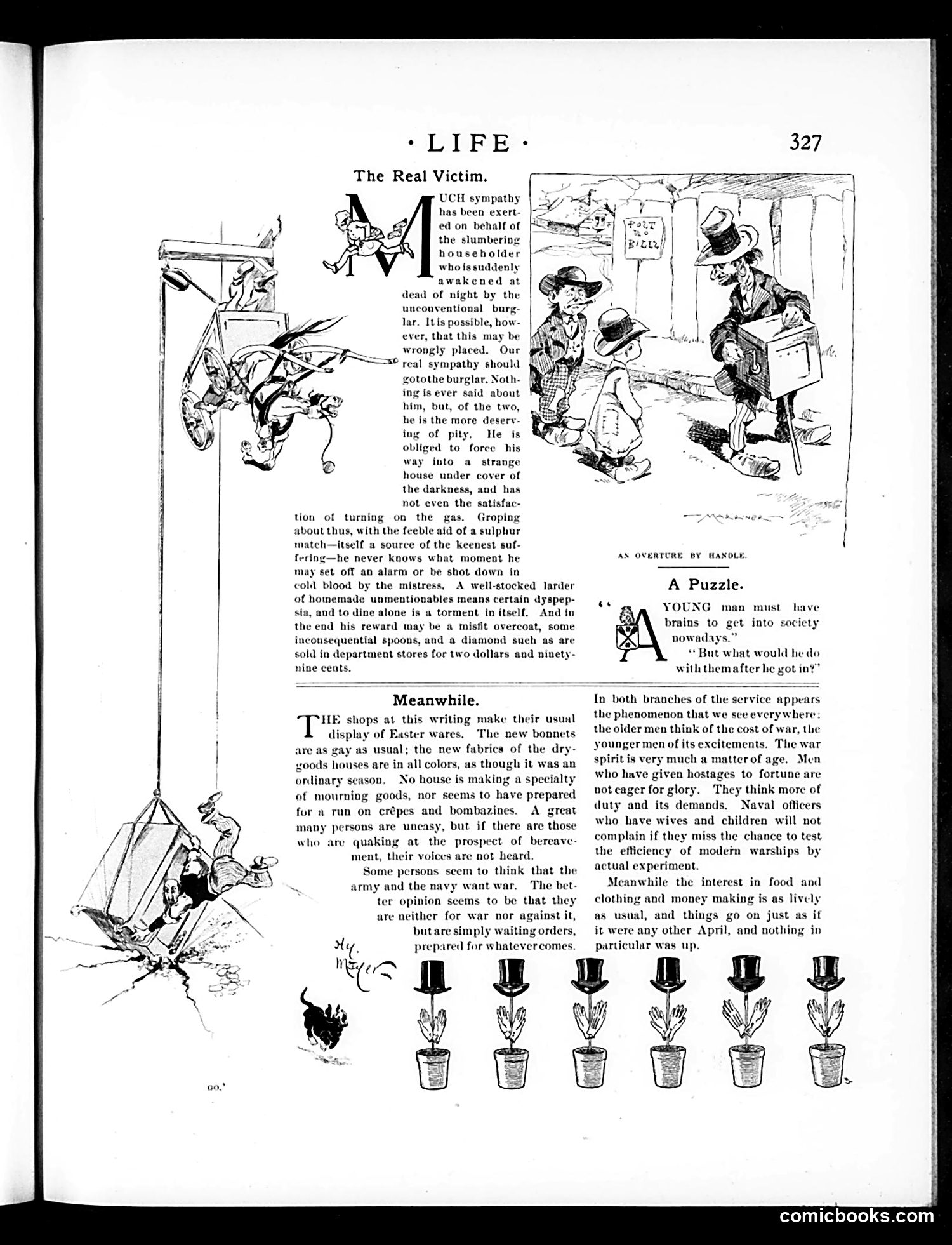
This page contains three separate satirical pieces reflecting early 20th-century American concerns: **"The Real Victim"** employs ironic sympathy—the burglar, not the householder, deserves pity. He risks arrest or being shot, endures darkness and dangerous matches, suffers indigestion from stolen food, and receives pittance (misfit coats, cheap spoons, fake diamonds). The satire mocks sentimental burglar narratives while commenting on social inequality. **"A Puzzle"** presents a brief, cynical joke about young men needing "brains to get into society" but lacking purpose once admitted—social climbing satire. **"Meanwhile"** addresses apparent public indifference during what appears to be wartime (references to army/navy and mourning goods suggest the World War I era). It observes that Easter shopping continues normally, and that younger military men embrace war excitement while older men with families fear its costs. The satire highlights generational differences in war enthusiasm and the public's materialism overriding war anxiety. The cartoons criticize both criminality-sympathy and wartime complacency through exaggeration and irony.
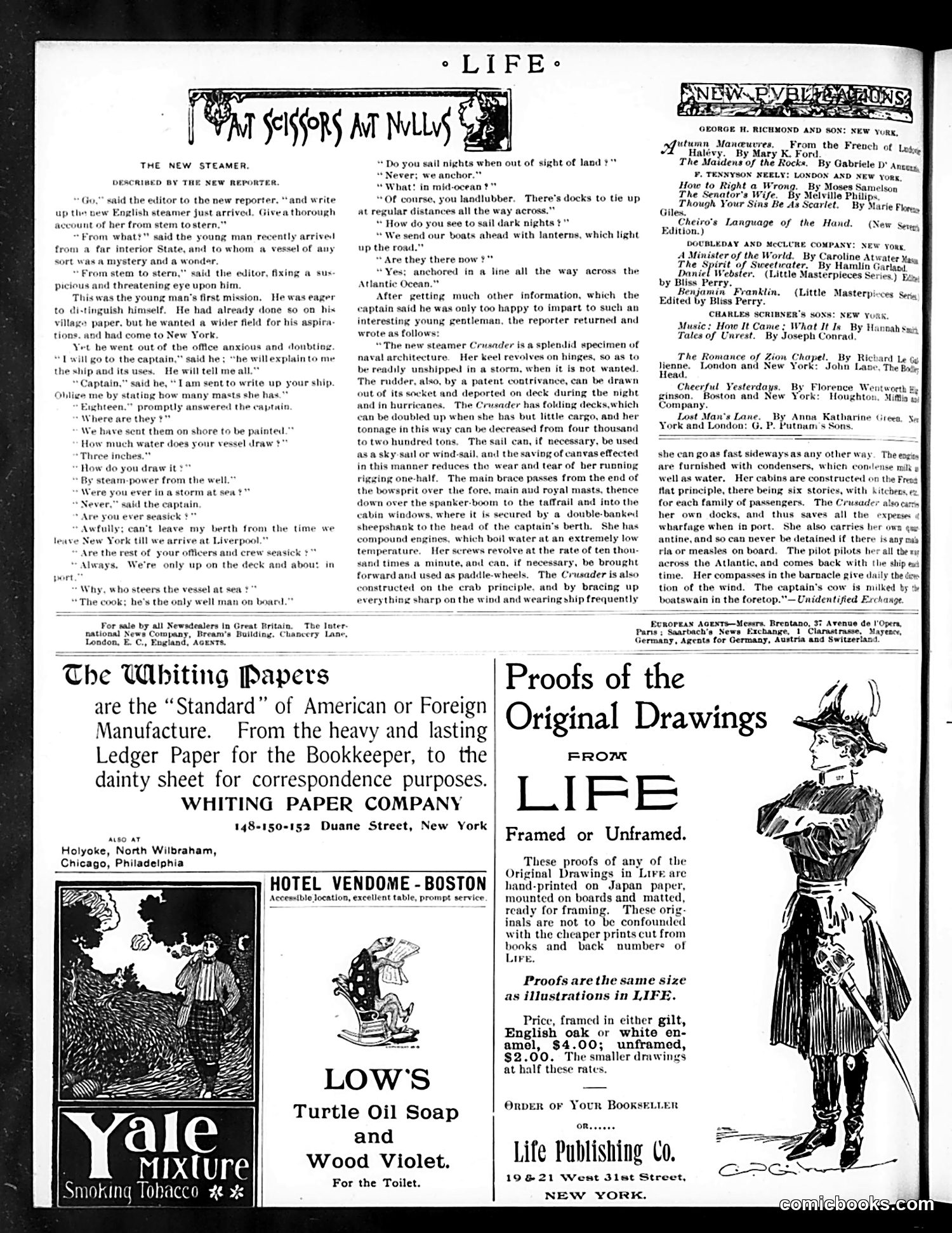
This humorous piece satirizes a naive newspaper reporter sent to interview a ship's captain about a new steamer. The joke hinges on the reporter's complete ignorance of nautical terminology and maritime operations. The captain exploits this ignorance, feeding him absurd misinformation: ships anchor in mid-ocean with "docks," boats with lanterns light "the road" across the Atlantic, the keel "revolves on hinges," decks fold up, and the main brace connects to the captain's cabin via sheepshank knots. The reporter dutifully reports all this nonsense as fact, producing a ridiculous article full of technical-sounding but physically impossible claims about the steamer *Crusader*. The satire targets both journalistic incompetence and working-class unfamiliarity with specialized knowledge. It mocks the era's "fake news" problem—reporters fabricating details rather than admitting ignorance—and the gullibility of interior Americans newly arrived in cosmopolitan New York.
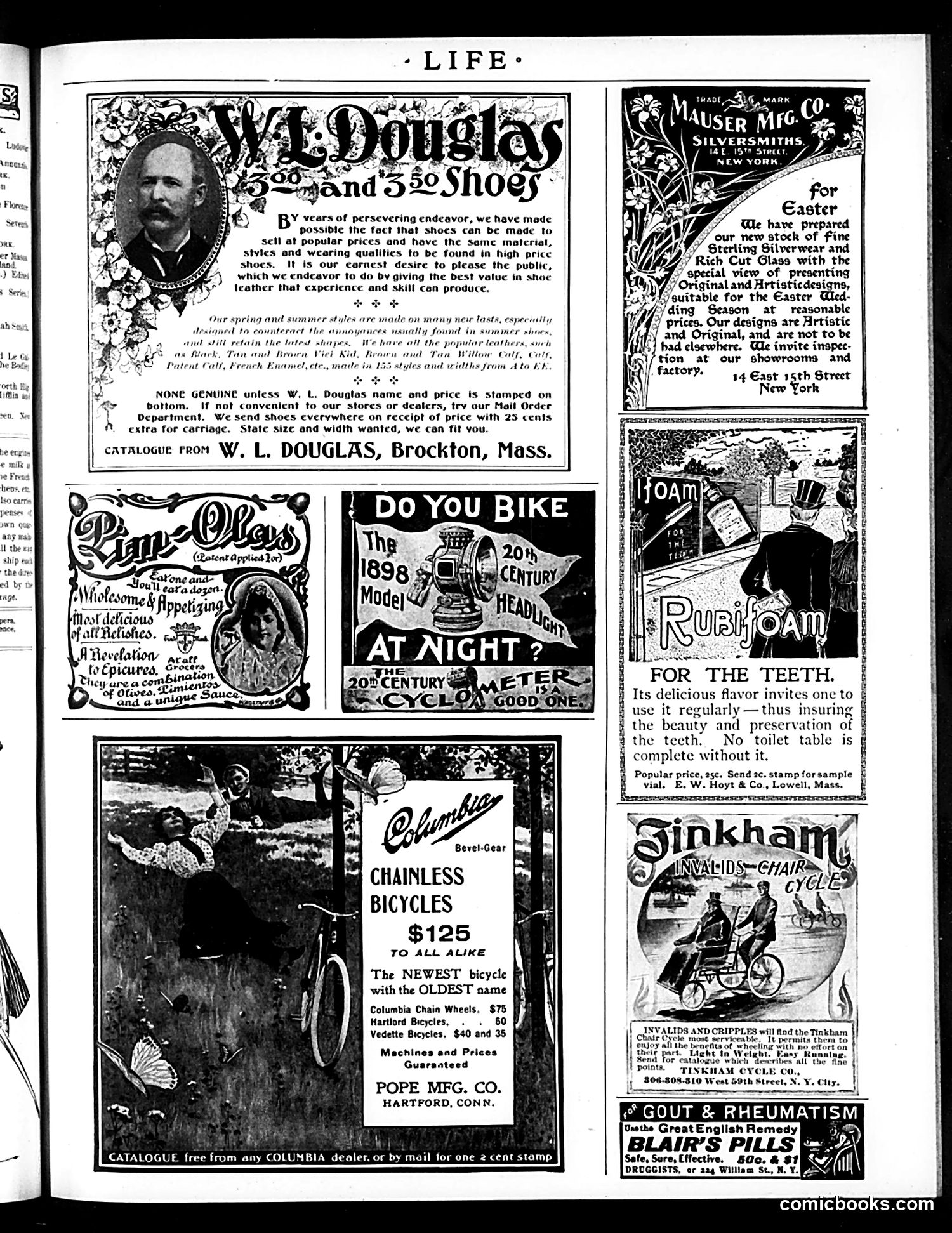
This is primarily an **advertising page**, not a satirical cartoon. The page contains various product advertisements from the 1890s-early 1900s era. The main featured ad showcases **W.L. Douglas shoes** ($3.00 and $3.50 models), with the company president's portrait. Douglas emphasizes that his shoes offer quality comparable to expensive footwear at affordable prices—a significant selling point during this period of growing consumer markets. Other advertisements include: - **Columbia bicycles** ($125)—marketed as "the NEWEST bicycle with the OLDEST name" - **Pim-Ola** sauce/condiment - **Rubi-Foam** toothpaste - **Sinkham Invalid Chair Cycle**—a tricycle designed for disabled users - **Blair's Pills**—a patent medicine The page reflects **late-19th-century consumer culture**: mass-produced goods, mail-order shopping, bicycle craze popularity, and patent medicines. Most notably, the Sinkham ad acknowledges disabled people as consumers—reflecting emerging attitudes toward accessibility and inclusive design.
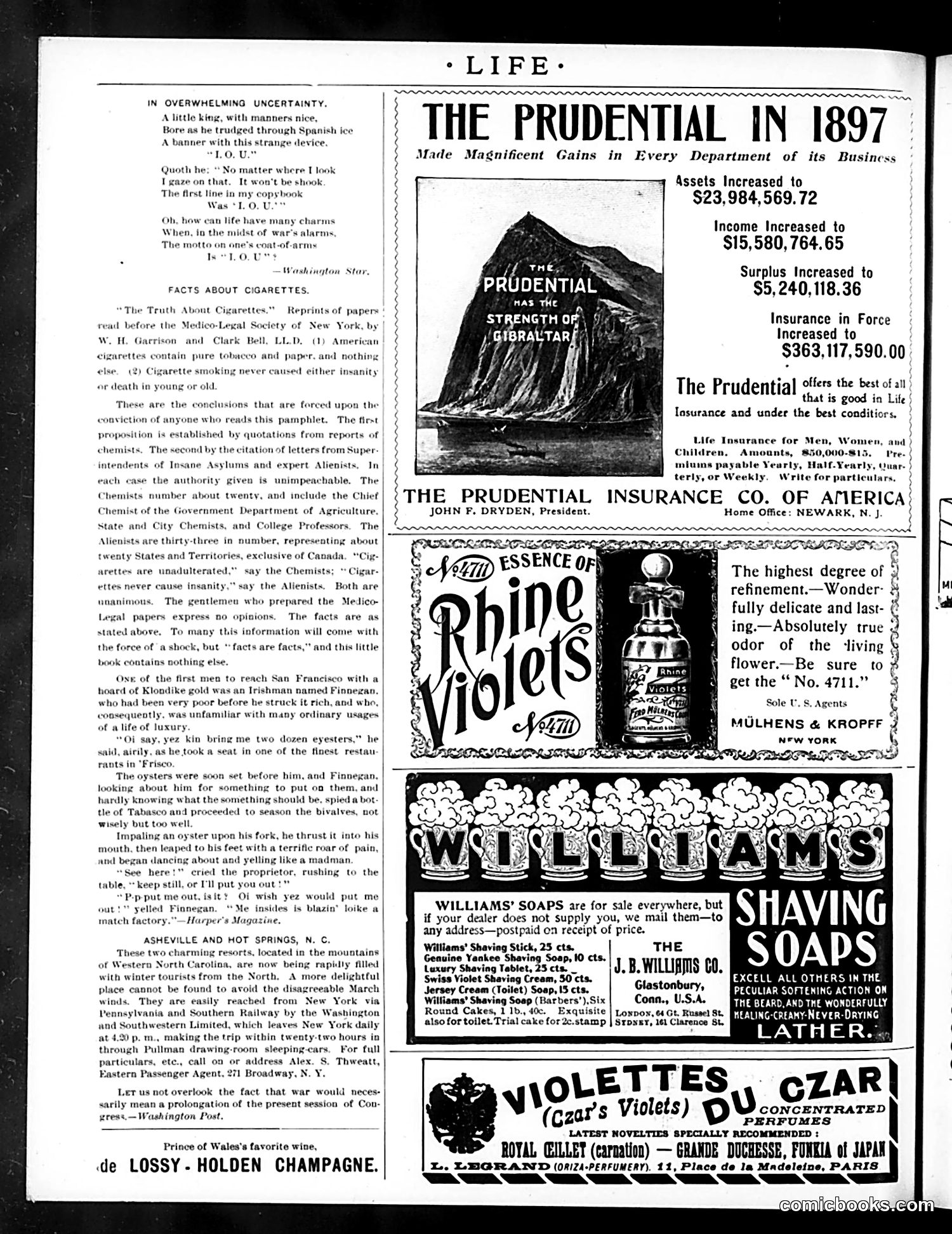
This page mixes satirical content with period advertising. The main cartoon, titled "In Overwhelming Uncertainty," appears to mock military uncertainty during wartime—likely referencing the Spanish-American War (1898). The protagonist, "a little king," carries a banner reading "I.O.U."—a humorous commentary on financial debt or obligation amid warfare chaos. The "Facts About Cigarettes" section presents pseudo-scientific claims (reprinting papers from the Medico-Legal Society) asserting that American cigarettes contain only "pure tobacco and paper" and that cigarette smoking "never caused either insanity." This reflects late-19th-century tobacco industry defensiveness against emerging health concerns. The Finnegan anecdote satirizes nouveau-riche Klondike miners unfamiliar with refined dining, using exaggerated Irish dialect humor typical of the era. The remainder consists of advertisements for insurance, perfume, soaps, and champagne—standard Life magazine content reflecting contemporary consumer culture and product marketing.
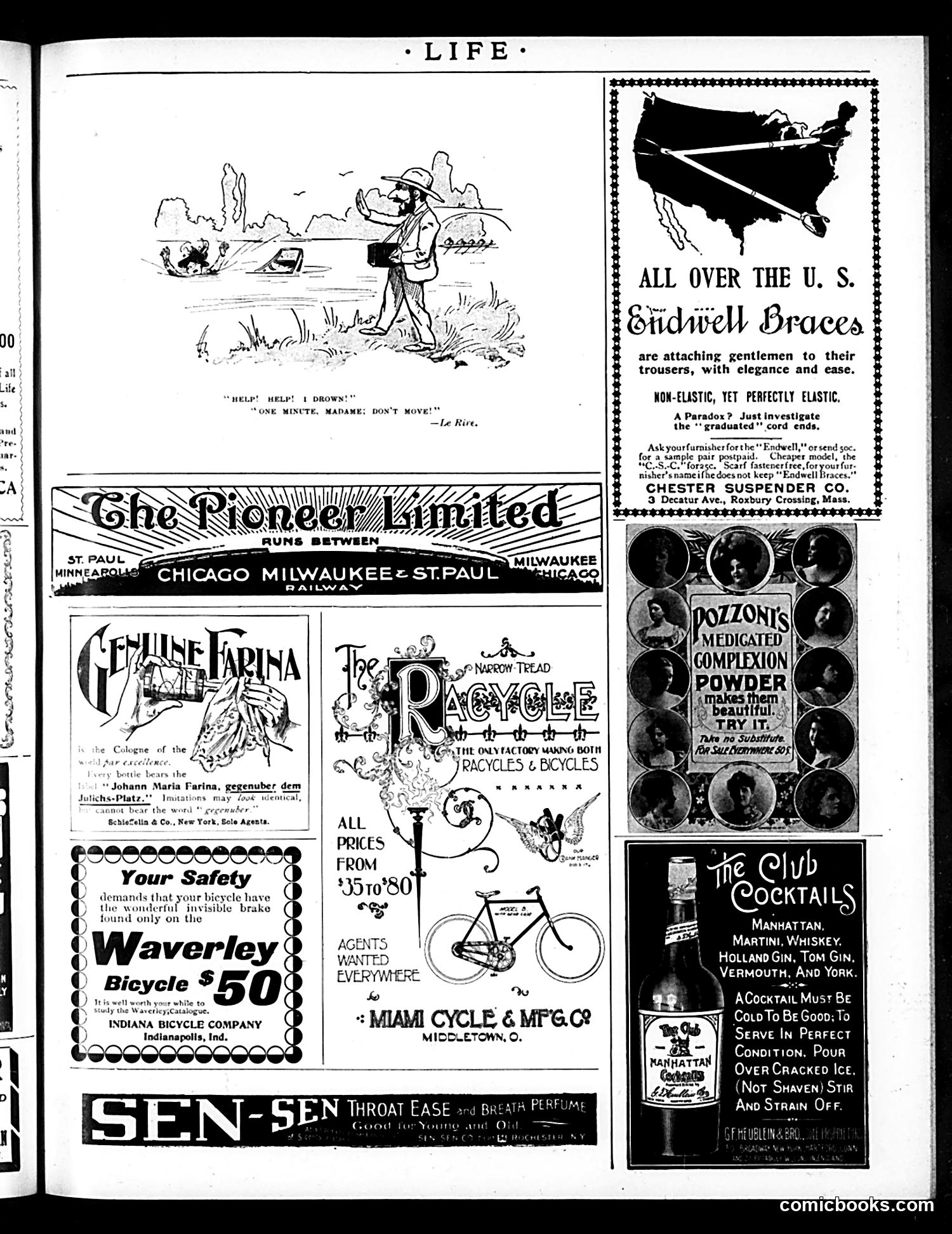
This page is primarily **advertising**, not editorial content or political satire. The main cartoon (upper left, credited to "Le Rire") depicts a drowning man calling for help while a woman stands nearby—a visual gag playing on the advertisement below it for "Endwell Braces," suspenders with an elastic cord. The joke: the woman tells the drowning man to wait while she attaches her suspenders, illustrating the product's claim of being "non-elastic, yet perfectly elastic"—a paradoxical selling point meant to demonstrate the braces' reliability and flexibility. The rest of the page consists of period advertisements for bicycles (Waverley, Racycle), a train service (The Pioneer Limited), cosmetic powder (Pozzoni's), and cocktail ingredients (The Club Cocktails). There is **no political satire or social commentary**—this is standard early 20th-century magazine advertising space, likely from the 1910s based on the product styles and typography.
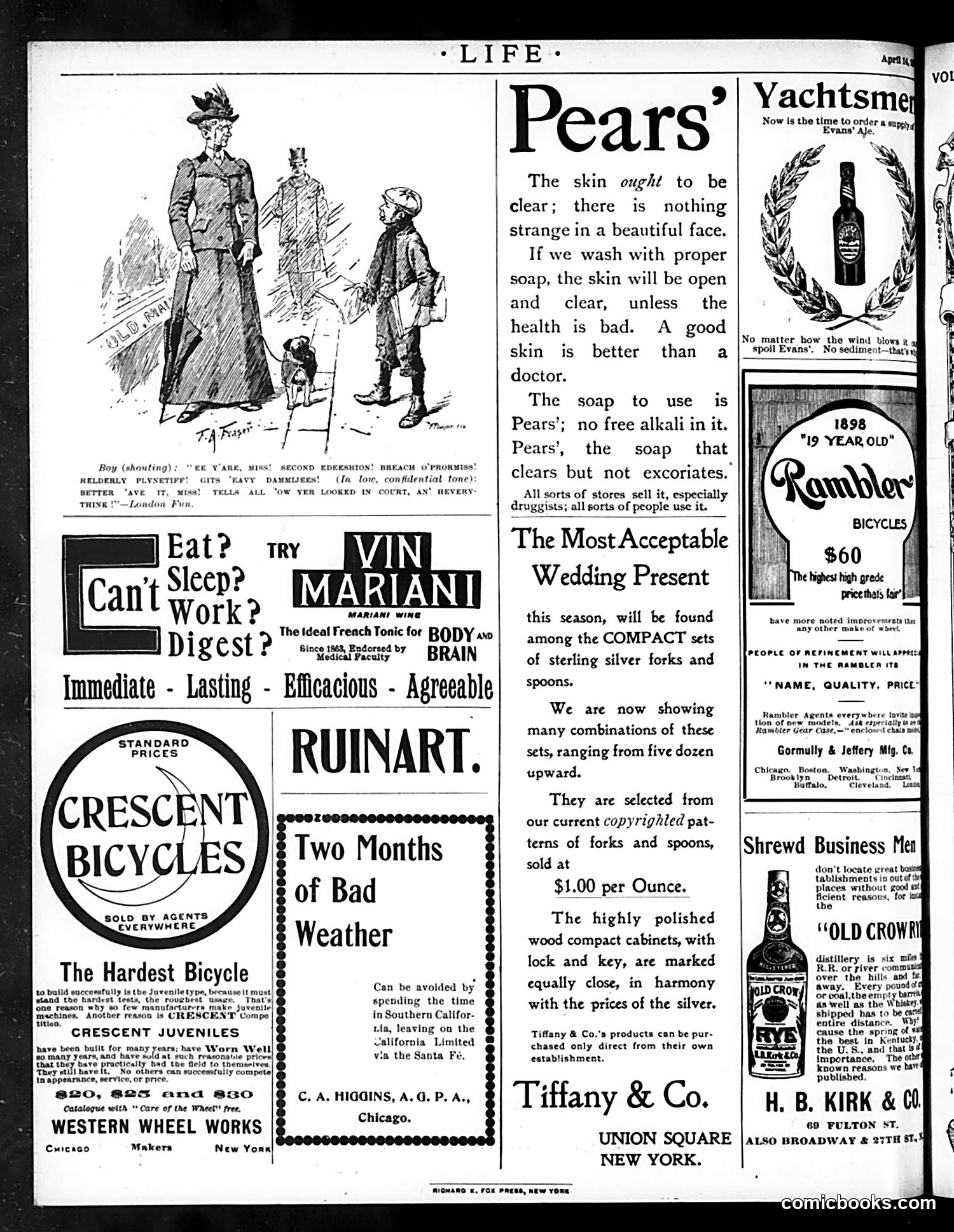
**The Cartoon:** The sketch depicts a street scene in London where a boy loudly shouts gossip to an elderly woman, then whispers conspiratorially to her. The caption references a legal proceeding or scandal, playing on how information spreads through social channels—publicly and secretly. The British dialect and tone suggest mockery of how lower-class Londoners spread court gossip and sensational news. **Context:** This is likely satirizing the Victorian/Edwardian obsession with scandalous court cases and breaches of promise suits (failed engagements), which were widely publicized and gossiped about. The joke targets how servant classes and ordinary people sensationalized such stories. **The Rest:** This page is predominantly **advertising**—for Pears' soap, Vin Mariani wine tonic, Crescent and Rambler bicycles, Tiffany silverware, and other luxury goods. The ads reflect turn-of-the-century consumer culture and the status-conscious market Life's readers represented.