
Life, 1898-04-14 · page 12 of 20
Life — April 14, 1898 — page 12: what you’re looking at
What you’re looking at
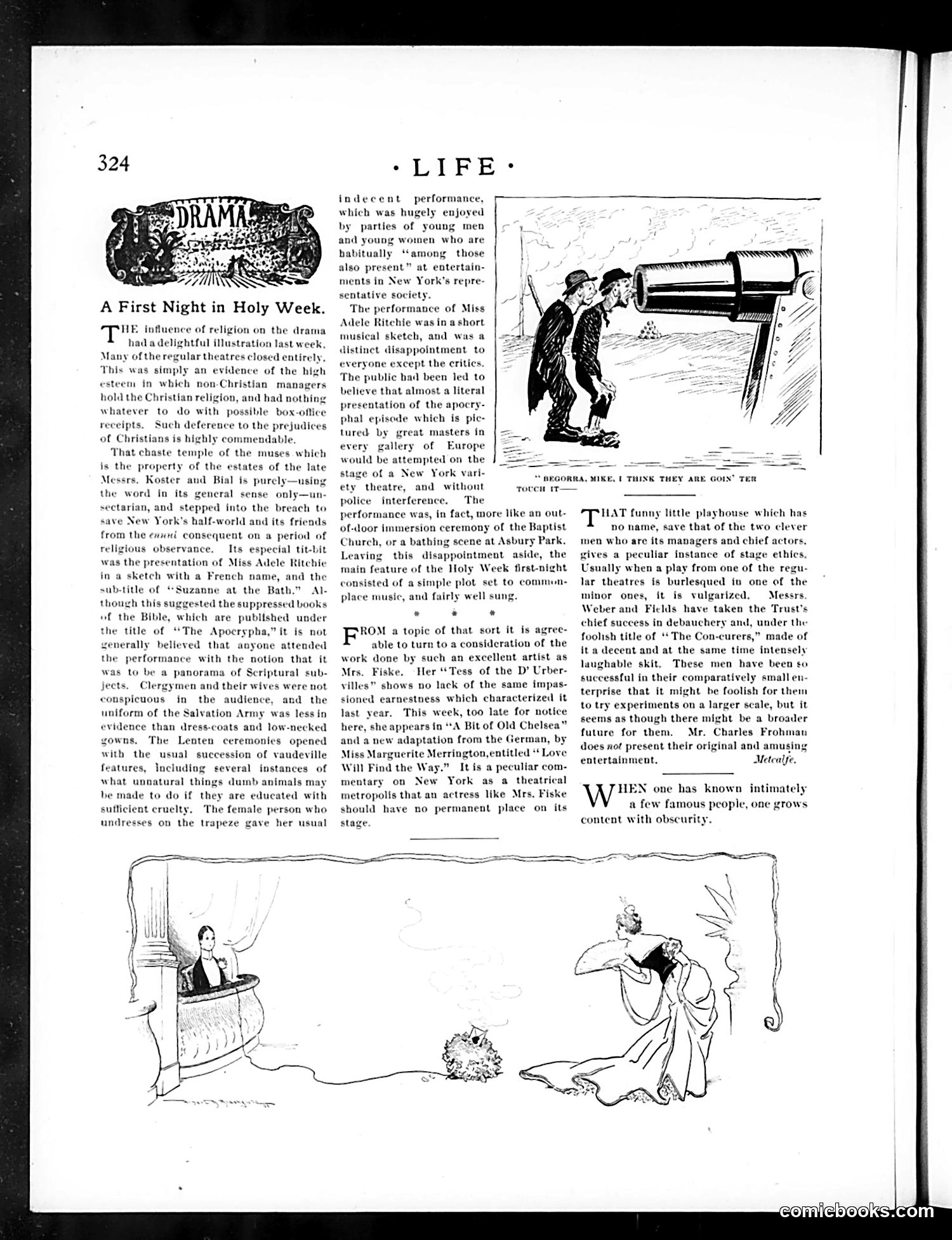
This page critiques theatrical performances during Holy Week. The main article "A First Night in Holy Week" attacks a drama that presented Biblical stories irreverently, calling it "highly commendable" mockery of Christian sensibilities. The piece criticizes the use of religious subjects for entertainment, particularly Adele Ritchie's performance in "Suzanne at the Bat." The text also reviews Mrs. Fiske's performance in "Tess of the D'Urbervilles," praising her talent while noting the theatrical world's bias against serious actresses. The bottom cartoon appears to be a humorous domestic scene, though details are unclear from the sketch alone. Overall, the page satirizes both the misuse of religion in theater and theatrical pretension during the early 1900s.
📄 Transcribed text from this page (OCR, searchable)
Machine-transcribed from the original scan — historical spelling and the odd misread are preserved.
A First Night in Holy Week. HE. influence of religion on the drama had a delightful illustration last week, Many of the regular theatres closed entirely, This was simply an evidence of the high esteem in which non-Christian managers hold the Christian religion, and had nothing whatever to do with possible box-oftice receipts, Such deference to the prejudices of Christians is highly commendable. That chaste temple of the muses which is the property of the estates of the late Messrs, Koster aud Bial is purely—using the word in its general sense only—un- sectarian, and stepped into the breach to save New York’s half-world and its friends from the ened consequent on a period of religious observance. Its especial tit-bit was the presentation of Miss Adele Ritchie in a sketch with a French name, and the sub-title of “Suzanne at the Bath.” Al- though this suggested the suppressed Looks uf the Bible, which are published under the title of “The Apocrypha,” it is not generally believed that anyone attended the performance with the notion that it was to be a panorama of Scriptural sub- jects, Clergymen and their wives were not conspicuous in the audience, the uniform of the Salvation Army was less in ce than dres: ts and low-necked wns. The Lenten ceremonies opened with the succession of vaudeville features, Including several instances of what unnatural things dumb animals may he made to do if they are educated with sufficient cruelty ¢ female person who undresses on the trapeze gave her usual usual *LIFE: indecent performance, which was hugely enjoyed by parties of young men and young women who are habitually “among also present” at entertain- ments in New York's repre- sentative society. The performance of Miss Adele Ritchie was in a short musical sketch, and was a distinct disappointment to everyone except the critics. The public had been led to believe that almost a literal presentation of the apocry- phal episode which is pic- tured by great masters in every gallery of would be attempted on the those stage of a New York vari- ety theatre, and without police interference. The performance was, in fact, more like an out- of-door immersion ceremony of the Baptist Church, or a bathing scene at Asbury Park. Leaving this disappointment aside, the in feature of the Holy Week first-n dof asimple plot set to com usic, and fairly well sung. consis! plac * * * From a topic of that sort it is agree- able to turn to a consideration of the work done by such an excellent artist as Mrs. Fiske. Her ‘Tess of the D’ Urber- villes” shows no lack of the same impas sioned earnestness which characterized it last year. This week, too late for notice here, she appears in “A Bit of Old Chelsea” a new adaptation from the German, by b Marguerite Merrington, entitled “ Lov: Will Find the Way.” It is a peculiar com- mentary on New York as a theatrical metropolis that an actress like Mrs. F should have no permanent place on its stage HAT funny little playhouse whieh has no name, save that of the two clever men who are its managers and chief actors, gives a peculiar instance of stage ethics, Usually when a play from one of the regu- lar theatres is burlesqued in one of the minor ones, it is vulgarized, Messrs Weber and Fields have taken the Trust's chief success in debauchery and, under the foolish title of “The Con-curers,” made of it a decent and at the same time intensely laughable skit. These men have been ¢ successful in their comparatively small en- terprise that it might be foolish for them to try experiments on a larger scale, but it seems as though there might be a broader future for them, Mr. Charles Frohman does not present their original and amusing entertainment. Metcaife. Ww" one has known intimately a few famous people, one grows content with obscurit