
Life, 1898-04-14 · page 6 of 20
Life — April 14, 1898 — page 6: what you’re looking at
What you’re looking at
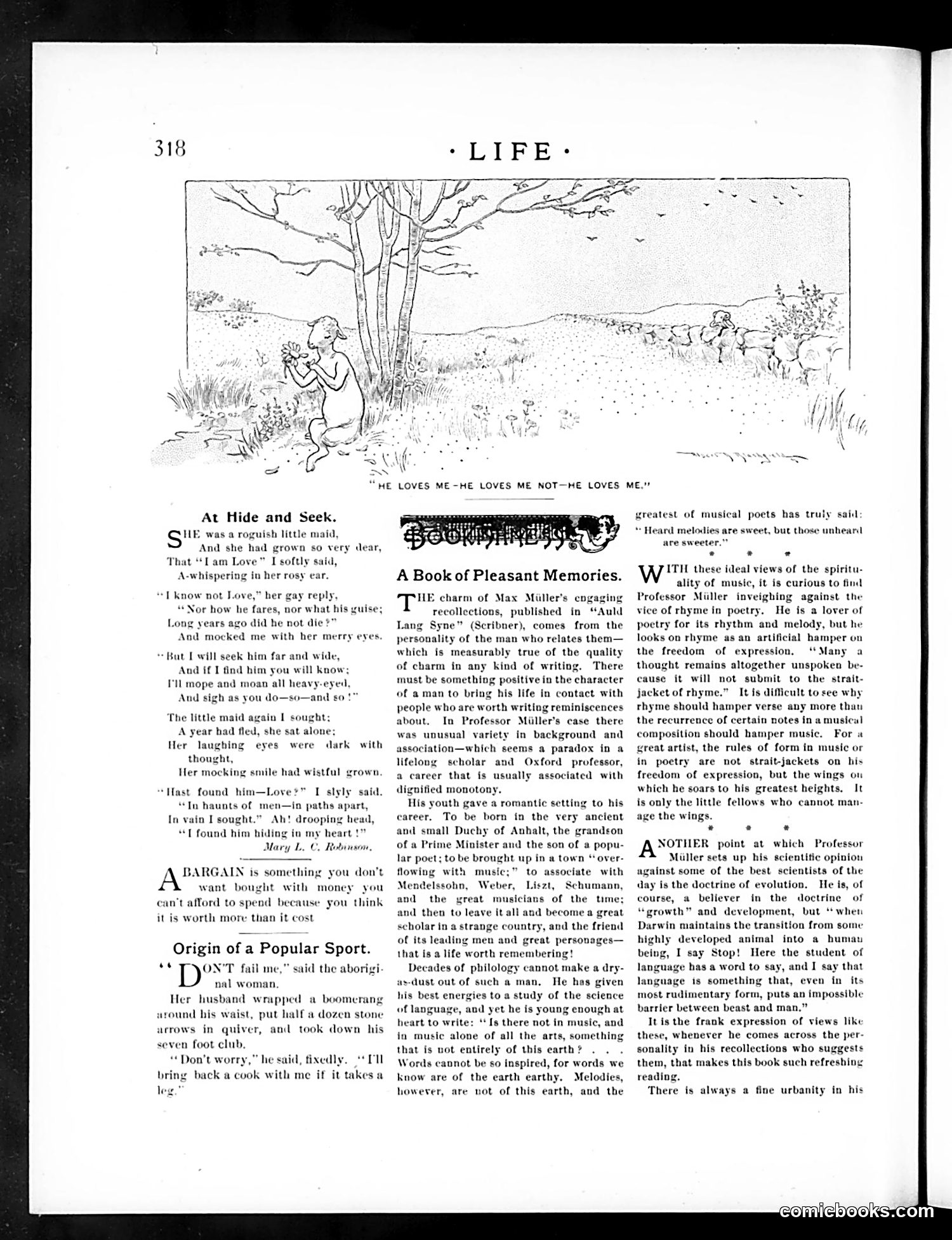
**The Main Cartoon** depicts a child playing "He loves me—he loves me not" while plucking flower petals beneath a tree. This is a straightforward illustration of childhood folklore, not political satire. **The Text Content** consists of three separate prose pieces: - "At Hide and Seek" — a sentimental poem about a maid and lost love - "A Book of Pleasant Memories" — discussing Max Müller's reminiscences and the relationship between music and poetry - "Origin of a Popular Sport" — explaining boomerang use by aboriginal women This page contains **no political cartoons or satire**. It's a mix of light verse, literary commentary, and humorous anecdotes typical of Life's satirical-but-genteel editorial content from this era.
📄 Transcribed text from this page (OCR, searchable)
Machine-transcribed from the original scan — historical spelling and the odd misread are preserved.
At Hide and Seek. HE was a roguish little maid, And she had grown so very dear, That “Lam Love” I softly said, A-whispering in her rosy ear. “IT know not Love,” her gay reply. “Nor how he fares, nor what his guise; Long years ago did he not die And mocked me with her merry eyes. * But [will seek him far and wide, And if 1 find him you will know: I'l mope and moan all heavy-eye And sigh as you do—so—and £0 The little maid again | sough A year had fled, she sat alone: Her laughing eyes were dark with thought, Her mocking smile had wistful grown ‘Hast found him—Love?” I slyly said. “In haunts of men—in paths In vain I sought.” Ab! drooping head, “T found him hiding in my heart !” part, BARGAIN is something you don’t want bought money can’t afford to spend because you think it is worth more than it cost with you Origin of a Popular Sport. +8 Dt fail me nal woman. Her husband wrapped a boomerang around his waist, put half a dozen stone arrows in quiver, and took down his seven foot club, “Don't worry,” he said, fixedly. "C1 bring back a cook with me if it takes a leg.” said the abori A Book of Pleasant Memories. HE charm of Max Miller’s engaging recollections, published in “Auld Lang Syne” (Scribner), comes from the personality of the man who relates them— which is measurably true of the quality of charm in any kind of writing. There must be something positive in the character of aman to bring his life in contact with people who are worth writing reminiscences about. In Professor Miiller’s case there was unusual variety in background and association—which seems a paradox in a lifelong scholar and Oxford professor, a career that is usually associated with dignified monoton His youth gave a romantic setting to his career, To be born in the very ancient and small Duchy of Anhalt, the grandson of a Prime Minister and the son of a popu- lar poet; to be brought up in a town “over- flowing with music. to associate with Mendelssohn, Weber, Liszt, Schumann, and the great musicians of the time; and then to leave itall and become a great scholar ina strange country, and the friend of its leading men and great personages— that is a life worth remembering! Decades of philology cannot make a dry- as-dust out of such a man, He has given his best energies to a study of the science of language, and yet he is young enough at heart to write: ‘Is there not in music, and in music alone of all the arts, something that is vot entirely of this earth ? Words cannot be so inspired, for words we know are of the earth earthy. Melodies, however, are not of this earth, and the greatest of musical poets has truly said * Heard melodies are sweet, but those unheard are sweeter.” * * * ITH these ideal views of the spiritu- ality of music, it is curious to find Professor Miller inveighing against the vice of rhyme in poetry, He is a lover of poetry for its rhythm and melody, but he looks on rhyme as an artificial hamper on the freedom of expression. ‘Many a thought remains altogether unspoken be- cause it will not submit to the strait- jacket of rhyme.” It is difficult to see why rhyme should hamper verse any more than the recurrence of certain notes in a musical composition should hamper music. For « Great artist, the rules of form in music or in poetry are not strait-jackets on his freedom of expression, but the wings ou which he soars to his greatest heights. It is only the little fellows who cannot man- age the wings. * > * NOTHER point at which Miller sets up his scientitic opinion against some of the best scientists of the day is the doctrine of evolution. He is, of course, a believer in the doctrine of “growth” and development, but “whet Darwin maintains the transition from some highly developed animal into a bumau being, I say Stop! Here the student of language has a word to say, and I say that language 1s something that, even in its most rudimentary form, puts an impossible barrier between beast and man.” It is the frank expression of views like these, whenever he comes across the per- sonality in his recollections who suggests them, that makes this book such refreshing reading. There is always a fine urbanity in his Professor