
A complete issue · 20 pages · 1898
Life — February 17, 1898
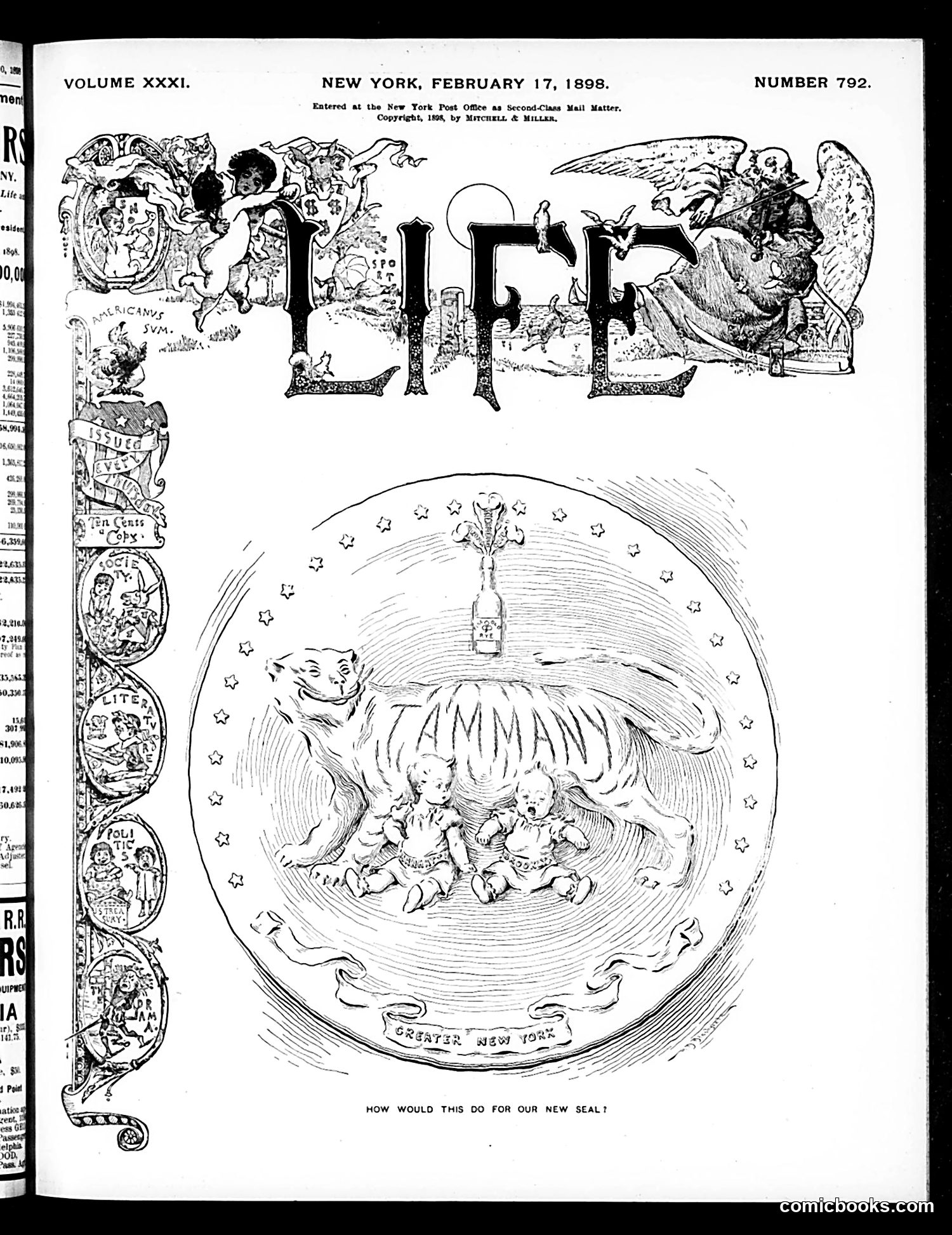
This satirical cartoon addresses New York City's new seal or official emblem. The circular design depicts cherubs surrounding a tiger (labeled "Tammany"), with a bottle suspended above—likely referencing alcohol or corruption. The caption "HOW WOULD THIS DO FOR OUR NEW SEAL?" is sarcastic. The tiger represents Tammany Hall, the Democratic political machine notorious for corruption. The cherubs suggest innocence, creating ironic contrast. The bottle may reference either political excess or specific scandals of the era. The ornate left border displays various vignettes, possibly depicting Tammany's activities or New York life. This cartoon mocks Tammany Hall's grip on New York politics and satirizes any attempt to portray the corrupt organization as wholesome or virtuous.
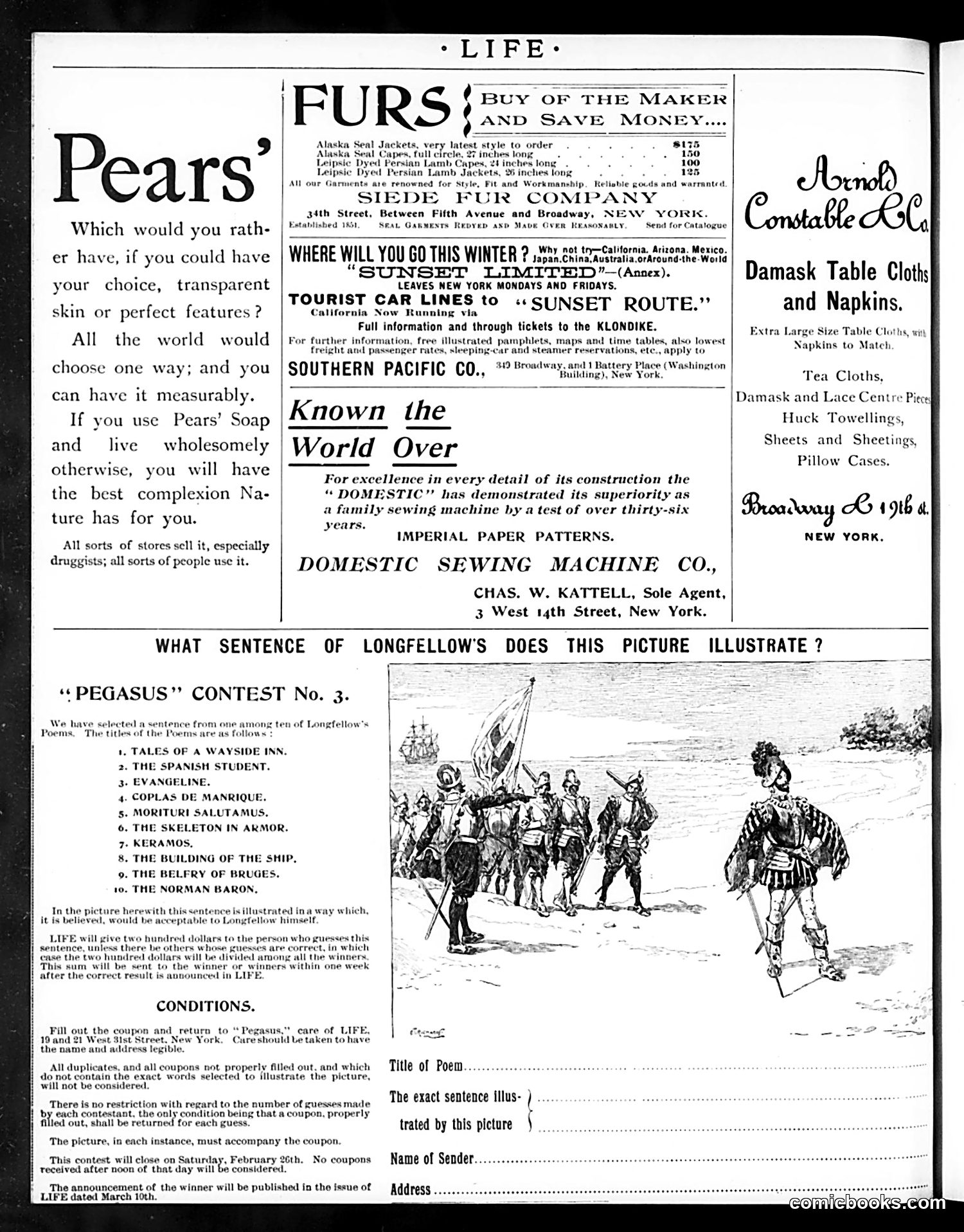
This page is primarily **advertising and contests**, not political satire. The main content includes: **Advertisements**: Pears' Soap (promoting clear complexion), fur coats, cruise lines, sewing machines, and table linens dominate the layout. **"Pegasus" Contest No. 3**: A literary contest asking readers to identify which Longfellow poem sentence is illustrated by the engraving shown. The image depicts what appears to be a colonial or period scene with multiple figures and a sailing vessel, suggesting a narrative moment from literature. The contest offers monetary prizes for correct answers and specifies entry conditions. **No apparent political satire** is present on this page—it reflects early 20th-century *Life* magazine's mixed model of advertising revenue alongside reader engagement contests, typical of periodicals from this era.
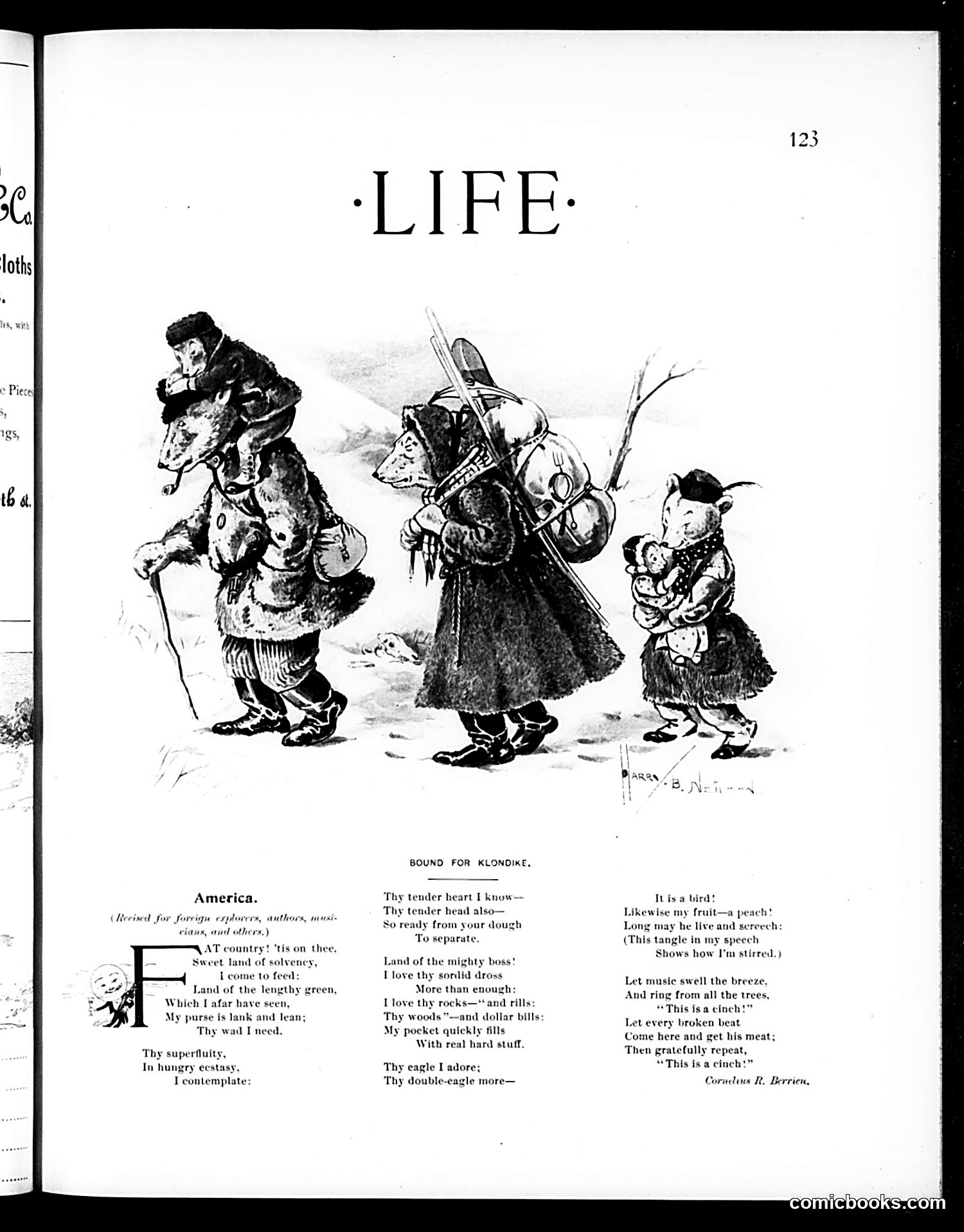
This page satirizes American expansionism during the Klondike Gold Rush era (late 1890s). The illustration shows three anthropomorphized animals—likely representing different nations or interests—heading toward the Klondike goldfields in Canada's Yukon Territory. The poem "America" celebrates American ambition and resources ("land of the mighty bass," "dollar bills," "eagle"). "Bound for Klondike" appears to mock the gold rush frenzy, with the animals dressed as prospectors carrying supplies, suggesting the chaotic scramble of fortune-seekers. The verse "It is a bird? Likewise fruit—peach!" humorously describes the rush's mixed motivations—some seeking natural resources, others quick profits. The overall satire mocks both American commercial greed and the broader international competition for resource extraction during this period of imperial expansion.
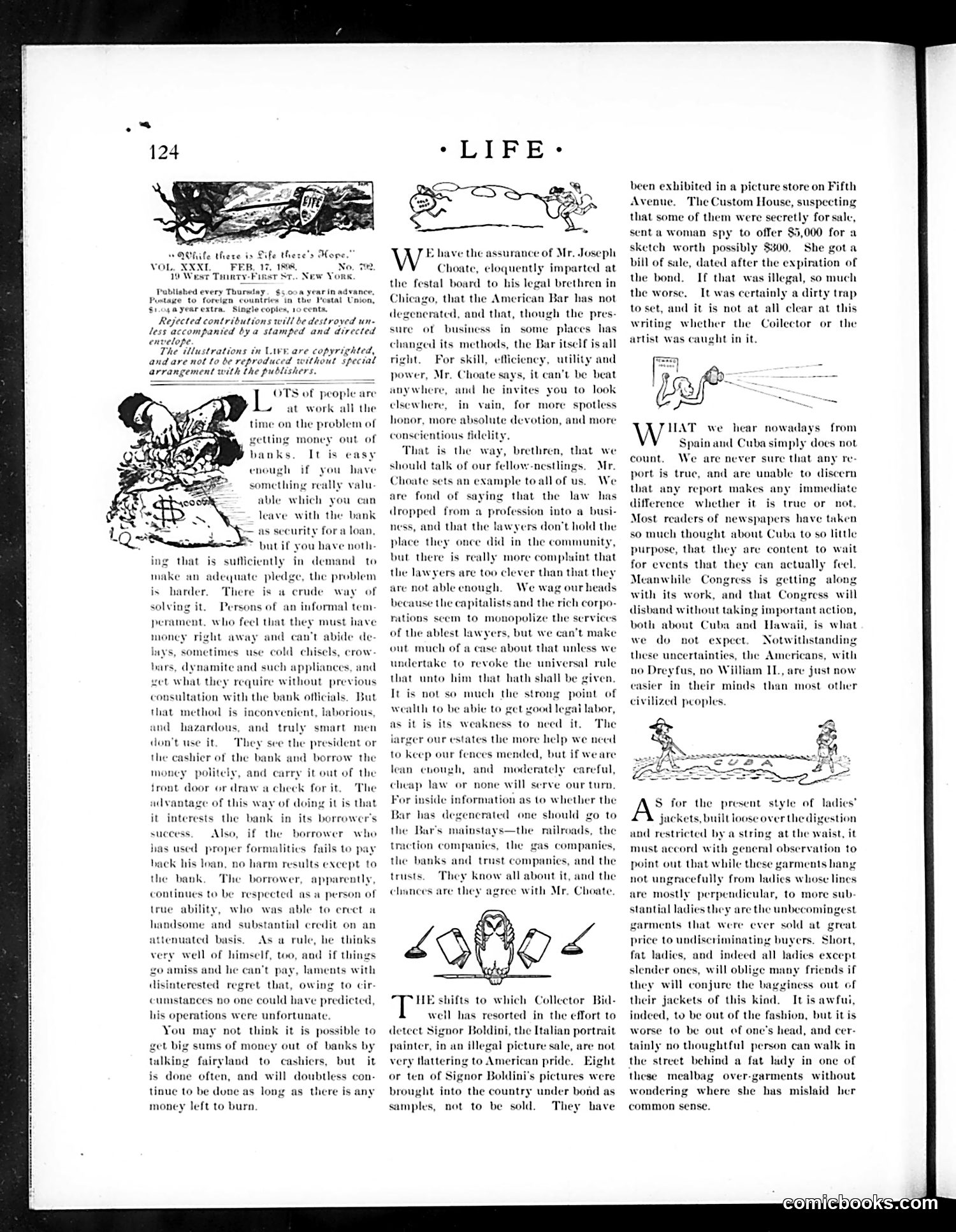
This page contains three distinct satirical sections: 1. **Top cartoon**: Appears to satirize banking practices, showing a figure extracting money from a bank vault. The accompanying text criticizes how banks handle loans and borrower relationships, suggesting banks use harsh methods to secure repayment while borrowers struggle with inadequate pledges. 2. **Middle cartoon**: Depicts what appears to be a Signor Bodini, an Italian portrait painter, in connection with an illegal art smuggling scheme. The text indicates customs officials discovered his pictures being brought into the country under false pretenses as "samples" rather than for sale. 3. **Bottom section**: Satirizes ladies' fashion, mocking loose-fitting jackets and suggesting they create unflattering silhouettes, particularly for fuller-figured women who appear dignified in properly fitted garments. The overall tone critiques financial institutions, art fraud, and questionable fashion trends.
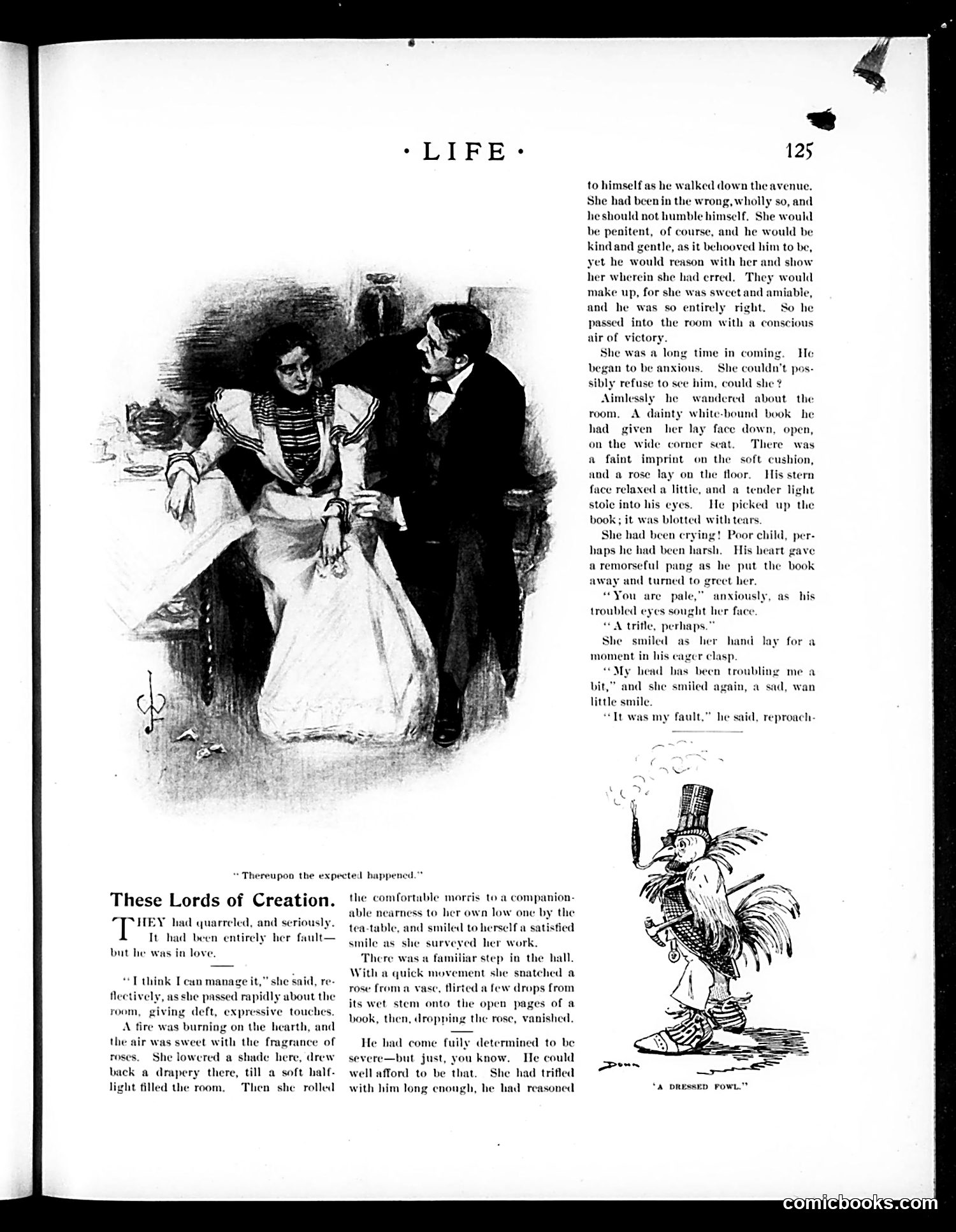
This page depicts a romantic domestic scene from what appears to be an Edwardian-era short story titled "These Lords of Creation." The illustration shows a woman in a peignoir receiving a man in her sitting room; the accompanying narrative describes their reconciliation after a quarrel. The satire is subtle: the section header "These Lords of Creation" ironically undercuts the male character's authority. The text reveals that despite the man's self-righteous demeanor, *he* was actually at fault, yet he expects the woman to apologize and comfort him. The joke mocks masculine pretense—these supposed "lords" depend entirely on women's emotional labor and forgiveness. The decorative illustration of "A Dressed Fowl" at page's bottom may reinforce this commentary on masculine vanity.
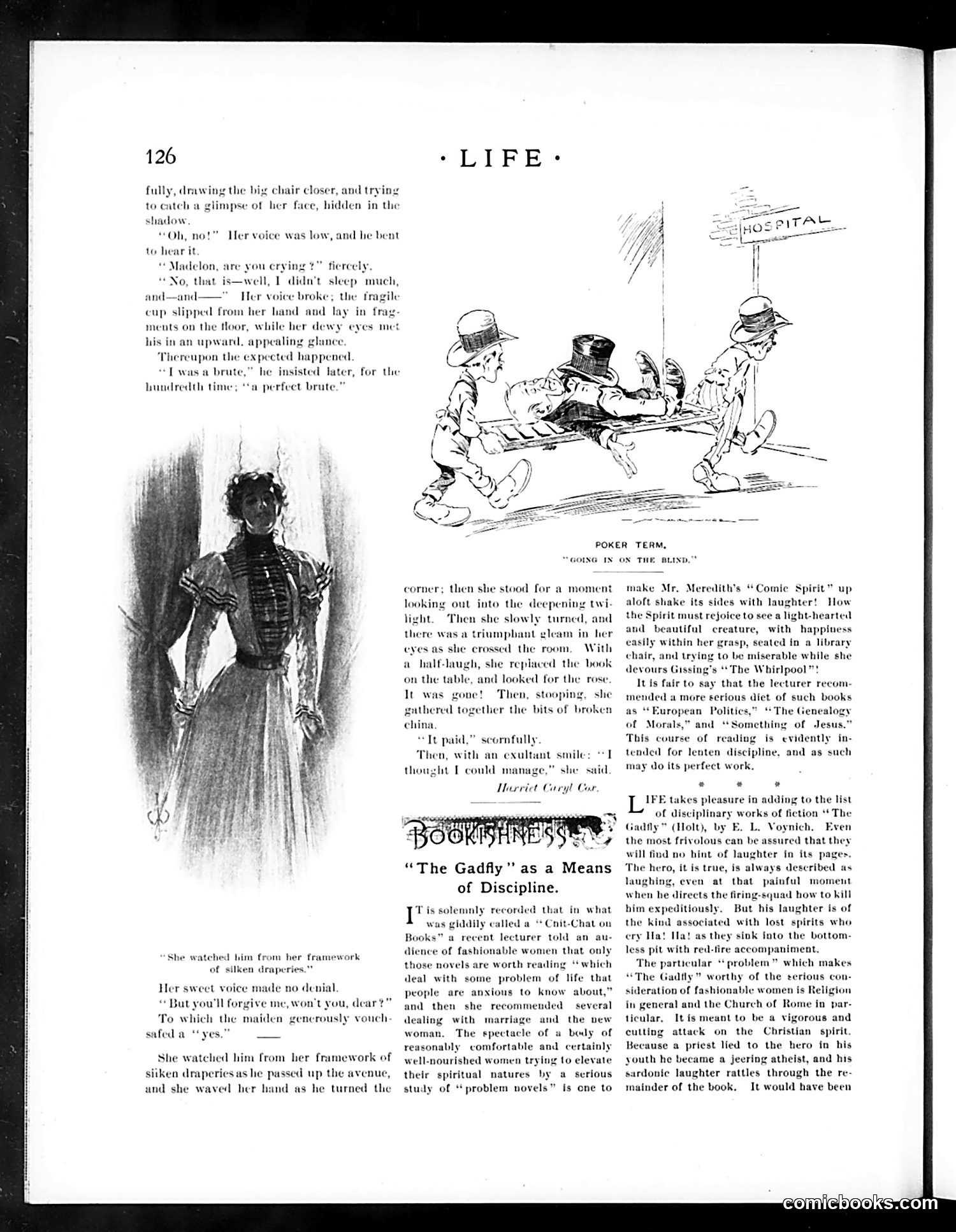
The page contains two distinct elements: **Upper illustration:** A sketch titled "Poker Term: 'Going in on the Blind'" shows four men in hats carrying an injured or unconscious person toward a hospital. This appears to be a visual pun—the poker term "going in blind" (betting without seeing your cards) is illustrated literally with someone being carried to a hospital. **Lower section:** A book review titled "The Gadfly as a Means of Discipline" discusses E. L. Voynich's novel *The Gadfly*. The reviewer praises the book's use of humor and satire as a teaching tool for addressing social problems, particularly criticizing what they call "problem novels" as an overly serious approach to fiction. The page blends humor with literary commentary.
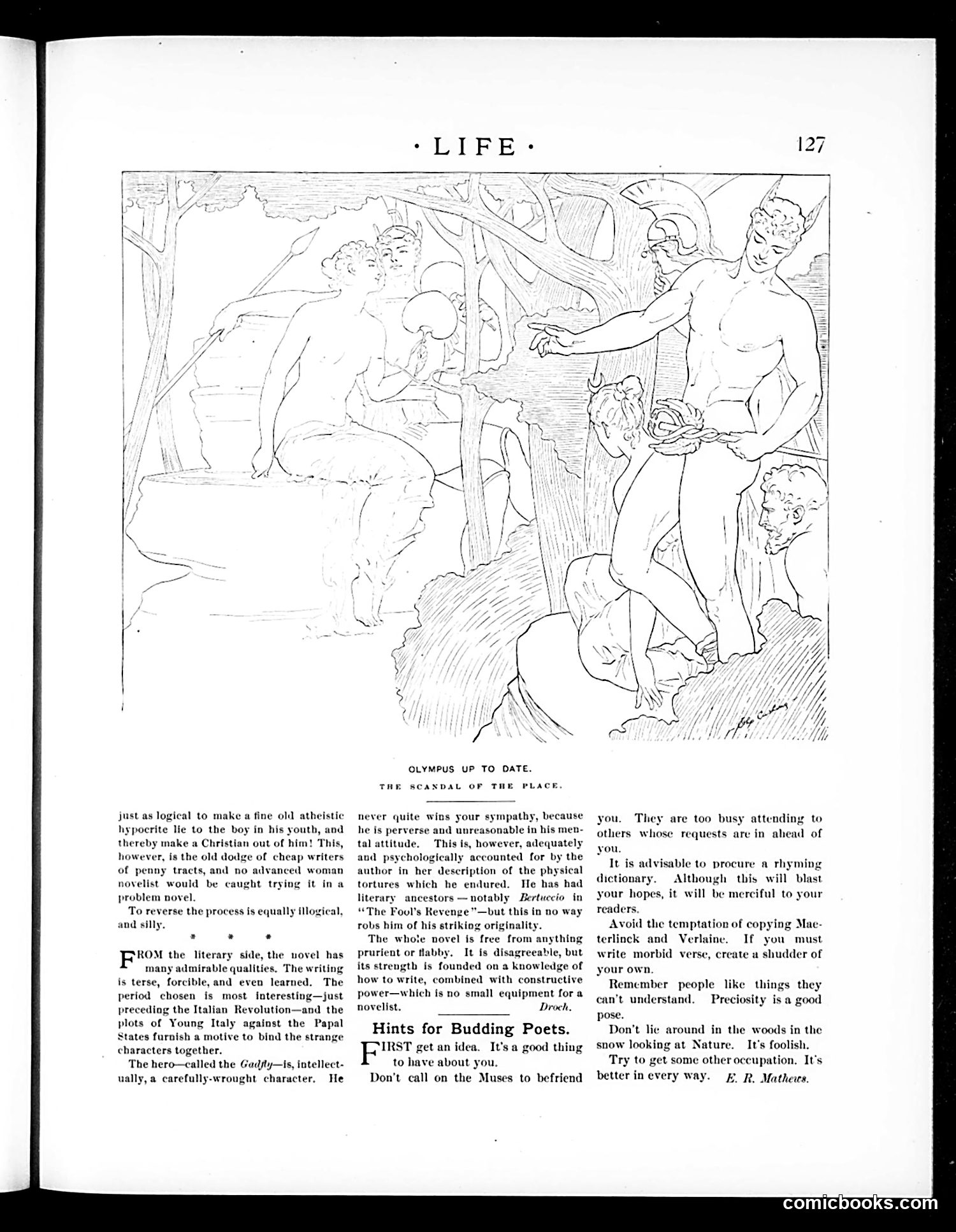
This cartoon depicts classical Greek gods and goddesses in a woodland setting, presented as a commentary on contemporary morality. The title suggests the ancient mythological pantheon is being recontextualized as a modern social scandal—the point being that classical mythology, with its abundant tales of divine seduction and illegitimate liaisons, represents timeless moral failings rather than elevated ideals. The accompanying text discusses how novels portraying morally questionable characters pose problems for Christian society, and debates whether depicting such figures constitutes endorsement. The cartoon's "scandal" likely satirizes Victorian prudishness about both classical literature and modern fiction—suggesting that if respectable society accepts Greek mythology as educational, it should logically accept frank modern novels addressing similar human behavior.
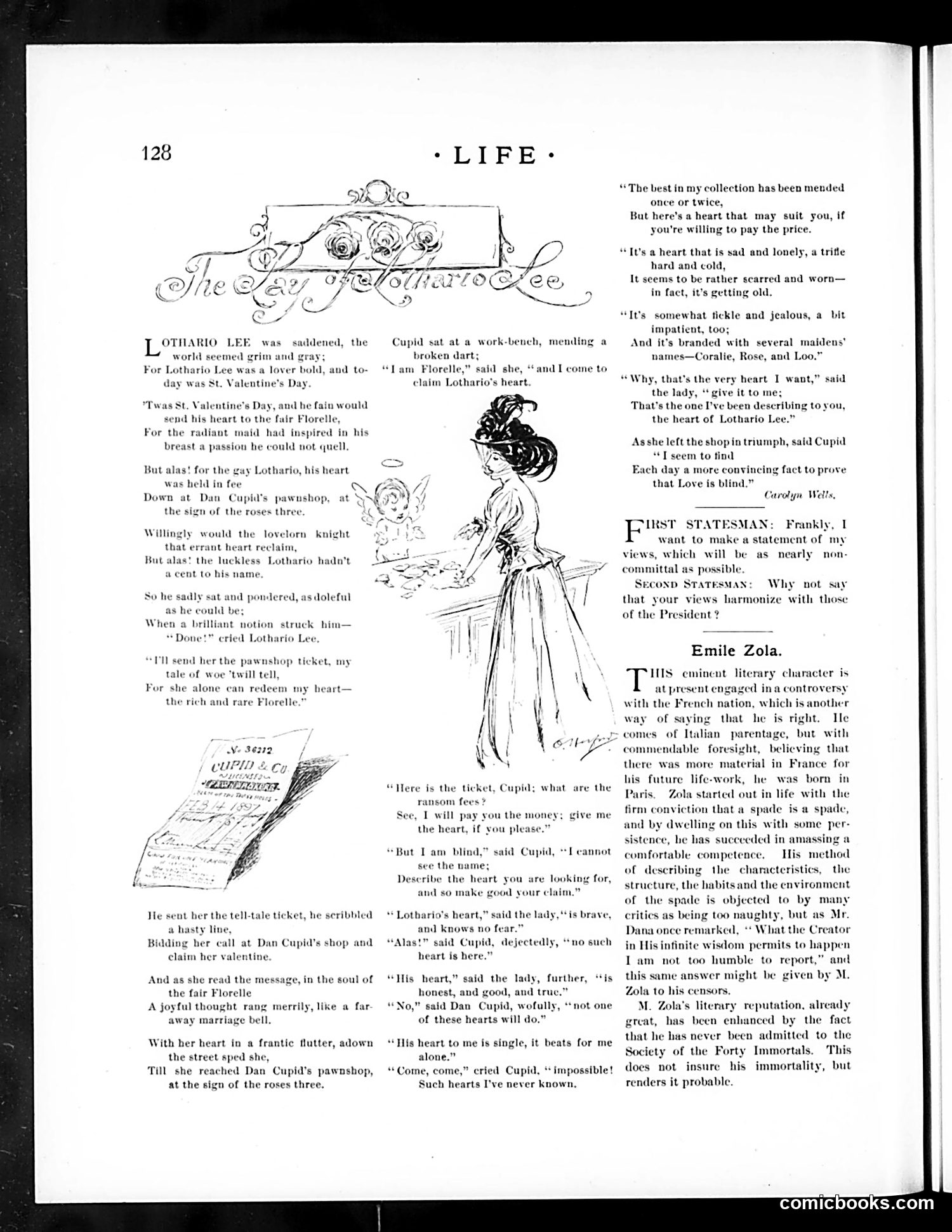
This page contains a serialized romantic story rather than political satire. It depicts **Lothario Lee**, a lovesick knight unable to afford his beloved Florelle's hand, attempting to sell his heart to Dan Cupid (represented as Cupid at a workbench) at "the sign of the roses three." The narrative is a tongue-in-cheek Valentine's Day tale: Lothario seeks payment for his heart to win his lady, but Cupid finds the heart "sad and lonely," "hard and cold," and "getting old"—making it worthless. The story plays on romantic clichés and the commercialization of love. The right column contains an unrelated piece about French author Émile Zola and literary criticism. This appears to be a typical mixed-content issue of *Life* magazine.
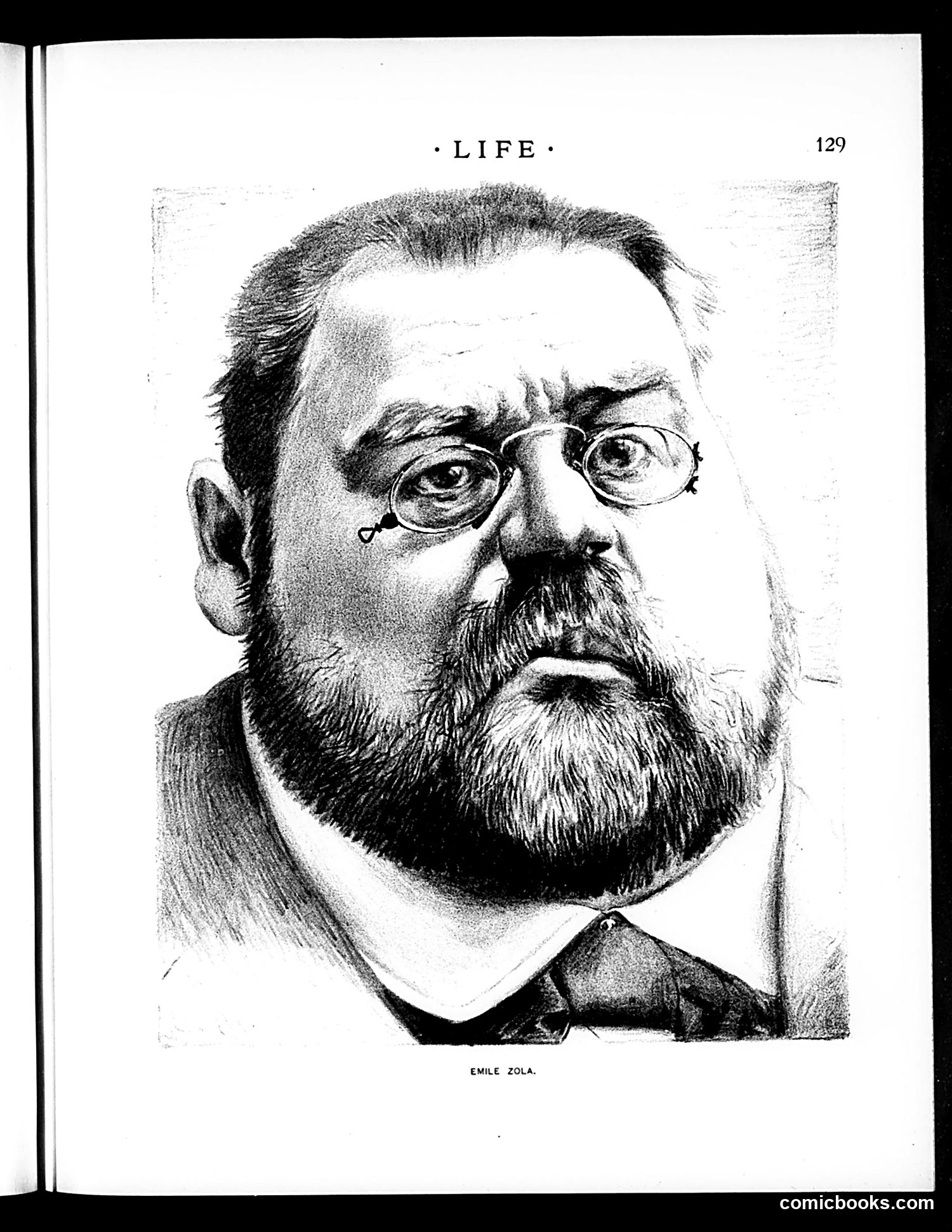
This page from *Life* magazine (page 129) features a portrait labeled "EMILE ZOLA." The image is a detailed engraving or sketch of a bearded man wearing glasses and formal attire with a bow tie. Émile Zola was a prominent French novelist and public intellectual of the late 19th century, known for his naturalist literary works and his vocal political activism. *Life* was an American satirical magazine that frequently featured portraits of notable public figures alongside commentary or satire. Without accompanying text on this page, the specific satirical angle or point of this portrait remains unclear—it may relate to his literary reputation, his political stances, or contemporary events involving him that American readers would have recognized.
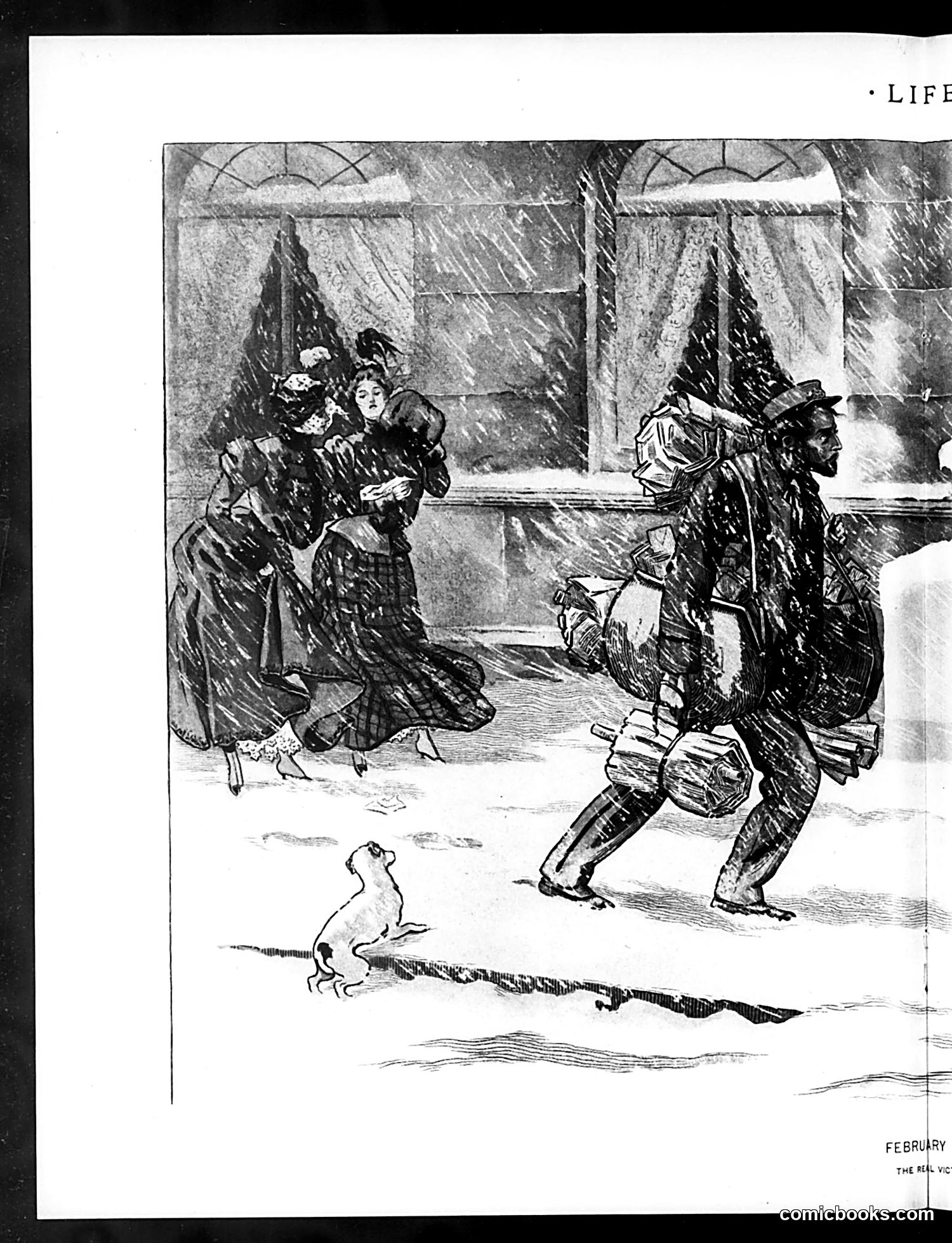
This is a winter scene showing elegantly dressed women and a soldier in the snow outside a building with decorated windows. A small dog plays in the foreground. The text visible is minimal—only "FEBRUARY" and what appears to be a publication mark. Without additional OCR text or captions identifying the figures or the cartoon's satirical point, I cannot determine the specific political or social commentary intended. The scene appears to depict a social or romantic scenario involving military personnel and civilians during winter, which was common subject matter for *Life* magazine's humor and satire. However, the exact references, identities, and satirical message remain unclear without more textual information.
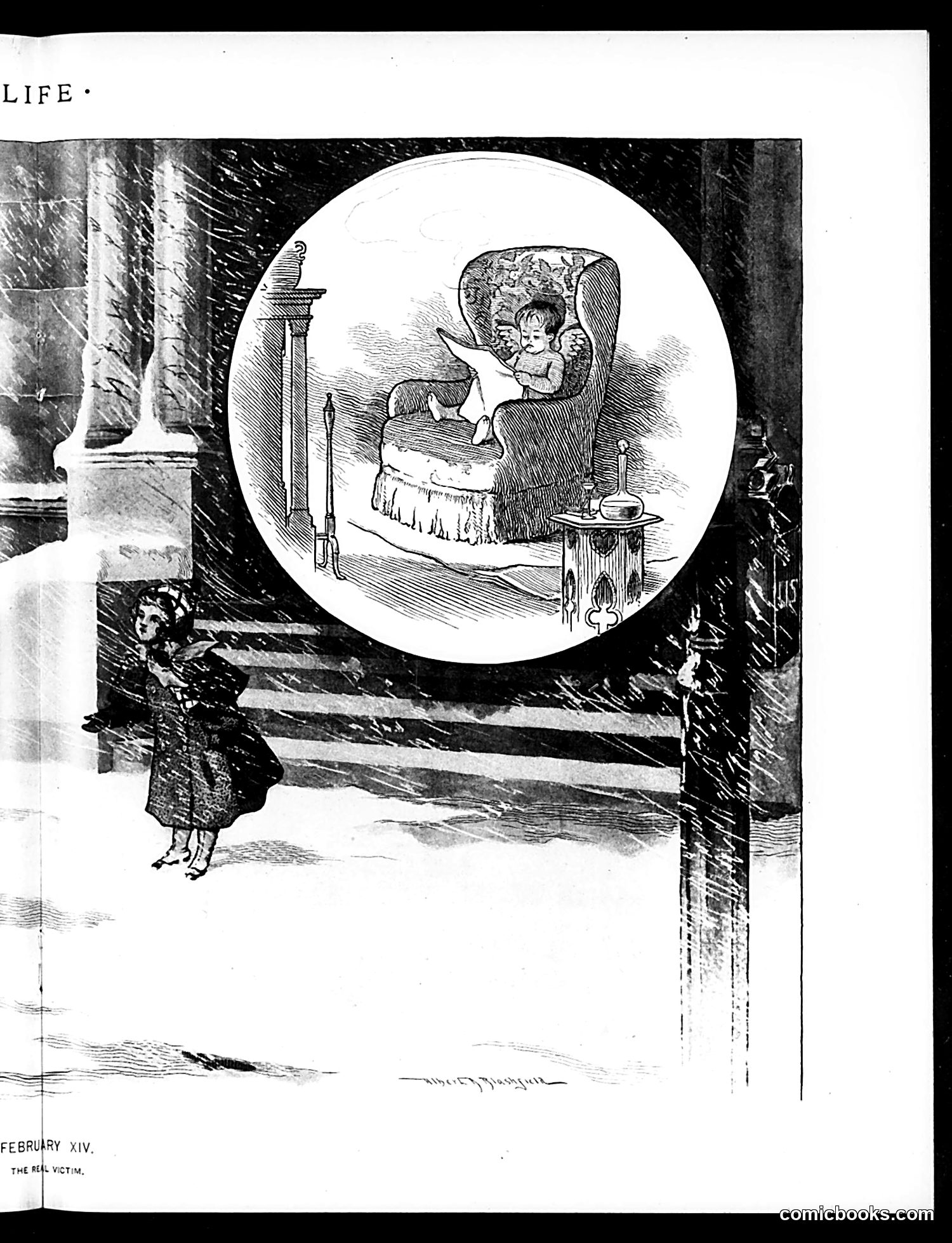
This page from Life magazine (dated February 14) features a single engraving showing a woman gazing through a circular window or frame at a domestic interior scene. Inside the circular view, a cherub or cupid figure sits in an armchair beside a small table with a candle. The image appears to be Valentine's Day-themed content, given the February 14 date and the cherub imagery traditionally associated with romance. The woman's wistful expression suggests she's observing an idealized domestic or romantic scene from outside—possibly satirizing romantic fantasies, domestic longing, or the gap between romantic ideals and reality. The engraving style and composition suggest this is commentary on contemporary attitudes toward love, home, or relationships, though the specific satirical point remains somewhat unclear without additional context.
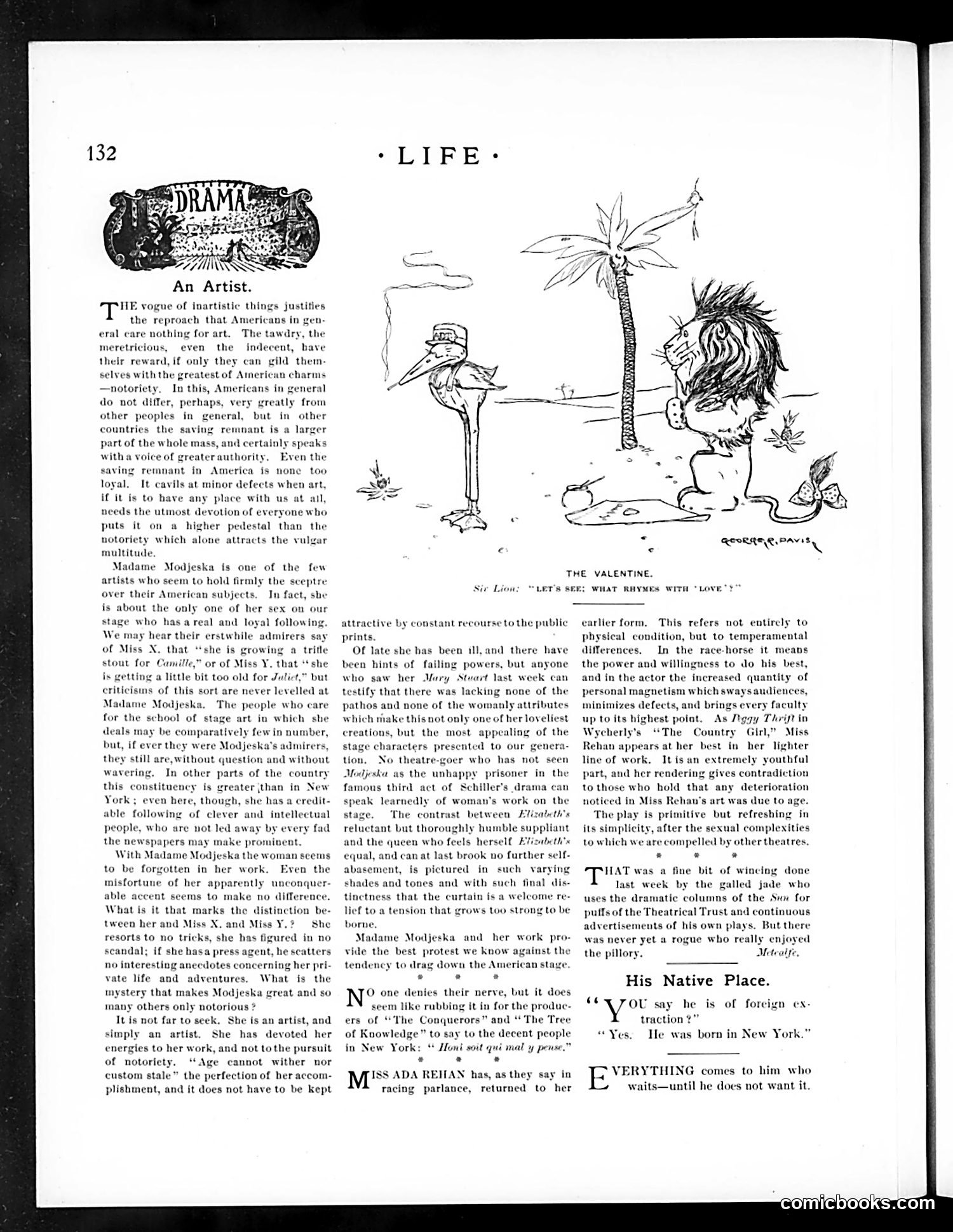
This page contains an article titled "An Artist" discussing Madame Modjeska, a prominent stage actress, and her American theatrical career. The text praises her artistic devotion and loyal following. The cartoon, titled "The Valentine," depicts surreal figures in a desert landscape with a palm tree. The caption reads "Sir Lion: 'Let's see; what rhymes with 'love'?'" The joke appears to be a visual pun: a lion attempting to compose romantic verse, with the absurdist humor suggesting difficulty finding suitable rhymes. The cartoon's whimsy contrasts with the serious theatrical discussion above it—typical of Life magazine's mix of satirical commentary and lighthearted illustrations. The artist is credited as "Cesare R. Davis."
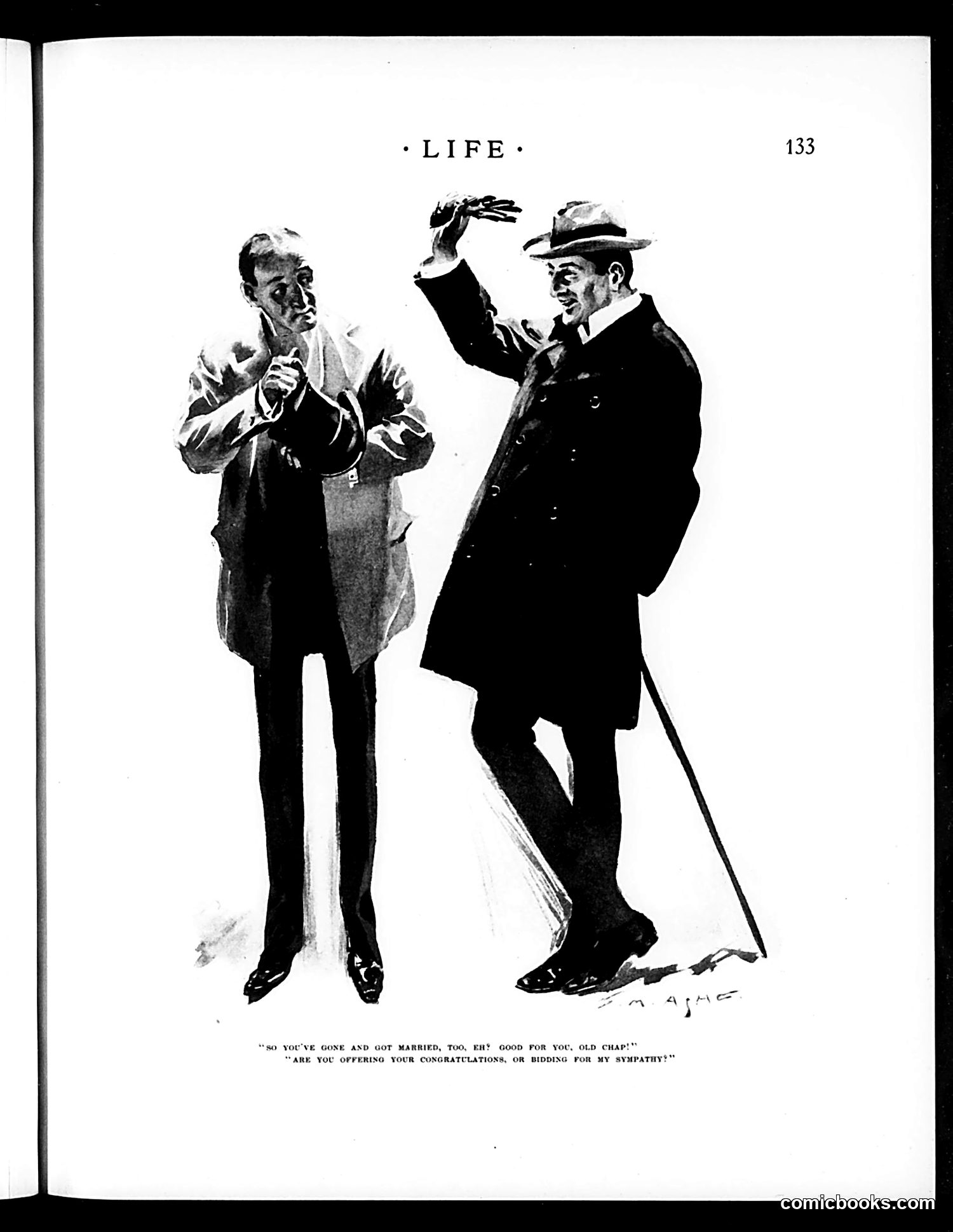
This single-panel cartoon depicts two well-dressed gentlemen in conversation. The figure on the left congratulates the other on getting married, calling it "good for you." The second man responds sarcastically, asking whether the speaker is offering congratulations or "bidding for [his] sympathy." The joke satirizes marriage as a misfortune rather than a blessing. The second man's response suggests that getting married is an unfortunate event deserving sympathy rather than celebration—a common bachelor's lament in early 20th-century humor. The cartoon mocks the social ritual of congratulating newlyweds while implying married life is actually a loss of freedom worth pitying. This represents typical period misogyny and anti-marriage sentiment found in satirical magazines targeting male readers.
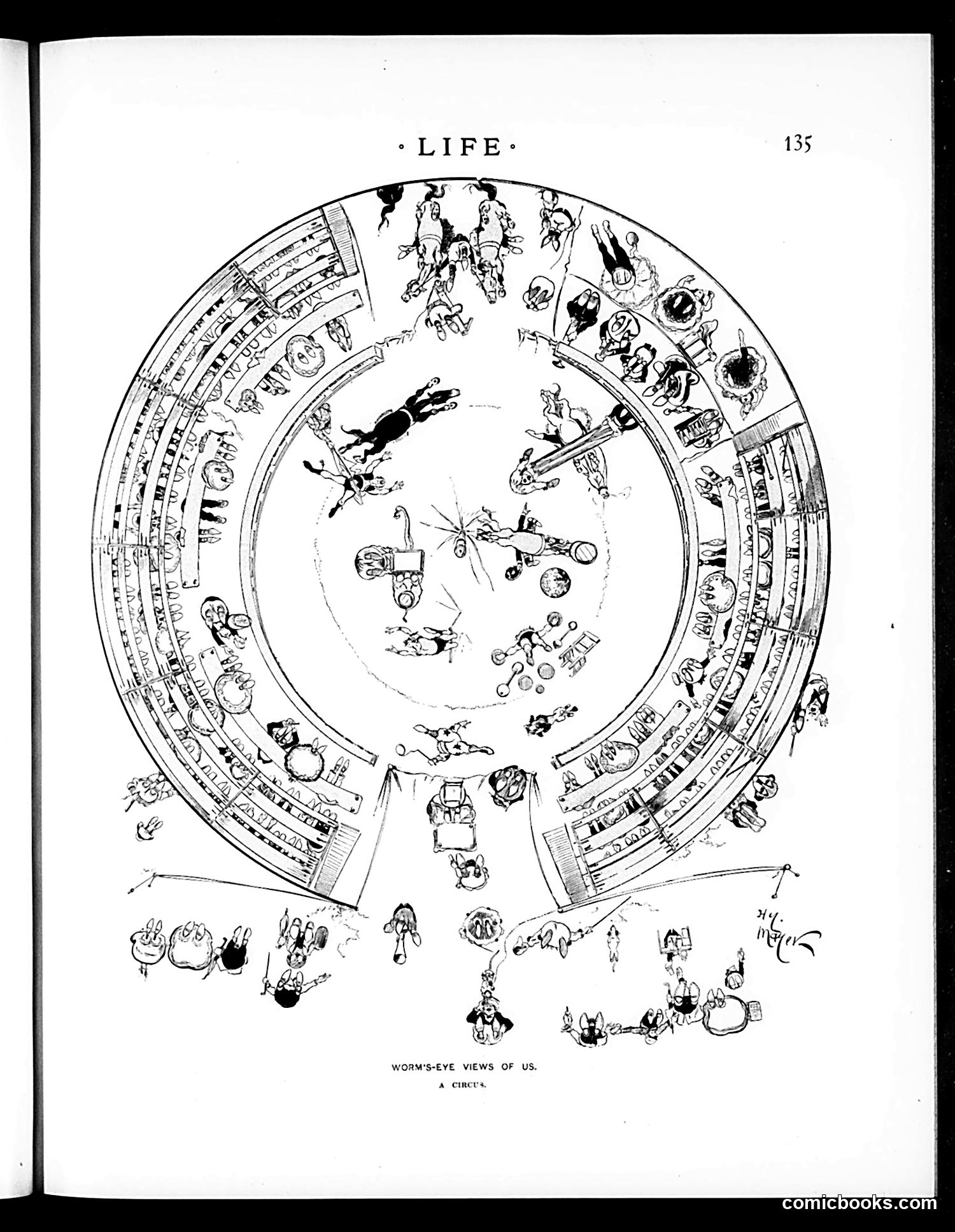
This satirical illustration presents American society as a circus viewed from a worm's perspective—literally from ground level looking up. The concentric rings depict various social activities and human behaviors arranged in circular bands, with figures scattered throughout engaged in typical pastimes: acrobatics, performances, socializing, and entertainment. The "worm's-eye view" framing suggests how ordinary people appear trivial or absurd when observed from an outsider's perspective. By labeling society "a circus," the cartoonist satirizes American social life as chaotic, performative, and lacking substance—everyone playing roles for amusement rather than engaging in meaningful activity. This reflects early 20th-century satirical commentary on modern American culture, leisure, and commercialism.
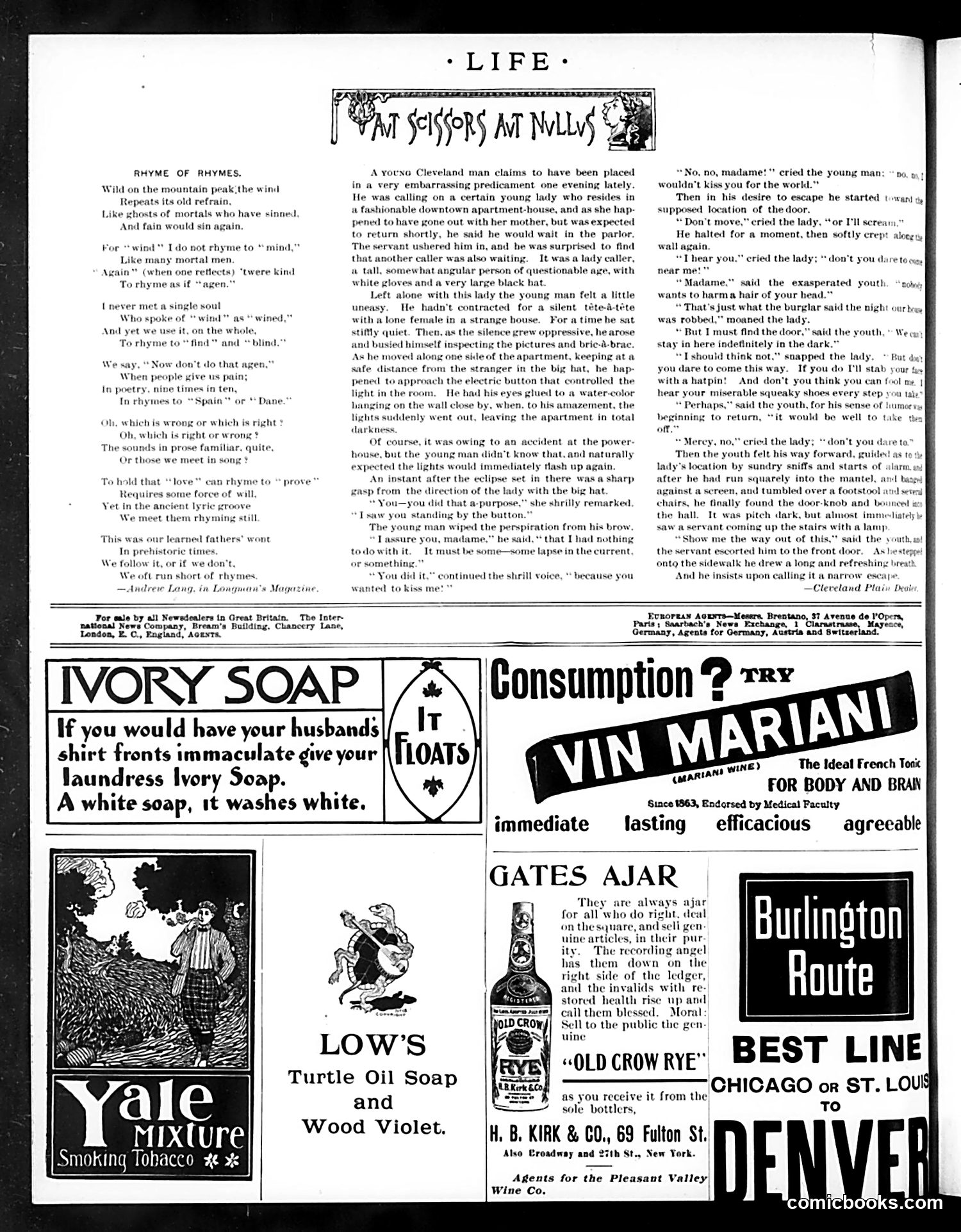
This page contains a humorous short story from *Life* magazine about a young Cleveland man caught in an awkward situation. Visiting his girlfriend's apartment, he finds an elderly, angular female caller already waiting. When he nervously approaches the light switch in the darkened room, the woman assumes he's deliberately turned off the lights to pursue her romantically. What follows is classic slapstick: the panicked young man insists he wants nothing to do with her, while the lady—apparently a widow or spinster—threatens him with a hatpin and blocks his escape. He stumbles through the dark apartment, colliding with furniture, until a servant arrives with a lamp. The humor depends on period conventions: the absurdity of this unattractive woman believing any man would desire her, combined with the young man's desperate attempts to escape an unwanted romantic situation. The title "Vat Scissors at Nully's" remains unclear from the text provided.
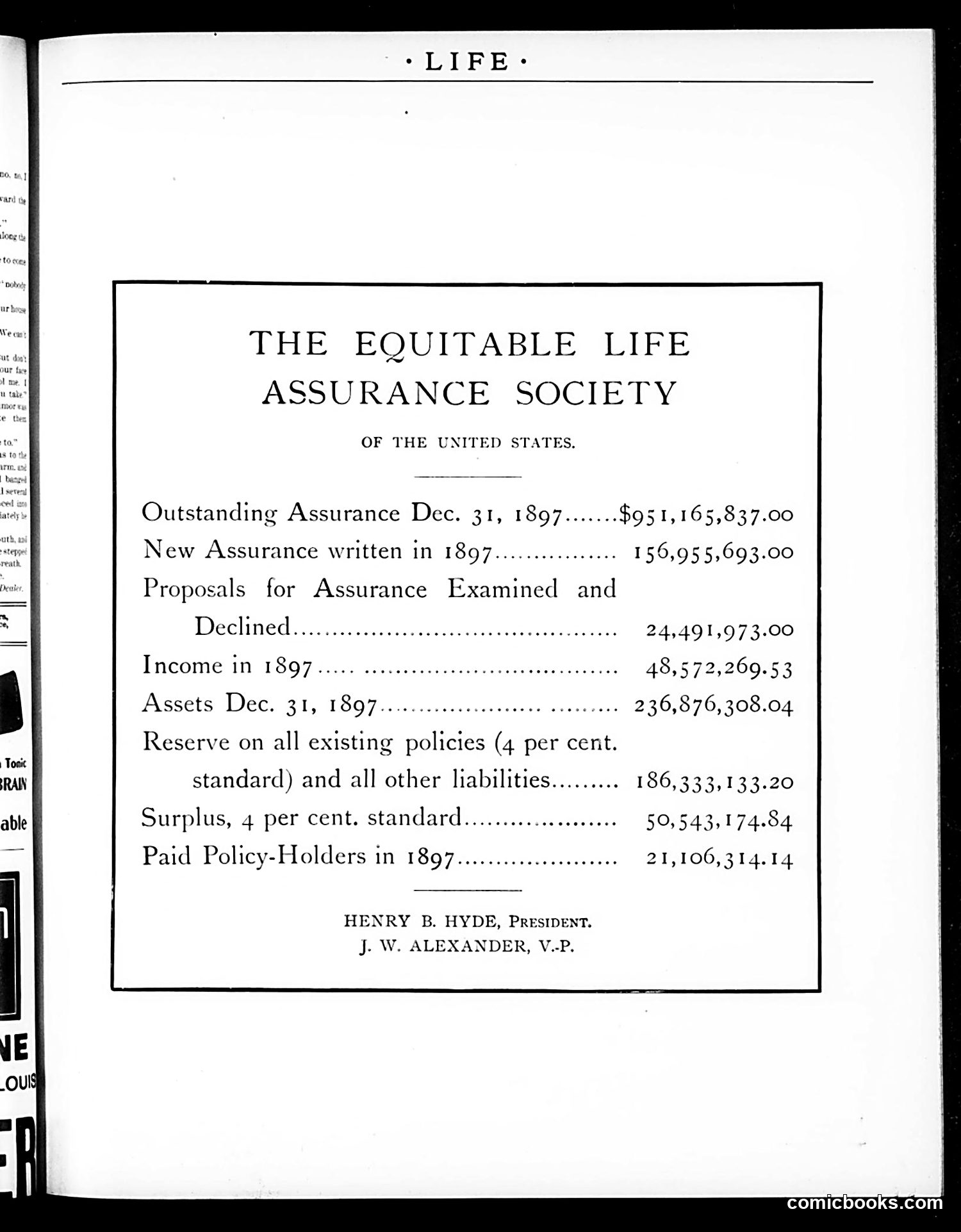
This page is not a cartoon or satirical content—it's a corporate advertisement and financial statement. The Equitable Life Assurance Society of the United States presents its 1897 financial performance and company officers (Henry B. Hyde, President, and J.W. Alexander, Vice-President). The page displays insurance metrics: outstanding policies worth over $951 million, new policies written, claims declined, income, assets, and payments to policyholders. It appears in *Life* magazine as paid advertising meant to demonstrate the company's financial stability and trustworthiness to potential customers. There is no satire or cartoon content to analyze on this particular page.
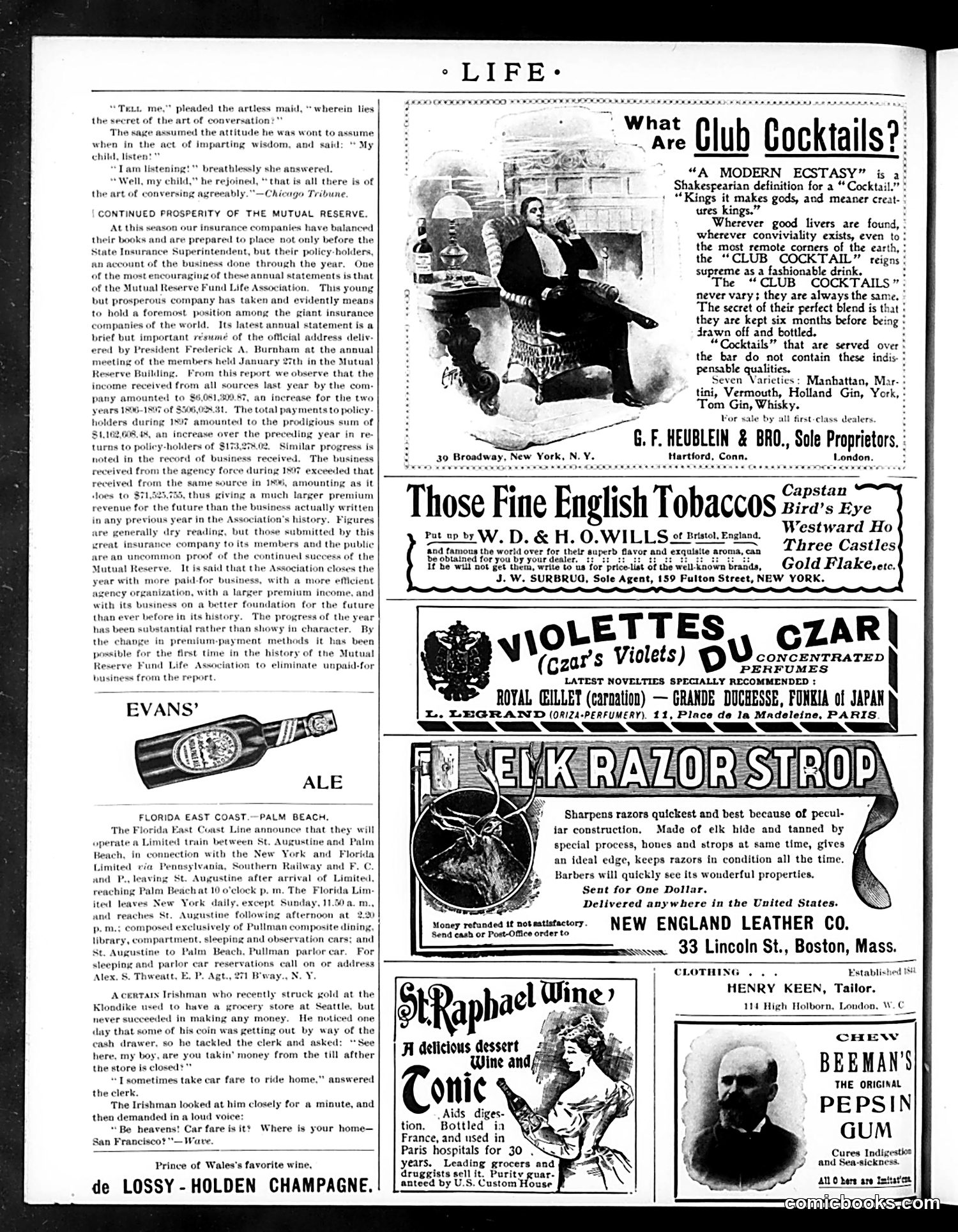
This page is primarily **advertising**, with minimal editorial cartoon content. The main illustrated article discusses the financial prosperity of the Mutual Reserve Fund Life Association insurance company, presenting statistics about their growth and policy payments. The brief **comic anecdote** at bottom-left features an Irish immigrant character (identifiable by dialect: "Be heavens!") who discovers his store clerk is stealing car fare. This represents a common early-1900s stereotype of Irish workers and petty theft. The remainder consists of period product advertisements: Evans' Ale, Club Cocktails (positioned as a sophisticated drink), English tobaccos, violets cologne, razor strops, wine, and pepsin gum. **For modern readers**: This reflects an era when Life magazine mixed serious business reporting with light humor and heavily relied on advertising revenue. The ethnic humor was considered acceptable entertainment. The ads showcase products and luxuries marketed to affluent readers.
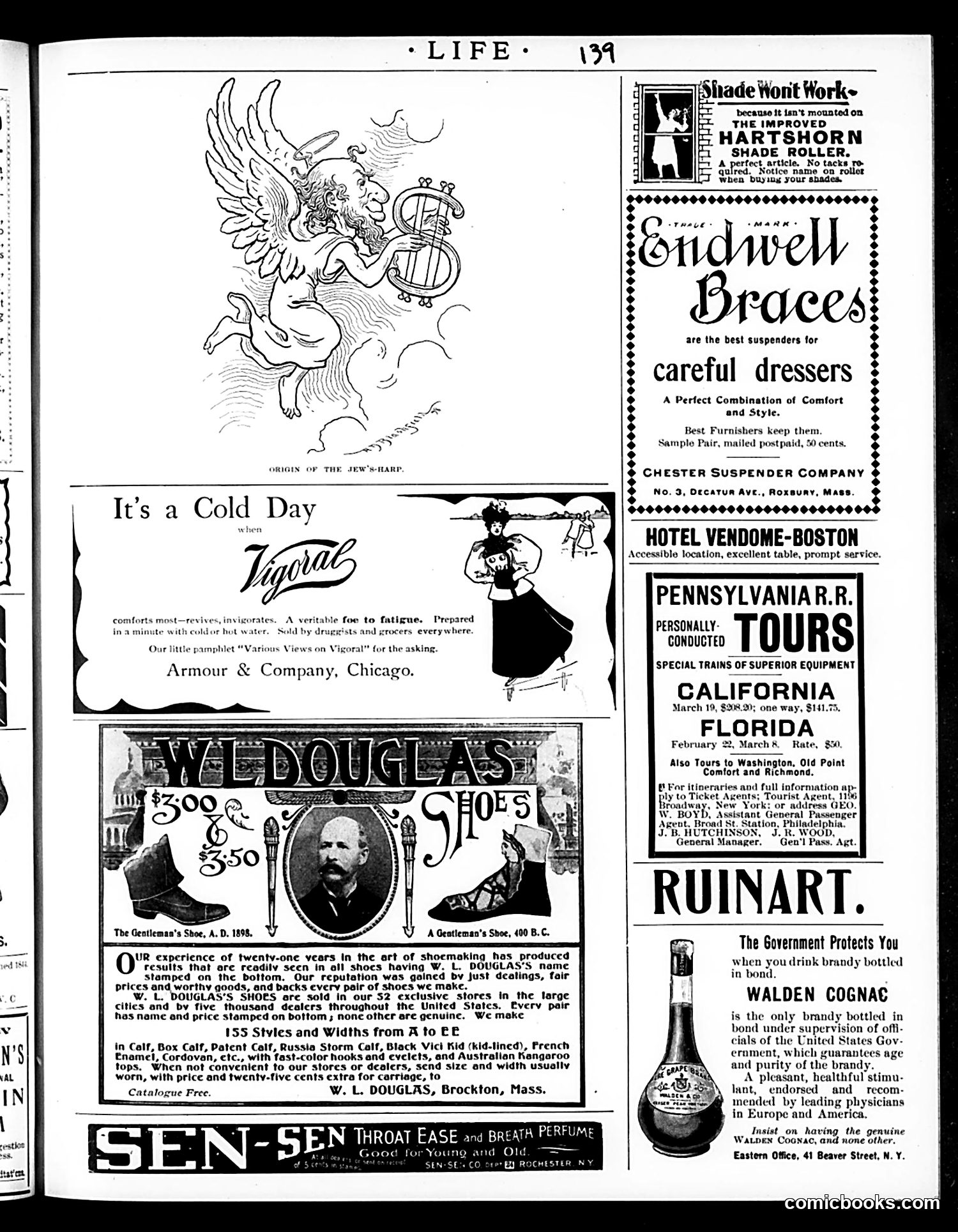
This is primarily an **advertising page** from Life magazine (page 139). The main illustration at top—labeled "Origin of the Jew's-Harp"—shows a winged, demonic or impish figure with exaggerated features playing a musical instrument. It appears to be a **crude ethnic caricature** typical of the period, using antisemitic imagery common in late-19th/early-20th century American satire magazines. The rest of the page contains commercial advertisements for shoes (W.L. Douglas), braces, suspenders, brandy, railroad tours, and patent shade rollers. The "Jew's-Harp" origin cartoon serves as the page's satirical content—a humorous pseudo-historical claim apparently intended to be comedic through ethnic stereotype. Modern readers would recognize this as offensive stereotyping reflecting period prejudices.
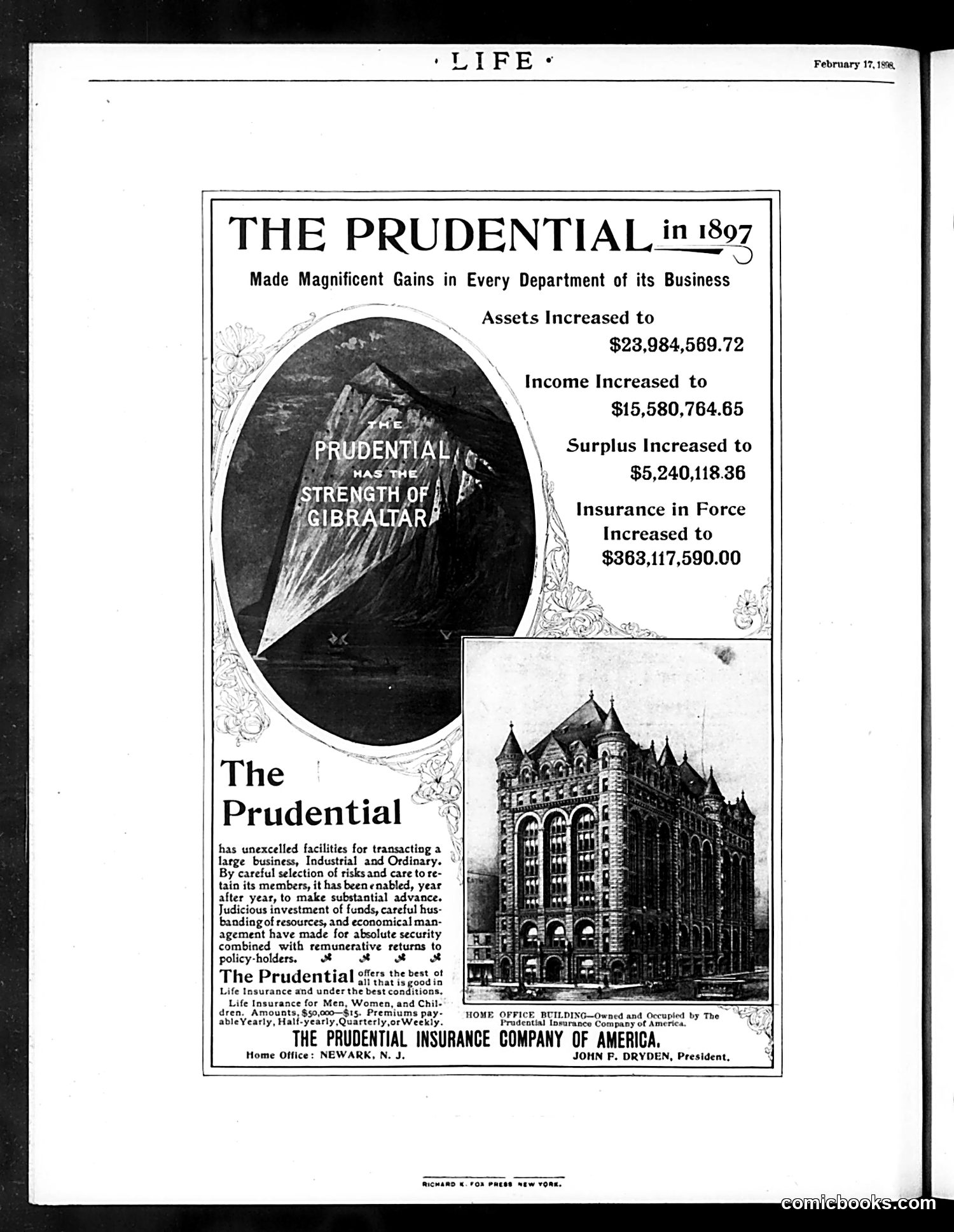
This is primarily a **full-page advertisement**, not political satire. It promotes The Prudential Insurance Company of America, highlighting their 1897 financial performance—assets of nearly $24 million, income of $15.5 million, and insurance in force of $363 million. The imagery is straightforward corporate branding: the Rock of Gibraltar (symbolizing stability and strength in insurance advertising of this era) and the company's Newark, New Jersey headquarters building. The text emphasizes Prudential's "unexcelled facilities," careful risk selection, and secure investment practices—standard insurance marketing language assuring customers of reliability. There is no satirical cartoon or political commentary here. The page functions as a business-focused advertisement targeting potential policyholders, emphasizing the company's growth and trustworthiness. This reflects late-19th-century advertising practices common in magazines like Life.