
Life, 1898-02-17 · page 12 of 20
Life — February 17, 1898 — page 12: what you’re looking at
What you’re looking at
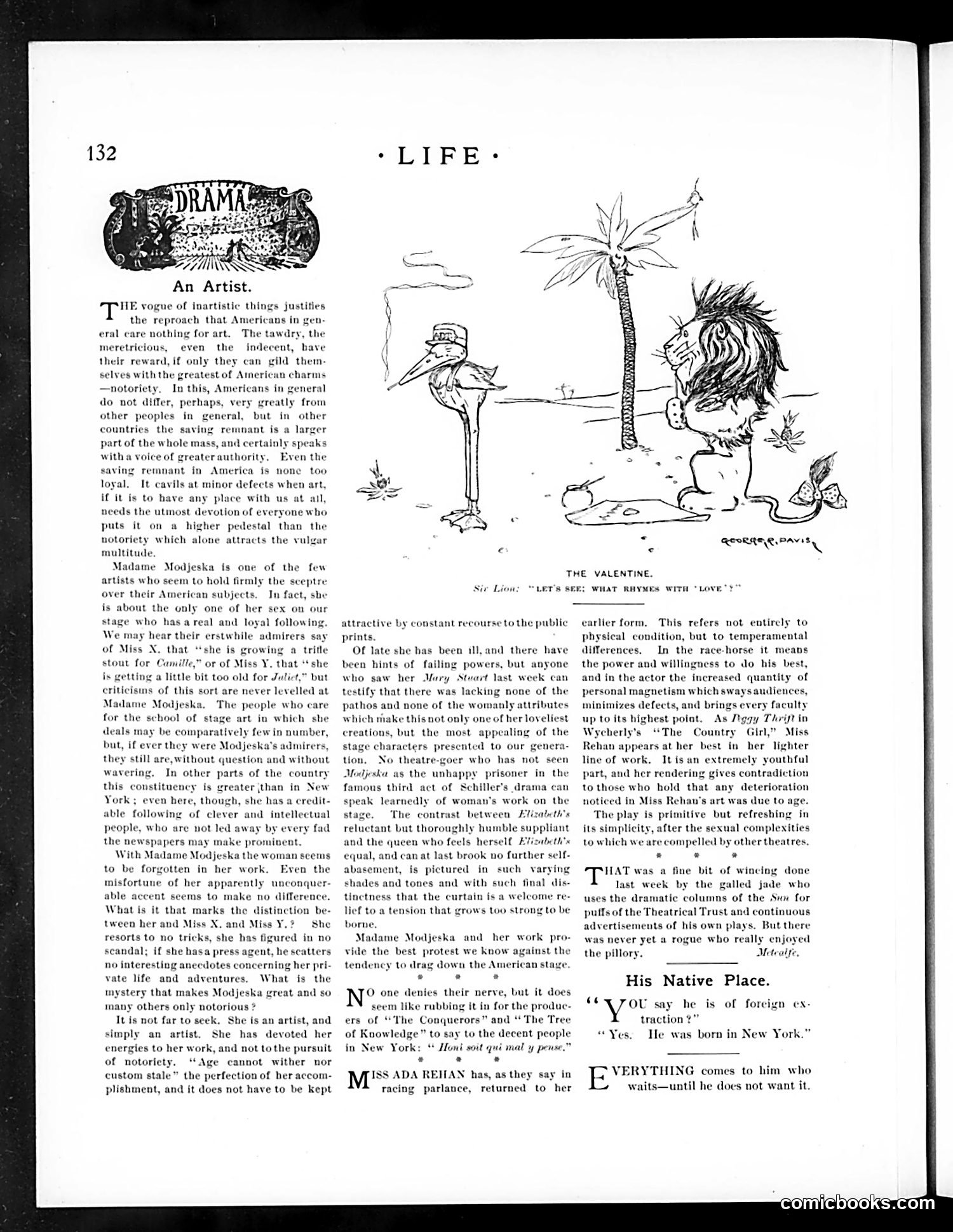
This page contains an article titled "An Artist" discussing Madame Modjeska, a prominent stage actress, and her American theatrical career. The text praises her artistic devotion and loyal following. The cartoon, titled "The Valentine," depicts surreal figures in a desert landscape with a palm tree. The caption reads "Sir Lion: 'Let's see; what rhymes with 'love'?'" The joke appears to be a visual pun: a lion attempting to compose romantic verse, with the absurdist humor suggesting difficulty finding suitable rhymes. The cartoon's whimsy contrasts with the serious theatrical discussion above it—typical of Life magazine's mix of satirical commentary and lighthearted illustrations. The artist is credited as "Cesare R. Davis."
📄 Transcribed text from this page (OCR, searchable)
Machine-transcribed from the original scan — historical spelling and the odd misread are preserved.
An Artist. HE vogue of inartistic things justities the reproach that Americans in gen- care nothing for art. The tawdry, the retric! even the indecent, bave their reward, if only they can gild them: selves withthe g tof American —notoriety, In this, Americans in gene do not differ, perhaps, very greatly from other peoples in general, but in other countries the saving remnant is a larger part of the whole mass, and certainly speaks with a voice of greater authority, Even the saving remnant in America is none too loyal, It cavils at minor defects when art, if it is to have any place with us at all, needs the utmost devotion of everyone who puts it on a higher pedestal than the notoriety which alone attracts the vulgar multitude. Madame Modjeska is one of the few artists who seem to hold firmly the sceptr over their American subjects. In fact, she is about the only one of her sex on our stage who has areal and loyal following We may hear their erstwhile admirers say of Miss X. that owing a trifle stout for Camille,” or of Miss Y. that ‘she is getting a little bit too old for Juliet,” but criticisms of this sort are never levelled at Madame Modjeska, The people who care for the school of stage art in which she deals may be comparatively few in number, but, if ever they were Modjeska’s admirers, they still are,without question and without wavering, In other parts of the country this constituency is greater jthan in New York ; even here, though, she has a credit- able following of clever and intellectual people, who are not led away by every fad the newspapers may make prominent. With Madame Modjeska the woman scems to be forgotten in her work. Even the misfortune of her apparently unconquer- able accent seems to make no differenc What is it that marks the distinction be- tween her and Miss X. and Miss Y.? She resorts to no tricks, she has figured in no scandal; if she hasa press agent, he scatters no interesting anecdotes concerning her pri- vate life and adventures. What is the mystery that makes Modjeska great and so many others only notorious ? It is not far to seek, She is an artist, and simply an artist. She has devoted her energies to her work, and not tothe pursuit of notoriety. “Age cannot wither nor custom stale” the perfection of her accom- plishment, and it does not have to be kept “she is THE VALENTINE. Sir Lion attractive by constant recourse to the public prints. Of late she b been ill,and there have been hints of failing powers, but anyone who saw her Mary Stuart last week can testify that there was lacking none of the pathos and none of the womanly attributes which riake this not only one of her loveliest creations, but the most appealing of the stage characters presented to our genera- tion, No theatre-goer who has not seen Modjeska as the unhappy prisoner in the famous third act of Schiller’s drama can speak learnedly of woman's work on the stage. T between Elizabeth's reluctant but thoroughly hun uppliant and the queen who feels herself Elizabeth's equal, and can at last brook no further self- ement, is pictured in such varying ades and tones and with such final dis- tinctness that the curtain is a welcome re- lief to a tension that grows too strong to be borne, Madame Modjeska and her work pro- le the best protest we know against the tendency to drag down the American staxe * * * e contrast O one denies their nerve, but it does seem like rubbing it in for the produc- ers of “The Conquerors” and “ The Tr of Koowledg y to the decent people in New York Honi soit qui mal y pense.” * . * M! SS ADA REITAN has, as they say in racing parlance, returned to her LET'S s WHAT RAYMES WITH "LO earlier form, This refers not entirely to physical condition, but to temperamental differences. In the race-horse it means the p rand willingness to do his best, and in the actor the increased quantity of personal magnetism which sways audiences, minimizes defects, and brings every faculty up to its highest poiat. As Peggy Thrift in Wyeherly’s. “The Country Girl,” Mis Rehan appears at her best in her lighter line of work. It isan extremely youthful part, and her rendering gives contradiction to those who hold that any deterioration noticed in Miss Rehan’s art was due to age. The play is primitive but refreshing in its simplicity xual complexities to which we are compelled by other theatres. * * * HAT was a fine bit of wincing done last week by the galled jade who uses the dramatic columns of the Su for pulls of the Theatrical Trust and continuous advertisements of his own plays. But there was never yet a rogue who really enjoyed the pillory. Metcalfe. His Native Place. OU say he is of foreign ex- traction?” ay Ile was boro in New York.” VERYTHING comes to him who waits—until he does not want it.