
Life, 1898-02-17 · page 7 of 20
Life — February 17, 1898 — page 7: what you’re looking at
What you’re looking at
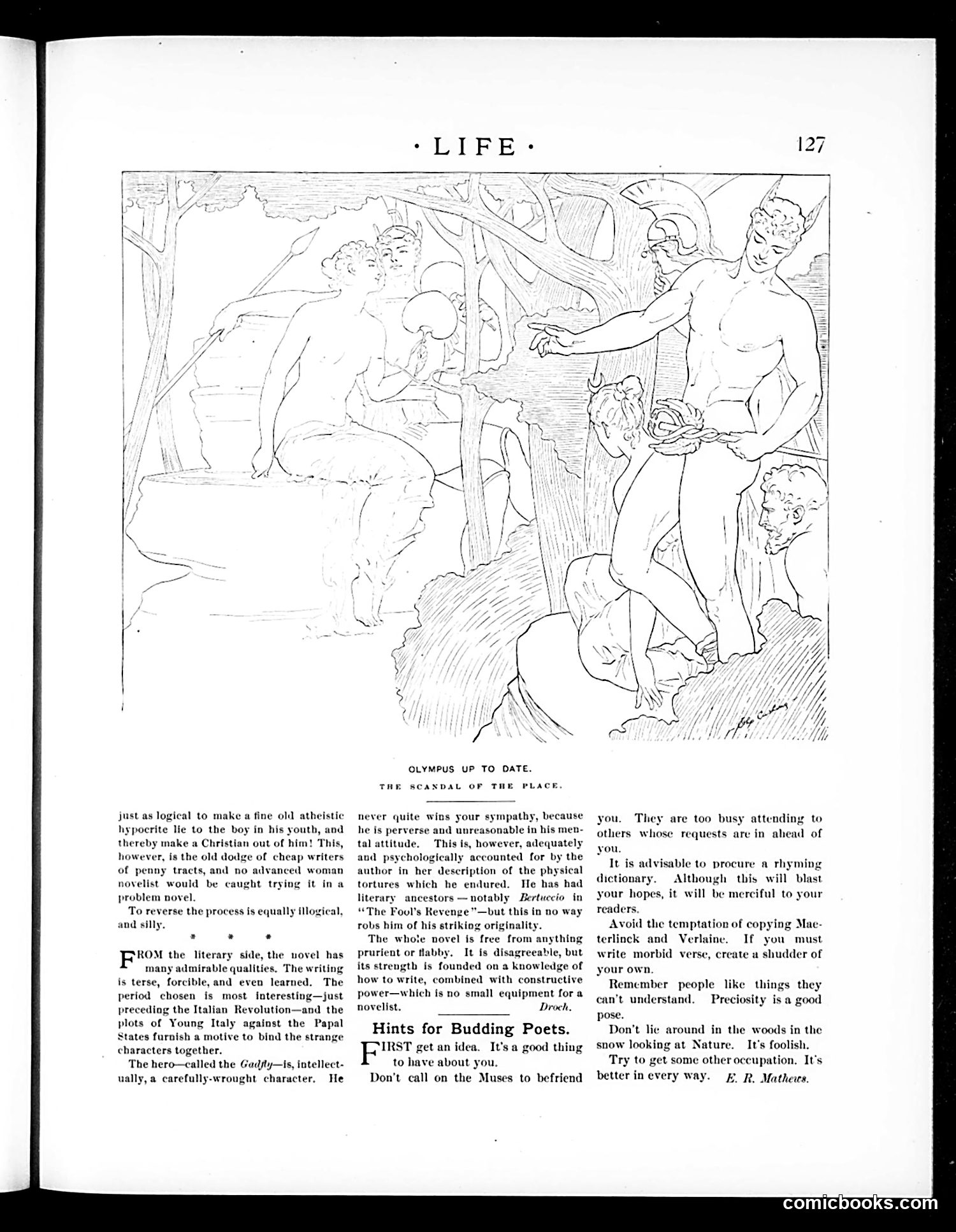
This cartoon depicts classical Greek gods and goddesses in a woodland setting, presented as a commentary on contemporary morality. The title suggests the ancient mythological pantheon is being recontextualized as a modern social scandal—the point being that classical mythology, with its abundant tales of divine seduction and illegitimate liaisons, represents timeless moral failings rather than elevated ideals. The accompanying text discusses how novels portraying morally questionable characters pose problems for Christian society, and debates whether depicting such figures constitutes endorsement. The cartoon's "scandal" likely satirizes Victorian prudishness about both classical literature and modern fiction—suggesting that if respectable society accepts Greek mythology as educational, it should logically accept frank modern novels addressing similar human behavior.
📄 Transcribed text from this page (OCR, searchable)
Machine-transcribed from the original scan — historical spelling and the odd misread are preserved.
just as logical to make a fine old atheistic hypocrite lie to the boy in his youth, and thereby make a Christian out of him! This, however, is the old dodge of cheap writers of penny tracts, and no advanced woman novelist would be caught trying it in a problem novel. To reverse the process is equally illogical, and silly. . . . ROM the literary side, the uovel has many admirable qualities. The writing is terse, forcible, and even learned. The period chosen is most interesting—just preceding the Italian Revolution—and the plots of Young Italy against the Papal States furnish a motive to bind the strange characters together. The hero—called the Gadjly—is, intellect- ually, a carefully-wrought character, He OLYMPUS UP TO DATE. THE SCANDAL OF THE PLACE. never quite wins your sympathy, because he is perverse and unreasonable in his men- tal attitude. This is, however, adequately and psychologically accounted for by the author in her description of the ph; tortures which he endured. He has had literary ancestors — notably Bertuccio in “The Fool's Revenge "—but this in no way robs him of his strikiog originality. The whote novel is free from anything prurient or flabby, It is disagreeable, but its strength is founded on a knowledge of how to write, combined with constructive power—which {fs no small equipment for a novelist. Droch. Hints for Budding Poets. Ee getan idea. It's a good thing to have about you. Don't call on the Muses to befriend you. They are too busy attending to others whose requests are in ahead of you It is advisable to procure a rhyming dictionary, Although this will blast your hopes, it will be merciful to your readers, Avoid the temptation of copying Mae- terlinck and Verlaine. If you write morbid verse, create a shudder of your own, Remember people like things they can’t understand. —Preciosity is a good pose. Don't lie around in the woods in the snow looking at Nature. It’s foolish. Try to get some other occupation. It’s better in every way. R. Mathews. must comicbooks.com