
Life, 1898-02-17 · page 4 of 20
Life — February 17, 1898 — page 4: what you’re looking at
What you’re looking at
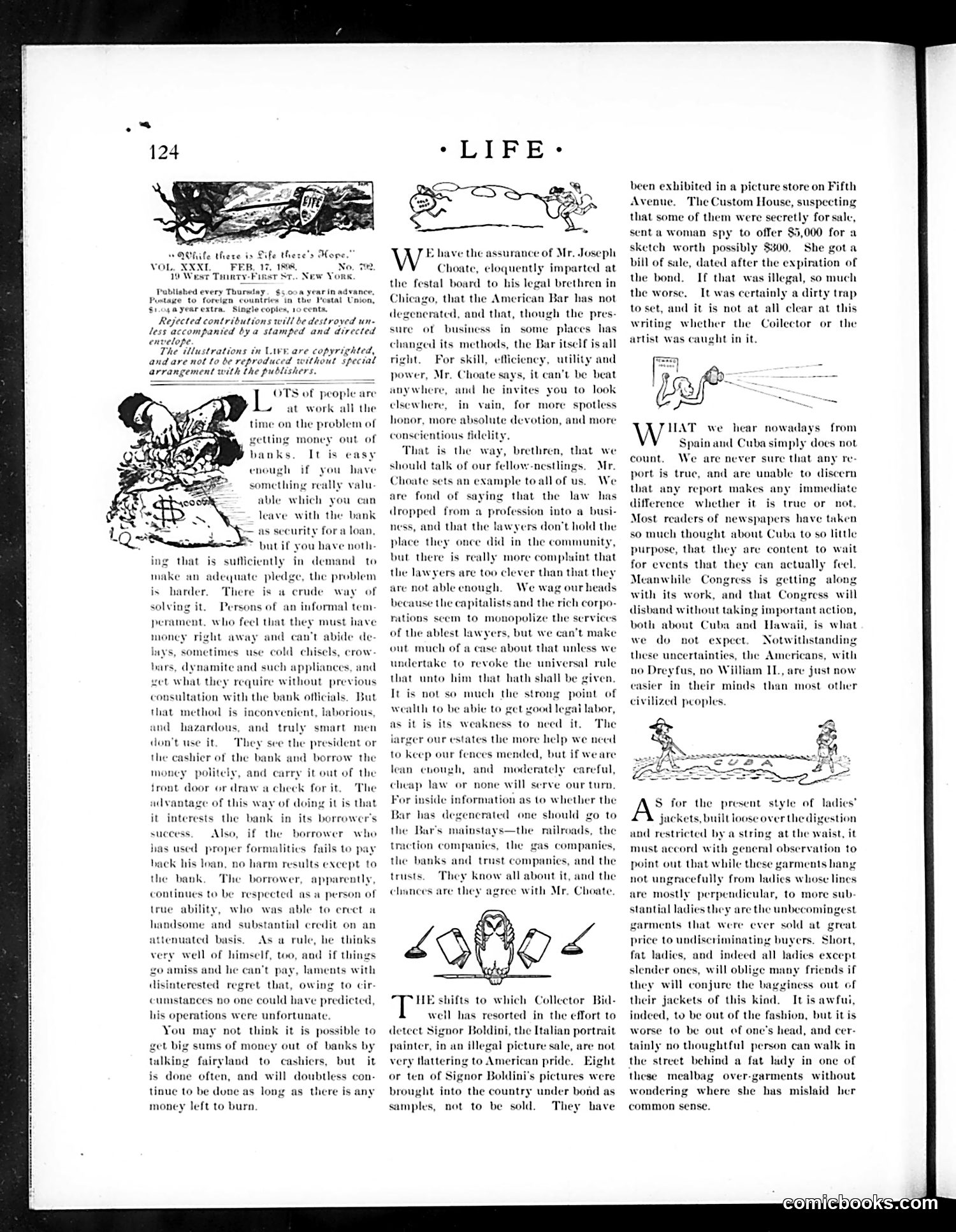
This page contains three distinct satirical sections: 1. **Top cartoon**: Appears to satirize banking practices, showing a figure extracting money from a bank vault. The accompanying text criticizes how banks handle loans and borrower relationships, suggesting banks use harsh methods to secure repayment while borrowers struggle with inadequate pledges. 2. **Middle cartoon**: Depicts what appears to be a Signor Bodini, an Italian portrait painter, in connection with an illegal art smuggling scheme. The text indicates customs officials discovered his pictures being brought into the country under false pretenses as "samples" rather than for sale. 3. **Bottom section**: Satirizes ladies' fashion, mocking loose-fitting jackets and suggesting they create unflattering silhouettes, particularly for fuller-figured women who appear dignified in properly fitted garments. The overall tone critiques financial institutions, art fraud, and questionable fashion trends.
📄 Transcribed text from this page (OCR, searchable)
Machine-transcribed from the original scan — historical spelling and the odd misread are preserved.
XXXL FEB. 9 West Tminty-Fin: every Thuretay to fore! $a year extra. Rejected contributions will be destroyed un- tess accompanied bya stamped and directed The illustrations in Livy. are copyr! and are not to be reproduced without 5 arrangement with the publishers. t work all the sting money out of banks. It is if you easy have something really valu which you can ank — as security fora loan, = put if you have noth able leave with the ing that is suficiently in demand to make an adequate ple There Persons of an informal tem- perament, who feel that they must have money Ti the problem is harder, ie w crude way of solving it. bide de y's, sometimes use cold chisels, crow: at away and can't hars, dynamite and such appliances, and get what they require without previous nsultation with the bank oflicials. But that method is inconvenient, laborious, and hazardous, don't use it the cashier of the and truly smart men They see the president or bank and borrow the and carry it out of the rit. The wdvantage of this way of doing it is that the bank in its borrower's Also, if the has used proper formalities fails to pay money px y front door or draw a check f it interests success, borrower who back his loan the bank, TI apparent] continues to be respected as a person of 20 harm results except to borrower true ability, who was able to erect handsome and substantial eredit on an As u rule, he thinks very well of himself, too, and if thing attenuated basis. amiss and he can’t pay, laments with disinterested regret that, owing to cir- cumstances no one could have predicted, his operations were unfortunate You may not think it is possible to t big sums of moncy out of banks t talking fairyland to cashiers, but it is done often, and will doubtless con- tinue to be done as long as there is any money left to burn. > V E have the assurance of Mr. Joseph Choate, eloquently imparted at the festal board to bis legal brethren in Chicago, that the American Bar has not degenerated, and that, though the pre: sure of business in some places ch al its methods, the Bar itself is all right. For skill, efficiency. y and power, Mr. Choate says, it can't be beat . and he invites you to look elsewhere, in vain, for more spotless honor, more absolute devotion, and more has any wher conscientious fidelity. That is the way, brethren, that we should talk of our fellow-nestlings. Mr. Choate sets an example toallof us. We fond of saying that the law ha: dropped from a profession into a busi- ness, and that the lawyers don’t hold the place they once did in the community but are there is really more complaint that the lawyers are too clever than that they are not able enough. We wag our heads because the capitalists and the rich corpo- nitions scem to monopolize the servic of the ablest lawyers, but we can’t mak out much of a undertake to revoke the universal rule that unto him that hath shall be given It is not so much the strong point of ilabor, The ger our estates the more help we need ase about that unless we wealth to be abie to get good le as it is its weakness to need it, to keep our fences mended, but if weare lean and moderately careful, none will serve our turn, For inside information as to whether the cnough, cheap law or Zar has degenerated one should go to the Bar's mainstays—the railroads, the traction companies, the g: the banks and trust companies, and the They know all about it, and the chances are they agree with Mr. Choate $s companies, trusts ILE shifts to which Collector Bid- well has resorted in the effort to ignor Boldini, the Italian portrait inter, in an ilegal picture sale, are not very tattering to American pride. or ten of Signor Boldini’s pictures were brought into the country under bond as samples, not to be sold. They have been exhibited in a picture store on h Avenue. The Custom House, suspecting that some of them were secretly for sale, senta woman spy to offer $5,000 for a sketch worth possibly $300, She gota Dill of sale, dated after the expiration of the bond. If that was illegal, so much the worse. It was certainly a dirty trap to set, and it is not at all clear at this writing whether the Coilector or the artist was caught in it. HAT we hear nowadays from Spain and Cuba simply does not count. We are never sure that an port is true, and are unable to discern that any report makes any immediate difference whether it not. Most readers of newspapers have taken so much thought about Cuba to so litle purpose, that they are to wait for events that they can actually feel. Meanwhile Congress is getting along ith its work, and that Congress will disband without taking important action, both about Cuba and Hawaii, is what do not expect. Notwithstanding these uncertainties, the Americans, with no Dreyfus, no William IL, are just now easier in their minds than most other civilized peoples. is true or content we S for the present jackets, built loose over the digestion und restricted by a string at the waist, it must accord with point out that while these garments hang: not ungracefully from ladies whose lines are mostly perpendicular, to more sub stantial ladies they are the unbecomingest garments that were ever sold at great price to undiscriminating buyers. Short, fat ladies, and indeed all ladies except slender ones, will oblige many friends if they will conjure the bagginess out of their jackets of this kind. It is awfui, indeed, to be out of the fashion, but itis worse to be out of one’s head, and ¢ tainly no thoughtful person can walk i the street behind a fat lady one of these mealbag over-garments without wondering where she has mislaid her common sense. ener observation to