
Life, 1898-02-17 · page 6 of 20
Life — February 17, 1898 — page 6: what you’re looking at
What you’re looking at
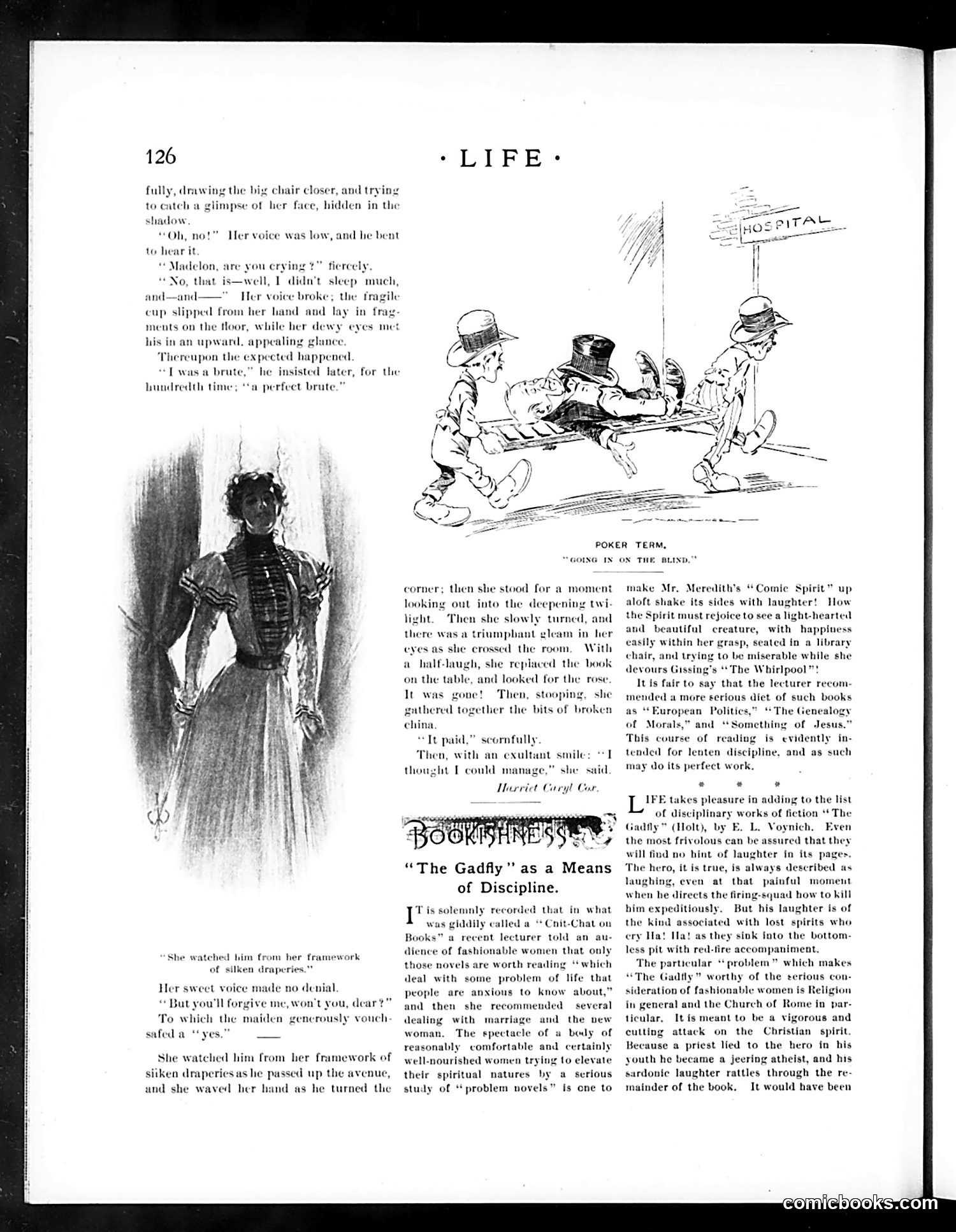
The page contains two distinct elements: **Upper illustration:** A sketch titled "Poker Term: 'Going in on the Blind'" shows four men in hats carrying an injured or unconscious person toward a hospital. This appears to be a visual pun—the poker term "going in blind" (betting without seeing your cards) is illustrated literally with someone being carried to a hospital. **Lower section:** A book review titled "The Gadfly as a Means of Discipline" discusses E. L. Voynich's novel *The Gadfly*. The reviewer praises the book's use of humor and satire as a teaching tool for addressing social problems, particularly criticizing what they call "problem novels" as an overly serious approach to fiction. The page blends humor with literary commentary.
📄 Transcribed text from this page (OCR, searchable)
Machine-transcribed from the original scan — historical spelling and the odd misread are preserved.
126 fully, dmuwing the big chair closer, and trying to catch a glimpse of her face, hidden in the shadow “Oh, not” Her voice was low, and he bent Her ve cup slipped from her hand and lay in frag- ments on the floor, while her dewy his in an upward, appealin ‘Thereupon the expected happened “Twas a brute,” he hundredth time and—and—" yes met a perfeet brute d him fro of silken drap framework Her sweet voice made no denial © But you'll forgive me, won't you, dear” To which the maiden gencrously vouch She watched him from her framework of siiken draperiesas he passed up the avenue, und she waved her hand as he turned the insisted later, for the POKER TERM, “GOING IN ON THE corner; then she stood for a moment looking out into the deepening twi light. Then she slowly turned, and there was a triumphant gleam in her With 1, she replaced the book eyes as she crossed the room a half-laug and looked for the rose. Then, stooping ther the bits of broken ‘on the tabl It was ¢ thered tog chin: “Tt paid,” scornfully. Then, with an exultant smile: “1 one! she thought [could manage,” she said Mhervict Caryl Cor “The Gadfly" as a Means of Discipline. T is solemnly recorded that in what was giddil Chit-Chat on Books” a recent lecturer told dience of fashionable women that onl those novels are worth reading “which deal with some problem of life that people are anxious to know about,” and then she recommended several dealing with marriage and the new woman, The spectacle of a bely of onably comfortable and certainly well-nourished women trying to elevate their spiritual natures by a serious study of “problem novels” is one to an au- BLtxp,”* make Mr. Meredith's “Comic Spirit” up aloft shake its sides with laughter! How the Spirit must rejoice to see a light-hearted and beautiful creature, with happiness easily within her grasp, seated in a library chair, and trying to be miserable while she devours Gissing’s “The Whirlpool”! Itis fair to say that the lecturer recom- mended a more serious diet of such books as “European Politics,” “The Genealogy of Morals,” and “Something of Jesus.” This course of reading is evidently in- tended for lenten discipline, and as such may do its perfect work. . * * IFE takes pleasure in adding to the list of disciplinary works of fiction ** The Gadfly” (Holt), by E. L, Voynich. Evi the most frivolous can be assured that they will find no hint of laughter in its pages. The hero, it is true, is always described as laughing, even at that painful moment when he directs the firing-squad bow to kill him expeditiously. But his laughter is of the kind associated with lost spirits who ery Hat Ha! as they sink into the bottom- less pit with red-fire accompaniment. The particular * problem” which makes “The Gadfly” worthy of the serious con- sideration of fashionable women is Religion in general and the Church of Rome in par- ticular, It is meant to be a vigorous and cutting attack on the Christian spirit. Because a priest lied to the hero in his youth he became a jeering atheist, and his sardonic laughter rattles through the re- mainder of the book, It would have been