
A complete issue · 20 pages · 1898
Life — January 6, 1898
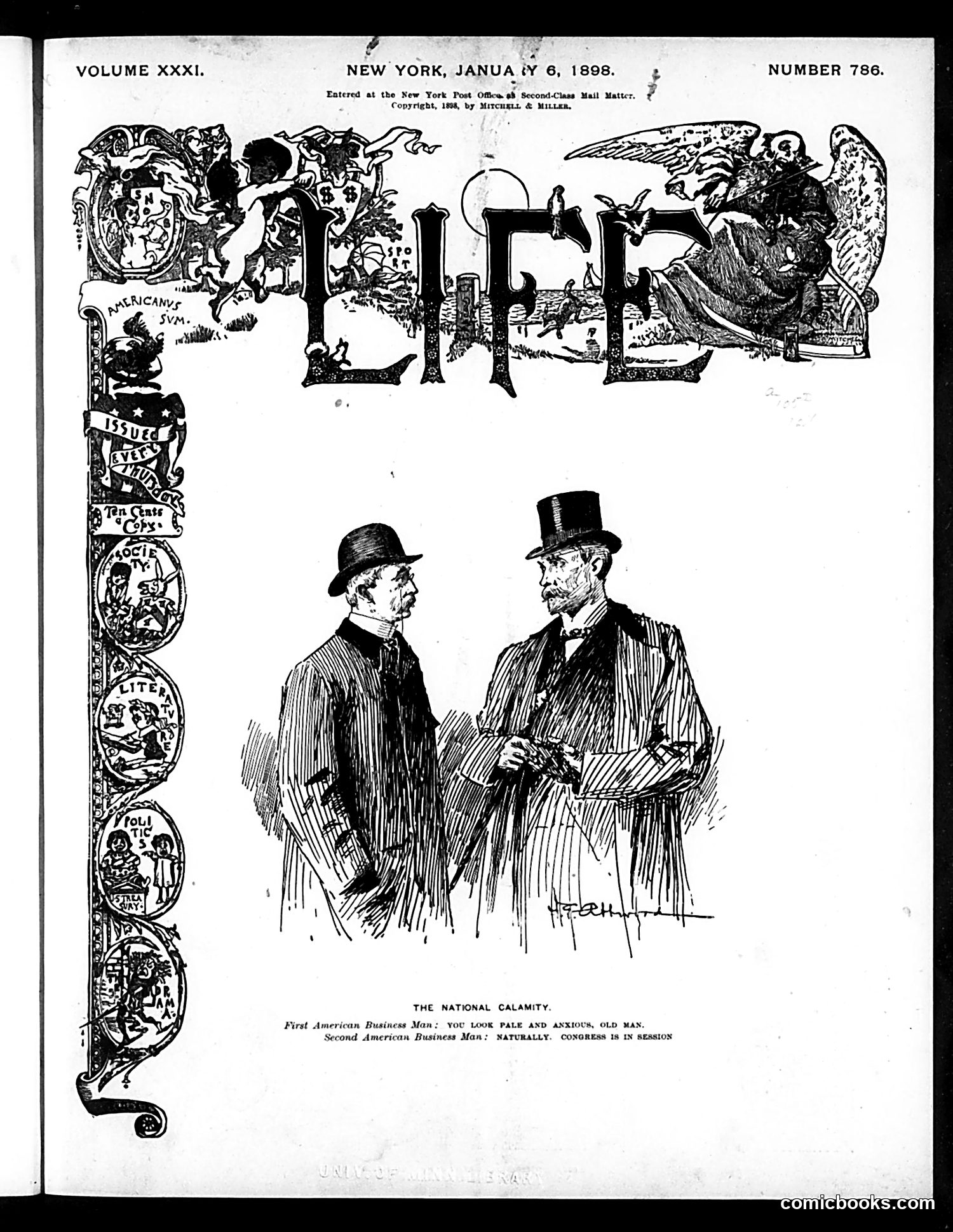
This Life magazine cover from January 6, 1898, presents a political cartoon satirizing Congress during what the caption labels "The National Calamity." The cartoon depicts two well-dressed businessmen in conversation. The first (labeled "First American Business Man") appears anxious, while the second responds that he naturally expects this situation because "Congress is in session." The satire suggests that Congress itself represents a calamity or disaster for American business interests. This reflects late-19th-century attitudes among wealthy industrialists and their sympathizers who viewed legislative activity—particularly regulatory efforts or taxation—as economically harmful. The joke assumes readers shared this perspective that congressional activity inherently threatened business prosperity.
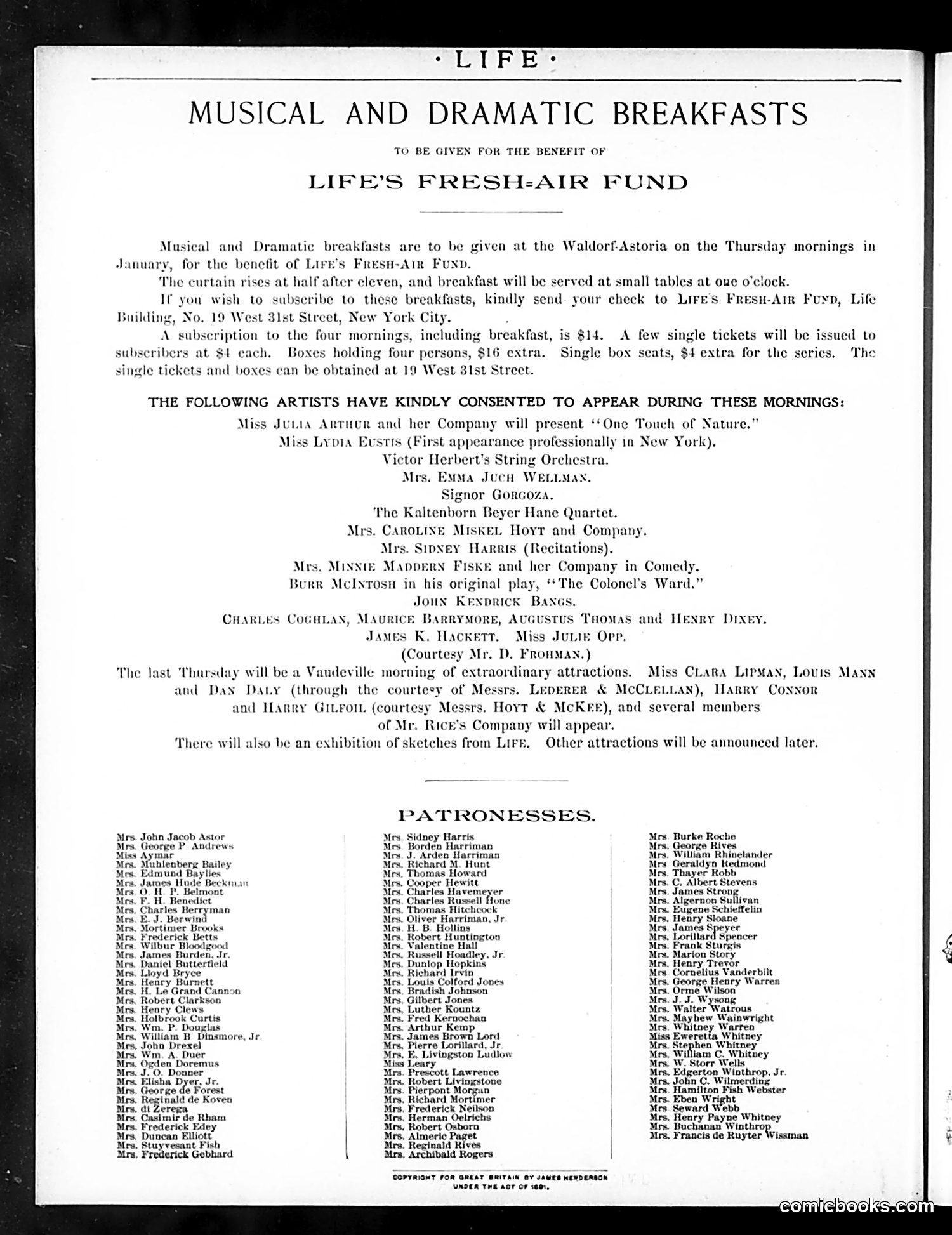
This page contains no cartoon or satirical content. It's a straightforward advertisement and announcement for "Musical and Dramatic Breakfasts" to benefit Life's Fresh-Air Fund—a charitable organization providing outdoor recreation for underprivileged children. The notice describes four Thursday morning events at the Waldorf-Astoria hotel in January, featuring performances by notable entertainers of the era (Julia Arthur, Victor Herbert's Orchestra, and others). Subscription costs $14 for all four breakfasts, with single tickets available. Below is a list of "Patronesses"—wealthy, socially prominent women whose names lent prestige to the fundraiser. This was typical early-20th-century charity work: combining entertainment with elite patronage to raise money for social welfare causes.
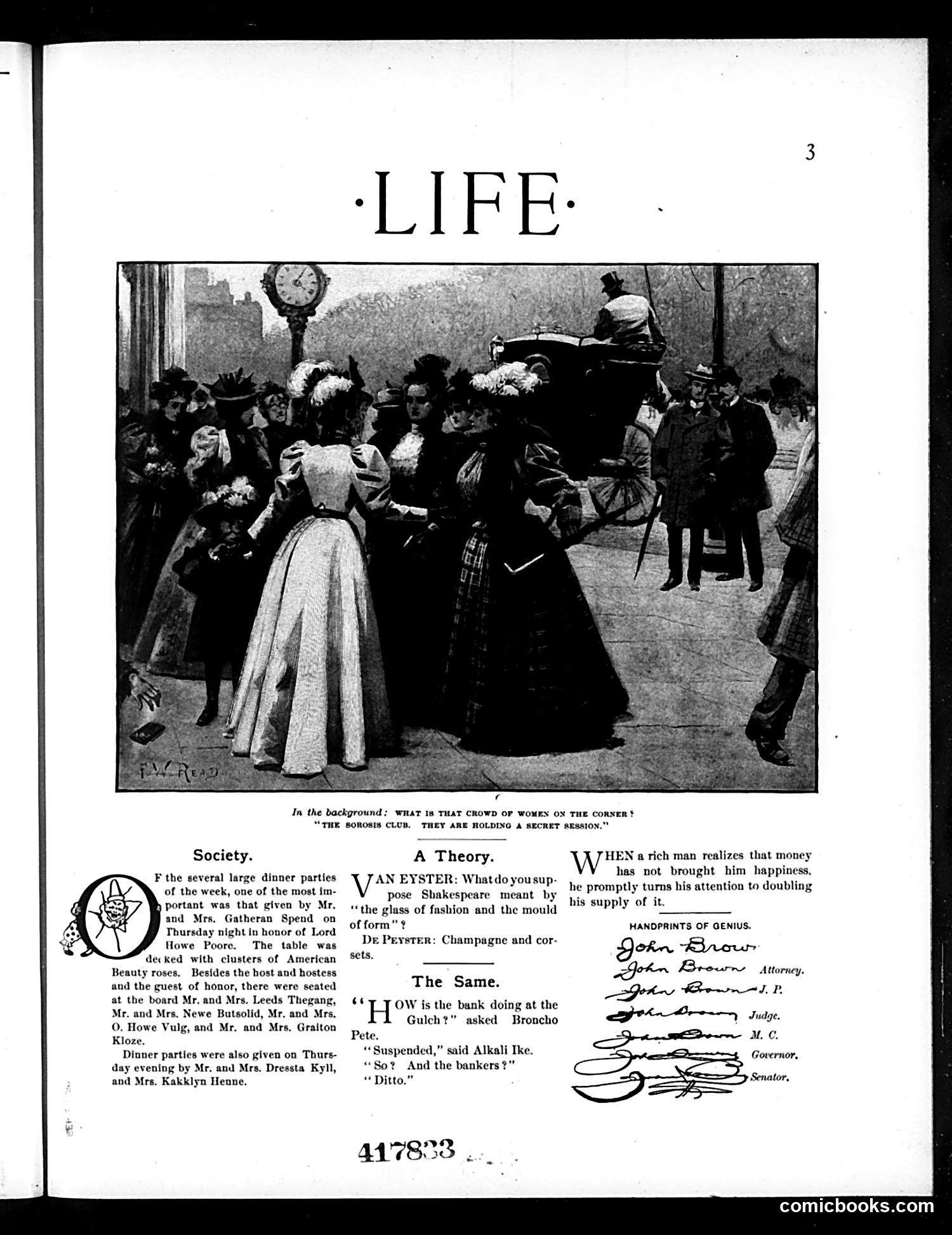
The main illustration depicts a street scene with well-dressed women in elaborate Edwardian-era clothing (large hats, corseted dresses) gathered around what appears to be a carriage or street corner. The caption references "The Robins Club" holding a "secret session," suggesting this satirizes a real women's social organization. The page includes three humor sections: "Society" (noting dinner parties), "A Theory" (Van Eyster and Dr. Peyster debating Shakespeare's "glass of fashion"), and "The Same" (a brief joke about bankers being "suspended" like banks during financial crisis—likely referencing economic instability of the era). The overall tone mocks upper-class women's social clubs and contemporary financial anxiety.
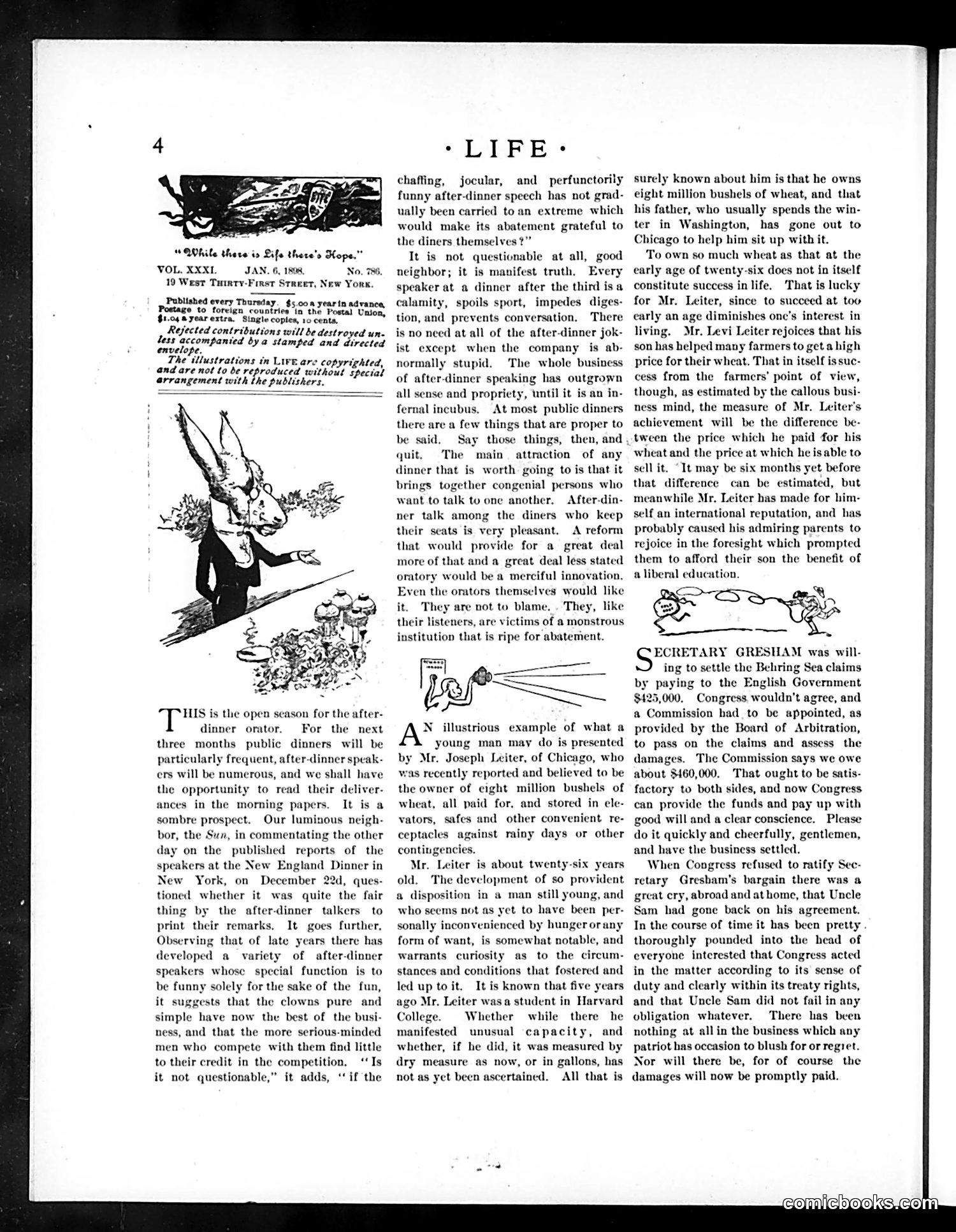
This page critiques **after-dinner speakers** as a social institution. The left cartoon depicts a speaker as an absurd figure—wild-haired, gesticulating dramatically—mocking the theatrical pretensions of dinner orators. The main text argues that after-dinner speaking has devolved into tedious performances where speakers drag on interminably. The author suggests speakers are "victims of a monstrous institution that is ripe for abatement," advocating for reform. The right section shifts to **Secretary Gresham's settlement of Bering Sea claims** with England for $425,000, which Congress disputed. The satirist praises Congress for acting decisively on this international dispute, contrasting decisive governance with the frivolous dinner-speech culture discussed above. The juxtaposition suggests the magazine values substantive political action over empty social performance.
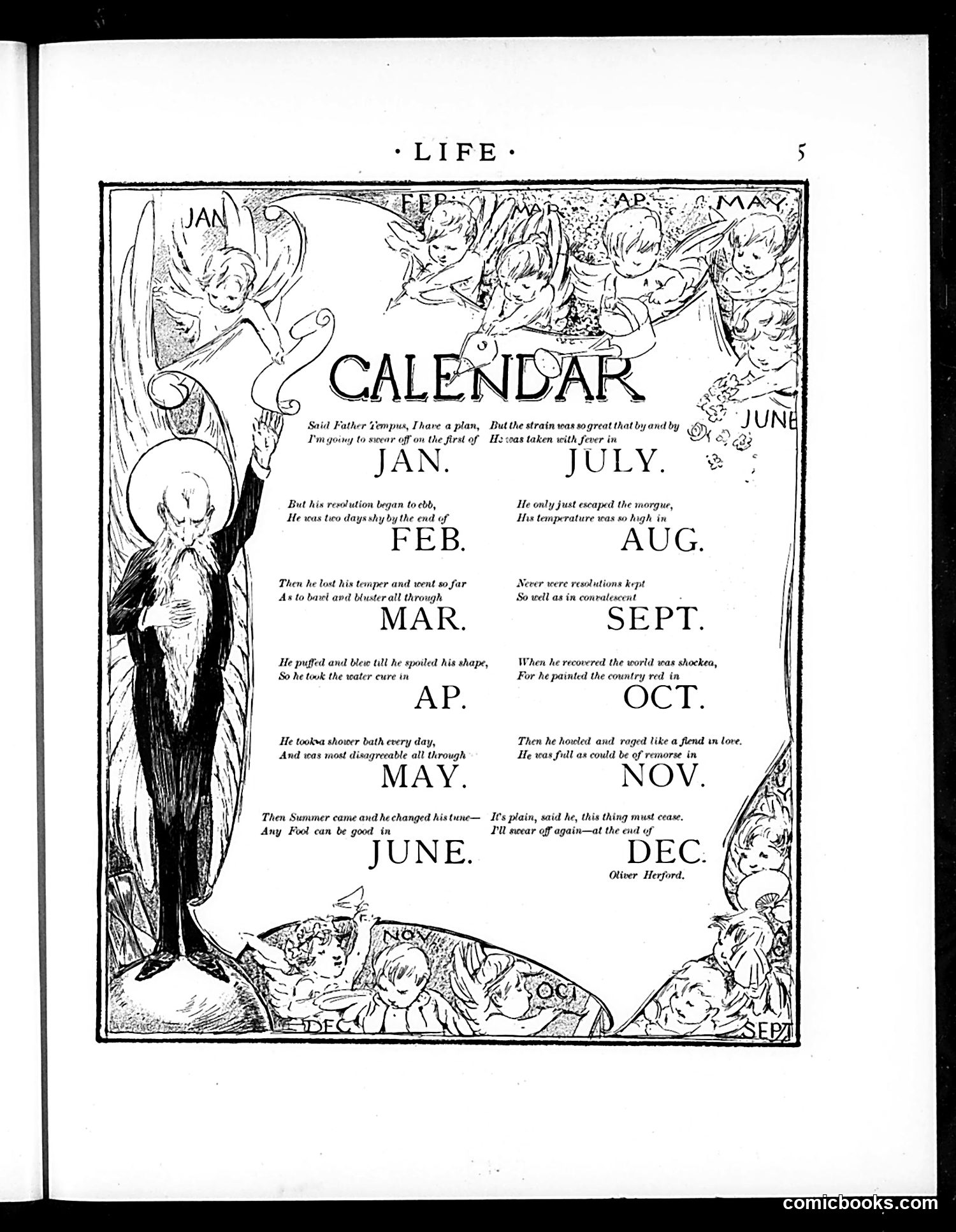
This page presents a allegorical calendar where a bearded old man (representing Father Time or the year itself) experiences monthly trials. The accompanying verses describe progressively worsening conditions: strain in January, lost temper by February, loss of shape by March, water cure in April, disagreeable behavior through May, and by summer, a fundamental change occurs. The narrative arc suggests commentary on a year of national crisis or conflict—likely World War I, given the references to fever, morgues, painted country "red" (bloodshed), and eventually the nation recovering from shock. The decorative cherubs and seasonal imagery frame this serious political message within an artistic, almost whimsical design typical of Life's satirical approach.
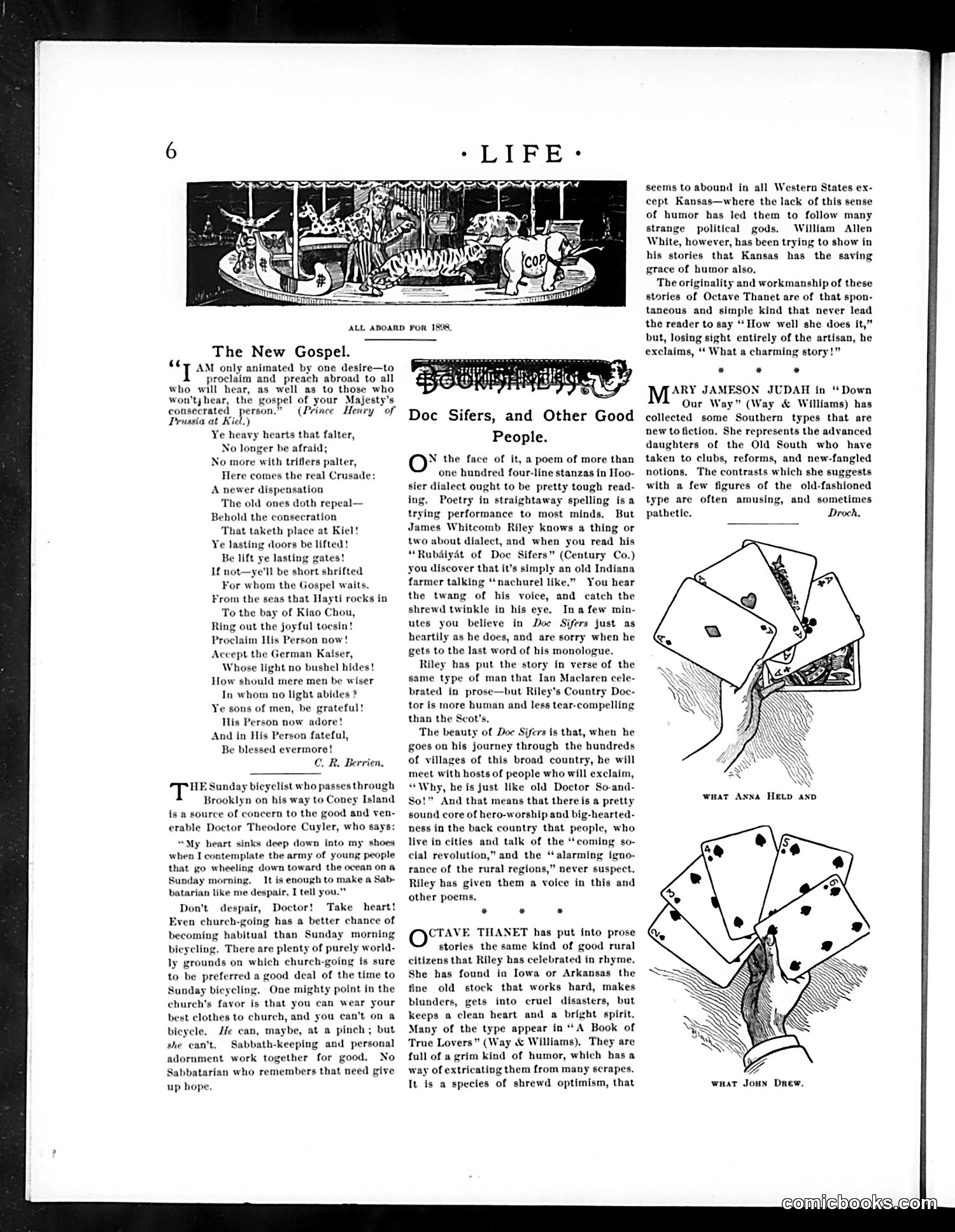
The top cartoon depicts a crowded carousel or merry-go-round labeled "ALL ABOARD FOR 1898," showing various figures and animals in apparent chaos. Based on the historical date and Life's satirical nature, this likely comments on American politics and society entering 1898—a year marked by the Spanish-American War and significant domestic debates. The accompanying text discusses literary works by Octave Thanet, James Whitcomb Riley, and others, praising their "good rural citizens" characters. The page critiques how these authors portrayed American heartland life with humor and authenticity, contrasting this with the "alarming ignorance of the rural region" among city dwellers. Without clearer visual identification of specific figures in the carousel, the exact political targets remain unclear, though the seasonal transition satirizes contemporary American society.
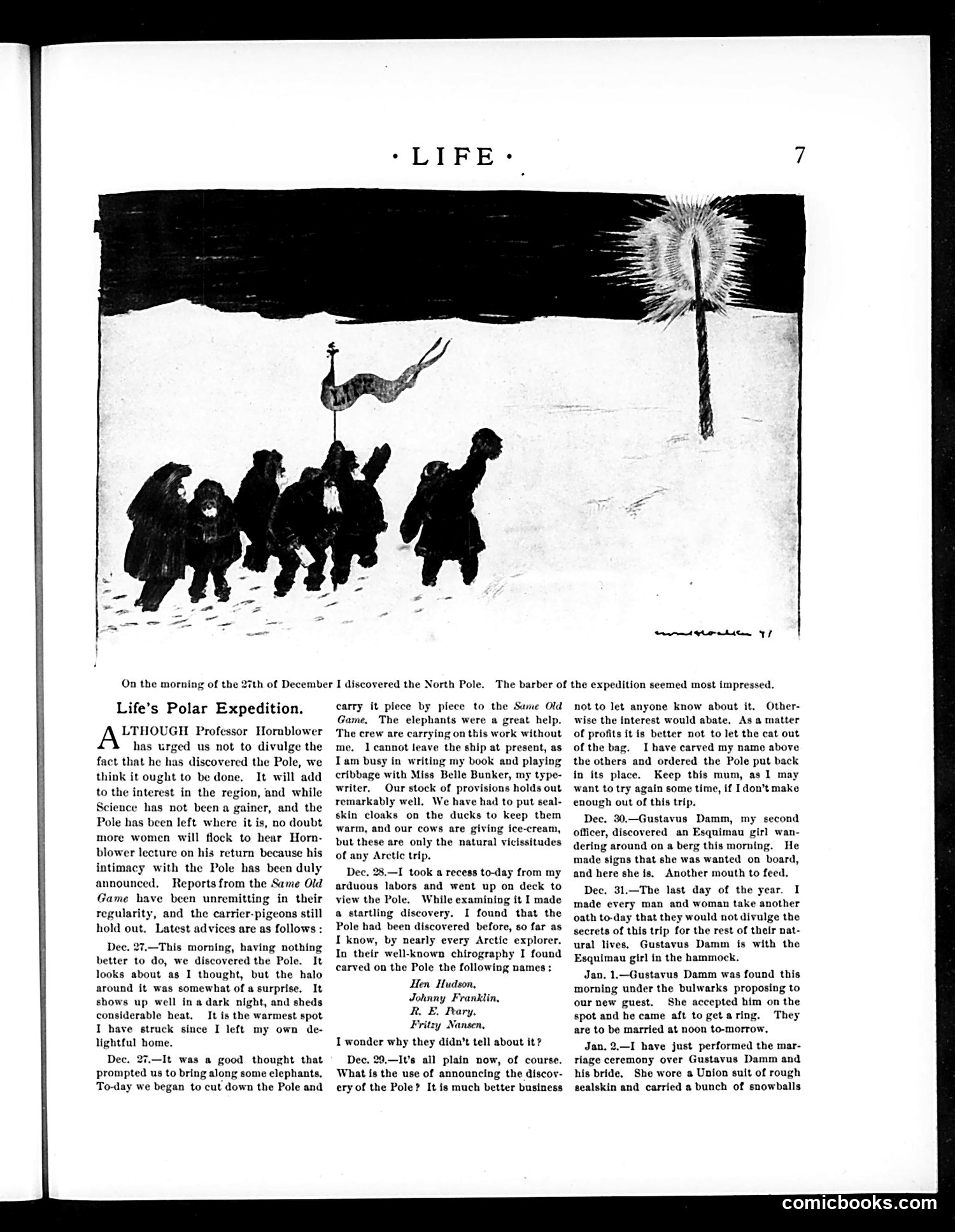
This is a humorous fake-expedition narrative mocking Professor Horablower's claim to have discovered the North Pole. The accompanying illustration shows a group traveling across snowy terrain toward a pole with a flag. The satire works on multiple levels: Life magazine questions the credibility of polar discovery claims (this references real contemporary polar exploration controversies). The text includes absurd details—elephants helping with the journey, provisions including ice cream for cows—designed to parody expedition journals. The narrative voice expresses skepticism about why major explorers supposedly "didn't tell about it" before, suggesting the discovery claim is fabricated or exaggerated for publicity. This mocks both the explorer and media sensationalism around polar achievement during this era of intense exploration competition.
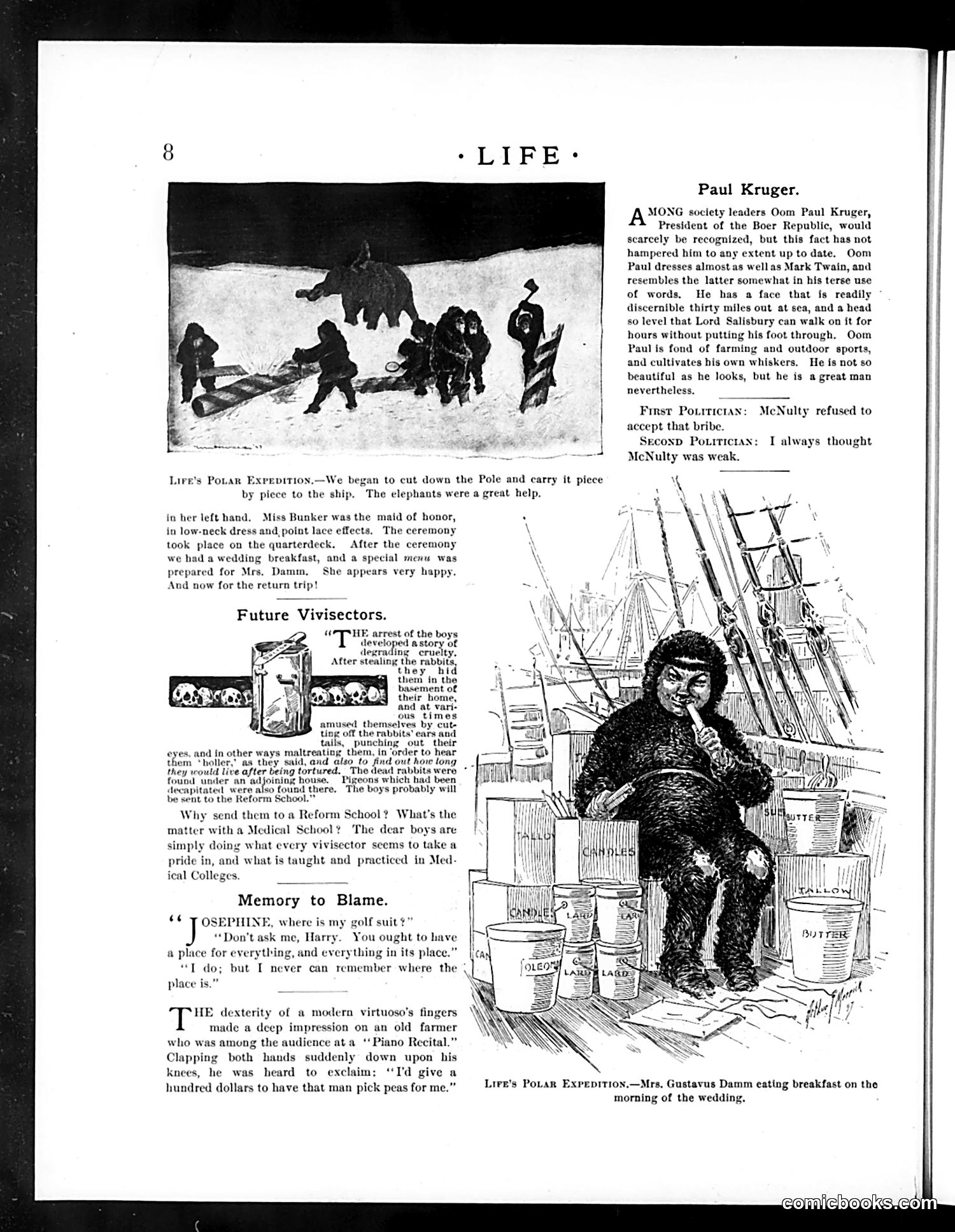
This page contains several distinct items: **Paul Kruger portrait and text**: A biographical piece on Oom Paul Kruger, President of the Boer Republic, describing his physical appearance and character. The accompanying anecdote about "McNulty" appears to be political humor regarding Boer leadership. **"Life's Polar Expedition"**: Two illustrations showing an Arctic expedition narrative—one depicting figures with a dog sled cutting down the pole, another showing a woman (Mrs. Gustavus Damm) eating breakfast aboard ship after a wedding ceremony. **"Future Vivisectors"** and **"Memory to Blame"**: Satirical pieces mocking medical school practices and a pianist's pretentious behavior respectively. The page combines travel reporting, social satire, and humorous anecdotes typical of Life magazine's eclectic Victorian-era editorial approach. The specific historical context of the Boer Republic reference suggests early 1900s dating.
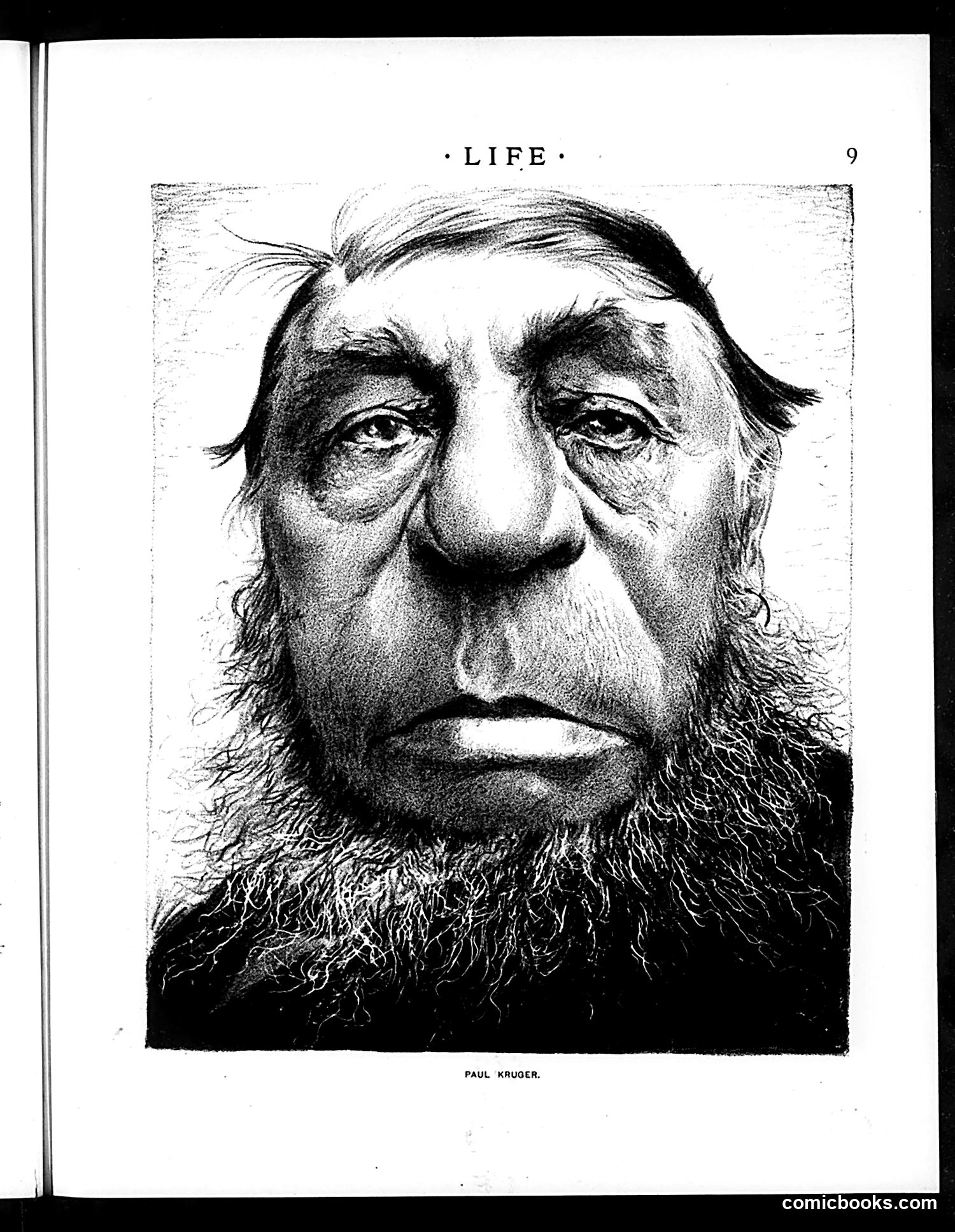
This page from *Life* magazine features a portrait labeled "PAUL KRUGER" — likely Paul Kruger, the Boer leader and president of the South African Republic during the Second Boer War (1899-1902). The detailed engraving emphasizes his distinctive appearance: full beard, weathered features, and stern expression. The artistic style suggests this is a serious portrait rather than comedic caricature, though *Life*'s satirical context implies commentary on Kruger himself. Given the publication's timing and American political climate, this likely relates to debates over the Boer War, British imperialism, or American foreign policy positions regarding the conflict. The portrait's prominence suggests Kruger was a significant figure in contemporary political discussion among *Life*'s educated readership.
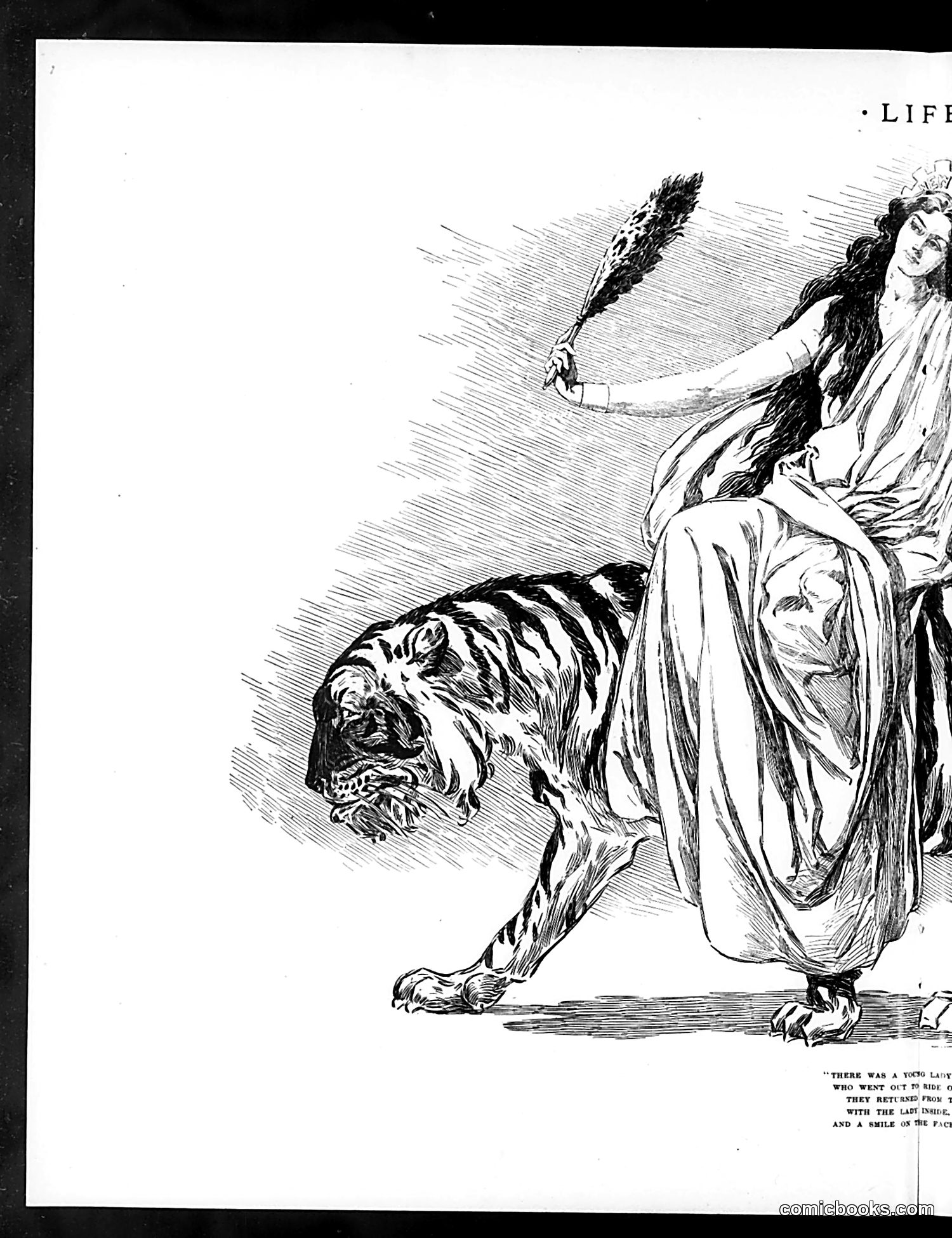
This illustration from *Life* magazine shows a classical female allegorical figure (possibly representing Lady Liberty or Justice, given her flowing robes and classical pose) wielding what appears to be a feather duster while confronting a tiger. The caption (partially legible) references "a young lady who went out to ride" and mentions they "returned from" something "with the last ounce" and "a smile on her face." The satire likely comments on a contemporary news event involving danger or threat—the tiger suggesting something fierce or predatory. The woman's composed, almost dismissive pose with the feather duster (rather than a weapon) appears to mock either underestimating a serious threat or mocking someone's trivial response to real danger. Without the complete caption or historical context, the specific political or social reference remains unclear.
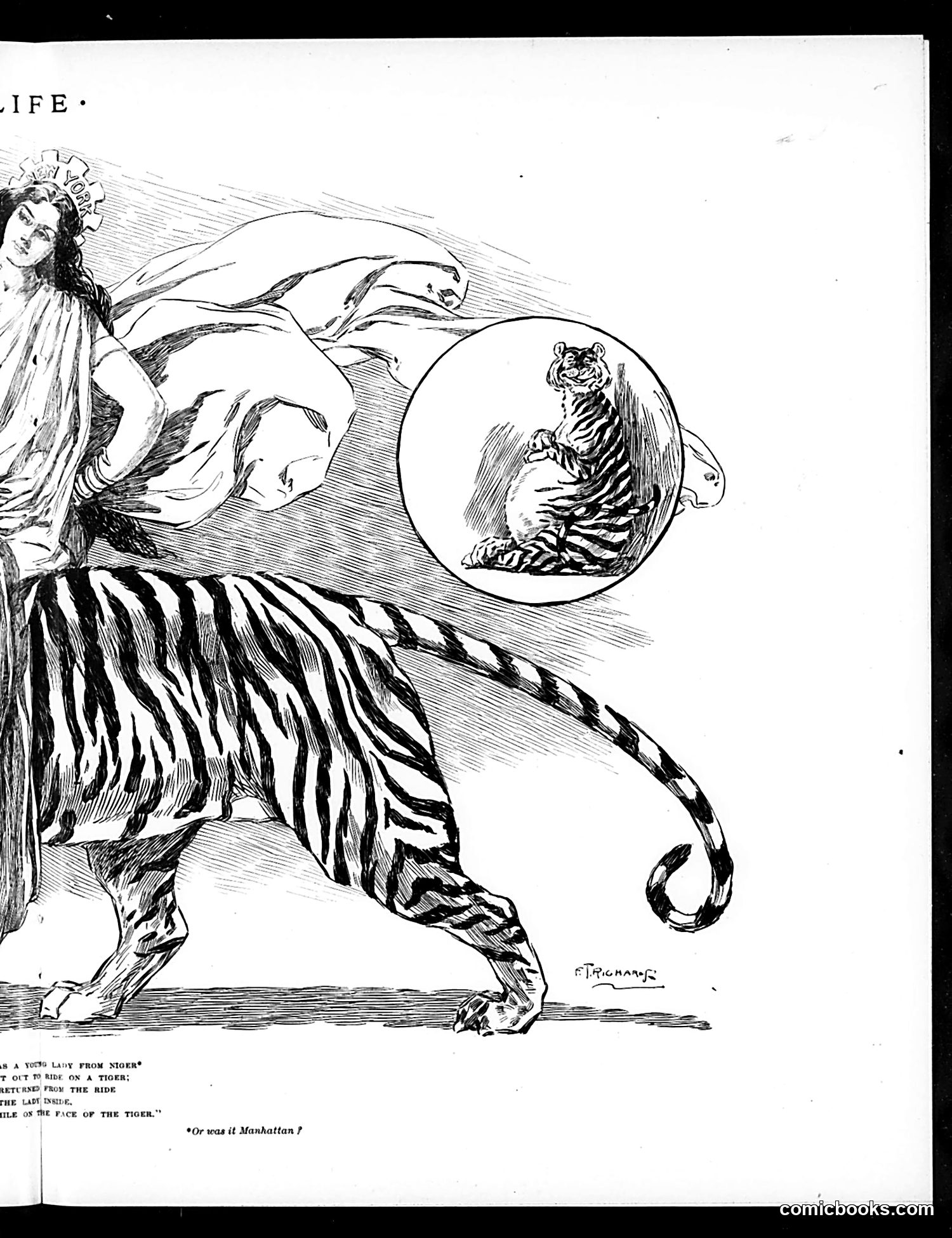
This is a satirical illustration from *Life* magazine showing a woman with a tiger. The partially legible text references "a young lady from Moors," riding on a tiger, with mentions of "the last issue" and "smile on the face of the tiger." The cartoon appears to be a visual joke based on a limerick or poem about a woman and a tiger—likely playing on the dark humor of the limerick form (popular in that era) where the subject typically meets a gruesome end. The woman's elegant dress and composed expression contrast with the tiger's presence, creating ironic tension. The exact historical or political reference remains unclear without additional context, but the satire seems to mock either the woman's naiveté or some contemporary figure/situation through this absurdist scenario.
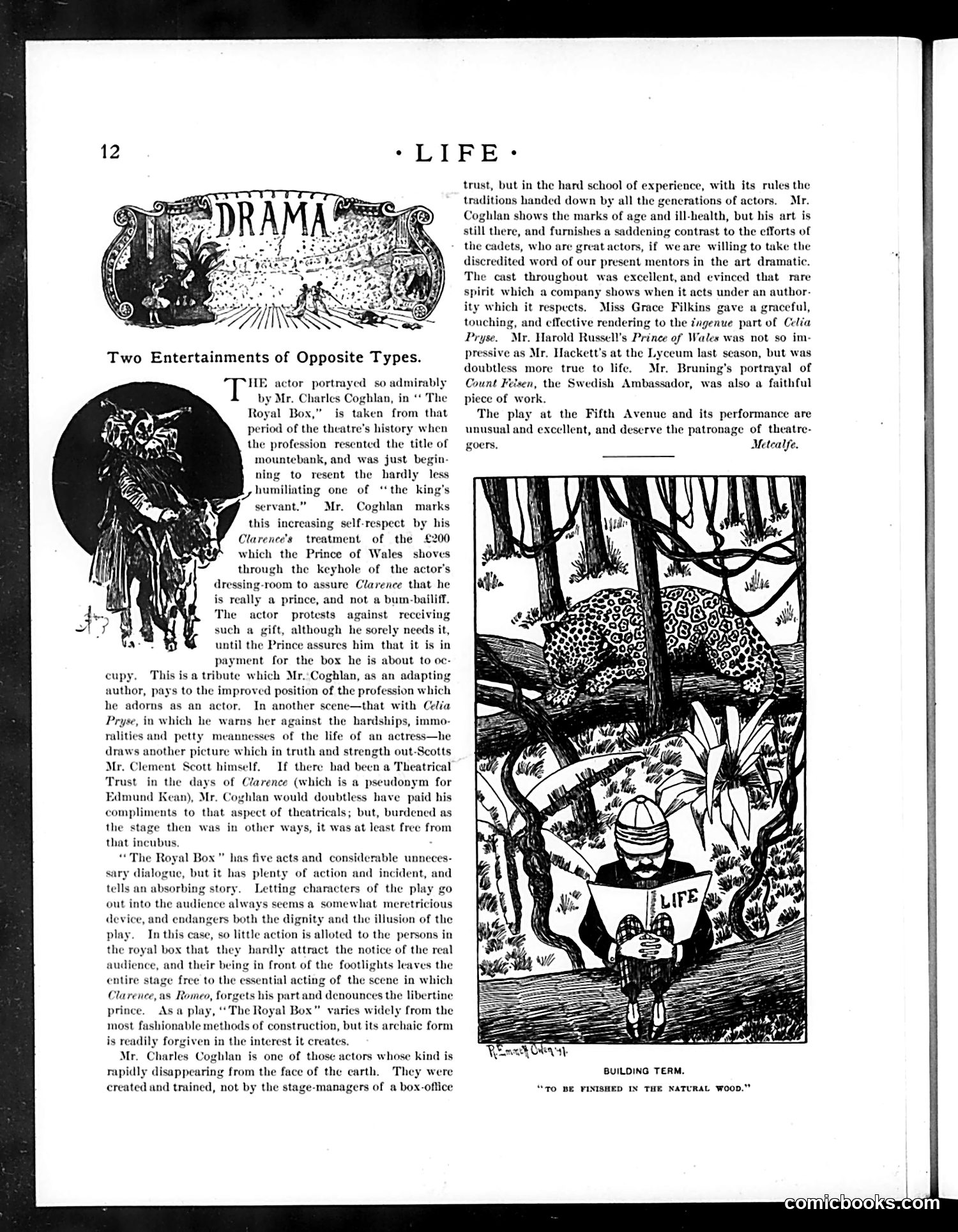
This page reviews theatrical performances, specifically discussing **Charles Coghlan's portrayal in "The Royal Box."** The left illustration shows Coghlan in period costume as a nobleman. The text praises Coghlan's "increasing self-respect" in his acting, noting he's portraying a prince rather than a "bum bailiff." The review examines how "The Royal Box" uses minimal action, instead relying on dialogue and character interaction staged at the front of the stage to avoid cluttering the set. The right illustration appears to be promotional artwork for another production, labeled "Building Term: To Be Finished in the Natural Wood." This is primarily **theater criticism** rather than political satire, evaluating acting techniques and staging methods of the era.
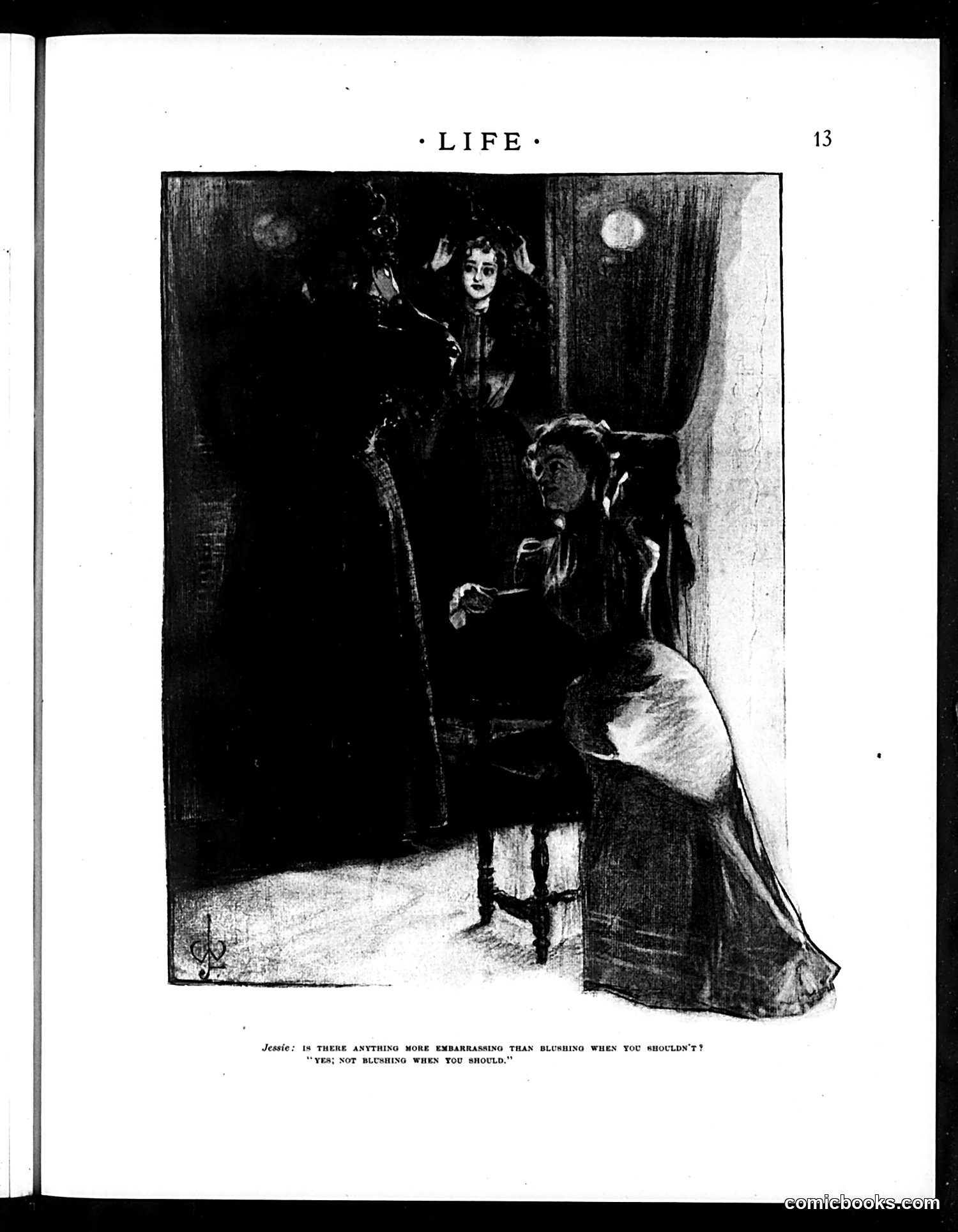
This appears to be a social satire cartoon about propriety and embarrassment. Two figures are shown in what seems to be a formal or social setting—one standing (labeled "Jessie") and another seated. The dialogue presents a humorous paradox about blushing: Jessie complains about the embarrassment of blushing inappropriately, to which the other person responds that *not* blushing when one should is worse. The joke satirizes Victorian-era social expectations around modesty and shame. For young women especially, blushing was considered a sign of proper virtue and sensitivity. The cartoon mocks the impossible double bind of etiquette—you're embarrassed either way. It's social commentary on rigid gender expectations and the artificial emotional performances society demanded.
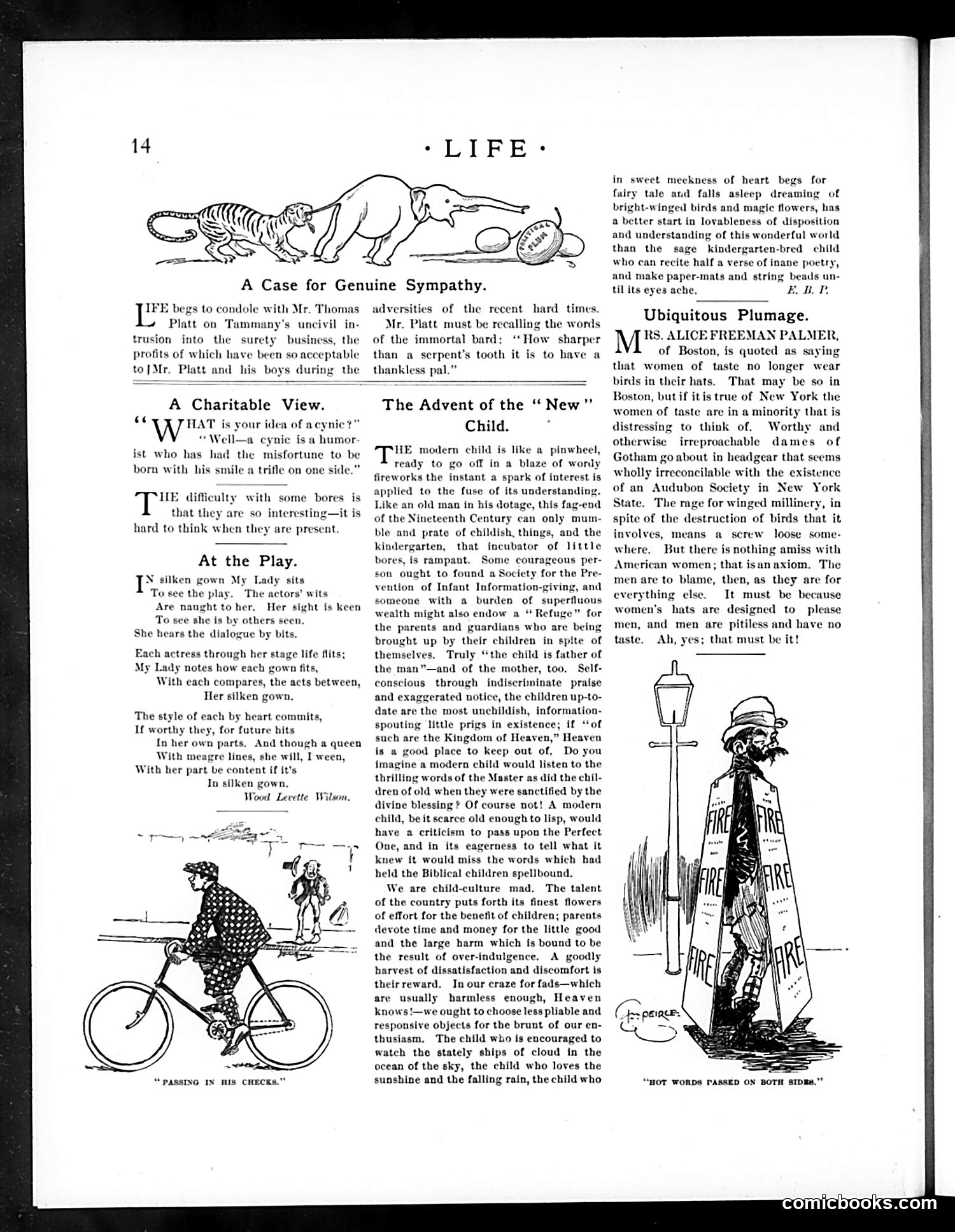
This page contains several satirical pieces typical of early Life magazine's social commentary: **"A Case for Genuine Sympathy"** mocks **Thomas Platt**, a New York Republican politician, for losing profits from his surety business during recent economic hardship—apparently due to Tammany Hall's (the Democratic machine's) interference. The satire suggests Platt deserves no sympathy. **"At the Play"** satirizes wealthy women attending theater solely to display their fashionable gowns rather than watch the performance, indifferent to the actors' work. **"The Advent of the 'New' Child"** criticizes modern over-indulgence of children through excessive education and praise, contrasting them unfavorably with obedient Biblical-era children. The author argues contemporary parenting produces pretentious, information-spouting "prigs" rather than imaginative, naturally curious children. The bicycle illustration captioned "PASSING IN HIS CHECKS" appears unrelated or unclear in context.
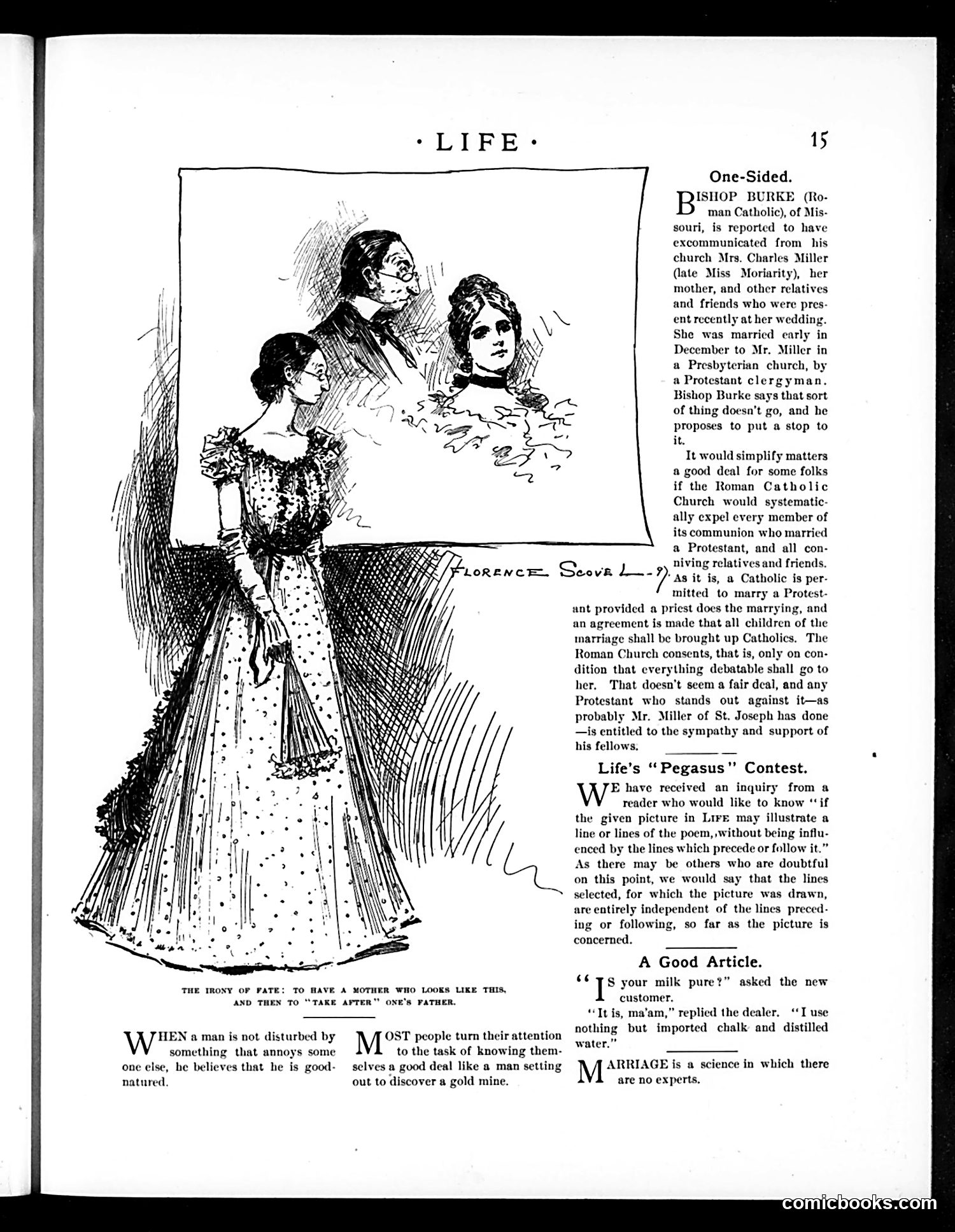
This page contains three distinct items: **Main Cartoon ("The Irony of Fate"):** Shows a fashionable woman with two male relatives. The caption jokes that she inherited her mother's attractive appearance but her father's less desirable traits—a common Victorian-era humor about heredity and family resemblance. **"One-Sided" Editorial:** Critiques Bishop Burke's excommunication of Mrs. Charles Miller for marrying a Protestant in a Presbyterian church. The author argues the Catholic Church's rule is unfair: it permits Catholic-Protestant marriages only if a priest presides and children are raised Catholic, but excommunicates those who don't comply. The piece supports Miller's defiance as justified protest against discriminatory church policy. **Minor Items:** A "Pegasus Contest" explanation (about Life magazine's poetry-illustration feature) and two brief jokes about milk purity and marriage. The page reflects early 20th-century tensions between American religious denominations and debates over institutional religious authority over personal life choices.
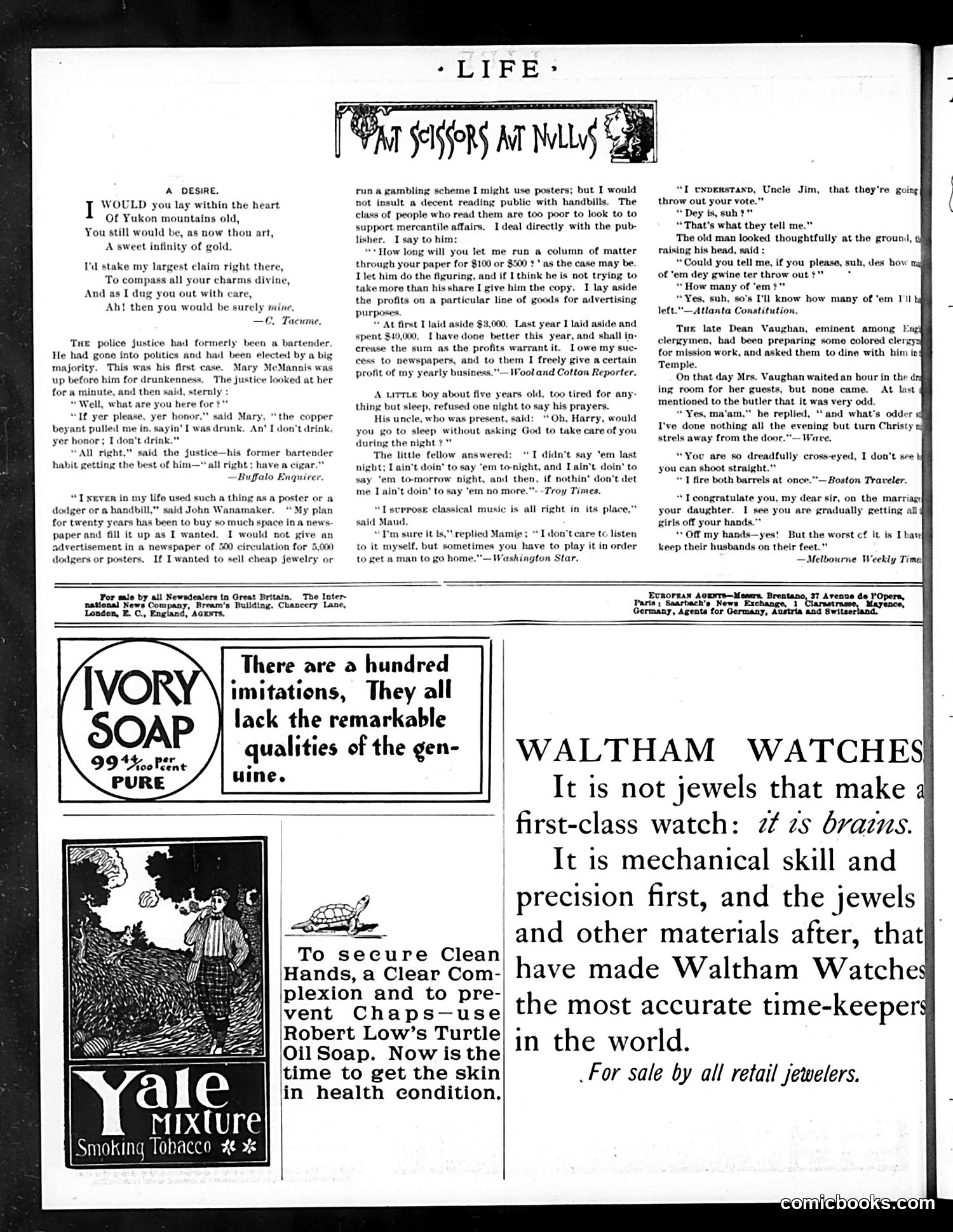
This page combines literary satire with social commentary typical of early Life magazine. **The main content** consists of humorous anecdotes and observations: 1. **Wanamaker's advertising philosophy** — a quote from department store magnate John Wanamaker dismissing posters and handbills as insulting to "decent reading public," claiming he only advertises in newspapers to reach the affluent. This satirizes both his snobbery and self-promotion. 2. **Political cartoon (top)**: "Am Scissors at Nulls" appears to be a pun-based visual joke, though details are unclear from the image. 3. **Social humor** includes anecdotes about a former bartender-turned-judge, a child refusing prayers, and Dean Vaughan's dinner party where Black clergy guests were mistaken for minstrel performers—this last item reflecting the casual racism of the era. The advertisements (Ivory Soap, Yale tobacco, Waltham Watches) are period-typical marketing alongside editorial content, common in Life's format during this era.
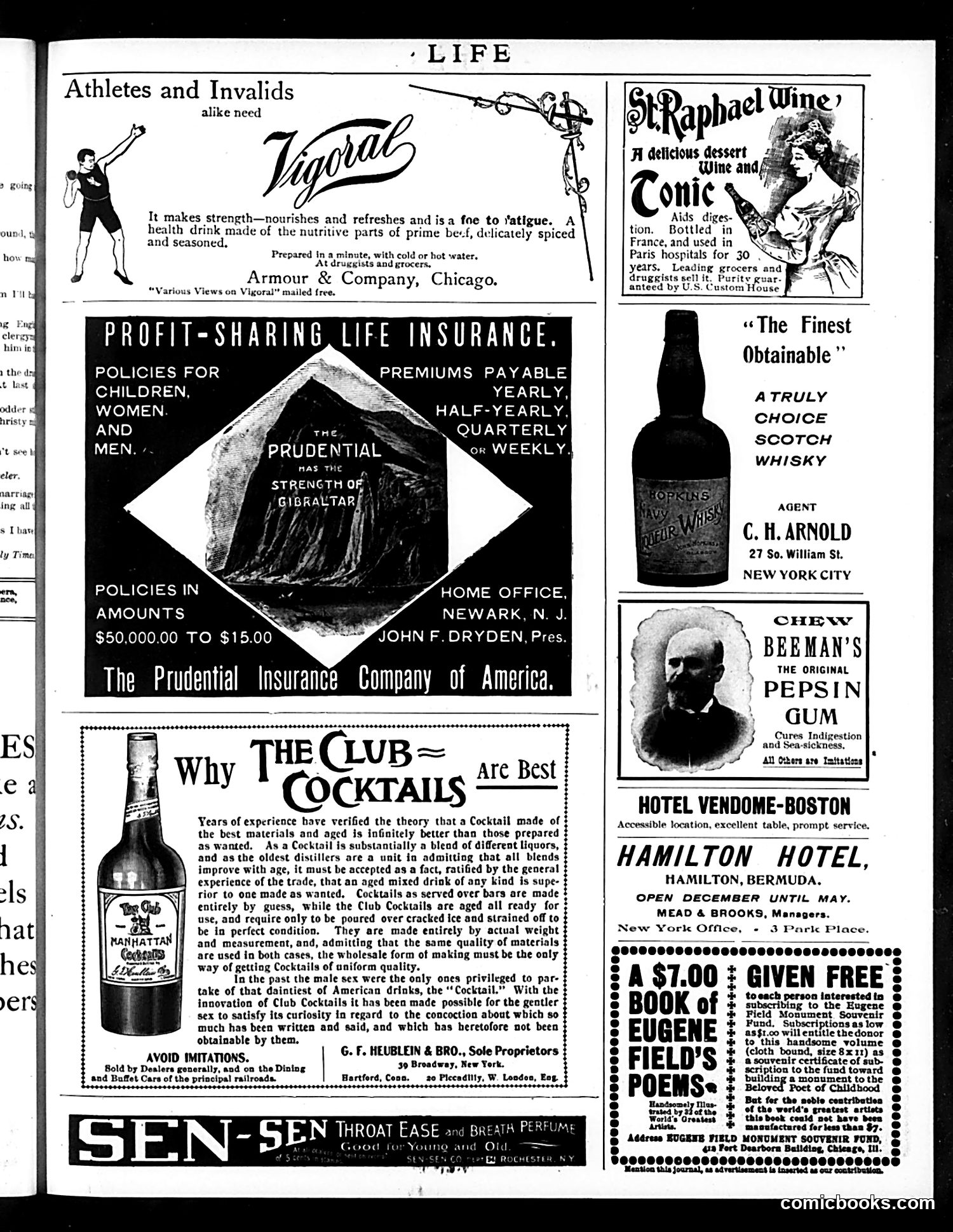
This page is primarily **advertising**, not political satire. It features early 1900s product and service advertisements aimed at the upper and middle classes. The ads promote: - **Vigoral** (beef tonic for "athletes and invalids") - **St. Raphael Wine** (marketed for digestion, used in Paris hospitals) - **Prudential Life Insurance** (profit-sharing policies) - **The Club Cocktails** (pre-made, aged cocktails—notably marketed as newly accessible to women) - **Scotch whisky, pepsin gum, and hotels** The most revealing detail for modern readers is **The Club Cocktails ad**, which explicitly notes that cocktails were previously "the only ones privileged to par-take" by men, but the company has now "made it possible for the gentler sex to satisfy its curiosity." This reflects early 1900s gender norms around alcohol consumption. There is **no political cartoon** on this page. It documents consumer marketing and social attitudes of the era.
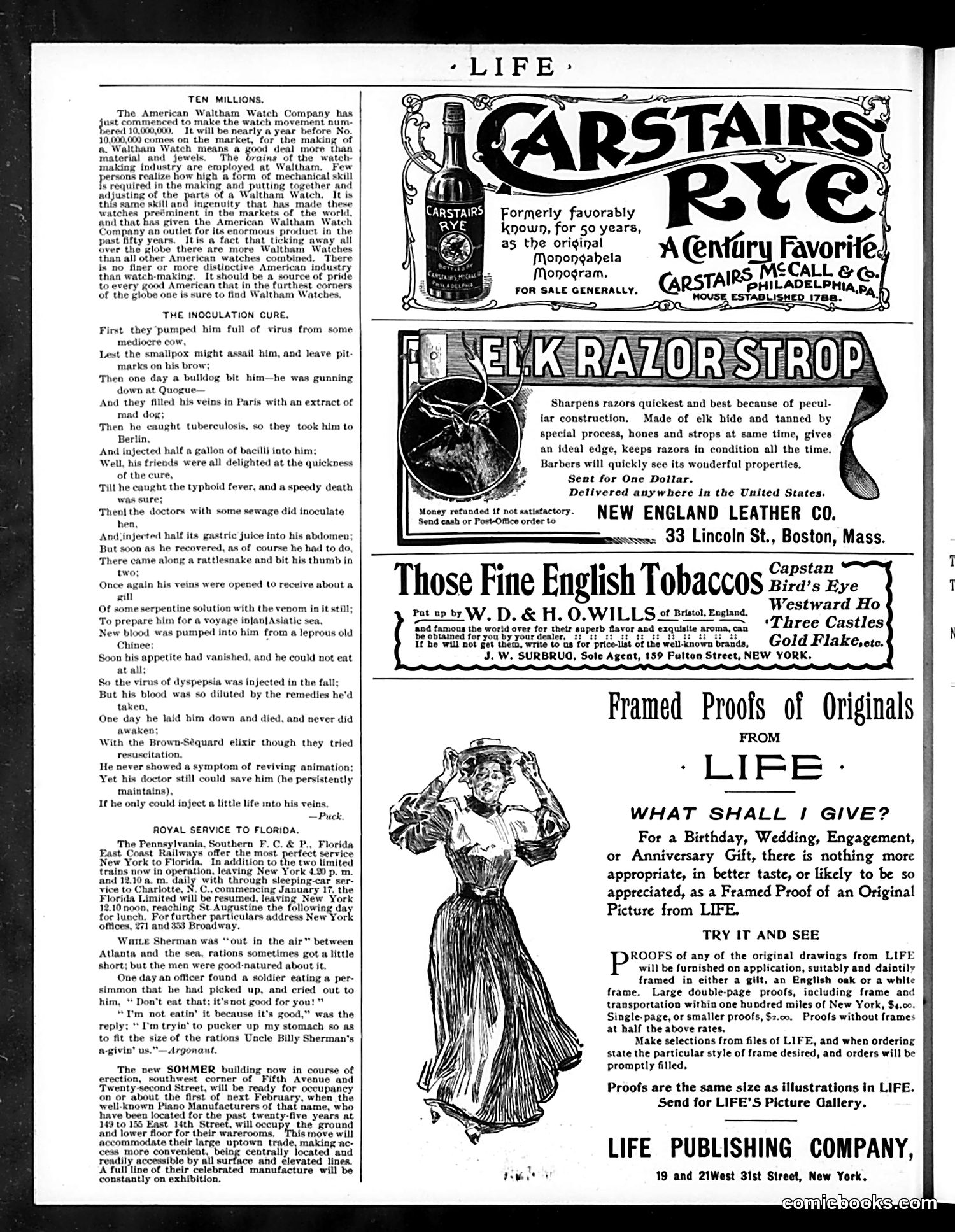
This is primarily an **advertising page** from Life magazine, with one satirical poem. **The Main Content:** The poem "**The Inoculation Cure**" (credited to Puck) satirizes the era's medical fads and over-reliance on inoculation treatments. It describes a hapless patient who survives various inoculations (smallpox vaccine, rabies extract, tuberculosis bacilli, typhoid sewage, rattlesnake venom, and blood from a leprous Chinese man), only to die anyway—yet his doctor insists he could have been saved "if he only could inject a little life into his veins." **The Satire's Point:** The poem mocks the indiscriminate faith in inoculation as a medical cure-all, suggesting doctors were recklessly injecting patients with increasingly bizarre substances without understanding consequences. The absurdist escalation (cow virus → dog extract → human sewage) emphasizes the irrationality. **Historical Context:** This reflects late 19th/early 20th-century skepticism about germ theory and vaccination practices before rigorous medical standards were established. The remainder of the page contains advertisements for watches, razors, tobacco, and Life's framed picture reproductions.
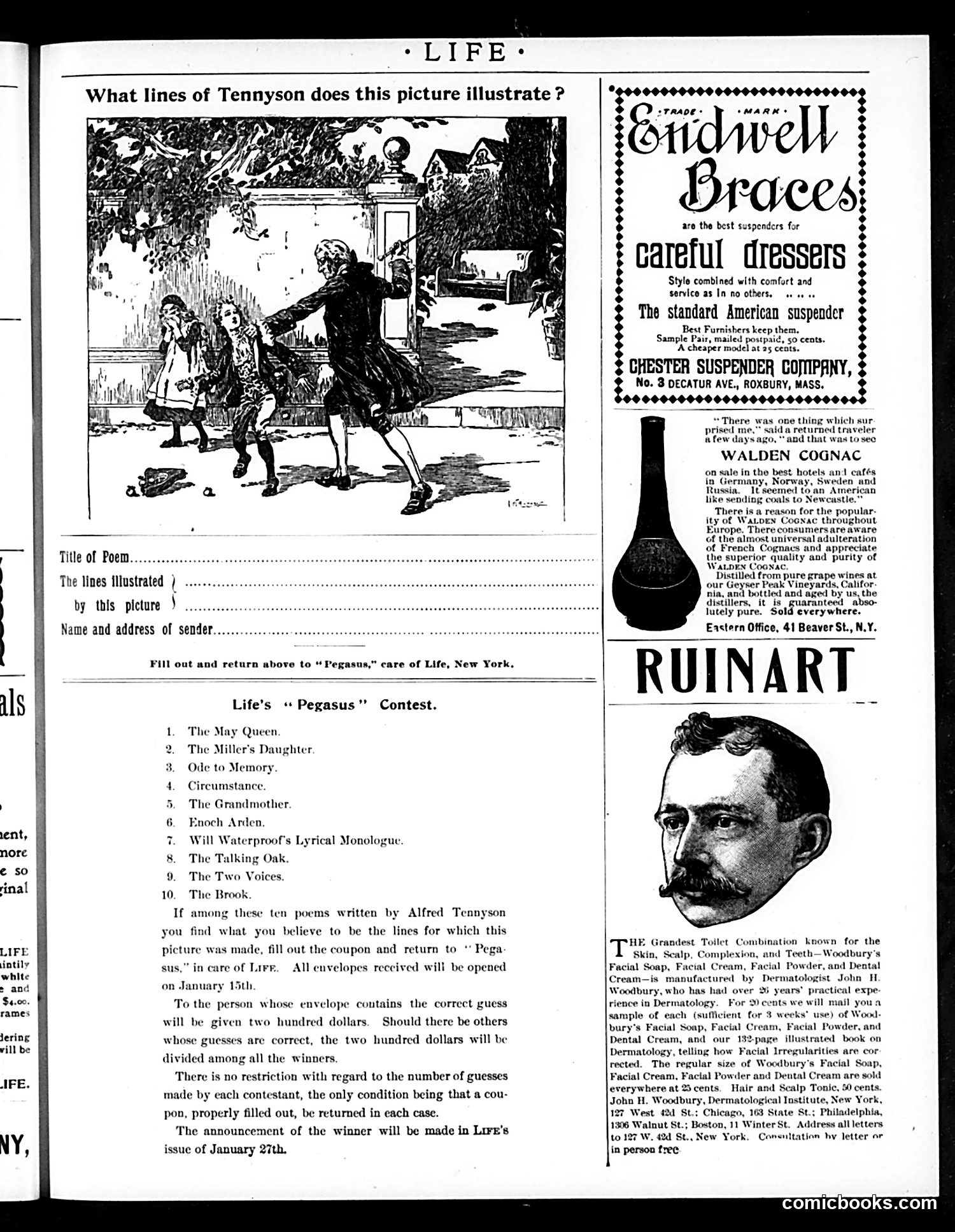
This page features a **literary contest**, not political satire. *Life* magazine presents an illustration and asks readers to identify which poem by Alfred Tennyson it depicts. The image shows an adult gesturing toward children in what appears to be a garden or outdoor setting—a domestic, Victorian scene typical of Tennyson's narrative poetry. Readers must select from ten Tennyson poems listed (including "The May Queen," "Enoch Arden," and "The Brook"). The winner receives $200, with prize money split if multiple correct answers arrive. The remainder of the page contains period advertisements: Caldwell Braces suspenders, Walden Cognac brandy, Ruinart champagne, and Woodbury's dermatological toiletries. These ads reflect early-1900s consumer products marketed to middle-class readers.
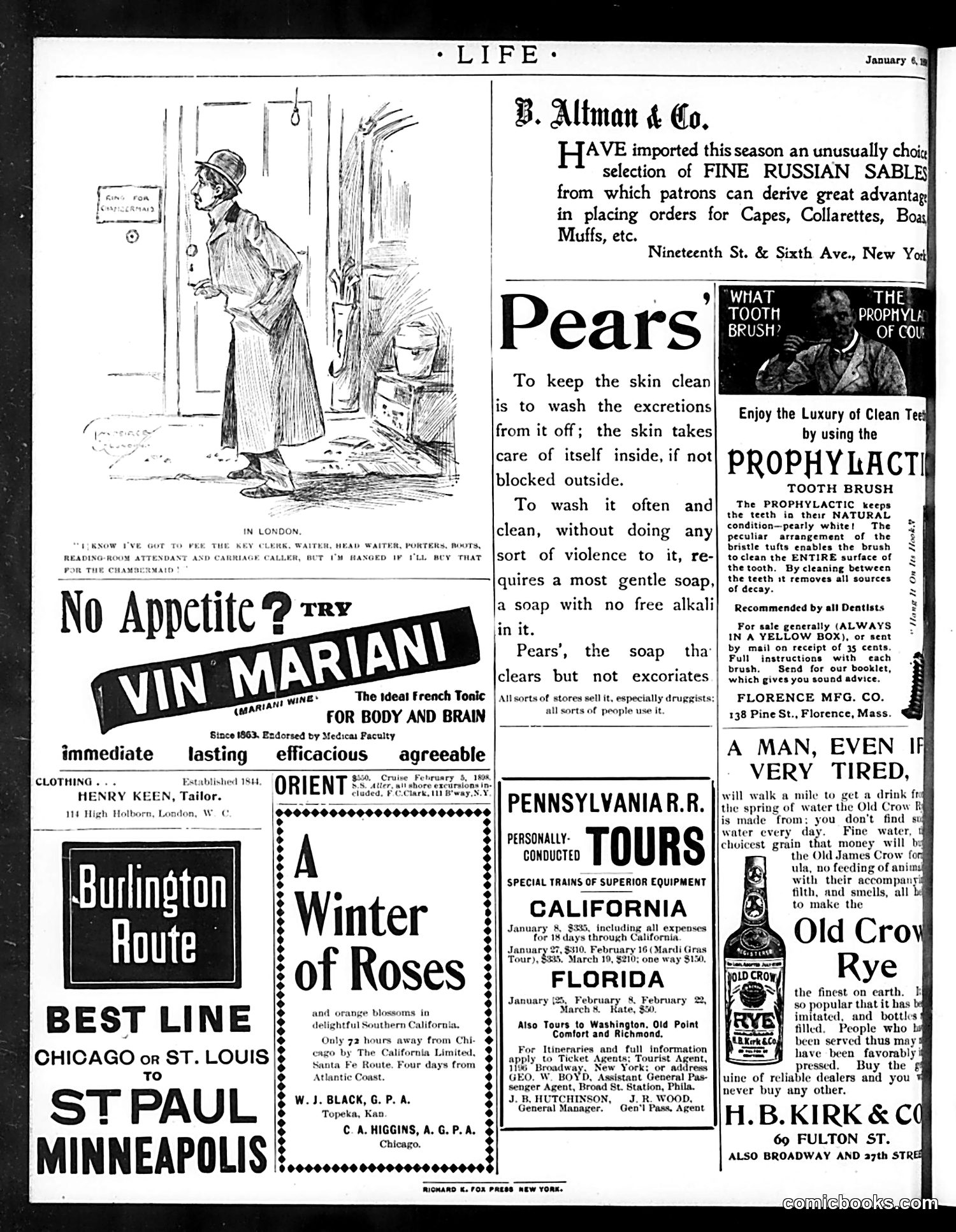
This is primarily an **advertising page** from Life magazine (dated January 6, [year not clearly visible, likely early 1900s]). The page contains mostly commercial advertisements rather than editorial content. The one **cartoon/illustration** shows a domestic servant or maid in London standing near a doorway. The caption references knowing "the key of the tea, waiter, head waiter, porters, boots..." and admits to not having "pee'd the chambermaid"—suggesting this is a satirical jab at the complex servant hierarchy in British households and the servant-employing classes' reliance on domestic staff. The advertisements reflect period consumer goods: Russian sable furs from B. Altman & Co., Vin Mariani tonic wine, Burlington Route trains to the American West, Pears' soap, toothbrushes, and rail tours to California and Florida. These ads target affluent readers who could afford such luxuries. No major political figures or events are referenced on this page.