
Life, 1898-01-06 · page 12 of 20
Life — January 6, 1898 — page 12: what you’re looking at
What you’re looking at
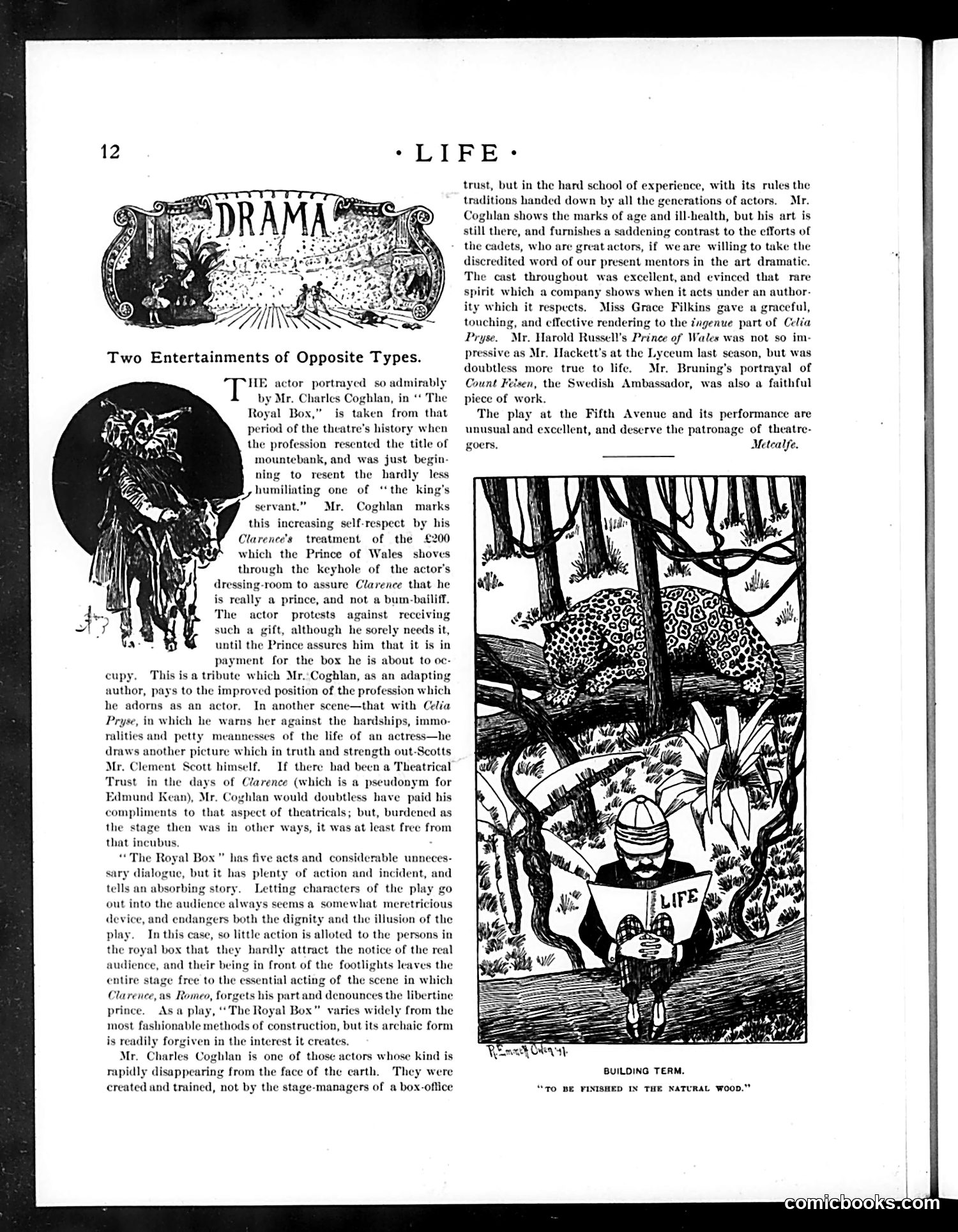
This page reviews theatrical performances, specifically discussing **Charles Coghlan's portrayal in "The Royal Box."** The left illustration shows Coghlan in period costume as a nobleman. The text praises Coghlan's "increasing self-respect" in his acting, noting he's portraying a prince rather than a "bum bailiff." The review examines how "The Royal Box" uses minimal action, instead relying on dialogue and character interaction staged at the front of the stage to avoid cluttering the set. The right illustration appears to be promotional artwork for another production, labeled "Building Term: To Be Finished in the Natural Wood." This is primarily **theater criticism** rather than political satire, evaluating acting techniques and staging methods of the era.
📄 Transcribed text from this page (OCR, searchable)
Machine-transcribed from the original scan — historical spelling and the odd misread are preserved.
* LIFE: Two Entertainments of Opposite Types. TE actor portrayed so admirably by Mr. Charles Coghlan, in ‘* The Royal Box,” is taken from that period of the theatre’s history when the profession resented the title of mountebank, and was just begin- ning to resent the hardly less E, humiliating one of ‘the king’ servant.” Mr. Coghlan marks this increasing self-respect by his Clarence’s treatment of the £200 which the Prince of Wales shoves through the keyhole of the actor's dressing-room to assure Clarence that he is really a prince, and not a bum-bailiff. The actor protests against receiving such a gift, although he sorely needs it, until the Prince assures him that it is in payment for the box he is about to oc- This isa tribute which Mr.Coghlan, as an adapting author, pays to the improved position of the profession which he adorns as an actor, In another scene—that with Celia », in which he warns her against the hardships, immo- and petty meannesses of the life of an actress—he draws another picture which in truth and strength out-Scotts Mr. Clement Scott himself. If there had been a Theatrical Trust in the days of Clarence (which is a pseudonym for Edmund Kean), Mr. Coghlan would doubtless have paid his compliments to that aspect of theatricals; but, burdened as the stage then was in other ways, it was at least free from that incubus, a) tress cupy. “The Royal Box” has five acts and considerable unneces- sary dialogue, but it has plenty of action and incident, and tells an absorbing story. Letting characters of the pl out into the audience always seems a somewhat meretri device, and endangers both the dignity and the illusion of the play. In this case, so little action is alloted to the persons in the royal box that th hardly attract the notice of the real audience, and their being in front of the footlights leaves the entire stage free to the essential acting of the scene in which Clarence, as Romeo, forgets his part and denounces the libertine prince. Asa play, ‘The Royal Box” varies widely from the most fashionable methods of construction, but its archaic form is readily forgiven in the interest it creates. Mr. Charles Coghlan is one of those actors whose kind is rapidly disappearing from the face of the earth. They were created and trained, not by the stage-managers of a box-oftice trust, but in the hard school of experience, with its rules the traditions handed down by all the gencrations of actor Mr. Coghlan shows the marks of age and ill-health, but his art is still there, and furnishes a saddening contrast to the efforts of the cadets, who are great actors, if we are willing to take the discredited word of our present mentors in the art dramatic. The cast throughout was excellent, and evinced that rare spirit which a company shows when it acts under an author- ity which it respects. Miss Grace Filkins gave a graceful, touching, and effective rendering to the tagenue part of Celia Pryse. Mr. Harold Russell's Prince of Wales was not so im- pressive as Mr. Hackett’s at the Lyceum last son, but was doubtless more true to life. Mr. Bruning’s portrayal of Count Feisen, the Swedish Ambassador, was also a faithful piece of work. The play at the Fifth Avenue and its performance are unusual and excellent, and deserve the patronage of theatre- goers. Metcalfe. BUILDING TERM. “TO BE FINISHED IX THE NATURAL woop.”