
Life, 1898-01-06 · page 6 of 20
Life — January 6, 1898 — page 6: what you’re looking at
What you’re looking at
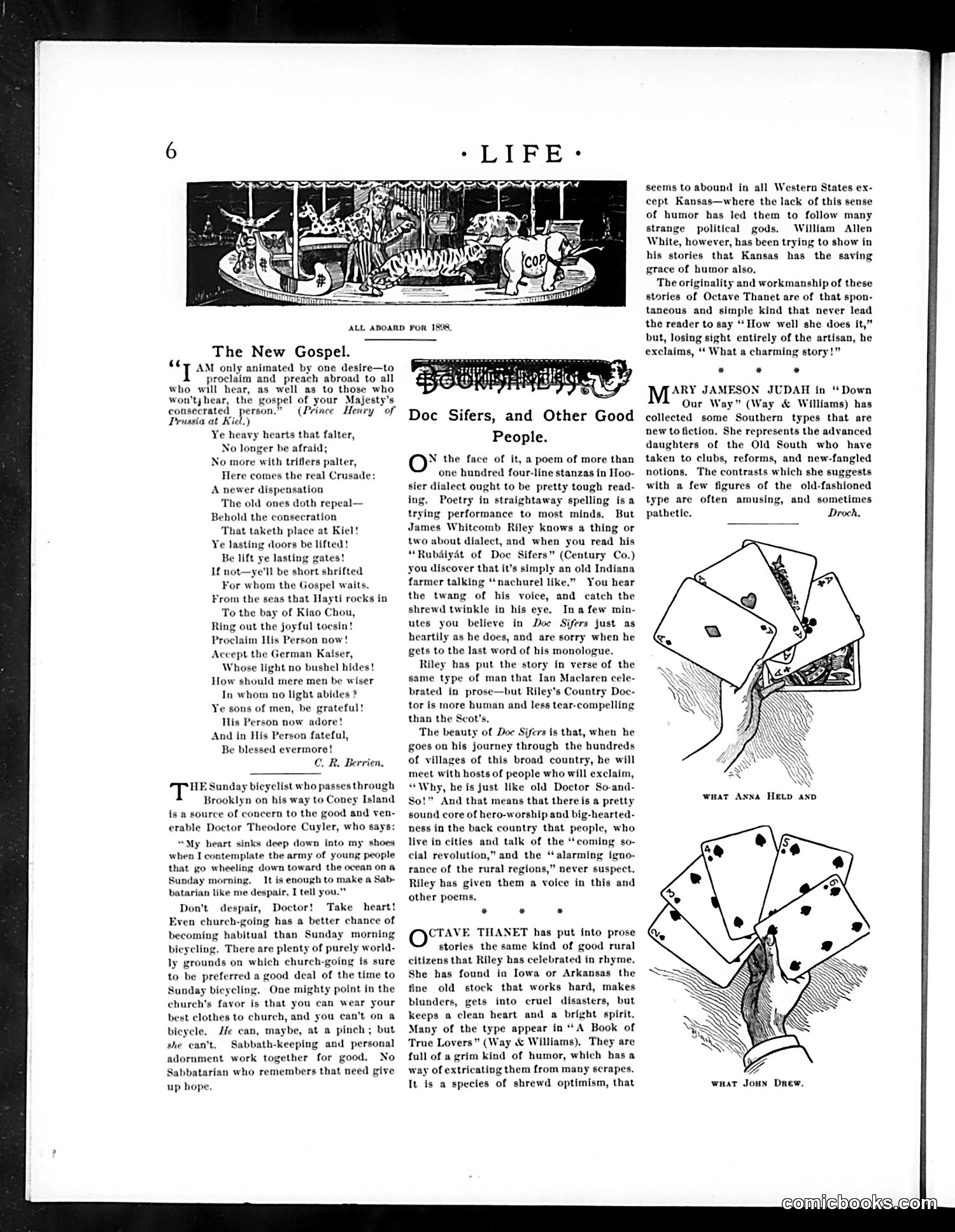
The top cartoon depicts a crowded carousel or merry-go-round labeled "ALL ABOARD FOR 1898," showing various figures and animals in apparent chaos. Based on the historical date and Life's satirical nature, this likely comments on American politics and society entering 1898—a year marked by the Spanish-American War and significant domestic debates. The accompanying text discusses literary works by Octave Thanet, James Whitcomb Riley, and others, praising their "good rural citizens" characters. The page critiques how these authors portrayed American heartland life with humor and authenticity, contrasting this with the "alarming ignorance of the rural region" among city dwellers. Without clearer visual identification of specific figures in the carousel, the exact political targets remain unclear, though the seasonal transition satirizes contemporary American society.
📄 Transcribed text from this page (OCR, searchable)
Machine-transcribed from the original scan — historical spelling and the odd misread are preserved.
ALL ABOARD POR 1898, The New Gospel. AM only animated by one desire—to proclaim and preach abroad to all who will hear, as well as to those who won'tyhear, the gospel of your Majesty's consecrated, person.” (Prince Henry “of Prussia at Kiel.) Ye heavy hearts that falter, No longer be afraid; No more with triflers palter, Here comes the real Crusade: A newer dispensation The old ones doth repeal— Behold the consecration That taketh place at Kiel! Ye lasting doors be lifted! Be lift ye lasting gate: If not—ye'll be short shrifted For whom the Gospel waits. From the seas that Hayti rocks in To the bay of Kiao Chou, Ring out the joyful tocsin! Proclaim His Person now! Accept the German Kaiser, Whose light no bushel hides! How should mere men be wiser In whom no light abides ? Ye sons of men, be grateful! His Person now adore! ‘And in His Person fateful, Be blessed evermore! C. R, Berrien, “ Te Sunday bicyclist who passesthrough Brooklyn on his way to Coney Island is a source of concern to the good and ven- erable Doctor Theodore Cuyler, who says: “My heart sinks deep down into my shoes when I contemplate the army of young people that go wheeling down toward the ocean on & Sunday morning. It is enough to make a Sab- batarian like me despair, I tell you.” Don't despair, Doctor! Take heart! Even church-going has a better chance of becoming habitual than Sunday morning bicycling. There are plenty of purely world- ly grounds on which church-going is sure to be preferred a good deal of the time to Sunday bicycling, One mighty point in the church's favor is that you can wear your best clothes to church, and you can’t on a bicycle. He can, maybe, at a pinch ; but she can't. Sabbath-keeping and personal adornment work together for good. No Sabbatarian who remembers that need give up hope. Doc Sifers, and Other Good People. O* the face of it, a poem of more than one hundred four-line stanzas in Hoo- sier dialect ought to be pretty tough read- ing. Poetry in straightaway spelling isa trying performance to most minds, But James Whitcomb Riley knows a thing or two about dialect, and when you read his “Rubdiyat of Doc Sifers” (Century Co.) you discover that it’s simply an old Indiana farmer talking “nachurel like.” You hear the twang of his voice, and catch the shrewd twinkle in his eye. Ina few min- utes you believe in Doc Sifers just as heartily as be does, and are sorry when he gets to the last word of his monologue. Riley has put the story in verse of the same type of man that Ian Maclaren cele- brated in prose—but Riley's Country Doe- tor is more human and less tear-compelling than the Scot's. The beauty of Doc Sifers is that, when he goes on his journey through the hundreds of villages of this broad country, he will meet with hosts of people who will exclaim, “Why, he is just like old Doctor So-and- So!” And that means that there is a pretty sound core of hero-worship and big-hearted- ness in the back country that people, who live in cities and talk of the ‘coming so- cial revolution,” and the “alarming igno- rance of the rural regions,” never suspect. Riley has given them a voice in this and other poems. . * . CTAVE TIANET has put into prose stories the same kind of good rural citizens that Riley has celebrated in rhyme. She has found in Iowa or Arkansas the fine old stock that works hard, makes blunders, gets into cruel disasters, but keeps a clean heart and a bright spirit. Many of the type appear in “A Book of ‘True Lovers” (Way & Williams), They are full of a grim kind of humor, which has a way of extricating them from many scrapes. It is a species of shrewd optimism, that seems to abound in all Western States ex- cept Kansas—where the lack of this sense of humor has led them to follow many strange political gods. William Allen White, however, has been trying to show in his stories that Kansas has the saving grace of humor also, The originality and workmanship of these stories of Octave Thanet are of that spon- taneous and simple kind that never lead the reader to say ‘‘ How well she does it,” but, losing sight entirely of the artisan, he exclaims, What a charming story!” * * * MA2* JAMESON JUDAH in “Down Our Way” (Way & Williams) has collected some Southern types that are new to fiction. She represents the advanced daughters of the Old South who have taken to clubs, reforms, and new-fangled notions. The contrasts which she suggests with a few figures of the old-fashioned type are often amusing, and sometimes pathetic, Droch, wat Axna Hetp ann wnat Joun Drew.