
Life, 1898-01-06 · page 4 of 20
Life — January 6, 1898 — page 4: what you’re looking at
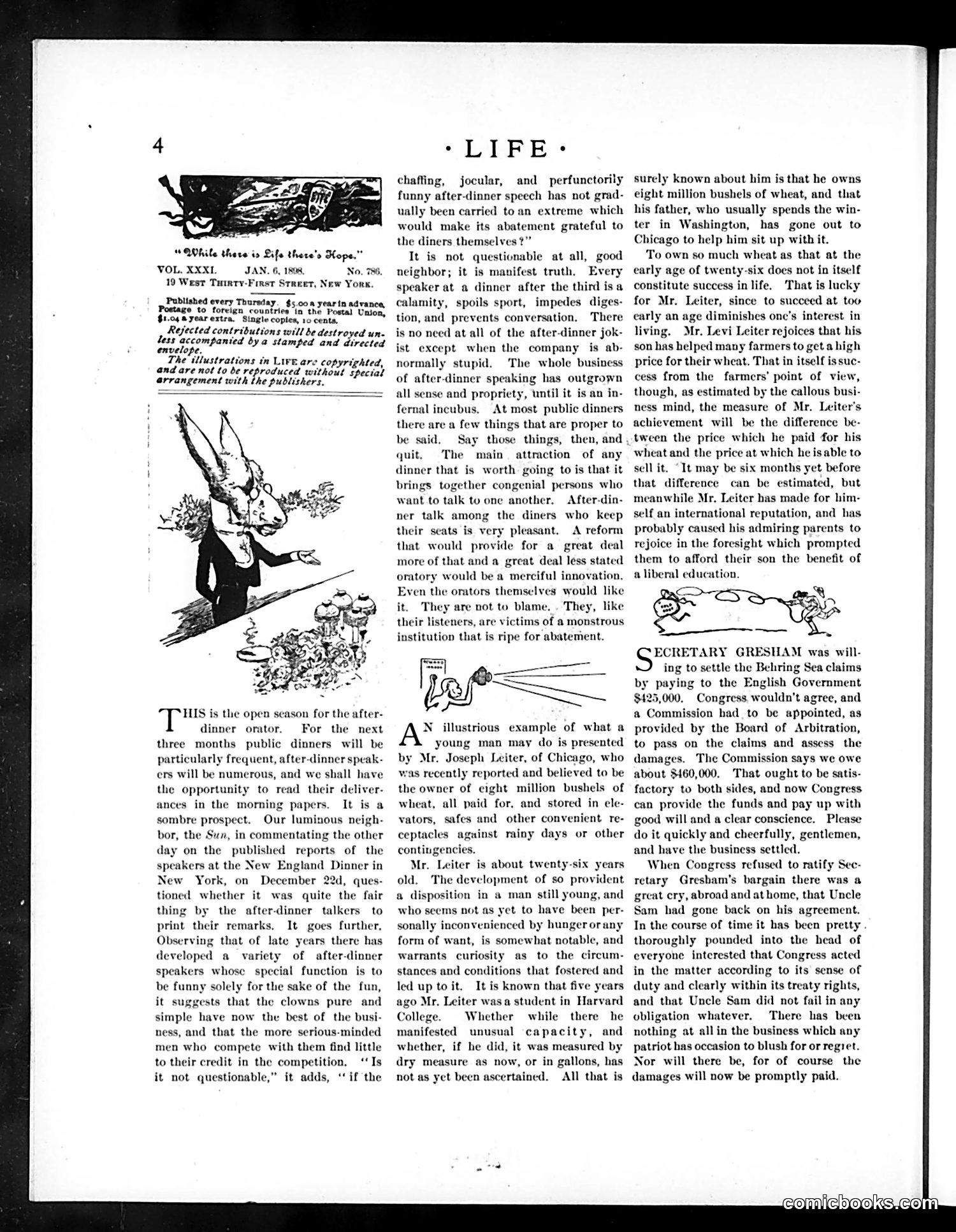
What you’re looking at
This page critiques **after-dinner speakers** as a social institution. The left cartoon depicts a speaker as an absurd figure—wild-haired, gesticulating dramatically—mocking the theatrical pretensions of dinner orators. The main text argues that after-dinner speaking has devolved into tedious performances where speakers drag on interminably. The author suggests speakers are "victims of a monstrous institution that is ripe for abatement," advocating for reform. The right section shifts to **Secretary Gresham's settlement of Bering Sea claims** with England for $425,000, which Congress disputed. The satirist praises Congress for acting decisively on this international dispute, contrasting decisive governance with the frivolous dinner-speech culture discussed above. The juxtaposition suggests the magazine values substantive political action over empty social performance.
📄 Transcribed text from this page (OCR, searchable)
Machine-transcribed from the original scan — historical spelling and the odd misread are preserved.
“Qhile there is Life there's Hope,” VOL, XXXI. 19 Wesr Tutrty-Finst Street, New Yors. Published every Toureday_ 45 Postage to forcien countties is the Postal Canes, $toqayearertra Single coplen 1o-centa Rejected contributions will be destroyed tess accompanied by a stamped fivected dass seco bya stamped and directed The illustrations in Live are copyrighted, and are not to be reproduced withaut special rangement with the publishers. HIS is the open season for the after- dinner orator. For the next three months public dinners will be particularly frequent, after-dinner speak- ers will be numerous, and we shall ha the opportunity to read their deli ances in the morning papers. It is a sombre prospect. Our luminous neigh- bor, the Sun, in commentating the other day on the published reports of the speakers at the New England Dinner in New York, on December 22d, ques- tioned whether it was quite the fair thing by the after-dinner talkers to print their remarks, It goes further, Observing that of late years there has loped a variety of after-dinner speakers whose special function is to be funny solely for the sake of the fun, it suggests that the clowns pure and simple have now the best of the busi- and that the more serious-minded men who compete with them find little to their credit in the competition, ‘Is it not questionable,” it adds, ‘if the nes: *> LIFE: chaffing, jocular, and _perfunctorily funny after-dinner speech has not grad- ually been carried to an extreme which would make its abatement grateful to the diners thems It is not questionable at all, good neighbor; it is manifest truth. Every speaker at a dinner after the third isa calamity, spoils sport, impedes diges- tion, and prevents conversation, The is no need at all of the after-dinner jok- ist except when the company is ab- normally stupid. The whole business of after-dinner speaking has outgrown all sense and propriety, until it is an in- fernal incubus, At most public dinners there are a few things that are proper to be said. Say those things, then, and qu The main attraction of any dinner that is worth going to is that it brings together congenial persons who want to talk to one another, After-din- ner talk among the diners who keep their seats is very pleasant. A reform that would provide for a great deal more of that and a great deal less stated oratory would be a merciful innovation, Even the orators themselves would like it. They are not to blame. . They, like their listeners, are victims of a monstrous institution that is ripe for abatement. illustrious example of what a young man may do is presented Mr. Joseph Leiter, of Chicago, who was recently reported and believed to be the owner of eight million bushels of wheat, all paid for, and stored in ele- vators, safes and other convenient re- ceptacles against rainy days or other contingencies. Mr. Leiter is about twenty-six years old. The devclopment of so provident position in a man still young, and who seems not as yet to have been per- sonally inconvenienced by hunger orany form of want, is somewhat notable, and warrants curiosity as to the circum- stances and conditions that fostered and led up to it, It is known that five years ago Mr. Leiter wasa student in Harvard College. Whether while there he manifested unusual capacity, and whether, if he did, it was measured by dry measure as now, or in gallons, has not as yet been ascertained. All that is surely known about him is that he owns eight million bushels of wheat, and that his father, who usually spends the win- ter in Washington, has gone out to Chicago to help him sit up with it. ‘To own so much wheat as that at the early age of twenty-six does not in itself constitute success in life. That is lucky for Mr. Leiter, since to succeed at too early an age diminishes one’s interest in living. Mr. Levi Leiter rejoices that his son has helped many farmers to get a high price for their wheat. That in itself is suc- cess from the farmers’ point of view, though, as estimated by the callous busi- ness mind, the measure of Mr. Leiter's achievement will be the difference be- tween the price which he paid for his wheat and the price at which he is able to sell it, “It may be six months yet before that difference can be estimated, but meanwhile Mr, Leiter has made for him- self an international reputation, and has probably caused his admiring parents to rejoice in the foresight which prompted them to afford their son the benefit of a liberal education. <> A) > ~ ECRETARY GRESHAM was will- ing to settle the Behring Sea claims 5 by paying to the English Government $425,000. Congress wouldn't agree, and a Commission had to be appointed, as provided by the Board of Arbitration, to pass on the claims and assess the damages. The Commission says we owe about $460,000. That ought to be sati factory to both sides, and now Congre: can provide the funds and pay up with good will and a clear conscience. Please do it quickly and cheerfully, gentlemen, and have the business settled. When Congress refused to ratify Sec- retary Gresbam's bargain there was a great cry, abroad and at home, that Uncle Sam had gone back on his agreement. In the course of time it has been pretty thoroughly pounded into the head of everyone interested that Congress acted in the matter according to its sense of duty and clearly within its treaty rights, and that Uncle Sam did not fail in any obligation whatever. There has been nothing at allin the business which any patriot has occasion to blush for or regret. Nor will there be, for of course the damages will now be promptly paid.