
A complete issue · 21 pages · 1897
Life — December 30, 1897
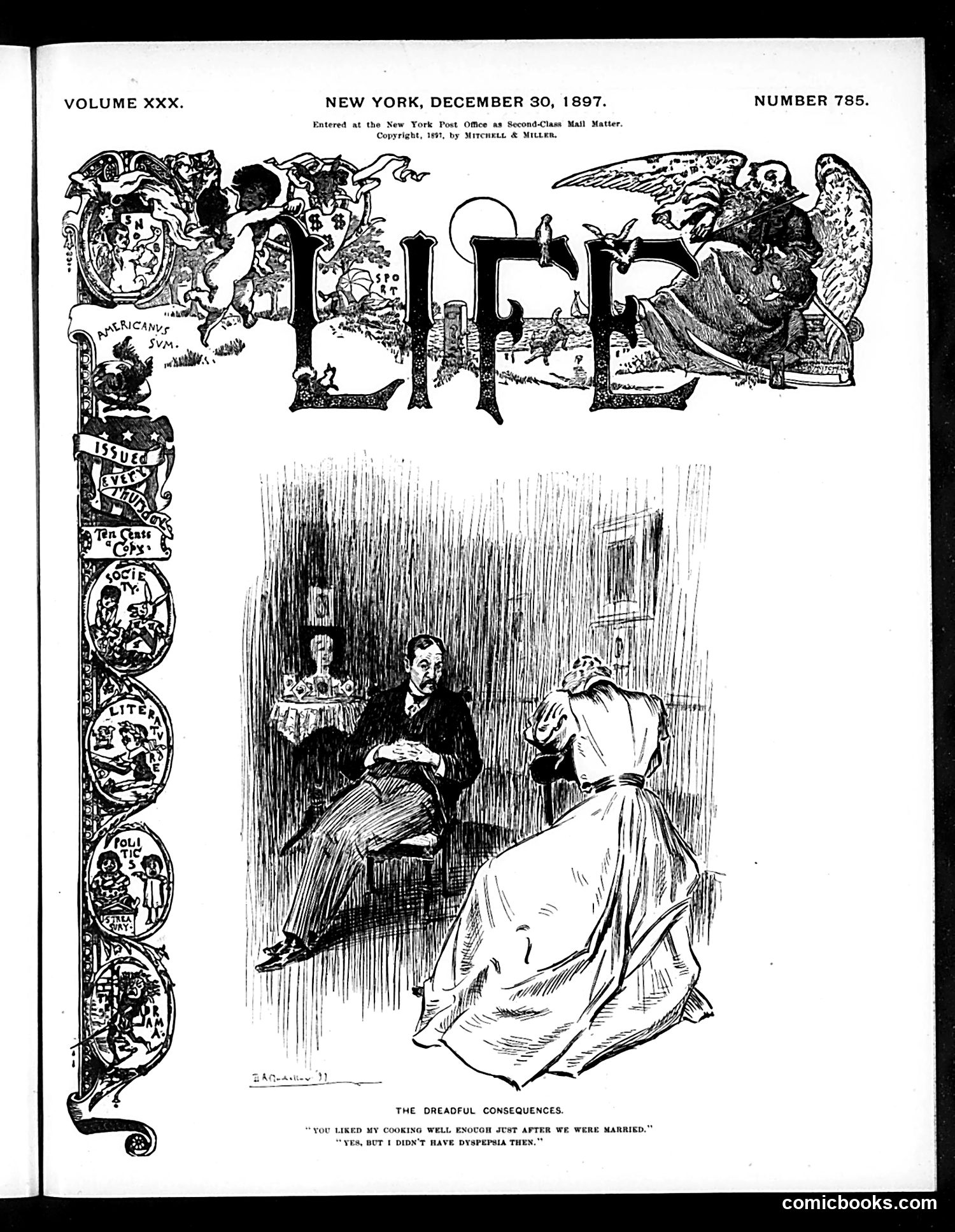
This cartoon satirizes marital discord and changing domestic expectations. The scene shows a wife confronting her husband about cooking, with the caption: "You liked my cooking well enough just after we were married." / "Yes, but I didn't have dyspepsia then." The joke targets husbands who blame their wives' cooking for digestive problems that actually develop over time. It's satirizing how men deflect responsibility for health issues onto their spouses, while also poking fun at the Victorian obsession with dyspepsia (indigestion)—a fashionable complaint of the era. The woman's accusatory posture and the man's defensive response reflect period anxieties about marriage, domesticity, and evolving gender dynamics in late 19th-century America.
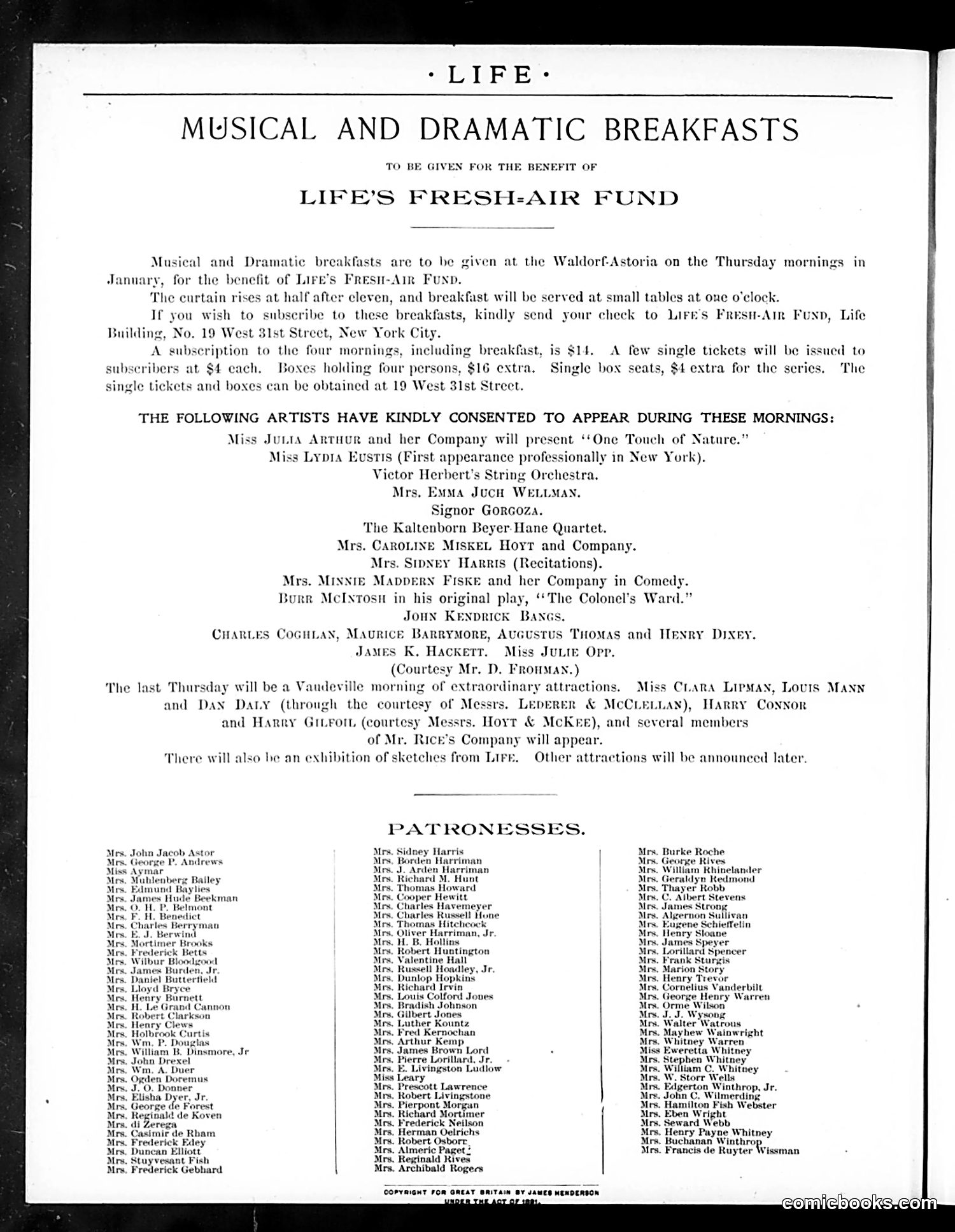
This page is **not a cartoon or satirical content** — it's entirely an announcement and advertisement for charitable fundraising events. The page announces "Musical and Dramatic Breakfasts" to benefit Life magazine's "Fresh-Air Fund," a real charitable organization providing outdoor experiences for underprivileged urban children. The announcement lists: - Event details (location, timing, pricing) - Prominent performers who agreed to appear (opera singers, orchestras, actors, comedians) - A lengthy list of society women serving as patronesses This represents Life's charitable mission and demonstrates the magazine's cultural influence by recruiting celebrity performers. The patronesses list reflects the era's social hierarchy and women's roles in society philanthropy. It's a historical document of early 20th-century American charity and entertainment, not satire.
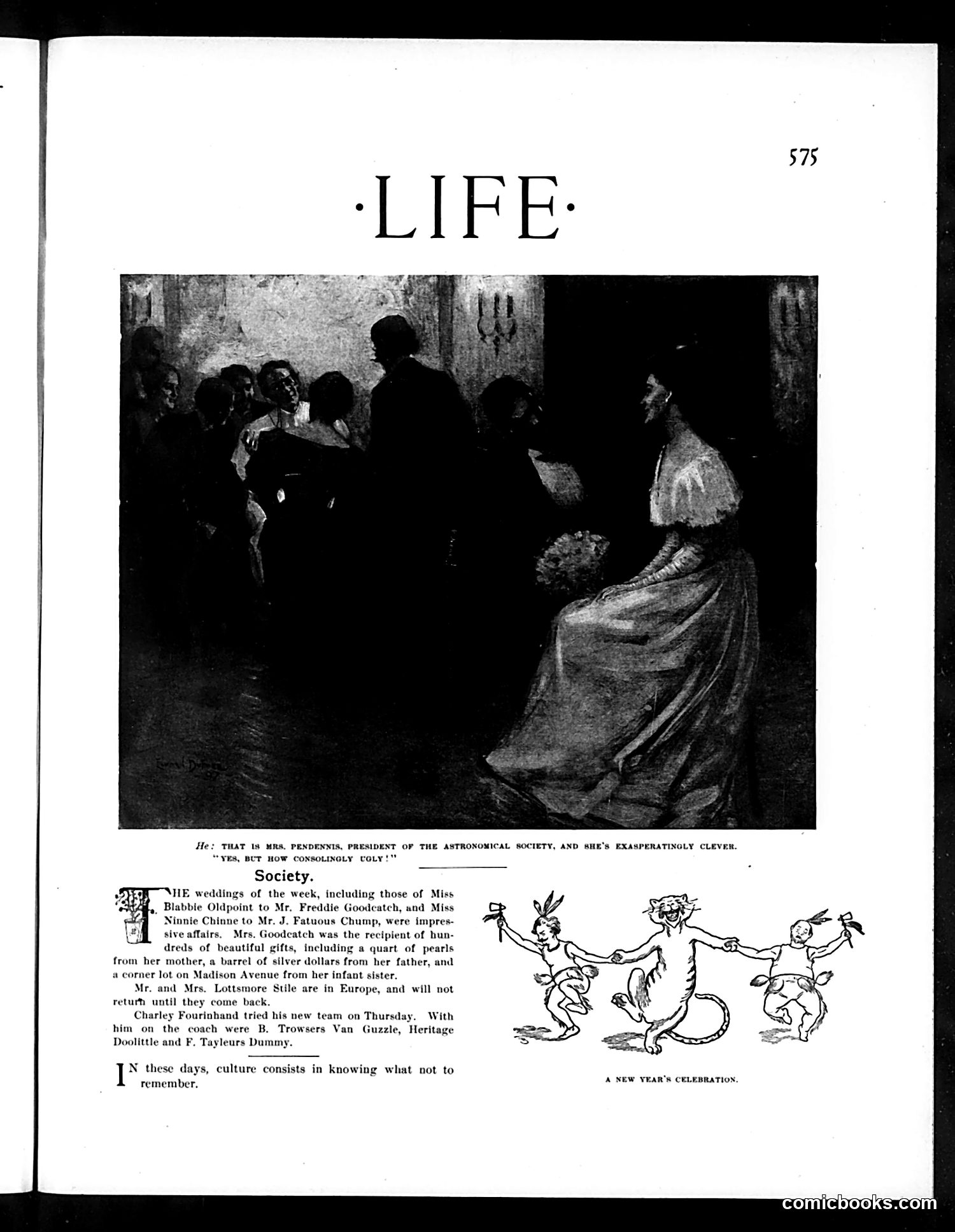
The main photograph shows a formal society gathering, captioned to identify "Mrs. Pendennix, President of the Astronomical Society" as notably clever. The image depicts what appears to be an indoor social event with formally dressed figures. The "Society" section below reports on upper-class social events: weddings of Miss Bibble Oldpoint and Miss Sloone Chittam, gifts received (pearls, silver dollars), and the Lottensurle Sures' European travel plans. It notes Charley Forjoband testing a new horse team. The page concludes with a satirical quote: "In these days, culture consists in knowing what not to remember"—a commentary on selective memory and pretense among the social elite. The decorative cherub illustration labeled "A New Year's Celebration" provides visual relief.
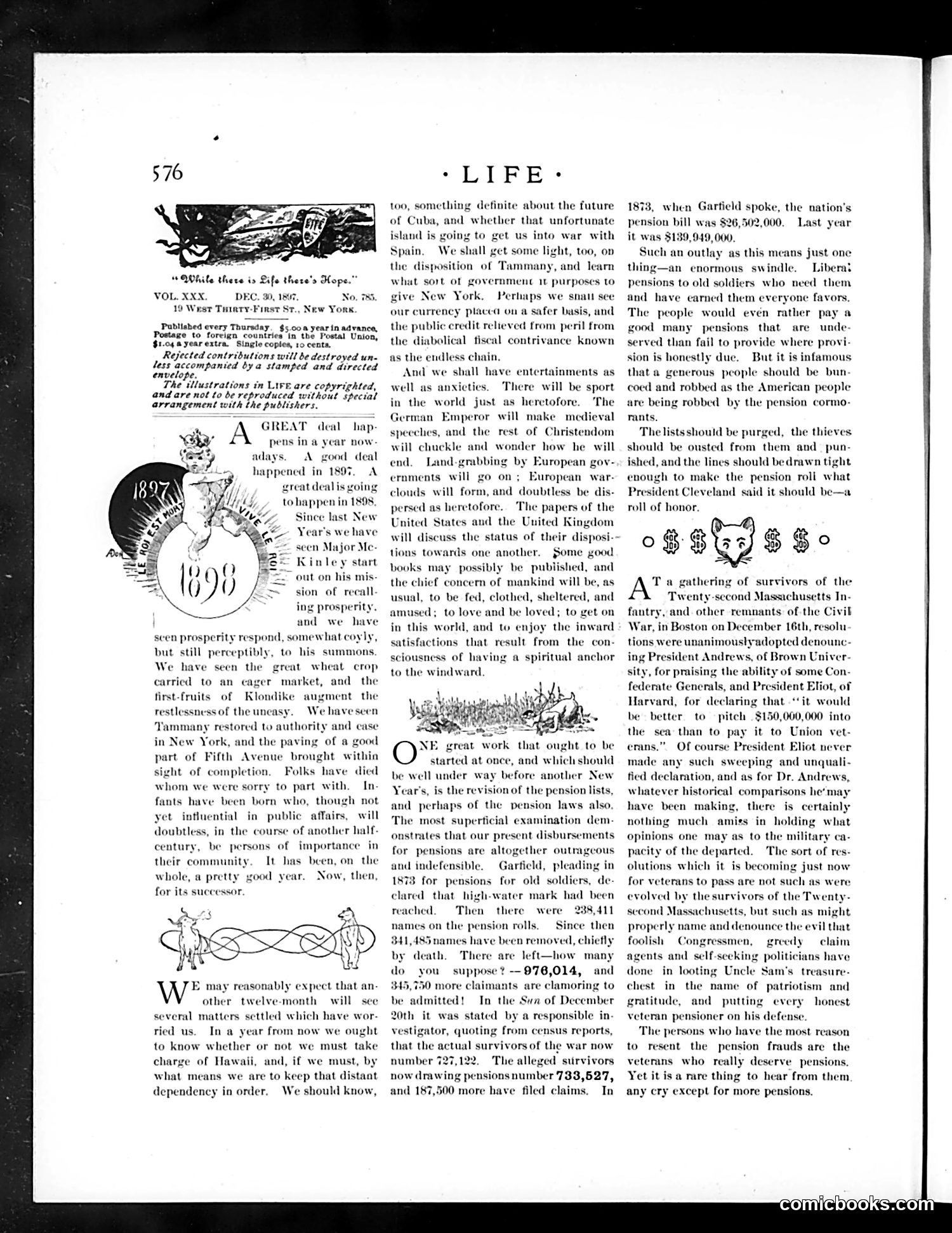
This page contains political commentary on late-1890s American issues. The main illustrations appear to be decorative circular designs labeled "1897," "1898," and "1899," symbolizing the passage of years. The text discusses pension fraud and reform. It references President Garfield's 1873 pension bill and criticizes fraud in Civil War pensions, mentioning specific numbers of fraudulent claimants (978,014 alleged survivors). The article advocates for pension list revision and removal of fraudulent names. The small illustrations at bottom—showing figures connected by lines—appear to be satirical cartoons, though details are unclear. They likely mock corruption or the tangled bureaucracy of pension administration. The overall theme: exposing pension system abuse and calling for governmental cleanup of fraudulent claims among supposed Civil War veterans.
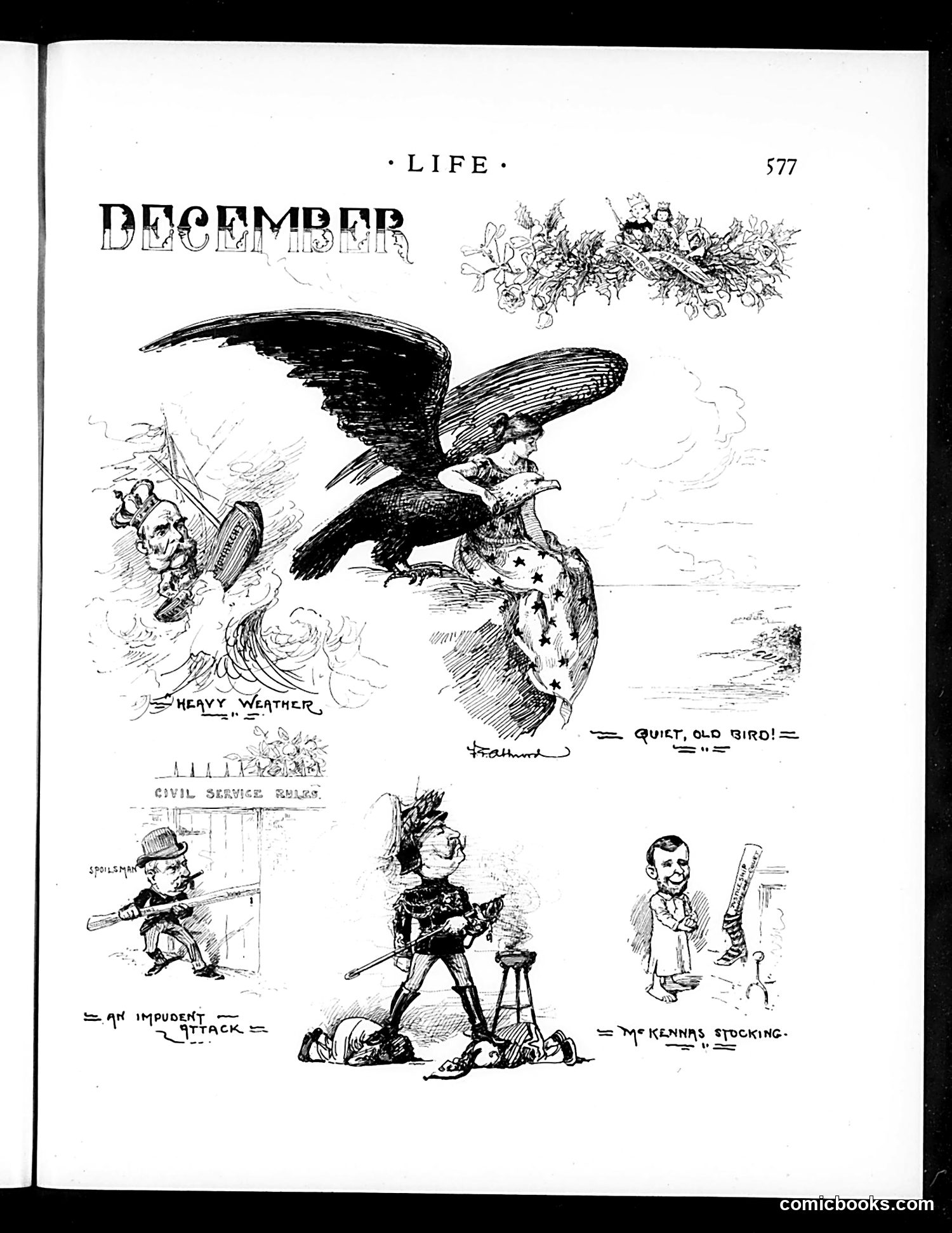
This satirical page depicts various December-themed political and social commentary through caricature: **"Heavy Weather"** (left): Shows figures struggling amid stormy conditions, likely referencing political turbulence of the period. **"Quiet, Old Bird!"** (center): Features an American eagle with a woman in star-spangled dress, suggesting commentary on American patriotism or national policy. **"An Impudent Attack"** (lower left): A figure appears to be attacking Civil Service Rules, suggesting political debate over government employment reform. **"Mrs. Kennas Stocking"** (lower right): References someone named Kennas and holiday imagery. The cartoons employ exaggerated facial features typical of early-20th-century political satire. Without specific historical context about December events and key political figures of this era, the precise targets remain unclear, though the page evidently comments on contemporary political controversies.
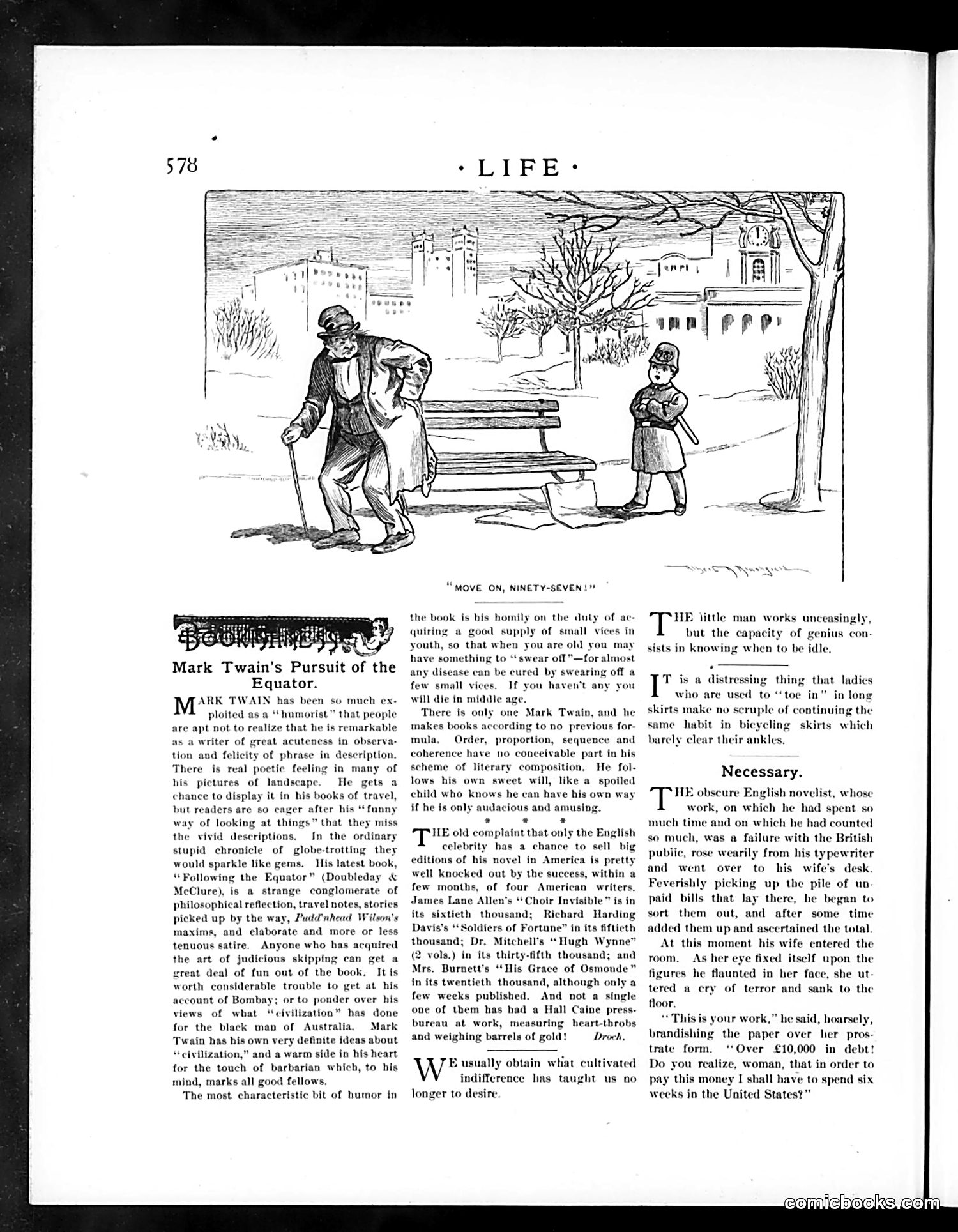
The main illustration depicts an adult figure telling a child to "Move on, ninety-seven!" in a public park setting. This cartoon satirizes poverty and homelessness, likely from the late 19th or early 20th century. The accompanying text discusses Mark Twain's "Following the Equator," praising his observational humor about human nature and civilization. The articles labeled "Necessary" critique an unnamed English novelist whose work failed commercially in Britain, forcing financial desperation. The "Move on" caption appears to mock police or authorities who routinely harass poor people from public spaces—a common Victorian-era social practice. The humor targets both arbitrary enforcement of vagrancy laws and the human tendency to displace society's uncomfortable realities.
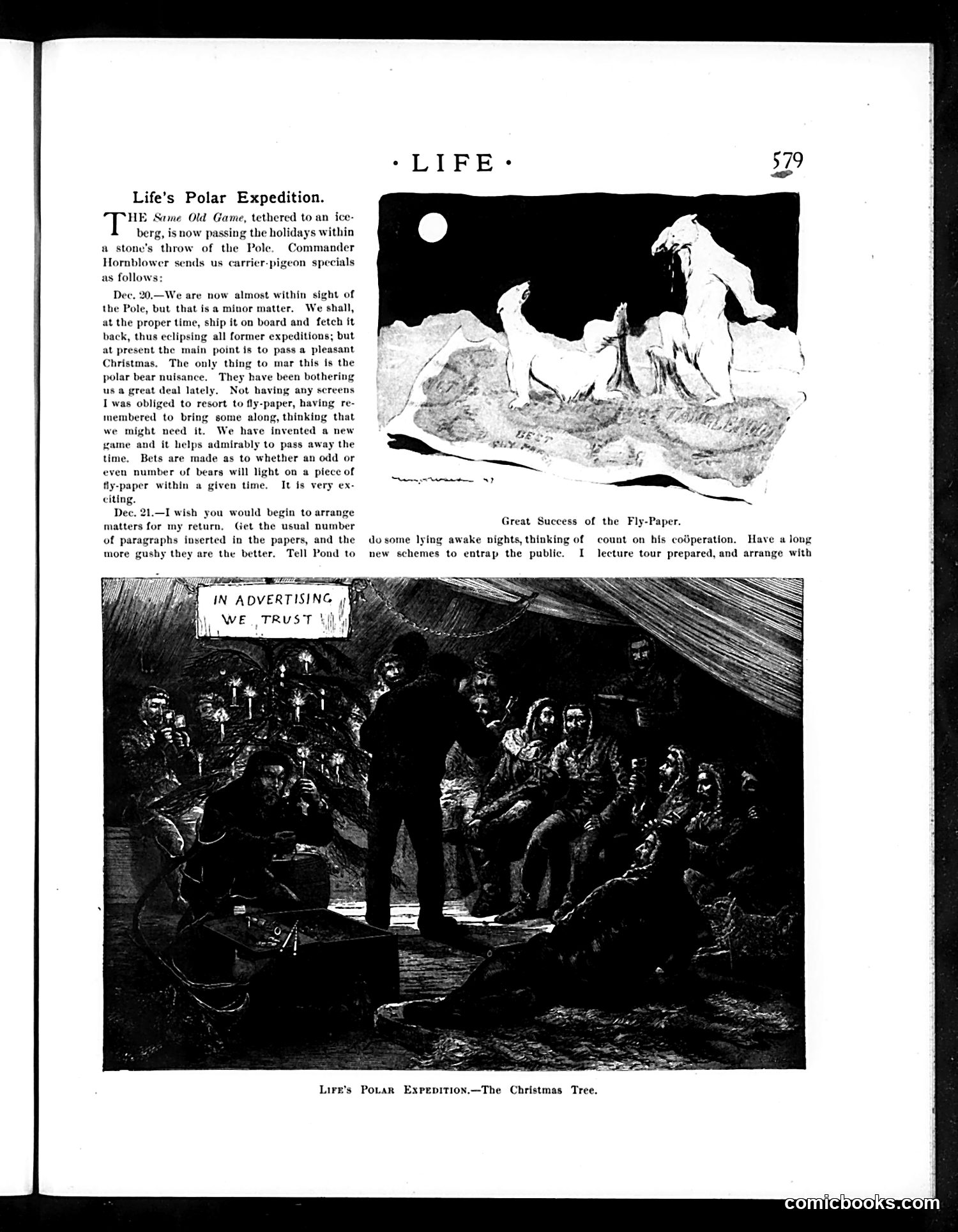
This page from *Life* magazine presents a humorous "polar expedition" narrative. The top section contains dispatches from "Commander Hornblower" describing an expedition near the North Pole, with tongue-in-cheek updates about Christmas plans and an invented "fly-paper" device supposedly designed to trap bears. The upper illustration shows a polar bear examining the fly-paper contraption under moonlight—the joke being the absurdity of using fly-paper on bears. The lower illustration depicts "Life's Polar Expedition—The Christmas Tree," showing an underground shelter where expedition members gather around a makeshift Christmas tree, with the caption "IN ADVERTISING WE TRUST" visible. This satirizes both the hardships of polar exploration and contemporary advertising culture, suggesting even in extreme conditions, commercial messaging persists.
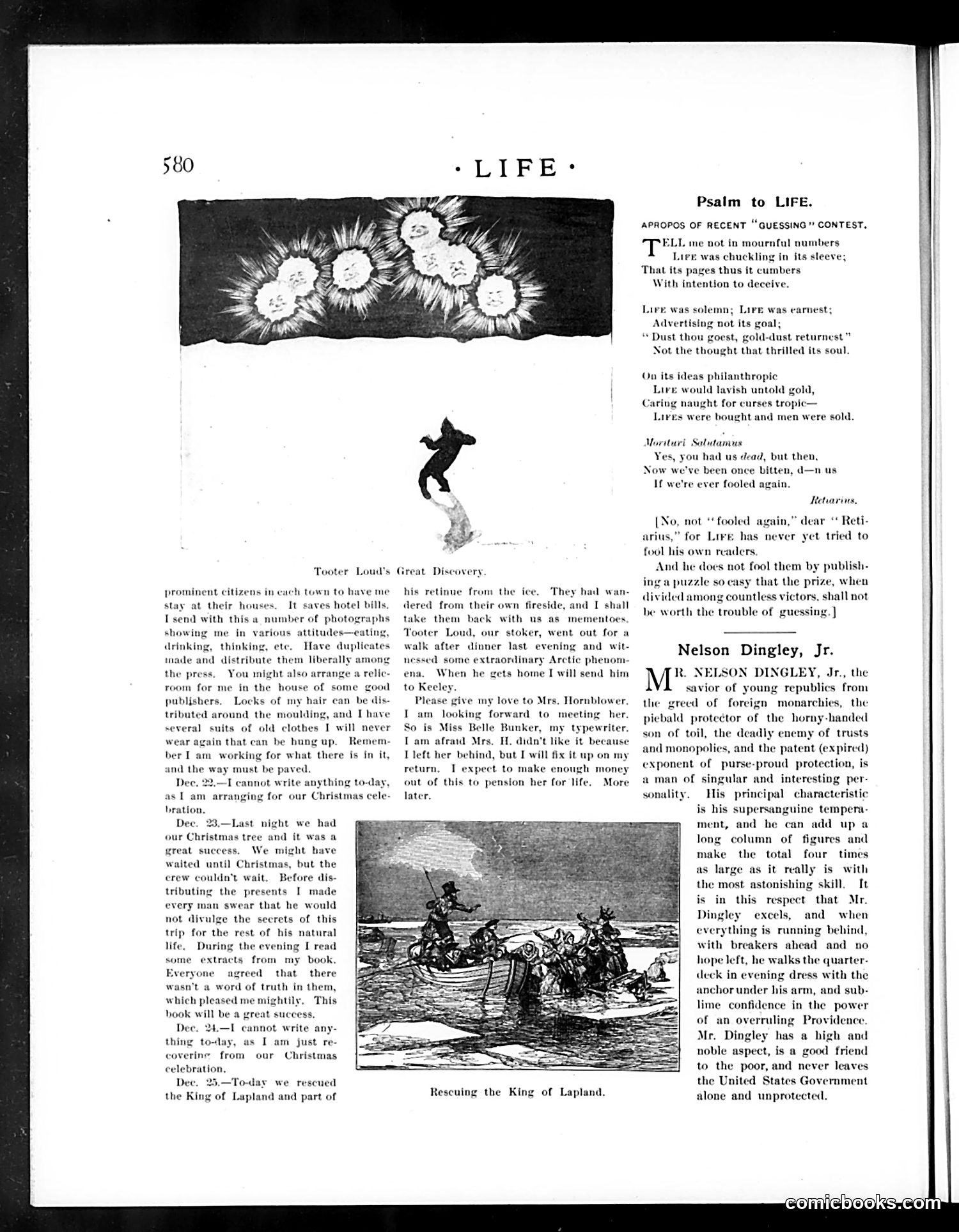
This page contains literary and biographical content rather than political cartoons. The main elements include: 1. **"Psalm to LIFE"** — A poem mocking Life magazine itself, suggesting it was deceptive ("chuckling in its sleeve") and corrupt, with references to "gold-dust" and "lives...bought and men were sold." 2. **"Toster Lout's Great Discovery"** — A humorous letter describing Arctic exploration, with illustrations of a man being pulled from ice and a rescue scene. 3. **"Nelson Dingley, Jr."** — A biographical profile praising a political figure as defender against "foreign monarchies" and "trusts," emphasizing his patriotic character and integrity. The page appears to blend satirical commentary on Life magazine itself with promotional political biography—typical of early 20th-century American periodicals mixing editorial content with favorable political coverage.
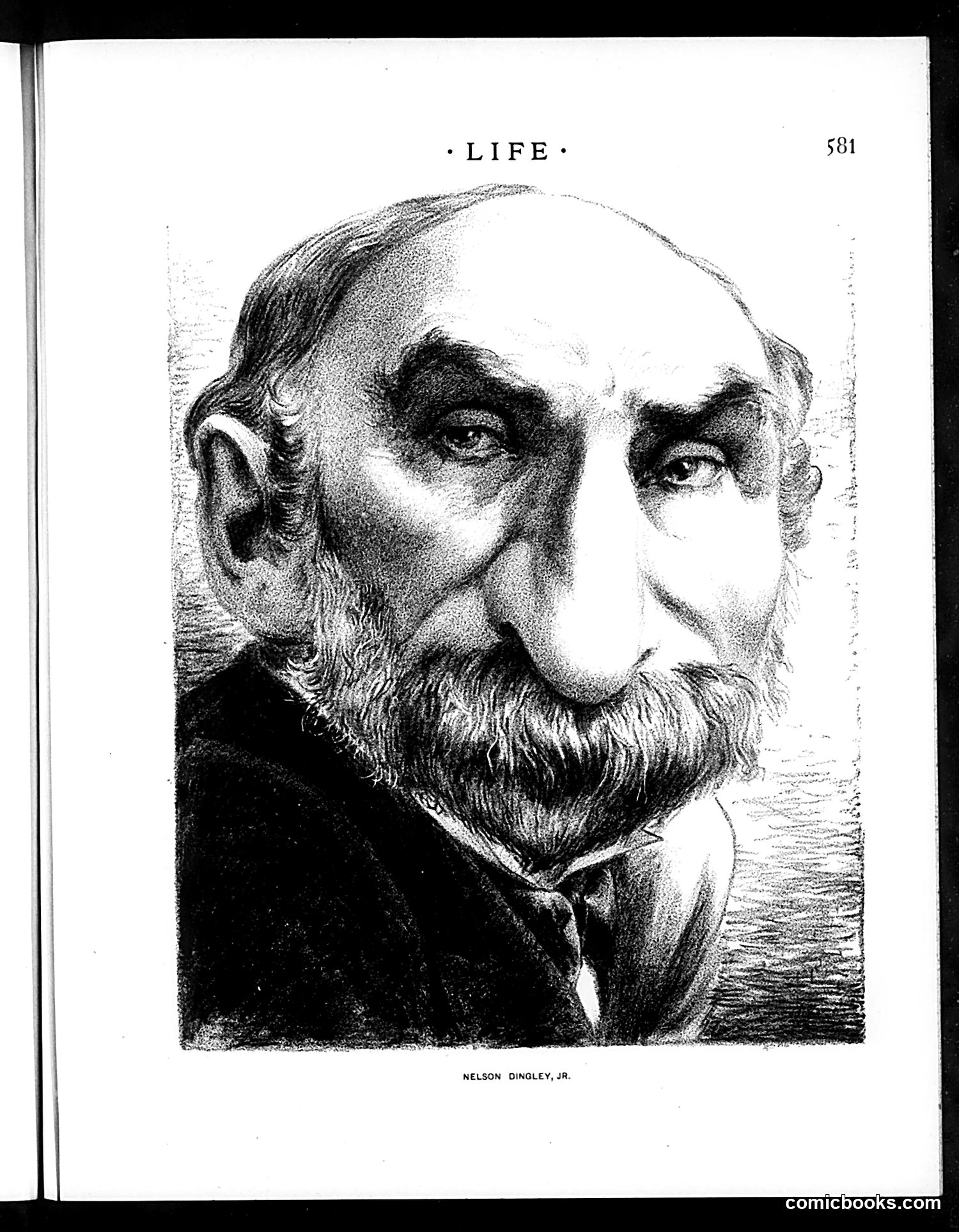
This page from *Life* magazine (page 581) features a portrait engraving labeled "NELSON DINGLEY, JR." The image shows a bearded man in formal attire rendered in a detailed stippled/cross-hatched engraving style typical of late 19th-century publication portraiture. Nelson Dingley Jr. was a prominent Republican congressman and politician from Maine. Without additional context on this specific page, I cannot determine if this is straightforward biographical documentation or if it contains satirical commentary typical of *Life* magazine's style. The page appears to be primarily a portrait rather than a cartoon, though *Life* frequently used such illustrations editorially. To identify the specific satirical intent would require seeing accompanying text or articles on this page.
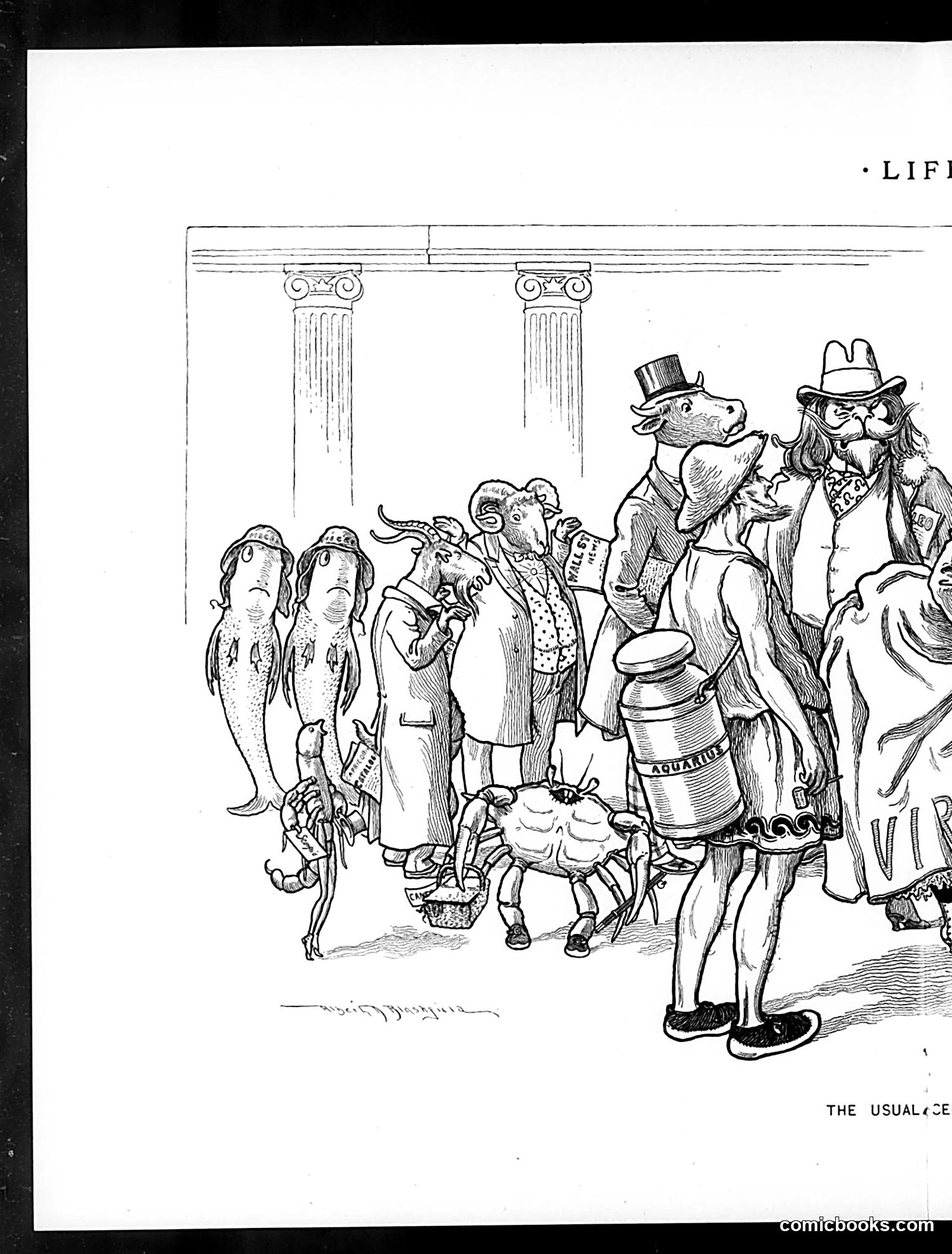
This appears to be a satirical cartoon from *Life* magazine showing what "THE USUAL ICE" (visible at bottom right) might represent—likely a social gathering or event involving aquatic/seafood themes. The cartoon depicts anthropomorphized fish and sea creatures attending what looks like a formal party or social event under classical columns. Among them are well-dressed human figures in top hats and formal wear, mingling with the aquatic characters. One figure carries a barrel labeled "AQUARIUM." The satire likely mocks high-society social events or nouveau riche pretensions, suggesting the absurdity of mixing different "classes" or types of people in formal settings. The inclusion of fish as party guests serves as visual humor to highlight the ridiculous or incongruous nature of whatever social convention or event is being lampooned. The title suggests this was a recurring satirical theme in the magazine.
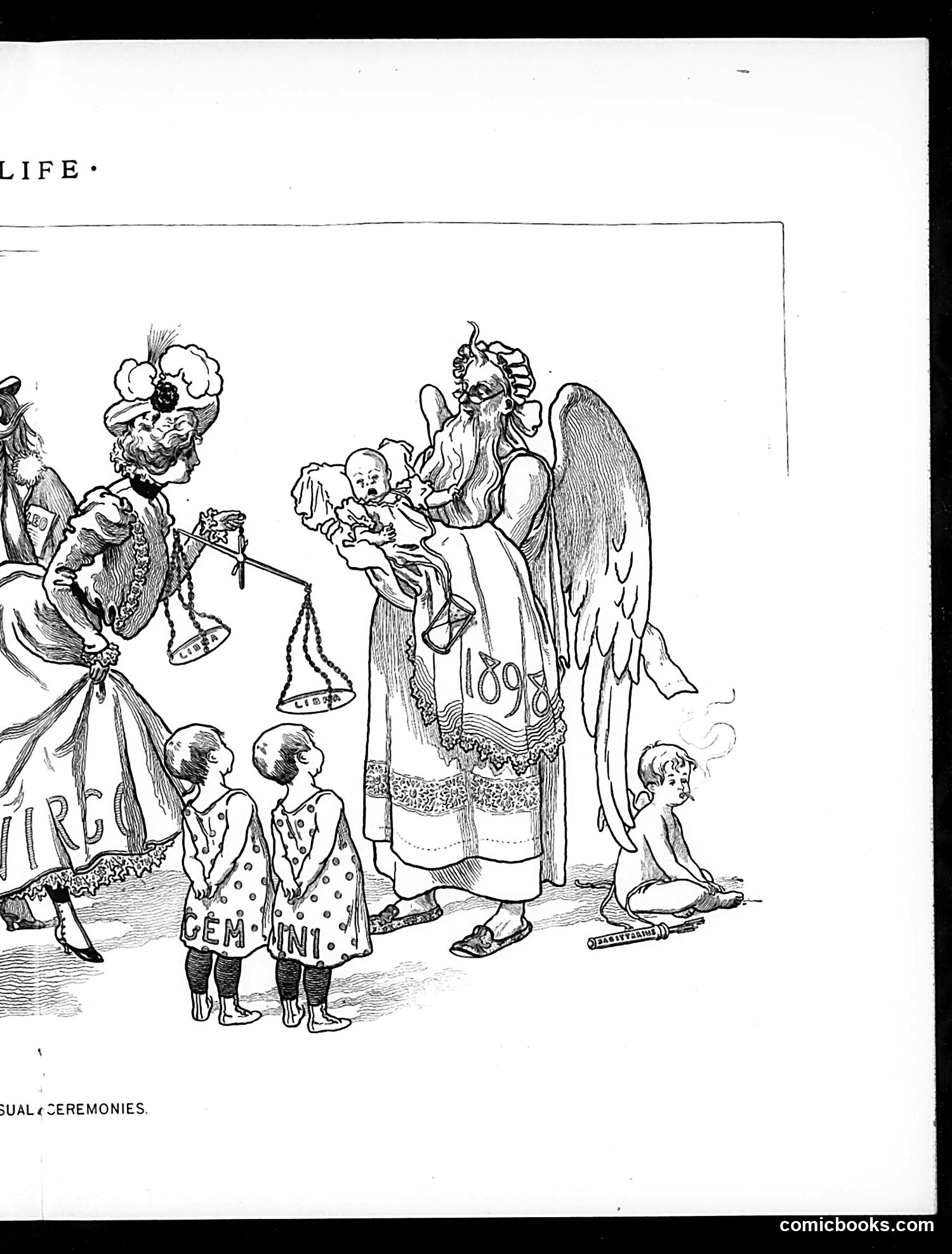
This satirical cartoon depicts an angel conducting what appears to be a marriage or legal ceremony, presiding over two small children labeled "GEMINI" (the zodiac twins). On the left stands Lady Justice, identifiable by her scales and blindfold, while other figures observe. The satire likely mocks early 20th-century occult or pseudoscientific practices—possibly astrology's influence on legal/social matters, or satirizes unusual marriage customs or legal ceremonies of the era. The presence of Justice alongside the angel and zodiac reference suggests the cartoon critiques how superstition or pseudoscience were influencing serious legal or social institutions that should rely on reason and law. The exact ceremony being mocked remains unclear from the image alone.
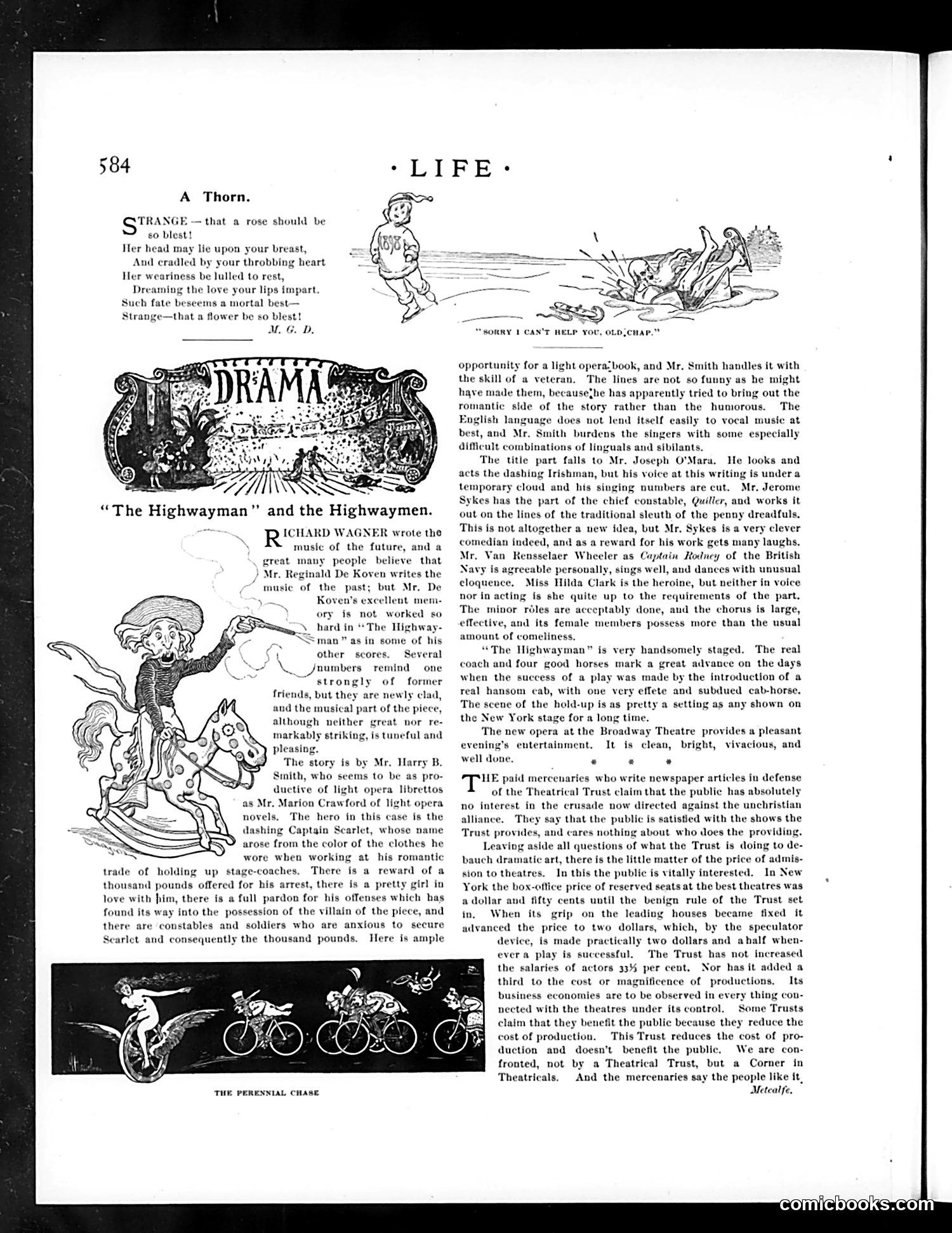
This page reviews a light opera called "The Highwayman," praising its staging and performances. The main illustration depicts a dramatic scene with a highwayman (a highway robber) holding up a stagecoach, which is the opera's plot device. The secondary article discusses the "Theatrical Trust"—a real business monopoly controlling theaters and ticket prices. The author criticizes how the Trust raised reserved-seat prices from fifty cents to two dollars, claiming they exploit both public and performers. The piece argues the Trust reduces production costs while charging audiences more, benefiting only themselves—a classic monopoly complaint about unfair pricing practices.
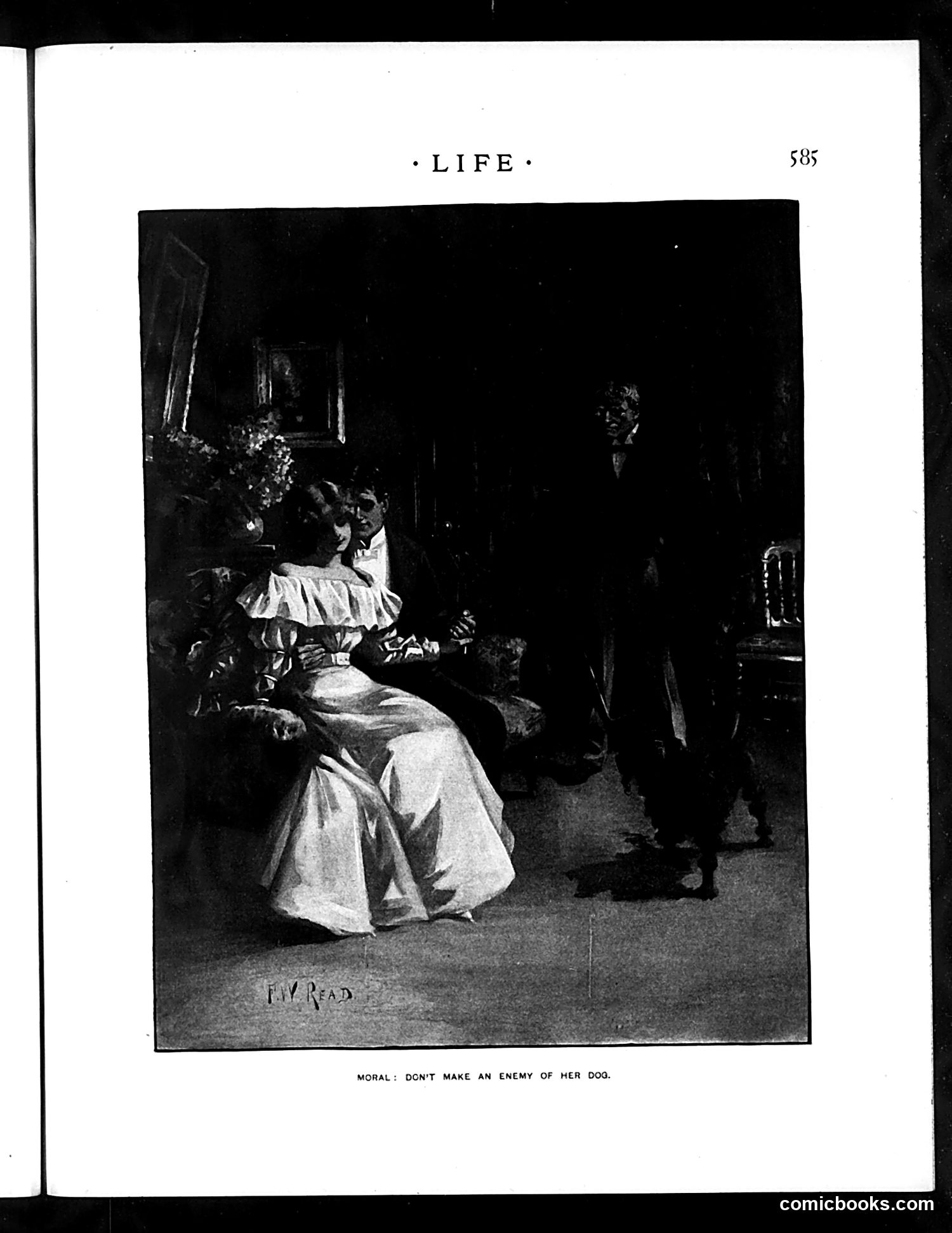
This is a satirical illustration by F.M. Read from *Life* magazine showing a woman in Edwardian-era dress (high collar, elaborate styling) interacting with a dog in what appears to be a domestic interior setting. Other figures are visible in the background. The moral "Don't make an enemy of her dog" is a humorous cautionary statement. The satire likely plays on social hierarchies of the period—suggesting that a woman's pet dog holds more power or influence than might be expected, perhaps commenting on how women of means wielded indirect social authority through their possessions and pets, or on the absurdity of treating an animal as more important than human relationships. The illustration appears to satirize upper-class domestic life and social pretension.
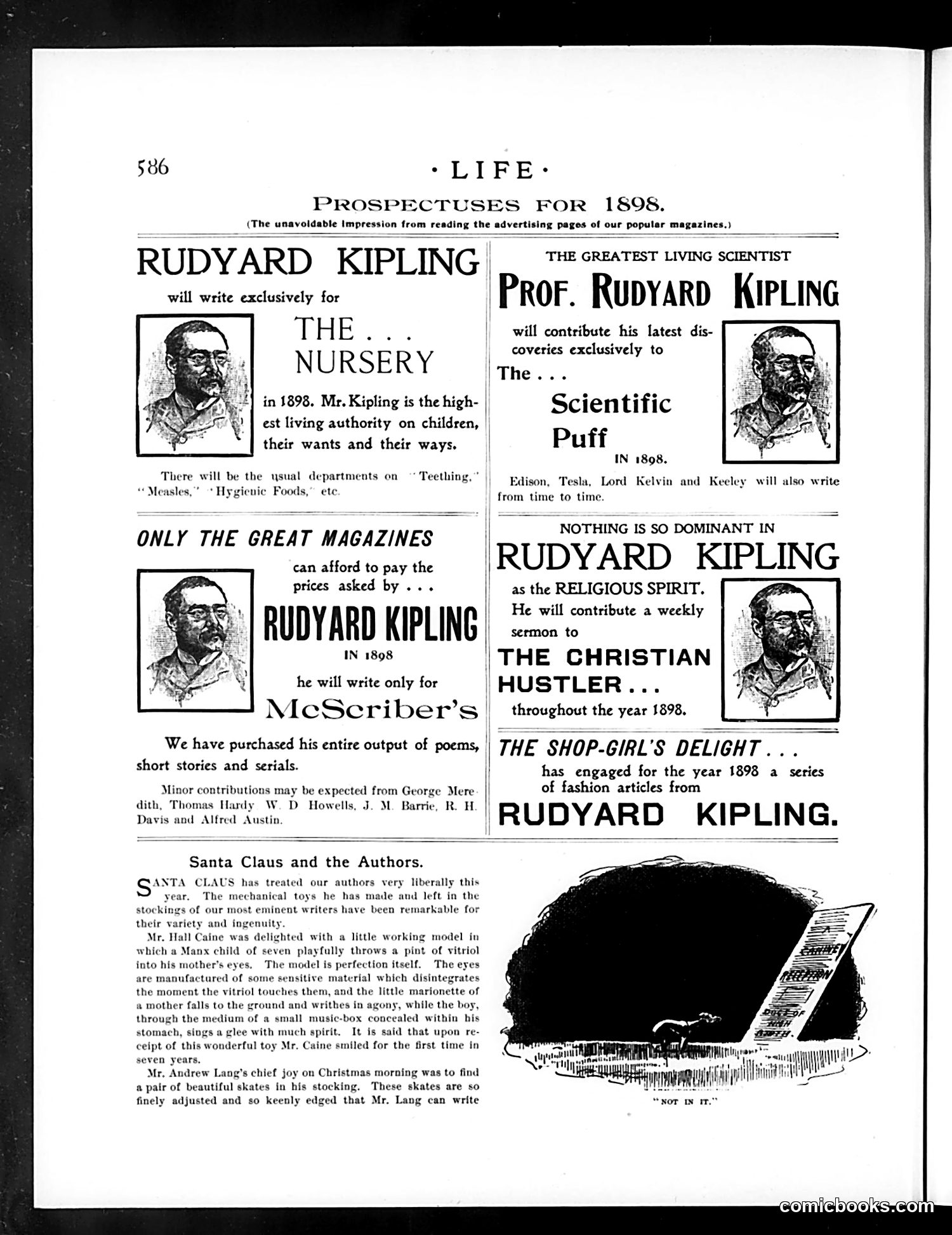
This *Life* magazine page satirizes the extravagant, contradictory advertising claims made by competing popular magazines competing for Rudyard Kipling's exclusive contributions. The joke: multiple publications simultaneously advertise that Kipling will write *exclusively* for them—an obvious impossibility. The layout mocks how magazines hype celebrity writers with inflated promises ("THE GREATEST LIVING SCIENTIST," claims he's the authority on children, science, religion, and fashion simultaneously). The bottom section parodies gift-giving to authors, describing absurd mechanical toys allegedly given by "Santa Claus." Hall Caine receives a disturbing toy depicting a child throwing acid into his mother's eyes—darkly satirizing the gap between sentimental holiday rhetoric and actual author preferences. The cartoon criticizes both magazine competition excess and the pretentious self-promotion of the publishing industry in the 1890s.
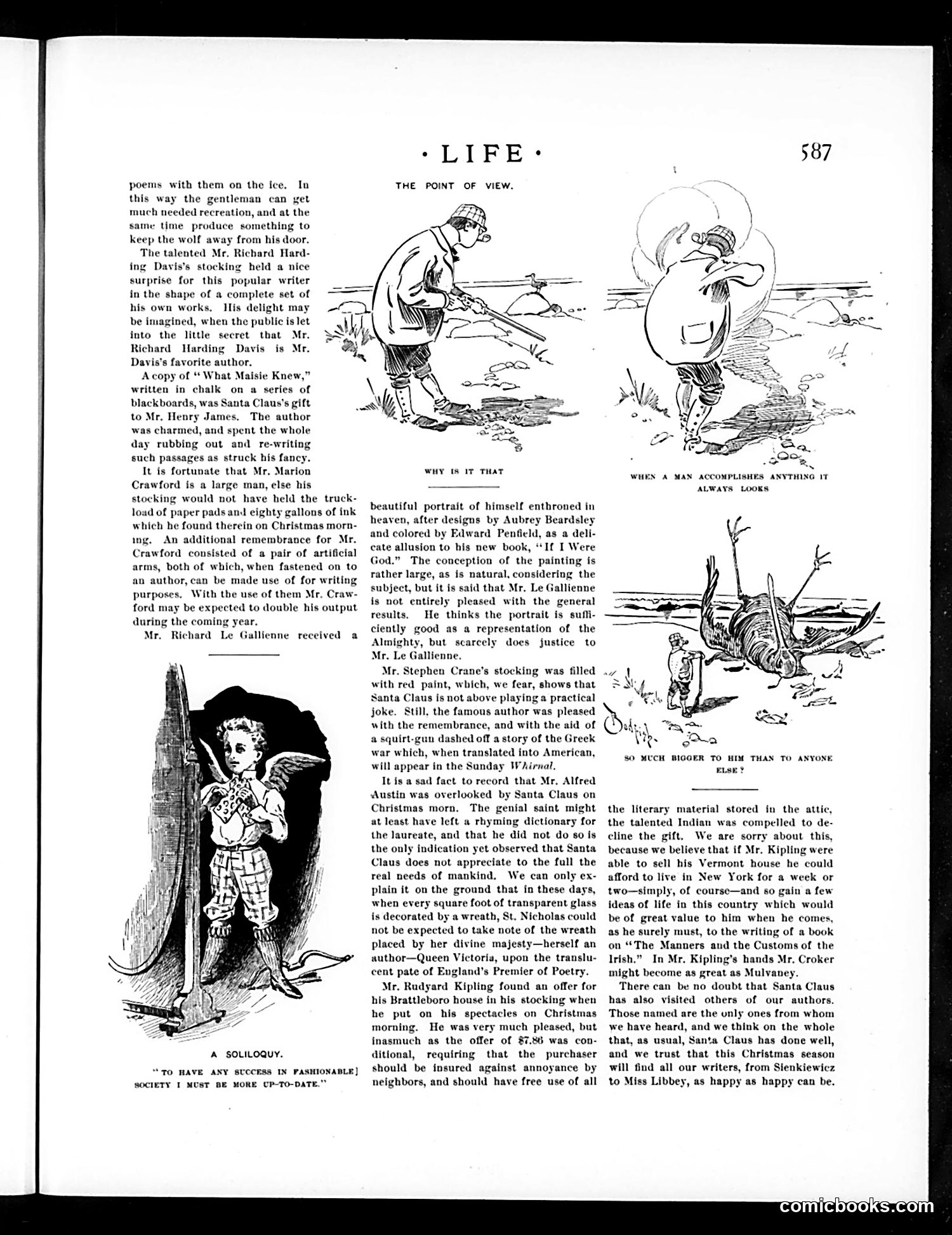
This page satirizes famous late-19th-century authors' supposed Christmas gifts, mocking their literary styles and public personas. Richard Harding Davis receives his own collected works (joke: he's his own favorite author). Henry James gets "What Maisie Knew" written on blackboards, which he spends the day revising—mocking his famously dense prose. Marion Crawford, a prolific novelist, receives massive quantities of paper and ink, plus artificial arms to write faster—exaggerating his productivity. Le Gallienne receives a portrait of himself as God (referencing his book "If I Were God"), criticized as better representing the Almighty than the subject himself. Stephen Crane gets red paint, allowing him to "dash off" a war story—mocking sensationalist journalism. Alfred Austin (England's Poet Laureate) is snubbed entirely, suggesting his work is worthless. The cartoons above ("The Point of View," "Why Is It That," "So Much Bigger") are separate satirical observations about human perspective and vanity, unrelated to the author commentary.
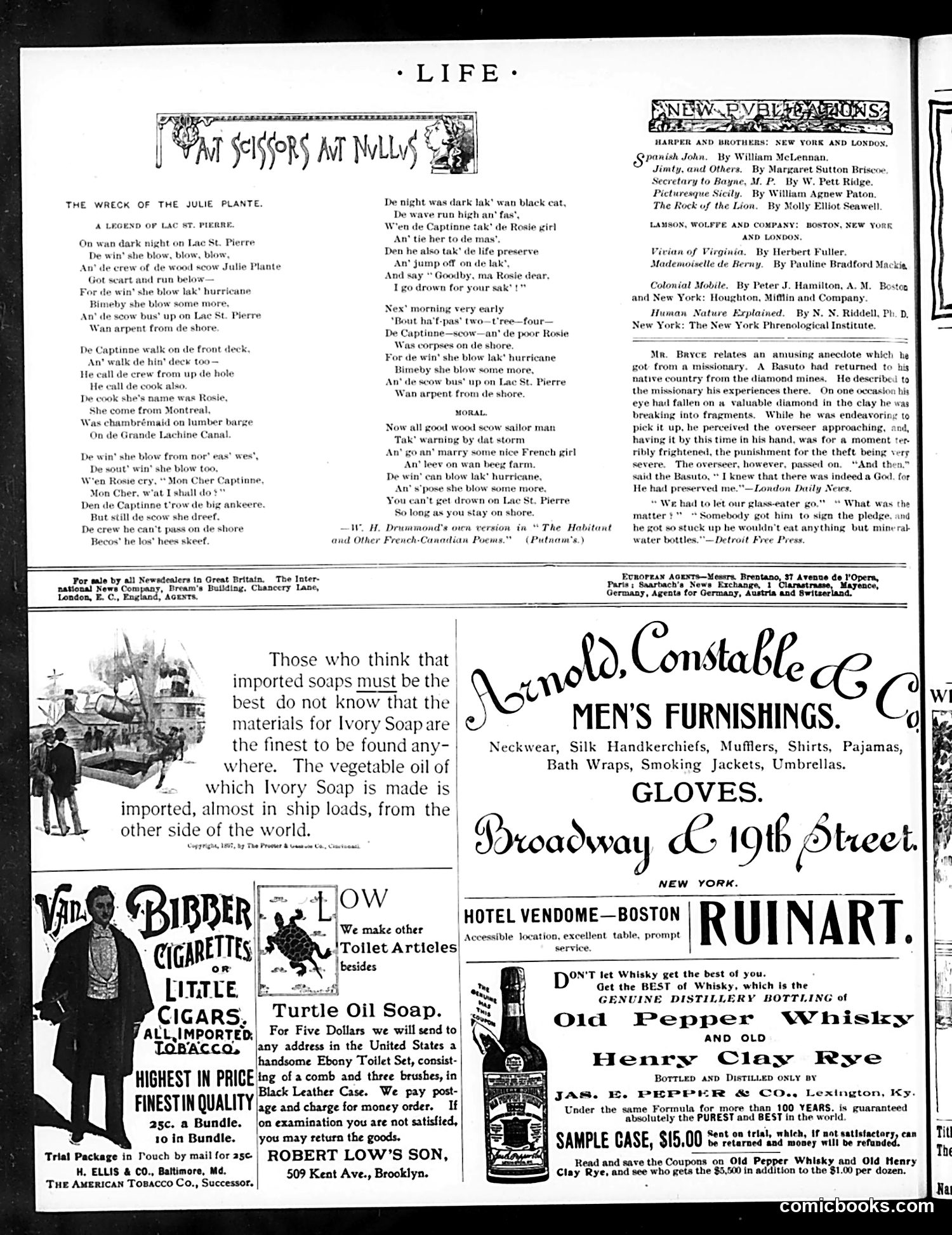
This page is primarily **literary and advertising content** rather than political satire. The main feature is a **poem by W.H. Drummond**, "The Wreck of the Julie Plante," a narrative ballad about a shipwreck on Lake St. Pierre. It's written in **French-Canadian dialect English** (phonetic Quebec French), telling of Captain Rosie and a cook named Rosie during a storm. This represents early 20th-century American interest in regional/ethnic literary humor—the exaggerated dialect itself was considered amusing to urban readers. The page is dominated by **period advertisements**: Arnold Constable menswear, Van Bibber cigarettes, Ivory Soap (emphasizing imported ingredients), Turtle Oil Soap, Old Pepper Whisky, and the Hotel Vendome. There's a brief **anecdote about a Basuto diamond miner** illustrating divine providence—typical uplift journalism of the era. **No political cartoons appear on this page.** The "satire" is incidental—the ethnic dialect poem and the commercial ads together reflect contemporary middle-class attitudes toward immigrants and consumption.
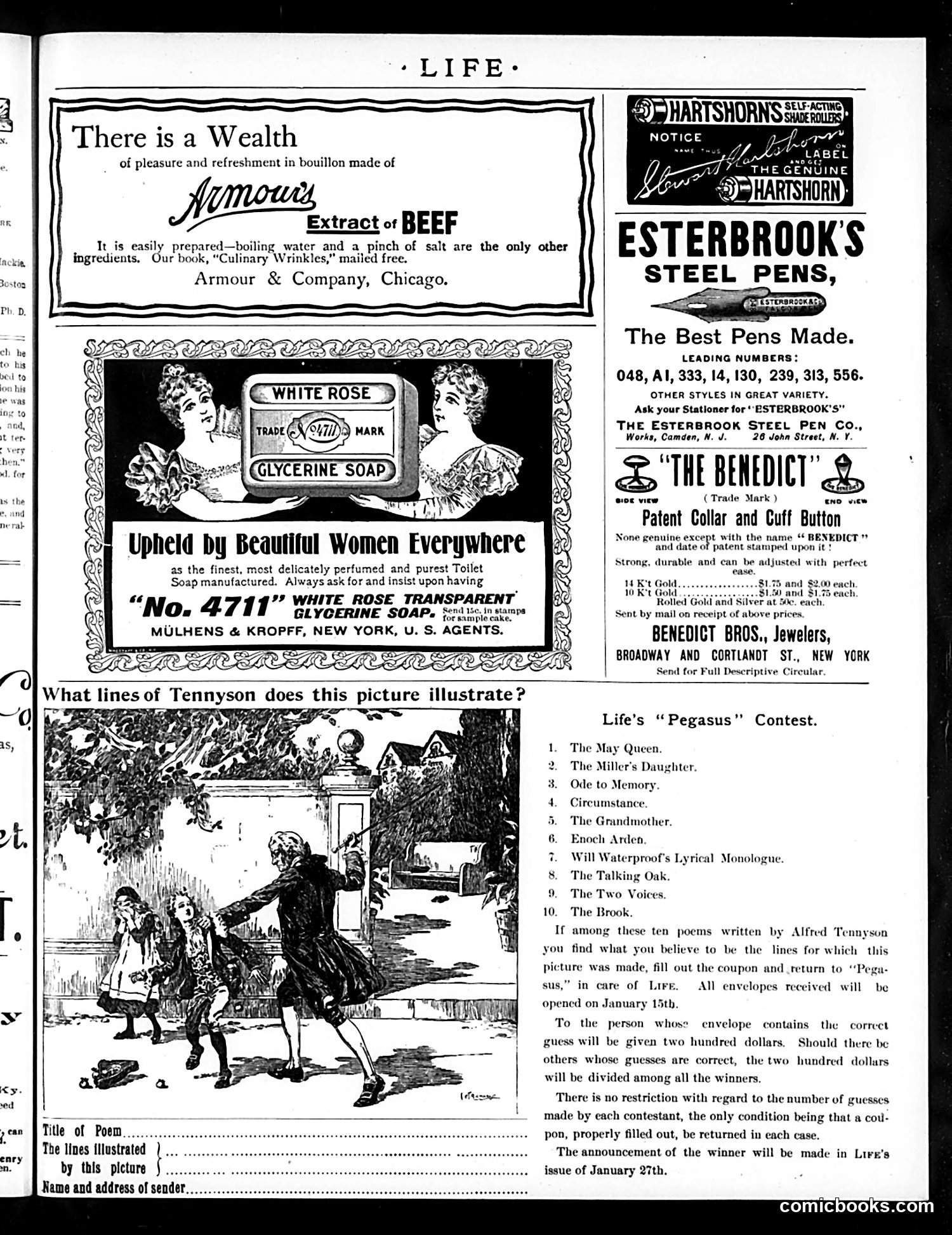
This page is primarily **advertising and a contest**, not political satire. The main content is Life's "Pegasus" Contest, offering $200 to readers who correctly identify which Alfred Tennyson poem the illustrated picture represents. The image shows a man gesturing toward two children near a house and water—readers must match it to one of ten listed Tennyson poems (including "Enoch Arden," "The Talking Oak," and "The Brook"). The page also contains period advertisements for consumer products: Armour's beef extract, White Rose glycerine soap (marketed to "beautiful women"), Esterbrook steel pens, and Benedict collar buttons. The contest reflects late 19th/early 20th-century popular culture where literary knowledge was treated as entertainment and intellectual engagement was encouraged through financial incentive. The Tennyson selection suggests his work was widely known and culturally valued among Life's readers.
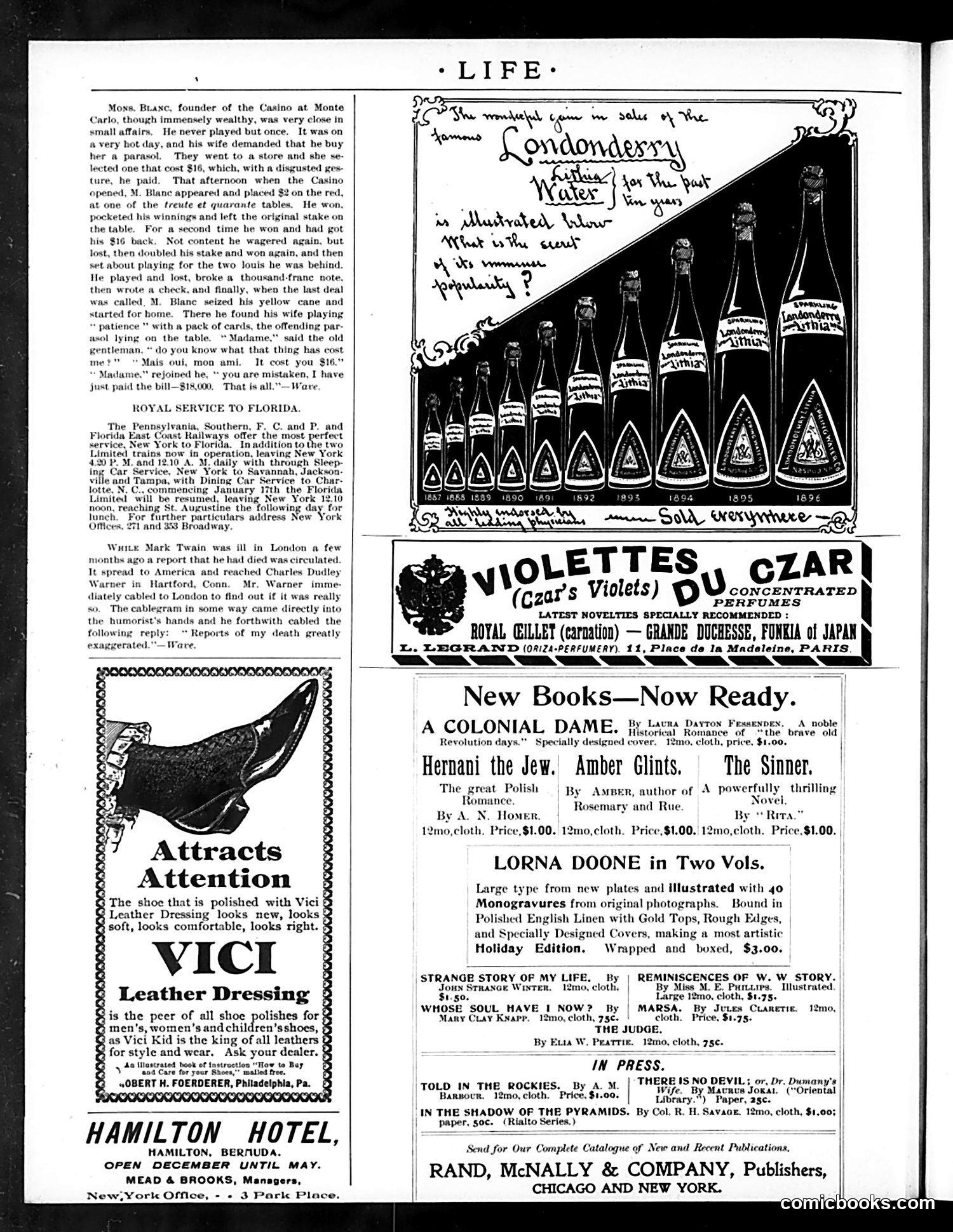
This page is primarily **advertising and book announcements** with minimal editorial content. The notable pieces are: **Text Stories:** - An anecdote about Monsieur Blanc, founder of Monte Carlo Casino, humorously contrasting his extreme frugality (refusing to buy his wife a parasol) with his compulsive gambling losses that ultimately cost him $18,000 - A brief item about Mark Twain: a death rumor circulated in America; when cabled for verification, Twain replied with his famous line: "Reports of my death greatly exaggerated" **Advertisements:** - Vici Leather Dressing (shoe polish) - Violettes du Czar perfume - Hamilton Hotel, Bermuda - Various railroad services to Florida - Publisher announcements for new books The page lacks political cartoons or satirical illustrations. It represents typical late-19th-century *Life* magazine content: light humor, product advertising, and literary notices aimed at an educated, affluent readership.
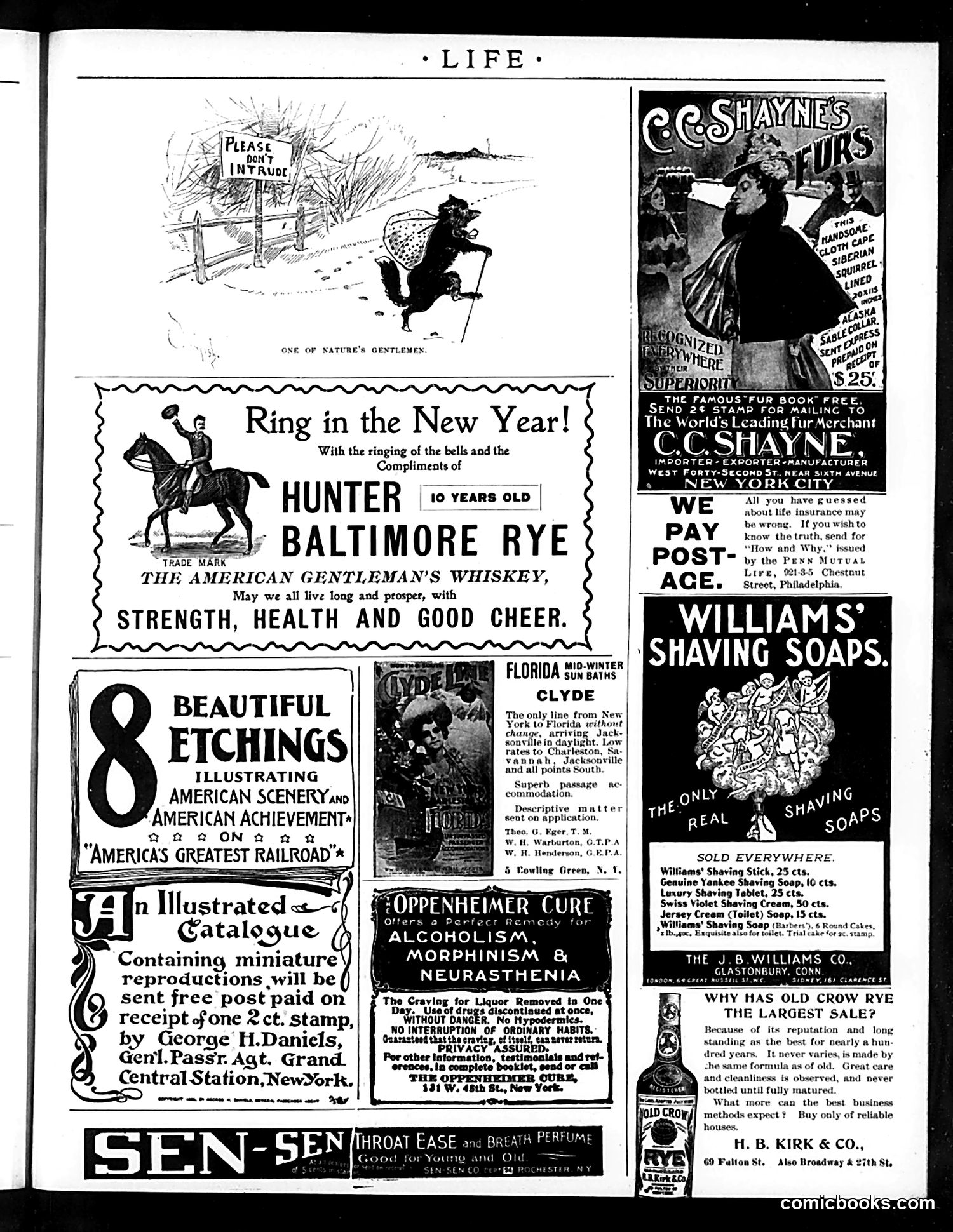
This page is primarily **advertising**—a common format for early 20th-century magazines. The only editorial cartoon appears at the top left: a small sketch of a beaver holding a lantern approaching a "Please Don't Intrude" sign, captioned "One of Nature's Gentlemen." This is a mild visual pun on nature and trespassing, likely a filler cartoon rather than political satire. The rest of the page contains period product advertisements: Hunter Baltimore Rye whiskey (a New Year's greeting ad), railroad and steamship travel services to Florida, the Oppenheimer Cure (a dubious medical remedy for addiction), CC Shayne furs, Williams' Shaving Soaps, and Old Crow Rye whiskey. **What's notable today**: The Oppenheimer advertisement shamelessly marketed a "cure" for alcoholism and morphine addiction without evidence—a practice that became illegal after food and drug regulation reforms. These quack medical ads were common in early-1900s publications.
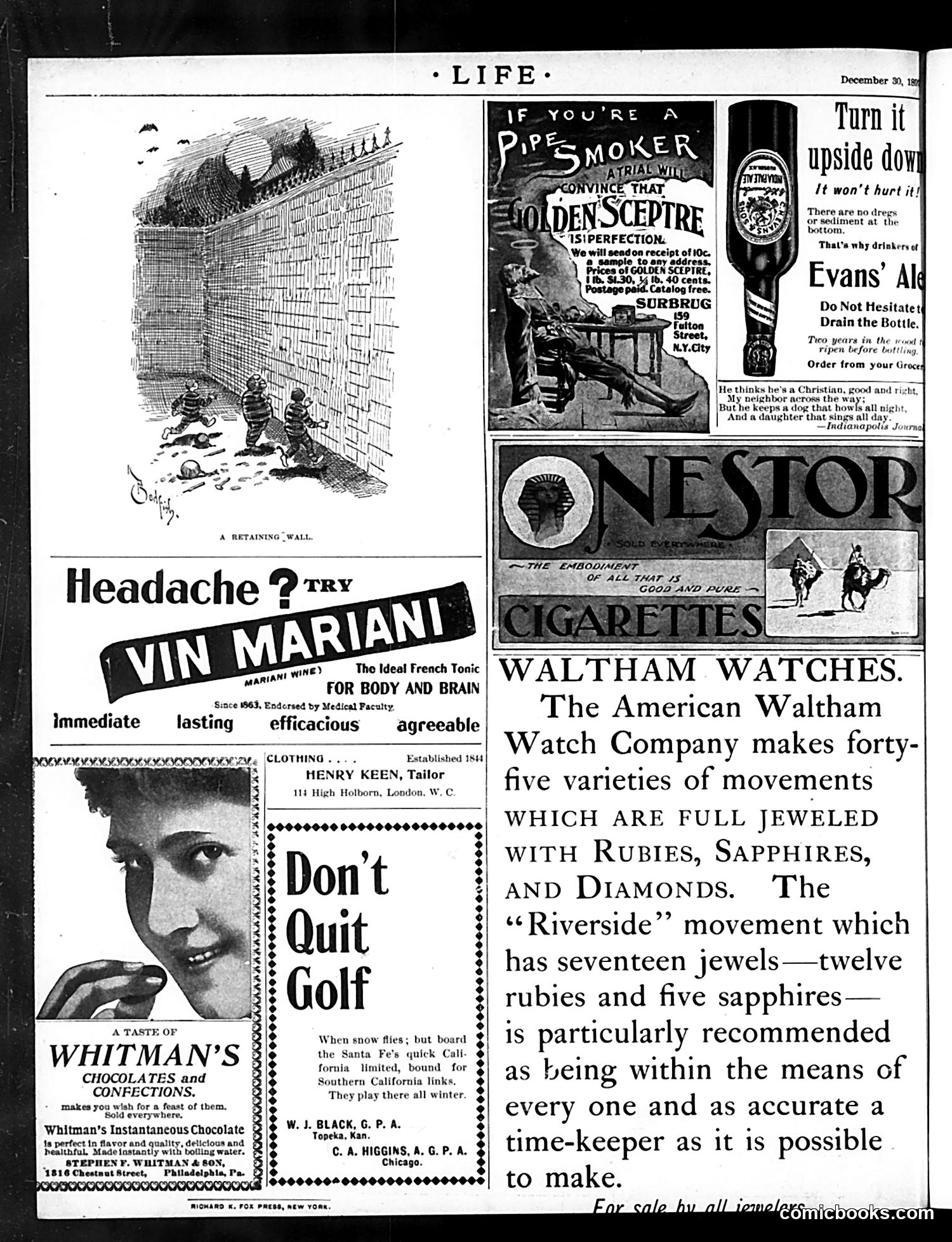
This page is primarily **advertising**, with one cartoon titled "A Retaining Wall" depicting two figures collapsed against a brick wall—likely satirizing exhaustion or collapse under pressure, though the specific reference is unclear without additional context. The advertisements reflect early 1900s consumer culture: Vin Mariani (a wine tonic endorsed by doctors), Whitman's Chocolates, Evans' Ale, Golden Sceptre pipe tobacco, and Waltham Watches. These ads showcase luxury goods marketed to middle-class Americans. The "Don't Quit Golf" advertisement references winter travel to Southern California, suggesting leisure activities for the affluent. Notable is the casual medical endorsement of alcoholic tonics—standard practice before FDA regulation. The watch advertisement emphasizes precision and affordability ("within the means of every one"), reflecting industrial-age values of reliability and democratic access to quality goods. The page captures pre-WWI American consumer aspirations and the era's unregulated marketing practices.
I can see this is a page from Life magazine, but the image quality and framing make it difficult to discern specific cartoon content or satirical commentary with confidence. The page appears mostly blank or very faint in the main area, with some fragmentary text visible along the left margin (partial words like "it," "OW," "Ale," etc.) that doesn't form coherent phrases I can definitively interpret. Without being able to clearly read the main cartoon, caption text, or identify specific figures, I cannot accurately explain what political or social satire this page contains. To provide accurate historical context as requested, I would need a clearer or more complete image of the page's content.